


oSIST prEN 15154-4:2026
(Main)Emergency safety showers - Part 4: Non plumbed-in eyewash units
Emergency safety showers - Part 4: Non plumbed-in eyewash units
This document is a product specification, giving minimum performance requirements for non plumbed-in emergency safety eyewash units.
It is applicable to non plumbed-in emergency safety eyewash units filled by the manufacturer with a washing fluid that can be either water or solutions for first aid use when the eyes have been exposed to harmful substances.
Requirements are also given concerning labelling, marking and information to be supplied by the manufacturer.
Sicherheitsnotduschen - Teil 4: Augenduschen ohne Wasseranschluss
Dieses Dokument ist eine Produktnorm, die Mindestfunktionsanforderungen an Sicherheitsaugenduschen festlegt, die nicht an die Wasserversorgung angeschlossen sind.
Es gilt für Augenduschen ohne Wasseranschluss, die seitens des Herstellers mit einer Spülflüssigkeit befüllt sind, bei der es sich entweder um Wasser oder um Lösungen handeln kann, und die der Erste-Hilfe-Versorgung dienen, wenn die Augen schädlichen Substanzen ausgesetzt waren.
Es sind zusätzlich Anforderungen hinsichtlich der Beschriftung und Kennzeichnung festgelegt sowie Anforderungen an die vom Hersteller zur Verfügung zu stellenden Informationen.
Douches de sécurité - Partie 4: Unités de lavage d'yeux non raccordées au réseau d'eau
Le présent document est une spécification de produit définissant les exigences minimales relatives aux performances des unités de lavage d’yeux de sécurité, non raccordées au réseau d’eau.
Le présent document s’applique aux unités de lavage d’yeux non raccordées au réseau d’eau remplies par le fabricant de fluide de lavage qui peut être soit de l’eau, soit des solutions et destiné à être utilisées lors des premiers secours, suite à l’exposition des yeux à des substances dangereuses.
Des exigences sont également données concernant l’étiquetage, le marquage et les informations à fournir par le fabricant.
Varnostne prhe za prvo pomoč - 4. del: Prenosni pripomočki za spiranje oči
General Information
Relations
Standards Content (Sample)
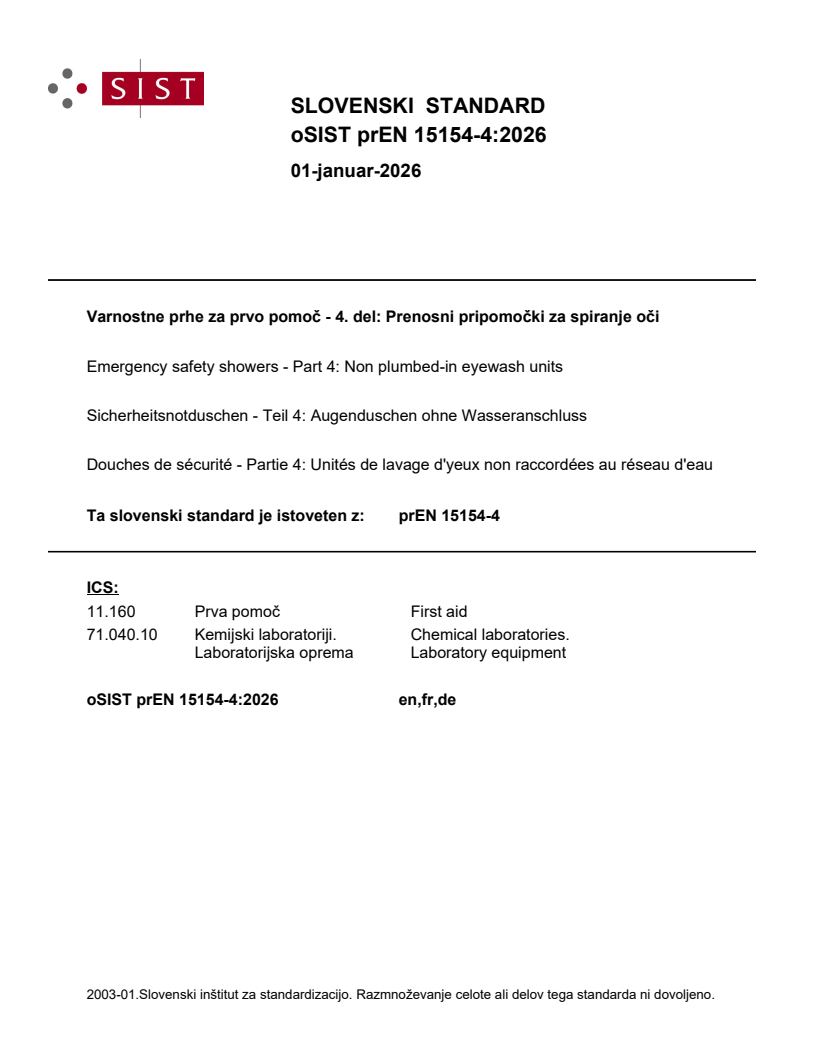
SLOVENSKI STANDARD
01-januar-2026
Varnostne prhe za prvo pomoč - 4. del: Prenosni pripomočki za spiranje oči
Emergency safety showers - Part 4: Non plumbed-in eyewash units
Sicherheitsnotduschen - Teil 4: Augenduschen ohne Wasseranschluss
Douches de sécurité - Partie 4: Unités de lavage d'yeux non raccordées au réseau d'eau
Ta slovenski standard je istoveten z: prEN 15154-4
ICS:
11.160 Prva pomoč First aid
71.040.10 Kemijski laboratoriji. Chemical laboratories.
Laboratorijska oprema Laboratory equipment
2003-01.Slovenski inštitut za standardizacijo. Razmnoževanje celote ali delov tega standarda ni dovoljeno.
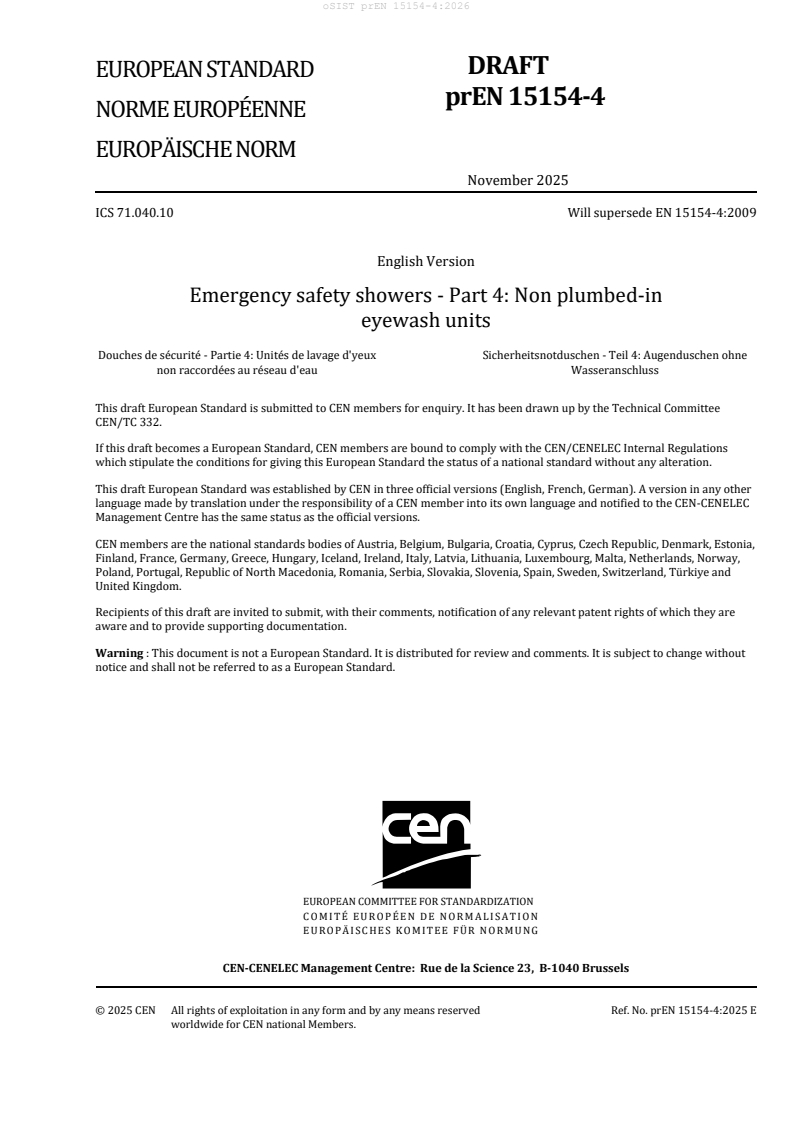
DRAFT
EUROPEAN STANDARD
NORME EUROPÉENNE
EUROPÄISCHE NORM
November 2025
ICS 71.040.10 Will supersede EN 15154-4:2009
English Version
Emergency safety showers - Part 4: Non plumbed-in
eyewash units
Douches de sécurité - Partie 4: Unités de lavage d'yeux Sicherheitsnotduschen - Teil 4: Augenduschen ohne
non raccordées au réseau d'eau Wasseranschluss
This draft European Standard is submitted to CEN members for enquiry. It has been drawn up by the Technical Committee
CEN/TC 332.
If this draft becomes a European Standard, CEN members are bound to comply with the CEN/CENELEC Internal Regulations
which stipulate the conditions for giving this European Standard the status of a national standard without any alteration.
This draft European Standard was established by CEN in three official versions (English, French, German). A version in any other
language made by translation under the responsibility of a CEN member into its own language and notified to the CEN-CENELEC
Management Centre has the same status as the official versions.
CEN members are the national standards bodies of Austria, Belgium, Bulgaria, Croatia, Cyprus, Czech Republic, Denmark, Estonia,
Finland, France, Germany, Greece, Hungary, Iceland, Ireland, Italy, Latvia, Lithuania, Luxembourg, Malta, Netherlands, Norway,
Poland, Portugal, Republic of North Macedonia, Romania, Serbia, Slovakia, Slovenia, Spain, Sweden, Switzerland, Türkiye and
United Kingdom.
Recipients of this draft are invited to submit, with their comments, notification of any relevant patent rights of which they are
aware and to provide supporting documentation.
Warning : This document is not a European Standard. It is distributed for review and comments. It is subject to change without
notice and shall not be referred to as a European Standard.
EUROPEAN COMMITTEE FOR STANDARDIZATION
COMITÉ EUROPÉEN DE NORMALISATION
EUROPÄISCHES KOMITEE FÜR NORMUNG
CEN-CENELEC Management Centre: Rue de la Science 23, B-1040 Brussels
© 2025 CEN All rights of exploitation in any form and by any means reserved Ref. No. prEN 15154-4:2025 E
worldwide for CEN national Members.
Contents Page
European foreword . 3
Introduction . 5
1 Scope . 6
2 Normative references . 6
3 Terms and definitions . 6
4 Performance requirements . 7
4.1 Efficacy . 7
4.2 Quality of washing fluid . 7
4.2.1 General. 7
4.2.2 Water . 7
4.2.3 Solutions . 7
4.3 Flow . 7
4.4 Container for washing fluid . 8
4.4.1 General. 8
4.4.2 Transportable eyewash units . 8
4.4.3 Portable eyewash units . 8
4.4.4 Personal eyewash units . 8
5 Functional Requirements . 8
5.1 General. 8
5.2 Single use eyewash units . 8
5.3 Multiple use for eyewash units . 8
5.4 Reconditionable eyewash units . 9
6 Information for use . 9
6.1 Labelling and marking . 9
6.2 Further information and instructions for use to be supplied . 9
6.3 Signage . 10
Annex A (informative) General guidance . 11
Annex B (informative) Recommendation regarding environmental impact . 12
Bibliography . 13
European foreword
This document (prEN 15154-4:2025) has been prepared by Technical Committee CEN/TC 332
“Laboratory equipment”, the secretariat of which is held by DIN.
This document is currently submitted to the CEN Enquiry.
This document will supersede EN 15154-4:2009.
EN 15154-4:2009:
— improvement of wording,
— update of 6.2,
— addition of 6.3,
— revision of A.4 from “Testing” to “Inspection and maintenance”,
— addition of Annex B on recommendation regarding environmental impact.
EN 15154 consists of the following parts under the general title Emergency safety showers:
— Part 1: Plumbed-in body showers for laboratories
— Part 2: Plumbed-in eyewash units
— Part 3: Non-plumbed-in body showers
— Part 4: Non-plumbed-in eyewash units
— Part 5: Water overhead body showers for sites other than laboratories
— Part 6: Plumbed-in multiple nozzle body showers for sites other than laboratories
This document, EN 15154-4, is part of a series of standards on emergency safety showers, which it rounds
off by dealing with body showers and combinations with eye showers and hand-held showers plumbed-
in used in laboratories (see Table 1).
Under revision. Stage at this time: Formal Vote
Under revision. Stage at this time: Formal Vote
Under revision. Stage at this time: NWI
Table 1 — Subject areas covered under the EN 15154 series of standards
Part of Sites other than
Type Laboratories Non plumbed-in Plumbed-in
EN 15154 laboratories
c
1 Body shower - - X
X
2 Eyewash unit X X - X
a a a
3 Body shower -
X X X
4 Eyewash unit X X X -
c b
5 Body shower - X
X X
6 Body shower - X - X
a
Non plumbed-in body showers affected by EN 15154-3 are fixed, transportable or portable.
b
Non plumbed-in body showers affected by EN 15154-5 are tank showers or trailer-mounted.
c
In possible combination with eyewash units.
NOTE Attention is drawn to national regulations in some European countries, e.g. Germany, which can request
to connect emergency safety showers to a water supply.
Introduction
The first seconds after an accident in which the eyes have been exposed to harmful substances are critical
to keep the eye injury to a minimum. Non plumbed-in emergency safety eyewash units are designed and
intended to be kept in the immediate proximity of persons working in a potentially hazardous area
exposed to the risks of burning/burns and/or hazardous chemical substances getting splashed into the
eyes, despite other risk mitigation measures. The main purpose of these devices is to supply immediate
first aid by supplying primary washing. After this first aid treatment, the user should be examined by
medical care.
Non plumbed-in emergency safety eyewash units can also allow continued washing on the way to medical
care.
Throughout this document, the term “non plumbed-in emergency safety eyewash unit” is referred to as
“eyewash unit”.
1 Scope
This document is a product specification, giving minimum performance requirements for non plumbed-
in emergency safety eyewash units.
It is applicable to non plumbed-in emergency safety eyewash units filled by the manufacturer with a
washing fluid that can be either water or solutions for first aid use when the eyes have been exposed to
harmful substances.
Requirements are also given concerning labelling, marking and information to be supplied by the
manufacturer.
2 Normative references
The following documents are referred to in the text in such a way that some or all of their content
constitutes requirements of this document. For dated references, only the edition cited applies. For
undated references, the latest edition of the referenced document (including any amendments) applies.
EN 556-1, Sterilization of medical devices – Requirements for medical devices to be designated “STERILE” –
Part 1: Requirements for terminally sterilized medical devices
EN 556-2, Sterilization of medical devices – Requirements for medical devices to be designated “STERILE” –
Part 2: Requirements for aseptically processed medical devices
EN ISO 15223-1:2021, Medical devices — Symbols to be used with information to be supplied by the
manufacturer - Part 1: General requirements (ISO 15223-1:2021)
EN ISO 20417, Medical devices — Information to be provided by the manufacturer (ISO 20417)
ISO 3864-1, Graphical symbols — Safety colours and safety signs — Part 1: design principles for safety signs
and safety markings
3 Terms and definitions
For the purposes of this document, the following terms and definitions apply.
ISO and IEC maintain terminology databases for use in standardization at the following addresses:
— ISO Online browsing platform: available at https://www.iso.org/obp/
— IEC Electropedia: available at https://www.electropedia.org/
3.1
non plumbed-in eyewash unit
self-contained device specially designed and intended to deliver a washing fluid to irrigate and flush the
eye(s) when exposed to harmful substances
3.2
transportable eyewash unit
non plumbed-in eyewash unit that is a movable device
3.3
portable eyewash unit
non plumbed-in eyewash unit that is designed to be carried by a single person unaided and kept or
mounted in immediate proximity of the user to supply immediate washing
3.4
personal eyewash unit
non plumbed-in eyewash unit that is designed to be carried by and on the user, in a pocket or a holster
3.5
single use eyewash unit
non plumbed-in eyewash unit designed to deliver a single application of washing fluid
3.6
multiple use disposable eyewash unit
non plumbed-in eyewash unit designed to deliver multiple applications of washing fluid prior to disposal
EXAMPLE Pressurized spray-cans.
3.7
reconditionable eyewash unit
non plumbed-in eyewash unit designed to be reconditioned
3.8
effective volume
minimum volume of fluid that can be dispensed from the unit during intended operation
4 Performance requirements
4.1 Efficacy
The efficacy of the product shall be sufficient to eliminate or reduce significantly the effects of harmful
substances.
4.2 Quality of washing fluid
4.2.1 General
The washing fluid shall be non harmful for the user during the entire shelf life of the product.
4.2.2 Water
If water is used in eyewash units, it shall be potable water or water of a similar quality wherein germ
multiplication is prevented.
NOTE Potable water is defined in the European Directive (EU) 2020/2184.
4.2.3 Solutions
If solutions, e.g. saline or buffered solutions, are used in eyewashes, these devices as a whole shall have a
medical device certification intended for this purpose. These solutions shall be sterile according to
EN 556-1 or EN 556-2.
NOTE Attention is drawn to European Regulation (EU) 2
...
Questions, Comments and Discussion
Ask us and Technical Secretary will try to provide an answer. You can facilitate discussion about the standard in here.