

SIST EN 3001:2019
(Main)Aerospace series - Tempered float glass plies for aircraft applications - Technical specification
General Information
- Abstract
This document specifies the requirements for tempered soda-lime float glass plies which are made from annealed glass either of the universally available type or of high light transmission type. The annealed glass is manufactured by a continuous process for general use.
The plies are tempered by either a thermal or chemical process.
The tempered glass is used mainly for cockpit glazing.
- Status
- Published
- Publication Date
- 18-Jun-2019
- Technical Committee
- I13 - Imaginarni 13
- Current Stage
- 6060 - National Implementation/Publication (Adopted Project)
- Start Date
- 13-Jun-2019
- Due Date
- 18-Aug-2019
- Completion Date
- 19-Jun-2019

Overview
SIST EN 3001:2019 is a European standard developed by CEN that defines the technical specifications for tempered float glass plies specifically designed for aerospace applications. This standard focuses on tempered soda-lime float glass made from annealed glass, available either as universally available or high light transmission types. These glass plies undergo thermal or chemical tempering processes and are predominantly used in aircraft cockpit glazing.
The standard ensures strict quality, optical, mechanical, and dimensional requirements are met to guarantee safety, durability, and optimal performance of glass components in demanding aerospace environments.
Key Topics
Glass Composition and Material
- Soda-lime float glass: The glass complies with high standards from annealed soda-lime float glass, either as universally available or with enhanced light transmission due to low iron content.
- Tempering methods: Thermal or chemical tempering induces a surface compression layer to improve mechanical strength and safety.
Dimensional and Physical Characteristics
- Thickness tolerances: Standard thicknesses range from 2 mm to 19 mm with specified tolerances (e.g., ±0.2 mm for 2-6 mm thickness).
- Density and expansion: Measured through ISO 1183-1 and ISO 7991 methods to ensure material stability under temperature variations.
- Flatness and refractive index: Flatness must comply with EN 3863, and refractive index is determined following EN ISO 489 for optical precision.
Optical Performance
- Light transmission: Measured for visible light per EN 2155-5 with additional spectrophotometric testing at 800 nm for high light transmission glass.
- Optical defects and distortion: Limits are defined for bubbles, scratches, surface ripple, and optical distortions, ensuring visual clarity and safety in cockpit glazing.
- Haze measurement: Conducted using EN 2155-9 to control clarity and transmission quality.
Mechanical Strength and Quality Assurance
- Modulus of rupture (MOR): Strength is quantified as per EN 3864 on edge-worked and tempered samples to assess breaking resistance.
- Stress profile testing: Stress distribution across glass plies is monitored per EN 3865, with acceptance tests regularly performed to maintain batch consistency.
- Batch testing and qualification: Each batch undergoes rigorous acceptance testing, while manufacturers must follow EN 9133 quality management systems for qualification.
Marking, Storage, and Ordering
- Traceability: Each ply is labeled with batch numbers linked to manufacturing records for full traceability.
- Packaging: Storage and transport protocols prevent damage, using stillages or wooden crates with appropriate interweaves.
- Ordering requirements: Purchase orders must specify drawings or master documents and strength requirements to meet application needs.
Applications
SIST EN 3001:2019 tempered float glass plies are essential for:
- Cockpit glazing: Providing safety, visibility, and durability against environmental and mechanical stress in aircraft cockpits.
- Aircraft windows and windshields: Enhancing structural integrity while maintaining optical performance under variable aerospace conditions.
- Other aerospace transparent components: Meeting strict regulatory and technical demands for commercial, military, and civil aviation glass parts.
The standard supports manufacturers, quality managers, and aerospace engineers by ensuring material consistency and compliance across the supply chain, ultimately improving aircraft safety and performance.
Related Standards
- EN 2155 series: Test methods for transparent materials for aircraft glazing, covering light transmission, optical defects, distortion, and haze.
- EN 3861 & EN 3862: Material standards for thermally and chemically tempered soda lime float glass, respectively.
- EN 9133: Quality Management Systems - Qualification procedures specific to aerospace standard products.
- EN 3863 to EN 3866: Test methods related to flatness, modulus of rupture, stress/optical measurement, and surface ripple of glass transparencies.
- EN ISO 489 & ISO 1183-1: Reference methods for refractive index and density measurement relevant to glass and plastics.
Keywords: SIST EN 3001:2019, tempered float glass, aircraft glazing, aerospace glass specifications, cockpit glass, soda-lime float glass, thermal tempering, chemical tempering, optical defects, aerospace standards, glass strength, glass light transmission, CEN aerospace standards.
Relations
- Effective Date
- 28-Jan-2026
- Effective Date
- 28-Jan-2026
- Effective Date
- 28-Jan-2026
- Effective Date
- 28-Jan-2026
- Effective Date
- 28-Jan-2026
- Effective Date
- 28-Jan-2026
- Effective Date
- 28-Jan-2026
- Effective Date
- 28-Jan-2026
- Effective Date
- 28-Jan-2026
- Effective Date
- 28-Jan-2026
- Effective Date
- 28-Jan-2026
Get Certified
Connect with accredited certification bodies for this standard

BUREAU VERITAS Certification Germany
Bureau Veritas certification in Germany.

Element Materials Technology
Materials testing and product certification.

AQMS Ltd.
AQMS provides ISO certification to SMEs across the UK.
Sponsored listings
Frequently Asked Questions
SIST EN 3001:2019 is a standard published by the Slovenian Institute for Standardization (SIST). Its full title is "Aerospace series - Tempered float glass plies for aircraft applications - Technical specification". This standard covers: This document specifies the requirements for tempered soda-lime float glass plies which are made from annealed glass either of the universally available type or of high light transmission type. The annealed glass is manufactured by a continuous process for general use. The plies are tempered by either a thermal or chemical process. The tempered glass is used mainly for cockpit glazing.
This document specifies the requirements for tempered soda-lime float glass plies which are made from annealed glass either of the universally available type or of high light transmission type. The annealed glass is manufactured by a continuous process for general use. The plies are tempered by either a thermal or chemical process. The tempered glass is used mainly for cockpit glazing.
SIST EN 3001:2019 is classified under the following ICS (International Classification for Standards) categories: 49.045 - Structure and structure elements. The ICS classification helps identify the subject area and facilitates finding related standards.
SIST EN 3001:2019 has the following relationships with other standards: It is inter standard links to SIST EN 2155-5:2001, SIST EN 2155-8:2001, SIST EN 2155-9:2001, SIST EN ISO 5555:2002, SIST EN 9133:2018, SIST EN 3866:2014, SIST EN 3864:2014, SIST EN 3863:2014, SIST EN ISO 489:2022, SIST EN 3862:2014, SIST EN 3861:2014. Understanding these relationships helps ensure you are using the most current and applicable version of the standard.
SIST EN 3001:2019 is available in PDF format for immediate download after purchase. The document can be added to your cart and obtained through the secure checkout process. Digital delivery ensures instant access to the complete standard document.
Standards Content (Sample)
SLOVENSKI STANDARD
01-september-2019
Aeronavtika - Utrjene plavajoče steklene plošče za uporabo v zrakoplovih -
Tehnična specifikacija
Aerospace series - Tempered float glass plies for aircraft applications - Technical
specification
Luft- und Raumfahrt - Vorgespannte Floatglasscheiben für Luftfahrzeuganwendungen -
Technische Lieferbedingungen
Série aérospatiale - Plis de verre renforcés pour applications aéronautiques -
Spécification technique
Ta slovenski standard je istoveten z: EN 3001:2019
ICS:
49.045 Konstrukcija in konstrukcijski Structure and structure
elementi elements
2003-01.Slovenski inštitut za standardizacijo. Razmnoževanje celote ali delov tega standarda ni dovoljeno.
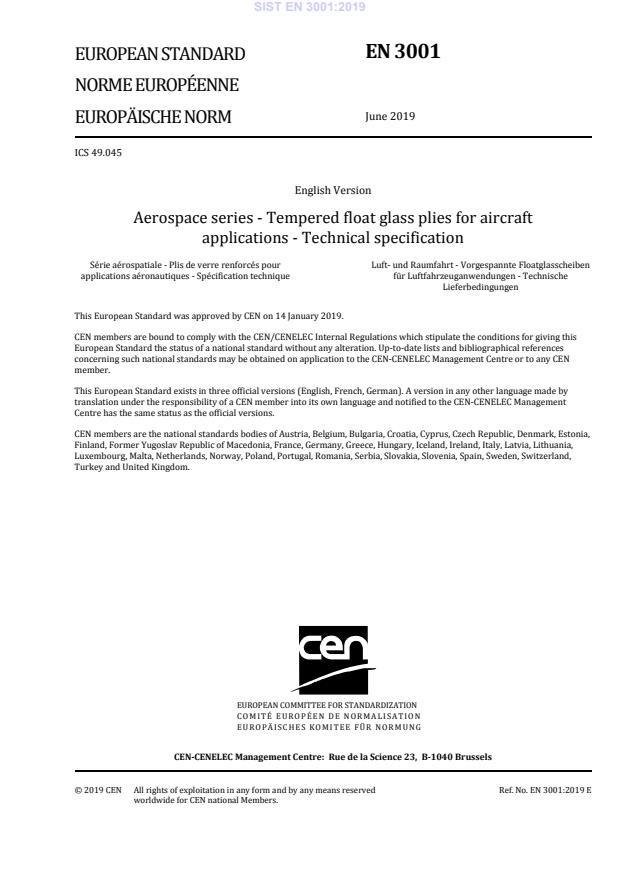
EN 3001
EUROPEAN STANDARD
NORME EUROPÉENNE
June 2019
EUROPÄISCHE NORM
ICS 49.045
English Version
Aerospace series - Tempered float glass plies for aircraft
applications - Technical specification
Série aérospatiale - Plis de verre renforcés pour Luft- und Raumfahrt - Vorgespannte Floatglasscheiben
applications aéronautiques - Spécification technique für Luftfahrzeuganwendungen - Technische
Lieferbedingungen
This European Standard was approved by CEN on 14 January 2019.
CEN members are bound to comply with the CEN/CENELEC Internal Regulations which stipulate the conditions for giving this
European Standard the status of a national standard without any alteration. Up-to-date lists and bibliographical references
concerning such national standards may be obtained on application to the CEN-CENELEC Management Centre or to any CEN
member.
This European Standard exists in three official versions (English, French, German). A version in any other language made by
translation under the responsibility of a CEN member into its own language and notified to the CEN-CENELEC Management
Centre has the same status as the official versions.
CEN members are the national standards bodies of Austria, Belgium, Bulgaria, Croatia, Cyprus, Czech Republic, Denmark, Estonia,
Finland, Former Yugoslav Republic of Macedonia, France, Germany, Greece, Hungary, Iceland, Ireland, Italy, Latvia, Lithuania,
Luxembourg, Malta, Netherlands, Norway, Poland, Portugal, Romania, Serbia, Slovakia, Slovenia, Spain, Sweden, Switzerland,
Turkey and United Kingdom.
EUROPEAN COMMITTEE FOR STANDARDIZATION
COMITÉ EUROPÉEN DE NORMALISATION
EUROPÄISCHES KOMITEE FÜR NORMUNG
CEN-CENELEC Management Centre: Rue de la Science 23, B-1040 Brussels
© 2019 CEN All rights of exploitation in any form and by any means reserved Ref. No. EN 3001:2019 E
worldwide for CEN national Members.
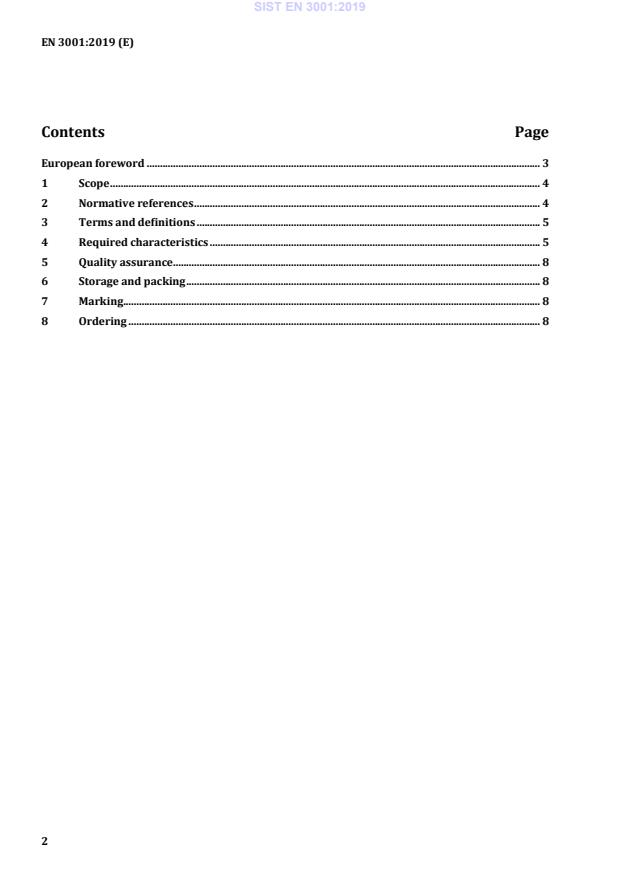
Contents Page
European foreword . 3
1 Scope . 4
2 Normative references . 4
3 Terms and definitions . 5
4 Required characteristics . 5
5 Quality assurance . 8
6 Storage and packing . 8
7 Marking . 8
8 Ordering . 8
European foreword
This document (EN 3001:2019) has been prepared by the Aerospace and Defence Industries Association
of Europe - Standardization (ASD-STAN).
After enquiries and votes carried out in accordance with the rules of this Association, this Standard has
received the approval of the National Associations and the Official Services of the member countries of
ASD, prior to its presentation to CEN.
This European Standard shall be given the status of a national standard, either by publication of an
identical text or by endorsement, at the latest by December 2019, and conflicting national standards shall
be withdrawn at the latest by December 2019.
Attention is drawn to the possibility that some of the elements of this document may be the subject of
patent rights. CEN shall not be held responsible for identifying any or all such patent rights.
According to the CEN-CENELEC Internal Regulations, the national standards organizations of the
following countries are bound to implement this European Standard: Austria, Belgium, Bulgaria, Croatia,
Cyprus, Czech Republic, Denmark, Estonia, Finland, Former Yugoslav Republic of Macedonia, France,
Germany, Greece, Hungary, Iceland, Ireland, Italy, Latvia, Lithuania, Luxembourg, Malta, Netherlands,
Norway, Poland, Portugal, Romania, Serbia, Slovakia, Slovenia, Spain, Sweden, Switzerland, Turkey and
the United Kingdom.
1 Scope
This document specifies the requirements for tempered soda-lime float glass plies which are made from
annealed glass either of the universally available type or of high light transmission type. The annealed
glass is manufactured by a continuous process for general use.
The plies are tempered by either a thermal or chemical process.
The tempered glass is used mainly for cockpit glazing.
2 Normative references
The following documents are referred to in the text in such a way that some or all of their content
constitutes requirements of this document. For dated references, only the edition cited applies. For
undated references, the latest edition of the referenced document (including any amendments) applies.
EN 2155-5, Aerospace series — Test methods for transparent materials for aircraft glazing — Part 5:
Determination of visible light transmission
EN 2155-6, Aerospace series — Test methods for transparent materials for aircraft glazing —Part 6:
1)
Determination of optical defects
EN 2155-8, Aerospace series — Test methods for transparent materials for aircraft glazing — Part 8:
Determination of optical distortion
EN 2155-9, Aerospace series — Test methods for transparent materials for aircraft glazing — Part 9:
Determination of haze
EN 9133, Aerospace series — Quality Management Systems — Qualification Procedure for Aerospace
Standard Products
EN 3861, Aerospace series — Non-metallic materials — Glass transparencies — Material standard —
Thermally tempered soda lime float glass
EN 3862, Aerospace series — Non-metallic materials — Glass transparencies — Material standard —
Chemically tempered soda lime float glass
EN 3863, Aerospace series — Non-metallic materials — Glass transparencies — Test methods —
Determination of flatness
EN 3864, Aerospace series — Non-metallic materials — Glass transparencies — Test methods —
Determination of modulus of rupture
2)
EN 3865, Aerospace series — Stress/optical measurement of tempered glass — Test method
EN 3866, Aerospace series — Non-metallic materials — Glass transparencies — Test methods —
Determination of ream and surface ripple
1) Published as ASD-STAN Prestandard at the date of publication of this standard by AeroSpace and Defence industries
Association of Europe - Standardization (ASD-STAN) (http://www.asd-stan.org/)
2) In preparation at the date of publication of this standard.
EN ISO
...