

SIST EN 3862:2014
(Main)Aerospace series - Non-metallic materials - Glass transparencies - Material standard - Chemically tempered soda lime float glass
- Abstract
This European Standard specifies the requirements relating to universally available and high light transmission, chemically tempered float glass plies, for aerospace applications.
- Status
- Published
- Publication Date
- 09-Jan-2014
- Technical Committee
- I13 - Imaginarni 13
- Current Stage
- 6060 - National Implementation/Publication (Adopted Project)
- Start Date
- 23-Dec-2013
- Due Date
- 27-Feb-2014
- Completion Date
- 10-Jan-2014


SIST EN 3862:2014 is the Slovenian adoption of EN 3862:2013, published as a European Standard by CEN and adopted by SIST. It specifies requirements for universally available and high light transmission, chemically tempered soda lime float glass plies for aerospace applications, so users can identify the material, its grades, and the properties that matter in use and acceptance.
What does SIST EN 3862:2014 specify?
SIST EN 3862:2014 defines a material standard for aerospace glass transparencies made from chemically tempered soda lime float glass. It covers the material description, grading, storage, delivery-condition properties, and the qualification-linked characteristics used for acceptance.
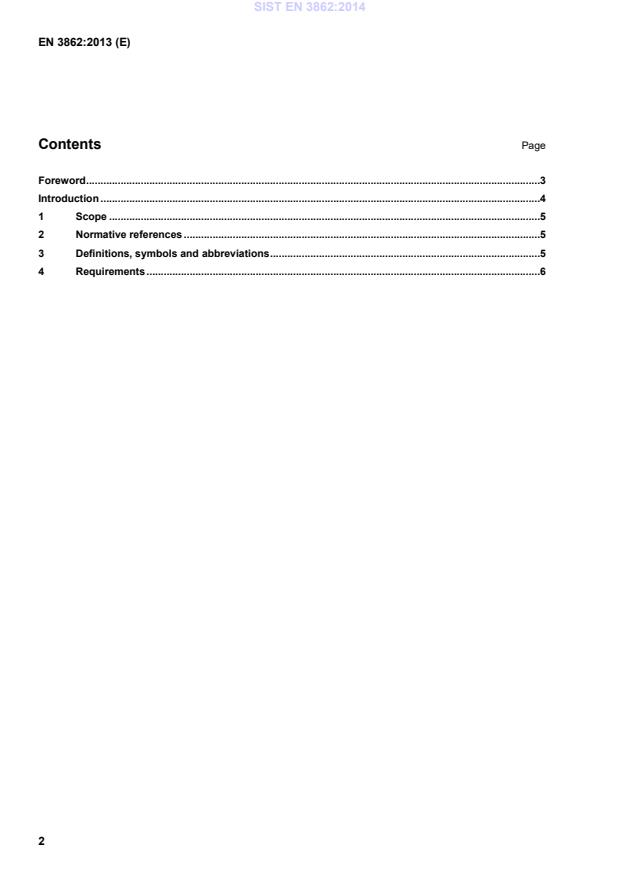
The document is organized into four clauses:
- Clause 1, Scope
- Clause 2, Normative references
- Clause 3, Definitions, symbols and abbreviations
- Clause 4, Requirements
The requirements themselves are set out in four tables:
- Table 1 - General requirements
- Table 2 - Requirements in the delivery condition
- Table 3 - Requirements as processed to characteristic number 1.013
- Table 4 - Environmental testing requirements as processed to characteristic number 1.013
In the introduction, SIST EN 3862:2014 is placed in the EN non-metallic materials series for aerospace applications and identified as a level 3 document under EN 4385. That helps readers understand that it is part of a structured family of aerospace material standards.
What are the key requirements of SIST EN 3862:2014?
SIST EN 3862:2014 ties the material definition, optical performance, and qualification checks together in one place. For procurement and quality control, the most useful information is in Tables 1 and 2, with Tables 3 and 4 linking processed-state and environmental-testing entries back to the same characteristic system.
Material identification and grading
Table 1 identifies the material as a glass transparency made from soda-lime glass and produced as chemically tempered float glass. It also says the material is supplied in the final condition of use. In practice, this tells the purchaser what manufacturing route and delivery state to specify.
Table 1 also splits the material into Type A and Type B and links each type to thickness ranges and grades. Type A is the universally available float glass version, while Type B is the high light transmission version. This is the ordering and marking basis for the material.
Table 1 also requires suitable storage conditions that avoid surface condensation, and it states that shelf life is not applicable. For stores and logistics teams, that means the material needs controlled handling even before installation.
Delivery-condition properties
Table 2 sets the main delivery-condition checks. It covers dimensional tolerance and flatness by reference to EN 3001, so those geometric checks are not restated here but are taken from the linked technical specification. The same table also points to EN 3001 for optical distortion and optical defects.
Table 2 gives visible-range light transmission requirements for each grade, and it adds a separate infrared check at 800 nm for Type B B08 glass. This is the key selection point for transparencies where transmitted light matters.
The same table specifies refractive index, haze, density, and linear expansion. In practice, these are the property checks used to confirm that the delivered glass matches the material class expected in aerospace service.
Qualification-linked limits
Table 2 also covers surface compression stress and modulus of rupture, but it ties both to limits agreed during product qualification. That means these strength-related values are part of the qualified material definition rather than a single universal table value.
Clause 3 explains the subcase numbering used in the requirement tables. The numbers identify what each requirement entry means, such as technical specification, test method, frequency of testing, sample type, test piece definition, conditioning, testing condition, or acceptance criteria. It also notes that batch acceptance test titles and subcase 7 acceptance criteria are highlighted as mandatory for routine acceptance of the material.
What terms does SIST EN 3862:2014 define?
SIST EN 3862:2014 defines a small set of terms and uses them consistently in the requirement tables.
- Type A - the universally available float glass variant.
- Type B - the high light transmission float glass variant.
- Subcase number - the code used in the requirement column to show what kind of information follows, such as a test method or acceptance criteria.
- Technical specification - the referenced requirement set that supplies details when the table points to EN 3001.
- Processing condition 1.013 - the state in which the material is supplied, described in the table as the final condition of use.
- Characteristic number - the numeric identifier used to track each requirement entry across the tables.
Who uses SIST EN 3862:2014?
SIST EN 3862:2014 is used by aerospace material engineers, suppliers of glass transparencies, quality managers, and procurement teams. They use it to specify the correct glass type and grade, check delivery-condition properties, and define acceptance criteria for routine and product qualification testing.
Testing laboratories use it to plan the measurements named in the tables, especially optical and physical property checks. Buyers and quality teams use it to make sure orders, incoming inspection, and batch acceptance are aligned with the same material definition.
What changed in SIST EN 3862:2014 from the previous edition?
SIST EN 3862:2014 is the Slovenian standard identical to EN 3862:2013.
Which standards are used with SIST EN 3862:2014?
SIST EN 3862:2014 names three normative or companion documents:
- EN 3001 - provides the technical specification and the referenced requirements for definitions and several property checks, including dimensional tolerance, flatness, optical distortion, optical defects, health and safety, and quality assurance.
- EN 4385 - gives the general organization of aerospace non-metallic materials standards and the links between types of standards.
- TR 7000-5 - gives the drafting and presentation rules used for glass transparency material standards.
What does the SIST EN 3862:2014 document contain?
SIST EN 3862:2014 contains the requirement tables that define the material, its grades, and its acceptance characteristics. Table 1 covers identification, formulation, form of production, storage, shelf life, processing condition, designation, quality assurance, and health and safety. Table 2 gives the delivery-condition checks for optical, physical, and strength-related properties. Tables 3 and 4 keep the processed-state and environmental-testing entries tied to the same characteristic system used in the main requirements.
Relations
- Effective Date
- 28-Jan-2026
Get Certified
Connect with accredited certification bodies for this standard

BUREAU VERITAS Certification Germany
Bureau Veritas certification in Germany.

Element Materials Technology
Materials testing and product certification.

AQMS Ltd.
AQMS provides ISO certification to SMEs across the UK.
Sponsored listings
Frequently Asked Questions
SIST EN 3862:2014 is a standard published by the Slovenian Institute for Standardization (SIST). Its full title is "Aerospace series - Non-metallic materials - Glass transparencies - Material standard - Chemically tempered soda lime float glass". This standard covers: This European Standard specifies the requirements relating to universally available and high light transmission, chemically tempered float glass plies, for aerospace applications.
This European Standard specifies the requirements relating to universally available and high light transmission, chemically tempered float glass plies, for aerospace applications.
SIST EN 3862:2014 is classified under the following ICS (International Classification for Standards) categories: 49.025.99 - Other materials. The ICS classification helps identify the subject area and facilitates finding related standards.
SIST EN 3862:2014 has the following relationships with other standards: It is inter standard links to SIST EN 3001:2019. Understanding these relationships helps ensure you are using the most current and applicable version of the standard.
SIST EN 3862:2014 is available in PDF format for immediate download after purchase. The document can be added to your cart and obtained through the secure checkout process. Digital delivery ensures instant access to the complete standard document.
Standards Content (Sample)
2003-01.Slovenski inštitut za standardizacijo. Razmnoževanje celote ali delov tega standarda ni dovoljeno.Luft- und Raumfahrt - Nichtmetallische Werkstoffe - Transparente Glaswerkstoffe - Werkstoffe Norm - Chemisch vorgespanntes Kalk-Natron-FloatglasSérie aérospatiale - Matériaux non-métalliques - Transparents en verre - Norme de matériaux - Feuilles de verre sodo calcique flotté trempées chimiquementAerospace series - Non-metallic materials - Glass transparencies - Material standard - Chemically tempered soda lime float glass49.025.99Drugi materialiOther materialsICS:Ta slovenski standard je istoveten z:EN 3862:2013SIST EN 3862:2014en01-februar-2014SIST EN 3862:2014SLOVENSKI
STANDARD
EUROPEAN STANDARD NORME EUROPÉENNE EUROPÄISCHE NORM
EN 3862
January 2013 ICS 49.025.99 English Version
Aerospace series - Non-metallic materials - Glass transparencies - Material standard - Chemically tempered soda lime float glass
Série aérospatiale - Matériaux non-métalliques - Transparents en verre - Norme de matériaux - Feuilles de verre sodo calcique flotté trempées chimiquement
Luft- und Raumfahrt - Nichtmetallische Werkstoffe - Transparente Glaswerkstoffe - Werkstoffnorm - Chemisch vorgespanntes Kalk-Natron-Floatglas This European Standard was approved by CEN on 17 November 2012.
CEN members are bound to comply with the CEN/CENELEC Internal Regulations which stipulate the conditions for giving this European Standard the status of a national standard without any alteration. Up-to-date lists and bibliographical references concerning such national standards may be obtained on application to the CEN-CENELEC Management Centre or to any CEN member.
This European Standard exists in three official versions (English, French, German). A version in any other language made by translation under the responsibility of a CEN member into its own language and notified to the CEN-CENELEC Management Centre has the same status as the official versions.
CEN members are the national standards bodies of Austria, Belgium, Bulgaria, Croatia, Cyprus, Czech Republic, Denmark, Estonia, Finland, Former Yugoslav Republic of Macedonia, France, Germany, Greece, Hungary, Iceland, Ireland, Italy, Latvia, Lithuania, Luxembourg, Malta, Netherlands, Norway, Poland, Portugal, Romania, Slovakia, Slovenia, Spain, Sweden, Switzerland, Turkey and United Kingdom.
EUROPEAN COMMITTEE FOR STANDARDIZATION
COMITÉ EUROPÉEN DE NORMALISATION EUROPÄISCHES KOMITEE FÜR NORMUNG
Management Centre:
Avenue Marnix 17,
B-1000 Brussels © 2013 CEN All rights of exploitation in any form and by any means reserved worldwide for CEN national Members. Ref. No. EN 3862:2013: ESIST EN 3862:2014
...