

SIST EN 3866:2014
(Main)Aerospace series - Non-metallic materials - Glass tranparencies - Test methods - Determination of ream and surface ripple
- Abstract
This European Standard defines a qualitative method for the determination of the ream and surface ripple in glass transparencies for aircraft applications.
- Status
- Published
- Publication Date
- 02-Jan-2014
- Technical Committee
- I13 - Imaginarni 13
- Current Stage
- 6060 - National Implementation/Publication (Adopted Project)
- Start Date
- 23-Dec-2013
- Due Date
- 27-Feb-2014
- Completion Date
- 03-Jan-2014



SIST EN 3866:2014 is the Slovenian national adoption of EN 3866:2013, published by SIST. It specifies a qualitative test method for determining ream and surface ripple in glass transparencies for aircraft applications. In practice, it gives aerospace suppliers and test laboratories a common visual method for checking these optical defects.
What does SIST EN 3866:2014 specify?
SIST EN 3866:2014 specifies one test method for glass transparencies used in aircraft applications. The method is qualitative, so it is meant to show whether ream and surface ripple are present, not to produce a numeric measurement.
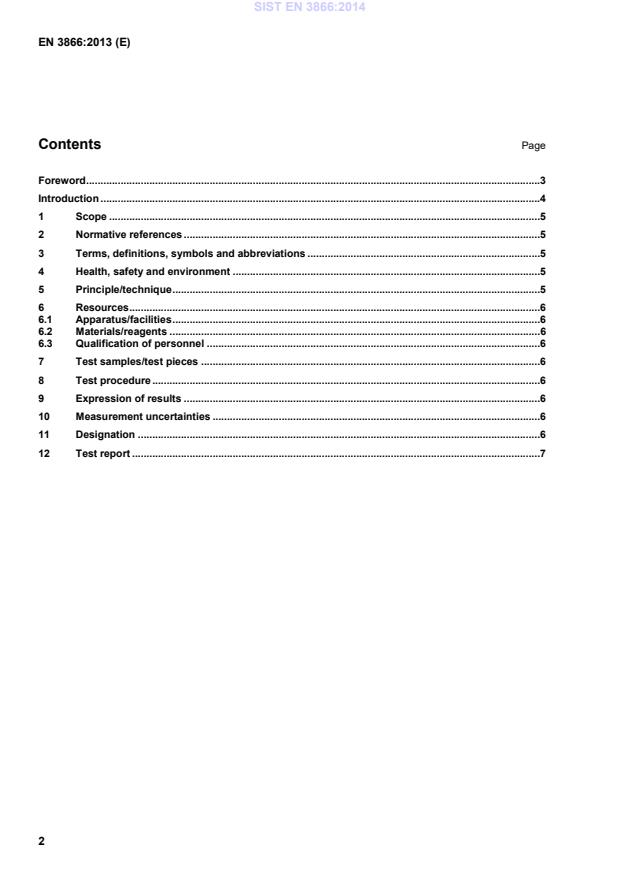
The document is organized into clauses for scope, normative references, terms and definitions, health, safety and environment, principle/technique, resources, test samples, test procedure, expression of results, measurement uncertainties, designation and test report. For a reader, that structure makes it clear where to find the setup, how to run the test, and what to record afterward.
What are the key requirements of SIST EN 3866:2014?
SIST EN 3866:2014 is centered on a simple shadow-based visual method. The most important practical points are the test setup, the use of the actual product, and the fact that the result is qualitative.
The test principle is shadow viewing on a matt screen. Clause 5 says the transparency is illuminated with homogeneous high-intensity light and the shadow is viewed on a matt screen. In practice, defects show up as distortions or optical irregularities in the shadow image.
The apparatus must create a controlled viewing environment. Clause 6.1 calls for a dark room, a high-intensity point light source of 200 W to 250 W that can create a homogeneous field, and a matt white screen. This matters because stray light or an unsuitable screen can hide the defect pattern.
The test is performed on actual plies. Clause 7 states that test samples or test pieces are not used. For users, this means the inspection is carried out on the real glass transparency as supplied or assembled.
The geometry of the setup is fixed. Clause 8 places the glass transparency parallel to the matt white screen at a distance of 1 000 mm, with the light source 3 000 mm from the transparency. The transparency may be angled slightly away from the screen if needed to reveal a fault, which gives the operator a practical way to confirm borderline visual effects.
The result is qualitative only. Clause 9 makes clear that the method does not produce a measured value. For quality control, this means the outcome is a visual accept or detect result, not a dimensional report.
Precision is not established. Clause 10 says the precision is not known because inter-laboratory data are not available. That is important for users comparing results between sites, because the method should be treated as a visual assessment method rather than a statistically characterized measurement method.
The report must identify the test and its traceability. Clause 12 requires the test method designation, apparatus designation, traceability of the semi-finished product, traceability to the test apparatus and to the person performing the work, any incident or deviation, and the test date. This supports internal quality records and supplier/customer traceability.
What changed in SIST EN 3866:2014 from the previous edition?
SIST EN 3866:2014 is identical to EN 3866:2013.
Which standards are used with SIST EN 3866:2014?
SIST EN 3866:2014 names two normative references.
- EN 4385 - gives the general organization of the aerospace non-metallic materials standards series and the links between types of standards. This helps users understand where this test method sits in the wider series.
- EN 4386 - gives the rules for drafting and presenting test method standards. This explains the document style and how the method is structured.
What does the SIST EN 3866:2014 document contain?
SIST EN 3866:2014 contains the foreword, introduction, the test method clauses, and Figure 1 showing the shadowgraph apparatus. It also includes the normative references and the test report requirements, which are the parts most relevant to day-to-day laboratory use.
Clause 5 gives the principle of the method, Clause 6 lists the required resources, and Clause 8 gives the viewing distances and arrangement. Clause 10 addresses measurement uncertainty by stating that precision data are not available. Clause 12 provides the reporting items needed to document the result and preserve traceability.
Relations
- Effective Date
- 28-Jan-2026
Get Certified
Connect with accredited certification bodies for this standard

BUREAU VERITAS Certification Germany
Bureau Veritas certification in Germany.

Element Materials Technology
Materials testing and product certification.

AQMS Ltd.
AQMS provides ISO certification to SMEs across the UK.
Sponsored listings
Frequently Asked Questions
SIST EN 3866:2014 is a standard published by the Slovenian Institute for Standardization (SIST). Its full title is "Aerospace series - Non-metallic materials - Glass tranparencies - Test methods - Determination of ream and surface ripple". This standard covers: This European Standard defines a qualitative method for the determination of the ream and surface ripple in glass transparencies for aircraft applications.
This European Standard defines a qualitative method for the determination of the ream and surface ripple in glass transparencies for aircraft applications.
SIST EN 3866:2014 is classified under the following ICS (International Classification for Standards) categories: 49.025.99 - Other materials. The ICS classification helps identify the subject area and facilitates finding related standards.
SIST EN 3866:2014 has the following relationships with other standards: It is inter standard links to SIST EN 3001:2019. Understanding these relationships helps ensure you are using the most current and applicable version of the standard.
SIST EN 3866:2014 is available in PDF format for immediate download after purchase. The document can be added to your cart and obtained through the secure checkout process. Digital delivery ensures instant access to the complete standard document.
Standards Content (Sample)
SLOVENSKI STANDARD
01-februar-2014
Aeronavtika - Nekovinski materiali - Prosojnost stekla - Preskusne metode -
Ugotavljanje valovitosti izvrtin in površin
Aerospace series - Non-metallic materials - Glass tranparencies - Test methods -
Determination of ream and surface ripple
Luft- und Raumfahrt - Nichtmetallische Werkstoffe - Transparente Glaswerkstoffe -
Prüfverfahren - Bestimmung der Riffel- und Oberflächenwelligkeit
Série aérospatiale - Matériaux non-métalliques - Transparents en verre - Méthodes
d’essais - Détermination des ondes et des coups de rouleaux
Ta slovenski standard je istoveten z: EN 3866:2013
ICS:
49.025.99 Drugi materiali Other materials
2003-01.Slovenski inštitut za standardizacijo. Razmnoževanje celote ali delov tega standarda ni dovoljeno.
EUROPEAN STANDARD
EN 3866
NORME EUROPÉENNE
EUROPÄISCHE NORM
January 2013
ICS 49.025.99
English Version
Aerospace series - Non-metallic materials - Glass tranparencies
- Test methods - Determination of ream and surface ripple
This European Standard was approved by CEN on 17 November 2012.
CEN members are bound to comply with the CEN/CENELEC Internal Regulations which stipulate the conditions for giving this European
Standard the status of a national standard without any alteration. Up-to-date lists and bibliographical references concerning such national
standards may be obtained on application to the CEN-CENELEC Management Centre or to any CEN member.
This European Standard exists in three official versions (English, French, German). A version in any other language made by translation
under the responsibility of a CEN member into its own language and notified to the CEN-CENELEC Management Centre has the same
status as the official versions.
CEN members are the national standards bodies of Austria, Belgium, Bulgaria, Croatia, Cyprus, Czech Republic, Denmark, Estonia,
Finland, Former Yugoslav Republic of Macedonia, France, Germany, Greece, Hungary, Iceland, Ireland, Italy, Latvia, Lithuania,
Luxembourg, Malta, Netherlands, Norway, Poland, Portugal, Romania, Slovakia, Slovenia, Spain, Sweden, Switzerland, Turkey and United
Kingdom.
EUROPEAN COMMITTEE FOR STANDARDIZATION
COMITÉ EUROPÉEN DE NORMALISATION
EUROPÄISCHES KOMITEE FÜR NORMUNG
Management Centre: Avenue Marnix 17, B-1000 Brussels
© 2013 CEN All rights of exploitation in any form and by any means reserved Ref. No. EN 3866:2013: E
worldwide for CEN national Members.
Contents Page
Foreword .3
Introduction .4
1 Scope .5
2 Normative references .5
3 Terms, definitions, symbols and abbreviations .5
4 Health, safety and environment .5
5 Principle/technique .5
6 Resources .6
6.1 Apparatus/facilities .6
6.2 Materials/reagents .6
6.3 Qualification of personnel .6
7 Test samples/test pieces .6
8 Test procedure .6
9 Expression of results .6
10 Measurement uncertainties .6
11 Designation .6
12 Test report .7
EN 3866
...