

oSIST prEN 485-1:2026
(Main)Aluminium and aluminium alloys - Sheet, strip and plate - Part 1: Technical conditions for inspection and delivery
- Abstract
This document specifies the technical conditions for inspection and delivery of wrought aluminium and wrought aluminium alloy sheet, strip and plate for general applications. It also includes provisions for ordering and testing.
It applies to products with a thickness over 0,20 mm up to and including 400 mm.
For many special applications of aluminium strip, sheet and plate, specific European Standards exist, where different or additional requirements are formulated and the appropriate alloys and tempers are selected: see Annex A. Most of these special European Standards refer to provisions of this document.
The selection of the relevant special European Standards is under the responsibility of the purchaser.
Specific European Standards are available for applications involving special properties, such as corrosion resistance, toughness, fatigue strength, surface appearance or welding properties.
- Status
- Not Published
- Public Enquiry End Date
- 30-Jul-2026
- Technical Committee
- INEK - Nonferrous metals
- Current Stage
- 4020 - Public enquire (PE) (Adopted Project)
- Start Date
- 10-Jun-2026
- Due Date
- 28-Oct-2026
- Completion Date
- 03-Aug-2026

oSIST prEN 485-1:2026 is the Slovenian standard identical to draft European Standard prEN 485-1:2026 from the European Committee for Standardization (CEN), published by SIST. It specifies the technical conditions for inspection and delivery of wrought aluminium and wrought aluminium alloy sheet, strip and plate for general applications, including ordering, testing, marking and packaging rules for products over 0.20 mm up to and including 400 mm thick.
It is the document to use when you need a common purchasing and acceptance basis for aluminium sheet, strip and plate, and when you need to link a product order to the right mechanical properties, tolerances, inspection documents and test methods.
What does oSIST prEN 485-1:2026 specify?
oSIST prEN 485-1:2026 sets the technical conditions for inspection and delivery of wrought aluminium and wrought aluminium alloy sheet, strip and plate for general applications. It also tells the buyer and supplier what to put in the order, how to test the material, and how to handle marking, packaging and claims.
The scope covers products with a thickness over 0.20 mm up to and including 400 mm. For many special applications, different European Standards apply and may add or replace requirements; Annex A points to those cases. The purchaser is responsible for choosing the relevant special standard when the product is intended for a special use such as corrosion resistance, toughness, fatigue strength, surface appearance or welding properties.
The document is organized into clauses 1 to 10 and one normative annex.
| Annex | What it covers |
|---|---|
| Annex A | European Standards for strip, sheet and plate of special form and for special applications |
What are the key requirements of oSIST prEN 485-1:2026?
Ordering and delivery
Clause 4 requires the order document to identify the product form, the alloy designation, the delivery temper, the reference to this document, the required tolerances standard, dimensions, quantity, inspection documents and any extra tests or special packing requirements. For decorative anodizing, the order must also state that anodizing is intended and describe the surface treatment and the required decorative appearance.
In practice, this means the order has to carry the acceptance criteria up front. If the buyer needs a special surface result, a special temper, or a property beyond the base standard, it must be written into the order document.
Production control and quality responsibility
Clause 5.1 leaves the production and manufacturing process to the manufacturer unless the order says otherwise. Clause 5.2 places responsibility for inspection and testing before shipment on the supplier, and the purchaser must ask for works inspection when placing the order if that is wanted.
In practice, the standard does not force one production route, but it does require the supplier to prove conformity before delivery. That makes inspection planning and supplier communication important.
Chemical, mechanical and corrosion requirements
Clause 5.3.1 requires chemical composition to comply with EN 573-3, with any extra element limits stated in the order. Clause 5.3.2 requires tensile properties to comply with EN 485-2 unless the order or an application standard sets something different, and it allows other properties such as hardness, bending ability and isotropy to be specified as well.
Clause 5.3.3 adds alloy-specific corrosion expectations. It treats certain 5xxx alloys in H116 and H321, and certain EN AW-7010 and EN AW-7075 tempers, as special cases with defined corrosion-related acceptance routes. In practice, buyers of marine or high-strength material need to check these clauses carefully because they affect lot release and the test method to be used.
Surface condition and dimensional conformity
Clause 5.3.4 requires the product to be free from defects that would make it unsuitable for proper use, while allowing small surface imperfections that cannot always be avoided. The clause also says that defects may not be hidden by masking operations, although superficial defects may be removed if the tolerances and properties still remain compliant.
Clause 5.3.5 requires dimensions and form tolerances to comply with EN 485-3 and EN 485-4 unless the order says otherwise. In practice, this is the clause that supports receiving inspection, rejection decisions and any agreed exceptions on tolerances.
Test methods, sampling and retest
Clause 6 sets the test framework. Chemical analysis uses sampling at casting according to EN 14361, with dispute analysis by EN 14242. Tensile testing follows EN ISO 6892-1, but the clause gives detailed rules for sampling location, specimen orientation, test piece shape and identification.
Clause 6.3.5 is important because it states that test pieces are normally taken transverse to the rolling direction, with a longitudinal option for narrow products. That matters because aluminium properties can vary with direction, so the test orientation must match the acceptance basis.
Clause 6 also covers bend testing, hardness testing, electrical conductivity, surface finish, stress corrosion resistance and exfoliation or inter-granular corrosion resistance for specific alloy groups. If a first test piece fails, Clause 6.12 gives retest rules and allows a lot to be retested only under the conditions stated there.
What terms does oSIST prEN 485-1:2026 define?
- Sheet/plate - A flat rolled product supplied in straight lengths; sheet is up to 6 mm thick, and plate is above 6 mm.
- Strip - A flat rolled product supplied in coils, usually with trimmed edges, and with thickness over 0.20 mm.
- Order document - The agreed set of documents at ordering time, such as a purchaser order confirmed by the supplier or a supplier quotation confirmed by the purchaser.
- Inspection lot - The batch or lot from which specimens and test pieces are taken for acceptance testing.
- Specimen - The sample taken from the product before the final test pieces are prepared.
- Temper - The delivery condition designation used to identify the material condition for supply and, if needed, for use.
Who uses oSIST prEN 485-1:2026?
Manufacturers and suppliers use this standard to control production, sampling, testing and shipment of aluminium sheet, strip and plate. Purchasers and buyers use it to define the product form, alloy, temper, tolerances and inspection documents they want on the order.
Quality managers and inspection staff use it for acceptance control, works inspection and complaint handling. Test laboratories and plant laboratories use it for tensile, bend, hardness, conductivity and corrosion testing.
It is relevant across general aluminium products and also when the product is intended for special sectors named in Annex A, including marine, aerospace, railway, electrical, structural construction, pressure equipment, packaging, food contact and decorative anodizing.
What changed in oSIST prEN 485-1:2026 from the previous edition?
oSIST prEN 485-1:2026 will supersede EN 485-1:2016. The stated technical change is a rewording of Subclause 6.3.5 on the orientation of samples for tensile testing.
Which standards are used with oSIST prEN 485-1:2026?
- EN 485-2, EN 485-3 and EN 485-4 - provide the mechanical property requirements and the dimensional and form tolerances used for acceptance.
- EN 515 - gives temper designations.
- EN 573-3 - defines the chemical composition limits for wrought products.
- EN 10204 - covers inspection documents.
- EN 12258-1 - provides general aluminium terms and definitions.
- EN 14361 and EN 14242 - cover sampling for chemical analysis and additional analysis in case of dispute.
- EN ISO 6892-1, EN ISO 7438, EN ISO 20482 and EN 1669 - provide the tensile, bend, Erichsen and earing test methods.
- EN 2004-1 - provides the electrical conductivity test method by eddy current.
- ISO 9591, ASTM G34, ASTM G47, ASTM G66 and ASTM G67 - provide the corrosion test methods used for specific alloy/tempers and acceptance cases.
- The EN 485 series companion parts named in the foreword - Part 2 covers mechanical properties, Part 3 covers tolerances for hot-rolled products, and Part 4 covers tolerances for cold-rolled products.
What does the oSIST prEN 485-1:2026 document contain?
The document contains order requirements, property requirements, test methods, inspection documentation rules, marking rules, packaging rules and a complaint process for non-conformity. It gives detailed instructions for sampling, specimen preparation, test-piece orientation and retest decisions.
It also includes Figure 1 and Figure 2 for tensile test-piece geometry, Table 1 for minimum thickness versus Brinell hardness applicability, and Annex A Table A.1 for special-application standards. In practice, these parts are what laboratories, inspectors and purchasers use to set up testing and decide whether a lot is acceptable.
Relations
- Effective Date
- 31-Dec-2025
Get Certified
Connect with accredited certification bodies for this standard

Element Materials Technology
Materials testing and product certification.

Inštitut za kovinske materiale in tehnologije
Institute of Metals and Technology. Materials testing, metallurgical analysis, NDT.
Sponsored listings
Frequently Asked Questions
oSIST prEN 485-1:2026 is a draft published by the Slovenian Institute for Standardization (SIST). Its full title is "Aluminium and aluminium alloys - Sheet, strip and plate - Part 1: Technical conditions for inspection and delivery". This standard covers: This document specifies the technical conditions for inspection and delivery of wrought aluminium and wrought aluminium alloy sheet, strip and plate for general applications. It also includes provisions for ordering and testing. It applies to products with a thickness over 0,20 mm up to and including 400 mm. For many special applications of aluminium strip, sheet and plate, specific European Standards exist, where different or additional requirements are formulated and the appropriate alloys and tempers are selected: see Annex A. Most of these special European Standards refer to provisions of this document. The selection of the relevant special European Standards is under the responsibility of the purchaser. Specific European Standards are available for applications involving special properties, such as corrosion resistance, toughness, fatigue strength, surface appearance or welding properties.
This document specifies the technical conditions for inspection and delivery of wrought aluminium and wrought aluminium alloy sheet, strip and plate for general applications. It also includes provisions for ordering and testing. It applies to products with a thickness over 0,20 mm up to and including 400 mm. For many special applications of aluminium strip, sheet and plate, specific European Standards exist, where different or additional requirements are formulated and the appropriate alloys and tempers are selected: see Annex A. Most of these special European Standards refer to provisions of this document. The selection of the relevant special European Standards is under the responsibility of the purchaser. Specific European Standards are available for applications involving special properties, such as corrosion resistance, toughness, fatigue strength, surface appearance or welding properties.
oSIST prEN 485-1:2026 is classified under the following ICS (International Classification for Standards) categories: 77.150.10 - Aluminium products. The ICS classification helps identify the subject area and facilitates finding related standards.
oSIST prEN 485-1:2026 has the following relationships with other standards: It is inter standard links to SIST EN 485-1:2016. Understanding these relationships helps ensure you are using the most current and applicable version of the standard.
oSIST prEN 485-1:2026 is available in PDF format for immediate download after purchase. The document can be added to your cart and obtained through the secure checkout process. Digital delivery ensures instant access to the complete standard document.
Standards Content (Sample)
SLOVENSKI STANDARD
01-julij-2026
Aluminij in aluminijeve zlitine - Pločevine, trakovi in plošče - 1. del: Tehnični pogoji
za pregled in dobavo
Aluminium and aluminium alloys - Sheet, strip and plate - Part 1: Technical conditions for
inspection and delivery
Aluminium und Aluminiumlegierungen - Bänder, Bleche und Platten - Teil 1: Technische
Lieferbedingungen
Aluminium et alliages d'aluminium - Tôles, bandes et tôles épaisses - Partie 1:
Conditions techniques de contrôle et de livraison
Ta slovenski standard je istoveten z: prEN 485-1
ICS:
77.150.10 Aluminijski izdelki Aluminium products
2003-01.Slovenski inštitut za standardizacijo. Razmnoževanje celote ali delov tega standarda ni dovoljeno.
DRAFT
EUROPEAN STANDARD
NORME EUROPÉENNE
EUROPÄISCHE NORM
May 2026
ICS 77.150.10 Will supersede EN 485-1:2016
English Version
Aluminium and aluminium alloys - Sheet, strip and plate -
Part 1: Technical conditions for inspection and delivery
Aluminium et alliages d'aluminium - Tôles, bandes et Aluminium und Aluminiumlegierungen - Bänder,
tôles épaisses - Partie 1: Conditions techniques de Bleche und Platten - Teil 1: Technische
contrôle et de livraison Lieferbedingungen
This draft European Standard is submitted to CEN members for enquiry. It has been drawn up by the Technical Committee
CEN/TC 132.
If this draft becomes a European Standard, CEN members are bound to comply with the CEN/CENELEC Internal Regulations
which stipulate the conditions for giving this European Standard the status of a national standard without any alteration.
This draft European Standard was established by CEN in three official versions (English, French, German). A version in any other
language made by translation under the responsibility of a CEN member into its own language and notified to the CEN-CENELEC
Management Centre has the same status as the official versions.
CEN members are the national standards bodies of Austria, Belgium, Bulgaria, Croatia, Cyprus, Czech Republic, Denmark, Estonia,
Finland, France, Germany, Greece, Hungary, Iceland, Ireland, Italy, Latvia, Lithuania, Luxembourg, Malta, Netherlands, Norway,
Poland, Portugal, Republic of North Macedonia, Romania, Serbia, Slovakia, Slovenia, Spain, Sweden, Switzerland, Türkiye and
United Kingdom.
Recipients of this draft are invited to submit, with their comments, notification of any relevant patent rights of which they are
aware and to provide supporting documentation.
Warning : This document is not a European Standard. It is distributed for review and comments. It is subject to change without
notice and shall not be referred to as a European Standard.
EUROPEAN COMMITTEE FOR STANDARDIZATION
COMITÉ EUROPÉEN DE NORMALISATION
EUROPÄISCHES KOMITEE FÜR NORMUNG
CEN-CENELEC Management Centre: Rue de la Science 23, B-1040 Brussels
© 2026 CEN All rights of exploitation in any form and by any means reserved Ref. No. prEN 485-1:2026 E
worldwide for CEN national Members.
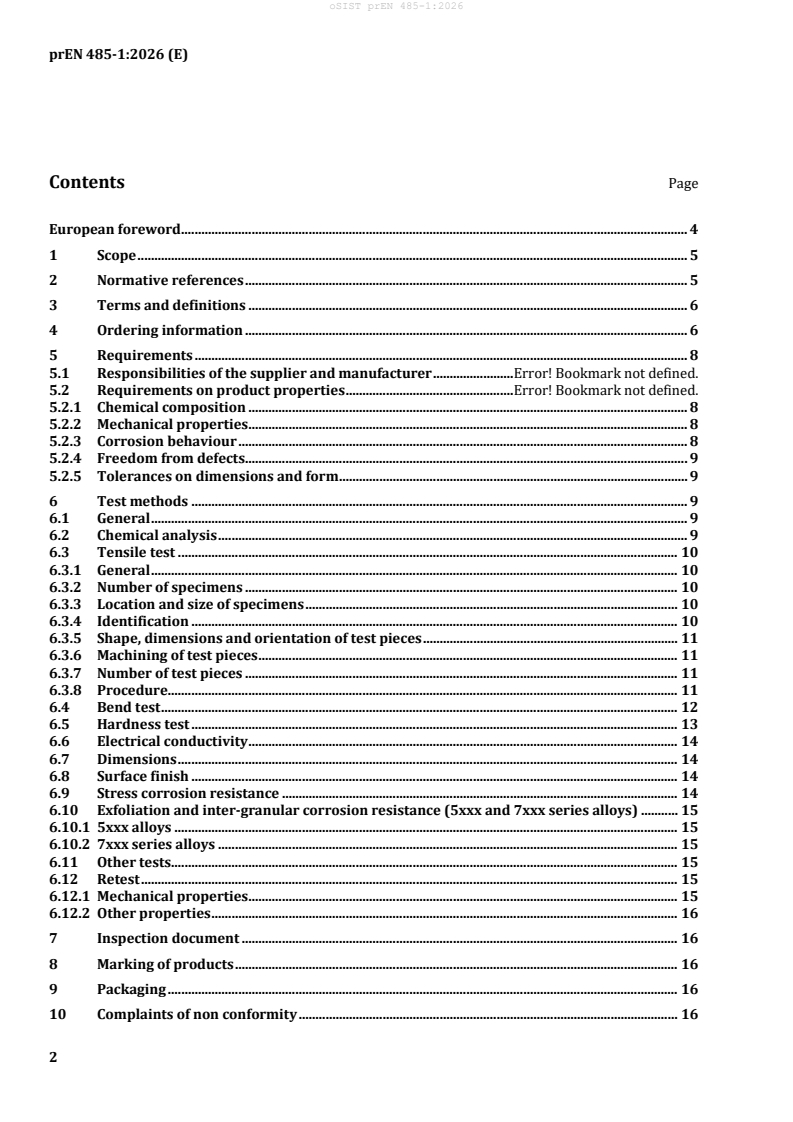
Contents Page
European foreword . 4
1 Scope . 5
2 Normative references . 5
3 Terms and definitions . 6
4 Ordering information . 6
5 Requirements . 8
5.1 Responsibilities of the supplier and manufacturer . Error! Bookmark not defined.
5.2 Requirements on product properties . Error! Bookmark not defined.
5.2.1 Chemical composition . 8
5.2.2 Mechanical properties . 8
5.2.3 Corrosion behaviour . 8
5.2.4 Freedom from defects. 9
5.2.5 Tolerances on dimensions and form . 9
6 Test methods . 9
6.1 General . 9
6.2 Chemical analysis . 9
6.3 Tensile test . 10
6.3.1 General . 10
6.3.2 Number of specimens . 10
6.3.3 Location and size of specimens . 10
6.3.4 Identification . 10
6.3.5 Shape, dimensions and orientation of test pieces . 11
6.3.6 Machining of test pieces . 11
6.3.7 Number of test pieces . 11
6.3.8 Procedure. 11
6.4 Bend test . 12
6.5 Hardness test . 13
6.6 Electrical conductivity . 14
6.7 Dimensions . 14
6.8 Surface finish . 14
6.9 Stress corrosion resistance . 14
6.10 Exfoliation and inter-granular corrosion resistance (5xxx and 7xxx series alloys) . 15
6.10.1 5xxx alloys . 15
6.10.2 7xxx series alloys . 15
6.11 Other tests . 15
6.12 Retest . 15
6.12.1 Mechanical properties . 15
6.12.2 Other properties . 16
7 Inspection document . 16
8 Marking of products . 16
9 Packaging . 16
10 Complaints of non conformity . 16
Annex A (normative) European Standards for strip, sheet and plate of special form and for
special applications . 17
Bibliography . 18
European foreword
This document (prEN 485-1:2026) has been prepared by Technical Committee CEN/TC 132 “Aluminium and
aluminium alloys”, the secretariat of which is held by AFNOR.
This document is currently submitted to the CEN Enquiry.
This document will supersede EN 485-1:2016.
— rewording of Subclause 6.3.5 related to the orientation of samples for tensile testing
EN 485 comprises the following parts under the general title “Aluminium and aluminium alloys — Sheet, strip
and plate”:
— Part 1: Technical conditions for inspection and delivery
— Part 2: Mechanical properties
— Part 3: Tolerances on dimensions and form for hot-rolled products
— Part 4: Tolerances on shape and dimensions for cold-rolled products
1 Scope
This document specifies the technical conditions for inspection and delivery of wrought aluminium and
wrought aluminium alloy sheet, strip and plate for general applications. It also includes provisions for
ordering and testing.
It applies to products with a thickness over 0,20 mm up to and including 400 mm.
For many special applications of aluminium strip, sheet and plate, specific European Standards exist, where
different or additional requirements are formulated and the appropriate alloys and tempers are selected: see
Annex A. Most of these special European Standards refer to provisions of this document.
The selection of the relevant special European Standards is under the responsibility of the purchaser.
Specific European Standards are available for applications involving special properties, such as corrosion
resistance, toughness, fatigue strength, surface appearance or welding properties.
2 Normative references
The following documents are referred to in the text in such a way that some or all of their content constitutes
requirements of this document. For dated references, only the edition cited applies. For undated references,
the latest edition of the referenced document (including any amendments) applies.
EN 485-2, Aluminium and aluminium alloys — Sheet, strip and plate — Part 2: Mechanical properties
EN 485-3, Aluminium and aluminium alloys — Sheet, strip and plate — Part 3: Tolerances on dimensions and
form for hot-rolled products
EN 485-4, Aluminium and aluminium alloys — Sheet, strip and plate — Part 4: Tolerances on shape and
dimensions for cold-rolled products
EN 515, Aluminium and aluminium alloys — Wrought products - Temper designations
EN 573-3, Aluminium and aluminium alloys — Chemical composition and form of wrought products - Part 3:
Chemical composition and form of products
EN 1669, Aluminium and aluminium alloys — Test methods - Earing test for sheet and strip
EN 2004-1, Aerospace series — Test methods for aluminium and aluminium alloy products — Part 1:
Determination of electrical conductivity of wrought aluminium alloys
EN 10204, Metallic products - Types of inspection documents
EN 12258-1, Aluminium and aluminium alloys — Terms and definitions — Part 1: General terms
EN 14242, Aluminium and aluminium alloys — Chemical analysis — Inductively coupled plasma optical emission
spectral analysis
EN 14361, Aluminium and aluminium alloys — Chemical analysis — Sampling from metal melts
EN ISO 6892-1, Metallic materials — Tensile testing — Part 1: Method of test at room temperature (ISO 6892-1)
EN ISO 7438, Metallic materials — Bend test (ISO 7438)
EN ISO 20482, Metallic materials — Sheet and strip — Erichsen cupping test (ISO 20482)
ISO 9591, Corrosion of aluminium alloys — Determination of resistance to stress corrosion cracking
ASTM G34, Standard Test Method for Exfoliation Corrosion Susceptibility in 2XXX and 7XXX Series Aluminum
Alloys (EXCO Test)
ASTM G47, Standard Test Method for Determining Susceptibility to Stress-Corrosion Cracking of 2XXX and 7XXX
Aluminum Alloy Products
ASTM G66, Standard Test Method for Visual Assessment of Exfoliation Corrosion Susceptibility of 5XXX Series
Aluminum Alloys (ASSET Test)
ASTM G67, Standard Test Method for Determining the Susceptibility to Intergranular Corrosion of 5XXX Series
Aluminum Alloys by Mass Loss After Exposure to Nitric Acid (NAMLT Test)
3 Terms and definitions
For the purposes of this document, the terms and definitions given in EN 12258-1 and the following apply.
3.1
sheet/plate
flat rolled product of rectangular cross-section with uniform thickness between 0,20 mm and 6 mm for sheet
or above 6 mm for plate, supplied in straight lengths (i.e. flat) usually with trimmed or sawn edges
Note 1 to entry: For sheet, the thickness does not exceed one-tenth of the width.
Note 2 to entry: Corrugated, embossed (with patterns, for example grooves, ribs, checkers, tears, buttons, lozenges),
coated, edge conditioned and perforated products in this general form when derived from sheet as defined above are
classified as sheet.
Note 3 to entry: Flat sheets and plates material between 3 mm and 15 mm are sometimes called “shate”.
3.2
strip
flat rolled product of rectangular cross-section with uniform thickness over 0,20 mm, supplied in coils usually
with trimmed edges
Note 1 to entry: The thickness does not exceed one-tenth of the width.
Note 2 to entry: Corrugated, embossed (with patterns, for example grooves, ribs, checkers, tears, buttons, lozenges),
coated, edge conditioned and perforated products in this general form when derived from sheet as defined above are
classified as sheet.
Note 3 to entry: “Strip” is sometimes called “coil”.
3.3
order document
document or set of documents agreed between supplier and purchaser at the time of ordering
Note 1 to entry: An order document can be an order of the purchaser confirmed by the supplier or a quotation of the
supplier confirmed by the purchaser.
4 Ordering information
The order document shall contain the following:
a) form and type of product:
— form of the product (sheet, strip, plate, etc.);
— designation of the aluminium or aluminium alloy;
b) temper of the material for delivery according to EN 515 and, if different, the temper for use;
c) reference to this document;
d) specification of mechanical properties, if additional to or different from EN 485-2 or as disclosed in any
application standard (see Annex A);
e) reference to the standard for tolerances of form and dimensions (e.g. EN 485-3, EN 485-4 or as disclosed
in any application standard (see Annex A));
f) dimensions of the product:
— thickness;
— width;
— length of sheet and plate, as applicable (in the rolling direction);
— internal and external diameters of the coil, or dimension and type of the core, as applicable.
NOTE 1 Unless otherwise agreed, the length is the largest dimension of the sheet or plate and corresponds to the
rolling direction.
g) quantity:
— mass or number of pieces;
— quantity tolerances if required;
h) any requirements for inspection documents;
i) any other test, in addition to chemical analysis and tensile testing;
j) any additional requirements, such as:
— quality assurance;
— specific inspection schemes;
— marking of products;
— references of drawing, etc.;
— special packing requirements;
k) for products intended for decorative anodizing by the purchaser, the order document shall also contain
the following:
— statement that the product is intended to be anodized;
— intended particular surface treatment (according to the relevant standard);
— whether a decorative appearance after anodizing is required for both sides and, if only one side, its
position with respect to the strip (inside or outside of the coil) or the sheet or plate (upside or
downside).
Products intended to form a specific area after anodizing (such as a façade) should be ordered in a single batch.
The order document should indicate the intended application.
NOTE 2 The codification scheme specified in EN 573-5 will preferably be used.
5 Requirements
5.1 Production and manufacturing processes
Unless otherwise specified in the order document, the production and manufacturing processes shall be left
to the discretion of the manufacturer. Unless it is explicitly stated in the order document, no obligation shall
be placed on the manufacturer to use the same processes for similar and subsequent orders.
5.2 Quality Control
The supplier shall be responsible for the performance of all inspection and tests required by the relevant
European Standard and/or the particular specification prior to shipment of the product. If the purchaser
wishes to inspect the product at the manufacturer’s works, he shall notify the supplier at the time of placing
the order.
5.3 Requirements on product properties
5.3.1 Chemical composition
The chemical composition shall comply with the requirements as specified in EN 573-3.
If the purchaser requires content limits for elements not specified in the above standard, these limits shall be
stated in the order document.
5.3.2 Mechanical properties
The mechanical properties determined by the tensile test shall be in conformity with those specified in
EN 485-2, if not otherwise stated in the order document. Other properties such as hardness, bending ability,
isotropy, etc. can be specified in the order document.
5.3.3 Corrosion behaviour
Products made of 5xxx alloys with nominal magnesium content equal to or higher than 3 % in the H116 and
H321 tempers shall be capable of exhibiting no exfoliation corrosion susceptibility according to ASTM G66
accelerated test and inter-granular corrosion susceptibility according to ASTM G67. The release criteria for
these tests are described in EN 13195.
Plate exhibit made of alloys EN AW-7010 and EN AW-7075 in the T73 and T7351 tempers and over 25 mm in
thickness, shall exhibit no evidence of stress-corrosion cracking when tested in accordance with ASTM G47 or
in ISO 9591.
Products made of alloys EN AW-7010 and EN AW-7075 in the tempers T76 and T7651 shall be capable of
exhibiting no evidence of exfoliation corrosion in excess of grade EB, as defined in ASTM G34, when subjected
to the test specified in 6.10.2.
5.3.4 Freedom from defects
The product shall be free from defects prejudicial to its suitable and proper use.
It shall have a smooth and clean surface. However small surface imperfections such as light scratches,
indentations, laminations, stripes, roll marks, discolorations and non-uniform surface appearance resulting
from heat treatment, etc., which cannot always be totally avoided, are generally permitted on both sides of the
product.
Whilst an operation designed to mask a defect is not permitted, superficial defects may be eliminated,
provided that the dimensional tolerances and material properties continue to meet the specifications.
For products intended for decorative anodizing, the superficial imperfections (discolouration, mechanical or
structural imperfections) might not be so extensive as to impair the decorative appearance after the agreed
surface treatment. Limiting samples can be agreed between supplier and purchaser.
5.3.5 Tolerances on dimensions and form
The dimensions and form tolerances shall be in conformity with EN 485-3 and EN 485-4, unless otherwise
agreed upon between supplier and purchaser and stated in the order document. Unless otherwise agreed
upon, the purchaser may reject only those products having dimensions not complying with the specified
tolerances.
5.3.6 Other properties
Any additional product requirements shall be defined and stated in the purchase order. For requirements
coming from application Standards, the requirements shall be those mentioned in the applicable Standards
listed in Annex A.
6 Test methods
6.1 General
If the purchaser wishes to inspect the product at the supplier's works, the purchaser shall notify the supplier
at the time of placing the order.
6.2 Chemical analysis
Sampling shall be carried out at the time of casting according to EN 14361. The average content accuracy to
each sample shall be within the specification for the chemical composition.
NOTE 1 EN 14361 includes criteria how to determine number, volume and shape of sample, about time and location
of sampling and about the design and maintenance of the tools, in order to make sure that the average chemical
composition of the sample is representative of the average chemical composition of the whole melt.
...