

SIST-TS CEN/TS 13149-9:2020
(Main)Public transport - Road vehicle scheduling and control systems - Part 9: Time service
General Information
- Abstract
The CEN 13149 series of products concerns on-board data communication systems on public transport vehicles. This series provides for data services that enable open and managed sharing of relevant information.
This document, being Part 9 of the series, specifies a time publication, enabling all on-vehicle services to share a common understanding of current time, based on a suitable agreed master network clock. It covers:
- the functional scope, i.e. which data the service provides, why, when and how often.
- the transport protocol, i.e. how the data are transmitted.
- the service publication, i.e. how the service can be found by other modules or applications
- the structure of the data, i.e. how the data are structured and how the data elements are named.
This document implements the service framework described in CEN/TS 13149-7.
- Status
- Published
- Publication Date
- 10-Jun-2020
- Technical Committee
- ITC - Information technology
- Current Stage
- 6060 - National Implementation/Publication (Adopted Project)
- Start Date
- 14-May-2020
- Due Date
- 19-Jul-2020
- Completion Date
- 11-Jun-2020


Overview
SIST-TS CEN/TS 13149-9:2020 is a Technical Specification developed by the European Committee for Standardization (CEN) as part of the broader CEN 13149 series. The series focuses on on-board data communication systems for public transport vehicles, enabling efficient and standardized data exchange. This document, Part 9 in the series, specifies the Time Service - a unified mechanism for publishing and synchronizing time data across all vehicle subsystems and applications. By offering a common time reference on the vehicle’s data network, this standard supports integration and interoperability for diverse electronic modules on buses, coaches, and other public road transport vehicles.
Key Topics
- Time Synchronization: Defines a standard approach for all on-board services to access a master clock and synchronize to Coordinated Universal Time (UTC), reducing discrepancies between subsystems.
- Functional Scope: Details the purpose, provided data, update intervals, and use cases for the Time Service, ensuring relevancy for device synchronization requirements.
- Transport Protocol: Specifies the use of Simple Network Time Protocol (SNTP) for reliable and recognized time data transmission over Internet Protocol (IP) networks.
- Service Publication: Outlines how the Time Service is published and discovered on the vehicle network. This includes the use of unique service names and records (SRV and TXT) for module identification.
- Data Structure: Describes the attributes and naming rules for distributed time data, allowing consistent and clear configuration by manufacturers and operators.
- Interoperability Framework: The specification leverages the service framework described in CEN/TS 13149-7, supporting overall architectural consistency.
Applications
SIST-TS CEN/TS 13149-9:2020 brings practical value to the management and operation of modern public transport fleets by enabling:
- Consistent Time Reference: Ensures passenger information systems, ticketing, vehicle monitoring, and other critical applications all use a unified time source, supporting synchronized operations and accurate scheduling.
- Equipment Interoperability: Facilitates integration of subsystems provided by different vendors, reducing the complexity of technical deployments and upgrades.
- Streamlined Maintenance: By standardizing time service discovery and access, maintenance becomes faster and troubleshooting is simplified for operators and system integrators.
- Enhanced Passenger Services: Accurate real-time information delivery such as schedule updates, announcements, and connections improves the passenger experience.
- Future-Proof Infrastructure: The IP-based approach supports progressive integration with emerging services such as WiFi, infotainment, and remote diagnostics.
Typical implementation scenarios include time synchronization for:
- Vehicle location and tracking systems
- Audio and display messaging
- Ticketing and fare systems
- Diagnostic and vehicle monitoring units
- On-board and off-board data exchanges
Related Standards
SIST-TS CEN/TS 13149-9:2020 is part of an integrated family of standards supporting public transport digitalization and networked vehicle architectures. Key related specifications include:
- CEN/TS 13149-7: System and network architecture for on-board equipment - provides the service framework.
- CEN/TS 13149-8: Physical layer for IP communication within public transport vehicles.
- CEN/TS 13149-10: Location service (covering GNSS-based location information).
- CEN/TS 13149-11: Vehicle platform interface service.
- RFC 4330: Reference for SNTP protocol implementation.
- VDV 301 and ITxPT S02: Referenced as supporting documentation and proof of large-scale deployments in Europe.
By adhering to SIST-TS CEN/TS 13149-9:2020, public transport operators and suppliers gain a robust, interoperable foundation for current and future intelligent vehicle systems, driving efficiency and service reliability across Europe’s public road transport sector.
Relations
- Effective Date
- 28-Jan-2026
Get Certified
Connect with accredited certification bodies for this standard

BSI Group
BSI (British Standards Institution) is the business standards company that helps organizations make excellence a habit.

TÜV Rheinland
TÜV Rheinland is a leading international provider of technical services.

TÜV SÜD
TÜV SÜD is a trusted partner of choice for safety, security and sustainability solutions.
Sponsored listings
Frequently Asked Questions
SIST-TS CEN/TS 13149-9:2020 is a technical specification published by the Slovenian Institute for Standardization (SIST). Its full title is "Public transport - Road vehicle scheduling and control systems - Part 9: Time service". This standard covers: The CEN 13149 series of products concerns on-board data communication systems on public transport vehicles. This series provides for data services that enable open and managed sharing of relevant information. This document, being Part 9 of the series, specifies a time publication, enabling all on-vehicle services to share a common understanding of current time, based on a suitable agreed master network clock. It covers: - the functional scope, i.e. which data the service provides, why, when and how often. - the transport protocol, i.e. how the data are transmitted. - the service publication, i.e. how the service can be found by other modules or applications - the structure of the data, i.e. how the data are structured and how the data elements are named. This document implements the service framework described in CEN/TS 13149-7.
The CEN 13149 series of products concerns on-board data communication systems on public transport vehicles. This series provides for data services that enable open and managed sharing of relevant information. This document, being Part 9 of the series, specifies a time publication, enabling all on-vehicle services to share a common understanding of current time, based on a suitable agreed master network clock. It covers: - the functional scope, i.e. which data the service provides, why, when and how often. - the transport protocol, i.e. how the data are transmitted. - the service publication, i.e. how the service can be found by other modules or applications - the structure of the data, i.e. how the data are structured and how the data elements are named. This document implements the service framework described in CEN/TS 13149-7.
SIST-TS CEN/TS 13149-9:2020 is classified under the following ICS (International Classification for Standards) categories: 03.220.20 - Road transport; 35.240.60 - IT applications in transport; 43.040.15 - Car informatics. On board computer systems. The ICS classification helps identify the subject area and facilitates finding related standards.
SIST-TS CEN/TS 13149-9:2020 has the following relationships with other standards: It is inter standard links to SIST-TS CEN/TS 13149-7:2020. Understanding these relationships helps ensure you are using the most current and applicable version of the standard.
SIST-TS CEN/TS 13149-9:2020 is available in PDF format for immediate download after purchase. The document can be added to your cart and obtained through the secure checkout process. Digital delivery ensures instant access to the complete standard document.
Standards Content (Sample)
SLOVENSKI STANDARD
01-julij-2020
Javni prevoz - Sistemi za časovno razporejanje in nadzor cestnih vozil - 9. del:
Časovna storitev
Public transport - Road vehicle scheduling and control systems - Part 9: Time service
Öffentlicher Verkehr - Planungs- und Steuerungssysteme für Straßenfahrzeuge - Teil 9:
Zeitdienst
Transport public - Systèmes de planification et de contrôle des véhicules routiers - Partie
9 : Service horaires
Ta slovenski standard je istoveten z: CEN/TS 13149-9:2020
ICS:
03.220.20 Cestni transport Road transport
35.240.60 Uporabniške rešitve IT v IT applications in transport
prometu
43.040.15 Avtomobilska informatika. Car informatics. On board
Vgrajeni računalniški sistemi computer systems
2003-01.Slovenski inštitut za standardizacijo. Razmnoževanje celote ali delov tega standarda ni dovoljeno.
CEN/TS 13149-9
TECHNICAL SPECIFICATION
SPÉCIFICATION TECHNIQUE
May 2020
TECHNISCHE SPEZIFIKATION
ICS 35.240.60; 43.040.15
English Version
Public transport - Road vehicle scheduling and control
systems - Part 9: Time service
Transport public - Systèmes de planification et de Öffentlicher Verkehr - Planungs- und
contrôle des véhicules routiers - Partie 9 : Service Steuerungssysteme für Straßenfahrzeuge - Teil 9:
horaires Zeitdienst
This Technical Specification (CEN/TS) was approved by CEN on 8 December 2019 for provisional application.
The period of validity of this CEN/TS is limited initially to three years. After two years the members of CEN will be requested to
submit their comments, particularly on the question whether the CEN/TS can be converted into a European Standard.
CEN members are required to announce the existence of this CEN/TS in the same way as for an EN and to make the CEN/TS
available promptly at national level in an appropriate form. It is permissible to keep conflicting national standards in force (in
parallel to the CEN/TS) until the final decision about the possible conversion of the CEN/TS into an EN is reached.
CEN members are the national standards bodies of Austria, Belgium, Bulgaria, Croatia, Cyprus, Czech Republic, Denmark, Estonia,
Finland, France, Germany, Greece, Hungary, Iceland, Ireland, Italy, Latvia, Lithuania, Luxembourg, Malta, Netherlands, Norway,
Poland, Portugal, Republic of North Macedonia, Romania, Serbia, Slovakia, Slovenia, Spain, Sweden, Switzerland, Turkey and
United Kingdom.
EUROPEAN COMMITTEE FOR STANDARDIZATION
COMITÉ EUROPÉEN DE NORMALISATION
EUROPÄISCHES KOMITEE FÜR NORMUNG
CEN-CENELEC Management Centre: Rue de la Science 23, B-1040 Brussels
© 2020 CEN All rights of exploitation in any form and by any means reserved Ref. No. CEN/TS 13149-9:2020 E
worldwide for CEN national Members.
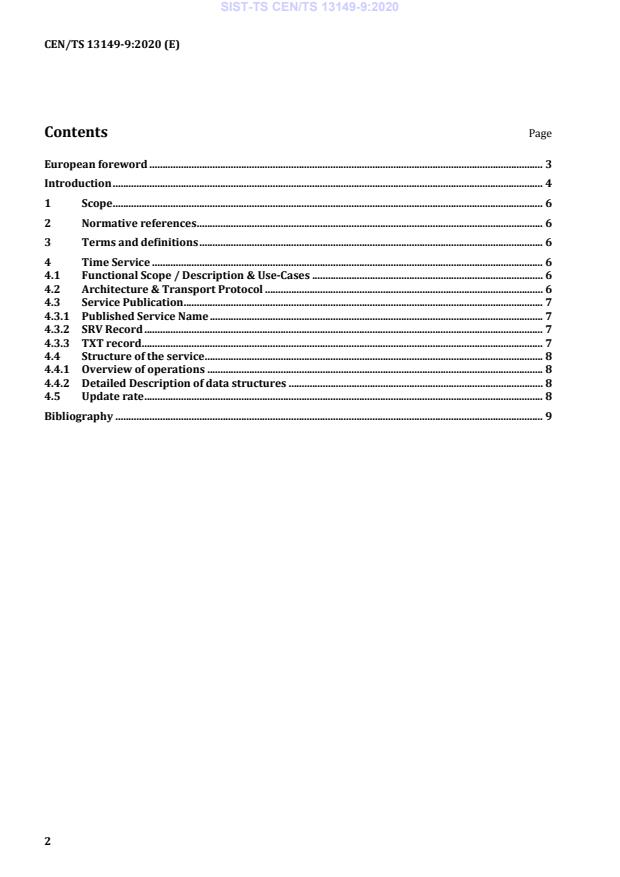
Contents Page
European foreword . 3
Introduction . 4
1 Scope . 6
2 Normative references . 6
3 Terms and definitions . 6
4 Time Service . 6
4.1 Functional Scope / Description & Use-Cases . 6
4.2 Architecture & Transport Protocol . 6
4.3 Service Publication . 7
4.3.1 Published Service Name . 7
4.3.2 SRV Record . 7
4.3.3 TXT record . 7
4.4 Structure of the service . 8
4.4.1 Overview of operations . 8
4.4.2 Detailed Description of data structures . 8
4.5 Update rate . 8
Bibliography . 9
European foreword
This document (CEN/TS 13149-9:2020) has been prepared by Technical Committee CEN/TC 278
“Intelligent transport systems”, the secretariat of which is held by NEN.
Attention is drawn to the possibility that some of the elements of this document may be the subject of
patent rights. CEN shall not be held responsible for identifying any or all such patent rights.
This document is Part 9 of a series of European Standards and Technical Specifications that includes:
— CEN/TS 13149-7, Public transport – Road vehicle scheduling and control systems – Part 7: System
and network architecture;
— CEN/TS 13149-8, Public transport – Road vehicle scheduling and control systems – Part 8: Physical
layer for IP communication;
— CEN/TS 13149-9, Public transport – Road vehicle scheduling and control systems – Part 9: Time
service [this document];
— CEN/TS 13149-10, Public transport – Road vehicle scheduling and control systems – Part 10:
Location service [currently at voting stage];
— CEN/TS 13149-11, Public transport – Road vehicle scheduling and control systems – Part 11: Vehicle
platform interface service [currently at voting stage].
According to the CEN/CENELEC Internal Regulations, the national standards organisations of the
following countries are bound to announce this Technical Specification: Austria, Belgium, Bulgaria,
Croatia, Cyprus, Czech Republic, Denmark, Estonia, Finland, France, Germany, Greece, Hungary, Iceland,
Ireland, Italy, Latvia, Lithuania, Luxembourg, Malta, Netherlands, Norway, Poland, Portugal, Republic of
North Macedonia, Romania, Serbia, Slovakia, Slovenia, Spain, Sweden, Switzerland, Turkey and the
United Kingdom.
Introduction
This Technical Specification is Part 9 of a series of European Standards and Technical Specifications.
The scope of this series is on-board data communication systems on public transport vehicles.
Public Transport (PT) vehicles have an increasing array of information and communications systems,
including ticket machines, Automated Vehicle Location (AVL) systems, destination displays, passenger
announcement systems, vehicle monitoring systems, etc. Other systems are beginning to be included
such as advertising screens, tourist guides, WiFi “hotspots” and infotainment.
In addition, equipped PT vehicle will usually have a communications facility to enable voice and data to
be exchanged with the control centre, other PT vehicles, PT infrastructure and roadside devices for
instance in requesting priority at traffic signals. Many types of communication channel are used
including public and private wireless communication networks.
These systems may be provided by a number of diffe
...