

SIST EN 1999-1-5:2023/oprA1:2026
(Amendment)Eurocode 9 - Design of aluminium structures - Part 1-5: Shell structures
General Information
- Abstract
1.1 Scope of EN 1999-1-5
(1) EN 1999-1-5 applies to the structural design of aluminium structures, stiffened and unstiffened, that have the form of a shell of revolution or of a round panel in monocoque structures.
(2) EN 1999-1-5 covers additional provisions to those given in the relevant parts of EN 1999 for design of aluminium structures.
NOTE Supplementary information for certain types of shells is given in EN 1993-1-6 and the relevant application parts of EN 1993 which include:
- Part 3-1 for towers and masts;
- Part 3-2 for chimneys;
- Part 4-1 for silos;
- Part 4-2 for tanks;
- Part 4-3 for pipelines.
(4) The provisions in EN 1999-1-5 apply to axisymmetric shells (cylinders, cones, spheres) and associated circular or annular plates, beam section rings and stringer stiffeners, where they form part of the complete structure.
(5) Single shell panels (cylindrical, conical or spherical) are not explicitly covered by EN 1999-1-5. However, the provisions can be applicable if the appropriate boundary conditions are duly taken into account.
(6) Types of shell walls covered in EN 1999-1-5 can be (see Figure 1.1):
- shell wall constructed from flat rolled sheet with adjacent plates connected with butt welds, termed “isotropic”;
- shell wall with lap joints formed by connecting adjacent plates with overlapping sections, termed “lap-jointed”;
- shell wall with stiffeners attached to the outside, termed “externally stiffened” irrespective of the spacing of stiffeners;
- shell wall with the corrugations running up the meridian, termed “axially corrugated”;
- shell wall constructed from corrugated sheets with the corrugations running around the shell circumference, termed “circumferentially corrugated”.
[Figure 1.1 - Illustration of cylindrical shell form]
(7) The provisions of EN 1999-1-5 are intended to be applied within the temperature range defined in EN 1999-1-1. The maximum temperature is restricted so that the influence of creep can be neglected. For structures subject to elevated temperatures associated with fire, see EN 1999-1-2.
(8) EN 1999-1-5 does not cover the aspect of leakage.
1.2 Assumptions
(1) The general assumptions of EN 1990 apply.
(2) The provisions of EN 1999-1-1 apply.
(3) The design procedures are valid only when the requirements for execution in EN 1090-3 or other equivalent requirements are complied with.
(4) EN 1999 is intended to be used in conjunction with:
- European Standards for construction products relevant for aluminium structures;
- EN 1090-1, Execution of steel structures and aluminium structures - Part 1: Requirements for conformity assessment of structural components;
- EN 1090-3, Execution of steel structures and aluminium structures - Part 3: Technical requirements for aluminium structures.
- Status
- Not Published
- Public Enquiry End Date
- 28-May-2026
- Technical Committee
- KON - Structures
- Current Stage
- 4020 - Public enquire (PE) (Adopted Project)
- Start Date
- 30-Mar-2026
- Due Date
- 17-Aug-2026

Overview
SIST EN 1999-1-5:2023/oprA1:2026, commonly referred to as Eurocode 9 Part 1-5: Shell Structures, is a European standard developed by the European Committee for Standardization (CEN). This standard provides comprehensive guidance for the structural design of aluminium shell structures, including both stiffened and unstiffened shells of revolution and round panels in monocoque applications. EN 1999-1-5 serves as an integral part of the Eurocode suite, addressing the unique properties and requirements of aluminium as a construction material for shell structures.
Eurocode 9 Part 1-5 builds upon general aluminium structure design rules described in other parts of EN 1999, offering specialized provisions for shell geometries. It covers a variety of shell wall arrangements and incorporates references to related standards for specific applications like silos, tanks, pipelines, towers, chimneys, and masts.
Key Topics
- Scope of Application: Applies to axisymmetric shells such as cylinders, cones, and spheres, together with related circular or annular plates, rings, and stiffeners forming part of an aluminium structure.
- Shell Wall Construction: Covers various shell wall configurations including:
- Isotropic (flat rolled sheets joined by butt welds)
- Lap-jointed (overlapping sections)
- Externally stiffened (with attached stiffeners)
- Axially or circumferentially corrugated shells
- Design Requirements:
- Follows general assumptions of EN 1990 (basis for structural and geotechnical design)
- Relies on provisions from EN 1999-1-1 (general rules for aluminium structures)
- Valid only if executed in accordance with EN 1090-3 (execution of aluminium structures)
- Boundary and Temperature Considerations:
- Designed for temperature ranges where creep can be neglected
- For fire situations, reference is made to EN 1999-1-2
- Buckling Resistance: Updated methods and parameters for buckling of both stiffened and unstiffened shells, ensuring safety and reliability
Applications
SIST EN 1999-1-5:2023/oprA1:2026 is essential for engineers, architects, and construction professionals involved in the design and verification of aluminium shell structures, offering practical guidance and compliance with European regulations. Typical applications include:
- Storage Silos and Tanks: Ensuring safe storage of materials with shell structures designed for pressure and environmental loads.
- Pipelines: Addressing unique stress distributions and buckling concerns in cylindrical shells.
- Industrial Chimneys, Towers, and Masts: Providing stability and wind resistance for tall, slender aluminium structures.
- Transport Infrastructure: Monocoque designs for bridges, canopies, and transportation equipment utilizing shells for strength and weight efficiency.
- Architectural Envelopes: Use in lightweight, curved façade elements and roofing systems.
By following EN 1999-1-5, designers achieve efficient material use, enhanced structural safety, and international conformity, thereby facilitating the reliable construction of complex shell geometries in aluminium.
Related Standards
EN 1999-1-5 is typically used in combination with the following related European standards and Eurocodes for comprehensive structural design and execution:
- EN 1990-1: Eurocode - Basis of structural and geotechnical design
- EN 1999-1-1: General structural rules for aluminium structures
- EN 1999-1-2: Structural fire design for aluminium structures
- EN 1090-1 and EN 1090-3: Execution standards for steel and aluminium structures
- EN 1993-1-6: Shell structures in steel (complementary provisions for certain shell types)
- EN 1991: Actions on structures (load specifications)
- EN 1993-3-1 and EN 1993-3-2: Towers, masts, and chimneys
- EN 1993-4-1, EN 1993-4-2, EN 1993-4-3: Design of silos, tanks, and pipelines
These standards support a harmonized approach to aluminium structure design, guarantee compliance across European states, and ensure safety, quality, and durability in civil engineering projects.
Relations
- Amends
kSIST FprEN 1999-1-5:2022 - Eurocode 9 - Design of aluminium structures - Part 1-5: Shell structures - Effective Date
- 30-Jul-2025
Get Certified
Connect with accredited certification bodies for this standard

DIBt (Deutsches Institut für Bautechnik)
German Institute for Building Technology.
DIN CERTCO
DIN Group product certification.

Aboma Certification B.V.
Specialized in construction, metal, and transport sectors.
Sponsored listings
Frequently Asked Questions
SIST EN 1999-1-5:2023/oprA1:2026 is a draft published by the Slovenian Institute for Standardization (SIST). Its full title is "Eurocode 9 - Design of aluminium structures - Part 1-5: Shell structures". This standard covers: 1.1 Scope of EN 1999-1-5 (1) EN 1999-1-5 applies to the structural design of aluminium structures, stiffened and unstiffened, that have the form of a shell of revolution or of a round panel in monocoque structures. (2) EN 1999-1-5 covers additional provisions to those given in the relevant parts of EN 1999 for design of aluminium structures. NOTE Supplementary information for certain types of shells is given in EN 1993-1-6 and the relevant application parts of EN 1993 which include: - Part 3-1 for towers and masts; - Part 3-2 for chimneys; - Part 4-1 for silos; - Part 4-2 for tanks; - Part 4-3 for pipelines. (4) The provisions in EN 1999-1-5 apply to axisymmetric shells (cylinders, cones, spheres) and associated circular or annular plates, beam section rings and stringer stiffeners, where they form part of the complete structure. (5) Single shell panels (cylindrical, conical or spherical) are not explicitly covered by EN 1999-1-5. However, the provisions can be applicable if the appropriate boundary conditions are duly taken into account. (6) Types of shell walls covered in EN 1999-1-5 can be (see Figure 1.1): - shell wall constructed from flat rolled sheet with adjacent plates connected with butt welds, termed “isotropic”; - shell wall with lap joints formed by connecting adjacent plates with overlapping sections, termed “lap-jointed”; - shell wall with stiffeners attached to the outside, termed “externally stiffened” irrespective of the spacing of stiffeners; - shell wall with the corrugations running up the meridian, termed “axially corrugated”; - shell wall constructed from corrugated sheets with the corrugations running around the shell circumference, termed “circumferentially corrugated”. [Figure 1.1 - Illustration of cylindrical shell form] (7) The provisions of EN 1999-1-5 are intended to be applied within the temperature range defined in EN 1999-1-1. The maximum temperature is restricted so that the influence of creep can be neglected. For structures subject to elevated temperatures associated with fire, see EN 1999-1-2. (8) EN 1999-1-5 does not cover the aspect of leakage. 1.2 Assumptions (1) The general assumptions of EN 1990 apply. (2) The provisions of EN 1999-1-1 apply. (3) The design procedures are valid only when the requirements for execution in EN 1090-3 or other equivalent requirements are complied with. (4) EN 1999 is intended to be used in conjunction with: - European Standards for construction products relevant for aluminium structures; - EN 1090-1, Execution of steel structures and aluminium structures - Part 1: Requirements for conformity assessment of structural components; - EN 1090-3, Execution of steel structures and aluminium structures - Part 3: Technical requirements for aluminium structures.
1.1 Scope of EN 1999-1-5 (1) EN 1999-1-5 applies to the structural design of aluminium structures, stiffened and unstiffened, that have the form of a shell of revolution or of a round panel in monocoque structures. (2) EN 1999-1-5 covers additional provisions to those given in the relevant parts of EN 1999 for design of aluminium structures. NOTE Supplementary information for certain types of shells is given in EN 1993-1-6 and the relevant application parts of EN 1993 which include: - Part 3-1 for towers and masts; - Part 3-2 for chimneys; - Part 4-1 for silos; - Part 4-2 for tanks; - Part 4-3 for pipelines. (4) The provisions in EN 1999-1-5 apply to axisymmetric shells (cylinders, cones, spheres) and associated circular or annular plates, beam section rings and stringer stiffeners, where they form part of the complete structure. (5) Single shell panels (cylindrical, conical or spherical) are not explicitly covered by EN 1999-1-5. However, the provisions can be applicable if the appropriate boundary conditions are duly taken into account. (6) Types of shell walls covered in EN 1999-1-5 can be (see Figure 1.1): - shell wall constructed from flat rolled sheet with adjacent plates connected with butt welds, termed “isotropic”; - shell wall with lap joints formed by connecting adjacent plates with overlapping sections, termed “lap-jointed”; - shell wall with stiffeners attached to the outside, termed “externally stiffened” irrespective of the spacing of stiffeners; - shell wall with the corrugations running up the meridian, termed “axially corrugated”; - shell wall constructed from corrugated sheets with the corrugations running around the shell circumference, termed “circumferentially corrugated”. [Figure 1.1 - Illustration of cylindrical shell form] (7) The provisions of EN 1999-1-5 are intended to be applied within the temperature range defined in EN 1999-1-1. The maximum temperature is restricted so that the influence of creep can be neglected. For structures subject to elevated temperatures associated with fire, see EN 1999-1-2. (8) EN 1999-1-5 does not cover the aspect of leakage. 1.2 Assumptions (1) The general assumptions of EN 1990 apply. (2) The provisions of EN 1999-1-1 apply. (3) The design procedures are valid only when the requirements for execution in EN 1090-3 or other equivalent requirements are complied with. (4) EN 1999 is intended to be used in conjunction with: - European Standards for construction products relevant for aluminium structures; - EN 1090-1, Execution of steel structures and aluminium structures - Part 1: Requirements for conformity assessment of structural components; - EN 1090-3, Execution of steel structures and aluminium structures - Part 3: Technical requirements for aluminium structures.
SIST EN 1999-1-5:2023/oprA1:2026 is classified under the following ICS (International Classification for Standards) categories: 91.010.30 - Technical aspects; 91.080.17 - Aluminium structures. The ICS classification helps identify the subject area and facilitates finding related standards.
SIST EN 1999-1-5:2023/oprA1:2026 has the following relationships with other standards: It is inter standard links to kSIST FprEN 1999-1-5:2022. Understanding these relationships helps ensure you are using the most current and applicable version of the standard.
SIST EN 1999-1-5:2023/oprA1:2026 is available in PDF format for immediate download after purchase. The document can be added to your cart and obtained through the secure checkout process. Digital delivery ensures instant access to the complete standard document.
Standards Content (Sample)
SLOVENSKI STANDARD
01-maj-2026
Evrokod 9 - Projektiranje konstrukcij iz aluminijevih zlitin - 1-5. del: Lupinaste
konstrukcije
Eurocode 9 - Design of aluminium structures - Part 1-5: Shell structures
Eurocode 9 - Bemessung und Konstruktion von Aluminiumtragwerken - Teil 1-5:
Schalentragwerke
Eurocode 9 - Calcul des structures en aluminium - Partie 1-5 : Coques
Ta slovenski standard je istoveten z: EN 1999-1-5:2023/prA1
ICS:
91.010.30 Tehnični vidiki Technical aspects
91.080.17 Aluminijaste konstrukcije Aluminium structures
2003-01.Slovenski inštitut za standardizacijo. Razmnoževanje celote ali delov tega standarda ni dovoljeno.
DRAFT
EUROPEAN STANDARD
EN 1999-1-5:2023
NORME EUROPÉENNE
EUROPÄISCHE NORM
prA1
March 2026
ICS 91.010.30; 91.080.17
English Version
Eurocode 9 - Design of aluminium structures - Part 1-5:
Shell structures
Eurocode 9 - Calcul des structures en aluminium - Eurocode 9 - Bemessung und Konstruktion von
Partie 1-5 : Coques Aluminiumtragwerken - Teil 1-5: Schalentragwerke
This draft amendment is submitted to CEN members for enquiry. It has been drawn up by the Technical Committee CEN/TC 250.
This draft amendment A1, if approved, will modify the European Standard EN 1999-1-5:2023. If this draft becomes an
amendment, CEN members are bound to comply with the CEN/CENELEC Internal Regulations which stipulate the conditions for
inclusion of this amendment into the relevant national standard without any alteration.
This draft amendment was established by CEN in three official versions (English, French, German). A version in any other
language made by translation under the responsibility of a CEN member into its own language and notified to the CEN-CENELEC
Management Centre has the same status as the official versions.
CEN members are the national standards bodies of Austria, Belgium, Bulgaria, Croatia, Cyprus, Czech Republic, Denmark, Estonia,
Finland, France, Germany, Greece, Hungary, Iceland, Ireland, Italy, Latvia, Lithuania, Luxembourg, Malta, Netherlands, Norway,
Poland, Portugal, Republic of North Macedonia, Romania, Serbia, Slovakia, Slovenia, Spain, Sweden, Switzerland, Türkiye and
United Kingdom.
Recipients of this draft are invited to submit, with their comments, notification of any relevant patent rights of which they are
aware and to provide supporting documentation.
Warning : This document is not a European Standard. It is distributed for review and comments. It is subject to change without
notice and shall not be referred to as a European Standard.
EUROPEAN COMMITTEE FOR STANDARDIZATION
COMITÉ EUROPÉEN DE NORMALISATION
EUROPÄISCHES KOMITEE FÜR NORMUNG
CEN-CENELEC Management Centre: Rue de la Science 23, B-1040 Brussels
© 2026 CEN All rights of exploitation in any form and by any means reserved Ref. No. EN 1999-1-5:2023/prA1:2026 E
worldwide for CEN national Members.
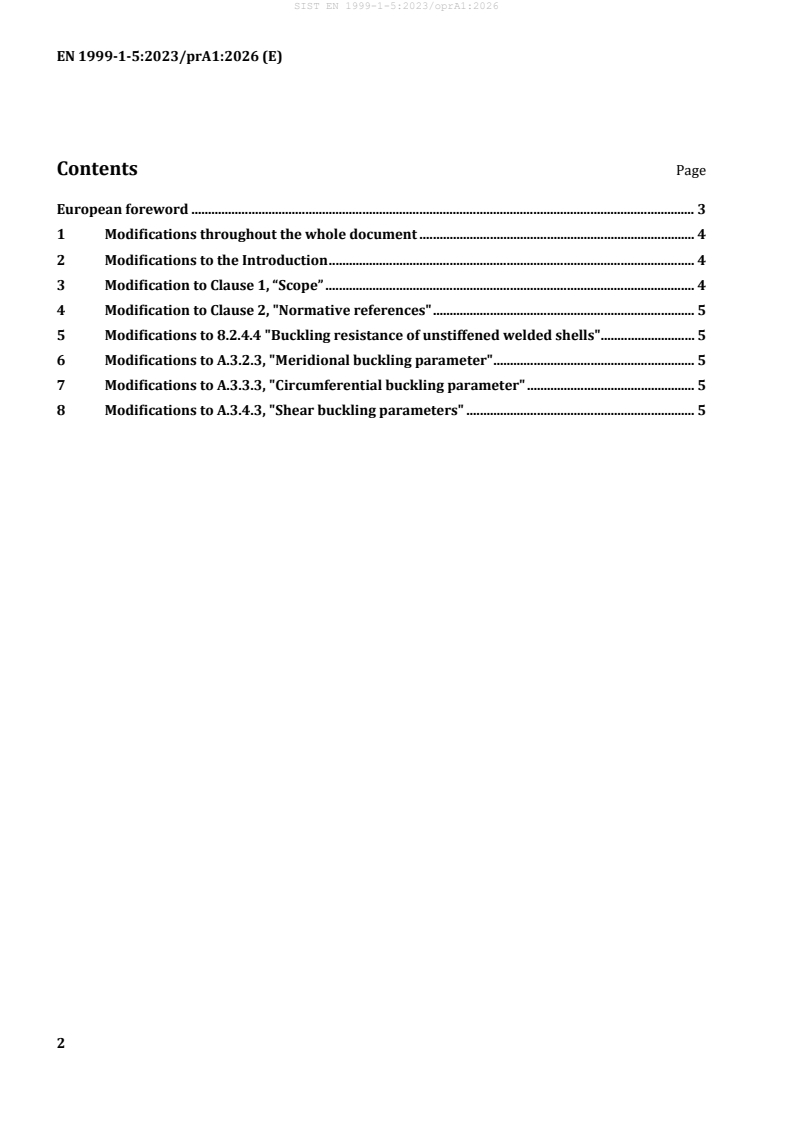
EN 1999-1-5:2023/prA1:2026 (E)
Contents Page
European foreword . 3
1 Modifications throughout the whole document . 4
2 Modifications to the Introduction . 4
3 Modification to Clause 1, “Scope” . 4
4 Modification to Clause 2, "Normative references" . 5
5 Modifications to 8.2.4.4 "Buckling resistance of unstiffened welded shells" . 5
6 Modifications to A.3.2.3, "Meridional buckling parameter" . 5
7 Modifications to A.3.3.3, "Circumferential buckling parameter" . 5
8 Modifications to A.3.4.3, "Shear buckling parameters" . 5
...