

ASTM D3928-00a(2018)
(Test Method)Standard Test Method for Evaluation of Gloss or Sheen Uniformity
General Information
- Abstract
SIGNIFICANCE AND USE
3.1 When coatings are applied to large flat surfaces such as walls, the film thickness may vary or there may be small areas missed entirely (holidays) when the color of the fresh material and the previous film are very similar. It is much less costly if these areas can be touched up instead of having to repaint the entire surface.
3.2 Thickness is also affected in the locations where an area coated a short time before is joined with the area currently being coated (laps). An application technique that may affect the final appearance of the film is brushing or rolling the material in different directions in adjacent areas.
3.3 Both buyers and sellers are interested in determining whether a coating can be applied without exhibiting areas that differ in appearance because of laps and brush or roller marks, and whether it can be readily touched up to provide a uniform appearance in regard to gloss or sheen and all other aspects.
SCOPE
1.1 This test method covers the determination of the uniformity of gloss or sheen of a paint applied by brush to a test panel simulating an interior wall section. Variations in gloss or sheen that may be caused by short wet edge time, poor leveling, and pigment orientation or flotation during and after application are evaluated visually.
1.2 Because both the application and the panel evaluation are very subjective, this test method should be used only for comparative testing within one laboratory as the ratings assigned by different laboratories do not usually agree (see 8.1).
1.3 The values given in SI units are to be regarded as the standard. The values given in parentheses are for information only.
1.4 This standard does not purport to address all of the safety concerns, if any, associated with its use. It is the responsibility of the user of this standard to establish appropriate safety, health, and environmental practices and determine the applicability of regulatory limitations prior to use.
1.5 This international standard was developed in accordance with internationally recognized principles on standardization established in the Decision on Principles for the Development of International Standards, Guides and Recommendations issued by the World Trade Organization Technical Barriers to Trade (TBT) Committee.
- Status
- Published
- Publication Date
- 31-May-2018
- Technical Committee
- D01 - Paint and Related Coatings, Materials, and Applications
- Drafting Committee
- D01.42 - Architectural Coatings


Overview
ASTM D3928-00a(2018), Standard Test Method for Evaluation of Gloss or Sheen Uniformity, is an internationally recognized guideline published by ASTM International. This standard provides a test method to assess the uniformity of gloss or sheen in paint coatings applied by brush to panels simulating interior wall surfaces. The evaluation is based on visual inspection and is primarily intended for comparative testing within a single laboratory, as results can be subjective and may vary between different testing locations. The test is especially significant for both buyers and sellers seeking assurance that coatings will deliver a visually uniform appearance and can be effectively touched up without requiring repainting of entire surfaces.
Key Topics
- Gloss and Sheen Uniformity: The method evaluates the evenness of gloss or sheen across painted surfaces, identifying areas where variations may occur.
- Visual Assessment: Paint is applied to a prepared test panel and visually inspected under specific lighting and angles to highlight differences in gloss or sheen.
- Influence of Application Techniques: The method highlights the impact of painting techniques, such as brush direction and overlap, as well as product properties, like wet edge time and pigment orientation, on final surface appearance.
- Touch-Up Performance: The standard assesses how well touch-ups blend with existing finishes in terms of gloss and sheen.
- Comparative Ratings: Uniformity is scored using a scale that ranges from “excellent” to “very poor,” enabling side-by-side comparisons of different coatings or techniques.
Applications
ASTM D3928-00a(2018) is particularly relevant in the architectural paint and coatings industry. Practical applications include:
- Quality Control: Paint manufacturers use the test to evaluate the consistency and uniformity of gloss or sheen in their products.
- Product Development: R&D teams can compare new formulations and application methods to optimize for uniform appearance and touch-up capabilities.
- Specification Compliance: Contractors and architects rely on the test to confirm that selected coatings meet performance expectations regarding finish uniformity.
- Troubleshooting: The method helps identify causes of surface inconsistencies, such as poor leveling or improper application technique, supporting corrective actions.
- Comparative Benchmarking: The test serves as a basis for ranking products internally or when selecting paints for large-scale projects where visual uniformity is critical.
Related Standards
For a comprehensive approach to paint and coating uniformity, the following related standards may be relevant:
- ASTM D523: Standard Test Method for Specular Gloss - for quantitative gloss measurement.
- ASTM D2457: Test Method for Specular Gloss of Plastic Films and Solid Plastics.
- ASTM D6736: Standard Test Method for Measurement of Hiding Power of Paints by Reflectometry.
- ASTM D7396: Standard Practice for Specification and Evaluation of Factory-Applied Interior Architectural Coatings.
- ISO 2813: Paints and varnishes - Determination of gloss value at 20°, 60° and 85°.
In summary, ASTM D3928-00a(2018) plays a crucial role in ensuring high standards of finish quality in painted surfaces, promoting greater customer satisfaction, and reducing maintenance costs by facilitating reliable touch-ups and uniform visual appearance. This standard supports consistent decision-making and benchmarking in the coating industry.
Relations
- Effective Date
- 01-Jun-2018
- Effective Date
- 01-Jun-2018
- Effective Date
- 01-Jun-2018
- Effective Date
- 01-Jun-2018
- Referred By
ASTM D6763-16(2022) - Standard Guide for Testing Exterior Wood Stains and Clear Water Repellents - Effective Date
- 01-Jun-2018
- Effective Date
- 01-Jun-2018
- Effective Date
- 01-Jun-2018
Frequently Asked Questions
ASTM D3928-00a(2018) is a standard published by ASTM International. Its full title is "Standard Test Method for Evaluation of Gloss or Sheen Uniformity". This standard covers: SIGNIFICANCE AND USE 3.1 When coatings are applied to large flat surfaces such as walls, the film thickness may vary or there may be small areas missed entirely (holidays) when the color of the fresh material and the previous film are very similar. It is much less costly if these areas can be touched up instead of having to repaint the entire surface. 3.2 Thickness is also affected in the locations where an area coated a short time before is joined with the area currently being coated (laps). An application technique that may affect the final appearance of the film is brushing or rolling the material in different directions in adjacent areas. 3.3 Both buyers and sellers are interested in determining whether a coating can be applied without exhibiting areas that differ in appearance because of laps and brush or roller marks, and whether it can be readily touched up to provide a uniform appearance in regard to gloss or sheen and all other aspects. SCOPE 1.1 This test method covers the determination of the uniformity of gloss or sheen of a paint applied by brush to a test panel simulating an interior wall section. Variations in gloss or sheen that may be caused by short wet edge time, poor leveling, and pigment orientation or flotation during and after application are evaluated visually. 1.2 Because both the application and the panel evaluation are very subjective, this test method should be used only for comparative testing within one laboratory as the ratings assigned by different laboratories do not usually agree (see 8.1). 1.3 The values given in SI units are to be regarded as the standard. The values given in parentheses are for information only. 1.4 This standard does not purport to address all of the safety concerns, if any, associated with its use. It is the responsibility of the user of this standard to establish appropriate safety, health, and environmental practices and determine the applicability of regulatory limitations prior to use. 1.5 This international standard was developed in accordance with internationally recognized principles on standardization established in the Decision on Principles for the Development of International Standards, Guides and Recommendations issued by the World Trade Organization Technical Barriers to Trade (TBT) Committee.
SIGNIFICANCE AND USE 3.1 When coatings are applied to large flat surfaces such as walls, the film thickness may vary or there may be small areas missed entirely (holidays) when the color of the fresh material and the previous film are very similar. It is much less costly if these areas can be touched up instead of having to repaint the entire surface. 3.2 Thickness is also affected in the locations where an area coated a short time before is joined with the area currently being coated (laps). An application technique that may affect the final appearance of the film is brushing or rolling the material in different directions in adjacent areas. 3.3 Both buyers and sellers are interested in determining whether a coating can be applied without exhibiting areas that differ in appearance because of laps and brush or roller marks, and whether it can be readily touched up to provide a uniform appearance in regard to gloss or sheen and all other aspects. SCOPE 1.1 This test method covers the determination of the uniformity of gloss or sheen of a paint applied by brush to a test panel simulating an interior wall section. Variations in gloss or sheen that may be caused by short wet edge time, poor leveling, and pigment orientation or flotation during and after application are evaluated visually. 1.2 Because both the application and the panel evaluation are very subjective, this test method should be used only for comparative testing within one laboratory as the ratings assigned by different laboratories do not usually agree (see 8.1). 1.3 The values given in SI units are to be regarded as the standard. The values given in parentheses are for information only. 1.4 This standard does not purport to address all of the safety concerns, if any, associated with its use. It is the responsibility of the user of this standard to establish appropriate safety, health, and environmental practices and determine the applicability of regulatory limitations prior to use. 1.5 This international standard was developed in accordance with internationally recognized principles on standardization established in the Decision on Principles for the Development of International Standards, Guides and Recommendations issued by the World Trade Organization Technical Barriers to Trade (TBT) Committee.
ASTM D3928-00a(2018) is classified under the following ICS (International Classification for Standards) categories: 87.040 - Paints and varnishes. The ICS classification helps identify the subject area and facilitates finding related standards.
ASTM D3928-00a(2018) has the following relationships with other standards: It is inter standard links to ASTM D3928-00a(2014), ASTM D5146-10(2019), ASTM D5324-16(2022), ASTM D6577-15(2019), ASTM D6763-16(2022), ASTM E1808-96(2021), ASTM D3730-17(2022). Understanding these relationships helps ensure you are using the most current and applicable version of the standard.
ASTM D3928-00a(2018) is available in PDF format for immediate download after purchase. The document can be added to your cart and obtained through the secure checkout process. Digital delivery ensures instant access to the complete standard document.
Standards Content (Sample)
This international standard was developed in accordance with internationally recognized principles on standardization established in the Decision on Principles for the
Development of International Standards, Guides and Recommendations issued by the World Trade Organization Technical Barriers to Trade (TBT) Committee.
Designation: D3928 − 00a (Reapproved 2018)
Standard Test Method for
Evaluation of Gloss or Sheen Uniformity
This standard is issued under the fixed designation D3928; the number immediately following the designation indicates the year of
original adoption or, in the case of revision, the year of last revision. A number in parentheses indicates the year of last reapproval. A
superscript epsilon (´) indicates an editorial change since the last revision or reapproval.
1. Scope missed entirely (holidays) when the color of the fresh material
and the previous film are very similar. It is much less costly if
1.1 This test method covers the determination of the unifor-
these areas can be touched up instead of having to repaint the
mityofglossorsheenofapaintappliedbybrushtoatestpanel
entire surface.
simulating an interior wall section. Variations in gloss or sheen
that may be caused by short wet edge time, poor leveling, and
3.2 Thickness is also affected in the locations where an area
pigmentorientationorflotationduringandafterapplicationare
coated a short time before is joined with the area currently
evaluated visually.
being coated (laps). An application technique that may affect
1.2 Because both the application and the panel evaluation the final appearance of the film is brushing or rolling the
are very subjective, this test method should be used only for material in different directions in adjacent areas.
comparative testing within one laboratory as the ratings as-
3.3 Both buyers and sellers are interested in determining
signed by different laboratories do not usually agree (see 8.1).
whether a coating can be applied without exhibiting areas that
1.3 The values given in SI units are to be regarded as the
differ in appearance because of laps and brush or roller marks,
standard. The values given in parentheses are for information
and whether it can be readily touched up to provide a uniform
only.
appearance in regard to gloss or sheen and all other aspects.
1.4 This standard does not purport to address all of the
safety concerns, if any, associated with its use. It is the 4. Apparatus
responsibility of the user of this standard to establish appro-
4.1 Paint Brush, 50 mm (2 in.) wide with polyester
priate safety, health, and environmental practices and deter-
3 9
filaments70mm(2 ⁄4in.)long,chiseltip15mm( ⁄16in.)thick.
mine the applicability of regulatory limitations prior to use.
Previously used brushes are preferred.
1.5 This international standard was developed in accor-
dance with internationally recognized principles on standard-
4.2 Paint Brush, 25 mm (1 in.) wide with polyester fila-
1 7
ization established in the Decision on Principles for the
ments 57 mm (2 ⁄4 in.) long, chisel tip 10 mm ( ⁄16 in. ) thick.
Development of International Standards, Guides and Recom-
Previously used brushes are preferred.
mendations issued by the World Trade Organization Technical
Barriers to Trade (TBT) Committee.
5. Reagents and Materials
2. Summary of Test Method 5.1 Laminated Fiber Board, 610 by 300 mm (24 by 12 in. )
with at least one smooth side.
2.1 Paint is brush applied to a test panel using procedures
and conditions that are most likely to cause nonuniformity of
5.2 Latex-Base Primer.
gloss or sheen. The dry film is then viewed under conditions
5.3 Control Paint (optional)—Since there are no standard
that accentuate variations in gloss or sheen and the overall
panels, photographs, or paints for this test method, an agreed-
appearance is evaluated.
upon paint of known uniformity of appearance should be
included with the test paints as a control, unless the paints are
3. Significance and Use
only ranked.
3.1 When coatings are applied to large flat surfaces such as
walls, the film thickness may vary or there may be small areas
The sole source of supply of a polyester brush No. B-20CS, known to the
This test method is under the jurisdiction of ASTM Committee D01 on Paint committee at this time is The Leneta Co., 15 Whitney Rd., Mahwah, NJ 07430. If
and Related Coatings, Materials, andApplications and is the direct responsibility of you are aware of alternative suppliers, please provide this information to ASTM
Subcommittee D01.42 on Architectural Coatings. International Headquarters. Your comments will receive careful consideration at a
Current edition approved June 1, 2018. Published June 2018. Originally meeting of the responsible technical committee, which you may attend.
approved in 1980. Last previous edition approved in 2014 as D3928 – 00a (2014). Similar to U.S. Federal Specification TT-P-650c Primer Coating Latex Base,
DOI: 10.1520/D3928-00AR18. White (for Gypsum Wallboard).
Copyright © ASTM International, 100 Barr Harbor Drive, PO Box C700, West Conshohocken, PA 19428-2959. United States
D3928 − 00a (2018)
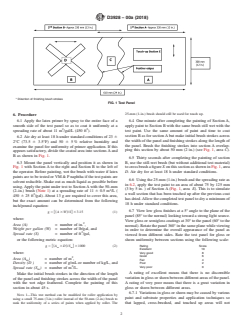
* Direction of finishing brush strokes
FIG. 1 Test Panel
25-mm (1-in.) brush should still be used for touch up.
6. Procedure
6.1 Apply the latex primer by spray to the entire face of a
6.4 One minute after completing the painting of Section A,
smooth side of the test panel so as to coat it uniformly at a apply paint to Section B with the same brush still wet with the
2 2
spreading rate of about 11 m /gal/L (450 ft ).
test paint. Use the same amount of paint and time to coat
section B as for sectionAbut make initial brush strokes across
6.2 Air dry at least 18 h under standard conditions of 23 6
the width of the panel and finishing strokes along the length of
2°C (73.5 6 3.5°F) and 50 6 5 % relative humidity and
the panel. Brush the finishing strokes i
...