

ASTM F977-22e1
(Specification)Standard Consumer Safety Specification for Infant Walkers
General Information
- Abstract
SCOPE
1.1 This consumer safety specification covers performance requirements, test methods, and marking requirements to promote safe use of the infant walker (see 3.1).
1.2 This consumer safety specification is intended to minimize accidents to children resulting from normal use and reasonably foreseeable misuse or abuse of walkers.
1.3 No walker produced after the approval date of this consumer safety specification shall, either by label or other means, indicate compliance with this specification unless it conforms to all requirements contained herein.
1.4 This consumer safety specification is not intended to address accidents and injuries resulting from the interaction of other persons with the child in the walker or the accidents resulting from abuse and misuse by children able to walk.
1.5 The values stated in inch-pound units are to be regarded as the standard. The SI units given in parentheses are for information only.
1.6 The following precautionary caveat pertains only to the test method portion, Section 7, of this consumer safety specification: This standard does not purport to address all of the safety concerns, if any, associated with its use. It is the responsibility of the user of this standard to establish appropriate safety, health, and environmental practices and determine the applicability of regulatory limitations prior to use.
1.7 This international standard was developed in accordance with internationally recognized principles on standardization established in the Decision on Principles for the Development of International Standards, Guides and Recommendations issued by the World Trade Organization Technical Barriers to Trade (TBT) Committee.
- Status
- Published
- Publication Date
- 14-Jun-2022
- Technical Committee
- F15 - Consumer Products
- Drafting Committee
- F15.17 - Carriages, Strollers, Walkers and Stationary Activity Centers
Overview
ASTM F977-22e1, titled Standard Consumer Safety Specification for Infant Walkers, is a critical consumer safety standard developed by ASTM International. This specification sets forth performance requirements, test methods, and marking requirements designed to promote the safe use of infant walkers. Its primary goal is to minimize the risk of accidents and injuries caused by infant walkers under normal use and foreseeable misuse, based on incident data provided by the U.S. Consumer Product Safety Commission (CPSC). The standard applies to all walkers manufactured after its approval date and ensures that only compliant products can claim adherence to its guidelines.
Key Topics
- Performance Requirements: Defines baseline safety and durability expectations for infant walkers to withstand routine and abusive conditions without creating hazards for infants.
- Test Methods: Establishes standardized procedures for assessing structural integrity, stability, labeling permanence, and other safety considerations in walkers.
- Marking and Labeling: Specifies requirements for permanent and conspicuous warning labels, including tests for label endurance and methods to prevent ingestion or detachment.
- Prevention of Injuries: Addresses probable hazards such as tipping over, falling downstairs, entrapment, sharp edges, scissoring and pinching, and access to hot surfaces or liquids.
- Calibration and Standardization: Guides manufacturers and test laboratories on the assembly, calibration, and environmental conditions needed for accurate and repeatable testing.
- Compliance Statement: Prohibits manufacturers from labeling non-conforming walkers as compliant, reinforcing accountability in production and marketing practices.
Applications
The ASTM F977-22e1 standard is applied throughout the lifecycle of infant walker design, manufacturing, and product testing. Key applications include:
- Product Design and Development: Designers and engineers use the requirements to eliminate or mitigate hazards such as tipping, entrapment, pinching, and exposure to sharp or small parts.
- Quality Assurance Testing: Manufacturers perform prescribed dynamic and static load tests, stability assessments, and label permanence checks before distributing walkers to market.
- Regulatory Compliance: Compliance with ASTM F977-22e1 assists businesses in meeting U.S. safety regulations and supports smoother entry into international markets by aligning with WTO Technical Barriers to Trade requirements.
- Consumer Safety Information: Retailers and educational organizations reference this standard to provide accurate, standardized safety information to caregivers and consumers.
- Incident Prevention: By addressing historical causes of injury, such as falls down stairs or tip-overs, the standard helps significantly reduce the number and severity of walker-related incidents involving infants under 15 months.
Related Standards
ASTM F977-22e1 integrates and references several additional standards and regulations to ensure comprehensive safety coverage:
- ASTM F963 - Consumer Safety Specification for Toy Safety: Ensures toy accessories included with walkers meet recognized safety criteria.
- CFR 16 Part 1303 - Ban of Lead-Containing Paint: Mandates lead-free paints and coatings on consumer products.
- 16 CFR 1500 and 1501 - Hazardous Substances and Small Parts Regulations: Prevents hazards associated with sharp points, sharp edges, and small parts that may pose choking risks for children.
- Test Methods D3359 - Rating Adhesion by Tape Test: Provides procedures for evaluating label adhesion and permanence.
By following ASTM F977-22e1, manufacturers, retailers, and safety organizations can ensure that infant walkers in the market meet rigorous safety expectations, reduce injury risks, and provide parents and caregivers with increased peace of mind. Products that comply with this standard demonstrate a clear commitment to infant safety and regulatory best practices.
Relations
- Effective Date
- 01-Aug-2023
- Effective Date
- 01-Aug-2016
- Effective Date
- 01-Dec-2011
- Effective Date
- 01-Jun-2009
- Effective Date
- 01-Dec-2008
- Effective Date
- 01-Nov-2007
- Effective Date
- 15-Mar-2007
- Effective Date
- 01-Oct-2003
- Effective Date
- 10-Aug-2002
- Effective Date
- 10-Nov-1996
- Effective Date
- 10-Nov-1996
- Effective Date
- 10-Nov-1996
Frequently Asked Questions
ASTM F977-22e1 is a technical specification published by ASTM International. Its full title is "Standard Consumer Safety Specification for Infant Walkers". This standard covers: SCOPE 1.1 This consumer safety specification covers performance requirements, test methods, and marking requirements to promote safe use of the infant walker (see 3.1). 1.2 This consumer safety specification is intended to minimize accidents to children resulting from normal use and reasonably foreseeable misuse or abuse of walkers. 1.3 No walker produced after the approval date of this consumer safety specification shall, either by label or other means, indicate compliance with this specification unless it conforms to all requirements contained herein. 1.4 This consumer safety specification is not intended to address accidents and injuries resulting from the interaction of other persons with the child in the walker or the accidents resulting from abuse and misuse by children able to walk. 1.5 The values stated in inch-pound units are to be regarded as the standard. The SI units given in parentheses are for information only. 1.6 The following precautionary caveat pertains only to the test method portion, Section 7, of this consumer safety specification: This standard does not purport to address all of the safety concerns, if any, associated with its use. It is the responsibility of the user of this standard to establish appropriate safety, health, and environmental practices and determine the applicability of regulatory limitations prior to use. 1.7 This international standard was developed in accordance with internationally recognized principles on standardization established in the Decision on Principles for the Development of International Standards, Guides and Recommendations issued by the World Trade Organization Technical Barriers to Trade (TBT) Committee.
SCOPE 1.1 This consumer safety specification covers performance requirements, test methods, and marking requirements to promote safe use of the infant walker (see 3.1). 1.2 This consumer safety specification is intended to minimize accidents to children resulting from normal use and reasonably foreseeable misuse or abuse of walkers. 1.3 No walker produced after the approval date of this consumer safety specification shall, either by label or other means, indicate compliance with this specification unless it conforms to all requirements contained herein. 1.4 This consumer safety specification is not intended to address accidents and injuries resulting from the interaction of other persons with the child in the walker or the accidents resulting from abuse and misuse by children able to walk. 1.5 The values stated in inch-pound units are to be regarded as the standard. The SI units given in parentheses are for information only. 1.6 The following precautionary caveat pertains only to the test method portion, Section 7, of this consumer safety specification: This standard does not purport to address all of the safety concerns, if any, associated with its use. It is the responsibility of the user of this standard to establish appropriate safety, health, and environmental practices and determine the applicability of regulatory limitations prior to use. 1.7 This international standard was developed in accordance with internationally recognized principles on standardization established in the Decision on Principles for the Development of International Standards, Guides and Recommendations issued by the World Trade Organization Technical Barriers to Trade (TBT) Committee.
ASTM F977-22e1 is classified under the following ICS (International Classification for Standards) categories: 97.190 - Equipment for children. The ICS classification helps identify the subject area and facilitates finding related standards.
ASTM F977-22e1 has the following relationships with other standards: It is inter standard links to ASTM F963-23, ASTM F963-16, ASTM F963-11, ASTM D3359-09e1, ASTM F963-08, ASTM D3359-07, ASTM F963-07e1, ASTM F963-03, ASTM D3359-02, ASTM F963-96ae2, ASTM F963-96ae1, ASTM F963-96a. Understanding these relationships helps ensure you are using the most current and applicable version of the standard.
ASTM F977-22e1 is available in PDF format for immediate download after purchase. The document can be added to your cart and obtained through the secure checkout process. Digital delivery ensures instant access to the complete standard document.
Standards Content (Sample)
This international standard was developed in accordance with internationally recognized principles on standardization established in the Decision on Principles for the
Development of International Standards, Guides and Recommendations issued by the World Trade Organization Technical Barriers to Trade (TBT) Committee.
´1
Designation:F977 −22
Standard Consumer Safety Specification for
Infant Walkers
ThisstandardisissuedunderthefixeddesignationF977;thenumberimmediatelyfollowingthedesignationindicatestheyearoforiginal
adoptionor,inthecaseofrevision,theyearoflastrevision.Anumberinparenthesesindicatestheyearoflastreapproval.Asuperscript
epsilon (´) indicates an editorial change since the last revision or reapproval.
ε NOTE—Note 8, Note 12, Note 16, and Note 17 were updated editorially in August 2022.
INTRODUCTION
This consumer safety specification addresses walker incidents that were identified by the U.S.
Consumer Product Safety Commission (CPSC).
BasedondatacollectedbytheCPSC,themajorityofincidentsinvolvedchildrenfallingdownstairs
orstepsinwalkers.Otherincidentsinvolvedchildrentippingoverinwalkersoraccessinghotsurfaces
or liquids. The injuries associated with these incidents ranged from cuts and bruises to burns, skull
fractures, and deaths. Most of the children injured were under 15 months old.
In response to the incident data provided by the CPSC, this consumer safety specification attempts
to minimize the risk of injury or death associated with children in walkers falling down stairs or
betweenlevels,ortippingover.Italsocontainsprovisionstoaddresstheriskofinjuryassociatedwith
walker seating systems and folding mechanisms.
1. Scope safety concerns, if any, associated with its use. It is the
responsibility of the user of this standard to establish appro-
1.1 This consumer safety specification covers performance
priate safety, health, and environmental practices and deter-
requirements, test methods, and marking requirements to
mine the applicability of regulatory limitations prior to use.
promote safe use of the infant walker (see 3.1).
1.7 This international standard was developed in accor-
1.2 This consumer safety specification is intended to mini-
dance with internationally recognized principles on standard-
mize accidents to children resulting from normal use and
ization established in the Decision on Principles for the
reasonably foreseeable misuse or abuse of walkers.
Development of International Standards, Guides and Recom-
mendations issued by the World Trade Organization Technical
1.3 No walker produced after the approval date of this
consumer safety specification shall, either by label or other Barriers to Trade (TBT) Committee.
means, indicate compliance with this specification unless it
2. Referenced Documents
conforms to all requirements contained herein.
2.1 ASTM Standards:
1.4 This consumer safety specification is not intended to
D3359Test Methods for Rating Adhesion by Tape Test
address accidents and injuries resulting from the interaction of
F963Consumer Safety Specification for Toy Safety
other persons with the child in the walker or the accidents
2.2 Federal Regulations:
resulting from abuse and misuse by children able to walk.
16 CFR 1303Ban of Lead-Containing Paint and Certain
1.5 The values stated in inch-pound units are to be regarded
Consumer Products Bearing Lead-Containing Paint
as the standard. The SI units given in parentheses are for
16CFR1500HazardousSubstancesActRegulationsInclud-
information only.
ing Sections:
1.6 The following precautionary caveat pertains only to the
1500.48Technical Requirements for Determining a Sharp
test method portion, Section 7, of this consumer safety speci-
Point in Toys or Other Articles Intended for Use by
fication: This standard does not purport to address all of the
Children Under Eight Years of Age
1 2
This consumer safety specification is under the jurisdiction ofASTM Commit- For referenced ASTM standards, visit the ASTM website, www.astm.org, or
tee F15 on Consumer Products and is the direct responsibility of Subcommittee contact ASTM Customer Service at service@astm.org. For Annual Book of ASTM
F15.17 on Carriages, Strollers, Walkers and Stationary Activity Centers. Standards volume information, refer to the standard’s Document Summary page on
Current edition approved June 15, 2022. Published July 2022. Originally the ASTM website.
approved in 1986. Last previous edition approved in 2018 as F977–18. DOI: AvailablefromU.S.GovernmentPrintingOffice,N.CapitalandHStreets,NW,
10.1520/F0977-22E01. Washington, DC 20401.
Copyright © ASTM International, 100 Barr Harbor Drive, PO Box C700, West Conshohocken, PA 19428-2959. United States
´1
F977−22
FIG. 1Illustrations of Five Types of Baby Walkers
1500.49Technical Requirements for Determining a Sharp 3.1.5 occupant, n—thatindividualwhoisinaproductthatis
MetalorGlassEdgeinToysorOtherArticlesIntendedfor set up in one of the manufacturer’s recommended use posi-
Use by Children Under Eight Years of Age tions.
1500.50–.52Test Methods for Simulating Use andAbuse of
3.1.6 paper label, n—anylabelmaterialwhichtearswithout
Toys and Other Articles Intended for Use by Children
the aid of tools and leaves a fibrous edge.
16 CFR 1501Method for Identifying Toys and Other Ar-
3.1.7 static load, n—averticallydownwardforceappliedby
ticles Intended for Use by Children Under ThreeYears of
a calibrated force gauge or by dead weights.
Age Which Present Choking, Aspiration, or Ingestion
Hazards Because of Small Parts
3.1.8 walker, n—a mobile unit that enables a child to move
on a horizontal surface when propelled by the child sitting or
3. Terminology
standing within the walker, and that is in the manufacturer’s
recommendeduseposition.Examplesofdifferentstylewalkers
3.1 Definitions of Terms Specific to This Standard:
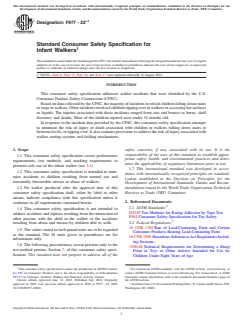
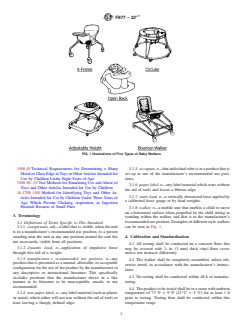
can be seen in Fig. 1.
3.1.1 conspicuous, adj—alabelthatisvisible,whentheunit
is in a manufacturer’s recommended use position, to a person
4. Calibration and Standardization
standing near the unit at any one position around the unit but
not necessarily visible from all positions.
4.1 All testing shall be conducted on a concrete floor that
3.1.2 dynamic load, n—application of impulsive force
may be covered with ⁄8 in. (3 mm) thick vinyl floor cover,
through free fall of a weight.
unless test instructs differently.
3.1.3 manufacturer’s recommended use position, n—any
4.2 The walker shall be completely assembled, unless oth-
position that is presented as a normal, allowable, or acceptable
erwise noted, in accordance with the manufacturer’s instruc-
configuration for the use of the product by the manufacturer in
tions.
any descriptive or instructional literature. This specifically
4.3 No testing shall be conducted within 48 h of manufac-
excludes positions that the manufacturer shows in a like
turing.
manner in its literature to be unacceptable, unsafe, or not
recommended.
4.4 Theproducttobetestedshallbeinaroomwithambient
3.1.4 non-paper label, n—anylabelmaterial(suchasplastic temperature of 73°F 6 9°F (23°C 6 5°C) for at least 1 h
or metal) which either will not tear without the aid of tools or prior to testing. Testing then shall be conducted within this
tears leaving a sharply defined edge. temperature range.
´1
F977−22
FIG. 2 Opening Examples
4.5 All testing required by this specification shall be con- 5.2 Priortotesting,anyexposedwoodpartsshallbesmooth
ducted on the same unit. and free from splinters.
4.6 The following guidelines shall apply to force gauges 5.3 Latching or Locking Mechanisms—Any unit that folds
shallhavealatchingorlockingdeviceorotherprovisioninthe
used for testing:
4.6.1 Equipment—Force gauge with a range of 0lbf to 25 design that will prevent the unit from unintentionally folding
when properly placed in the manufacturer’s recommended use
lbf (111 N) and a tolerance of 60.25 lbf (1.1 N).Acalibration
interval shall be maintained for the force gauge which will position. The unit shall remain in its manufacturer’s recom-
mendedusepositionduringanduponcompletionofthetest,in
ensure that the accuracy does not drift beyond the stated
tolerance. accordance with 7.2. If a unit is designed with a latching or
lockingdevice,thatdeviceshallremainengagedandoperative
4.6.2 Equipment—Force gauge with a range 0lbf to 100 lbf
(445N)andatoleranceof 61lbf(4.4N).Acalibrationinterval after testing.
shall be maintained for the force gauge which will ensure that
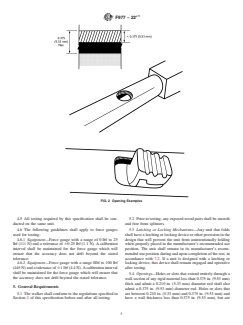
5.4 Openings—Holes or slots that extend entirely through a
the accuracy does not drift beyond the stated tolerance.
wallsectionofanyrigidmateriallessthan0.375in.(9.53mm)
thick and admit a 0.210 in. (5.33 mm) diameter rod shall also
5. General Requirements
admit a 0.375 in. (9.53 mm) diameter rod. Holes or slots that
5.1 The walker shall conform to the regulations specified in are between 0.210 in. (5.33 mm) and 0.375 in. (9.53 mm) and
Section 2 of this specification before and after all testing. have a wall thickness less than 0.375 in. (9.53 mm), but are
´1
F977−22
limited in depth to 0.375 in. (9.53 mm) maximum by another materials, or changes in adjustments that could cause the unit
rigidsurfaceshallbepermissible(seeFig.2).Theproductshall nottofullysupportthechildorcreateahazardousconditionas
beevaluatedinallmanufacturer’srecommendedusepositions. definedinSection5.Maximumslippageofadjustablefeatures,
if any, is 1 in. (25 mm).
5.5 Scissoring, Shearing, Pinching—A product, when in a
6.2.1 Dynamic Load—The occupant support member (seat)
manufacturer’s recommended use position, shall be designed
shall support a dynamic load when tested in accordance with
and constructed so as to prevent injury to the occupant from
7.1.1.
any scissoring, shearing, or pinching when members or com-
6.2.2 Static Load—The walker shall not create a hazardous
ponents rotate about a common axis or fastening point, slide,
condition as defined in 5.4 when tested in accordance with
pivot, fold or otherwise move relative to one another.
7.1.2.
Scissoring, shearing, or pinching that may cause injury shall
6.2.3 Leg Openings—The seat of the walker shall be de-
not be permissible when the edges of any rigid parts admit a
signed so that the leg openings will not permit passage of the
probe greater than 0.210 in. (5.33 mm) and less than 0.375 in.
test probe (see Fig. 3) when tested in accordance with 7.1.3.
(9.53 mm) diameter at any accessible point throughout the
range of motion of such parts. 6.3 Prevention of Falls Down Step(s)—The walker shall
maintain contact with and be supported only by the test
5.6 Exposed Coil Springs—Any exposed coil spring which
platform at the conclusion of the tests in 7.6.
is accessible to the occupant, having or capable of generating
a space between coils of 0.210 in. (5.33 mm) or greater during 6.4 Parking Device (applicable to walkers equipped with
static load testing in accordance with 7.1.2 shall be covered or parking brakes)—The walker shall have a maximum displace-
otherwise designed to prevent injury from entrapment. ment of 1.97 in. (50 mm) for each test in each direction
(forward, rearward, and sideward) when tested in accordance
5.7 Labeling:
with 7.7.
5.7.1 Warning labels, whether paper or non-paper, shall be
permanent when tested per 7.4.1 – 7.4.3.
7. Test Methods
5.7.2 Warning statements applied directly onto the surface
NOTE 2—Except for the structural integrity tests (see 7.1), that shall be
of the product by hot stamping, heat transfer, printing, wood
performed first, the tests can be performed in any sequence.
burning, etc. shall be permanent when tested per 7.4.4.
7.1 Structural Integrity (see 6.2):
5.7.3 Non-paper labels shall not liberate small parts when
NOTE 3—All wood blocks are fabricated from 1 in. nominal thickness
tested in accordance with 7.4.5.
lumberhavingafinishthicknessof ⁄4in.(19mm)unlessotherwisestated.
5.8 Protective Components—If a child can grasp compo-
7.1.1 Dynamic Load (see 6.2.1):
nentsbetweenthethumbandforefinger,orteeth(suchascaps,
7.1.1.1 Position the walker in the manufacturer’s recom-
sleeves, or plugs used for protection from sharp edges, points,
mended use position with all wheels on the floor. If adjustable,
orentrapmentoffingersortoes),orifthereisatleast0.040in.
adjust to the highest and most upright position.
(1.00 mm) gap between the component and its adjacent parent
7.1.1.2 Affix to the walker seat a 6in. by 6 in. (150mm by
component, such component shall not be removed when tested
150mm)woodblock.Iftheunithasahammocktypeseat,use
in accordance with 7.5.
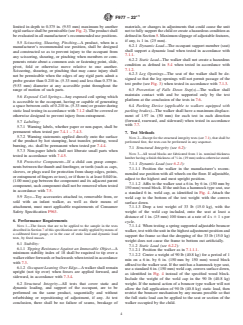
a standard 6 in. weld cap, as identified in Fig. 4. Attach the
5.9 Toys—Toy accessories attached to, removable from, or
weld cap to the bottom of the test weight with the convex
sold with an infant walker, as well as their means of
surface down.
attachment, must meet applicable requirements of Consumer
7.1.1.3 Drop a test weight of 33 lb (15.0 kg), with the
Safety Specification F963.
weight of the weld cap included, onto the seat at least a
distance of 1 in. (25 mm) 100 times at a rate of 4s 6 1 s per
6. Performance Requirements
cycle.
NOTE 1—The forces that are to be applied to the sample in the tests
7.1.1.4 When testing a spring supported adjustable bouncer
describedinSection7ofthisspecificationarereadilyappliedbymeansof
walker,testwiththeunitinthehighestadjustmentpositionand
a calibrated force gauge, or in the case of static load and dynamic load
support the frame so that the dropping of the 33 lb (15.0 kg)
tests, by fixed masses.
weight does not cause the frame to bottom out artificially.
6.1 Stability:
7.1.2 Static Load (see 6.2.2):
6.1.1 Tipping Resistance Against an Immovable Object—A
7.1.2.1 Position the walker as in 7.1.1.1.
minimum stability index of 18 shall be required to tip over a
7.1.2.2 Center a weight of 90 lb (40.8 kg) for a period of 1
walkereitherforwardsorbackwardswhentestedinaccordance
min on a 6in. by 6 in. (150mm by 150 mm) wood block
with 7.3.
affixed to the walker seat. If the unit has a hammock type seat,
6.1.2 Occupant Leaning Over Edge—Awalker shall remain
use a standard 6 in. (150 mm) weld cap, convex surface down,
upright (not tip over) when forces are applied forward, and
as identified in Fig. 4 instead of the specified wood block.
sideward, in accordance with 7.3.4.
Include the weight of the weld cap in the 90 lb (40.8 kg)
6.2 Structural Integrity—All tests that cover static and weight. If the natural action of a bouncer type walker will not
dynamic loading, and support of the occupant, are to be allow the full application of 90 lb (40.8 kg) static load, then
performed on the same product, sequentially and without restrict the bouncer mechanism by any means possible so that
refurbishing or repositioning of adjustment, if any. At test the full static load can be applied to the seat or section of the
conclusion, there shall be no failure of seams, breakage of walker occupied by the child.
´1
F977−22
NOTE 1—Dimensions are based on a 5th percentile 6-month-old child. Gauge may be modified to facilitate testing to allow for pulling of the gauge.
FIG. 3Small Head Test Probe
use a standard 6 in. (150 mm) weld cap convex surface face
down, as identified in Fig. 4 instead of the specified wood
block.Includetheweightoftheweldcapinthe50lb(22.7kg)
weight. In this test DO NOT restrict the bouncer mechanism
from folding or bottoming out. Observe visually the action of
allsupporting,locking,andadjustingcomponentstomakesure
that they do not create a hazardous condition as defined in 5.4.
7.1.3 Leg Openings Test (see 6.2.3):
7.1.3.1 If the seat is adjustable, adjust the seat to obtain the
largest leg opening.
NOTE 1—Caps furnished toANSI standards unless otherwise specified.
7.1.3.2 Rotate the test probe shown in Fig. 3 to the orien-
Weldingcapsareformedfromsteelplateandareellipsoidalinshape.The
tation most likely to fail and gradually apply a force of 25 lbf
minoraxisbeingequaltoonehalfthemajoraxisradii“R”and“r”closely
(111N).Applytheforceperpendiculartothebaseoftheprobe
approximate the actual semi-ellipsoidal shape. All dimensions in inches
and are in accordance with ANSI B16.9. within a period of 5 s and maintain it for an additional 10 s.
FIG. 4Nominal 6 in. Weld Cap Weight (Approximately) 6.4 lb
7.2 Latching or Locking Mechanisms (see 5.3):
7.2.1 Erect the walker in accordance with the manufactur-
er’s instructions and adjust to the highest and most upright
7.1.2.3 Position the walker in the manufacturer’s recom-
recommended use position.
mended use position with all wheels on the floor. If adjustable,
7.2.2 Position the walker so that the normal folding motion
adjust to the lowest use position.
is not impeded.
7.1.2.4 Center a weight of 50 lb (22.7 kg) for a period of 1
minute on a 6in. by 6 in. (150mm by 150 mm) wood block 7.2.3 Apply a force of 10 lbf (44 N) in the direction
affixed to the walker seat. If the unit has a hammock type seat, normallyassociatedwithfoldingthewalkerinaccordancewith
´1
F977−22
FIG. 5Placement of CAMI Infant Dummy
manufacturer’s instructions. Apply the force gradually over a 7.3.2.4 Graduallyincreasethehorizontalforceoveraperiod
5-s period and maintain for an additional 10 s before releasing of a least 5 s and continue to pull the walker forward until the
the force. walkerreachesthepointthatitbecomesunstableandbeginsto
7.2.4 Perform this procedure for a total of five times within tip over. Record the maximum force F in pounds (lb) applied
a 2 min period. duringthetestandalsothehorizontaldistance Dininches(in.)
from the initial location of the reference point selected in
7.3 Stability Test (see 6.1):
7.3.2.3 to the location of the reference point where the walker
7.3.1 Tipping Resistance Against An Immovable Object (see
becomes unstable and begins to tip over. Force shall be
6.1.1)—Establish a horizontal test plane with a piece of ⁄2 in.
maintained in a horizontal direction throughout the test.
(13 mm) high by ⁄4 in. (19 mm) wide aluminum angle stop
7.3.2.5 If during the application of the force the front edge
affixedthereto.Itslengthshallbeaminimumof6in.(150mm)
of the walker contacts the test plane and the wheels contacting
wider than the width of the walker being tested.
the aluminum stop begin to lift upward, release the force
7.3.2 Forward Tip Resistance:
allowingthewalkertorestuponthetestplane,removethestop
7.3.2.1 Place the walker on the horizontal test plane and
from the wheels and position a suitable stop against the front
adjust it to the manufacturer’s highest recommended use
edge of the walker. Then reapply the force as specified in
position. If the walker has a reclinable seat, place it in its most
7.3.2.3 and 7.3.2.4 until the walker tips over forward.
upright position. Place a six month old CAMI Infant Dummy
7.3.2.6 Calculate the forward Stability Index using the
Mark II in the walker and affix it in a position so that its feet
formula shown below:
just touch the test plane and its abdomen is positioned firmly
against the forward edge of the occupant area (see Fig. 5). If
StabilityIndex=F 1 D (1)
the dummy’s feet do not touch the test plane when the walker
where:
is in its highest use position, lower the walker until the
F = force measured in pounds (lb), and
dummy’s feet just touch the test plane. 2
D = distance measured in inches (in.).
7.3.2.2 Position the walker so that its two most forward
wheels are touching and perpendicular to the aluminum stop.
7.3.3 Rear Tip Resistance:
For walkers that have offset wheels, place the wheels in the
7.3.3.1 Withoutadjustingtheseatheightortheheightofthe
most disadvantageous position.
CAMI dummy relative to the horizontal test plane, position
7.3.2.3 Pretensionbygraduallyapplyingaforwardhorizon-
the dummy so that its back is firmly against the rear of the
tal force F of 3 lbf (13 N) at a level just below the CAMI
occupant area.
dummy’s armpits in a direction perpendicular to the axis
7.3.3.2 Position the walker so that its two most rearward
connecting the two most forward wheels and centered halfway
wheels are touching and perpendicular to the aluminum stop.
between the wheels (see Fig. 6). While maintaining the force,
For walkers that have offset wheels, place wheels in the most
establish the initial location of a reference point some distance
disadvantageous position.
away from the force gauge as shown in Fig. 6.
7.3.3.3 Pretension by gradually applying a rearward hori-
zontal force F of 3 lbf (13 N) perpendicular to the axis
connecting the two most rear wheels and centered between the
CAMI Infant Dummy (Mark II), Department of Transportation, Memorandum
Report AAC-119-74-14, Revision II, Drawing No. SA-1101 (see Fig. 7). wheels. Apply the force at a level just below the CAMI
´1
F977−22
FIG. 6Tip Resistance Setup
becomes unstable and begins to tip over. Force shall be
maintained in a horizontal direction throughout the test.
7.3.3.5 Calculate the rearward Stability Index using the
formula shown below:
StabilityIndex=F 1 D (2)
where:
F = force measured in pounds (lb), and
D = distance measured in inches (in.).
7.3.4 Occupant Leaning Outward Over Edge of Walker (see
6.1.2):
7.3.4.1 Positionwalkerinthemanufacturer’srecommended
usepositionwithallwheelsonthefloor(flathorizontalplane).
For walkers that have offset wheels, place wheels in the most
disadvantageous position. If the walker is adjustable, adjust to
its highest use position.
7.3.4.2 Clamp a 1in. by 1 in. (25mm by 25 mm) rigid
aluminum angle to the uppermost part of the frame forward of
NOTE 1—This CAMI Infant Dummy was constructed in accordance
the occupant seating area in a direction perpendicular to the
withtheDepartmentofTransportationSpecificationdatedApril29,1975.
axis of the two most forward wheels and centered between the
FIG. 7CAMI Infant Dummy—Mark II
wheels.Thealuminumangleshallbeparalleltothefloorwhen
allwheelshavecontacttothefloor.Thelengthofthealuminum
dummy’s armpits. If the walker has a seat pad whose back is
angle should be such that it extends forward at least 12 in.
higher than the dummy’s armpits, apply the horizontal force at
(300mm) beyond the front edge of the occupant seating area
the same height as that of the dummy’s armpits. While
(see Fig. 8).
maintaining the force, establish the initial location of a refer-
7.3.4.3 Locate the point on the aluminum angle that is 1 in.
ence point some distance away from the force gauge as shown
(25 mm) less than one half the difference between 32 in. (810
in Fig. 6.
mm), and the height of the walker at the top edge of the tray
adjacent to the seating area (see Fig. 8). Over a period of 5 s,
NOTE 4—The attachment of the force gauge to the walker may need to
be at or pass through the seatback in order to be at the same height as the
gradually apply a vertically downward force of 17 lb to this
dummy’s armpits.
point and maintain it for an additional 10s.
7.3.3.4 Graduallyincreasethehorizontalforceoveraperiod
NOTE 5—32 in. is the maximum height of the user.
of a least 5 s and continue to pull the walker rearward until the
walkerreachesthepointthatitbecomesunstableandbeginsto 7.3.4.4 Repeat the steps in 7.3.4.1, 7.3.4.2, and 7.3.4.3,
tip over. Record the maximum force F in pounds (lb) applied except position the aluminum angle in a sideward direction
duringthetestandalsothehorizontaldistance Dininches(in.) perpendicular to the axis connecting the two most sideward
from the initial location of the reference point selected in wheels and centered halfway between the wheels. Be sure the
7.3.3.3 to the location of the reference point where the walker aluminum angle extends at least 12 in. (300 mm) beyond the
´1
F977−22
NOTE 1—X inches depends on height of walker, Y = height of walker tray or uppermost frame member.
FIG. 8Leaning Over Setup
inside edge of the tray or horizontal frame member. Placement 7.5 Removal of Components (see 5.8):
of the 17 lb (7.7 kg) weight to the side shall not cause the
7.5.1 Test components in accordance with each of the
walker to tip over.
following methods in the sequence listed.
7.4 Permanency of Labels and Warnings (see 5.7): 7.5.2 Secure the walker so that it cannot move during the
7.4.1 A paper label (excluding labels attached by a seam)
performance of the following tests.
shall be considered permanent if, during an attempt to remove
7.5.3 Torque Test—A torque of 3 lbf·in. (0.3 N·m) shall be
it without the aid of tools or solvents, it cannot be removed, it
applied evenly within a period of5sina clockwise direction
tears into pieces upon removal, or such action damages the
until a rotation of 180° from the original position has been
surface to which it is attached.
attainedor3lbf·in.(0.3N·m)hasbeenexceeded.Thetorqueor
7.4.2 A non-paper label (excluding labels attached by a
maximum rotation shall be maintained for an additional 10 s.
seam) shall be considered permanent if, during an attempt to
The torque shall then be removed and the test components
remove it without the aid of tools or solvents, it cannot be
permitted to return to a relaxed condition.This procedure shall
removed or such action damages the surface to which it is
then be repeated in a counter-clockwise direction.
attached.
7.5.4 Tension Test:
7.4.3 A warning label attached by a seam shall be consid-
7.5.4.1 Attach a force gauge to the cap, sleeve or plug by
ered permanent if it does not detach when subjected to a 15 lb
means of any suitable device. For components that cannot
pull force applied in any direction most likely to cause failure
3 reasonably be expected to be grasped between thumb and
using a ⁄4 in. diameter clamp surface. Apply the force evenly
forefinger,orteeth,ontheirouterdiameterbuthaveagapofat
over 5 s and maintain for an additional 10 s.
least 0.040 in. (1.00 mm) between the rear surface of the
7.4.4 Adhesion Test for Warnings Applied Directly onto the
component and the structural member of the walker to which
Surface of the Product:
theyareattached,aclampsuchastheoneshowninFig.9may
7.4.4.1 Apply the tape test defined inTest Method B-Cross-
be a suitable device.
CutTapeTestofTestMethodsD3359eliminatingparallelcuts.
7.4.4.2 Perform this test once in each different location
7.5.4.2 Be sure that the attachment device does not com-
where warnings are applied.
press or expand the
...