

ASTM F2167-22
(Specification)Standard Consumer Safety Specification for Infant Bouncer Seats
General Information
- Abstract
SCOPE
1.1 This consumer safety specification covers establishment of requirements, test methods, and marking requirements to promote safe use of an infant bouncer seat by an occupant and a caregiver.
1.2 For purposes of this consumer safety specification, an infant bouncer seat is a freestanding product intended to support an occupant in a reclined position to facilitate bouncing by the occupant, with the aid of a caregiver or by other means. Intended occupants are infants who have not developed the ability to sit up unassisted (approximately 0 to 6 months of age).
1.3 This consumer safety specification is intended to minimize the risk of injury to an occupant resulting from normal use and reasonably foreseeable misuse or abuse of an infant bouncer seat.
1.4 No infant bouncer seat produced after the approval date of this consumer safety specification shall, either by label or other means, indicate compliance with this specification unless it conforms to all requirements contained herein.
1.5 This consumer safety specification is not intended to address incidents and injuries resulting from the interaction of other persons with the occupant in an infant bouncer seat or the incidents resulting from abuse or misuse by other children.
1.6 The values stated in inch-pound units are to be regarded as standard. The values given in parentheses are mathematical conversions to SI units that are provided for information only and are not considered standard.
1.7 The following precautionary caveat pertains only to the test method portion, Section 7, of this consumer safety specification: This standard does not purport to address all of the safety concerns, if any, associated with its use. It is the responsibility of the user of this standard to establish appropriate safety, health, and environmental practices and determine the applicability of regulatory requirements prior to use.
1.8 This international standard was developed in accordance with internationally recognized principles on standardization established in the Decision on Principles for the Development of International Standards, Guides and Recommendations issued by the World Trade Organization Technical Barriers to Trade (TBT) Committee.
- Status
- Published
- Publication Date
- 30-Apr-2022
- Technical Committee
- F15 - Consumer Products
- Drafting Committee
- F15.21 - Infant Carriers, Bouncers and Baby Swings
Buy Documents
ASTM F2167-22 - Standard Consumer Safety Specification for Infant Bouncer Seats
REDLINE ASTM F2167-22 - Standard Consumer Safety Specification for Infant Bouncer Seats
Overview
ASTM F2167-22 Standard Consumer Safety Specification for Infant Bouncer Seats provides comprehensive safety requirements, test methods, and labeling protocols to minimize risks of injury associated with the use of infant bouncer seats. Developed by ASTM International, this standard is applicable to freestanding infant bouncer products designed to support infants (typically aged 0–6 months) in a reclined position, allowing for bouncing motion either unaided or with caregiver assistance. The goal of ASTM F2167-22 is to ensure safer products for both the child and caregiver, covering foreseeable hazards in normal and reasonably foreseeable misuse scenarios.
Key Topics
- Scope and Purpose: The standard details safety requirements to protect infants who cannot sit up unassisted, setting performance guidelines and test methodologies for infant bouncer seat manufacturers and sellers.
- Definitions: Clarifies essential terms such as “restraint system,” “static load,” “toy bars,” and warning label attributes.
- General Requirements: Includes eliminating hazardous sharp points, small parts, exposed lead, scissoring/pinching hazards, and dangerous openings.
- Performance Requirements: Specifies criteria for:
- Stability (forward, sideward, rearward)
- Slip resistance (dynamic and static tests)
- Structural integrity
- Resistance to disassembly or collapse
- Integrity of restraint and toy bar attachments
- Safety of battery compartments and temperature control for electrical components
- Marking and Labeling: Mandates permanent and conspicuous warning labels on both product and packaging, aligning with ANSI Z535 standards for safety signs and labels.
- Instructional Literature: Requires clear, easy-to-follow assembly and safety instructions supplied with every unit.
Applications
ASTM F2167-22 is critically important for:
- Manufacturers: Ensures the design, construction, and testing of infant bouncer seats meet global safety benchmarks, thus reducing the risk of recalls, regulatory intervention, and liability claims.
- Importers and Retailers: Assists in verifying compliance for safe and legitimate product offerings, especially in markets governed by strong consumer protection laws.
- Testing Laboratories: Establishes standardized testing processes for batch certification or investigation in the event of incidents or consumer complaints.
- Product Designers and Engineers: Provides detailed performance requirements and real-world scenarios to factor into the design phase, improving the overall safety profile of products.
- Consumer Safety Regulators: Offers a reliable reference standard for safety audits, compliance checks, and market surveillance activities.
Related Standards
ASTM F2167-22 references several key standards and regulations to enhance safety and consistency:
- ASTM F963 - Consumer Safety Specification for Toy Safety: Mandates toy accessories with bouncer seats comply with toy safety standards.
- ASTM F404 - Consumer Safety Specification for High Chairs
- ASTM F2050 - Consumer Safety Specification for Hand-Held Infant Carriers
- ANSI Z535.4 & Z535.6 - Product Safety Signs, Labels, and Information
- 16 CFR 1303 - Ban of Lead-Containing Paint
- 16 CFR 1500.48 & 1500.49 - Technical Requirements for Sharp Points and Edges
- 16 CFR 1501 - Choking, Aspiration, or Ingestion Hazards from Small Parts
- 16 CFR 1500.50–.51 - Simulating Use and Abuse of Toys and Children's Products
Adhering to ASTM F2167-22 enables safer infant bouncer seat production, supports global market acceptance, and safeguards infants by reducing risks of falls, suffocation, product collapse, and other hazards. For product compliance and up-to-date best practices, refer to the current published ASTM F2167-22 standard.
Relations
- Effective Date
- 01-Aug-2023
- Effective Date
- 15-Feb-2018
- Effective Date
- 01-Oct-2017
- Effective Date
- 01-Feb-2017
- Effective Date
- 01-Aug-2016
- Effective Date
- 01-Jul-2016
- Effective Date
- 01-Feb-2016
- Effective Date
- 15-Jan-2016
- Effective Date
- 15-May-2015
- Effective Date
- 01-Sep-2014
- Effective Date
- 01-Jan-2014
- Effective Date
- 01-Nov-2013
- Effective Date
- 01-Sep-2013
- Effective Date
- 01-Jul-2013
- Effective Date
- 01-Jul-2013
Buy Documents
ASTM F2167-22 - Standard Consumer Safety Specification for Infant Bouncer Seats
REDLINE ASTM F2167-22 - Standard Consumer Safety Specification for Infant Bouncer Seats
Frequently Asked Questions
ASTM F2167-22 is a technical specification published by ASTM International. Its full title is "Standard Consumer Safety Specification for Infant Bouncer Seats". This standard covers: SCOPE 1.1 This consumer safety specification covers establishment of requirements, test methods, and marking requirements to promote safe use of an infant bouncer seat by an occupant and a caregiver. 1.2 For purposes of this consumer safety specification, an infant bouncer seat is a freestanding product intended to support an occupant in a reclined position to facilitate bouncing by the occupant, with the aid of a caregiver or by other means. Intended occupants are infants who have not developed the ability to sit up unassisted (approximately 0 to 6 months of age). 1.3 This consumer safety specification is intended to minimize the risk of injury to an occupant resulting from normal use and reasonably foreseeable misuse or abuse of an infant bouncer seat. 1.4 No infant bouncer seat produced after the approval date of this consumer safety specification shall, either by label or other means, indicate compliance with this specification unless it conforms to all requirements contained herein. 1.5 This consumer safety specification is not intended to address incidents and injuries resulting from the interaction of other persons with the occupant in an infant bouncer seat or the incidents resulting from abuse or misuse by other children. 1.6 The values stated in inch-pound units are to be regarded as standard. The values given in parentheses are mathematical conversions to SI units that are provided for information only and are not considered standard. 1.7 The following precautionary caveat pertains only to the test method portion, Section 7, of this consumer safety specification: This standard does not purport to address all of the safety concerns, if any, associated with its use. It is the responsibility of the user of this standard to establish appropriate safety, health, and environmental practices and determine the applicability of regulatory requirements prior to use. 1.8 This international standard was developed in accordance with internationally recognized principles on standardization established in the Decision on Principles for the Development of International Standards, Guides and Recommendations issued by the World Trade Organization Technical Barriers to Trade (TBT) Committee.
SCOPE 1.1 This consumer safety specification covers establishment of requirements, test methods, and marking requirements to promote safe use of an infant bouncer seat by an occupant and a caregiver. 1.2 For purposes of this consumer safety specification, an infant bouncer seat is a freestanding product intended to support an occupant in a reclined position to facilitate bouncing by the occupant, with the aid of a caregiver or by other means. Intended occupants are infants who have not developed the ability to sit up unassisted (approximately 0 to 6 months of age). 1.3 This consumer safety specification is intended to minimize the risk of injury to an occupant resulting from normal use and reasonably foreseeable misuse or abuse of an infant bouncer seat. 1.4 No infant bouncer seat produced after the approval date of this consumer safety specification shall, either by label or other means, indicate compliance with this specification unless it conforms to all requirements contained herein. 1.5 This consumer safety specification is not intended to address incidents and injuries resulting from the interaction of other persons with the occupant in an infant bouncer seat or the incidents resulting from abuse or misuse by other children. 1.6 The values stated in inch-pound units are to be regarded as standard. The values given in parentheses are mathematical conversions to SI units that are provided for information only and are not considered standard. 1.7 The following precautionary caveat pertains only to the test method portion, Section 7, of this consumer safety specification: This standard does not purport to address all of the safety concerns, if any, associated with its use. It is the responsibility of the user of this standard to establish appropriate safety, health, and environmental practices and determine the applicability of regulatory requirements prior to use. 1.8 This international standard was developed in accordance with internationally recognized principles on standardization established in the Decision on Principles for the Development of International Standards, Guides and Recommendations issued by the World Trade Organization Technical Barriers to Trade (TBT) Committee.
ASTM F2167-22 is classified under the following ICS (International Classification for Standards) categories: 97.190 - Equipment for children. The ICS classification helps identify the subject area and facilitates finding related standards.
ASTM F2167-22 has the following relationships with other standards: It is inter standard links to ASTM F963-23, ASTM F404-18, ASTM F404-17a, ASTM F404-17, ASTM F963-16, ASTM F404-16a, ASTM F2050-16, ASTM F404-16, ASTM F404-15, ASTM F404-14a, ASTM F404-14, ASTM F404-13a, ASTM F2050-13a, ASTM F2050-13, ASTM F404-13. Understanding these relationships helps ensure you are using the most current and applicable version of the standard.
ASTM F2167-22 is available in PDF format for immediate download after purchase. The document can be added to your cart and obtained through the secure checkout process. Digital delivery ensures instant access to the complete standard document.
Standards Content (Sample)
This international standard was developed in accordance with internationally recognized principles on standardization established in the Decision on Principles for the
Development of International Standards, Guides and Recommendations issued by the World Trade Organization Technical Barriers to Trade (TBT) Committee.
Designation:F2167 −22
Standard Consumer Safety Specification for
Infant Bouncer Seats
This standard is issued under the fixed designation F2167; the number immediately following the designation indicates the year of
original adoption or, in the case of revision, the year of last revision. A number in parentheses indicates the year of last reapproval. A
superscript epsilon (´) indicates an editorial change since the last revision or reapproval.
INTRODUCTION
This consumer safety specification is intended to minimize the risk of injury or death associated
with a child’s use of an infant bouncer seat. The specific hazards addressed by this specification are
product disassembly/collapse, stability, and falls from elevated surfaces.
1. Scope fication: This standard does not purport to address all of the
safety concerns, if any, associated with its use. It is the
1.1 This consumer safety specification covers establishment
responsibility of the user of this standard to establish appro-
of requirements, test methods, and marking requirements to
priate safety, health, and environmental practices and deter-
promote safe use of an infant bouncer seat by an occupant and
mine the applicability of regulatory requirements prior to use.
a caregiver.
1.8 This international standard was developed in accor-
1.2 For purposes of this consumer safety specification, an
dance with internationally recognized principles on standard-
infant bouncer seat is a freestanding product intended to
ization established in the Decision on Principles for the
supportanoccupantinareclinedpositiontofacilitatebouncing
Development of International Standards, Guides and Recom-
by the occupant, with the aid of a caregiver or by other means.
mendations issued by the World Trade Organization Technical
Intended occupants are infants who have not developed the
Barriers to Trade (TBT) Committee.
ability to sit up unassisted (approximately 0 to 6 months of
age).
2. Referenced Documents
1.3 This consumer safety specification is intended to mini-
2.1 ASTM Standards:
mize the risk of injury to an occupant resulting from normal
D3359 Test Methods for Rating Adhesion by Tape Test
use and reasonably foreseeable misuse or abuse of an infant
F404 Consumer Safety Specification for High Chairs
bouncer seat.
F963 Consumer Safety Specification for Toy Safety
F2050 Consumer Safety Specification for Hand-Held Infant
1.4 No infant bouncer seat produced after the approval date
Carriers
of this consumer safety specification shall, either by label or
other means, indicate compliance with this specification unless
2.2 Federal Regulations:
it conforms to all requirements contained herein.
16 CFR 1303 Ban of Lead-Containing Paint and Certain
Consumer Products Bearing Lead-Containing Paint
1.5 This consumer safety specification is not intended to
16 CFR 1500.48 Technical Requirements for Determining a
address incidents and injuries resulting from the interaction of
Sharp Point in Toys or OtherArticles Intended for Use by
otherpersonswiththeoccupantinaninfantbouncerseatorthe
Children Under Eight Years of Age
incidents resulting from abuse or misuse by other children.
16 CFR 1500.49 Technical Requirements for Determining a
1.6 The values stated in inch-pound units are to be regarded
Sharp Metal or Glass Edge in Toys or Other Articles
as standard. The values given in parentheses are mathematical
Intended for Use by Children Under Eight Years of Age
conversions to SI units that are provided for information only
16 CFR 1500.50-.51 Test Methods for Simulating Use and
and are not considered standard.
Abuse of Toys and Other Articles Intended for Use by
1.7 The following precautionary caveat pertains only to the
Children
test method portion, Section 7, of this consumer safety speci-
1 2
This specification is under the jurisdiction of ASTM Committee F15 on For referenced ASTM standards, visit the ASTM website, www.astm.org, or
Consumer Products and is the direct responsibility of Subcommittee F15.21 on contact ASTM Customer Service at service@astm.org. For Annual Book of ASTM
Infant Carriers, Bouncers and Baby Swings. Standards volume information, refer to the standard’s Document Summary page on
Current edition approved May 1, 2022. Published May 2022. Originally the ASTM website.
approved in 2001. Last previous edition approved in 2019 as F2167 – 19. DOI: Code of Federal Regulations, available from U.S. Government Printing Office,
10.1520/F2167-22. 732 North Capitol St., NW, Mail Stop: SDE, Washington DC 20401.
Copyright © ASTM International, 100 Barr Harbor Drive, PO Box C700, West Conshohocken, PA 19428-2959. United States
F2167−22
3. Terminology
3.1 Definitions:
3.1.1 conspicuous, adj—labelthatisvisible,whentheinfant
bouncer seat is in a manufacturer’s recommended use position,
to a person sitting near the infant bouncer seat at any one
position around the infant bouncer seat but is not necessarily
visible from all positions.
3.1.2 cord, n—length of slender, flexible material including
monofilaments, rope, woven and twisted cord, plastic and
textile tapes, ribbon, and those fibrous materials commonly
called string.
3.1.3 dynamic load, n—application of an impulsive force
through free fall of a weight.
3.1.4 fabric, n—any woven, knit, coated, laminated,
extruded, or calendered flexible material that is intended to be
sewn, welded, heat sealed, or glued together as an assembly.
3.1.5 grasping point on toy bar, n—five-inchwidesectionof
FIG. 1CAMI Infant Dummy, Mark II (17.5 lb, 8.0 kg)
thetoybarcenteredatthemid-pointofthetoybarifthetoybar
is attached at two points on the bouncer frame.
3.1.5.1 Discussion—If the toy bar has a single attachment
point, the 5-in. dimension is either centered at the mid-point of
the product or as close to the mid-point as possible, should the
toy bar not extend far enough beyond the mid-point to achieve
this. The load should be evenly distributed over this 5-in.
dimension.
3.1.6 manufacturer’s recommended use position(s), n—any
position that is presented as a normal, allowable, or acceptable
configuration for the use of the product by the manufacturer in
any descriptive or instructional literature.
3.1.6.1 Discussion—This specifically excludes positions
that the manufacturer shows in a like manner in its literature to
be unacceptable, unsafe, or not recommended.
3.1.7 non-paper label, n—any label material (such as plastic
or metal) that either will not tear without the aid of tools or
tears leaving a sharply defined edge.
3.1.8 occupant, n—thatindividualwhoisinaproductthatis
FIG. 2CAMI Newborn Dummy (7.5 lb, 3.4 kg)
set up in one of the manufacturer’s recommended use posi-
tions.
3.1.9 paper label, n—any label material that tears without
16 CFR 1501 Method for Identifying Toys and Other Ar-
the aid of tools and leaves a fibrous edge.
ticles Intended for Use by Children Under Three Years of
3.1.10 seam, n—means of joining fabric components, such
Age Which Present Choking, Aspiration or Ingestion
as sewing, welding, heat sealing, or gluing.
Hazards Because of Small Parts
3.1.11 static load, n—vertically downward force applied by
2.3 Other References:
a calibrated force gauge or by dead weights.
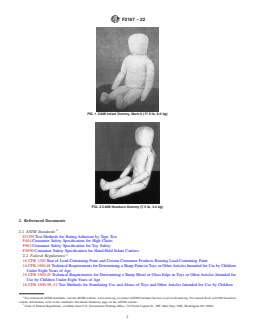
CAMI Infant Dummy, Mark II (see Fig. 1)
3.1.12 toy bars, n—any bar or mobile connected to the
CAMI Newborn Dummy (see Fig. 2)
5 frame of the bouncer in any location with one or more
2.4 ANSI Standards:
attachment points typically used to suspend toys over the
ANSI Z535.4 American National Standard for Product
occupant.
Safety Signs and Labels
3.1.12.1 Discussion—Canopies, fixed and rotating, are not
ANSI Z535.6 Product Safety Information in Product
considered a toy bar regardless of whether they allow for the
Manuals, Instructions, and Other Collateral Materials
attachment of toys.
4. Calibration and Standardization
Department of Transportation, Federal Aviation Administration, Drawing No.
4.1 All testing shall be conducted on a concrete floor, which
SA-1001.
may be covered with ⁄8-in. (3-mm) thick vinyl flooring cover,
Available fromAmerican National Standards Institute (ANSI), 25 W. 43rd St.,
4th Floor, New York, NY 10036, http://www.ansi.org. unless the test instructs differently.
F2167−22
4.2 The product shall be completely assembled, unless static load testing in accordance with 7.5.2 shall be covered or
otherwise noted, in accordance with the manufacturer’s in- otherwise designed to prevent injury from entrapment.
structions.
5.9 Protective Components—If a child can grasp compo-
nentsbetweenthethumbandforefingerorbetweenteeth,(such
4.3 No testing shall be conducted within 48 h of manufac-
as caps, sleeves, or plugs used for protection from sharp edges,
turing.
points, or entrapment of fingers or toes), or if there is at least
4.4 The product to be tested shall be in a room with an
a 0.040-in. (1.00-mm) gap between the component and its
ambient temperature of 73° 6 9°F (23° 6 5°C) for at least one
adjacent parent component, such component shall not be
hour prior to testing. Testing shall then be conducted within
removed when tested in accordance with 7.9.
this temperature range.
5.10 Permanency of Labels and Warnings:
4.5 All testing required by this specification shall be con-
5.10.1 Warning labels (whether paper or non-paper) shall be
ducted on the same infant bouncer seat.
permanent when tested in accordance with 7.8.1 – 7.8.3.
5.10.2 Warning statements applied directly onto the surface
5. General Requirements
of the product by hot stamping, heat transfer, printing, wood
burning, etc. shall be permanent when tested in accordance
5.1 Hazardous Sharp Points and Edges—There shall be no
with 7.8.4.
hazardous points or edges as defined by 16 CFR 1500.48 and
5.10.3 Non-paper labels shall not liberate small parts when
16 CFR 1500.49 before and after testing to this consumer
tested in accordance with 7.8.5.
safety specification.
5.11 Toys—Toy accessories attached to, removable from, or
5.2 Small Parts—Thereshallbenosmallpartsasdefinedby
sold with an infant bouncer seat, as well as their means of
16 CFR 1501 before testing or liberated as a result of testing to
attachment, must meet applicable requirements of Specifica-
this specification.
tion F963.
5.3 Lead—There shall be no lead-containing paint as de-
fined by 16 CFR 1303.
6. Performance Requirements
5.4 Wood Parts—Prior to testing, any exposed wood parts
6.1 Restraint System:
shall be smooth and free from splinters.
6.1.1 A restraint system shall be provided to secure a child
in any of the manufacturer’s recommended use positions.
5.5 Latching or Locking Mechanisms—If the infant bouncer
6.1.2 The restraint system shall include both a waist and
seat is designed with a latching or locking device that prevents
crotch restraint, where the crotch restraint’s use is mandatory
unintentionalfolding,theinfantbouncerseatshallremaininits
when the waist restraint is in use.
manufacturer’s recommended use position during and upon
6.1.3 The anchorages for the restraint system shall not
completionofthetest,inaccordancewith7.10.Thelatchingor
separate from their attachment points when tested in accor-
locking device shall remain engaged and operative after
dance with 7.2.
testing.
6.2 Stability:
5.6 Scissoring, Shearing, and Pinching—A product, when
6.2.1 Forward Stability—The infant bouncer seat shall not
in any manufacturer’s recommended use position(s), shall be
tip over when tested in accordance with 7.3.2. If the stability
designed and constructed so as to prevent injury to the
test fixture touches the test surface and prevents the product
occupant from any scissoring, shearing, or pinching when
from tipping over, retest the product near the edge of an
members or components rotate about a common axis or
elevated test surface to allow the product to tip.
fastening point, slide, pivot, fold, or otherwise move relative to
6.2.2 Sideward and Rearward Stability—The infant bouncer
one another. Scissoring, shearing, or pinching that may cause
seat shall not tip over when tested in accordance with 7.3.3 –
injury shall not be permissible when the edges of any rigid
7.3.6.
parts admit a probe greater than 0.210 in. (5.33 mm) and less
than 0.375 in. (9.52 mm) in diameter at any accessible point 6.3 Slip Resistance:
throughout the range of motion of such parts. 6.3.1 Dynamic Slip Resistance—The infant bouncer seat
shall not slip more than ⁄2 in. (13 mm) when tested in
5.7 Openings—Holes or slots that extend entirely through a
accordance with 7.4.4.
wallsectionofanyrigidmateriallessthan0.375-in.(9.53-mm)
thick and admit a 0.210-in. (5.33-mm) diameter rod shall also NOTE 1—As this is a dynamic impact test, the ⁄2 in. allows for a small
amount of settling prior to the feet gripping.
admit a 0.375-in. (9.53-mm) diameter rod. Holes or slots that
are between 0.210-in. (5.33-mm) and 0.375-in. (9.53-mm) and
6.3.2 Static Slip Resistance—The infant bouncer seat shall
have a wall thickness less than 0.375-in. (9.53-mm), but are
not slip more than ⁄8 in. (3 mm) when tested in accordance
limited in depth to 0.375-in. (9.53-mm) maximum by another
with 7.4.5 – 7.4.9.
rigidsurfaceshallbepermissible(seeFig.3).Theproductshall
6.4 Structural Integrity—At test conclusion, there shall be
be evaluated in all manufacturer’s recommended use positions.
no failure of seams, breakage of materials, or changes of
5.8 Exposed Coil Springs—Any exposed coil spring that is adjustments that could cause the product not to fully support
accessible to the occupant, having or capable of generating a the child or create a hazardous condition as defined in Section
space between coils of 0.210 in. (5.33 mm) or greater during 5.
F2167−22
FIG. 3Opening Example
6.4.1 Dynamic Load—The infant bouncer seat shall not 6.7.1.3 For toy bars that contain a single attachment point,
create a hazardous condition as defined in Section 5 when the toy bar must move more than 2 in. (5.1 cm) from its
tested in accordance with 7.5.1. original resting position when measured at the furthermost
6.4.2 Static Load—The infant bouncer seat shall not create point at the free end of the toy bar while attempting to lift the
a hazardous condition as defined in Section 5 when tested in bouncer off the test surface when tested to 7.12.1.2.
accordance with 7.5.2.
6.8 Battery Compartments (remote control devices are ex-
6.5 Disassembly/Collapse—The infant bouncer seat shall
empt from these requirements):
not disassemble or collapse when tested in accordance with
6.8.1 Each battery compartment or area immediately adja-
7.6.
cent to the battery compartment shall be marked permanently
6.6 Drop Test—The infant bouncer seat shall not create a and legibly to show the correct battery polarity, size, and
hazardous condition as defined in Section 5 when tested in voltage.
accordance with 7.7.
6.8.2 Each battery compartment shall provide a means to
contain the electrolytic material in the event of a battery
6.7 Toy Bar Attachment Integrity:
leakage. This containment means shall not be accessible to the
6.7.1 Toy Bar Attachment Release—Toy bars must meet the
occupant.
requirements in 6.7.1.1 or 6.7.1.2 or 6.7.1.3:
6.7.1.1 The toy bar must not completely release from the 6.8.3 Positive protection from the possibility of charging
bouncer seat when tested to 7.12.1.1 and 7.12.2. anyprimary(non-rechargeable)batteryshallbeachievedeither
6.7.1.2 The toy bar must completely release before the through physical design of the battery compartment or through
entire bouncer lifts off the test surface when tested to 7.12.1.2. the use of appropriate electrical circuit design. This applies to
F2167−22
situations in which a battery may be installed incorrectly 7.3.1.2 The fixture should be constructed according to Fig.
(reversed), and in which a battery charger may be applied to a 4.
product containing primary batteries. This section does not
7.3.2 Test Procedure:
apply to a circuit having one or two batteries as the only source
7.3.2.1 Establish the restraint system adjustment by placing
of power.
the CAMI Infant Dummy, Mark II (see Fig. 1) in the infant
6.8.4 The surfaces of any accessible electrical component, bouncer seat, fastening the restraint system in accordance with
including batteries, shall not achieve temperatures exceeding
the manufacturer’s instructions, and removing the dummy.
160°F (71°C) when tested in accordance with 7.1. At the
7.3.2.2 Insert the stability test fixture into the bouncer and
conclusion of the test, there shall be no battery leakage or,
pull forward to remove any slack in the crotch restraint.
explosion or a fire to any electrical component. This test shall
7.3.2.3 Use a force gauge to apply a static load of 21 lbf (93
be performed prior to conducting any other testing within the
N) or the maximum manufacturer’s recommended weight,
performance requirements section.
whichever is greater, vertically downward on the stability test
fixture in the location designated on the drawing (6 in. (152.4
7. Test Methods
mm) in front of the crotch post; see Fig. 4) within a period of
5 s and maintain for an additional 60 s (see Fig. 5).
7.1 The battery compartment shall be tested using fresh
7.3.2.4 The test surface shall be an impregnated high-
alkaline batteries or an a/c power source. If the function
pressure laminate of unspecified color with a smooth matte
powered by the compartment can be operated using both, then
finish.
both batteries and a/c power must be tested separately. If
another battery chemistry is specifically recommended for use
Sideward and Rearward Stability
in the bouncer by the manufacturer, repeat the test using the
7.3.3 Place a CAMI Infant Dummy, Mark II (see Fig. 1)in
batteries specified by the manufacturer. If the bouncer will not
the infant bouncer seat with the restraint system fastened in
operate using alkaline batteries, then test with the type of
accordance with the manufacturer’s instructions.
battery recommended by the manufacturer at the specified
7.3.4 Position the infant bouncer seat in the most unfavor-
voltage. The test is to be carried out in a draft-free location, at
able sideward or rearward position on a test surface inclined at
an ambient temperature of 68 6 9°F (20 6 5°C).
20°. The most unfavorable position could be a position in
7.1.1 Operate the function powered by the battery compart-
betweenthetruesidewardandrearwardpositions.Ifnecessary,
mentatthemaximumspeedorhighestintensity.Donotdisable
prevent the product from sliding but do not prevent it from
any mechanical or electrical protective device, such as clutches
tipping.
or fuses. Operate the function powered by the battery compart-
7.3.5 The test surface shall be an impregnated high-pressure
ment continuously, and record peak temperature. The test shall
laminate of unspecified color with a smooth matte finish.
be discontinued 60 min after the peak temperature is recorded.
7.3.6 Maintain for 1 min.
If the function shuts off automatically or must be kept “on” by
hand or foot, monitor temperatures for 30 s, resetting the
7.4 Slip Resistance:
function as many times as necessary to complete the 30 s of
Test Preparation
operation. If the function shuts off automatically after an
7.4.1 Test Surface:
operating time of greater than 30 s, continue the test until the
function shuts off. 7.4.1.1 The test surface shall be an impregnated high-
NOTE 2—The tests described in 7.2 through 7.7 are to be performed in pressure laminate of unspecified color with a smooth matte
the order specified without refurbishing or repositioning of adjustments, if
finish.
any.
7.4.1.2 The laminate should be mounted on a flat surface,
7.2 Restraint System:
with a thickness no less than ⁄4 in. (19 mm), in accordance
7.2.1 Secure the infant bouncer seat so that it can not move
with the laminate manufacturer’s instructions.
vertically or horizontally.
7.4.1.3 Clean the test surface with a damp cloth. Any
7.2.2 Apply a force of 45 lbf (200 N) to a single attachment products that will interfere with the performance of the
point of the restraint system in the normal use direction(s) that
laminate are unacceptable, for example, solvents or cleaners
stress would be applied to the attachment. Gradually apply the that leave residue or alter the surface finish.
force within a period of 5 s and maintain for an additional 10
7.4.1.4 Precautions should be taken to prevent the contami-
s.
nation of the testing surface. Graduation or pencil marks are
unacceptable unless located in a position that never interferes
NOTE 3—This is in accordance with Specification F404.
withtheperformanceofthetestproduct(thatis,alongtheedge
7.2.3 Repeat 7.2.2 for each attachment point of the restraint
of the surface).
system and fastening device.
7.4.2 Test Procedure:
7.3 Stability Test: 7.4.2.1 Incline the prepared laminate surface to 10°.
NOTE 4—The 10° incline is in accordance with Specification F2050.
Forward Stability
7.3.1 Stability Test Fixture:
7.4.2.2 Clean slip-resistant pads, feet, or any other objects
7.3.1.1 The stability test fixture is to be constructed of ⁄4-in. on the infant bouncer seat that come in contact with the
(19-mm) plywood or the equivalent of such product. inclined surface with a damp cloth.
F2167−22
FIG. 4Forward Stability Test Fixture
7.4.3.2 Thefixtureshouldbeconstructedinaccordancewith
Fig. 6.
7.4.4 Test Procedure:
7.4.4.1 Prepare the test surface, clean the slip resistant pads
by wiping with a damp cloth, and incline the test surface in
accordance with 7.4.1 and 7.4.2.
7.4.4.2 Center and affix a static load of 7.5 lb (3.40 kg) to
the slip resistance test fixture in the location designated on the
drawing(6in.(150mm)fromthefrontedgeofthetestfixture).
The 7.5-lb (3.40-kg) static load is to be constructed of a
5-by-10–in. (125-by-250–mm) bag filled with sand.
7.4.4.3 Establish the restraint system adjustment by placing
the CAMI Infant Dummy, Mark II (see Fig. 1) in the infant
bouncer seat, fastening the restraint system in accordance with
the manufacturer’s instructions, and removing the dummy.
Insert the slip resistance test fixture into the bouncer and pull
forward to remove any slack in the crotch restraint.
7.4.4.4 Place weighted infant bouncer seat onto inclined
surface with the front of the infant bouncer seat facing directly
down the incline. If the bouncer has a vibration unit, turn the
unit to the speed setting most likely to cause the infant bouncer
FIG. 5Forward Stability Test
seat to slide.
7.4.4.5 Drop a test weight of 2.5 lb (1.13 kg) onto the
Dynamic Slip Resistance designated drop area from a distance of 6 in. (150 mm) ten
7.4.3 Dynamic Slip Resistance Test Fixture: times. The cycle time is to be 5 s/cycle, 61 s. The 2.5-lb
7.4.3.1 The dynamic slip resistance test fixture is to be (1.13-kg) test weight shall be constructed of 3-in. (75-mm)
constructed of ⁄4-in. (19-mm) plywood or the equivalent of diameter steel and be approximately 1.25 in. (31.8 mm) thick
such product. (see Fig. 7).
F2167−22
FIG. 6Dynamic Slip Resistance Test Fixture
for this dynamic slip test.
Static Slip Resistance
7.4.5 Prepare the test surface, clean the slip resistant pads,
and incline the test surface in accordance with 7.4.1.
7.4.6 Place a 7.5-lb (3.40-kg) newborn dummy in the seat.
7.4.7 Place weighted infant bouncer seat onto an inclined
surface with the front of the infant bouncer seat facing directly
down the incline.
7.4.8 The infant bouncer seat should not move more than ⁄8
in. (3 mm) in 1 min.
7.4.9 Repeat 7.4.7 and 7.4.8 for the left side, right side, and
rearward directions.
7.5 Structural Integrity:
7.5.1 Dynamic Load:
7.5.1.1 Position the infant bouncer seat in the manufactur-
er’s recommended use position(s).
7.5.1.2 Position a standard 6-in. (150-mm) weld cap (see
Fig. 8) with the convex surface down.Affix a weight to the top
of the weld cap to achieve a total weight of 33 lb (15.0 kg).
FIG. 7Dynamic Slip Resistance Test
7.5.1.3 Drop the 33-lb (15.0-kg) test weight onto the seat
from a distance of 1 in. (25 mm) one hundred times.
7.4.4.6 The infant bouncer seat should not move more than
NOTE 6—This test is in accordance with the walker standard. The
⁄2 in. (13 mm).
weight is higher than that of a 6-month-old in the 95th percentile to justify
7.4.4.7 Repeat 7.4.4.4 – 7.4.4.6 for the left side, right side,
limiting the test to only 100 cycles, as well as eliminating the need for an
and rearward directions.
additional seam strength test.
NOTE 5—The 10-lb (7.5 lb + 2.5 lb) load represents a 5th percentile 3
7.5.2 Static Load:
to 5-month-old. The 7.5 lb load is intended to simulate the torso. The 2.5
7.5.2.1 Position the infant bouncer seat in the manufactur-
lb load is intended to simulate upper body bouncing in the infant bouncer
seat. It is believed that the 5th percentile weight is a worst case scenario er’s recommended use position(s).
F2167−22
FIG. 8Weld Cap
7.5.2.2 Place a 6-by-6–in. (150-by-150–mm) wood block remove it without the aid of tools or solvents, it cannot be
that is ⁄4 in. (19 mm) thick on the center of the seat. removed or such action damages the surface to which it is
7.5.2.3 Gradually apply a static load of 60 lb (27.3 kg) or attached.
three times the maximum manufacturer’s recommended
7.8.3 A warning label attached by a seam shall be consid-
weight, whichever is greater, on the wood block within a
ered permanent if it does not detach when subjected to a 15-lbf
period of 5 s and maintain for an additional 60 s.
(67-N) pull force applied in the direction most likely to cause
failure using a ⁄4-in. (19-mm) diameter clamp surface. Gradu-
NOTE 7—The 60-lb static load is approximately three times the weight
ally apply the force within a period of 5 s and maintain for an
of a 95th percentile 6-month-old.
additional 10 s.
7.6 Disassembly/Collapse:
7.8.4 Adhesion Test for Warnings Applied Directly onto the
7.6.1 Position the infant bouncer seat in the manufacturer’s
Surface of the Product:
recommended use position(s).
7.8.4.1 Apply the tape test defined in Test Method B of Test
7.6.2 Place a 7.5-lb (3.40-kg) newborn dummy in the seat.
Method D3359, eliminating parallel cuts.
7.6.3 Apply a force of 15 lbf (67 N) to a single frame
7.8.4.2 Perform this test once in each different location
attachment point in the direction(s) associated with disassem-
where warnings are applied.
bly. Gradually apply the force within a period of5sand
7.8.4.3 The warning statements will be considered perma-
maintain for an additional 10 s. If necessary, se
...
This document is not an ASTM standard and is intended only to provide the user of an ASTM standard an indication of what changes have been made to the previous version. Because
it may not be technically possible to adequately depict all changes accurately, ASTM recommends that users consult prior editions as appropriate. In all cases only the current version
of the standard as published by ASTM is to be considered the official document.
Designation: F2167 − 19 F2167 − 22
Standard Consumer Safety Specification for
Infant Bouncer Seats
This standard is issued under the fixed designation F2167; the number immediately following the designation indicates the year of
original adoption or, in the case of revision, the year of last revision. A number in parentheses indicates the year of last reapproval. A
superscript epsilon (´) indicates an editorial change since the last revision or reapproval.
INTRODUCTION
This consumer safety specification is intended to minimize the risk of injury or death associated
with a child’s use of an infant bouncer seat. The specific hazards addressed by this specification are
product disassembly/collapse, stability, and falls from elevated surfaces.
1. Scope
1.1 This consumer safety specification covers establishment of requirements, test methods, and marking requirements to promote
safe use of an infant bouncer seat by an occupant and a caregiver.
1.2 For purposes of this consumer safety specification, an infant bouncer seat is a freestanding product intended to support an
occupant in a reclined position to facilitate bouncing by the occupant, with the aid of a caregiver or by other means. Intended
occupants are infants who have not developed the ability to sit up unassisted (approximately 0 to 6 months of age).
1.3 This consumer safety specification is intended to minimize the risk of injury to an occupant resulting from normal use and
reasonably foreseeable misuse or abuse of an infant bouncer seat.
1.4 No infant bouncer seat produced after the approval date of this consumer safety specification shall, either by label or other
means, indicate compliance with this specification unless it conforms to all requirements contained herein.
1.5 This consumer safety specification is not intended to address incidents and injuries resulting from the interaction of other
persons with the occupant in an infant bouncer seat or the incidents resulting from abuse or misuse by other children.
1.6 The values stated in inch-pound units are to be regarded as standard. The values given in parentheses are mathematical
conversions to SI units that are provided for information only and are not considered standard.
1.7 The following precautionary caveat pertains only to the test method portion, Section 7, of this consumer safety specification:
This standard does not purport to address all of the safety concerns, if any, associated with its use. It is the responsibility of the
user of this standard to establish appropriate safety, health, and environmental practices and determine the applicability of
regulatory requirements prior to use.
1.8 This international standard was developed in accordance with internationally recognized principles on standardization
established in the Decision on Principles for the Development of International Standards, Guides and Recommendations issued
by the World Trade Organization Technical Barriers to Trade (TBT) Committee.
This specification is under the jurisdiction of ASTM Committee F15 on Consumer Products and is the direct responsibility of Subcommittee F15.21 on Infant Carriers,
Bouncers and Baby Swings.
Current edition approved May 1, 2019May 1, 2022. Published June 2019May 2022. Originally approved in 2001. Last previous edition approved in 20172019 as
F2167 – 17.F2167 – 19. DOI: 10.1520/F2167-19.10.1520/F2167-22.
Copyright © ASTM International, 100 Barr Harbor Drive, PO Box C700, West Conshohocken, PA 19428-2959. United States
F2167 − 22
FIG. 1 CAMI Infant Dummy, Mark II (17.5 lb, 8.0 kg)
FIG. 2 CAMI Newborn Dummy (7.5 lb, 3.4 kg)
2. Referenced Documents
2.1 ASTM Standards:
D3359 Test Methods for Rating Adhesion by Tape Test
F404 Consumer Safety Specification for High Chairs
F963 Consumer Safety Specification for Toy Safety
F2050 Consumer Safety Specification for Hand-Held Infant Carriers
2.2 Federal Regulations:
16 CFR 1303 Ban of Lead-Containing Paint and Certain Consumer Products Bearing Lead-Containing Paint
16 CFR 1500.48 Technical Requirements for Determining a Sharp Point in Toys or Other Articles Intended for Use by Children
Under Eight Years of Age
16 CFR 1500.49 Technical Requirements for Determining a Sharp Metal or Glass Edge in Toys or Other Articles Intended for
Use by Children Under Eight Years of Age
16 CFR 1500.50-.51 Test Methods for Simulating Use and Abuse of Toys and Other Articles Intended for Use by Children
For referenced ASTM standards, visit the ASTM website, www.astm.org, or contact ASTM Customer Service at service@astm.org. For Annual Book of ASTM Standards
volume information, refer to the standard’s Document Summary page on the ASTM website.
Code of Federal Regulations, available from U.S. Government Printing Office, 732 North Capitol St., NW, Mail Stop: SDE, Washington DC 20401.
F2167 − 22
16 CFR 1501 Method for Identifying Toys and Other Articles Intended for Use by Children Under Three Years of Age Which
Present Choking, Aspiration or Ingestion Hazards Because of Small Parts
2.3 Other References:
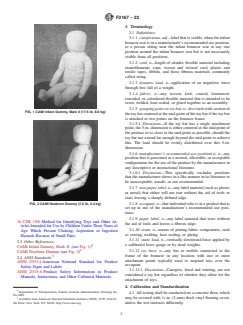
CAMI Infant Dummy, Mark II (see Fig. 1)
CAMI Newborn Dummy (see Fig. 2)
2.4 ANSI Standards:
ANSI Z535.4 American National Standard for Product Safety Signs and Labels
ANSI Z535.6 Product Safety Information in Product Manuals, Instructions, and Other Collateral Materials
3. Terminology
3.1 Definitions:
3.1.1 conspicuous, adj—label that is visible, when the infant bouncer seat is in a manufacturer’s recommended use position, to
a person sitting near the infant bouncer seat at any one position around the infant bouncer seat but is not necessarily visible from
all positions.
3.1.2 cord, n—length of slender, flexible material including monofilaments, rope, woven and twisted cord, plastic and textile tapes,
ribbon, and those fibrous materials commonly called string.
3.1.3 dynamic load, n—application of an impulsive force through free fall of a weight.
3.1.4 fabric, n—any woven, knit, coated, laminated, extruded, or calendered flexible material that is intended to be sewn, welded,
heat sealed, or glued together as an assembly.
3.1.5 grasping point on toy bar, n—five-inch wide section of the toy bar centered at the mid-point of the toy bar if the toy bar is
attached at two points on the bouncer frame.
3.1.5.1 Discussion—
If the toy bar has a single attachment point, the 5-in. dimension is either centered at the mid-point of the product or as close to
the mid-point as possible, should the toy bar not extend far enough beyond the mid-point to achieve this. The load should be evenly
distributed over this 5-in. dimension.
3.1.6 manufacturer’s recommended use position(s), n—any position that is presented as a normal, allowable, or acceptable
configuration for the use of the product by the manufacturer in any descriptive or instructional literature.
3.1.6.1 Discussion—
This specifically excludes positions that the manufacturer shows in a like manner in its literature to be unacceptable, unsafe, or
not recommended.
3.1.7 non-paper label, n—any label material (such as plastic or metal) that either will not tear without the aid of tools or tears
leaving a sharply defined edge.
3.1.8 occupant, n—that individual who is in a product that is set up in one of the manufacturer’s recommended use positions.
3.1.9 paper label, n—any label material that tears without the aid of tools and leaves a fibrous edge.
3.1.10 seam, n—means of joining fabric components, such as sewing, welding, heat sealing, or gluing.
3.1.11 static load, n—vertically downward force applied by a calibrated force gauge or by dead weights.
3.1.12 toy bars, n—any bar or mobile connected to the frame of the bouncer in any location with one or more attachment points
typically used to suspend toys over the occupant.
3.1.12.1 Discussion—
Canopies, fixed and rotating, are not considered a toy bar regardless of whether they allow for the attachment of toys.
Department of Transportation, Federal Aviation Administration, Drawing No. SA-1001.
Available from American National Standards Institute (ANSI), 25 W. 43rd St., 4th Floor, New York, NY 10036, http://www.ansi.org.
F2167 − 22
4. Calibration and Standardization
4.1 All testing shall be conducted on a concrete floor, which may be covered with ⁄8-in. (3-mm) thick vinyl flooring cover, unless
the test instructs differently.
4.2 The product shall be completely assembled, unless otherwise noted, in accordance with the manufacturer’s instructions.
4.3 No testing shall be conducted within 48 h of manufacturing.
4.4 The product to be tested shall be in a room with an ambient temperature of 73° 6 9°F (23° 6 5°C) for at least one hour prior
to testing. Testing shall then be conducted within this temperature range.
4.5 All testing required by this specification shall be conducted on the same infant bouncer seat.
5. General Requirements
5.1 Hazardous Sharp Points and Edges—There shall be no hazardous points or edges as defined by 16 CFR 1500.48 and 16 CFR
1500.49 before and after testing to this consumer safety specification.
5.2 Small Parts—There shall be no small parts as defined by 16 CFR 1501 before testing or liberated as a result of testing to this
specification.
5.3 Lead—There shall be no lead-containing paint as defined by 16 CFR 1303.
5.4 Wood Parts—Prior to testing, any exposed wood parts shall be smooth and free from splinters.
5.5 Latching or Locking Mechanisms—If the infant bouncer seat is designed with a latching or locking device that prevents
unintentional folding, the infant bouncer seat shall remain in its manufacturer’s recommended use position during and upon
completion of the test, in accordance with 7.10. The latching or locking device shall remain engaged and operative after testing.
5.6 Scissoring, Shearing, and Pinching—A product, when in any manufacturer’s recommended use position(s), shall be designed
and constructed so as to prevent injury to the occupant from any scissoring, shearing, or pinching when members or components
rotate about a common axis or fastening point, slide, pivot, fold, or otherwise move relative to one another. Scissoring, shearing,
or pinching that may cause injury shall not be permissible when the edges of any rigid parts admit a probe greater than 0.210 in.
(5.33 mm) and less than 0.375 in. (9.52 mm) in diameter at any accessible point throughout the range of motion of such parts.
5.7 Openings—Holes or slots that extend entirely through a wall section of any rigid material less than 0.375-in. (9.53-mm) thick
and admit a 0.210-in. (5.33-mm) diameter rod shall also admit a 0.375-in. (9.53-mm) diameter rod. Holes or slots that are between
0.210-in. (5.33-mm) and 0.375-in. (9.53-mm) and have a wall thickness less than 0.375-in. (9.53-mm), but are limited in depth
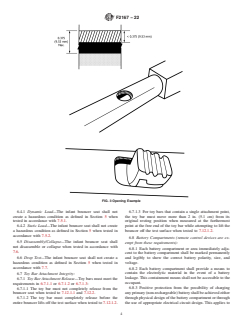
to 0.375-in. (9.53-mm) maximum by another rigid surface shall be permissible (see Fig. 3). The product shall be evaluated in all
manufacturer’s recommended use positions.
5.8 Exposed Coil Springs—Any exposed coil spring that is accessible to the occupant, having or capable of generating a space
between coils of 0.210 in. (5.33 mm) or greater during static load testing in accordance with 7.5.2 shall be covered or otherwise
designed to prevent injury from entrapment.
5.9 Protective Components—If a child can grasp components between the thumb and forefinger or between teeth, (such as caps,
sleeves, or plugs used for protection from sharp edges, points, or entrapment of fingers or toes), or if there is at least a 0.040-in.
(1.00-mm) gap between the component and its adjacent parent component, such component shall not be removed when tested in
accordance with 7.9.
5.10 Permanency of Labels and Warnings:
5.10.1 Warning labels (whether paper or non-paper) shall be permanent when tested in accordance with 7.8.1 – 7.8.3.
F2167 − 22
FIG. 3 Opening Example
5.10.2 Warning statements applied directly onto the surface of the product by hot stamping, heat transfer, printing, wood burning,
etc. shall be permanent when tested in accordance with 7.8.4.
5.10.3 Non-paper labels shall not liberate small parts when tested in accordance with 7.8.5.
5.11 Toys—Toy accessories attached to, removable from, or sold with an infant bouncer seat, as well as their means of attachment,
must meet applicable requirements of Specification F963.
6. Performance Requirements
6.1 Restraint System:
6.1.1 A restraint system shall be provided to secure a child in any of the manufacturer’s recommended use positions.
6.1.2 The restraint system shall include both a waist and crotch restraint, where the crotch restraint’s use is mandatory when the
waist restraint is in use.
6.1.3 The anchorages for the restraint system shall not separate from their attachment points when tested in accordance with 7.2.
F2167 − 22
6.2 Stability:
6.2.1 Forward Stability—The infant bouncer seat shall not tip over when tested in accordance with 7.3.2. If the stability test fixture
touches the test surface and prevents the product from tipping over, retest the product near the edge of an elevated test surface to
allow the product to tip.
6.2.2 Sideward and Rearward Stability—The infant bouncer seat shall not tip over when tested in accordance with 7.3.3 – 7.3.6.
6.3 Slip Resistance:
6.3.1 Dynamic Slip Resistance—The infant bouncer seat shall not slip more than ⁄2 in. (13 mm) when tested in accordance with
7.4.4.
NOTE 1—As this is a dynamic impact test, the ⁄2 in. allows for a small amount of settling prior to the feet gripping.
6.3.2 Static Slip Resistance—The infant bouncer seat shall not slip more than ⁄8 in. (3 mm) when tested in accordance with 7.4.5
– 7.4.9.
6.4 Structural Integrity—At test conclusion, there shall be no failure of seams, breakage of materials, or changes of adjustments
that could cause the product not to fully support the child or create a hazardous condition as defined in Section 5.
6.4.1 Dynamic Load—The infant bouncer seat shall not create a hazardous condition as defined in Section 5 when tested in
accordance with 7.5.1.
6.4.2 Static Load—The infant bouncer seat shall not create a hazardous condition as defined in Section 5 when tested in
accordance with 7.5.2.
6.5 Disassembly/Collapse—The infant bouncer seat shall not disassemble or collapse when tested in accordance with 7.6.
6.6 Drop Test—The infant bouncer seat shall not create a hazardous condition as defined in Section 5 when tested in accordance
with 7.7.
6.7 Toy Bar Attachment Integrity:
6.7.1 Toy Bar Attachment Release—Toy bars must meet the requirements in 6.7.1.1 or 6.7.1.2 or 6.7.1.3:
6.7.1.1 The toy bar must not completely release from the bouncer seat when tested to 7.12.1.1 and 7.12.2.
6.7.1.2 The toy bar must completely release before the entire bouncer lifts off the test surface when tested to 7.12.1.2.
6.7.1.3 For toy bars that contain a single attachment point, the toy bar must move more than 2 in. (5.1 cm) from its original resting
position when measured at the furthermost point at the free end of the toy bar while attempting to lift the bouncer off the test surface
when tested to 7.12.1.2.
6.8 Battery Compartments (remote control devices are exempt from these requirements):
6.8.1 Each battery compartment or area immediately adjacent to the battery compartment shall be marked permanently and legibly
to show the correct battery polarity, size, and voltage.
6.8.2 Each battery compartment shall provide a means to contain the electrolytic material in the event of a battery leakage. This
containment means shall not be accessible to the occupant.
6.8.3 Positive protection from the possibility of charging any primary (non-rechargeable) battery shall be achieved either through
physical design of the battery compartment or through the use of appropriate electrical circuit design. This applies to situations
F2167 − 22
in which a battery may be installed incorrectly (reversed), and in which a battery charger may be applied to a product containing
primary batteries. This section does not apply to a circuit having one or two batteries as the only source of power.
6.8.4 The surfaces of any accessible electrical component, including batteries, shall not achieve temperatures exceeding 160°F
(71°C) when tested in accordance with 7.1. At the conclusion of the test, there shall be no battery leakage or, explosion or a fire
to any electrical component. This test shall be performed prior to conducting any other testing within the performance requirements
section.
7. Test Methods
7.1 The battery compartment shall be tested using fresh alkaline batteries or an a/c power source. If the function powered by the
compartment can be operated using both, then both batteries and a/c power must be tested separately. If another battery chemistry
is specifically recommended for use in the bouncer by the manufacturer, repeat the test using the batteries specified by the
manufacturer. If the bouncer will not operate using alkaline batteries, then test with the type of battery recommended by the
manufacturer at the specified voltage. The test is to be carried out in a draft-free location, at an ambient temperature of 68 6 9°F
(20 6 5°C).
7.1.1 Operate the function powered by the battery compartment at the maximum speed or highest intensity. Do not disable any
mechanical or electrical protective device, such as clutches or fuses. Operate the function powered by the battery compartment
continuously, and record peak temperature. The test shall be discontinued 60 min after the peak temperature is recorded. If the
function shuts off automatically or must be kept “on” by hand or foot, monitor temperatures for 30 s, resetting the function as many
times as necessary to complete the 30 s of operation. If the function shuts off automatically after an operating time of greater than
30 s, continue the test until the function shuts off.
NOTE 2—The tests described in 7.2 through 7.7 are to be performed in the order specified without refurbishing or repositioning of adjustments, if any.
7.2 Restraint System:
7.2.1 Secure the infant bouncer seat so that it can not move vertically or horizontally.
7.2.2 Apply a force of 45 lbf (200 N) to a single attachment point of the restraint system in the normal use direction(s) that stress
would be applied to the attachment. Gradually apply the force within a period of 5 s and maintain for an additional 10 s.
NOTE 3—This is in accordance with Specification F404.
7.2.3 Repeat 7.2.2 for each attachment point of the restraint system and fastening device.
7.3 Stability Test:
Forward Stability
7.3.1 Stability Test Fixture:
7.3.1.1 The stability test fixture is to be constructed of ⁄4-in. (19-mm) plywood or the equivalent of such product.
7.3.1.2 The fixture should be constructed according to Fig. 4.
7.3.2 Test Procedure:
7.3.2.1 Establish the restraint system adjustment by placing the CAMI Infant Dummy, Mark II (see Fig. 1) in the infant bouncer
seat, fastening the restraint system in accordance with the manufacturer’s instructions, and removing the dummy.
7.3.2.2 Insert the stability test fixture into the bouncer and pull forward to remove any slack in the crotch restraint.
7.3.2.3 Use a force gauge to apply a static load of 21 lbf (93 N) or the maximum manufacturer’s recommended weight, whichever
is greater, vertically downward on the stability test fixture in the location designated on the drawing (6 in. (152.4 mm) in front of
the crotch post; see Fig. 4) within a period of 5 s and maintain for an additional 60 s (see Fig. 5).
F2167 − 22
FIG. 4 Forward Stability Test Fixture
FIG. 5 Forward Stability Test
7.3.2.4 The test surface shall be an impregnated high-pressure laminate of unspecified color with a smooth matte finish.
F2167 − 22
Sideward and Rearward Stability
7.3.3 Place a CAMI Infant Dummy, Mark II (see Fig. 1) in the infant bouncer seat with the restraint system fastened in accordance
with the manufacturer’s instructions.
7.3.4 Position the infant bouncer seat in the most unfavorable sideward or rearward position on a test surface inclined at 20°. The
most unfavorable position could be a position in between the true sideward and rearward positions. If necessary, prevent the
product from sliding but do not prevent it from tipping.
7.3.5 The test surface shall be an impregnated high-pressure laminate of unspecified color with a smooth matte finish.
7.3.6 Maintain for 1 min.
7.4 Slip Resistance:
Test Preparation
7.4.1 Test Surface:
7.4.1.1 The test surface shall be an impregnated high-pressure laminate of unspecified color with a smooth matte finish.
7.4.1.2 The laminate should be mounted on a flat surface, with a thickness no less than ⁄4 in. (19 mm), in accordance with the
laminate manufacturer’s instructions.
7.4.1.3 Clean the test surface with a damp cloth. Any products that will interfere with the performance of the laminate are
unacceptable, for example, solvents or cleaners that leave residue or alter the surface finish.
7.4.1.4 Precautions should be taken to prevent the contamination of the testing surface. Graduation or pencil marks are
unacceptable unless located in a position that never interferes with the performance of the test product (that is, along the edge of
the surface).
7.4.2 Test Procedure:
7.4.2.1 Incline the prepared laminate surface to 10°.
NOTE 4—The 10° incline is in accordance with Specification F2050.
7.4.2.2 Clean slip-resistant pads, feet, or any other objects on the infant bouncer seat that come in contact with the inclined surface
with a damp cloth.
Dynamic Slip Resistance
7.4.3 Dynamic Slip Resistance Test Fixture:
7.4.3.1 The dynamic slip resistance test fixture is to be constructed of ⁄4-in. (19-mm) plywood or the equivalent of such product.
7.4.3.2 The fixture should be constructed in accordance with Fig. 6.
7.4.4 Test Procedure:
7.4.4.1 Prepare the test surface, clean the slip resistant pads by wiping with a damp cloth, and incline the test surface in accordance
with 7.4.1 and 7.4.2.
F2167 − 22
FIG. 6 Dynamic Slip Resistance Test Fixture
7.4.4.2 Center and affix a static load of 7.5 lb (3.40 kg) to the slip resistance test fixture in the location designated on the drawing
(6 in. (150 mm) from the front edge of the test fixture). The 7.5-lb (3.40-kg) static load is to be constructed of a 5-by-10–in.
(125-by-250–mm) bag filled with sand.
7.4.4.3 Establish the restraint system adjustment by placing the CAMI Infant Dummy, Mark II (see Fig. 1) in the infant bouncer
seat, fastening the restraint system in accordance with the manufacturer’s instructions, and removing the dummy. Insert the slip
resistance test fixture into the bouncer and pull forward to remove any slack in the crotch restraint.
7.4.4.4 Place weighted infant bouncer seat onto inclined surface with the front of the infant bouncer seat facing directly down the
incline. If the bouncer has a vibration unit, turn the unit to the speed setting most likely to cause the infant bouncer seat to slide.
7.4.4.5 Drop a test weight of 2.5 lb (1.13 kg) onto the designated drop area from a distance of 6 in. (150 mm) ten times. The cycle
time is to be 5 s/cycle, 61 s. The 2.5-lb (1.13-kg) test weight shall be constructed of 3-in. (75-mm) diameter steel and be
approximately 1.25 in. (31.8 mm) thick (see Fig. 7).
7.4.4.6 The infant bouncer seat should not move more than ⁄2 in. (13 mm).
7.4.4.7 Repeat 7.4.4.4 – 7.4.4.6 for the left side, right side, and rearward directions.
NOTE 5—The 10-lb (7.5 lb + 2.5 lb) load represents a 5th percentile 3 to 5-month-old. The 7.5 lb load is intended to simulate the torso. The 2.5 lb load
is intended to simulate upper body bouncing in the infant bouncer seat. It is believed that the 5th percentile weight is a worst case scenario for this dynamic
slip test.
Static Slip Resistance
7.4.5 Prepare the test surface, clean the slip resistant pads, and incline the test surface in accordance with 7.4.1.
7.4.6 Place a 7.5-lb (3.40-kg) newborn dummy in the seat.
F2167 − 22
FIG. 7 Dynamic Slip Resistance Test
7.4.7 Place weighted infant bouncer seat onto an inclined surface with the front of the infant bouncer seat facing directly down
the incline.
7.4.8 The infant bouncer seat should not move more than ⁄8 in. (3 mm) in 1 min.
7.4.9 Repeat 7.4.7 and 7.4.8 for the left side, right side, and rearward directions.
7.5 Structural Integrity:
7.5.1 Dynamic Load:
7.5.1.1 Position the infant bouncer seat in the manufacturer’s recommended use position(s).
7.5.1.2 Position a standard 6-in. (150-mm) weld cap (see Fig. 8) with the convex surface down. Affix a weight to the top of the
weld cap to achieve a total weight of 33 lb (15.0 kg).
FIG. 8 Weld Cap
F2167 − 22
7.5.1.3 Drop the 33-lb (15.0-kg) test weight onto the seat from a distance of 1 in. (25 mm) one hundred times.
NOTE 6—This test is in accordance with the walker standard. The weight is higher than that of a 6-month-old in the 95th percentile to justify limiting
the test to only 100 cycles, as well as eliminating the need for an additional seam strength test.
7.5.2 Static Load:
7.5.2.1 Position the infant bouncer seat in the manufacturer’s recommended use position(s).
7.5.2.2 Place a 6-by-6–in. (150-by-150–mm) wood block that is ⁄4 in. (19 mm) thick on the center of the seat.
7.5.2.3 Gradually apply a static load of 60 lb (27.3 kg) or three times the maximum manufacturer’s recommended weight,
whichever is greater, on the wood block within a period of 5 s and maintain for an additional 60 s.
NOTE 7—The 60-lb static load is approximately three times the weight of a 95th percentile 6-month-old.
7.6 Disassembly/Collapse:
7.6.1 Position the infant bouncer seat in the manufacturer’s recommended use position(s).
7.6.2 Place a 7.5-lb (3.40-kg) newborn dummy in the seat.
7.6.3 Apply a force of 15 lbf (67 N) to a single frame attachment point in the direction(s) associated with disassembly. Gradually
apply the force within a period of 5 s and maintain for an additional 10 s. If necessary, secure a portion of the product to prevent
it from moving. The means of securing the product shall not prevent disassembly.
NOTE 8—The 15-lbf force is intended to exceed the forces the attachment points would see while the product is slid across a surface or while the product
is carried.
7.6.4 Repeat 7.6.3 for all other frame attachment points.
7.7 Drop Test:
7.7.1 The infant bouncer seat shall be dropped from a height of 36 in. (910 mm).
7.7.1.1 If the infant bouncer seat does not fold, drop the infant bouncer seat once on each of six different planes (top, bottom, front,
rear, left side, and right side).
7.7.1.2 If the infant bouncer seat does fold, drop the infant bouncer seat once on each of six different planes, both in the folded
and erect configurations.
7.8 Permanency of Labels and Wa
...