

ASTM F1004-23
(Specification)Standard Consumer Safety Specification for Expansion Gates and Expandable Enclosures
General Information
- Abstract
SCOPE
1.1 This consumer safety specification covers minimum safety performance requirements, test methods, and requirements for labeling and instructional material to minimize hazards to young children resulting from the normal use and reasonably foreseeable misuse and abuse of expansion gates and expandable enclosures.
1.2 Products known as expansion gates and expandable enclosures, or by any other name, which are in the scope of this consumer safety specification are intended for young children aged six months through 24 months, and are defined in Section 3.
1.3 Expansion gates and expandable enclosures defined in Section 3 are for domestic use and are not to be confused with other types of gates or enclosures that may be specifically designed for commercial, institutional, agricultural, pet use, or any other such use.
1.4 No expansion gate or expandable enclosure as defined in Section 3, that is, produced after the approval date of this consumer safety specification either by label or other means, shall indicate compliance with this specification unless it conforms to all the requirements contained herein.
1.5 For expediency, expansion gates and expandable enclosures as defined in Section 3 will heretofore be referred to in this consumer safety specification as “gates” and “enclosures” unless referred to definitively.
1.6 The values stated in inch-pound units are to be regarded as standard. The values given in parentheses are mathematical conversions to SI units that are provided for information only and are not considered standard.
1.7 The following pertains only to the test methods portion, Section 7, of this specification. This standard does not purport to address all of the safety concerns, if any, associated with its use. It is the responsibility of the user of this standard to establish appropriate safety, health, and environmental practices and determine the applicability of regulatory limitations prior to use.
1.8 This international standard was developed in accordance with internationally recognized principles on standardization established in the Decision on Principles for the Development of International Standards, Guides and Recommendations issued by the World Trade Organization Technical Barriers to Trade (TBT) Committee.
- Status
- Published
- Publication Date
- 31-Dec-2022
- Technical Committee
- F15 - Consumer Products
- Drafting Committee
- F15.11 - Bed Rails and Expandable Gates
Buy Documents
ASTM F1004-23 - Standard Consumer Safety Specification for Expansion Gates and Expandable Enclosures
REDLINE ASTM F1004-23 - Standard Consumer Safety Specification for Expansion Gates and Expandable Enclosures
Overview
ASTM F1004-23: Standard Consumer Safety Specification for Expansion Gates and Expandable Enclosures is an internationally recognized standard developed by ASTM International. This specification sets out minimum safety performance requirements, test methods, and criteria for labeling and instructional materials aimed at minimizing hazards to young children during the typical use, and reasonably foreseeable misuse or abuse, of domestic expansion gates and expandable enclosures. These products are specifically intended for use by children aged six to 24 months and must not be confused with barriers designed for commercial, institutional, pet, or agricultural use.
The specification includes comprehensive guidelines to address potential risks such as head and neck entrapment, strangulation, and climbing attempts, as identified by safety bodies such as the U.S. Consumer Product Safety Commission (CPSC).
Key Topics
- Scope and Applicability: Covers domestic expansion gates and expandable enclosures intended for children 6–24 months.
- Safety Performance Requirements: Defines minimum standards for structural integrity, design, and durability to prevent injuries.
- Test Methods: Outlines precise, repeatable procedures for assessing compliance, including vertical and horizontal strength, opening dimensions, and more.
- Labeling and Instructions: Requires clear, permanent warning labels and comprehensive instructional materials to promote safe installation and use.
- Material Requirements: Specifies acceptable materials, finishes, and construction methods, including surface coatings and prohibition of sharp points, edges, and small parts.
- Entrapment and Pinch Points: Establishes design criteria to prevent entrapment of head, torso, fingers, or toes.
- Locking and Latching Systems: Sets requirements for secure and child-resistant locking mechanisms, including double-action releases and automatic closing systems.
- Accessory Restrictions: Limits on accompanying toy accessories to ensure they do not introduce additional hazards.
Applications
- Manufacturers and Product Designers: Ensures that expansion gates and expandable enclosures meet strict safety requirements before reaching the market. This helps prevent recalls and liability issues, while enhancing consumer confidence.
- Retailers and Importers: Provides a benchmark for product acceptance, making sure only compliant products are delivered to consumers.
- Testing and Certification Bodies: Supplies precise methods for lab or in-house testing to assess product safety and durability.
- Consumers and Caregivers: Delivers assurance that certified products-when installed and used as directed-provide reliable safety barriers to protect young children within homes.
- Regulatory Compliance: Assists companies in meeting applicable U.S. federal regulations and international safety standards for juvenile products.
Related Standards
- ASTM F406: Consumer Safety Specification for Non-Full-Size Baby Cribs/Play Yards
- ASTM F963: Consumer Safety Specification for Toy Safety
- ANSI Z535 Series: Standards for product safety signs, labels, and instructional materials
- 16 CFR 1303: U.S. regulation regarding lead in paint
- 16 CFR 1500 & 1501: U.S. regulations addressing hazardous substances, sharp points/edges, and small parts in child products
- BS 4125: British Standard for child safety barriers for domestic use
Practical Value
By adhering to ASTM F1004-23, stakeholders ensure that expansion gates and expandable enclosures meet recognized child safety benchmarks. This not only helps prevent accidents such as entrapment, falls, or injuries due to product failure, but also supports regulatory compliance and product reliability. The standard is crucial for anyone manufacturing, importing, selling, or using juvenile safety gates and enclosures in a domestic setting.
For more information, refer to the official ASTM F1004-23 documentation and subsequent updates to guarantee the most current compliance requirements.
Relations
- Effective Date
- 01-Aug-2023
- Effective Date
- 01-Dec-2017
- Effective Date
- 01-Aug-2016
- Effective Date
- 01-Nov-2015
- Effective Date
- 01-May-2013
- Refers
ASTM F406-12a - Standard Consumer Safety Specification for Non-Full-Size Baby Cribs/Play Yards - Effective Date
- 01-May-2012
- Effective Date
- 15-Jan-2012
- Effective Date
- 01-Dec-2011
- Refers
ASTM F406-11b - Standard Consumer Safety Specification for Non-Full-Size Baby Cribs/Play Yards - Effective Date
- 15-Aug-2011
- Refers
ASTM F406-11a - Standard Consumer Safety Specification for Non-Full-Size Baby Cribs/Play Yards - Effective Date
- 01-Jul-2011
- Effective Date
- 15-May-2011
- Refers
ASTM F406-10b - Standard Consumer Safety Specification for Non-Full-Size Baby Cribs/Play Yards - Effective Date
- 01-Dec-2010
- Refers
ASTM F406-10a - Standard Consumer Safety Specification for Non-Full-Size Baby Cribs/Play Yards - Effective Date
- 15-Oct-2010
- Effective Date
- 01-Jun-2010
- Effective Date
- 01-Jul-2009
Buy Documents
ASTM F1004-23 - Standard Consumer Safety Specification for Expansion Gates and Expandable Enclosures
REDLINE ASTM F1004-23 - Standard Consumer Safety Specification for Expansion Gates and Expandable Enclosures
Frequently Asked Questions
ASTM F1004-23 is a technical specification published by ASTM International. Its full title is "Standard Consumer Safety Specification for Expansion Gates and Expandable Enclosures". This standard covers: SCOPE 1.1 This consumer safety specification covers minimum safety performance requirements, test methods, and requirements for labeling and instructional material to minimize hazards to young children resulting from the normal use and reasonably foreseeable misuse and abuse of expansion gates and expandable enclosures. 1.2 Products known as expansion gates and expandable enclosures, or by any other name, which are in the scope of this consumer safety specification are intended for young children aged six months through 24 months, and are defined in Section 3. 1.3 Expansion gates and expandable enclosures defined in Section 3 are for domestic use and are not to be confused with other types of gates or enclosures that may be specifically designed for commercial, institutional, agricultural, pet use, or any other such use. 1.4 No expansion gate or expandable enclosure as defined in Section 3, that is, produced after the approval date of this consumer safety specification either by label or other means, shall indicate compliance with this specification unless it conforms to all the requirements contained herein. 1.5 For expediency, expansion gates and expandable enclosures as defined in Section 3 will heretofore be referred to in this consumer safety specification as “gates” and “enclosures” unless referred to definitively. 1.6 The values stated in inch-pound units are to be regarded as standard. The values given in parentheses are mathematical conversions to SI units that are provided for information only and are not considered standard. 1.7 The following pertains only to the test methods portion, Section 7, of this specification. This standard does not purport to address all of the safety concerns, if any, associated with its use. It is the responsibility of the user of this standard to establish appropriate safety, health, and environmental practices and determine the applicability of regulatory limitations prior to use. 1.8 This international standard was developed in accordance with internationally recognized principles on standardization established in the Decision on Principles for the Development of International Standards, Guides and Recommendations issued by the World Trade Organization Technical Barriers to Trade (TBT) Committee.
SCOPE 1.1 This consumer safety specification covers minimum safety performance requirements, test methods, and requirements for labeling and instructional material to minimize hazards to young children resulting from the normal use and reasonably foreseeable misuse and abuse of expansion gates and expandable enclosures. 1.2 Products known as expansion gates and expandable enclosures, or by any other name, which are in the scope of this consumer safety specification are intended for young children aged six months through 24 months, and are defined in Section 3. 1.3 Expansion gates and expandable enclosures defined in Section 3 are for domestic use and are not to be confused with other types of gates or enclosures that may be specifically designed for commercial, institutional, agricultural, pet use, or any other such use. 1.4 No expansion gate or expandable enclosure as defined in Section 3, that is, produced after the approval date of this consumer safety specification either by label or other means, shall indicate compliance with this specification unless it conforms to all the requirements contained herein. 1.5 For expediency, expansion gates and expandable enclosures as defined in Section 3 will heretofore be referred to in this consumer safety specification as “gates” and “enclosures” unless referred to definitively. 1.6 The values stated in inch-pound units are to be regarded as standard. The values given in parentheses are mathematical conversions to SI units that are provided for information only and are not considered standard. 1.7 The following pertains only to the test methods portion, Section 7, of this specification. This standard does not purport to address all of the safety concerns, if any, associated with its use. It is the responsibility of the user of this standard to establish appropriate safety, health, and environmental practices and determine the applicability of regulatory limitations prior to use. 1.8 This international standard was developed in accordance with internationally recognized principles on standardization established in the Decision on Principles for the Development of International Standards, Guides and Recommendations issued by the World Trade Organization Technical Barriers to Trade (TBT) Committee.
ASTM F1004-23 is classified under the following ICS (International Classification for Standards) categories: 97.190 - Equipment for children. The ICS classification helps identify the subject area and facilitates finding related standards.
ASTM F1004-23 has the following relationships with other standards: It is inter standard links to ASTM F963-23, ASTM F406-17, ASTM F963-16, ASTM F406-15, ASTM F406-13, ASTM F406-12a, ASTM F406-12, ASTM F963-11, ASTM F406-11b, ASTM F406-11a, ASTM F406-11, ASTM F406-10b, ASTM F406-10a, ASTM F406-10, ASTM F406-09. Understanding these relationships helps ensure you are using the most current and applicable version of the standard.
ASTM F1004-23 is available in PDF format for immediate download after purchase. The document can be added to your cart and obtained through the secure checkout process. Digital delivery ensures instant access to the complete standard document.
Standards Content (Sample)
This international standard was developed in accordance with internationally recognized principles on standardization established in the Decision on Principles for the
Development of International Standards, Guides and Recommendations issued by the World Trade Organization Technical Barriers to Trade (TBT) Committee.
Designation:F1004 −23
Standard Consumer Safety Specification for
Expansion Gates and Expandable Enclosures
This standard is issued under the fixed designation F1004; the number immediately following the designation indicates the year of
original adoption or, in the case of revision, the year of last revision.Anumber in parentheses indicates the year of last reapproval.A
superscript epsilon (´) indicates an editorial change since the last revision or reapproval.
INTRODUCTION
This consumer safety specification addresses incidents of head and neck entrapment in children’s
expansion gates and expandable enclosures. It also addresses the ability of a pressure gate to resist a
push-out force.
TheU.S.ConsumerProductSafetyCommission(CPSC)identifiedincidentsthatgenerallyinvolved
achild’sheadorneck,orboth,becomingentrappedindiamond-shapedopeningsandstrangulationof
children in V-shapes at the top of accordion style expansion gates or expandable enclosures.
Additional incidents and injuries were identified that involved children attempting to climb up and
over expansion gates and expandable enclosures, and pushing or pulling pressure gates out of
doorways.
Thisconsumersafetyspecificationiswrittenwithinthecurrentstate-of-the-artofgateandenclosure
technology.Itisintendedthatthisconsumersafetyspecificationwillbeupdatedwheneversubstantive
information becomes available, which necessitates additional requirements or justifies the revision of
existing requirements.
This specification does not address incidents in which gates or enclosures are blatantly misused
although warnings and safety instructions are required to be displayed prominently on and with each
gate or enclosure.
1. Scope* 1.4 Noexpansiongateorexpandableenclosureasdefinedin
Section 3, that is, produced after the approval date of this
1.1 This consumer safety specification covers minimum
consumer safety specification either by label or other means,
safety performance requirements, test methods, and require-
shall indicate compliance with this specification unless it
ments for labeling and instructional material to minimize
conforms to all the requirements contained herein.
hazards to young children resulting from the normal use and
reasonably foreseeable misuse and abuse of expansion gates
1.5 For expediency, expansion gates and expandable enclo-
and expandable enclosures.
sures as defined in Section 3 will heretofore be referred to in
1.2 Products known as expansion gates and expandable this consumer safety specification as “gates” and “enclosures”
enclosures,orbyanyothername,whichareinthescopeofthis
unless referred to definitively.
consumer safety specification are intended for young children
1.6 Thevaluesstatedininch-poundunitsaretoberegarded
agedsixmonthsthrough24months,andaredefinedinSection
as standard. The values given in parentheses are mathematical
3.
conversions to SI units that are provided for information only
1.3 Expansion gates and expandable enclosures defined in
and are not considered standard.
Section 3 are for domestic use and are not to be confused with
1.7 The following pertains only to the test methods portion,
other types of gates or enclosures that may be specifically
Section 7, of this specification. This standard does not purport
designed for commercial, institutional, agricultural, pet use, or
to address all of the safety concerns, if any, associated with its
any other such use.
use. It is the responsibility of the user of this standard to
establish appropriate safety, health, and environmental prac-
tices and determine the applicability of regulatory limitations
This consumer safety specification is under the jurisdiction ofASTM Commit-
prior to use.
tee F15 on Consumer Products and is the direct responsibility of Subcommittee
F15.11 on Bed Rails and Expandable Gates.
1.8 This international standard was developed in accor-
Current edition approved Jan. 1, 2023. Published January 2023. Originally
dance with internationally recognized principles on standard-
approved in 1986. Last previous edition approved in 2022 as F1004–22. DOI:
10.1520/F1004-23. ization established in the Decision on Principles for the
*A Summary of Changes section appears at the end of this standard
Copyright © ASTM International, 100 Barr Harbor Drive, PO Box C700, West Conshohocken, PA 19428-2959. United States
F1004−23
Development of International Standards, Guides and Recom- one position around the gate/expandable enclosure, but not
mendations issued by the World Trade Organization Technical necessarily visible from all positions.
Barriers to Trade (TBT) Committee.
3.1.4 double-action release mechanism, n—a release
mechanismrequiringeithertwoconsecutiveactions,thefirstof
2. Referenced Documents
which must be maintained while the second is carried out, or
2.1 ASTM Standards: two separate and independent single-action release mecha-
D3359Test Methods for Rating Adhesion by Tape Test nisms that must be activated simultaneously to unlock the
F406 Consumer Safety Specification for Non-Full-Size gate/enclosure.
Baby Cribs/Play Yards
3.1.5 egress panel, n—panel(s) within a gate or enclosure
F963Consumer Safety Specification for Toy Safety
designed to swing, retract, or fold open to allow passage.
2.2 British Standard: 3.1.5.1 Discussion—Pressure-mountedgatesthatrequirethe
BS4125Specification for Safety Requirements for Child
pressure to be released in order to allow passage are not
Safety Barriers for Domestic Use considered to contain an egress panel.
2.3 Federal Regulations: 3.1.6 expandable enclosures, n—self-supporting barrier in-
16 CFR 1303Ban of Lead-Containing Paint and Certain
tended to completely surround an area or play-space within
Consumer Products Bearing Lead Containing Paint which a young child (see 1.2) may be confined.
16 CFR 1500Hazardous Substances Act Regulations, In-
3.1.6.1 Discussion—Enclosuresmaybemarketedforindoor
cluding Parts: or outdoor use, or both. Expandable enclosures do not include
16 CFR 1500.48Technical Requirements for Determining a
an attached floor.
Sharp Point in Toys and Other Articles Intended for Use
3.1.7 expansion gate, n—barrierintendedtobeerectedinan
by Children Under Eight Years of Age
opening, such as a doorway, to prevent the passage of young
16 CFR 1500.49Technical Requirements for Determining a
children (see 1.2), but which can be removed by older persons
Sharp Metal or Glass Edge in Toys and Other Articles
who are able to operate the locking mechanism.
Intended for Use by Children Under Eight-Years of Age
3.1.7.1 Discussion—Suchgatesareavailableinanumberof
16 CFR 1501Method for Identifying Toys and Other Ar-
different styles of construction and are manufactured from a
ticles Intended for Use by Children Under ThreeYears of
variety of different materials.
Age Which Present Choking, Aspiration, or Ingestion
3.1.8 extension panel(s), n—any panel recommended by the
Hazards Because of Small Parts
manufacturer for extending the length or height of the product
2.4 ANSI Standards:
including panels sold with the gate/enclosure and those sold
ANSIZ535.1AmericanNationalStandardforSafetyColors
separately.
ANSI Z535.4American National Standard for Product
3.1.9 hold-open mechanism, n—a feature sometimes in-
Safety Signs and Labels
cludedwithautomaticclosinggateswherethegatewillstayin
ANSI Z535.6American National Standard: Product Safety
a fully open position and not automatically close the egress
Information in Product Manuals, Instructions, and Other
panel.
Collateral Materials
3.1.10 manufacturer’s recommended use position(s)—any
position that is presented by the manufacturer in any descrip-
3. Terminology
tive or instructional literature as a normal, allowable, or
3.1 Definitions of Terms Specific to This Standard:
acceptable configuration for the use of the product.
3.1.1 automatic closing system, n—a feature (or mecha-
3.1.10.1 Discussion—This specifically excludes positions
nism) the manufacturer claims, markets, or intends to close an
which the manufacturer shows in its literature to be
egresspanelautomaticallywithouttheinterventionoftheuser.
unacceptable, unsafe, or not recommended.
3.1.2 completely-bounded opening, n—any opening in the
3.1.11 nonpaper label, n—anylabelmaterial,suchasplastic
main structure of a product that is enclosed totally by bound-
or metal, which either will not tear without the aid of tools or
aries on all sides.
tears leaving a sharply-defined edge.
3.1.3 conspicuous, adj—visible, when the gate/expandable
3.1.12 paper label, n—any label material, which tears with-
enclosure is in all manufacturer’s recommended use positions,
out the aid of tools and leaves a fibrous edge.
to a person standing near the gate/expandable enclosure at any
3.1.13 partially-bounded opening, n—any opening in the
main structure of a product that is not enclosed totally by
2 boundaries on all sides.
For referenced ASTM standards, visit the ASTM website, www.astm.org, or
contact ASTM Customer Service at service@astm.org. For Annual Book of ASTM 3.1.13.1 Discussion—For example, a V-shape in the top of
Standards volume information, refer to the standard’s Document Summary page on
an accordion slat-style product or a rectangular notch resulting
the ASTM website.
from a gap between a wall surface and the main structure of a
Available from British Standards Institute (BSI), 389 Chiswick High Rd.,
baby gate would be considered a partially-bounded opening.
London W4 4AL, U.K., http://www.bsi-global.com.
Code of Federal Regulations is available from the Superintendent of
3.1.14 pressure-mounted gate, n—any gate which relies on
Documents, Government Printing Office, Washington, DC 21402.
pressure as the mechanism by which the gate stays in its
Available fromAmerican National Standards Institute (ANSI), 25 W. 43rd St.,
4th Floor, New York, NY 10036, http://www.ansi.org. manufacturer’s recommended use position.
F1004−23
3.1.15 side pressure, n—force required, at each contact 5.5.1 Openingsthroughmultiplewallsectionsandopenings
location of the gate and mounting surface, to meet the created by multiple wall sections must meet the size require-
requirements of 6.3 as determined by the manufacturer. mentsin5.5ifthetotalthicknessofthecombinedwallsections
and any air gap between the wall sections is less than 0.375 in.
3.1.16 static load, n—vertically downward force applied by
(9.53 mm).
a calibrated force gauge or by dead weights.
5.6 Exposed Coil Springs—Any exposed coil spring, which
3.1.17 visual side-pressure indicator, n—a warning system,
is accessible to the occupant having or capable of generating a
device, or provision using contrasting colors, lights, or other
space between coils of 0.210 in. (5.33 mm) or greater during
similarmeansdesignedtovisuallyalerttheinstaller/usertothe
static load testing in accordance with 7.8 shall be covered or
status of the side pressure of a pressure-mounted gate during
otherwise designed to prevent injury from entrapment.
installation and use.
5.7 Scissoring, Shearing, and Pinching—The gate/
4. Calibration and Standardization expandable enclosure when in the manufacturer’s recom-
mended use position(s) shall be designed and constructed to
4.1 All testing shall be conducted on a concrete floor which
prevent injury to the child from any scissoring, shearing, or
may be covered with ⁄8-in. (3-mm) thick vinyl floor cover,
pinchingwhenmembersorcomponentsrotateaboutacommon
unless the test instructs differently.
axis or fastening point, slide, pivot, fold, or otherwise move
4.2 The gate/expandable enclosure shall be completely
relative to one another. Scissoring, shearing, or pinching that
assembled, unless otherwise noted, in accordance with the
may cause injury shall not be permissible when the edges of
manufacturer’s instructions.
any rigid parts admit a probe greater than 0.210 in. (5.33 mm)
and less than 0.375 in. (9.53 mm) diameter at any accessible
4.3 No testing shall be conducted within 48 h of manufac-
point through the range of motion of such parts.
turing.
5.8 Labeling:
4.4 The product to be tested shall be preconditioned in a
5.8.1 Warning labels (whether paper or nonpaper) shall be
room with an ambient temperature of 73°F 6 9°F (23°C 6
permanent when tested in accordance with 7.12.1 – 7.12.3.
5°C) for at least 1 h prior to testing. Testing then shall be
5.8.2 Warning statements applied directly onto the surface
conducted within this temperature range.
of the product by hot stamping, heat transfer, printing, wood
4.5 All testing required by this specification shall be con-
burning, etc., shall be permanent when tested in accordance
ducted on the same unit. The gate/expandable enclosure with
with 7.12.4.
andwithoutanyandallextensionpanelsinstalledinanyofthe
5.8.3 Nonpaper labels shall not liberate small parts when
manufacturer’s recommended use positions must comply with
tested in accordance with 7.12.5.
the standard.
5.9 The paint and surface coating on the product shall
comply with 16 CFR 1303.
5. General Requirements
5.10 Protective Components—Ifachildcangraspprotective
5.1 Wood Parts—Prior to testing, any exposed wood parts
components,suchascaps,sleeves,orplugsusedforprotection
shallbesmoothandfreefromsplinters.Slatsarenotpermitted
from sharp edges, points, or entrapment of fingers or toes,
to contain any lateral/transverse joints, such as finger-joints, or
betweenthethumbandforefinger,orteeth,orifthereisatleast
any other means of joining pieces of lumber end-to-end.
a 0.040 in. (1.00 mm) gap between the component and its
5.2 Screws shall not be used in the assembly of any
adjacent parent component, such components shall not be
componentsorlockingorattachingdevice(ordevices)thatare
removed when tested in accordance with 7.7.
intended to be removed by the consumer during daily opera-
6. Performance Requirements
tions.
6.1 The following performance requirements apply to gates
5.3 There shall be no hazardous sharp edges or points as
and enclosures when they are erected or installed in any of the
defined by 16 CFR 1500.48 and 16 CFR 1500.49 before or
manufacturer’s recommended use positions.
after testing to this consumer safety specification.
6.1.1 Completely-bounded Openings—Openings within the
5.4 Thereshallbenosmallpartsasdefinedby16CFR1501
gate or enclosure, and completely-bounded openings between
before testing or liberated as a result of testing to this
the gate and the test fixture, shall not permit the complete
specification.
passage of the small torso probe (see Fig. 2) when tested in
5.5 Openings—Holes or slots that extend entirely through a accordance with 7.10.
wallsectionofanyrigidmateriallessthan0.375in.(9.53mm) 6.1.2 Height of Sides—The vertical distance from the floor
thick and admit a 0.210-in. (5.33-mm) diameter rod shall also to the lowest point of the uppermost surface shall not be less
admit a 0.375-in. (9.53-mm) diameter rod. Holes or slots that than 22 in. (560 mm) when measured from the floor.
are between 0.210 in. (5.33 mm) and 0.375 in. (9.53 mm) and 6.1.3 Vertical Strength—Uppermost top rails, edges, or
have a wall thickness less than 0.375 in. (9.53 mm) but are framing components of the gates or enclosures shall be tested
limited in depth to 0.375 in. (9.53 mm) maximum by another in accordance with 7.8 and shall not fracture, disengage, fold,
rigidsurfaceshallbepermissible(seeFig.1).Theproductshall or have a deflection that reduces the lowest point of the
be evaluated in all manufacturer’s recommended positions. uppermostsurfaceofagateorenclosuretoadimensionofless
F1004−23
FIG. 1Openings
than 22 in. (560 mm) when measured vertically from the floor more than one of surfaces “B,” “C,” or corner “BC” or “CC”
at any time during or after completion of the test (see 6.1.2). in any combination if they are not opposing sides of the center
The unit shall remain in its manufacturer’s recommended use
line of Test Template B (see Fig. 4).
positionandthelock/latchshallremainengagedduringthetest
6.2 Latching/Locking and Hinge Mechanisms:
and engaged and operative upon completion of the tests
6.2.1 Pressure-MountedGates—Allpressure-mountedgates
described in 7.8.
shallhavealatchingorlockingdeviceorotherprovisioninthe
6.1.4 Bottom Spacing—For enclosures, the space between
the floor and the bottom of the enclosure shall not permit the designthatwillpreventtheunitfromunintentionallyfoldingor
complete passage of the small torso probe (see Fig. 2) when contracting when properly placed in the manufacturer’s rec-
tested in accordance with 7.10. For gates, the space between
ommended use position. The locking or latching device shall
the test fixture and the bottom of the gate shall not permit the
remainengagedduringanduponcompletionofthetesting,and
passage of the small torso probe (see Fig. 2) when tested in
the locking or latching device shall remain operative upon
accordance with 7.10.
completion of the testing in accordance with 7.3.
6.1.5 Configuration of Uppermost Edge—A partially-
6.2.2 Units with Egress Panels—All gates or enclosures
bounded opening at any point in the uppermost edge of a
designed with egress panels shall have a latching or locking
product that is greater than 1.5 in. (38 mm) in width and more
device to keep the panel in the closed position and prevent
than 0.64 in. (16.2 mm) in depth shall be subjected to the test
unintentional opening. The locking or latching device shall
procedure in 7.11 (see Fig. 3). During the test, no portions of
remainengagedduringanduponcompletionofthetesting,and
the boundaries of the opening shall simultaneously contact
F1004−23
NOTE 1—Not to scale.
FIG. 2Small Torso Probe
the locking or latching device shall remain operative upon 6.6 Slat Strength Test—Gates and enclosures with wood or
completion of the testing in accordance with 7.3. metal vertical members (slats) shall be tested in accordance
6.2.2.1 Automatic Closing Systems—Any unit with an auto-
with the procedure in 7.13. Upon completion of testing, there
matic closing mechanism shall continue to close and automati-
shall be no complete breakage of any slat or complete
cally lock or latch, without the intervention of the user, when
separation of either end of a slat from the gate or enclosure
tested in accordance with 7.4.
assembly’s horizontal members. Audible indications during
testingshallnotconstituteevidenceoffailure.Aftertestingthe
6.3 Horizontal Push-Out:
gateshallcomplywiththerequirementsofSection5and6.1.1.
6.3.1 All gates shall be tested in accordance with 7.9.At
each test location, the average push-out force shall exceed 30
6.7 Pressure-Mounted Gate-Mounting Hardware—
lbf (133 N). In addition, each individual force shall exceed 20
Installation components (for example, wall cups) that are
lbf (89 N).
necessaryforthegatetomeettheperformancerequirementsin
6.4 Locking Device—Every device provided to prevent the
6.3.1 shall be included with the gate in one of the following
unlocking or unlatching of a product from the manufacturer’s
ways:
recommended use position(s) shall meet either 6.4.1 or 6.4.2.
(a)Temporarilyaffixedtoamainpanelofthegatewiththe
6.4.1 Each single-action locking or latching device shall
warning in 8.5.7 similarly attached.
requireaminimumforceof10lbf(45N)toactivatetherelease
(b)Temporarily attached to each of the pressure pads/
mechanism when tested in accordance with 7.6.
tension bolt pads of the gate.
6.4.2 The locking or latching device shall be a double-
(c)Not affixed or attached to the gate as long as the gate is
action release mechanism.There are no force requirements for
designed in such a way that does not allow for its installation
double-action locking or latching devices.
without the mounting hardware.
6.5 Toys:
NOTE 1—The following are examples that would meet 6.7:(a) a bag
6.5.1 Toy accessories shall not be attached to, or sold with,
containingthewallcupsandprintedwiththesamewarningasin8.5.7.(b)
a gate.
wall cups that are attached to the pressure pads/tension bolt pads of the
6.5.2 Toy accessories attached to, removable from, or sold
gate and remain in place until the consumer installs the gate or removes
with an enclosure, as well as their means of attachment, shall
them. (c) a gate with an on-gate pressure point that would obviously
meet applicable requirements of Specification F963. damage a wall without the wall cups installed.
F1004−23
NOTE 1—Use a rectangular template to determine when a partially-bounded opening must be tested with Test Template B in accordance with 7.11.
FIG. 3Walk-Through Style Baby Gate and Walls or Doorposts
6.8 Visual Side-pressure Indicators—Anypressure-mounted 6.8.2.3 Asingle visual side-pressure indicator for the entire
gate that does not require the use of pressure-mounted gate- gate.
mounting hardware per 6.7 to meet the performance require-
7. Test Methods
ments in 6.3.1 shall include visual side-pressure indicators.
6.8.1 Visual side-pressure indicators shall be conspicuous
7.1 Test Fixture—A test fixture suitable for conducting the
andreadilyidentifiabletoapersoninstallingandstandingnear testing of gates shall be constructed and restrained in such a
the gate.
way to prohibit movement of the fixture and shall not impede
6.8.2 Visual side-pressure indicators shall monitor pressure theapplicationoftheloadordeflectionofthegatebeingtested.
for each point of contact with the mounting surface utilizing Thereshallbeameanstoadjustthewidthoftheopeninginthe
one or more of the following three options. Such indicators, fixture to allow installation of the gate at the minimum and
when the gate is tested in accordance with 7.9, shall indicate maximum opening sizes specified by the manufacturer. The
when the required side pressure has been attained upon height of the fixture shall be at least as tall as the gate being
installationofthegateandcontinuetodisplaythesidepressure tested.
status while the gate is in a manufacturer’s recommend use 7.1.1 The vertical rigid side members of the fixture shall be
position. faced with nominal 2in. by 4in. (50 mm by 100 mm) pine
6.8.2.1 A single visual side-pressure indicator for each boards free of knots and surface blemishes. The bottom
individual contact point. horizontal surface shall include a piece of ⁄4 in. plywood that
1 1
6.8.2.2 A single visual side-pressure indicator for each is 18in. 6 ⁄4 in. (457 mm 6 6 mm) wide by 24in. 6 ⁄4 in.
individual rail (top and bottom), so the opposing horizontal (610 mm 6 6 mm) long located under the area being tested in
contact points are addressed. 7.10. The test surface of each board shall be sanded with 100
F1004−23
NOTE 1—Test Template B is to be constructed of smooth rigid material not less than ⁄8 in. (3.18 mm) thick.
FIG. 4Test Template B
grit sandpaper, painted with two coats of semi-gloss latex the manufacturer. For pressure gates containing egress panels,
paint, and then sanded with 220 grit sandpaper to remove any the pressure mounts shall be rigidly connected to the test
roughness or standing wood grain.
fixture so that proper pressure is maintained to hold the gate in
7.1.1.1 All sanding shall be with the grain of the wood.The place during the test.
surface of the boards shall remain flat after sanding.
NOTE2—Thepurposeofthistestistocycletesthingemechanismsand
7.1.1.2 The boards shall be replaced as needed when gate
locks/latches.Itisnotmeanttotesttheattachmentofanypressuremount.
mounting hardware affects the wood surface so as to influence
7.3.1.2 For Testing Enclosures—Assemble the enclosure
the test results.
7.1.1.3 The boards shall be attached to the fixture in a accordingtomanufacturer’sinstructionsandsecurethesection
being tested to the floor such that it does not move during the
manner that ensures no hardware interfere with mounting of
the gate or the test procedure. tests below.
7.1.2 The test fixture shall have some means to ensure that
7.3.2 Mechanisms Durability Testing:
the pine boards are parallel after the width of the opening has
7.3.2.1 Units with egress panels shall be cycled through
been adjusted to accommodate a specific gate sample.
their normal full range of motion a total of 2000 cycles in
7.2 Testing Guidelines: accordance with the manufacturer’s instructions. For egress
7.2.1 The tests under this section shall be conducted in the
panelsthatopeninmorethanonedirection,thecyclesshallbe
order shown: done half in one direction and half in the other direction.
(1)Latching/Locking and Hinge Mechanism Durability
Cycling shall be conducted at a rate of no less than 12 cycles
Test perminute.Forgatesequippedwithautomaticclosingsystems,
(2)Automatic Closing System Test, if applicable
perform the test at the rate of the automatic closing system.
(3)Remainingtests,exceptSlatStrengthtest,conductedin
NOTE 3—If it is found to be more efficient, test method 7.3.2 may be
any order
dividedintotwoseparatetests:2000cyclesoftestingthelocking/latching
(4)Slat Strength Test (the last test)
mechanisms, and another 2000 cycles to test the hinge or retracting
mechanism.Inthiscase,thelocking/latchingmechanismshouldbecycled
7.3 Latching/Locking and Hinge Mechanism Durability
back and forth through its locked/latched position to its unlocked/
Test:
unlatched position. Then, in a separate test, the durability of the hinge or
7.3.1 Setup for Testing:
retract mechanism should be tested cycling the egress panel 2000 times
7.3.1.1 For Testing Gates—Installthegateinthetestfixture
through its full range of motion per 7.3.2, but leaving out the step of
and adjust to the maximum opening width recommended by actually locking/latching it shut between each cycle.
F1004−23
FIG. 5Open Egress Panel
7.3.2.2 For pressure gates without egress panels, the
locking/latching mechanism shall be cycled 550 times; a cycle
consisting of removal and re-installing the gate on the test
fixture.
7.4 Automatic Closing System Test—Following7.3,withthe
unitstillinstalledinthetestfixtureorsecuredtothefloor,open
the egress panel 8in. 6 ⁄4 in. (203mm 6 6 mm) (see Fig. 5)
FIG. 6Tension Test Adapter/Clamp
and allow the panel to shut on its own. Repeat the test with the
egress panel opened to its maximum allowable opening. If the
7.7.3.3 Applytheforcegraduallyovera5speriodandhold
gate has a hold-open feature, open the gate to the point just
for an additional 10 s. The force required to break or remove
before the hold-open mechanism engages.
the component shall not be less than 15 lbf (67 N). Repeat this
7.5 Locking Mechanism Test—Forfootpedalactuatedgates,
procedure once.
apply a force of 35 lbf (156 N) in the direction tending to
7.7.4 Torque Test—A torque of 3 lbf-in. (0.3 N-m) shall be
unlock it. The force shall be applied to the foot pedal through
appliedgraduallywithinaperiodof5sinaclockwisedirection
a2in.by2in.by ⁄4in.(50mmby50mmby19mm)wooden
until a rotation of 180° from the original position has been
block.Graduallyapplytheforcewithin5sandmaintainforan
attained or 3 lbf-in. (0.3 N-m) has been reached.The torque or
additional 10 s.
maximum rotation shall be maintained for an additional 10 s.
7.6 Release Mechanism Test Method—With the product in The torque shall then be removed and the test components
each of the manufacturer’s recommended use position(s), permitted to return to a relaxed condition.This procedure shall
gradually apply a force of 10 lbf (45 N) to the release then be repeated in the counter-clockwise direction.
mechanism in the direction tending to unlock it.
7.8 Vertical Strength (6.1.3 and 5.6):
7.7 Removal of Protective Components (5.10): 7.8.1 Gates—Adjust the gate to the maximum opening
7.7.1 Componentsshallbetestedinaccordancewitheachof widthrecommendedbythemanufacturer.Installthegateinthe
the following methods in the sequence listed. test fixture according to the manufacturer’s instructions and
7.7.2 Securely affix the gate/expandable enclosure so that it lock or latch it in the closed position.Apply a static load of 45
cannot move during performance of the following tests. lbf (200 N) vertically downward five times to the center of the
7.7.3 Tension Test—Attach a force gauge to the component top rail, surface, or edge. For gates without a single top rail,
(cap,sleeve,orplug)bymeansofanysuitabledevice.Aclamp, surface,oredge,applytheforcetoeachofthetoppointsofthe
such as shown in Fig. 6 may be a suitable device for gate. The force shall be applied through a 2in. by 2in. by ⁄4
components that cannot reasonably be expected to be grasped in.(50mmby50mmby19mm)woodblock.Graduallyapply
by a child’s fingers on their outer diameter but which have a the force within 5s and maintain for an additional 10 s, with
gapof0.040in.(1.00mm)ormorebetweentherearfaceofthe approximately 5s intervals between applications. Repeat the
component and the structural member of the gate/expandable test with the gate adjusted to the minimum opening width
enclosure to which they are attached. recommended by the manufacturer.
7.7.3.1 Theattachmentdeviceshallnotcompressorexpand 7.8.2 Enclosures—Adjust the enclosure to the manufactur-
the component so that it hinders any possible removal. er’s recommended maximum size configuration. Setup the
7.7.3.2 Applyforceonthescaleinadirectionthatnormally enclosure in the manufacturer’s recommended use position.
would be associated with the removal of the protective Applythesameloadingprocedureasspecifiedin7.8.1toevery
component. otheruppermostrail,surface,oredgeandeveryothertopjoint.
F1004−23
NOTE 1—For Locations 1 and 3, force is applied at the top edge.
FIG. 7Location of Force Application
If there is an odd number of top joints, apply the loading force is applied through a 7-strand military rope with a 550 lb
proceduretoanadditionaljoint.Ifthejointsaredifferent,apply tensile strength (for example, paracord 550) at each location.
load to the joints, which are more likely to result in failure or (3)Whenever possible, the cord shall be attached by
a nonconformance as defined in 5.3. passing it through the gate and tying it around the frame or
multiple components of the gate. If the frame or multiple
7.9 Horizontal Push-Out Test:
componentsarenotlocatedatatestlocation,theforceshallbe
7.9.1 Test Procedure:
appliedbyattachingthecordtothecenterofahardwoodblock
7.9.1.1 Horizontal push-out tests shall be conducted at the
with a contact area of 6 in. by 6 in. (152mm by 152 mm).
maximum opening widths recommended by the manufacturer.
When performing the test, one side of the block shall be
7.9.1.2 Follow the manufacturer’s installation instructions
aligned with the top or bottom of the gate; the center of the
when installing the gate in the center of the test opening. For
block shall be located 5 in. (127 mm) from the side of the
pressure-mounted gates with visual side-pressure indicators,
opening and 3 in. (76 mm) from the top or bottom of the gate,
ensure the visual side-pressure indicators are displaying the
as applicable.
proper status per manufacturer’s instructions.
(4)If the gate configuration does not allow the attachment
NOTE 4—To improve repeatability of the test, ensure the gate is
of a cord per 7.9.1.3(1) (Position No. (1)), compressive forces
mounted in the same location in the test fixture for each force application.
shallbeappliedtothesideofthegatenormallyoccupiedbythe
7.9.1.3 Markthegatetoshowthefivelocationsfortheforce
child.Acompressiveforcemaybeappliedthroughahardwood
application as shown in Fig. 7.
block with a contact area of 1in. by 2 in. (25mm by 50 mm).
7.9.1.4 Graduallyapplyaforceperpendiculartotheplaneof
7.10 Completely-bounded Openings and Bottom Spacing
the gate at each marked location, over a period of 5 s until it
(6.1.1 and 6.1.4):
reaches 45 lbf (200 N) and sustain this force for an additional
7.10.1 For Testing Gates—Securely install the gate in the
10 s. If the gate contact surface loses contact with the test
test fixture in the manufacturer’s recommended use position
fixturebeforeattaining45lbf(200N),recordthepeakforceat
deemed most likely to cause failure. For pressure-mounted
which loss of contact occurred. Each location shall be tested
gates, the tester shall use temporary mounting hardware to
five times and the five readings then shall be averaged.
ensure the gate does not disengage from the test fixture during
(1)Ensure the test fixture remains square, within 0.063 in.
the test. Gates recommended for use at top of stairs shall be
(1.6 mm) throughout the remainder of the test.
installed with one edge of the “plywood floor board” at the
NOTE 5—Use of a stop watch is recommended to ensure the force is
minimumdistancetothefrontedgeofthefirststepofthestairs
applied gradually over 5 s and maintained for 10 s.
as recommended by the manufacturer.
NOTE 6—To improve consistency of the test results, ensure that the
7.10.2 For Testing Enclosures—Assemble the enclosure in
contact pads of a pressure-mounted gate are clean, especially after each
the manufacturer’s recommended use position deemed most
force application.
(2)Tensile forces shall be applied to the side of the gate likely to cause failure and secure the section being tested such
oppositetothesidenormallyoccupiedbythechild.Thetensile that it does not move during the tests below.
F1004−23
7.10.3 Into each completely-bounded opening or bottom 7.12.3 Awarning label attached by a seam shall be consid-
space,insertthetaperedendofthesmalltorsoprobe,shownin eredpermanentifitdoesnotdetachwhensubjectedtoa15-lbf
Fig. 2, with the major axis of the base of the probe parallel to (67-N) pull force applied in any direction using a ⁄4-in.
the major axis of opening and in the locations deemed most (19-mm) diameter clamp surface.
likely to fail. Push the probe with a 25 lbf (111 N) perpendicu-
7.12.4 Adhesion test for warnings applied directly onto the
lar to the base of the probe while maintaining the same angle.
surface of the product.
The force shall be applied gradually within 5 s and maintained
7.12.4.1 Apply the tape test defined in Test Method B
for an additional 10 s.
(Cross-Cut Tape Test of Test Methods D3359) eliminating
parallel cuts.
7.11 Partially-bounded Openings at the Uppermost Edge
7.12.4.2 Perform this test once in each different location
(6.1.5):
where warnings are applied.
7.11.1 Place Test Template B (see Fig. 4) vertically down-
7.12.4.3 The warning statements will be considered perma-
wardintotheopeningwithitscenterlineverticalandtheplane
nentiftheprintingintheareatestedisstilllegibleandattached
of the template parallel to the plane of the opening, until
after being subjected to this test.
downward motion is arrested by contact between the test
7.12.5 A nonpaper label, during an attempt to remove it
template and the boundaries of the opening. By visual
without the aid of tools or solvents, shall not be removed or
inspection, determine if there is simultaneous contact between
shall not fit entirely within the small parts cylinder defined in
more than one of surfaces “B” or “C,” or corners “BC” or
16 CFR 1501 if it can be removed.
“CC,” in any combination, that are on opposite sides of the
template center line.
7.13 Slat Static Load Strength—Testing, as defined in this
7.11.2 If the opening conforms to the requirements, but is
section, shall be the last in the sequence of testing performed
not symmetrical about a vertical centerline, perform the fol-
upon a gate or enclosure.
lowing additional test:
7.13.1 Gates—Adjust the gate to the maximum opening
7.11.2.1 Rockthetemplatesideways(paralleltotheplaneof
widthrecommendedbythemanufacturer.Installthegateinthe
the opening), while maintaining contact between the boundary
test fixture according to the manufacturer’s instructions and
of the opening and surface “A” or corners “AB,” or both. The
lock or latch it in the closed position. Pressure-mounted gates
rockingmotionshallbeterminatedwhenthereiseithercontact
shall be securely attached to ensure the gate remains in the test
between a boundary of the opening and a surface or corner of
fixture during performance of this test.
the template other than surface “A” or corners “AB,” or until
7.13.1.1 Test25%(roundinguptothenearestpercentage,if
surface “B” attains a vertical orientation. Again, visually
necessary) of all slats. Slats that offer the least resistance to
determine if there is simultaneous contact between more than
bending based upon their geometry shall be selected to be
one of surfaces “B” or “C,” or corners “BC” or “CC,” in any
tested within this grouping of 25% except that adjacent
combination, that are on opposite sides of the template center
spindles/slats shall not be tested.
line. If such contact occurs, the opening fails to conform to the
7.13.1.2 Gradually, over a period of not less than 2 s nor
requirement.
greater than 5 s, apply a 45-lb force (200 N) perpendicular to
7.11.3 Ifaproductcontainsanypartially-boundedopenings,
the plane of the side at the midpoint, between the top and
which change their configuration if the product is erected to
bottom of the slat being tested. This force shall be applied
less than the maximum dimension claimed by the
through a force measuring device and contact area 1in. 6 ⁄16
manufacturer, the test for conformance shall be repeated at the
in. (25.4 mm 6 1.6 mm) wide by a length at least equal to the
minimumdimensionand,atthediscretionofthetestpersonnel,
widthofthespindle/slatbeingtestedatthepointofapplication.
at any dimension between the claimed minimum and maxi-
This force shall be maintained for 10 s.
mum.
7.13.2 Enclosures—Adjust the enclosure to the manufactur-
7.11.4 For any product in which the uppermost edge is a
er’s recommended maximum size configuration. Securely affix
nonrigid member, the visual inspection for conformance to the
one panel of the enclosure in the test fixture so that it cannot
requirement shall be performed when a force of 30 lbf (134 N)
move during performance of the test. Apply the same loading
is applied vertically downwards to Test Template B (see Fig.
procedure as specified in 7.13.1.1 and 7.13.1.2. If there are
4).
structural differences between panels of the same enclosure,
test each unique panel independently.
7.12 Label Testing (5.8):
7.12.1 A paper label (excluding labels attached by a seam)
8. Marking and Labeling
shall be considered permanent if, during an attempt to remove
it without the aid of tools or solvents, it cannot be removed, it 8.1 Each gate/expandable enclosure and its retail packaging
shall be marked or labeled clearly and legibly to indicate the
tears into pieces upon removal, or such action damages the
surface to which it is attached. following:
8.1.1 The name, place of business (city, state, and mailing
7.12.2 A nonpaper label (excluding labels attached by a
address, including zip code), and telephone number of the
seam) shall be considered permanent if, during an attempt to
manufacturer, distributor, or seller.
remove it without the aid of tools or solvents, it cannot be
removed or such action damages the surface to which it is 8.1.2 A code mark or other means that identifies the date
attached. (month and year as a minimum) of manufacture.
F1004−23
FIG. 8Horizontal Warning Example Using List Format
NOTE 11—Address means that verbiage other than what is shown can
8.2 The marking and labeling on the product shall be
be used as long as the meaning is the same or information that is
permanent.
product-specificispresented.Bracketsindicatethatoptionalwordingmay
8.3 Any upholstery labeling required by law shall not be be used at the manufacturer’s discretion if another identifier is more
appropriate.
used to meet the requirements of this section.
8.5.1 Children have died or been seriously injured when
8.4 Warning Design for Product:
[gates/enclosures] are not securely installed.
8.4.1 Thewarningsshallbeeasytoreadandunderstandand
8.5.2 ALWAYS install and use [gates/enclosures] as di-
be in the English language at a minimum.
rected using all required parts.
8.4.2 Any marking or labeling provided in addition to those
8.5.3 STOP using when a child can climb over or dislodge
required by this section shall not contradict or confuse the
the [gate/enclosure].
meaning of the required information, or be otherwise mislead-
8.5.4 Pressure-mounted gates that have single-action lock-
ing to the consumer.
ing mechanisms on one side of the product shall have a
8.4.3 The warnings shall be conspicuous and permanent.
warning located on a vertical surface on the side with the
8.4.4 The warnings shall conform to ANSI Z535.4–2011,
locking mechanism stating: Install with this side AWAY from
sections 6.1–6.4, 7.2–7.6.3, and 8.1, with the following
child.
changes.
8.5.5 For enclosures with locking/latching mechanisms:
8.4.4.1 In 6.2.2, 7.3, 7.5, and 8.1.2, replace “should” with
“shall.” Use only with the [locking/latching] mechanism securely
engaged.
8.4.4.2 In 7.6.3, replace “should (when feasible)” with
“shall.” 8.5.6 NEVER use to keep child away from pool.
8.4.4.3 Strike the word “safety” when used immediately 8.5.7 Pressure-mounted gates that provide wall cups or
before a color (for example, replace “safety white” with other mounting hardware to meet the requirements of 6.3 shall
“white”). have the following warning in the location specified:
You MUST install [wall cups] to keep gate in place. Without
NOTE 7—For reference,ANSI Z535.1 provides a system for specifying
[wall cups], child can push out and escape.
safety colors.
8.5.7.1 This warning shall be separate from all other warn-
8.4.5 The safety alert symbol and the signal word “WARN-
ings required on the product and shall not include any
ING”shallbeatleast0.2in.(5mm)high.Theremainderofthe
additional language.
textshallbeincharacterswhoseuppercaseshallbeatleast0.1
in. (2.5 mm), except where otherwise specified.
NOTE12—Thiswarningisnotrequiredtobeseparateonthepackaging
per 8.6 and the instructions per 9.1.
NOTE 8—For improved warning readability, typefaces with large
8.5.7.2 This warning shall be on the top rail.
height-to-width ratios, which are commonly identified as “condensed,”
“compressed,” “narrow,” or similar should be avoided.
8.5.7.3 Thiswarningshallbeascloseaspossibletotheside
of the product where the locking mechanism is located. If the
8.4.6 Message Panel Text Layout:
locking mechanism is in the center of the product, then this
8.4.6.1 Thetextshallbeleft-aligned,ragged-rightforallbut
warningshallbeadjacenttothemechanismoneithersideofit.
one-line text messages, which can be left-aligned or centered.
8.6 Theretailpackageforgatesshallstatetherecommended
NOTE 9—Left-aligned means that the test is aligned along the left
margin, and, in the case of multiple columns of text, along the left side of ageoftheuseroftheproduct,thattheproductisnottobeused
each individual column. Please see Fig. X1.2 in Appendix X1 for
with a child able to climb over or dislodge/open the gate, and
examples of left-aligned text.
the warning in 8.5.7, if required. The warnings and statements
8.4.6.2 Thetextineachcolumnshouldbearrangedinlistor arenotrequiredontheretailpackageiftheyareontheproduct
outline format, with precautionary (hazard avoidance) state-
and visible in their entirety and are not concealed by the retail
ments preceded by bullet points. Multiple precautionary state- package. Cartons and other materials used exclusively for
ments shall be separated by bullet points if paragraph format-
shipping the product are not considered retail packaging.
ting is used.
8.6.1 Retail packaging shall state the applicable opening
8.4.7 Examples of warnings in the format described in this
sizes for the product.
section are shown in Figs. 8-11.
8.6.2 Products that include wall cups or other mounting
hardware to meet the requirements in 6.3.1 shall clearly show
NOTE 10—The examples shown in Figs. 8-11 are not shown to scale.
the wall cups or other mounting hardware in use in any picture
8.5 Warning statements on the product shall address the
or graphic representation included with the product.
following:
8.7 For products where available space to locate all warn-
ings conspicuously is prohibitive, warnings may be placed in
F1004−23
FIG. 9Horizontal Warning Example Using Paragraph Format
FIG. 10Vertical Warning Example Using List Format
FIG. 11 Example Separate Wall Cup Installation Warning
two lo
...
This document is not an ASTM standard and is intended only to provide the user of an ASTM standard an indication of what changes have been made to the previous version. Because
it may not be technically possible to adequately depict all changes accurately, ASTM recommends that users consult prior editions as appropriate. In all cases only the current version
of the standard as published by ASTM is to be considered the official document.
Designation: F1004 − 22 F1004 − 23
Standard Consumer Safety Specification for
Expansion Gates and Expandable Enclosures
This standard is issued under the fixed designation F1004; the number immediately following the designation indicates the year of
original adoption or, in the case of revision, the year of last revision. A number in parentheses indicates the year of last reapproval. A
superscript epsilon (´) indicates an editorial change since the last revision or reapproval.
INTRODUCTION
This consumer safety specification addresses incidents of head and neck entrapment in children’s
expansion gates and expandable enclosures. It also addresses the ability of a pressure gate to resist a
push-out force.
The U.S. Consumer Product Safety Commission (CPSC) identified incidents that generally involved
a child’s head or neck, or both, becoming entrapped in diamond-shaped openings and strangulation of
children in V-shapes at the top of accordion style expansion gates or expandable enclosures.
Additional incidents and injuries were identified that involved children attempting to climb up and
over expansion gates and expandable enclosures, and pushing or pulling pressure gates out of
doorways.
This consumer safety specification is written within the current state-of-the-art of gate and enclosure
technology. It is intended that this consumer safety specification will be updated whenever substantive
information becomes available, which necessitates additional requirements or justifies the revision of
existing requirements.
This specification does not address incidents in which gates or enclosures are blatantly misused
although warnings and safety instructions are required to be displayed prominently on and with each
gate or enclosure.
1. Scope*
1.1 This consumer safety specification covers minimum safety performance requirements, test methods, and requirements for
labeling and instructional material to minimize hazards to young children resulting from the normal use and reasonably foreseeable
misuse and abuse of expansion gates and expandable enclosures.
1.2 Products known as expansion gates and expandable enclosures, or by any other name, which are in the scope of this consumer
safety specification are intended for young children aged six months through 24 months, and are defined in Section 3.
1.3 Expansion gates and expandable enclosures defined in Section 3 are for domestic use and are not to be confused with other
types of gates or enclosures that may be specifically designed for commercial, institutional, agricultural, pet use, or any other such
use.
1.4 No expansion gate or expandable enclosure as defined in Section 3, that is, produced after the approval date of this consumer
safety specification either by label or other means, shall indicate compliance with this specification unless it conforms to all the
requirements contained herein.
This consumer safety specification is under the jurisdiction of ASTM Committee F15 on Consumer Products and is the direct responsibility of Subcommittee F15.11
on Bed Rails and Expandable Gates.
Current edition approved June 1, 2022Jan. 1, 2023. Published July 2022January 2023. Originally approved in 1986. Last previous edition approved in 20212022 as
F1004 – 21.F1004 – 22. DOI: 10.1520/F1004-22.10.1520/F1004-23.
*A Summary of Changes section appears at the end of this standard
Copyright © ASTM International, 100 Barr Harbor Drive, PO Box C700, West Conshohocken, PA 19428-2959. United States
F1004 − 23
1.5 For expediency, expansion gates and expandable enclosures as defined in Section 3 will heretofore be referred to in this
consumer safety specification as “gates” and “enclosures” unless referred to definitively.
1.6 The values stated in inch-pound units are to be regarded as standard. The values given in parentheses are mathematical
conversions to SI units that are provided for information only and are not considered standard.
1.7 The following pertains only to the test methods portion, Section 7, of this specification. This standard does not purport to
address all of the safety concerns, if any, associated with its use. It is the responsibility of the user of this standard to establish
appropriate safety, health, and environmental practices and determine the applicability of regulatory limitations prior to use.
1.8 This international standard was developed in accordance with internationally recognized principles on standardization
established in the Decision on Principles for the Development of International Standards, Guides and Recommendations issued
by the World Trade Organization Technical Barriers to Trade (TBT) Committee.
2. Referenced Documents
2.1 ASTM Standards:
D3359 Test Methods for Rating Adhesion by Tape Test
F406 Consumer Safety Specification for Non-Full-Size Baby Cribs/Play Yards
F963 Consumer Safety Specification for Toy Safety
2.2 British Standard:
BS 4125 Specification for Safety Requirements for Child Safety Barriers for Domestic Use
2.3 Federal Regulations:
16 CFR 1303 Ban of Lead-Containing Paint and Certain Consumer Products Bearing Lead Containing Paint
16 CFR 1500 Hazardous Substances Act Regulations, Including Parts:
16 CFR 1500.48 Technical Requirements for Determining a Sharp Point in Toys and Other Articles Intended for Use by Children
Under Eight Years of Age
16 CFR 1500.49 Technical Requirements for Determining a Sharp Metal or Glass Edge in Toys and Other Articles Intended for
Use by Children Under Eight-Years of Age
16 CFR 1501 Method for Identifying Toys and Other Articles Intended for Use by Children Under Three Years of Age Which
Present Choking, Aspiration, or Ingestion Hazards Because of Small Parts
2.4 ANSI Standards:
ANSI Z535.1 American National Standard for Safety Colors
ANSI Z535.4 American National Standard for Product Safety Signs and Labels
ANSI Z535.6 American National Standard: Product Safety Information in Product Manuals, Instructions, and Other Collateral
Materials
3. Terminology
3.1 Definitions of Terms Specific to This Standard:
3.1.1 automatic closing system, n—a feature (or mechanism) the manufacturer claims, markets, or intends to close an egress panel
automatically without the intervention of the user.
3.1.2 completely-bounded opening, n—any opening in the main structure of a product that is enclosed totally by boundaries on
all sides.
3.1.3 conspicuous, adj—visible, when the gate/expandable enclosure is in all manufacturer’s recommended use positions, to a
person standing near the gate/expandable enclosure at any one position around the gate/expandable enclosure, but not necessarily
visible from all positions.
3.1.4 double-action release mechanism, n—a release mechanism requiring either two consecutive actions, the first of which must
For referenced ASTM standards, visit the ASTM website, www.astm.org, or contact ASTM Customer Service at service@astm.org. For Annual Book of ASTM Standards
volume information, refer to the standard’s Document Summary page on the ASTM website.
Available from British Standards Institute (BSI), 389 Chiswick High Rd., London W4 4AL, U.K., http://www.bsi-global.com.
Code of Federal Regulations is available from the Superintendent of Documents, Government Printing Office, Washington, DC 21402.
Available from American National Standards Institute (ANSI), 25 W. 43rd St., 4th Floor, New York, NY 10036, http://www.ansi.org.
F1004 − 23
be maintained while the second is carried out, or two separate and independent single-action release mechanisms that must be
activated simultaneously to unlock the gate/enclosure.
3.1.5 egress panel, n—panel(s) within a gate or enclosure designed to swing, retract, or fold open to allow passage.
3.1.5.1 Discussion—
Pressure-mounted gates that require the pressure to be released in order to allow passage are not considered to contain an egress
panel.
3.1.6 expandable enclosures, n—self-supporting barrier intended to completely surround an area or play-space within which a
young child (see 1.2) may be confined.
3.1.6.1 Discussion—
Enclosures may be marketed for indoor or outdoor use, or both. Expandable enclosures do not include an attached floor.
3.1.7 expansion gate, n—barrier intended to be erected in an opening, such as a doorway, to prevent the passage of young children
(see 1.2), but which can be removed by older persons who are able to operate the locking mechanism.
3.1.7.1 Discussion—
Such gates are available in a number of different styles of construction and are manufactured from a variety of different materials.
3.1.8 extension panel(s), n—any panel recommended by the manufacturer for extending the length or height of the product
including panels sold with the gate/enclosure and those sold separately.
3.1.9 hold-open mechanism, n—a feature sometimes included with automatic closing gates where the gate will stay in a fully open
position and not automatically close the egress panel.
3.1.10 manufacturer’s recommended use position(s)—any position that is presented by the manufacturer in any descriptive or
instructional literature as a normal, allowable, or acceptable configuration for the use of the product.
3.1.10.1 Discussion—
This specifically excludes positions which the manufacturer shows in its literature to be unacceptable, unsafe, or not recommended.
3.1.11 nonpaper label, n—any label material, such as plastic or metal, which either will not tear without the aid of tools or tears
leaving a sharply-defined edge.
3.1.12 paper label, n—any label material, which tears without the aid of tools and leaves a fibrous edge.
3.1.13 partially-bounded opening, n—any opening in the main structure of a product that is not enclosed totally by boundaries on
all sides.
3.1.13.1 Discussion—
For example, a V-shape in the top of an accordion slat-style product or a rectangular notch resulting from a gap between a wall
surface and the main structure of a baby gate would be considered a partially-bounded opening.
3.1.14 pressure-mounted gate, n—any gate which relies on pressure as the mechanism by which the gate stays in its
manufacturer’s recommended use position.
3.1.15 side pressure, n—force required, at each contact location of the gate and mounting surface, to meet the requirements of 6.3
as determined by the manufacturer.
3.1.16 static load, n—vertically downward force applied by a calibrated force gauge or by dead weights.
3.1.17 visual side-pressure indicator, n—a warning system, device, or provision using contrasting colors, lights, or other similar
means designed to visually alert the installer/user to the status of the side pressure of a pressure-mounted gate during installation
and use.
F1004 − 23
4. Calibration and Standardization
4.1 All testing shall be conducted on a concrete floor which may be covered with ⁄8-in. (3-mm) thick vinyl floor cover, unless
the test instructs differently.
4.2 The gate/expandable enclosure shall be completely assembled, unless otherwise noted, in accordance with the manufacturer’s
instructions.
4.3 No testing shall be conducted within 48 h of manufacturing.
4.4 The product to be tested shall be preconditioned in a room with an ambient temperature of 73 °F 6 9 °F (23 °C 6 5 °C) for
at least 1 h prior to testing. Testing then shall be conducted within this temperature range.
4.5 All testing required by this specification shall be conducted on the same unit. The gate/expandable enclosure with and without
any and all extension panels installed in any of the manufacturer’s recommended use positions must comply with the standard.
5. General Requirements
5.1 Wood Parts—Prior to testing, any exposed wood parts shall be smooth and free from splinters. Slats are not permitted to
contain any lateral/transverse joints, such as finger-joints, or any other means of joining pieces of lumber end-to-end.
5.2 Screws shall not be used in the assembly of any components or locking or attaching device (or devices) that are intended to
be removed by the consumer during daily operations.
5.3 There shall be no hazardous sharp edges or points as defined by 16 CFR 1500.48 and 16 CFR 1500.49 before or after testing
to this consumer safety specification.
5.4 There shall be no small parts as defined by 16 CFR 1501 before testing or liberated as a result of testing to this specification.
5.5 Openings—Holes or slots that extend entirely through a wall section of any rigid material less than 0.375 in. (9.53 mm) thick
and admit a 0.210-in. (5.33-mm) diameter rod shall also admit a 0.375-in. (9.53-mm) diameter rod. Holes or slots that are between
0.210 in. (5.33 mm) and 0.375 in. (9.53 mm) and have a wall thickness less than 0.375 in. (9.53 mm) but are limited in depth to
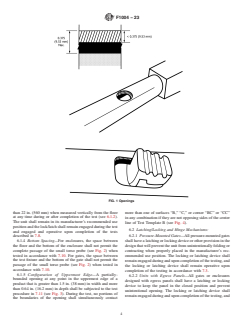
0.375 in. (9.53 mm) maximum by another rigid surface shall be permissible (see Fig. 1). The product shall be evaluated in all
manufacturer’s recommended positions.
5.5.1 Openings through multiple wall sections and openings created by multiple wall sections must meet the size requirements in
5.5 if the total thickness of the combined wall sections and any air gap between the wall sections is less than 0.375 in. (9.53 mm).
5.6 Exposed Coil Springs—Any exposed coil spring, which is accessible to the occupant having or capable of generating a space
between coils of 0.210 in. (5.33 mm) or greater during static load testing in accordance with 7.8 shall be covered or otherwise
designed to prevent injury from entrapment.
5.7 Scissoring, Shearing, and Pinching—The gate/expandable enclosure when in the manufacturer’s recommended use position(s)
shall be designed and constructed to prevent injury to the child from any scissoring, shearing, or pinching when members or
components rotate about a common axis or fastening point, slide, pivot, fold, or otherwise move relative to one another. Scissoring,
shearing, or pinching that may cause injury shall not be permissible when the edges of any rigid parts admit a probe greater than
0.210 in. (5.33 mm) and less than 0.375 in. (9.53 mm) diameter at any accessible point through the range of motion of such parts.
5.8 Labeling:
5.8.1 Warning labels (whether paper or nonpaper) shall be permanent when tested in accordance with 7.12.1 – 7.12.3.
5.8.2 Warning statements applied directly onto the surface of the product by hot stamping, heat transfer, printing, wood burning,
etc., shall be permanent when tested in accordance with 7.12.4.
F1004 − 23
FIG. 1 Openings
5.8.3 Nonpaper labels shall not liberate small parts when tested in accordance with 7.12.5.
5.9 The paint and surface coating on the product shall comply with 16 CFR 1303.
5.10 Protective Components—If a child can grasp protective components, such as caps, sleeves, or plugs used for protection from
sharp edges, points, or entrapment of fingers or toes, between the thumb and forefinger, or teeth, or if there is at least a 0.040 in.
(1.00 mm) gap between the component and its adjacent parent component, such components shall not be removed when tested in
accordance with 7.7.
6. Performance Requirements
6.1 The following performance requirements apply to gates and enclosures when they are erected or installed in any of the
manufacturer’s recommended use positions.
6.1.1 Completely-bounded Openings—Openings within the gate or enclosure, and completely-bounded openings between the gate
and the test fixture, shall not permit the complete passage of the small torso probe (see Fig. 2) when tested in accordance with 7.10.
F1004 − 23
NOTE 1—Not to scale.
FIG. 2 Small Torso Probe
6.1.2 Height of Sides—The vertical distance from the floor to the lowest point of the uppermost surface shall not be less than 22
in. (560 mm) when measured from the floor.
6.1.3 Vertical Strength—Uppermost top rails, edges, or framing components of the gates or enclosures shall be tested in
accordance with 7.8 and shall not fracture, disengage, fold, or have a deflection that reduces the lowest point of the uppermost
surface of a gate or enclosure to a dimension of less than 22 in. (560 mm) when measured vertically from the floor at any time
during or after completion of the test (see 6.1.2). The unit shall remain in its manufacturer’s recommended use position and the
lock/latch shall remain engaged during the test and engaged and operative upon completion of the tests described in 7.8.
6.1.4 Bottom Spacing—For enclosures, the space between the floor and the bottom of the enclosure shall not permit the complete
passage of the small torso probe (see Fig. 2) when tested in accordance with 7.10. For gates, the space between the test fixture and
the bottom of the gate shall not permit the passage of the small torso probe (see Fig. 2) when tested in accordance with 7.10.
6.1.5 Configuration of Uppermost Edge—A partially-bounded opening at any point in the uppermost edge of a product that is
greater than 1.5 in. (38 mm) in width and more than 0.64 in. (16.2 mm) in depth shall be subjected to the test procedure in 7.11
(see Fig. 3). During the test, no portions of the boundaries of the opening shall simultaneously contact more than one of surfaces
“B,” “C,” or corner “BC” or “CC” in any combination if they are not opposing sides of the center line of Test Template B (see
Fig. 4).
6.2 Latching/Locking and Hinge Mechanisms:
6.2.1 Pressure-Mounted Gates—All pressure-mounted gates shall have a latching or locking device or other provision in the
design that will prevent the unit from unintentionally folding or contracting when properly placed in the manufacturer’s
recommended use position. The locking or latching device shall remain engaged during and upon completion of the testing, and
the locking or latching device shall remain operative upon completion of the testing in accordance with 7.3.
6.2.2 Units with Egress Panels—All gates or enclosures designed with egress panels shall have a latching or locking device to keep
F1004 − 23
NOTE 1—Use a rectangular template to determine when a partially-bounded opening must be tested with Test Template B in accordance with 7.11.
FIG. 3 Walk-Through Style Baby Gate and Walls or Doorposts
the panel in the closed position and prevent unintentional opening. The locking or latching device shall remain engaged during and
upon completion of the testing, and the locking or latching device shall remain operative upon completion of the testing in
accordance with 7.3.
6.2.2.1 Automatic Closing Systems—Any unit with an automatic closing mechanism shall continue to close and automatically lock
or latch, without the intervention of the user, when tested in accordance with 7.4.
6.3 Horizontal Push-Out:
6.3.1 All gates shall be tested in accordance with 7.9. At each test location, the average push-out force shall exceed 30 lbf (133
N). In addition, each individual force shall exceed 20 lbf (89 N).
6.4 Locking Device—Every device provided to prevent the unlocking or unlatching of a product from the manufacturer’s
recommended use position(s) shall meet either 6.4.1 or 6.4.2.
6.4.1 Each single-action locking or latching device shall require a minimum force of 10 lbf (45 N) to activate the release
mechanism when tested in accordance with 7.6.
6.4.2 The locking or latching device shall be a double-action release mechanism. There are no force requirements for
double-action locking or latching devices.
6.5 Toys:
F1004 − 23
NOTE 1—Test Template B is to be constructed of smooth rigid material not less than ⁄8 in. (3.18 mm) thick.
FIG. 4 Test Template B
6.5.1 Toy accessories shall not be attached to, or sold with, a gate.
6.5.2 Toy accessories attached to, removable from, or sold with an enclosure, as well as their means of attachment, shall meet
applicable requirements of Specification F963.
6.6 Slat Strength Test—Gates and enclosures with wood or metal vertical members (slats) shall be tested in accordance with the
procedure in 7.13. Upon completion of testing, there shall be no complete breakage of any slat or complete separation of either
end of a slat from the gate or enclosure assembly’s horizontal members. Audible indications during testing shall not constitute
evidence of failure. After testing the gate shall comply with the requirements of Section 5 and 6.1.1.
6.7 Pressure-Mounted Gate-Mounting Hardware—Installation components (for example, wall cups) that are necessary for the gate
to meet the performance requirements in 6.3.1 shall be included with the gate in one of the following ways:
(a) Temporarily affixed to a main panel of the gate with the warning in 8.5.7 similarly attached.
(b) Temporarily attached to each of the pressure pads/tension bolt pads of the gate.
(c) Not affixed or attached to the gate as long as the gate is designed in such a way that does not allow for its installation without
the mounting hardware.
NOTE 1—The following are examples that would meet 6.7: (a) a bag containing the wall cups and printed with the same warning as in 8.5.7. (b) wall
cups that are attached to the pressure pads/tension bolt pads of the gate and remain in place until the consumer installs the gate or removes them. (c) a
gate with an on-gate pressure point that would obviously damage a wall without the wall cups installed.
6.8 Visual Side-pressure Indicators—Any pressure-mounted gate that does not require the use of pressure-mounted gate-mounting
hardware per 6.7 to meet the performance requirements in 6.3.1 shall include visual side-pressure indicators.
6.8.1 Visual side-pressure indicators shall be conspicuous and readily identifiable to a person installing and standing near the gate.
6.8.2 Visual side-pressure indicators shall monitor pressure for each point of contact with the mounting surface utilizing one or
F1004 − 23
more of the following three options. Such indicators, when the gate is tested in accordance with 7.9, shall indicate when the
required side pressure has been attained upon installation of the gate and continue to display the side pressure status while the gate
is in a manufacturer’s recommend use position.
6.8.2.1 A single visual side-pressure indicator for each individual contact point.
6.8.2.2 A single visual side-pressure indicator for each individual rail (top and bottom), so the opposing horizontal contact points
are addressed.
6.8.2.3 A single visual side-pressure indicator for the entire gate.
7. Test Methods
7.1 Test Fixture—A test fixture suitable for conducting the testing of gates shall be constructed and restrained in such a way to
prohibit movement of the fixture and shall not impede the application of the load or deflection of the gate being tested. There shall
be a means to adjust the width of the opening in the fixture to allow installation of the gate at the minimum and maximum opening
sizes specified by the manufacturer. The height of the fixture shall be at least as tall as the gate being tested.
7.1.1 The vertical rigid side members of the fixture shall be faced with nominal 2 in. by 4 in. (50 mm by 100 mm) pine boards
3 1
free of knots and surface blemishes. The bottom horizontal surface shall include a piece of ⁄4 in. plywood that is 18 in. 6 ⁄4 in.
(457 mm 6 6 mm) wide by 24 in. 6 ⁄4 in. (610 mm 6 6 mm) long located under the area being tested in 7.10. The test surface
of each board shall be sanded with 100 grit sandpaper, painted with two coats of semi-gloss latex paint, and then sanded with 220
grit sandpaper to remove any roughness or standing wood grain.
7.1.1.1 All sanding shall be with the grain of the wood. The surface of the boards shall remain flat after sanding.
7.1.1.2 The boards shall be replaced as needed when gate mounting hardware affects the wood surface so as to influence the test
results.
7.1.1.3 The boards shall be attached to the fixture in a manner that ensures no hardware interfere with mounting of the gate or
the test procedure.
7.1.2 The test fixture shall have some means to ensure that the pine boards are parallel after the width of the opening has been
adjusted to accommodate a specific gate sample.
7.2 Testing Guidelines:
7.2.1 The tests under this section shall be conducted in the order shown:
(1) Latching/Locking and Hinge Mechanism Durability Test
(2) Automatic Closing System Test, if applicable
(3) Remaining tests, except Slat Strength test, conducted in any order
(4) Slat Strength Test (the last test)
7.3 Latching/Locking and Hinge Mechanism Durability Test:
7.3.1 Setup for Testing:
7.3.1.1 For Testing Gates—Install the gate in the test fixture and adjust to the maximum opening width recommended by the
manufacturer. For pressure gates containing egress panels, the pressure mounts shall be rigidly connected to the test fixture so that
proper pressure is maintained to hold the gate in place during the test.
NOTE 2—The purpose of this test is to cycle test hinge mechanisms and locks/latches. It is not meant to test the attachment of any pressure mount.
7.3.1.2 For Testing Enclosures—Assemble the enclosure according to manufacturer’s instructions and secure the section being
tested to the floor such that it does not move during the tests below.
7.3.2 Mechanisms Durability Testing:
F1004 − 23
FIG. 5 Open Egress Panel
7.3.2.1 Units with egress panels shall be cycled through their normal full range of motion a total of 2000 cycles in accordance
with the manufacturer’s instructions. For egress panels that open in more than one direction, the cycles shall be done half in one
direction and half in the other direction. Cycling shall be conducted at a rate of no less than 12 cycles per minute. For gates
equipped with automatic closing systems, perform the test at the rate of the automatic closing system.
NOTE 3—If it is found to be more efficient, test method 7.3.2 may be divided into two separate tests: 2000 cycles of testing the locking/latching
mechanisms, and another 2000 cycles to test the hinge or retracting mechanism. In this case, the locking/latching mechanism should be cycled back and
forth through its locked/latched position to its unlocked/unlatched position. Then, in a separate test, the durability of the hinge or retract mechanism should
be tested cycling the egress panel 2000 times through its full range of motion per 7.3.2, but leaving out the step of actually locking/latching it shut between
each cycle.
7.3.2.2 For pressure gates without egress panels, the locking/latching mechanism shall be cycled 550 times; a cycle consisting of
removal and re-installing the gate on the test fixture.
7.4 Automatic Closing System Test—Following 7.3, with the unit still installed in the test fixture or secured to the floor, open the
egress panel 8 in. 6 ⁄4 in. (203 mm 6 6 mm) (see Fig. 5) and allow the panel to shut on its own. Repeat the test with the egress
panel opened to its maximum allowable opening. If the gate has a hold-open feature, open the gate to the point just before the
hold-open mechanism engages.
7.5 Locking Mechanism Test—For foot pedal actuated gates, apply a force of 35 lbf (156 N) in the direction tending to unlock it.
The force shall be applied to the foot pedal through a 2 in. by 2 in. by ⁄4 in. (50 mm by 50 mm by 19 mm) wooden block. Gradually
apply the force within 5 s and maintain for an additional 10 s.
7.6 Release Mechanism Test Method—With the product in each of the manufacturer’s recommended use position(s), gradually
apply a force of 10 lbf (45 N) to the release mechanism in the direction tending to unlock it.
7.7 Removal of Protective Components (5.10):
7.7.1 Components shall be tested in accordance with each of the following methods in the sequence listed.
7.7.2 Securely affix the gate/expandable enclosure so that it cannot move during performance of the following tests.
7.7.3 Tension Test—Attach a force gauge to the component (cap, sleeve, or plug) by means of any suitable device. A clamp, such
as shown in Fig. 6 may be a suitable device for components that cannot reasonably be expected to be grasped by a child’s fingers
on their outer diameter but which have a gap of 0.040 in. (1.00 mm) or more between the rear face of the component and the
structural member of the gate/expandable enclosure to which they are attached.
7.7.3.1 The attachment device shall not compress or expand the component so that it hinders any possible removal.
F1004 − 23
FIG. 6 Tension Test Adapter/Clamp
7.7.3.2 Apply force on the scale in a direction that normally would be associated with the removal of the protective component.
7.7.3.3 Apply the force gradually over a 5 s period and hold for an additional 10 s. The force required to break or remove the
component shall not be less than 15 lbf (67 N). Repeat this procedure once.
7.7.4 Torque Test—A torque of 3 lbf-in. (0.3 N-m) shall be applied gradually within a period of 5 s in a clockwise direction until
a rotation of 180° from the original position has been attained or 3 lbf-in. (0.3 N-m) has been reached. The torque or maximum
rotation shall be maintained for an additional 10 s. The torque shall then be removed and the test components permitted to return
to a relaxed condition. This procedure shall then be repeated in the counter-clockwise direction.
7.8 Vertical Strength (6.1.3 and 5.6):
7.8.1 Gates—Adjust the gate to the maximum opening width recommended by the manufacturer. Install the gate in the test fixture
according to the manufacturer’s instructions and lock or latch it in the closed position. Apply a static load of 45 lbf (200 N)
vertically downward five times to the center of the top rail, surface, or edge. For gates without a single top rail, surface, or edge,
apply the force to each of the top points of the gate. The force shall be applied through a 2 in. by 2 in. by ⁄4 in. (50 mm by 50 mm
by 19 mm) wood block. Gradually apply the force within 5 s and maintain for an additional 10 s, with approximately 5 s intervals
between applications. Repeat the test with the gate adjusted to the minimum opening width recommended by the manufacturer.
7.8.2 Enclosures—Adjust the enclosure to the manufacturer’s recommended maximum size configuration. Setup the enclosure in
the manufacturer’s recommended use position. Apply the same loading procedure as specified in 7.8.1 to every other uppermost
rail, surface, or edge and every other top joint. If there is an odd number of top joints, apply the loading procedure to an additional
joint. If the joints are different, apply load to the joints, which are more likely to result in failure or a nonconformance as defined
in 5.3.
7.9 Horizontal Push-Out Test:
7.9.1 Test Procedure:
F1004 − 23
NOTE 1—For Locations 1 and 3, force is applied at the top edge.
FIG. 7 Location of Force Application
7.9.1.1 Horizontal push-out tests shall be conducted at the maximum opening widths recommended by the manufacturer.
7.9.1.2 Follow the manufacturer’s installation instructions when installing the gate in the center of the test opening. For
pressure-mounted gates with visual side-pressure indicators, ensure the visual side-pressure indicators are displaying the proper
status per manufacturer’s instructions.
NOTE 4—To improve repeatability of the test, ensure the gate is mounted in the same location in the test fixture for each force application.
7.9.1.3 Mark the gate to show the five locations for the force application as shown in Fig. 7.
7.9.1.4 Gradually apply a force perpendicular to the plane of the gate at each marked location, over a period of 5 s until it reaches
45 lbf (200 N) and sustain this force for an additional 10 s. If the gate contact surface loses contact with the test fixture before
attaining 45 lbf (200 N), record the peak force at which loss of contact occurred. Each location shall be tested five times and the
five readings then shall be averaged.
(1) Ensure the test fixture remains square, within 0.063 in. (1.6 mm) throughout the remainder of the test.
NOTE 5—Use of a stop watch is recommended to ensure the force is applied gradually over 5 s and maintained for 10 s.
NOTE 6—To improve consistency of the test results, ensure that the contact pads of a pressure-mounted gate are clean, especially after each force
application.
(2) Tensile forces shall be applied to the side of the gate opposite to the side normally occupied by the child. The tensile force
is applied through a 7-strand military rope with a 550 lb tensile strength (for example, paracord 550) at each location.
(3) Whenever possible, the cord shall be attached by passing it through the gate and tying it around the frame or multiple
components of the gate. If the frame or multiple components are not located at a test location, the force shall be applied by
attaching the cord to the center of a hardwood block with a contact area of 6 in. by 6 in. (152 mm by 152 mm). When performing
the test, one side of the block shall be aligned with the top or bottom of the gate; the center of the block shall be located 5 in. (127
mm) from the side of the opening and 3 in. (76 mm) from the top or bottom of the gate, as applicable.
(4) If the gate configuration does not allow the attachment of a cord per 7.9.1.3(1) (Position No. (1)), compressive forces shall
be applied to the side of the gate normally occupied by the child. A compressive force may be applied through a hardwood block
with a contact area of 1 in. by 2 in. (25 mm by 50 mm).
7.10 Completely-bounded Openings and Bottom Spacing (6.1.1 and 6.1.4):
F1004 − 23
7.10.1 For Testing Gates—Securely install the gate in the test fixture in the manufacturer’s recommended use position deemed
most likely to cause failure. For pressure-mounted gates, the tester shall use temporary mounting hardware to ensure the gate does
not disengage from the test fixture during the test. Gates recommended for use at top of stairs shall be installed with one edge of
the “plywood floor board” at the minimum distance to the front edge of the first step of the stairs as recommended by the
manufacturer.
7.10.2 For Testing Enclosures—Assemble the enclosure in the manufacturer’s recommended use position deemed most likely to
cause failure and secure the section being tested such that it does not move during the tests below.
7.10.3 Into each completely-bounded opening or bottom space, insert the tapered end of the small torso probe, shown in Fig. 2,
with the major axis of the base of the probe parallel to the major axis of opening and in the locations deemed most likely to fail.
Push the probe with a 25 lbf (111 N) perpendicular to the base of the probe while maintaining the same angle. The force shall be
applied gradually within 5 s and maintained for an additional 10 s.
7.11 Partially-bounded Openings at the Uppermost Edge (6.1.5):
7.11.1 Place Test Template B (see Fig. 4) vertically downward into the opening with its center line vertical and the plane of the
template parallel to the plane of the opening, until downward motion is arrested by contact between the test template and the
boundaries of the opening. By visual inspection, determine if there is simultaneous contact between more than one of surfaces “B”
or “C,” or corners “BC” or “CC,” in any combination, that are on opposite sides of the template center line.
7.11.2 If the opening conforms to the requirements, but is not symmetrical about a vertical centerline, perform the following
additional test:
7.11.2.1 Rock the template sideways (parallel to the plane of the opening), while maintaining contact between the boundary of
the opening and surface “A” or corners “AB,” or both. The rocking motion shall be terminated when there is either contact between
a boundary of the opening and a surface or corner of the template other than surface “A” or corners “AB,” or until surface “B”
attains a vertical orientation. Again, visually determine if there is simultaneous contact between more than one of surfaces “B” or
“C,” or corners “BC” or “CC,” in any combination, that are on opposite sides of the template center line. If such contact occurs,
the opening fails to conform to the requirement.
7.11.3 If a product contains any partially-bounded openings, which change their configuration if the product is erected to less than
the maximum dimension claimed by the manufacturer, the test for conformance shall be repeated at the minimum dimension and,
at the discretion of the test personnel, at any dimension between the claimed minimum and maximum.
7.11.4 For any product in which the uppermost edge is a nonrigid member, the visual inspection for conformance to the
requirement shall be performed when a force of 30 lbf (134 N) is applied vertically downwards to Test Template B (see Fig. 4).
7.12 Label Testing (5.8):
7.12.1 A paper label (excluding labels attached by a seam) shall be considered permanent if, during an attempt to remove it without
the aid of tools or solvents, it cannot be removed, it tears into pieces upon removal, or such action damages the surface to which
it is attached.
7.12.2 A nonpaper label (excluding labels attached by a seam) shall be considered permanent if, during an attempt to remove it
without the aid of tools or solvents, it cannot be removed or such action damages the surface to which it is attached.
7.12.3 A warning label attached by a seam shall be considered permanent if it does not detach when subjected to a 15-lbf (67-N)
pull force applied in any direction using a ⁄4-in. (19-mm) diameter clamp surface.
7.12.4 Adhesion test for warnings applied directly onto the surface of the product.
7.12.4.1 Apply the tape test defined in Test Method B (Cross-Cut Tape Test of Test Methods D3359) eliminating parallel cuts.
7.12.4.2 Perform this test once in each different location where warnings are applied.
F1004 − 23
7.12.4.3 The warning statements will be considered permanent if the printing in the area tested is still legible and attached after
being subjected to this test.
7.12.5 A nonpaper label, during an attempt to remove it without the aid of tools or solvents, shall not be removed or shall not fit
entirely within the small parts cylinder defined in 16 CFR 1501 if it can be removed.
7.13 Slat Static Load Strength—Testing, as defined in this section, shall be the last in the sequence of testing performed upon a
gate or enclosure.
7.13.1 Gates—Adjust the gate to the maximum opening width recommended by the manufacturer. Install the gate in the test fixture
according to the manufacturer’s instructions and lock or latch it in the closed position. Pressure-mounted gates shall be securely
attached to ensure the gate remains in the test fixture during performance of this test.
7.13.1.1 Test 25 % (rounding up to the nearest percentage, if necessary) of all slats. Slats that offer the least resistance to bending
based upon their geometry shall be selected to be tested within this grouping of 25 % except that adjacent spindles/slats shall not
be tested.
7.13.1.2 Gradually, over a period of not less than 2 s nor greater than 5 s, apply a 45-lb force (200 N) perpendicular to the plane
of the side at the midpoint, between the top and bottom of the slat being tested. This force shall be applied through a force
measuring device and contact area 1 in. 6 ⁄16 in. (25.4 mm 6 1.6 mm) wide by a length at least equal to the width of the
spindle/slat being tested at the point of application. This force shall be maintained for 10 s.
7.13.2 Enclosures—Adjust the enclosure to the manufacturer’s recommended maximum size configuration. Securely affix one
panel of the enclosure in the test fixture so that it cannot move during performance of the test. Apply the same loading procedure
as specified in 7.13.1.1 and 7.13.1.2. If there are structural differences between panels of the same enclosure, test each unique panel
independently.
8. Marking and Labeling
8.1 Each gate/expandable enclosure and its retail packaging shall be marked or labeled clearly and legibly to indicate the
following:
8.1.1 The name, place of business (city, state, and mailing address, including zip code), and telephone number of the manufacturer,
distributor, or seller.
8.1.2 A code mark or other means that identifies the date (month and year as a minimum) of manufacture.
8.2 The marking and labeling on the product shall be permanent.
8.3 Any upholstery labeling required by law shall not be used to meet the requirements of this section.
8.4 Warning Design for Product:
8.4.1 The warnings shall be easy to read and understand and be in the English language at a minimum.
8.4.2 Any marking or labeling provided in addition to those required by this section shall not contradict or confuse the meaning
of the required information, or be otherwise misleading to the consumer.
8.4.3 The warnings shall be conspicuous and permanent.
8.4.4 The warnings shall conform to ANSI Z535.4 – 2011, sections 6.1 – 6.4, 7.2 – 7.6.3, and 8.1, with the following changes.
8.4.4.1 In 6.2.2, 7.3, 7.5, and 8.1.2, replace “should” with “shall.”
8.4.4.2 In 7.6.3, replace “should (when feasible)” with “shall.”
F1004 − 23
FIG. 8 Horizontal Warning Example Using List Format
8.4.4.3 Strike the word “safety” when used immediately before a color (for example, replace “safety white” with “white”).
NOTE 7—For reference, ANSI Z535.1 provides a system for specifying safety colors.
8.4.5 The safety alert symbol and the signal word “WARNING” shall be at least 0.2 in. (5 mm) high. The remainder of the text
shall be in characters whose upper case shall be at least 0.1 in. (2.5 mm), except where otherwise specified.
NOTE 8—For improved warning readability, typefaces with large height-to-width ratios, which are commonly identified as “condensed,” “compressed,”
“narrow,” or similar should be avoided.
8.4.6 Message Panel Text Layout:
8.4.6.1 The text shall be left-aligned, ragged-right for all but one-line text messages, which can be left-aligned or centered.
NOTE 9—Left-aligned means that the test is aligned along the left margin, and, in the case of multiple columns of text, along the left side of each individual
column. Please see Fig. X1.2 in Appendix X1 for examples of left-aligned text.
8.4.6.2 The text in each column should be arranged in list or outline format, with precautionary (hazard avoidance) statements
preceded by bullet points. Multiple precautionary statements shall be separated by bullet points if paragraph formatting is used.
8.4.7 Examples of warnings in the format described in this section are shown in Figs. 8-11.
NOTE 10—The examples shown in Figs. 8-11 are not shown to scale.
8.5 Warning statements on the product shall address the following:
F1004 − 23
FIG. 9 Horizontal Warning Example Using Paragraph Format
FIG. 10 Vertical Warning Example Using List Format
FIG. 11 Example Separate Wall Cup Installation Warning
NOTE 11—Address means that verbiage other than what is shown can be used as long as the meaning is the same or information that is product-specific
is presented. Brackets indicate that optional wording may be used at the manufacturer’s discretion if another identifier is more appropriate.
8.5.1 Children have died or been seriously injured when [gates/enclosures] are not securely installed.
8.5.2 ALWAYS install and use [gates/enclosures] as directed using all required parts.
8.5.3 STOP using when a child can climb over or dislodge the [gate/enclosure].
8.5.4 Pressure-mounted gates that have single-action locking mechanisms on one side of the product shall have a warning located
on a vertical surface on the side with the locking mechanism stating: Install with this side AWAY from child.
8.5.5 For enclosures with locking/latching mechanisms: Use only with the [locking/latching] mechanism securely engaged.
8.5.6 NEVER use to keep child away from pool.
8.5.7 Pressure-mounted gates that provide wall cups or other mounting hardware to meet the requirements of 6.3 shall have the
following warning in the location specified:
You MUST install [wall cups] to keep gate in place. Without [wall c
...