

ASTM D8531-23
(Specification)Standard Specification for Latex-Based Pavement Sealers Containing Mineral Aggregates
General Information
- Abstract
SCOPE
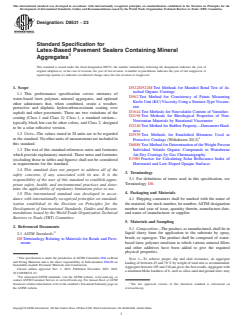
1.1 This performance specification covers mixtures of water-based latex polymer, mineral aggregates, and optional other admixtures that, when combined, create a weather-protective and aliphatic hydrocarbon-resistant coating over asphalt and other pavements. There are two variations of the coating (Class 1 and Class 2): Class 1, a standard version—typically black but can be other colors, and Class 2, designed to be a solar reflective version.
1.2 Units—The values stated in SI units are to be regarded as the standard. No other units of measurement are included in this standard.
1.3 The text of this standard references notes and footnotes which provide explanatory material. These notes and footnotes (excluding those in tables and figures) shall not be considered as requirements for the standard.
1.4 This standard does not purport to address all of the safety concerns, if any, associated with its use. It is the responsibility of the user of this standard to establish appropriate safety, health, and environmental practices and determine the applicability of regulatory limitations prior to use.
1.5 This international standard was developed in accordance with internationally recognized principles on standardization established in the Decision on Principles for the Development of International Standards, Guides and Recommendations issued by the World Trade Organization Technical Barriers to Trade (TBT) Committee.
- Status
- Published
- Publication Date
- 31-Oct-2023
- Technical Committee
- D04 - Road and Paving Materials
- Drafting Committee
- D04.99 - Sustainable Asphalt Pavement Materials and Construction


Overview
ASTM D8531-23: Standard Specification for Latex-Based Pavement Sealers Containing Mineral Aggregates establishes requirements for water-based latex polymer mixtures with mineral aggregates and optional admixtures. Designed for weather-protective and aliphatic hydrocarbon-resistant coatings, this standard applies to both asphalt and other pavement surfaces. The specification covers two types of sealers:
- Class 1: Standard version, typically black (may vary in color)
- Class 2: Solar reflective version for increased sustainability
This international ASTM standard supports the use of latex-based pavement sealers to improve pavement durability, resistance, and sustainability while aligning with global trade and quality requirements.
Key Topics
- Scope and Coverage: Includes performances of coatings made from water-based latex polymer emulsion, reinforced with mineral aggregates (such as silica sand or slate), and optional additives for enhanced properties.
- Performance Requirements: Specifies necessary physical and chemical characteristics of both liquid and cured sealers, such as:
- Viscosity
- Weight solids content
- VOC emissions (Volatile Organic Compounds)
- Shore A hardness
- Flexibility and resistance to hydrocarbons and water
- Drying and curing times
- Solar reflectance (notably for Class 2, with a minimum reflectance index)
- Application Guidance: Details proper application forms (spray, brush, squeegee) and environmental conditions for best results.
- Material Identification and Sampling: Outlines packaging markings for traceability, sampling practices, and quality control measures.
- Safety and Environmental Considerations: Notes that users must address all safety, health, and environmental aspects, ensuring compliance with relevant regulations.
Applications
Latex-based pavement sealers formulated according to ASTM D8531-23 are widely used in a range of settings to enhance the durability and longevity of paved surfaces. Common applications include:
- Roads and Highways: Protection against weathering and chemical attack, slowing pavement deterioration.
- Parking Lots and Driveways: Resistance to fuel and oil spills, reduction of cracks and surface degradation.
- Airport Runways and Taxiways: Protection against jet fuel, gasoline, and other hydrocarbons.
- Industrial and Commercial Pavements: Suitable for areas exposed to heavy traffic and chemical exposure.
The inclusion of mineral aggregates in the sealer improves slip and skid resistance, while the use of water-based latex polymers reduces VOC emissions and environmental impact. Solar reflective variants (Class 2) support urban heat island mitigation by improving reflective properties, making them especially suitable for sustainable infrastructure projects.
Related Standards
Several ASTM standards are referenced within ASTM D8531-23 or provide complementary requirements, including:
- ASTM D8: Terminology Relating to Materials for Roads and Pavements
- ASTM D522/D522M: Mandrel Bend Test of Attached Organic Coatings
- ASTM D562: Consistency of Paints Measuring Krebs Unit (KU) Viscosity
- ASTM D1644: Nonvolatile Content of Varnishes
- ASTM D2196: Rheological Properties of Non-Newtonian Materials by Rotational Viscometer
- ASTM D2240: Rubber Property - Durometer Hardness
- ASTM D2939: Emulsified Bitumens Used as Protective Coatings
- ASTM D6886: Determination of VOC in Waterborne Air-Dry Coatings
- ASTM E1980: Practice for Calculating Solar Reflectance Index
By adhering to ASTM D8531-23, users can ensure that latex-based pavement sealers deliver reliable, high-performance protection with clear specifications for composition, testing, and application, supporting safe, sustainable, and resilient infrastructure.
Frequently Asked Questions
ASTM D8531-23 is a technical specification published by ASTM International. Its full title is "Standard Specification for Latex-Based Pavement Sealers Containing Mineral Aggregates". This standard covers: SCOPE 1.1 This performance specification covers mixtures of water-based latex polymer, mineral aggregates, and optional other admixtures that, when combined, create a weather-protective and aliphatic hydrocarbon-resistant coating over asphalt and other pavements. There are two variations of the coating (Class 1 and Class 2): Class 1, a standard version—typically black but can be other colors, and Class 2, designed to be a solar reflective version. 1.2 Units—The values stated in SI units are to be regarded as the standard. No other units of measurement are included in this standard. 1.3 The text of this standard references notes and footnotes which provide explanatory material. These notes and footnotes (excluding those in tables and figures) shall not be considered as requirements for the standard. 1.4 This standard does not purport to address all of the safety concerns, if any, associated with its use. It is the responsibility of the user of this standard to establish appropriate safety, health, and environmental practices and determine the applicability of regulatory limitations prior to use. 1.5 This international standard was developed in accordance with internationally recognized principles on standardization established in the Decision on Principles for the Development of International Standards, Guides and Recommendations issued by the World Trade Organization Technical Barriers to Trade (TBT) Committee.
SCOPE 1.1 This performance specification covers mixtures of water-based latex polymer, mineral aggregates, and optional other admixtures that, when combined, create a weather-protective and aliphatic hydrocarbon-resistant coating over asphalt and other pavements. There are two variations of the coating (Class 1 and Class 2): Class 1, a standard version—typically black but can be other colors, and Class 2, designed to be a solar reflective version. 1.2 Units—The values stated in SI units are to be regarded as the standard. No other units of measurement are included in this standard. 1.3 The text of this standard references notes and footnotes which provide explanatory material. These notes and footnotes (excluding those in tables and figures) shall not be considered as requirements for the standard. 1.4 This standard does not purport to address all of the safety concerns, if any, associated with its use. It is the responsibility of the user of this standard to establish appropriate safety, health, and environmental practices and determine the applicability of regulatory limitations prior to use. 1.5 This international standard was developed in accordance with internationally recognized principles on standardization established in the Decision on Principles for the Development of International Standards, Guides and Recommendations issued by the World Trade Organization Technical Barriers to Trade (TBT) Committee.
ASTM D8531-23 is available in PDF format for immediate download after purchase. The document can be added to your cart and obtained through the secure checkout process. Digital delivery ensures instant access to the complete standard document.
Standards Content (Sample)
This international standard was developed in accordance with internationally recognized principles on standardization established in the Decision on Principles for the
Development of International Standards, Guides and Recommendations issued by the World Trade Organization Technical Barriers to Trade (TBT) Committee.
Designation: D8531 − 23
Standard Specification for
Latex-Based Pavement Sealers Containing Mineral
Aggregates
This standard is issued under the fixed designation D8531; the number immediately following the designation indicates the year of
original adoption or, in the case of revision, the year of last revision. A number in parentheses indicates the year of last reapproval. A
superscript epsilon (´) indicates an editorial change since the last revision or reapproval.
1. Scope D522/D522M Test Methods for Mandrel Bend Test of At-
tached Organic Coatings
1.1 This performance specification covers mixtures of
D562 Test Method for Consistency of Paints Measuring
water-based latex polymer, mineral aggregates, and optional
Krebs Unit (KU) Viscosity Using a Stormer-Type Viscom-
other admixtures that, when combined, create a weather-
eter
protective and aliphatic hydrocarbon-resistant coating over
D1644 Test Methods for Nonvolatile Content of Varnishes
asphalt and other pavements. There are two variations of the
D2196 Test Methods for Rheological Properties of Non-
coating (Class 1 and Class 2): Class 1, a standard version—
Newtonian Materials by Rotational Viscometer
typically black but can be other colors, and Class 2, designed
D2240 Test Method for Rubber Property—Durometer Hard-
to be a solar reflective version.
ness
1.2 Units—The values stated in SI units are to be regarded
D2939 Test Methods for Emulsified Bitumens Used as
as the standard. No other units of measurement are included in
Protective Coatings (Withdrawn 2012)
this standard.
D6886 Test Method for Determination of the Weight Percent
Individual Volatile Organic Compounds in Waterborne
1.3 The text of this standard references notes and footnotes
which provide explanatory material. These notes and footnotes Air-Dry Coatings by Gas Chromatography
E1980 Practice for Calculating Solar Reflectance Index of
(excluding those in tables and figures) shall not be considered
as requirements for the standard. Horizontal and Low-Sloped Opaque Surfaces
1.4 This standard does not purport to address all of the
3. Terminology
safety concerns, if any, associated with its use. It is the
3.1 For definitions of terms used in this specification, see
responsibility of the user of this standard to establish appro-
Terminology D8.
priate safety, health, and environmental practices and deter-
mine the applicability of regulatory limitations prior to use.
4. Packaging and Materials
1.5 This international standard was developed in accor-
dance with internationally recognized principles on standard-
4.1 Shipping containers shall be marked with the name of
ization established in the Decision on Principles for the the material, the stock number, lot number, ASTM designation
Development of International Standards, Guides and Recom-
number and year of issue, quantity therein, manufacture date,
mendations issued by the World Trade Organization Technical and name of manufacturer or supplier.
Barriers to Trade (TBT) Committee.
5. Materials and Sampling
2. Referenced Documents
5.1 Composition—The product, as manufactured, shall be in
liquid slurry form for application to the substrate by spray,
2.1 ASTM Standards:
brush, or squeegee. The product shall be composed of water-
D8 Terminology Relating to Materials for Roads and Pave-
based latex polymer emulsion to which various mineral fillers
ments
and other additives have been added to give the required
physical properties.
This specification is under the jurisdiction of ASTM Committee D04 on Road
NOTE 1—To achieve proper slip and skid resistance, an aggregate
and Paving Materials and is the direct responsibility of Subcommittee D04.99 on
loading of between 45 and 70 % by weight of total mix is recommended.
Sustainable Asphalt Pavement Materials and Construction.
Aggregate between 105 and 210 μm gives the best results. Aggregate with
Current edition approved Nov. 1, 2023. Published November 2023. DOI:
a minimum Mohs hardness of 6, such as silica sand and ground slate, may
10.1520/D8531-23.
For referenced ASTM standards, visit the ASTM website, www.astm.org, or
contact ASTM Customer Service at service@astm.org. For Annual Book of ASTM
Standards volume information, refer to the standard’s Document Summary page on The last approved version of this historical standard is referenced on
the ASTM website. www.astm.org.
Copyright © ASTM International, 100 Barr Harbor Drive, PO Box C700, West Conshohocken, PA 19428-2959. United States
D8531 − 23
ensure long wear resistance.
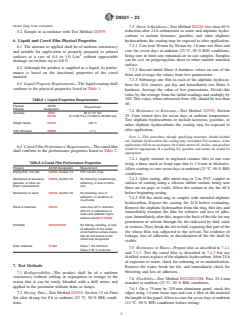
7.3 Shore A Hardness—Test Method D2240, less than 40 %
reduction after 24 h submersion in water and aliphatic hydro-
5.2 Sample in accordance with Test Method D2939.
carbons to include kerosene, gasoline, and other aliphatic
6. Liquid and Cured Film Physical Properties
hydrocarbons the coating may be exposed to after application.
7.3.1 Cast four 50 mm by 50 mm by 1.6 mm wet films and
6.1 The mixture as applied shall be of uniform consistency
cure for seven days at ambient (23 °C, 50 % RH) conditions,
and suitable for application to properly prepared or primed
being sure to limit any entrained air in cast samples. Samples
surfaces at a rate of 0.4 to 1.0 L/m without appreciable
can be cast on polypropylene sheet or other suitable nonstick
drainage on inclines up to 0.8 %.
surface.
6.2 Although the product is supplied as a liquid, its perfor-
7.3.2 Record initial Shore A hardness values on one of the
mance is based on the functional properties of the cured
films and average the values from five penetrations.
material.
7.3.3 Submerge one film in each of the aliphatic hydrocar-
6.3 Liquid Property Requirements—The liquid coating shall
bons for 24 h, remove, pat dry, and immediately test Shore A
conform to the physical properties listed in Table 1.
hardness. Average the value of five penetrations. Divide this
value by the average from the initial readings and multiply by
100. This value, when subtracted from 100, should be less than
TABLE 1 Liquid Properties Requirements
40.
Physical ASTM
Requirement
Property Designation
7.4 Resistance to Kerosene—Test Method D2939, Section
Viscosity D562 85 to 141 KU
25. Cure coated tiles for seven days at ambient temperature.
D2196 12 t
...