

ASTM A914/A914M-19
(Specification)Standard Specification for Steel Bars Subject to Restricted End-Quench Hardenability Requirements
General Information
- Abstract
ABSTRACT
This specification covers hot-worked alloy and carbon-boron steels designed to attain restricted depth of hardening in the end-quench test. These steel compositions are identified by the suffix letter “RH” added to the conventional grade number. The steel shall be made by one or more of the following primary processes: open-hearth, basic-oxygen, or electric furnace. The primary melting may incorporate separate degassing or ladle refining and may be followed by secondary melting using electroslag remelting or vacuum arc remelting. Where secondary melting is employed, the heat shall be defined as all the ingots remelted from a single primary heat. Immediately after hot working, the bars shall be allowed to cool when necessary to a temperature below the critical range under suitable conditions, to prevent injury by too rapid cooling. The steel shall have an austenitic grain size of five to eight. The grain structure shall be considered satisfactory when a minimum of 70% of the rated grains are within the specified size limits. Hardenability values specified are based on fine-grain steels and are not applicable to coarse-grain steel. All forged and rolled hardenability test specimens must be normalized prior to testing. Cast specimens need not be normalized.
SCOPE
1.1 This specification covers hot-worked alloy and carbon-boron steels designed to attain restricted depth of hardening in the end-quench test. These steel compositions are identified by the suffix letter “RH” added to the conventional grade number.
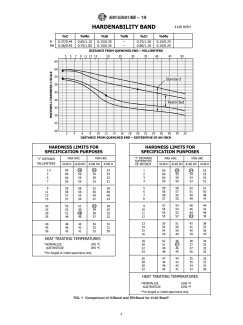
1.2 In general, steels with restricted hardenability (RH steels) will exhibit a hardness range not greater than 5 HRC at the initial position on the end-quench hardenability bar and not greater than 65 % of the hardness range for standard H-band steels (Specification A304) in the inflection region. Generally the restricted hardenability band follows the middle of the corresponding standard H-band. An example of the RH band compared with the H band is given for Grade 4140 in Fig. 1.
FIG. 1 Comparison of H-Band and RH-Band for 4140 SteelA
1.2.1 The values stated in either SI units or inch-pound units are to be regarded separately as standard. The values stated in each system may not be exact equivalents; therefore, each system shall be used independently of the other. Combining values from the two systems may result in non-conformance with the standard.
1.3 This specification is expressed in both inch-pound units and SI units. However, the material will be supplied to inch-pound units unless the purchase order specifies the “M” specification designation.
1.4 This international standard was developed in accordance with internationally recognized principles on standardization established in the Decision on Principles for the Development of International Standards, Guides and Recommendations issued by the World Trade Organization Technical Barriers to Trade (TBT) Committee.
- Status
- Published
- Publication Date
- 31-Oct-2019
- Technical Committee
- A01 - Steel, Stainless Steel and Related Alloys
- Drafting Committee
- A01.15 - Bars
Buy Documents
ASTM A914/A914M-19 - Standard Specification for Steel Bars Subject to Restricted End-Quench Hardenability Requirements
REDLINE ASTM A914/A914M-19 - Standard Specification for Steel Bars Subject to Restricted End-Quench Hardenability Requirements
Overview
ASTM A914/A914M-19 is the internationally recognized standard specification for hot-worked alloy and carbon-boron steel bars manufactured to meet restricted end-quench hardenability requirements. Under the jurisdiction of ASTM Committee A01, this standard applies to steel grades identified with the suffix “RH,” denoting “restricted hardenability.” The primary intent of ASTM A914/A914M-19 is to provide material solutions where carefully controlled depth and uniformity of hardening are essential for next-step manufacturing and critical engineering applications.
Steel bars compliant with this specification are processed to deliver a consistent, narrow band of hardenability performance, minimizing variation across the section. This is achieved by clearly defined manufacturing controls, grain size requirements, and hardness range limits according to the Jominy end-quench test.
Key Topics
Restricted Hardenability (RH) Bars
- Steels designated with “RH” demonstrate a controlled and limited depth of hardening, maintaining specific hardness ranges throughout.
- RH steels fall within a maximum hardness variation of 5 HRC at the initial position and not more than 65% of the corresponding standard H-band hardness range in the inflection region.
- Example grades include 4140RH, 4130RH, and 8620RH.
Manufacturing Methods
- Steel production may involve basic-oxygen or electric furnace processes, with optional secondary melting (such as electroslag or vacuum arc remelting) for enhanced cleanliness and consistency.
- Immediate cooling to below critical temperature after hot working ensures grain structure integrity.
Grain Size and Structure
- Specifications require an austenitic grain size between five and eight, with at least 70% of the grains within these limits.
- Fine grain size is essential for consistent hardenability and mechanical properties.
Hardenability Testing
- Conformance to the standard is established via hardness measurements at specific points along the quenched bar in accordance with ASTM A255.
- Both SI and inch-pound units are supported, but default supply is in inch-pound unless otherwise specified.
Applications
ASTM A914/A914M-19 steel bars are utilized whenever controlled hardenability is paramount for parts that undergo heat treatment, and where through-hardening or excessive case depth must be avoided. Typical applications include:
- Automotive and Heavy Equipment Components
- Shafts, gears, and axles requiring uniform mechanical properties and predictable performance after heat treatment.
- Forgings and Machined Parts
- Ideal for large cross-section forgings where a defined hardness profile is needed for fatigue resistance and dimensional stability.
- Precision-Engineered Structures
- Machine elements that demand minimized variation in core and surface hardness for function and safety.
These bars support robust quality assurance in demanding manufacturing environments by ensuring repeatability of heat treatment response, mechanical reliability, and optimized material usage.
Related Standards
ASTM A914/A914M-19 is referenced alongside and builds on several related standards for steel bar production and performance:
- ASTM A29/A29M - General requirements for hot-wrought carbon and alloy steel bars.
- ASTM A255 - Standard test methods for determining the hardenability of steel bars via the end-quench (Jominy) test.
- ASTM A304 - Specification for bars subject to standard (H-band) end-quench hardenability requirements.
- ASTM E112 - Test methods for determining average grain size.
- SAE J406/J1268/J1868 - SAE standards for hardenability determination and band specifications in steels.
By complying with ASTM A914/A914M-19, manufacturers and designers can select or specify steel bars with consistent, restricted hardenability, optimizing the heat treatment process and ensuring high-quality finished components across a range of industries.
Relations
- Effective Date
- 01-Nov-2019
- Effective Date
- 01-Sep-2018
- Effective Date
- 01-Dec-2016
- Effective Date
- 01-Nov-2015
- Effective Date
- 01-Oct-2014
- Effective Date
- 15-Nov-2012
- Effective Date
- 01-May-2012
- Effective Date
- 01-May-2012
- Effective Date
- 01-Oct-2011
- Effective Date
- 01-Oct-2011
- Effective Date
- 01-Apr-2011
- Effective Date
- 01-Apr-2011
- Effective Date
- 01-Nov-2010
- Effective Date
- 01-May-2010
- Effective Date
- 01-Sep-2007
Buy Documents
ASTM A914/A914M-19 - Standard Specification for Steel Bars Subject to Restricted End-Quench Hardenability Requirements
REDLINE ASTM A914/A914M-19 - Standard Specification for Steel Bars Subject to Restricted End-Quench Hardenability Requirements
Get Certified
Connect with accredited certification bodies for this standard

Element Materials Technology
Materials testing and product certification.

Inštitut za kovinske materiale in tehnologije
Institute of Metals and Technology. Materials testing, metallurgical analysis, NDT.
Sponsored listings
Frequently Asked Questions
ASTM A914/A914M-19 is a technical specification published by ASTM International. Its full title is "Standard Specification for Steel Bars Subject to Restricted End-Quench Hardenability Requirements". This standard covers: ABSTRACT This specification covers hot-worked alloy and carbon-boron steels designed to attain restricted depth of hardening in the end-quench test. These steel compositions are identified by the suffix letter “RH” added to the conventional grade number. The steel shall be made by one or more of the following primary processes: open-hearth, basic-oxygen, or electric furnace. The primary melting may incorporate separate degassing or ladle refining and may be followed by secondary melting using electroslag remelting or vacuum arc remelting. Where secondary melting is employed, the heat shall be defined as all the ingots remelted from a single primary heat. Immediately after hot working, the bars shall be allowed to cool when necessary to a temperature below the critical range under suitable conditions, to prevent injury by too rapid cooling. The steel shall have an austenitic grain size of five to eight. The grain structure shall be considered satisfactory when a minimum of 70% of the rated grains are within the specified size limits. Hardenability values specified are based on fine-grain steels and are not applicable to coarse-grain steel. All forged and rolled hardenability test specimens must be normalized prior to testing. Cast specimens need not be normalized. SCOPE 1.1 This specification covers hot-worked alloy and carbon-boron steels designed to attain restricted depth of hardening in the end-quench test. These steel compositions are identified by the suffix letter “RH” added to the conventional grade number. 1.2 In general, steels with restricted hardenability (RH steels) will exhibit a hardness range not greater than 5 HRC at the initial position on the end-quench hardenability bar and not greater than 65 % of the hardness range for standard H-band steels (Specification A304) in the inflection region. Generally the restricted hardenability band follows the middle of the corresponding standard H-band. An example of the RH band compared with the H band is given for Grade 4140 in Fig. 1. FIG. 1 Comparison of H-Band and RH-Band for 4140 SteelA 1.2.1 The values stated in either SI units or inch-pound units are to be regarded separately as standard. The values stated in each system may not be exact equivalents; therefore, each system shall be used independently of the other. Combining values from the two systems may result in non-conformance with the standard. 1.3 This specification is expressed in both inch-pound units and SI units. However, the material will be supplied to inch-pound units unless the purchase order specifies the “M” specification designation. 1.4 This international standard was developed in accordance with internationally recognized principles on standardization established in the Decision on Principles for the Development of International Standards, Guides and Recommendations issued by the World Trade Organization Technical Barriers to Trade (TBT) Committee.
ABSTRACT This specification covers hot-worked alloy and carbon-boron steels designed to attain restricted depth of hardening in the end-quench test. These steel compositions are identified by the suffix letter “RH” added to the conventional grade number. The steel shall be made by one or more of the following primary processes: open-hearth, basic-oxygen, or electric furnace. The primary melting may incorporate separate degassing or ladle refining and may be followed by secondary melting using electroslag remelting or vacuum arc remelting. Where secondary melting is employed, the heat shall be defined as all the ingots remelted from a single primary heat. Immediately after hot working, the bars shall be allowed to cool when necessary to a temperature below the critical range under suitable conditions, to prevent injury by too rapid cooling. The steel shall have an austenitic grain size of five to eight. The grain structure shall be considered satisfactory when a minimum of 70% of the rated grains are within the specified size limits. Hardenability values specified are based on fine-grain steels and are not applicable to coarse-grain steel. All forged and rolled hardenability test specimens must be normalized prior to testing. Cast specimens need not be normalized. SCOPE 1.1 This specification covers hot-worked alloy and carbon-boron steels designed to attain restricted depth of hardening in the end-quench test. These steel compositions are identified by the suffix letter “RH” added to the conventional grade number. 1.2 In general, steels with restricted hardenability (RH steels) will exhibit a hardness range not greater than 5 HRC at the initial position on the end-quench hardenability bar and not greater than 65 % of the hardness range for standard H-band steels (Specification A304) in the inflection region. Generally the restricted hardenability band follows the middle of the corresponding standard H-band. An example of the RH band compared with the H band is given for Grade 4140 in Fig. 1. FIG. 1 Comparison of H-Band and RH-Band for 4140 SteelA 1.2.1 The values stated in either SI units or inch-pound units are to be regarded separately as standard. The values stated in each system may not be exact equivalents; therefore, each system shall be used independently of the other. Combining values from the two systems may result in non-conformance with the standard. 1.3 This specification is expressed in both inch-pound units and SI units. However, the material will be supplied to inch-pound units unless the purchase order specifies the “M” specification designation. 1.4 This international standard was developed in accordance with internationally recognized principles on standardization established in the Decision on Principles for the Development of International Standards, Guides and Recommendations issued by the World Trade Organization Technical Barriers to Trade (TBT) Committee.
ASTM A914/A914M-19 is classified under the following ICS (International Classification for Standards) categories: 77.140.60 - Steel bars and rods. The ICS classification helps identify the subject area and facilitates finding related standards.
ASTM A914/A914M-19 has the following relationships with other standards: It is inter standard links to ASTM A914/A914M-16, ASTM A255-10(2018), ASTM A304-16, ASTM A29/A29M-15, ASTM A255-10(2014), ASTM E112-12, ASTM A29/A29M-12, ASTM A29/A29M-12e1, ASTM A304-11, ASTM A29/A29M-11a, ASTM A304-05(2011), ASTM A29/A29M-11, ASTM E112-10, ASTM A255-10, ASTM A255-07. Understanding these relationships helps ensure you are using the most current and applicable version of the standard.
ASTM A914/A914M-19 is available in PDF format for immediate download after purchase. The document can be added to your cart and obtained through the secure checkout process. Digital delivery ensures instant access to the complete standard document.
Standards Content (Sample)
This international standard was developed in accordance with internationally recognized principles on standardization established in the Decision on Principles for the
Development of International Standards, Guides and Recommendations issued by the World Trade Organization Technical Barriers to Trade (TBT) Committee.
Designation:A914/A914M −19
Standard Specification for
Steel Bars Subject to Restricted End-Quench Hardenability
Requirements
This standard is issued under the fixed designationA914/A914M; the number immediately following the designation indicates the year
of original adoption or, in the case of revision, the year of last revision. A number in parentheses indicates the year of last reapproval.
A superscript epsilon (´) indicates an editorial change since the last revision or reapproval.
1. Scope* A29/A29M SpecificationforGeneralRequirementsforSteel
Bars, Carbon and Alloy, Hot-Wrought
1.1 This specification covers hot-worked alloy and carbon-
A255 Test Methods for Determining Hardenability of Steel
boron steels designed to attain restricted depth of hardening in
A304 Specification for Carbon andAlloy Steel Bars Subject
the end-quench test. These steel compositions are identified by
to End-Quench Hardenability Requirements
the suffix letter “RH” added to the conventional grade number.
E112 Test Methods for Determining Average Grain Size
1.2 In general, steels with restricted hardenability (RH 3
2.2 SAE Standards:
steels) will exhibit a hardness range not greater than 5 HRC at
J 406 Methods of Determining Hardenability of Steels
the initial position on the end-quench hardenability bar and not
J 1268 Hardenability Bands for Carbon and Alloy H Steels
greater than 65 % of the hardness range for standard H-band
J 1868 Restricted Hardenability Bands for Selected Alloy
steels (Specification A304) in the inflection region. Generally
Steels
the restricted hardenability band follows the middle of the
corresponding standard H-band. An example of the RH band
3. Terminology
compared with the H band is given for Grade 4140 in Fig. 1.
3.1 Definitions of Terms Specific to This Standard:
1.2.1 ThevaluesstatedineitherSIunitsorinch-poundunits
3.1.1 hardenability—the relative ability of a steel to harden
are to be regarded separately as standard. The values stated in
under heat treatment becomes apparent in the degree to which
each system may not be exact equivalents; therefore, each
the material hardens when quenched at different cooling rates.
system shall be used independently of the other. Combining
3.1.1.1 Discussion—Hardenability is measured
values from the two systems may result in non-conformance
quantitatively, usually by noting the extent or depth of hard-
with the standard.
ening of a standard size and shape test specimen in a
1.3 This specification is expressed in both inch-pound units
standardized quench. In the end-quench test the depth of
and SI units. However, the material will be supplied to
hardening is the distance along the specimen from the
inch-pound units unless the purchase order specifies the “M”
quenched end to a given hardness.
specification designation.
4. Ordering Information
1.4 This international standard was developed in accor-
4.1 Orders for material under this specification should
dance with internationally recognized principles on standard-
include the following information, in proper sequence:
ization established in the Decision on Principles for the
4.1.1 Quantity (weight),
Development of International Standards, Guides and Recom-
4.1.2 Name of material (alloy or carbon-boron steel),
mendations issued by the World Trade Organization Technical
4.1.3 Cross-sectional shape,
Barriers to Trade (TBT) Committee.
4.1.4 Size,
2. Referenced Documents
4.1.5 Length,
4.1.6 Grade,
2.1 ASTM Standards:
4.1.7 End-quenched hardenability (see Section 9),
4.1.8 Report of heat analysis, if desired (see Section 7),
This specification is under the jurisdiction of ASTM Committee A01 on Steel,
4.1.9 Special straightness, if required,
Stainless Steel and Related Alloys and is the direct responsibility of Subcommittee
4.1.10 ASTM designation and date of issue, and
A01.15 on Bars.
Current edition approved Nov. 1, 2019. Published November 2019. Originally 4.1.11 End use or special requirements.
approved in 1992. Last previous edition approved in 2016 as A914/A914M – 16.
NOTE 1—A typical ordering description is as follows: 10 000 lb, alloy
DOI: 10.1520/A0914_A0914M-19.
For referenced ASTM standards, visit the ASTM website, www.astm.org, or
contact ASTM Customer Service at service@astm.org. For Annual Book of ASTM
Standards volume information, refer to the standard’s Document Summary page on Available from SAE International (SAE), 400 Commonwealth Dr.,Warrendale,
the ASTM website. PA 15096, http://www.sae.org.
*A Summary of Changes section appears at the end of this standard
Copyright ©ASTM International, 100 Barr Harbor Drive, PO Box C700, West Conshohocken, PA19428-2959. United States
A914/A914M−19
bars, round, 4.0-in. diameter by 10 ft, Grade 4140RH, heat analysis
5. Manufacture
required,completehardenabilitydatarequired,ASTMAXXX,[AXXXM]
5.1 Melting Practice—The steel shall be made by one or
dated _____ worm gear.
more of the following primary processes: basic-oxygen or
4.2 The purchaser shall specify the desired grade, including
electric furnace.The primary melting may incorporate separate
the suffix letters “RH,” in accordance with Table 1.
degassing or ladle refining and may be followed by secondary
melting using electroslag remelting or vacuum arc remelting.
4.3 Band limits are shown graphically and as tabulations in
Where secondary melting is employed, the heat shall be
Figs. 2-23, inclusive. For specification purposes, one must use
defined as all the ingots remelted from a single primary heat.
tabulated values of Rockwell hardness (HRC) as a function of
distance from the quenched end of the hardenability bar, either 5.2 Slow Cooling—Immediately after hot working, the bars
in inch-pound units (sixteenths of an inch) or in SI units shallbeallowedtocoolwhennecessarytoatemperaturebelow
thecriticalrangeundersuitableconditions,topreventinjuryby
(millimetres). Values below 20 HRC are not specified because
too rapid cooling.
such values are not accurate.
4.3.1 Band limits shown graphically are so depicted for
6. General Requirements
convenience in estimating the hardness values at various
6.1 Material furnished under this specification shall con-
intermediate locations on the end quench test bar for quick
form to the applicable requirements of the current edition of
comparisons of the various RH grades. The values of “Ap-
Specification A29/A29M, unless otherwise provided for in this
proximate Diameter of Rounds with SameAs-Quenched Hard-
specification.
ness” shown above each RH-band, were selected from ranges
appearing in Fig. 7 of SAE J 406. The RH-bands are presented
7. Chemical Requirements
graphically, with distances from the quenched end in both
7.1 The heat analysis shall conform to the requirements as
inch-pound units and also SI units.
to chemical composition prescribed in Table 1 for the grade
4.4 For specification purposes, RH-band steels shall exhibit
specified by the purchaser.
hardness within the minimum and maximum HRC range
8. Grain Size Requirements
specified at the J1 (J1.5-mm) position and shall meet one
additional minimum and one additional maximum value. In
8.1 The steel shall have an austenitic grain size of five to
this specification, the two additional hardness values shall
eight.The grain structure shall be considered satisfactory when
represent the approximate hardness for 50 % martensite for the
a minimum of 70 % of the rated grains are within the specified
minimum and maximum specified carbon content, respectively
size limits.
(exceptwherehardenabilityistoohigh;thenthetwoadditional
8.2 Hardenability values specified are based on fine-grain
hardness control values shall be five HRC points below the
steels and are not applicable to coarse-grain steel.
maximum hardness value specified at the J1 (J1.5-mm) posi-
tion).
9. End-Quench Hardenability Requirements
4.4.1 In general, these points define the critical locations of
9.1 The end-quench hardenability shall conform to the
the Jominy hardenability band for purposes of characterizing
requirements specified on the purchase order.
heat treatment response. The four specification points are
9.2 Hardenability values shall be specified in accordance
circled in the tables of hardness versus Jominy distance and on
withtheapplicablevaluesinFigs.2-23,inclusive,forthegrade
the RH-bands. For all other Jominy positions, a tolerance of
specified.
two points HRC is permitted for a maximum consecutive
⁄16-in. or 5-mm Jominy distance on the restricted hardenability
10. Test Specimens
band.
10.1 Number and Locat
...
This document is not an ASTM standard and is intended only to provide the user of an ASTM standard an indication of what changes have been made to the previous version. Because
it may not be technically possible to adequately depict all changes accurately, ASTM recommends that users consult prior editions as appropriate. In all cases only the current version
of the standard as published by ASTM is to be considered the official document.
Designation: A914/A914M − 16 A914/A914M − 19
Standard Specification for
Steel Bars Subject to Restricted End-Quench Hardenability
Requirements
This standard is issued under the fixed designation A914/A914M; the number immediately following the designation indicates the year
of original adoption or, in the case of revision, the year of last revision. A number in parentheses indicates the year of last reapproval.
A superscript epsilon (´) indicates an editorial change since the last revision or reapproval.
1. Scope*
1.1 This specification covers hot-worked alloy and carbon-boron steels designed to attain restricted depth of hardening in the
end-quench test. These steel compositions are identified by the suffix letter “RH” added to the conventional grade number.
1.2 In general, steels with restricted hardenability (RH steels) will exhibit a hardness range not greater than 5 HRC at the initial
position on the end-quench hardenability bar and not greater than 65 % of the hardness range for standard H-band steels
(Specification A304) in the inflection region. Generally the restricted hardenability band follows the middle of the corresponding
standard H-band. An example of the RH band compared with the H band is given for Grade 4140 in Fig. 1.
1.2.1 The values stated in either SI units or inch-pound units are to be regarded separately as standard. The values stated in each
system may not be exact equivalents; therefore, each system shall be used independently of the other. Combining values from the
two systems may result in non-conformance with the standard.
1.3 This specification is expressed in both inch-pound units and SI units. However, the material will be supplied to inch-pound
units unless the purchase order specifies the “M” specification designation.
1.4 This international standard was developed in accordance with internationally recognized principles on standardization
established in the Decision on Principles for the Development of International Standards, Guides and Recommendations issued
by the World Trade Organization Technical Barriers to Trade (TBT) Committee.
2. Referenced Documents
2.1 ASTM Standards:
A29/A29M Specification for General Requirements for Steel Bars, Carbon and Alloy, Hot-Wrought
A255 Test Methods for Determining Hardenability of Steel
A304 Specification for Carbon and Alloy Steel Bars Subject to End-Quench Hardenability Requirements
E112 Test Methods for Determining Average Grain Size
2.2 SAE Standards:
J 406 Methods of Determining Hardenability of Steels
J 1268 Hardenability Bands for Carbon and Alloy H Steels
J 1868 Restricted Hardenability Bands for Selected Alloy Steels
3. Terminology
3.1 Definitions of Terms Specific to This Standard:
3.1.1 hardenability—the relative ability of a steel to harden under heat treatment becomes apparent in the degree to which the
material hardens when quenched at different cooling rates.
3.1.1.1 Discussion—
This specification is under the jurisdiction of ASTM Committee A01 on Steel, Stainless Steel and Related Alloys and is the direct responsibility of Subcommittee A01.15
on Bars.
Current edition approved Dec. 1, 2016Nov. 1, 2019. Published December 2016November 2019. Originally approved in 1992. Last previous edition approved in 20112016
as A914/A914M - 92A914/A914M – 16.(2011). DOI: 10.1520/A0914_A0914M-16.10.1520/A0914_A0914M-19.
For referenced ASTM standards, visit the ASTM website, www.astm.org, or contact ASTM Customer Service at service@astm.org. For Annual Book of ASTM Standards
volume information, refer to the standard’s Document Summary page on the ASTM website.
Available from SAE International (SAE), 400 Commonwealth Dr., Warrendale, PA 15096, http://www.sae.org.
*A Summary of Changes section appears at the end of this standard
Copyright © ASTM International, 100 Barr Harbor Drive, PO Box C700, West Conshohocken, PA 19428-2959. United States
A914/A914M − 19
Hardenability is measured quantitatively, usually by noting the extent or depth of hardening of a standard size and shape test
specimen in a standardized quench. In the end-quench test the depth of hardening is the distance along the specimen from the
quenched end to a given hardness.
4. Ordering Information
4.1 Orders for material under this specification should include the following information, in proper sequence:
4.1.1 Quantity (weight),
4.1.2 Name of material (alloy or carbon-boron steel),
4.1.3 Cross-sectional shape,
4.1.4 Size,
4.1.5 Length,
4.1.6 Grade,
4.1.7 End-quenched hardenability (see Section 9),
4.1.8 Report of heat analysis, if desired (see Section 7),
4.1.9 Special straightness, if required,
4.1.10 ASTM designation and date of issue, and
4.1.11 End use or special requirements.
NOTE 1—A typical ordering description is as follows: 10 000 lb, alloy bars, round, 4.0-in. diameter by 10 ft, Grade 4140RH, heat analysis required,
complete hardenability data required, ASTM AXXX, [AXXXM] dated _____ worm gear.
4.2 The purchaser shall specify the desired grade, including the suffix letters “RH,” in accordance with Table 1.
4.3 Band limits are shown graphically and as tabulations in Figs. 2-23, inclusive. For specification purposes, one must use
tabulated values of Rockwell hardness (HRC) as a function of distance from the quenched end of the hardenability bar, either in
inch-pound units (sixteenths of an inch) or in SI units (millimetres). Values below 20 HRC are not specified because such values
are not accurate.
4.3.1 Band limits shown graphically are so depicted for convenience in estimating the hardness values at various intermediate
locations on the end quench test bar for quick comparisons of the various RH grades. The values of “Approximate Diameter of
Rounds with Same As-Quenched Hardness” shown above each RH-band, were selected from ranges appearing in Fig. 7 of SAE
J 406. The RH-bands are presented graphically, with distances from the quenched end in both inch-pound units and also SI units.
4.4 For specification purposes, RH-band steels shall exhibit hardness within the minimum and maximum HRC range specified
at the J1 (J1.5-mm) position and shall meet one additional minimum and one additional maximum value. In this specification, the
two additional hardness values shall represent the approximate hardness for 50 % martensite for the minimum and maximum
specified carbon content, respectively (except where hardenability is too high; then the two additional hardness control values shall
be five HRC points below the maximum hardness value specified at the J1 (J1.5-mm) position).
4.4.1 In general, these points define the critical locations of the Jominy hardenability band for purposes of characterizing heat
treatment response. The four specification points are circled in the tables of hardness versus Jominy distance and on the RH-bands.
For all other Jominy positions, a tolerance of two points HRC is permitted for a maximum consecutive ⁄16-in. or 5-mm Jominy
distance on the restricted hardenability band.
4.4.2 For example, referring to Fig. 9, a hardenability test bar of a steel meeting the requirements for 4140RH must exhibit a
hardness at J1 not less than 54 HRC, nor more than 59 HRC. At J12, the test bar must exhibit hardness not less than 43 HRC, but
the maximum hardness can be as high as 52 HRC (or even 54 HRC if the region of the test bar is chosen as the exception). At
J20, the bar must exhibit hardness not greater than 47 HRC, but the minimum hardness can be as low as 37 HRC (or as low as
35 HRC if this region of the test bar is chosen as the exception).
4.4.3 A similar example, referring to Fig. 9, for 4140RH with distances from the quenched end in millimetres would limit
hardness at J1.5 mm to not less than 54 HRC nor more than 59 HRC. At J20 mm, the test bar must exhibit hardness not less than
42 HRC. At J30 mm, the test bar must exhibit hardness not greater than 48 HRC.
5. Manufacture
5.1 Melting Practice—The steel shall be made by one or more of the following primary processes: basic-oxygen or electric
furnace. The primary melting may incorporate separate degassing or ladle refining and may be followed by secondary melting
using electroslag remelting or vacuum arc remelting. Where secondary melting is employed, the heat shall be defined as all the
ingots remelted from a single primary heat.
5.2 Slow Cooling—Immediately after hot working, the bars shall be allowed to cool when necessary to a temperature below the
critical range under suitable conditions, to prevent injury by too rapid cooling.
6. General Requirements
6.1 Material furnished under this specification shall conform to the applicable requirements of the current edition of
Specification A29/A29M, unless otherwise provided for in this specification.
---
...