

ASTM D1781-98(2021)
(Test Method)Standard Test Method for Climbing Drum Peel for Adhesives
General Information
- Abstract
SIGNIFICANCE AND USE
5.1 This test method may be used to determine comparative rather than fundamental measurements of adhesion and is particularly suitable for process control, some examples of which are listed.
5.1.1 This test method is particularly sensitive to adherend surface preparation and is of value where the adhesive is used in conjunction with a primer.
5.1.2 When a relatively brittle adhesive is used, the peel resistance can often give an indication of the degree of cure, that is, higher values than normally realized may indicate an incomplete cure. Direct comparison of different adhesives or processes can only be made when specimen design and test conditions are identical.
SCOPE
1.1 This test method covers the determination of the peel resistance of adhesive bonds between: a relatively flexible adherend and a rigid adherend; and the relatively flexible facing of a sandwich structure and its core, when tested under specified conditions.
1.2 The values stated in SI units are to be regarded as the standard. The values given in parentheses are for information only.
1.3 This standard does not purport to address all of the safety concerns, if any, associated with its use. It is the responsibility of the user of this standard to establish appropriate safety, health, and environmental practices and determine the applicability of regulatory limitations prior to use.
1.4 This international standard was developed in accordance with internationally recognized principles on standardization established in the Decision on Principles for the Development of International Standards, Guides and Recommendations issued by the World Trade Organization Technical Barriers to Trade (TBT) Committee.
- Status
- Published
- Publication Date
- 31-May-2021
- Technical Committee
- D14 - Adhesives
- Drafting Committee
- D14.80 - Metal Bonding Adhesives

Overview
ASTM D1781-98(2021), Standard Test Method for Climbing Drum Peel for Adhesives, is an internationally recognized standard published by ASTM International. This standard defines a consistent method for determining the peel resistance of adhesive bonds between a relatively flexible adherend and a rigid adherend, or between the flexible facing of a sandwich structure and its core. The climbing drum peel test is particularly useful for assessing adhesives used in industrial applications, emphasizing comparative analysis rather than fundamental adhesion properties.
Key Topics
Test Method Significance:
- Provides comparative measurements of adhesion for process control and quality assurance.
- Sensitive to the surface preparation of adherends, making it highly significant when adhesives are used with primers.
- The test can indicate the degree of cure, especially for relatively brittle adhesives; unusually high peel resistance may suggest incomplete cure.
- Directly compares adhesives or bonding processes only when specimen design and testing conditions are identical.
Specimen and Apparatus Requirements:
- Uses specimens consisting of bonded panels with specific dimensions.
- Requires a specialized climbing drum peel apparatus and a universal testing machine with controlled head speed and accurate load measurement.
- At least six specimens are typically tested for statistical relevance.
Procedure Highlights:
- Specimens are properly conditioned, bonded, and cut to avoid compromising the adhesive interface.
- The bonded assembly is clamped onto a drum, and the flexible adherend is peeled at a specific rate to measure the average peel load.
- Results are calculated and reported as peel torque per unit width, along with documentation of specimen preparation, testing conditions, and failure type.
Safety and Compliance:
- Users must establish appropriate safety, health, and environmental practices.
- The standard does not address specific risks; compliance with local regulations is required.
Applications
ASTM D1781 is widely used in the manufacturing, aerospace, construction, automotive, and composite materials industries to evaluate adhesive bonds in flexible-rigid assemblies and sandwich panels. Key application areas include:
Process Control:
Used routinely by manufacturers for quality assurance of adhesive bonding in layered materials and sandwich structures.Product Development:
Helps in selecting adhesives and surface preparation methods for new products that require durable bonding between flexible and rigid materials.Performance Evaluation:
Measures the consistency of adhesive performance and verifies the effectiveness of primers or curing processes.Failure Analysis:
Identifies the mode of failure in adhesive joints, supporting investigations into peel strength and possible improvements to bonding processes.
Related Standards
For broader context and integration, organizations may refer to the following related ASTM standards:
- ASTM D907: Terminology of Adhesives - Provides definitions of terms used in adhesive testing and bonding industries.
- ASTM E4: Practices for Force Verification of Testing Machines - Ensures accuracy and verification of load testing machines.
- ASTM B209/B209M: Specification for Aluminum and Aluminum-Alloy Sheet and Plate - Often relevant to test specimens for climbing drum peel tests.
Practical Value
Implementing ASTM D1781 supports:
- Consistent testing and benchmarking of adhesive bond strength
- Improved process control in laminated and sandwich panel production
- Enhanced product reliability and adherence to international quality standards
- Effective diagnosis of bonding failures and informed material selection
By following ASTM D1781, manufacturers and quality professionals ensure reliable performance of adhesive bonds, reducing risks and product failures in critical applications.
Relations
- Effective Date
- 01-Jun-2014
- Effective Date
- 01-Jul-2012
- Effective Date
- 01-May-2012
- Effective Date
- 01-Dec-2011
- Effective Date
- 01-Jan-2011
- Effective Date
- 01-Nov-2010
- Effective Date
- 01-Jun-2010
- Effective Date
- 01-Nov-2009
- Effective Date
- 01-Apr-2009
- Effective Date
- 01-Dec-2008
- Effective Date
- 01-Oct-2008
- Effective Date
- 15-Aug-2008
- Effective Date
- 01-Mar-2008
- Effective Date
- 01-Aug-2007
- Effective Date
- 01-Jan-2007
Get Certified
Connect with accredited certification bodies for this standard

DIN CERTCO
DIN Group product certification.

Smithers Quality Assessments
US management systems and product certification.
Sponsored listings
Frequently Asked Questions
ASTM D1781-98(2021) is a standard published by ASTM International. Its full title is "Standard Test Method for Climbing Drum Peel for Adhesives". This standard covers: SIGNIFICANCE AND USE 5.1 This test method may be used to determine comparative rather than fundamental measurements of adhesion and is particularly suitable for process control, some examples of which are listed. 5.1.1 This test method is particularly sensitive to adherend surface preparation and is of value where the adhesive is used in conjunction with a primer. 5.1.2 When a relatively brittle adhesive is used, the peel resistance can often give an indication of the degree of cure, that is, higher values than normally realized may indicate an incomplete cure. Direct comparison of different adhesives or processes can only be made when specimen design and test conditions are identical. SCOPE 1.1 This test method covers the determination of the peel resistance of adhesive bonds between: a relatively flexible adherend and a rigid adherend; and the relatively flexible facing of a sandwich structure and its core, when tested under specified conditions. 1.2 The values stated in SI units are to be regarded as the standard. The values given in parentheses are for information only. 1.3 This standard does not purport to address all of the safety concerns, if any, associated with its use. It is the responsibility of the user of this standard to establish appropriate safety, health, and environmental practices and determine the applicability of regulatory limitations prior to use. 1.4 This international standard was developed in accordance with internationally recognized principles on standardization established in the Decision on Principles for the Development of International Standards, Guides and Recommendations issued by the World Trade Organization Technical Barriers to Trade (TBT) Committee.
SIGNIFICANCE AND USE 5.1 This test method may be used to determine comparative rather than fundamental measurements of adhesion and is particularly suitable for process control, some examples of which are listed. 5.1.1 This test method is particularly sensitive to adherend surface preparation and is of value where the adhesive is used in conjunction with a primer. 5.1.2 When a relatively brittle adhesive is used, the peel resistance can often give an indication of the degree of cure, that is, higher values than normally realized may indicate an incomplete cure. Direct comparison of different adhesives or processes can only be made when specimen design and test conditions are identical. SCOPE 1.1 This test method covers the determination of the peel resistance of adhesive bonds between: a relatively flexible adherend and a rigid adherend; and the relatively flexible facing of a sandwich structure and its core, when tested under specified conditions. 1.2 The values stated in SI units are to be regarded as the standard. The values given in parentheses are for information only. 1.3 This standard does not purport to address all of the safety concerns, if any, associated with its use. It is the responsibility of the user of this standard to establish appropriate safety, health, and environmental practices and determine the applicability of regulatory limitations prior to use. 1.4 This international standard was developed in accordance with internationally recognized principles on standardization established in the Decision on Principles for the Development of International Standards, Guides and Recommendations issued by the World Trade Organization Technical Barriers to Trade (TBT) Committee.
ASTM D1781-98(2021) is classified under the following ICS (International Classification for Standards) categories: 83.180 - Adhesives. The ICS classification helps identify the subject area and facilitates finding related standards.
ASTM D1781-98(2021) has the following relationships with other standards: It is inter standard links to ASTM E4-14, ASTM D907-12a, ASTM D907-12, ASTM D907-11a, ASTM D907-11, ASTM B209-10, ASTM E4-10, ASTM E4-09a, ASTM E4-09, ASTM E4-08, ASTM D907-08b, ASTM D907-08a, ASTM D907-08, ASTM B209-07, ASTM E4-07. Understanding these relationships helps ensure you are using the most current and applicable version of the standard.
ASTM D1781-98(2021) is available in PDF format for immediate download after purchase. The document can be added to your cart and obtained through the secure checkout process. Digital delivery ensures instant access to the complete standard document.
Standards Content (Sample)
This international standard was developed in accordance with internationally recognized principles on standardization established in the Decision on Principles for the
Development of International Standards, Guides and Recommendations issued by the World Trade Organization Technical Barriers to Trade (TBT) Committee.
Designation: D1781 − 98 (Reapproved 2021)
Standard Test Method for
Climbing Drum Peel for Adhesives
This standard is issued under the fixed designation D1781; the number immediately following the designation indicates the year of
original adoption or, in the case of revision, the year of last revision. A number in parentheses indicates the year of last reapproval. A
superscript epsilon (´) indicates an editorial change since the last revision or reapproval.
This standard has been approved for use by agencies of the U.S. Department of Defense.
1. Scope 3. Terminology
1.1 This test method covers the determination of the peel
3.1 Definitions—Many of the terms used in this test method
resistance of adhesive bonds between: a relatively flexible
are defined in Terminology D907.
adherend and a rigid adherend; and the relatively flexible
facing of a sandwich structure and its core, when tested under
4. Summary of Test Method
specified conditions.
4.1 Determine the peeling force of a conditioned adhesive
1.2 The values stated in SI units are to be regarded as the
bonded sandwich assembly by peeling a face skin around a
standard. The values given in parentheses are for information
circular drum. This is done by clamping the assembly in a
only.
universal test machine. The average peeling load is determined
using a standard formula.
1.3 This standard does not purport to address all of the
safety concerns, if any, associated with its use. It is the
responsibility of the user of this standard to establish appro- 5. Significance and Use
priate safety, health, and environmental practices and deter-
5.1 This test method may be used to determine comparative
mine the applicability of regulatory limitations prior to use.
rather than fundamental measurements of adhesion and is
1.4 This international standard was developed in accor-
particularly suitable for process control, some examples of
dance with internationally recognized principles on standard-
which are listed.
ization established in the Decision on Principles for the
5.1.1 This test method is particularly sensitive to adherend
Development of International Standards, Guides and Recom-
surface preparation and is of value where the adhesive is used
mendations issued by the World Trade Organization Technical
in conjunction with a primer.
Barriers to Trade (TBT) Committee.
5.1.2 When a relatively brittle adhesive is used, the peel
resistance can often give an indication of the degree of cure,
2. Referenced Documents
that is, higher values than normally realized may indicate an
2.1 ASTM Standards:
incomplete cure. Direct comparison of different adhesives or
B209 Specification for Aluminum and Aluminum-Alloy
processes can only be made when specimen design and test
Sheet and Plate (Metric) B0209_B0209M
conditions are identical.
D907 Terminology of Adhesives
E4 Practices for Force Verification of Testing Machines
6. Apparatus
2.2 ASTM Adjuncts:
6.1 Peeling Apparatus, consisting of a flanged drum, flex-
Climbing Drum Peel Tester
ible loading straps or cables, and suitable clamps for holding
the test specimen. The apparatus illustrated in Fig. 1 has been
found to be satisfactory.
This test method is under the jurisdiction of ASTM Committee D14 on
6.1.1 The outside radius of the drum is 51.00 6 0.13 mm
Adhesives and is under the jurisdiction of Subcommittee D14.80 on Metal Bonding
(2.000 6 0.005 in.), and the radius of the flange, including one
Adhesives.
Current edition approved June 1, 2021. Published June 2021. Originally half of the thickness of the loading straps or cables, is 12.70 6
approved in 1960. Last previous edition approved in 2012 as D1781 – 98 (2012).
0.13mm(0.500 60.005in.)largerthantheradiusofthedrum.
DOI: 10.1520/D1781-98R21.
This 12.70 6 0.13 mm (0.500 6 0.005 in.) less half the
For referenced ASTM standards, visit the ASTM website, www.astm.org, or
thickness of the adherend to be peeled, is the effective torque
contact ASTM Customer Service at service@astm.org. For Annual Book of ASTM
Standards volume information, refer to the standard’s Document Summary page on
arm of the apparatus.
the ASTM website.
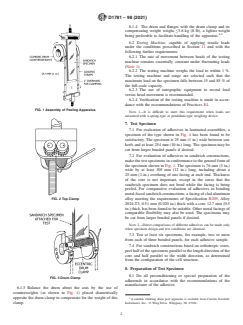
6.1.2 Use a suitable top clamp (Fig. 2) for supporting the
Detailed working drawings for the apparatus illustrated are available from
specimen, and a drum clamp (Fig. 3) to hold the adherend
ASTM International Headquarters. OrderAdjunct No. ADJD1781. Original adjunct
produced in 1960. against the face of the drum.
Copyright © ASTM International, 100 Barr Harbor Drive, PO Box C700, West Conshohocken, PA 19428-2959. United States
D1781 − 98 (2021)
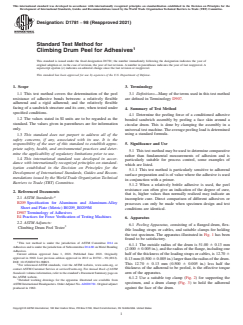
6.1.4 The drum and flanges with the drum clamp and its
compensating weight weighs ≤3.6 kg (8 lb), a lighter weight
4,3
being preferable to facilitate handling of the apparatus.
6.2 Testing Machine, capable of applying tensile loads
under the conditions prescribed in Section 11 and with the
following further requirements:
6.2.1 The rate of movement between heads of the testing
machine remains essentially constant under fluctuating loads
(Note 1).
6.2.2 The testing machine weighs the load to within 1 %.
The testing machine and range are selected such that the
maximum load on the specimen falls between 15 and 85 % of
the full-scale capacity.
6.2.3 The use of autographic equipment to record load
versus head movement is recommended.
6.2.4 Verification of the testing machine is made in accor-
dance with the recommendations of Practices E4.
FIG. 1 Assembly of Peeling Apparatus
NOTE 1—It is difficult to meet this requirement when loads are
measured with a spring-type or pendulum-type weighing device.
7. Test Specimen
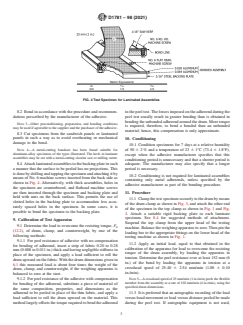
7.1 For evaluation of adhesives in laminated assemblies, a
specimen of the type shown in Fig. 4 has been found to be
satisfactory. The specimen is 25 mm (1 in.) wide between saw
kerfs and at least 254 mm (10 in.) long. The specimen may be
cut from larger bonded panels if desired.
7.2 For evaluation of adhesives in sandwich constructions,
make the test specimens in conformance to the general form of
the specimen shown in Fig. 1. The specimen is 76 mm (3 in.)
wide by at least 305 mm (12 in.) long, including about a
25-mm (1-in.) overhang of one facing at each end. Thickness
of the core is not important, except in the sense that the
sandwich specimen does not bend while the facing is being
peeled. For comparative evaluation of adhesives in bonding
metal-facedsandwichconstructions,afacingofcladaluminum
FIG. 2 Top Clamp alloy meeting the requirements of Specification B209, Alloy
2024-T3, 0.51 mm (0.020 in.) thick with a core 12.7 mm (0.5
in.) thick, has been found to be suitable. Other metal facings of
comparable flexibility may also be used. The specimens may
be cut from larger bonded panels if desired.
NOTE 2—Direct comparisons of different adhesives can be made only
when specimen design and test conditions are identical.
7.3 Test at least six specimens, for example, two or more
from each of three bonded panels, for each adhesive sample.
7.4 For sandwich constructions based on orthotropic cores,
peel half of the specimens parallel to the length direction of the
core and half parallel to the width direction, as determined
from the configuration of the cell structure.
8. Preparation of Test Specimen
8.1 Do all preconditioning or special preparation of the
FIG. 3 Drum Clamp
adherends in accordance with the recommendations of the
manufacturer of the adhesive.
6.1.3 Balance the drum about the axis by the use of
counterweights (as shown in Fig. 1) placed diametrically
opposite the drum clamp to compensate for the weight of this
A suitable climbing drum peel apparatus is available from Custom Scientific
clamp. Instruments, Inc., 13 Wing Drive, Whippany, NJ, 07981.
D1781 − 98 (2021)
Metric Equivalents
1 3
in. ⁄16 ⁄16
mm 1.5 4.5
FIG. 4 Test Specimen for Laminated Assemblies
8.2 Bond in accordance with the procedure and recommen- in the peel test. The forces imposed on the adherend during the
dations prescribed by the manufacturer of the adhesive. peel test usually result in greater bending than is obtained in
bending the unbonded adherend around the drum. More torque
NOTE 3—Other preconditioning, preparation, and bonding conditions
is required, therefore, to bend a bonded than an unbonded
may be u
...