

ASTM D3686-20
(Practice)Standard Practice for Sampling Atmospheres to Collect Organic Compound Vapors (Activated Charcoal Tube Adsorption Method)
General Information
- Abstract
SIGNIFICANCE AND USE
5.1 Promulgations by the U.S. Occupational Safety and Health Administration (OSHA) in 29 CFR 1910.1000 designate that certain organic compounds must not be present in workplace atmospheres at concentrations above specific values.
5.2 This practice, when used in conjunction with Test Method D3687, will provide the needed accuracy and precision for the determination of airborne time-weighted average concentrations of many of the organic chemicals including but not limited to CDC-99-74-45, HSM-99-71-31, NIOSH Manual of Analytical Methods, 29 CFR 1910.1000, OSHA Chemical Sampling Information, OSHA Sampling and Analytical Methods, and HSE Methods for the Determination of Hazardous Substances.
5.3 A partial list of chemicals for which this method is applicable is given in Annex A1, along with their OSHA permissible exposure limits.
SCOPE
1.1 This practice covers a method for the sampling of atmospheres to determine the presence of certain organic vapors by means of adsorption on activated charcoal using a charcoal tube and a small portable sampling pump worn by a worker. A list of some of the organic chemical vapors that can be sampled by this practice is provided in Annex A1. This list is presented as an information guide and should not be considered as absolute or complete.
1.2 This practice does not cover any method of sampling that requires special impregnation of activated charcoal or other adsorption media.
1.3 The values stated in SI units are to be regarded as standard. The values given in parentheses after SI units are provided for information only and are not considered standard.
1.4 This standard does not purport to address all of the safety concerns, if any, associated with its use. It is the responsibility of the user of this standard to establish appropriate safety, health, and environmental practices and determine the applicability of regulatory limitations prior to use. A specific safety precaution is given in 9.4.
1.5 This international standard was developed in accordance with internationally recognized principles on standardization established in the Decision on Principles for the Development of International Standards, Guides and Recommendations issued by the World Trade Organization Technical Barriers to Trade (TBT) Committee.
- Status
- Published
- Publication Date
- 29-Feb-2020
- Technical Committee
- D22 - Air Quality
- Drafting Committee
- D22.04 - Workplace Air Quality
Buy Documents
ASTM D3686-20 - Standard Practice for Sampling Atmospheres to Collect Organic Compound Vapors (Activated Charcoal Tube Adsorption Method)
REDLINE ASTM D3686-20 - Standard Practice for Sampling Atmospheres to Collect Organic Compound Vapors (Activated Charcoal Tube Adsorption Method)
Overview
ASTM D3686-20 is the international standard practice for sampling atmospheres to collect organic compound vapors using the activated charcoal tube adsorption method. Developed by ASTM International, this method provides a reliable approach for determining the presence of volatile organic compounds (VOCs) in workplace atmospheres. Its significance is highlighted by regulatory requirements such as those from the U.S. Occupational Safety and Health Administration (OSHA), which mandate monitoring and limiting worker exposure to hazardous organic vapors.
This standard is widely recognized in the fields of occupational hygiene, industrial safety, and environmental monitoring due to its accuracy, reproducibility, and compatibility with established analytical methods.
Key Topics
- Activated Charcoal Tube Sampling: The standard details the use of commercially available glass tubes filled with specified quantities of activated charcoal to adsorb organic vapors from air samples.
- Sampling Equipment: Instructions for the assembly and calibration of personal sampling pumps, tube holders, and flow meters are provided, ensuring accurate measurement and traceability.
- Applications to a Wide Range of Compounds: Annex A1 lists numerous organic vapors suitable for this method, including benzene, toluene, chloroform, acetone, and various alcohols and esters.
- Relevance to Regulatory Limits: The method supports compliance with regulatory requirements such as OSHA Permissible Exposure Limits (PELs), ensuring workplace air quality meets legal safety standards.
- Quality Control: Guidance on sample handling, chain-of-custody procedures, and the use of field blanks helps maintain data integrity and reliability.
- Limitations and Interferences: The standard addresses issues such as humidity and the presence of water vapor, which can affect the adsorptive capacity of activated charcoal.
Applications
ASTM D3686-20 is a core practice for the following applications:
- Workplace Air Monitoring: Used by industrial hygienists to assess airborne concentrations of hazardous organic compounds in occupational settings, such as manufacturing plants, laboratories, and chemical processing facilities.
- Regulatory Compliance: Ensures routine monitoring meets OSHA and NIOSH requirements for limiting worker exposure to toxic vapors.
- Exposure Assessment: Provides reliable data on time-weighted average concentrations of VOCs to support health risk assessments and the implementation of engineering controls or personal protective equipment (PPE).
- Industrial Hygiene Surveys: Facilitates baseline and ongoing assessments necessary for exposure monitoring plans, hazard communication, and risk management strategies.
Sampling typically involves a worker wearing a calibrated low-flow sampling pump connected to a charcoal tube positioned in the breathing zone. After sampling, the tubes are sealed, labeled, and sent to an analytical laboratory for quantification, typically via gas chromatography.
Related Standards
Several standards and best practice documents are referenced within ASTM D3686-20, ensuring its integration with broader air quality and laboratory quality systems:
- ASTM D3687 – Analysis of organic compound vapors collected by the charcoal tube adsorption method
- ASTM D1356 – Terminology relating to sampling and analysis of atmospheres
- ASTM D5337 – Practice for flow rate adjustment of personal sampling pumps
- NIOSH Manual of Analytical Methods (NMAM)
- OSHA 29 CFR 1910.1000 – Air contaminants regulations
- OSHA Sampling and Analytical Methods
- ISO/IEC 17025 – General requirements for the competence of testing and calibration laboratories
- UK HSE MDHS – Methods for the Determination of Hazardous Substances
ASTM D3686-20 remains a vital standard for effective air monitoring, exposure assessment, and regulatory compliance in workplaces where organic vapors pose health and safety risks.
Relations
- Effective Date
- 01-Mar-2020
- Effective Date
- 15-Mar-2020
- Effective Date
- 15-Aug-2018
- Effective Date
- 15-Oct-2015
- Effective Date
- 01-Jul-2015
- Effective Date
- 01-Dec-2014
- Effective Date
- 01-May-2014
- Effective Date
- 15-Jan-2014
- Effective Date
- 01-Apr-2012
- Effective Date
- 15-Nov-2011
- Effective Date
- 01-Apr-2010
- Effective Date
- 01-Feb-2010
- Effective Date
- 01-Oct-2007
- Effective Date
- 01-May-2005
- Effective Date
- 01-Dec-2004
Buy Documents
ASTM D3686-20 - Standard Practice for Sampling Atmospheres to Collect Organic Compound Vapors (Activated Charcoal Tube Adsorption Method)
REDLINE ASTM D3686-20 - Standard Practice for Sampling Atmospheres to Collect Organic Compound Vapors (Activated Charcoal Tube Adsorption Method)
Get Certified
Connect with accredited certification bodies for this standard

CIS Institut d.o.o.
Personal Protective Equipment (PPE) certification body. Notified Body NB-2890 for EU Regulation 2016/425 PPE.

Kiwa BDA Testing
Building and construction product certification.
Kmetijski inštitut Slovenije
Agricultural Institute of Slovenia. Soil testing, plant health, agricultural product analysis.
Sponsored listings
Frequently Asked Questions
ASTM D3686-20 is a standard published by ASTM International. Its full title is "Standard Practice for Sampling Atmospheres to Collect Organic Compound Vapors (Activated Charcoal Tube Adsorption Method)". This standard covers: SIGNIFICANCE AND USE 5.1 Promulgations by the U.S. Occupational Safety and Health Administration (OSHA) in 29 CFR 1910.1000 designate that certain organic compounds must not be present in workplace atmospheres at concentrations above specific values. 5.2 This practice, when used in conjunction with Test Method D3687, will provide the needed accuracy and precision for the determination of airborne time-weighted average concentrations of many of the organic chemicals including but not limited to CDC-99-74-45, HSM-99-71-31, NIOSH Manual of Analytical Methods, 29 CFR 1910.1000, OSHA Chemical Sampling Information, OSHA Sampling and Analytical Methods, and HSE Methods for the Determination of Hazardous Substances. 5.3 A partial list of chemicals for which this method is applicable is given in Annex A1, along with their OSHA permissible exposure limits. SCOPE 1.1 This practice covers a method for the sampling of atmospheres to determine the presence of certain organic vapors by means of adsorption on activated charcoal using a charcoal tube and a small portable sampling pump worn by a worker. A list of some of the organic chemical vapors that can be sampled by this practice is provided in Annex A1. This list is presented as an information guide and should not be considered as absolute or complete. 1.2 This practice does not cover any method of sampling that requires special impregnation of activated charcoal or other adsorption media. 1.3 The values stated in SI units are to be regarded as standard. The values given in parentheses after SI units are provided for information only and are not considered standard. 1.4 This standard does not purport to address all of the safety concerns, if any, associated with its use. It is the responsibility of the user of this standard to establish appropriate safety, health, and environmental practices and determine the applicability of regulatory limitations prior to use. A specific safety precaution is given in 9.4. 1.5 This international standard was developed in accordance with internationally recognized principles on standardization established in the Decision on Principles for the Development of International Standards, Guides and Recommendations issued by the World Trade Organization Technical Barriers to Trade (TBT) Committee.
SIGNIFICANCE AND USE 5.1 Promulgations by the U.S. Occupational Safety and Health Administration (OSHA) in 29 CFR 1910.1000 designate that certain organic compounds must not be present in workplace atmospheres at concentrations above specific values. 5.2 This practice, when used in conjunction with Test Method D3687, will provide the needed accuracy and precision for the determination of airborne time-weighted average concentrations of many of the organic chemicals including but not limited to CDC-99-74-45, HSM-99-71-31, NIOSH Manual of Analytical Methods, 29 CFR 1910.1000, OSHA Chemical Sampling Information, OSHA Sampling and Analytical Methods, and HSE Methods for the Determination of Hazardous Substances. 5.3 A partial list of chemicals for which this method is applicable is given in Annex A1, along with their OSHA permissible exposure limits. SCOPE 1.1 This practice covers a method for the sampling of atmospheres to determine the presence of certain organic vapors by means of adsorption on activated charcoal using a charcoal tube and a small portable sampling pump worn by a worker. A list of some of the organic chemical vapors that can be sampled by this practice is provided in Annex A1. This list is presented as an information guide and should not be considered as absolute or complete. 1.2 This practice does not cover any method of sampling that requires special impregnation of activated charcoal or other adsorption media. 1.3 The values stated in SI units are to be regarded as standard. The values given in parentheses after SI units are provided for information only and are not considered standard. 1.4 This standard does not purport to address all of the safety concerns, if any, associated with its use. It is the responsibility of the user of this standard to establish appropriate safety, health, and environmental practices and determine the applicability of regulatory limitations prior to use. A specific safety precaution is given in 9.4. 1.5 This international standard was developed in accordance with internationally recognized principles on standardization established in the Decision on Principles for the Development of International Standards, Guides and Recommendations issued by the World Trade Organization Technical Barriers to Trade (TBT) Committee.
ASTM D3686-20 is classified under the following ICS (International Classification for Standards) categories: 13.040.20 - Ambient atmospheres. The ICS classification helps identify the subject area and facilitates finding related standards.
ASTM D3686-20 has the following relationships with other standards: It is inter standard links to ASTM D3686-13, ASTM D1356-20, ASTM D4840-99(2018)e1, ASTM D1356-15a, ASTM D1356-15, ASTM D1356-14b, ASTM D1356-14a, ASTM D1356-14, ASTM D3687-07(2012), ASTM D5337-11, ASTM D1356-05(2010), ASTM D4840-99(2010), ASTM D3687-07, ASTM D1356-05, ASTM D5337-04. Understanding these relationships helps ensure you are using the most current and applicable version of the standard.
ASTM D3686-20 is available in PDF format for immediate download after purchase. The document can be added to your cart and obtained through the secure checkout process. Digital delivery ensures instant access to the complete standard document.
Standards Content (Sample)
This international standard was developed in accordance with internationally recognized principles on standardization established in the Decision on Principles for the
Development of International Standards, Guides and Recommendations issued by the World Trade Organization Technical Barriers to Trade (TBT) Committee.
Designation: D3686 − 20
Standard Practice for
Sampling Atmospheres to Collect Organic Compound
Vapors (Activated Charcoal Tube Adsorption Method)
This standard is issued under the fixed designation D3686; the number immediately following the designation indicates the year of
original adoption or, in the case of revision, the year of last revision. A number in parentheses indicates the year of last reapproval. A
superscript epsilon (´) indicates an editorial change since the last revision or reapproval.
1. Scope D3687 Test Method for Analysis of Organic Compound
Vapors Collected by theActivated CharcoalTubeAdsorp-
1.1 This practice covers a method for the sampling of
tion Method
atmospheres to determine the presence of certain organic
D4840 Guide for Sample Chain-of-Custody Procedures
vapors by means of adsorption on activated charcoal using a
D5337 Practice for Flow RateAdjustment of Personal Sam-
charcoal tube and a small portable sampling pump worn by a
pling Pumps
worker.Alist of some of the organic chemical vapors that can
2.2 NIOSH Standards:
be sampled by this practice is provided in Annex A1. This list
CDC-99-74-45 Documentation of NIOSH Validation Tests
is presented as an information guide and should not be
HSM-99-71-31 Personal Sampler Pump for Charcoal
considered as absolute or complete.
Tubes; Final Report
1.2 This practice does not cover any method of sampling 4
NIOSH Manual of Analytical Methods
that requires special impregnation of activated charcoal or
2.3 OSHA Standards:
other adsorption media.
29 CFR 1910 U.S. Code of Federal Regulations Relating to
1.3 The values stated in SI units are to be regarded as Labor, U.S. Occupational Safety and Health
standard. The values given in parentheses after SI units are Administration, Department of Labor
provided for information only and are not considered standard. OSHA Chemical Sampling Information
OSHA Sampling and Analytical Methods
1.4 This standard does not purport to address all of the
2.4 Other Documents:
safety concerns, if any, associated with its use. It is the
ISO/IEC 17025 General Requirements for the Competence
responsibility of the user of this standard to establish appro-
of Testing and Calibration Laboratories
priate safety, health, and environmental practices and deter-
mine the applicability of regulatory limitations prior to use. A
3. Terminology
specific safety precaution is given in 9.4.
3.1 Definitions—For definitions of terms used in this
1.5 This international standard was developed in accor-
method, refer to Terminology D1356.
dance with internationally recognized principles on standard-
ization established in the Decision on Principles for the
3.2 Definitions of Terms Specific to This Standard:
Development of International Standards, Guides and Recom-
3.2.1 activated charcoal, n—charcoal that has been heated
mendations issued by the World Trade Organization Technical
or otherwise treated to increase its adsorptive power.
Barriers to Trade (TBT) Committee.
3.2.1.1 Discussion—Acommon procedure is to increase the
inherent porosity of charcoal derived from biological precur-
2. Referenced Documents
sors (for example, nut shells) by steam activation. Prior to use
2.1 ASTM Standards:
D1356 Terminology Relating to Sampling and Analysis of
Available from National Technical Information Service (NTIS), 5285 Port
Atmospheres
Royal Rd., Springfield, VA 22161, http://www.ntis.gov.
NIOSH Manual of Analytical Methods, http://www.cdc.gov/niosh/nmam.
AvailablefromU.S.GovernmentPrintingOfficeSuperintendentofDocuments,
This practice is under the jurisdiction ofASTM Committee D22 on Air Quality 732 N. Capitol St., NW, Mail Stop: SDE, Washington, DC 20401, http://
and is the direct responsibility of Subcommittee D22.04 on WorkplaceAir Quality. www.access.gpo.gov.
Current edition approved March 1, 2020. Published June 2020. Originally OSHAChemical Sampling Information, http://osha.gov/dts/chemicalsampling/
approved in 1978. Last previous edition approved in 2013 as D3686 – 13. DOI: toc/toc_chemsamp.html.
10.1520/D3686-20. OSHA Sampling and Analytical Methods, http://osha.gov/dts/sltc/methods/
For referenced ASTM standards, visit the ASTM website, www.astm.org, or toc.html.
contact ASTM Customer Service at service@astm.org. For Annual Book of ASTM Available from International Organization for Standardization (ISO), ISO
Standards volume information, refer to the standard’s Document Summary page on Central Secretariat, BIBC II, Chemin de Blandonnet 8, CP 401, 1214 Vernier,
the ASTM website. Geneva, Switzerland, http://www.iso.org.
Copyright © ASTM International, 100 Barr Harbor Drive, PO Box C700, West Conshohocken, PA 19428-2959. United States
D3686 − 20
FIG. 1 Activated Charcoal Adsorption Sampling Tube
in this application, activated charcoals may need to be further and reactive chemicals, for example, acetone, although it
treated to remove remnant organic compounds. should not affect most chemicals listed in Annex A1. Alterna-
tive sorbents are available for sampling polar and reactive
4. Summary of Practice
compounds at high humidity. Users are advised to consult their
4.1 Air samples are collected for organic vapor analysis by analytical laboratory, method documentation, or associated
literature for more information.
aspirating air at a known rate and for an appropriate time
through sampling tubes containing activated charcoal.
6.2 High levels of organic vapors can interfere by reducing
the amount of time a workplace can be sampled before the
4.2 Instructions are given to enable assembly of charcoal
tubes suitable for sampling purposes. charcoal sampler becomes saturated.
4.3 Information on the correct use of the charcoal tube
7. Apparatus
sampling device is presented.
7.1 Charcoal Tube:
4.4 Test Method D3687 describes a method for the analysis
7.1.1 A sampling tube consists of a length of glass tubing
of these samples.
usually containing two sections of activated charcoal that are
held in place and separated by nonadsorbent material.The tube
5. Significance and Use
is sealed at each end.
5.1 Promulgations by the U.S. Occupational Safety and
7.1.1.1 Sampling tubes are commercially available. The
Health Administration (OSHA) in 29 CFR 1910.1000 desig-
tubes are usually divided into two sections with the front
nate that certain organic compounds must not be present in
section containing 100 to 800 mg of activated charcoal and the
workplace atmospheres at concentrations above specific val-
back section containing 50 to 400 mg of activated charcoal.
ues.
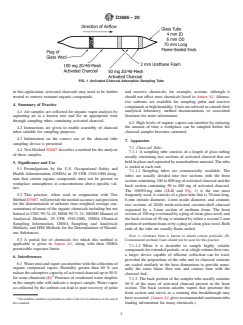
The 100/50-mg tube ((2-4) and Fig. 1) is the one most
5.2 This practice, when used in conjunction with Test
frequently used, it consists of a glass tube that is 70-mm long,
MethodD3687,willprovidetheneededaccuracyandprecision
6-mm outside diameter, 4-mm inside diameter, and contains
for the determination of airborne time-weighted average con-
two sections of 20/40 mesh-activated coconut-shell charcoal
centrations of many of the organic chemicals including but not
separated by a 2-mm section of urethane foam. The front
limited to CDC-99-74-45, HSM-99-71-31, NIOSH Manual of
sectionof100mgisretainedbyaplugofcleanglasswool,and
Analytical Methods, 29 CFR 1910.1000, OSHA Chemical
the back section of 50 mg is retained by either a second 2-mm
Sampling Information, OSHA Sampling and Analytical
portionofurethanefoamorbyaplugofcleanglasswool.Both
Methods, and HSE Methods for the Determination of Hazard-
ends of the tube are usually flame-sealed.
ous Substances.
NOTE 1—Urethane foam is known to adsorb certain pesticides (5).
5.3 A partial list of chemicals for which this method is Contaminated urethane foam should not be used for this practice.
applicable is given in Annex A1, along with their OSHA
7.1.1.2 When it is desirable to sample highly volatile
permissible exposure limits.
compoundsforextendedperiods,oratahighvolumeflowrate,
a larger device capable of efficient collection can be used,
6. Interferences
provided the proportions of the tube and its charcoal contents
6.1 Watermistandvaporcaninterferewiththecollectionof
are scaled similarly to the base dimensions to provide nomi-
organic compound vapors. Humidity greater than 60 % can
nally the same linear flow rate and contact time with the
reducetheadsorptivecapacityofactivatedcharcoalupto50%
charcoal bed.
for some chemicals (1). Presence of condensed water droplets
7.1.2 The back portion of the sampler tube usually contains
in the sample tube will indicate a suspect sample. Water vapor
50 % of the mass of activated charcoal present in the front
co-collected by the sorbent can lead to poor recovery of polar
section. The back section adsorbs vapors that penetrate the
front section and serves as a warning that breakthrough may
have occurred. (AnnexA1 gives recommended maximum tube
The boldface numbers in parentheses refer to the list of references at the end of
this standard. loading information for many chemicals.)
D3686 − 20
7.1.3 Theadsorptivecapacityandextractionefficiency(also 9. Sampling with Activated Charcoal Samplers
called desorption efficiency) of different batches of activated
9.1 Setting the Flow-rate of the Sampling System—The
charcoal can vary. Commercial tubes, if used, should be
sampling system consists of a pump, flow regulator, tubing to
purchased from the same batch and in sufficient number to
be used, and a representative charcoal tube (or an equivalent
provide sampling capability for an adequate period of time.
induced resistance). The air flow through the sampling system
Care must be taken to have enough tubes from the same batch
should be adjusted and set at the desired rate by means of a
for a given study.
flowmeter calibrated traceably to national or international
7.1.4 Pressure drop across the sampling tube should be less
standards (see D5337). The calibration of the flow meter must
than 3.3 kPa (25 mm Hg) at a flow rate of 1000 mL/min and
be performed by an organization accredited for the purpose
less than 0.61 kPa (4.6 mm Hg) at a flow rate of 200 mL/min.
accordingtoISO17205.Theflowthroughthesamplingsystem
7.1.5 Charcoal sampling tubes prepared in accordance with
shall be measured in a clean location with similar temperature
this practice and with sealed glass ends can be stored indefi-
and barometric pressure as the sampling site. Normally, pump
nitely. Accrediting bodies, such as American Industrial Hy-
flow rates or sample air volumes are not corrected for tempera-
giene Association, may require that sampling media have an
tureorbarometricpressurewhereconcentrationsarecalculated
expiration date. Accredited facilities must abide by this date.
for normal temperature and pressure.
7.2 Sampling Pumps: 9.2 Break open both ends of the charcoal tube to be used for
sampling, ensuring that each opening is at least one half the
7.2.1 Any pump with a flow rate that can be accurately
inside diameter of the tube.
determined, that can be set at the desired sampling rate, and
that can maintain the desired sampling rate for a sufficient time
9.3 Insert the charcoal tube into the connective flexible
is suitable. Primarily though, this practice is intended for use
tubing, placing the back-up section nearest to the pump.At no
with small personal sampling pumps.
time should there be any tubing ahead of the sampling tubes.
7.2.2 Pumps having stable low flow rates (10 to 200
Use a sampling tube holder to protect the worker from the
mL/min) are preferable for long period sampling (up to 8 h) or
sharp end of the sampling tube.
when the concentration of organic vapors is expected to be
9.4 For a breathing zone sample, fasten the sampling pump
high. Reduced sample volumes will avoid exceeding the
to the worker, and attach the sampling tube as close to the
adsorptivecapacityofthecharcoaltubes.(Suggestedflowrates
worker’s breathing zone as possible. Position the tube in a
and sampling times are given in Annex A1 for anticipated
verticalpositiontoavoidchannelingofairthroughthecharcoal
concentration ranges.) (Sample volumes are discussed in 9.5.)
sections. (Warning—Assure that the presence of the sampling
7.2.3 Pumps are available that will provide stable flow rates
equipment is not a safety hazard to the worker and that the
between 65 % of the desired flow rate. Flow rate through the
equipment will not interfere with the worker’s duties.)
charcoal tubes should be measured before and after sampling
9.4.1 Turn on the pump.
with an instrument calibrated for the purpose.
9.4.2 Record the flow rate, the starting time, and depending
7.2.4 Asampling tube holder with flexible tubing is used to
on the make of pump used, the register reading.
connectthesamplingtubetothesamplingpump.Thesampling
9.5 Sampling Volumes—The minimum sample volume will
tube holder is used to protect the worker from the sharp end of
be based on the detection limit of the analytical method, and
the samping tube.
the maximum sample volume will be based on either the
7.3 Flowmeter:
adsorptive capacity of the charcoal or limitations of the pump
7.3.1 Flowmeter,portable,withanaccuracythatissufficient and battery.
to enable the volumetric flow rate to be measured to within 65 9.5.1 Onemethodofcalculatingrequiredsamplevolumesis
%. The flowmeter calibration by a provider accredited to to determine first the concentration range, over which it is
ISO/IEC 17025 for such calibrations shall be traceable to important to report an exact number, for example from 0.2 to
national or international standards. Retain the calibration 2 times the permissible exposure concentration, and then
certificate, including the pressure and temperature at which the calculate the sample volumes as follows:
calibration was performed, and identifying and performance 3
Minimum sample volume, m 5 (1)
documentation for the flowmeter.
minimum detection limit, mg
8. Reagents
0.2 3permissible exposure limit, mg/m
Maximum sample volume, m 5 (2)
8.1 Activated Charcoal—Prior to being used to make sam-
plingdevicesthecharcoalshouldbeheatedinaninertgasatan
tube capacity for vapors, mg
appropriate temperature for a sufficient time to ensure back-
2 3permissible exposure limit, mg/m
ground of organic compounds sufficiently low as to not
interfere with the analysis of low concentrations of volatile 9.5.2 Select a sampling rate that, in the sampling time
organic compounds (VOC). Commercially available coconut- desired,
...
This document is not an ASTM standard and is intended only to provide the user of an ASTM standard an indication of what changes have been made to the previous version. Because
it may not be technically possible to adequately depict all changes accurately, ASTM recommends that users consult prior editions as appropriate. In all cases only the current version
of the standard as published by ASTM is to be considered the official document.
Designation: D3686 − 13 D3686 − 20
Standard Practice for
Sampling Atmospheres to Collect Organic Compound
Vapors (Activated Charcoal Tube Adsorption Method)
This standard is issued under the fixed designation D3686; the number immediately following the designation indicates the year of
original adoption or, in the case of revision, the year of last revision. A number in parentheses indicates the year of last reapproval. A
superscript epsilon (´) indicates an editorial change since the last revision or reapproval.
1. Scope
1.1 This practice covers a method for the sampling of atmospheres to determine the presence of certain organic vapors by means
of adsorption on activated charcoal using a charcoal tube and a small portable sampling pump worn by a worker. A list of some
of the organic chemical vapors that can be sampled by this practice is provided in Annex A1. This list is presented as an information
guide and should not be considered as absolute or complete.
1.2 This practice does not cover any method of sampling that requires special impregnation of activated charcoal or other
adsorption media.
1.3 The values stated in SI units are to be regarded as the standard. The values given in parentheses after SI units are provided
for information only and are not considered standard.
1.4 This standard does not purport to address all of the safety concerns, if any, associated with its use. It is the responsibility
of the user of this standard to establish appropriate safety safety, health, and healthenvironmental practices and determine the
applicability of regulatory limitations prior to use. A specific safety precaution is given in 9.4.
1.5 This international standard was developed in accordance with internationally recognized principles on standardization
established in the Decision on Principles for the Development of International Standards, Guides and Recommendations issued
by the World Trade Organization Technical Barriers to Trade (TBT) Committee.
2. Referenced Documents
2.1 ASTM Standards:
D1356 Terminology Relating to Sampling and Analysis of Atmospheres
D3687 Test Method for Analysis of Organic Compound Vapors Collected by the Activated Charcoal Tube Adsorption Method
D4840 Guide for Sample Chain-of-Custody Procedures
D5337 Practice for Flow Rate Adjustment of Personal Sampling Pumps
2.2 NIOSH Standards:
CDC-99-74-45 Documentation of NIOSH Validation Tests
HSM-99-71-31 Personal Sampler Pump for Charcoal Tubes; Final Report
NIOSH Manual of Analytical Methods,Methods Fourth Edition
2.3 OSHA Standards:
29 CFR 1910 U.S. Code of Federal Regulations Relating to Labor, U.S. Occupational Safety and Health Administration,
Department of Labor
OSHA Chemical Sampling Information
OSHA Sampling and Analytical Methods
This practice is under the jurisdiction of ASTM Committee D22 on Air Quality and is the direct responsibility of Subcommittee D22.04 on Workplace Air Quality.
Current edition approved April 1, 2013March 1, 2020. Published April 2013June 2020. Originally approved in 1978. Last previous edition approved in 20082013 as
D3686 – 08.D3686 – 13. DOI: 10.1520/D3686-13.10.1520/D3686-20.
For referenced ASTM standards, visit the ASTM website, www.astm.org, or contact ASTM Customer Service at service@astm.org. For Annual Book of ASTM Standards
volume information, refer to the standard’s Document Summary page on the ASTM website.
Available from National Technical Information Service (NTIS), 5285 Port Royal Rd., Springfield, VA 22161, http://www.ntis.gov.
NIOSH Manual of Analytical Methods.Methods, http://www.cdc.gov/niosh/nmam.
Available from U.S. Government Printing Office Superintendent of Documents, 732 N. Capitol St., NW, Mail Stop: SDE, Washington, DC 20401, http://
www.access.gpo.gov.
OSHA Chemical Sampling Information, http://osha.gov/dts/chemicalsampling/toc/toc_chemsamp.html.
OSHA Sampling and Analytical Methods, http://osha.gov/dts/sltc/methods/toc.html.
Copyright © ASTM International, 100 Barr Harbor Drive, PO Box C700, West Conshohocken, PA 19428-2959. United States
D3686 − 20
2.4 UK Health and Safety Executive:Other Documents:
ISO/IEC 17025 Methods for Determination of Hazardous Substances (MDHS)General Requirements for the Competence of
Testing and Calibration Laboratories
2.5 Berufsgenossenschaftliches Institut für Arbeitsschulz (BGIA):
GESTIS Analytical Methods
3. Terminology
3.1 Definitions—For definitions of terms used in this method, refer to Terminology D1356.
3.2 Activated charcoal refers to properly conditioned charcoal.
3.2 Definitions of Terms Specific to This Standard:
3.2.1 activated charcoal, n—charcoal that has been heated or otherwise treated to increase its adsorptive power.
Health Safety Executive. Methods for the Determination of Hazardous Substances (MDHS) guidance. http://www.hse.gov.uk/pubns/mdhs/index.htm# Available from
International Organization for Standardization (ISO), ISO Central Secretariat, BIBC II, Chemin de Blandonnet 8, CP 401, 1214 Vernier, Geneva, Switzerland,
http://www.iso.org.
3.2.1.1 Discussion—
A common procedure is to increase the inherent porosity of charcoal derived from biological precursors (for example, nut shells)
by steam activation. Prior to use in this application, activated charcoals may need to be further treated to remove remnant organic
compounds.
4. Summary of Practice
4.1 Air samples are collected for organic vapor analysis by aspirating air at a known rate and for an appropriate time through
sampling tubes containing activated charcoal.
4.2 Instructions are given to enable assembly of charcoal tubes suitable for sampling purposes.
4.3 Information on the correct use of the charcoal tube sampling device is presented.
4.4 Practice Test Method D3687 describes a practicemethod for the analysis of these samples.
5. Significance and Use
5.1 Promulgations by the U.S. Occupational Safety and Health Administration (OSHA) in 29 CFR 1910.1000 designate that
certain organic compounds must not be present in workplace atmospheres at concentrations above specific values.
5.2 This practice, when used in conjunction with Practice Test Method D3687, will provide the needed accuracy and precision
for the determination of airborne time-weighted average concentrations of many of the organic chemicals cited in including but
not limited to CDC-99-74-45, HSM-99-71-31, NIOSH Manual of Analytical Methods, 29 CFR 1910.1000, OSHA Chemical
Sampling Information, OSHA Sampling and Analytical Methods, and HSE Methods for the Determination of Hazardous
Substances, and BGIA GETIS Analytical Methods.Substances.
5.3 A partial list of chemicals for which this method is applicable is given in Annex A1, along with their OSHA permissible
exposure limits.
6. Interferences
6.1 Water mist and vapor can interfere with the collection of organic compound vapors. Humidity greater than 60 % 60 % can
reduce the adsorptive capacity of activated charcoal up to 50 % 50 % for some chemicals (1). Presence of condensed water
droplets in the sample tube will indicate a suspect sample. Water vapor co-collected by the sorbent can lead to poor recovery of
polar and reactive chemicals, for example, acetone, although it should not affect most chemicals listed in Annex A1. Alternative
sorbents are available for sampling polar and reactive compounds at high humidity. Users are advised to consult their analytical
laboratory, method documentation, or associated literature for more information.
6.2 High levels of organic vapors can interfere by reducing the amount of time a workplace can be sampled before the charcoal
sampler becomes saturated.
7. Apparatus
7.1 Charcoal Tube:
The boldface numbers in parentheses refer to the list of references at the end of this standard.
D3686 − 20
FIG. 1 Activated Charcoal Adsorption Sampling Tube
7.1.1 A sampling tube consists of a length of glass tubing usually containing two sections of activated charcoal that are held
in place and separated by nonadsorbent material. The tube is sealed at each end.
7.1.1.1 Sampling tubes are commercially available. The tubes are usually divided into two sections with the front section
containing 100 to 800 mg of activated charcoal and the back section containing 50 to 400 mg of activated charcoal. The 100/50-mg
tube ((2-4) and Fig. 1) is the one most frequently used, it consists of a glass tube that is 70-mm long, 6-mm outside diameter, 4-mm
inside diameter, and contains two sections of 20/40 mesh-activated coconut-shell charcoal separated by a 2-mm section of urethane
foam. The front section of 100 mg is retained by a plug of clean glass wool, and the back section of 50 mg is retained by either
a second 2-mm portion of urethane foam or by a plug of clean glass wool. Both ends of the tube are usually flame-sealed.
NOTE 1—Urethane foam is known to adsorb certain pesticides (5). Contaminated urethane foam should not be used for this practice.
7.1.1.2 When it is desirable to sample highly volatile compounds for extended periods, or at a high volume flow rate, a larger
device capable of efficient collection can be used, provided the proportions of the tube and its charcoal contents are scaled similarly
to the base dimensions to provide nominally the same linear flow rate and contact time with the charcoal bed.
7.1.2 The back portion of the sampler tube usually contains 50 % of the mass of activated charcoal present in the front section.
The back section adsorbs vapors that penetrate the front section and serves as a warning that breakthrough may have occurred.
(Annex A1 gives recommended maximum tube loading information for many chemicals.)
7.1.3 The adsorptive capacity and extraction efficiency (also called desorption efficiency) of different batches of activated
charcoal can vary. Commercial tubes, if used, should be purchased from the same batch and in sufficient number to provide
sampling capability for an adequate period of time. Care must be taken to have enough tubes from the same batch for a given study.
7.1.4 Pressure drop across the sampling tube should be less than 25 mm Hg (3.3 kPa)3.3 kPa (25 mm Hg) at a flow rate of 1000
mL/min and less than 4.6 mm Hg (0.61 kPa)0.61 kPa (4.6 mm Hg) at a flow rate of 200 mL/min.
7.1.5 Charcoal sampling tubes prepared in accordance with this practice and with sealed glass ends can be stored indefinitely.
Accrediting bodies, such as American Industrial Hygiene Association, may require that sampling media have an expiration date.
Accredited facilities must abide by this date.
7.2 Sampling Pumps:
7.2.1 Any pump with a flow rate that can be accurately determined, that can be set at the desired sampling rate, and that can
maintain the desired sampling rate for a sufficient time is suitable. Primarily though, this practice is intended for use with small
personal sampling pumps.
7.2.2 Pumps having stable low flow rates (10 to 200 mL/min) are preferable for long period sampling (up to 8 h) or when the
concentration of organic vapors is expected to be high. Reduced sample volumes will avoid exceeding the adsorptive capacity of
the charcoal tubes. (Suggested flow rates and sampling times are given in Annex A1 for anticipated concentration ranges.) (Sample
volumes are discussed in 9.5.)
7.2.3 Pumps are available that will provide stable flow rates between 65 % of the desired flow rate. Pumps Flow rate through
the charcoal tubes should be calibratedmeasured before and after sampling.sampling with an instrument calibrated for the purpose.
7.2.4 All sampling pumps must be carefully calibrated with the charcoal tube device in the proper sampling position.
7.2.4 A sampling tube holder with flexible tubing is used to connect the sampling tube to the sampling pump. The sampling tube
holder is used to protect the worker from the sharp end of the samping tube.
7.3 Flowmeter:
7.3.1 Flowmeter, portable, with an accuracy that is sufficient to enable the volumetric flow rate to be measured to within 65
%. The flowmeter calibration by a provider accredited to ISO/IEC 17025 for such calibrations shall be traceable to national or
international standards. Retain the calibration certificate, including the pressure and temperature at which the calibration was
performed, and identifying and performance documentation for the flowmeter.
D3686 − 20
8. Reagents
8.1 Activated Charcoal—Prior to being used to make sampling devices the charcoal should be heated in an inert gas at an
appropriate temperature for a sufficient time. time to ensure background of organic compounds sufficiently low as to not interfere
with the analysis of low concentrations of volatile organic compounds (VOC). Commercially available coconut-shell charcoal
(20/40 mesh) has been found to have adequate adsorption capacity for many volatile chemicals. Other charcoals, such as
petroleum-based charcoal and proprietary charcoals, can be used for appropriate applications.
9. Sampling with Activated Charcoal Samplers
9.1 Calibration Setting the Flow-rate of the Sampling System—Calibrate the sampling system, including The sampling system
consists of a pump, flow regulator, tubing to be used, and a representative charcoal tube (or an equivalent induced resistance) with
a primary flow-rate standard or with a calibrated secondary standard to within 65 % of the desiredresistance). The air flow through
the sampling system should be adjusted and set at the desired rate by means of a flowmeter calibrated traceably to national or
international standards (see D5337flow rate as described in Practice). The calibration of the flow D5337. Calibrate the sampling
pump meter must be performed by an organization accredited for the purpose according to ISO 17205. The flow through the
sampling system shall be measured in a clean location with similar temperature and barometric pressure as the sampling site.
Normally, calibrated pump flow rates or sample air volumes are not corrected for temperature or barometric pressure where
concentrations are calculated for normal temperature and pressure.
9.2 Break open both ends of the charcoal tube to be used for sampling, ensuring that each opening is at least one half the inside
diameter of the tube.
9.3 Insert the charcoal tube into the connective flexible tubing, placing the back-up section nearest to the pump. At no time
should there be any tubing ahead of the sampling tubes. Use a sampling tube holder to protect the worker from the sharp end of
the sampling tube.
9.4 For a breathing zone sample, fasten the sampling pump to the worker, and attach the sampling tube as close to the worker’s
breathing zone as possible. Position the tube in a vertical position to avoid channeling of air through the charcoal sections.
(Warning—Assure that the presence of the sampling equipment is not a safety hazard to the worker and that the equipment will
not interfere with the worker’s duties.)
9.4.1 Turn on the pump.
9.4.2 Record the flow rate, the starting time, and depending on the make of pump used, the register reading.
9.5 Sampling Volumes—The minimum sample volume will be governed bybased on the detection limit of the analytical method,
and the maximum sample volume will be determined bybased on either the adsorptive capacity of the charcoal or limitations of
the pump and battery.
9.5.1 One method of calculating required sample volumes is to determine first the concentration range, over which it is
important to report an exact number, for example from 0.2 to 2 times the permissible exposure concentration, and then calculate
the sample volumes as follows:
Minimum sample volume, m 5 (1)
minimum detection limit, mg
0.2 3permissible exposure limit, mg/m
Maximum sample volume, m 5 (2)
tube capacity for vapors, mg
23permissible exposure limit, mg/m
9.5.2 Select a sampling rate that, in the sampling time desired, will result in a sample volume between the minimum and
maximum calculated in 9.5.1.
9.5.2.1 Generally a long sampling time at a low flow rate is preferable to short-term, high-volume sampling. This is consistent
with the fact that most health standards are based on 8-h/day time-weighted averages of exposure concentrations. Often, two 4-h
samples are preferable to a single 8-h sample so that if one is lost then the other can be used to partially document exposure. Work
practices may change during the day and be better documented with two samples.
9.5.2.2 A sample flow rate of less than 10 mL/min, however, should not be used. Calculations based upon diffusion coefficients
for several representative compounds indicate that sampling at less than 10 mL/min may not give accurate results.results (6).
9.5.2.3 Sampling information for a large number of organic chemicals is given in Annex A1, in the NIOSH Manual of Analytical
Methods, OSHA Chemical Sampling Information file and methods, UK HSE MDHS database, and German BGIA GESTIS
Analytical Methods database. Other appropriate sources of information and guidance, including Annex A1, can also be used.
9.5.3 When spot checks are being made of an environment, a sample volume of 10 L is adequate for determining vapor
concentrations in accordance with exposure guidelines. Particularly volatile organic chemicals may require a lesser sample volume
to prevent sampler saturation. Consult the above sources for sampling information before sampling.
D3686 − 20
9.5.4 Periodically check the sampling system to ensure the flow-rate remains within 5 % of the set flow. Some pumps trigger
alarms or shut-down if this occurs, while others may not.
9.6 At the end of the sampling period, turn off the pump, and record all pertinent information: time, register reading, and if
pertinent, sampling site temperature, barometric pressure, and relative humidity.
9.6.1 Seal the charcoal tube with the plastic caps provided.
9.6.2 Label the tube with the appropriate information to identify it.
9.6.3 Re-check the flow-rate through the sampling system a representative charcoal tube (or an equivalent induced resistance)
using the calibrated measurement instrument. Record the flow-rate through the sampler as the average of the pre- and post-
sampling flow-rate readings. If the flow-rate readings differ by more than 5 %, both measurements should be provided to the
analytical laboratory for calculation of maximum and minimum bounds to the concentration. Alternatively, the sample can be
discarded.
9.7 At least one charcoal sampling tube should be presented for analysis as a field blank with every 10 or 15 samples, or for
each specific inspection or field study.
9.7.1 Break the sealed ends off the field blank tube and cap it with the plastic caps. Do not draw air through the blank tube, but
in all other ways treat it as an air sample.
9.7.2 The purpose of the field b
...