

ASTM D1914-95(2022)
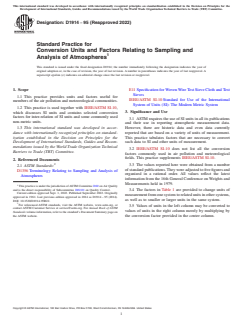
(Practice)Standard Practice for Conversion Units and Factors Relating to Sampling and Analysis of Atmospheres
General Information
- Abstract
SIGNIFICANCE AND USE
3.1 ASTM requires the use of SI units in all its publications and their use in reporting atmospheric measurement data. However, there are historic data and even data currently reported that are based on a variety of units of measurement. This practice tabulates factors that are necessary to convert such data to SI and other units of measurement.
3.2 IEEE/ASTM SI-10 does not list all the conversion factors commonly used in air pollution and meteorological fields. This practice supplements IEEE/ASTM SI-10.
3.3 The values reported here were obtained from a number of standard publications. They were adjusted to five figures and organized in a rational order. All values reflect the latest information from the 16th General Conference on Weights and Measurements held in 1979.
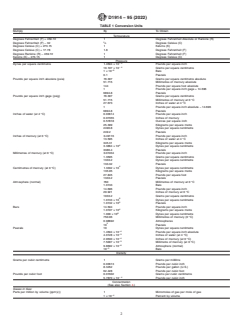
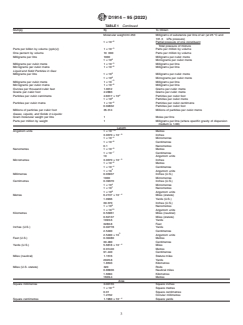
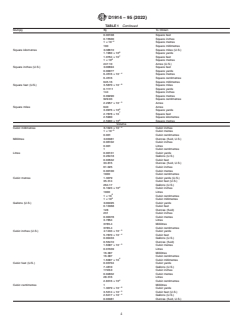
3.4 The factors in Table 1 are provided to change units of measurement from one system to related units in other systems, as well as to smaller or larger units in the same system.
3.5 Values of units in the left column may be converted to values of units in the right column merely by multiplying by the conversion factor provided in the center column. (A) For specific applications and exceptions, see Terminology D1356.
SCOPE
1.1 This practice provides units and factors useful for members of the air pollution and meteorological communities.
1.2 This practice is used together with IEEE/ASTM SI-10, which discusses SI units and contains selected conversion factors for inter-relation of SI units and some commonly used non-metric units.
1.3 This international standard was developed in accordance with internationally recognized principles on standardization established in the Decision on Principles for the Development of International Standards, Guides and Recommendations issued by the World Trade Organization Technical Barriers to Trade (TBT) Committee.
- Status
- Published
- Publication Date
- 31-Aug-2022
- Technical Committee
- D22 - Air Quality
- Drafting Committee
- D22.01 - Quality Control
Overview
ASTM D1914-95(2022): Standard Practice for Conversion Units and Factors Relating to Sampling and Analysis of Atmospheres is an international standard developed by ASTM International. This standard provides a comprehensive compendium of units and conversion factors crucial for professionals in air pollution monitoring and meteorology. It helps ensure data uniformity and comparability by facilitating the conversion of historic and non-standard measurement units into the International System of Units (SI), as mandated by ASTM.
The standard supplements the IEEE/ASTM SI-10 by presenting additional conversion factors commonly used in atmospheric sampling and analysis, which are not included in SI-10. It also aligns with principles from the World Trade Organization Technical Barriers to Trade (TBT) Committee, supporting international interoperability.
Key Topics
- SI Units and Compliance: Outlines ASTM's requirement for SI units in publications and data reporting related to atmospheric measurement.
- Comprehensive Conversion Factors: Includes tabulated factors to convert between a wide range of units common in air quality and meteorological fields.
- Supplement to Existing Standards: Complements IEEE/ASTM SI-10 by addressing omissions and providing further practical conversion guidance.
- Standardized Data Reporting: Enables conversion of legacy data or ongoing measurements from non-SI units to SI, fostering consistency and data quality.
- Sieve Analysis Reference: Provides sieve number and particle size conversions relevant to air sampling and particulate analysis.
Applications
ASTM D1914-95(2022) is widely employed in industries and research areas where atmospheric data is collected, reported, and analyzed. Typical applications include:
- Air Pollution Monitoring: Ensuring that concentration, pressure, volume, and particulate measurements are converted to SI units for regulatory compliance and scientific comparability.
- Meteorological Studies: Converting variables such as temperature, pressure, wind velocity, and density to standardized units for consistent climate and weather data analysis.
- Environmental Reporting: Facilitating regulatory submissions and international reporting that require SI units.
- Laboratory Analysis: Standardizing results reported from historic datasets or third-party laboratories that may use different unit systems.
- Sieve and Particle Analysis: Referencing conversion values for particle size analysis based on sieve number and opening size, critical in determining particulate matter in air samples.
Related Standards
- IEEE/ASTM SI-10 (Standard for Use of the International System of Units (SI)): Provides the foundational guidance for the use of SI units and selected conversion factors but does not cover the complete range of conversions found in D1914.
- ASTM D1356 (Terminology Relating to Sampling and Analysis of Atmospheres): Offers definitions and clarification for units, terms, and potential application-specific exceptions referenced within D1914.
- ASTM E11 (Specification for Woven Wire Test Sieve Cloth and Test Sieves): Cited for detailed information on particle size and sieve number correlations relevant to air sampling.
Practical Value
Implementing ASTM D1914-95(2022) is essential for any organization seeking to maintain accuracy, reliability, and comparability in atmospheric sampling and analysis. By providing clear, rationally organized conversion factors and facilitating the movement to globally recognized SI units, this standard supports regulatory compliance, enhances international data exchange, and improves the integrity of environmental research.
Keywords: SI units, atmospheric sampling, air quality, unit conversion, meteorology, ASTM, concentration, pressure, density, particle size, compliance, standardization, environmental measurement.
Relations
- Effective Date
- 01-Sep-2020
- Effective Date
- 15-Mar-2020
- Effective Date
- 15-Oct-2015
- Effective Date
- 01-Jul-2015
- Effective Date
- 01-Dec-2014
- Effective Date
- 01-May-2014
- Effective Date
- 15-Jan-2014
- Effective Date
- 01-Oct-2013
- Effective Date
- 01-Apr-2010
- Effective Date
- 01-May-2009
- Effective Date
- 01-May-2005
- Effective Date
- 01-May-2004
- Effective Date
- 10-May-2001
- Effective Date
- 10-May-2001
- Effective Date
- 10-Nov-2000
Get Certified
Connect with accredited certification bodies for this standard

CIS Institut d.o.o.
Personal Protective Equipment (PPE) certification body. Notified Body NB-2890 for EU Regulation 2016/425 PPE.

Kiwa BDA Testing
Building and construction product certification.
Kmetijski inštitut Slovenije
Agricultural Institute of Slovenia. Soil testing, plant health, agricultural product analysis.
Sponsored listings
Frequently Asked Questions
ASTM D1914-95(2022) is a standard published by ASTM International. Its full title is "Standard Practice for Conversion Units and Factors Relating to Sampling and Analysis of Atmospheres". This standard covers: SIGNIFICANCE AND USE 3.1 ASTM requires the use of SI units in all its publications and their use in reporting atmospheric measurement data. However, there are historic data and even data currently reported that are based on a variety of units of measurement. This practice tabulates factors that are necessary to convert such data to SI and other units of measurement. 3.2 IEEE/ASTM SI-10 does not list all the conversion factors commonly used in air pollution and meteorological fields. This practice supplements IEEE/ASTM SI-10. 3.3 The values reported here were obtained from a number of standard publications. They were adjusted to five figures and organized in a rational order. All values reflect the latest information from the 16th General Conference on Weights and Measurements held in 1979. 3.4 The factors in Table 1 are provided to change units of measurement from one system to related units in other systems, as well as to smaller or larger units in the same system. 3.5 Values of units in the left column may be converted to values of units in the right column merely by multiplying by the conversion factor provided in the center column. (A) For specific applications and exceptions, see Terminology D1356. SCOPE 1.1 This practice provides units and factors useful for members of the air pollution and meteorological communities. 1.2 This practice is used together with IEEE/ASTM SI-10, which discusses SI units and contains selected conversion factors for inter-relation of SI units and some commonly used non-metric units. 1.3 This international standard was developed in accordance with internationally recognized principles on standardization established in the Decision on Principles for the Development of International Standards, Guides and Recommendations issued by the World Trade Organization Technical Barriers to Trade (TBT) Committee.
SIGNIFICANCE AND USE 3.1 ASTM requires the use of SI units in all its publications and their use in reporting atmospheric measurement data. However, there are historic data and even data currently reported that are based on a variety of units of measurement. This practice tabulates factors that are necessary to convert such data to SI and other units of measurement. 3.2 IEEE/ASTM SI-10 does not list all the conversion factors commonly used in air pollution and meteorological fields. This practice supplements IEEE/ASTM SI-10. 3.3 The values reported here were obtained from a number of standard publications. They were adjusted to five figures and organized in a rational order. All values reflect the latest information from the 16th General Conference on Weights and Measurements held in 1979. 3.4 The factors in Table 1 are provided to change units of measurement from one system to related units in other systems, as well as to smaller or larger units in the same system. 3.5 Values of units in the left column may be converted to values of units in the right column merely by multiplying by the conversion factor provided in the center column. (A) For specific applications and exceptions, see Terminology D1356. SCOPE 1.1 This practice provides units and factors useful for members of the air pollution and meteorological communities. 1.2 This practice is used together with IEEE/ASTM SI-10, which discusses SI units and contains selected conversion factors for inter-relation of SI units and some commonly used non-metric units. 1.3 This international standard was developed in accordance with internationally recognized principles on standardization established in the Decision on Principles for the Development of International Standards, Guides and Recommendations issued by the World Trade Organization Technical Barriers to Trade (TBT) Committee.
ASTM D1914-95(2022) is classified under the following ICS (International Classification for Standards) categories: 13.040.20 - Ambient atmospheres. The ICS classification helps identify the subject area and facilitates finding related standards.
ASTM D1914-95(2022) has the following relationships with other standards: It is inter standard links to ASTM D1356-20a, ASTM D1356-20, ASTM D1356-15a, ASTM D1356-15, ASTM D1356-14b, ASTM D1356-14a, ASTM D1356-14, ASTM E11-13, ASTM D1356-05(2010), ASTM E11-09e1, ASTM D1356-05, ASTM E11-04, ASTM E11-95, ASTM E11-01, ASTM D1356-00a. Understanding these relationships helps ensure you are using the most current and applicable version of the standard.
ASTM D1914-95(2022) is available in PDF format for immediate download after purchase. The document can be added to your cart and obtained through the secure checkout process. Digital delivery ensures instant access to the complete standard document.
Standards Content (Sample)
This international standard was developed in accordance with internationally recognized principles on standardization established in the Decision on Principles for the
Development of International Standards, Guides and Recommendations issued by the World Trade Organization Technical Barriers to Trade (TBT) Committee.
Designation: D1914 − 95 (Reapproved 2022)
Standard Practice for
Conversion Units and Factors Relating to Sampling and
Analysis of Atmospheres
This standard is issued under the fixed designation D1914; the number immediately following the designation indicates the year of
original adoption or, in the case of revision, the year of last revision. A number in parentheses indicates the year of last reapproval. A
superscript epsilon (´) indicates an editorial change since the last revision or reapproval.
1. Scope E11 Specification for Woven Wire Test Sieve Cloth and Test
Sieves
1.1 This practice provides units and factors useful for
IEEE/ASTM SI-10 Standard for Use of the International
members of the air pollution and meteorological communities.
System of Units (SI): The Modern Metric System
1.2 This practice is used together with IEEE/ASTM SI-10,
3. Significance and Use
which discusses SI units and contains selected conversion
factors for inter-relation of SI units and some commonly used
3.1 ASTM requires the use of SI units in all its publications
non-metric units.
and their use in reporting atmospheric measurement data.
1.3 This international standard was developed in accor- However, there are historic data and even data currently
reported that are based on a variety of units of measurement.
dance with internationally recognized principles on standard-
ization established in the Decision on Principles for the This practice tabulates factors that are necessary to convert
such data to SI and other units of measurement.
Development of International Standards, Guides and Recom-
mendations issued by the World Trade Organization Technical
3.2 IEEE/ASTM SI-10 does not list all the conversion
Barriers to Trade (TBT) Committee.
factors commonly used in air pollution and meteorological
fields. This practice supplements IEEE/ASTM SI-10.
2. Referenced Documents
3.3 The values reported here were obtained from a number
2.1 ASTM Standards:
ofstandardpublications.Theywereadjustedtofivefiguresand
D1356 Terminology Relating to Sampling and Analysis of
organized in a rational order. All values reflect the latest
Atmospheres
information from the 16th General Conference on Weights and
Measurements held in 1979.
This practice is under the jurisdiction ofASTM Committee D22 on Air Quality
and is the direct responsibility of Subcommittee D22.01 on Quality Control.
3.4 The factors in Table 1 are provided to change units of
Current edition approved Sept. 1, 2022. Published September 2022. Originally
measurementfromonesystemtorelatedunitsinothersystems,
approved in 1961. Last previous edition approved in 2014 as D1914 – 95 (2014).
as well as to smaller or larger units in the same system.
DOI: 10.1520/D1914-95R22.
For referenced ASTM standards, visit the ASTM website, www.astm.org, or
3.5 Values of units in the left column may be converted to
contact ASTM Customer Service at service@astm.org. For Annual Book of ASTM
values of units in the right column merely by multiplying by
Standards volume information, refer to the standard’s Document Summary page on
the ASTM website. the conversion factor provided in the center column.
Copyright © ASTM International, 100 Barr Harbor Drive, PO Box C700, West Conshohocken, PA 19428-2959. United States
D1914 − 95 (2022)
TABLE 1 Conversion Units
Multiply By To Obtain
Temperature
Degrees Fahrenheit (F) + 459.72 1 Degrees Fahrenheit Absolute or Rankine (R)
Degrees Fahrenheit (F) − 32 ⁄9 Degrees Celsius (C)
Degrees Celsius (C) + 273.15 1 Kelvins (K)
Degrees Celsius (C) + 17.78 1.8 Degrees Fahrenheit (F)
Degrees Rankine (R) − 459.72 1 Degrees Fahrenheit (F)
Kelvins (K) − 273.15 1 Degrees Celsius (C)
Pressure
−5
Dynes per square centimetre 1.4504 × 10 Pounds per square inch
−4
10.197 × 10 Grams per square centimetre
−6
1×10 Bars
0.1 Pascals
Pounds per square inch absolute (psia) 70.307 Grams per square centimetre absolute
51.715 Millimetres of mercury absolute
144 Pounds per square foot absolute
1 Pounds per square inch gage + 14.696
6894.8 Pascals
Pounds per square inch gage (psig) 70.307 Grams per square centimetre
51.715 Millimetres of mercury at 0 °C
27.673 Inches of water at 4 °C
1 Pounds per square inch absolute − 14.696
6894.8 Pascals
Inches of water (at 4 °C) 0.03614 Pounds per square inch
0.07355 Inches of mercury
0.57818 Ounces per square inch
25.399 Kilograms per square metre
2490.8 Dynes per square centimetre
249.2 Pascals
Inches of mercury (at 0 °C) 0.49116 Pounds per square inch
13.595 Inches of water at 4 °C
345.31 Kilograms per square metre
3.3864 × 10 Dynes per square centimetre
3386.4 Pascals
Millimetres of mercury (at 0 °C) 0.01934 Pounds per square inch
1.3595 Grams per square centimetre
1333.2 Dynes per square centimetre
133.32 Pascals
Centimetres of mercury (at 0 °C) 1.3332 × 10 Dynes per square centimetre
135.95 Kilograms per square metre
27.845 Pounds per square foot
1333.2 Pascals
Atmosphere (normal) 760 Millimetres of mercury at 0 °C
1.0133 Bars
14.696 Pounds per square inch
29.921 Inches of mercury at 0 °C
1033.2 Grams per square centimetre
1.0133 × 10 Dynes per square centimetre
1.0132 × 10 Pascals
Bars 14.504 Pounds per square inch
1.0197 × 10 Kilograms per square metre
1.000 × 10 Dynes per square centimetre
750.06 Millimetres of mercury (0 °C)
0.98692 Atmospheres
10 Pascals
Pascals 10 Dynes per square centimetre
−4
1.4504 × 10 Pounds per square inch absolute
−3
4.0128 × 10 Inches of water (at 4 °C)
−4
2.9530 × 10 Inches of mercury (at 0 °C)
−3
7.5007 × 10 Millimetre of mercury (at 0 °C)
−6
9.8692 × 10 Atmosphere (normal)
−5
10 Bars
Density
Grams per cubic centimetre 1 Grams per millilitre
0.03613 Pounds per cubic inch
8.3452 Pounds per gallon (U.S.)
62.428 Pounds per cubic foot
Pounds per cubic foot 0.01602 Grams per cubic centimetre
−4
5.7870 × 10 Pounds per cubic inch
Concentration
(See also Section 4.)
Gases in Gas:
Parts per million by volume (ppm(v)) 1 Micromoles of gas per mole of gas
−4
1×10 Percent by volume
D1914 − 95 (2022)
TABLE 1 Continued
Multiply By To Obtain
Molecular weight/24 450 Milligrams of substance per litre of air (at 25 °C and
101.3 kPa pressure)
−6
1×10 Partial pressure of one constituent
Total pressure of mixture
−3
Parts per billion by volume (ppb(v)) 1 × 10 Parts per million by volume
One percent by volume 10 000 Parts per million by volume
Milligrams per litre 1000 Milligrams per cubic metre
1×10 Micrograms per cubic metre
−3
Milligrams per cubic metre 1 × 10 Milligrams per litre
−6
Micrograms per cubic metre 1 × 10 Milligrams per litre
Liquid and Solid Particles in Gas:
Milligrams per litre 1 × 10 Milligrams per cubic metre
1×10 Micrograms per cubic metre
−3
Milligrams per cubic metre 1 × 10 Milligrams per litre
−6
Micrograms per cubic metre 1 × 10 Milligrams per litre
Ounces per thousand cubic feet 1.0012 Grams per cubic metre
Grains per cubic foot 2.2883 Grams per cubic metre
Particles per cubic centimetre 2.8317 × 10 Particles per cubic foot
1×10 Particles per cubic metre
−6
Particles per cubic metre 1 × 10 Particles per cubic centimetre
0.02832 Particles per cubic foot
Millions of particles per cubic foot 35.314 Millions of particles per cubic metre
Gases, Liquids, and Solids in Liquids:
Gram molecular weight per litre 1 Moles per litre
Parts per million by weight 1 Milligrams per litre (where specific gravity of dispersion
medium is 1.00)
Length
−10
Angstrom units 1 × 10 Metres
−9
3.9370 × 10 Inches
−4
1×10 Micrometres
−8
1×10 Centimetres
0.1 Nanometres
−9
Nanometres 1 × 10 Metres
−7
1×10 Centimetres
10 Angstrom units
−5
Micrometres 3.9370 × 10 Inches
−6
1×10 Metres
−4
1×10 Centimetres
1×10 Angstrom units
Millimetres 0.03937 Inches (U.S.)
1000 Micromet
...