

ASTM D4628-23
(Test Method)Standard Test Method for Analysis of Barium, Calcium, Magnesium, and Zinc in Unused Lubricating Oils by Atomic Absorption Spectrometry
General Information
- Abstract
SIGNIFICANCE AND USE
5.1 Some oils are formulated with metal-containing additives that act as detergents, antioxidants, antiwear agents, etc. Some of these additives contain one or more of these metals: barium, calcium, zinc, and magnesium. This test method provides a means of determining the concentration of these metals that gives an indication of the additive content in these oils.
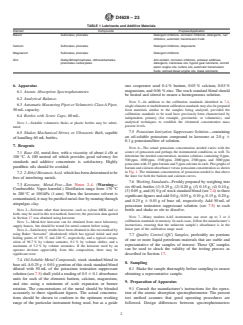
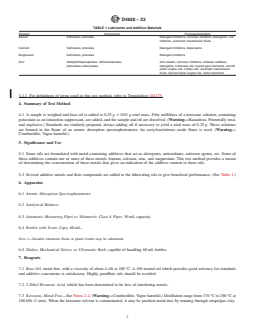
5.2 Several additive metals and their compounds are added to the lubricating oils to give beneficial performance. (See Table 1.)
SCOPE
1.1 This test method is applicable for the determination of mass percent barium from 0.005 % to 1.0 %, calcium and magnesium from 0.002 % to 0.3 %, and zinc from 0.002 % to 0.2 % in lubricating oils.
1.2 Higher concentrations can be determined by appropriate dilution. Lower concentrations of metals such as barium, calcium, magnesium, and zinc at about 10 ppm level can also be determined by this test method. Use of this test method for the determination at these lower concentrations should be by agreement between the buyer and the seller.
1.3 Lubricating oils that contain viscosity index improvers may give low results when calibrations are performed using standards that do not contain viscosity index improvers.
1.4 The values stated in SI units are to be regarded as standard. No other units of measurement are included in this standard.
1.5 This standard does not purport to address all of the safety concerns, if any, associated with its use. It is the responsibility of the user of this standard to establish appropriate safety, health, and environmental practices and determine the applicability of regulatory limitations prior to use. Specific warning statements are given in 4.1, 7.3, and 9.1.
1.6 This international standard was developed in accordance with internationally recognized principles on standardization established in the Decision on Principles for the Development of International Standards, Guides and Recommendations issued by the World Trade Organization Technical Barriers to Trade (TBT) Committee.
- Status
- Published
- Publication Date
- 30-Apr-2023
- Technical Committee
- D02 - Petroleum Products, Liquid Fuels, and Lubricants
- Drafting Committee
- D02.03 - Elemental Analysis
Buy Documents
ASTM D4628-23 - Standard Test Method for Analysis of Barium, Calcium, Magnesium, and Zinc in Unused Lubricating Oils by Atomic Absorption Spectrometry
REDLINE ASTM D4628-23 - Standard Test Method for Analysis of Barium, Calcium, Magnesium, and Zinc in Unused Lubricating Oils by Atomic Absorption Spectrometry
Overview
ASTM D4628-23 is the internationally recognized standard test method for the analysis of barium, calcium, magnesium, and zinc concentrations in unused lubricating oils using atomic absorption spectrometry (AAS). Established by ASTM International, this standard is vital for determining the content of metal-containing additives that enhance the performance of lubricating oils. These metallic additives serve a range of functions, including acting as detergents, antioxidants, antiwear agents, and corrosion inhibitors.
By accurately quantifying these metals, ASTM D4628-23 provides essential data for oil formulators, manufacturers, and quality control laboratories aiming to ensure the reliability and effectiveness of their products.
Key Topics
Analyte Scope and Ranges:
- Barium quantification from 0.005% to 1.0% by mass
- Calcium and magnesium from 0.002% to 0.3% by mass
- Zinc from 0.002% to 0.2% by mass
- Capable of detecting lower concentrations (~10 ppm) and higher levels through dilution by agreement
Applicable Sample Types:
- Unused lubricating oils, including those formulated with various additive packages
- Special instructions for oils containing viscosity index improvers, as these may influence accuracy
Methods & Apparatus:
- Use of atomic absorption spectrophotometry with defined instrumental parameters
- Preparation of oil-soluble metal calibration standards and potassium ionization suppressant solutions
- Strict protocols for calibration, sample dilution, and quality control verification
Precision, Repeatability, and Reproducibility:
- Defined measurement repeatability and reproducibility across different concentration ranges
- Ongoing monitoring of instrument calibration and performance is emphasized
Quality Control:
- Routine analysis of QC samples and use of statistical control charts as per ASTM D6299
- Recommendations for representative QC materials and frequency of QC checks
Applications
ASTM D4628-23 delivers significant practical value across the petroleum and lubrication industries. Key applications include:
- Additive Content Verification: Ensures lubricating oils contain the specified levels of barium, calcium, magnesium, and zinc additives, contributing to engine cleanliness, wear resistance, and oxidation stability.
- Product Development and Formulation: Supports new product design by confirming the correct dosage of essential metal-based additives.
- Quality Control and Assurance: Regularly monitors batch consistency and compliance with manufacturer or regulatory specifications.
- Lab Accreditation and Customer Acceptance: Establishes recognized, reproducible results that support claims in technical datasheets and procurement contracts between buyers and sellers.
- Regulatory and Performance Compliance: Helps meet industry and governmental requirements for lubricant formulation and performance standards.
Related Standards
For a comprehensive approach to lubricant analysis and quality control, the following related standards are often used in conjunction with ASTM D4628-23:
- ASTM D4175: Terminology Relating to Petroleum Products, Liquid Fuels, and Lubricants
- ASTM D6299: Statistical Quality Assurance and Control Charting Techniques for Analytical Measurement Systems
- ASTM D4951: Determination of Additive Elements in Lubricating Oils by ICP Emission Spectrometry
These standards enhance the robustness of analytical protocols, ensure the accuracy of test results, and promote consistency across the oil and lubricant industry.
Keywords: lubricating oil analysis, ASTM D4628-23, atomic absorption spectrometry, barium, calcium, magnesium, zinc, additive elements, oil additives, quality control, lubricant formulation.
Relations
- Refers
ASTM D4175-23a - Standard Terminology Relating to Petroleum Products, Liquid Fuels, and Lubricants - Effective Date
- 15-Dec-2023
- Effective Date
- 01-Dec-2023
- Refers
ASTM D4175-23e1 - Standard Terminology Relating to Petroleum Products, Liquid Fuels, and Lubricants - Effective Date
- 01-Jul-2023
- Effective Date
- 15-Dec-2017
- Effective Date
- 15-Nov-2017
- Effective Date
- 01-Jan-2017
- Effective Date
- 01-Oct-2013
- Effective Date
- 01-Mar-2010
- Effective Date
- 01-Mar-2010
- Effective Date
- 01-Nov-2009
- Effective Date
- 15-Oct-2008
- Effective Date
- 01-Nov-2007
- Effective Date
- 01-Nov-2007
- Effective Date
- 10-Jun-2002
- Effective Date
- 10-Jun-2002
Buy Documents
ASTM D4628-23 - Standard Test Method for Analysis of Barium, Calcium, Magnesium, and Zinc in Unused Lubricating Oils by Atomic Absorption Spectrometry
REDLINE ASTM D4628-23 - Standard Test Method for Analysis of Barium, Calcium, Magnesium, and Zinc in Unused Lubricating Oils by Atomic Absorption Spectrometry
Get Certified
Connect with accredited certification bodies for this standard

ECOCERT
Organic and sustainability certification.

Element Materials Technology
Materials testing and product certification.

ABS Group Brazil
ABS Group certification services in Brazil.
Sponsored listings
Frequently Asked Questions
ASTM D4628-23 is a standard published by ASTM International. Its full title is "Standard Test Method for Analysis of Barium, Calcium, Magnesium, and Zinc in Unused Lubricating Oils by Atomic Absorption Spectrometry". This standard covers: SIGNIFICANCE AND USE 5.1 Some oils are formulated with metal-containing additives that act as detergents, antioxidants, antiwear agents, etc. Some of these additives contain one or more of these metals: barium, calcium, zinc, and magnesium. This test method provides a means of determining the concentration of these metals that gives an indication of the additive content in these oils. 5.2 Several additive metals and their compounds are added to the lubricating oils to give beneficial performance. (See Table 1.) SCOPE 1.1 This test method is applicable for the determination of mass percent barium from 0.005 % to 1.0 %, calcium and magnesium from 0.002 % to 0.3 %, and zinc from 0.002 % to 0.2 % in lubricating oils. 1.2 Higher concentrations can be determined by appropriate dilution. Lower concentrations of metals such as barium, calcium, magnesium, and zinc at about 10 ppm level can also be determined by this test method. Use of this test method for the determination at these lower concentrations should be by agreement between the buyer and the seller. 1.3 Lubricating oils that contain viscosity index improvers may give low results when calibrations are performed using standards that do not contain viscosity index improvers. 1.4 The values stated in SI units are to be regarded as standard. No other units of measurement are included in this standard. 1.5 This standard does not purport to address all of the safety concerns, if any, associated with its use. It is the responsibility of the user of this standard to establish appropriate safety, health, and environmental practices and determine the applicability of regulatory limitations prior to use. Specific warning statements are given in 4.1, 7.3, and 9.1. 1.6 This international standard was developed in accordance with internationally recognized principles on standardization established in the Decision on Principles for the Development of International Standards, Guides and Recommendations issued by the World Trade Organization Technical Barriers to Trade (TBT) Committee.
SIGNIFICANCE AND USE 5.1 Some oils are formulated with metal-containing additives that act as detergents, antioxidants, antiwear agents, etc. Some of these additives contain one or more of these metals: barium, calcium, zinc, and magnesium. This test method provides a means of determining the concentration of these metals that gives an indication of the additive content in these oils. 5.2 Several additive metals and their compounds are added to the lubricating oils to give beneficial performance. (See Table 1.) SCOPE 1.1 This test method is applicable for the determination of mass percent barium from 0.005 % to 1.0 %, calcium and magnesium from 0.002 % to 0.3 %, and zinc from 0.002 % to 0.2 % in lubricating oils. 1.2 Higher concentrations can be determined by appropriate dilution. Lower concentrations of metals such as barium, calcium, magnesium, and zinc at about 10 ppm level can also be determined by this test method. Use of this test method for the determination at these lower concentrations should be by agreement between the buyer and the seller. 1.3 Lubricating oils that contain viscosity index improvers may give low results when calibrations are performed using standards that do not contain viscosity index improvers. 1.4 The values stated in SI units are to be regarded as standard. No other units of measurement are included in this standard. 1.5 This standard does not purport to address all of the safety concerns, if any, associated with its use. It is the responsibility of the user of this standard to establish appropriate safety, health, and environmental practices and determine the applicability of regulatory limitations prior to use. Specific warning statements are given in 4.1, 7.3, and 9.1. 1.6 This international standard was developed in accordance with internationally recognized principles on standardization established in the Decision on Principles for the Development of International Standards, Guides and Recommendations issued by the World Trade Organization Technical Barriers to Trade (TBT) Committee.
ASTM D4628-23 is classified under the following ICS (International Classification for Standards) categories: 71.040.50 - Physicochemical methods of analysis; 75.100 - Lubricants, industrial oils and related products. The ICS classification helps identify the subject area and facilitates finding related standards.
ASTM D4628-23 has the following relationships with other standards: It is inter standard links to ASTM D4175-23a, ASTM D6299-23a, ASTM D4175-23e1, ASTM D6299-17b, ASTM D6299-17a, ASTM D6299-17, ASTM D6299-13e1, ASTM D6299-10, ASTM D6299-10e2, ASTM D6299-09, ASTM D6299-08, ASTM D6299-07e1, ASTM D6299-07, ASTM D6299-02e1, ASTM D6299-02. Understanding these relationships helps ensure you are using the most current and applicable version of the standard.
ASTM D4628-23 is available in PDF format for immediate download after purchase. The document can be added to your cart and obtained through the secure checkout process. Digital delivery ensures instant access to the complete standard document.
Standards Content (Sample)
This international standard was developed in accordance with internationally recognized principles on standardization established in the Decision on Principles for the
Development of International Standards, Guides and Recommendations issued by the World Trade Organization Technical Barriers to Trade (TBT) Committee.
Designation: D4628 − 23
Standard Test Method for
Analysis of Barium, Calcium, Magnesium, and Zinc in
Unused Lubricating Oils by Atomic Absorption
Spectrometry
This standard is issued under the fixed designation D4628; the number immediately following the designation indicates the year of
original adoption or, in the case of revision, the year of last revision. A number in parentheses indicates the year of last reapproval. A
superscript epsilon (´) indicates an editorial change since the last revision or reapproval.
This standard has been approved for use by agencies of the U.S. Department of Defense.
1. Scope* 2. Referenced Documents
2.1 ASTM Standards:
1.1 This test method is applicable for the determination of
D4175 Terminology Relating to Petroleum Products, Liquid
mass percent barium from 0.005 % to 1.0 %, calcium and
Fuels, and Lubricants
magnesium from 0.002 % to 0.3 %, and zinc from 0.002 % to
D6299 Practice for Applying Statistical Quality Assurance
0.2 % in lubricating oils.
and Control Charting Techniques to Evaluate Analytical
1.2 Higher concentrations can be determined by appropriate
Measurement System Performance
dilution. Lower concentrations of metals such as barium,
3. Terminology
calcium, magnesium, and zinc at about 10 ppm level can also
3.1 Definitions:
be determined by this test method. Use of this test method for
3.1.1 For definitions of terms used in this test method, refer
the determination at these lower concentrations should be by
to Terminology D4175.
agreement between the buyer and the seller.
4. Summary of Test Method
1.3 Lubricating oils that contain viscosity index improvers
may give low results when calibrations are performed using
4.1 A sample is weighed and base oil is added to 0.25 g 6
standards that do not contain viscosity index improvers.
0.01 g total mass. Fifty millilitres of a kerosene solution,
containing potassium as an ionization suppressant, are added,
1.4 The values stated in SI units are to be regarded as
and the sample and oil are dissolved. (Warning—Hazardous.
standard. No other units of measurement are included in this
Potentially toxic and explosive.) Standards are similarly
standard.
prepared, always adding oil if necessary to yield a total mass of
1.5 This standard does not purport to address all of the 0.25 g. These solutions are burned in the flame of an atomic
safety concerns, if any, associated with its use. It is the absorption spectrophotometer. An acetylene/nitrous oxide
flame is used. (Warning—Combustible. Vapor harmful.)
responsibility of the user of this standard to establish appro-
priate safety, health, and environmental practices and deter-
5. Significance and Use
mine the applicability of regulatory limitations prior to use.
5.1 Some oils are formulated with metal-containing addi-
Specific warning statements are given in 4.1, 7.3, and 9.1.
tives that act as detergents, antioxidants, antiwear agents, etc.
1.6 This international standard was developed in accor-
Some of these additives contain one or more of these metals:
dance with internationally recognized principles on standard-
barium, calcium, zinc, and magnesium. This test method
ization established in the Decision on Principles for the
provides a means of determining the concentration of these
Development of International Standards, Guides and Recom-
metals that gives an indication of the additive content in these
mendations issued by the World Trade Organization Technical
oils.
Barriers to Trade (TBT) Committee.
5.2 Several additive metals and their compounds are added
to the lubricating oils to give beneficial performance. (See
Table 1.)
This test method is under the jurisdiction of ASTM Committee D02 on
Petroleum Products, Liquid Fuels, and Lubricants and is the direct responsibility of
Subcommittee D02.03 on Elemental Analysis. For referenced ASTM standards, visit the ASTM website, www.astm.org, or
Current edition approved May 1, 2023. Published June 2023. Originally contact ASTM Customer Service at service@astm.org. For Annual Book of ASTM
approved in 1986. Last previous edition approved in 2016 as D4628 – 16. DOI: Standards volume information, refer to the standard’s Document Summary page on
10.1520/D4628-23. the ASTM website.
*A Summary of Changes section appears at the end of this standard
Copyright © ASTM International, 100 Barr Harbor Drive, PO Box C700, West Conshohocken, PA 19428-2959. United States
D4628 − 23
TABLE 1 Lubricants and Additive Materials
Element Compounds Purpose/Application
Barium Sulfonates, phenates Detergent inhibitors, corrosion inhibitors, detergents, rust
inhibitors, automatic transmission fluids
Calcium Sulfonates, phenates Detergent inhibitors, dispersants
Magnesium Sulfonates, phenates Detergent inhibitors
Zinc Dialkyldithiophosphates, dithiocarbamates, Anti-oxidant, corrosion inhibitors, antiwear additives,
phenolates carboxylates detergents, crankcase oils, hypoid gear lubricants, aircraft
piston engine oils, turbine oils, automatic transmission
fluids, railroad diesel engine oils, brake lubricants
6. Apparatus one cooperator used 0.4 % barium, 0.03 % calcium, 0.03 %
magnesium, and 0.06 % zinc. The stock standard blend should
6.1 Atomic Absorption Spectrophotometer.
be heated and stirred to ensure a homogeneous solution.
6.2 Analytical Balance.
NOTE 5—In addition to the calibration standards identified in 7.4,
6.3 Automatic Measuring Pipet or Volumetric Class A Pipet,
single-element or multielement calibration standards may also be prepared
50 mL capacity.
from materials similar to the samples being analyzed, provided the
calibration standards to be used have previously been characterized by
6.4 Bottles with Screw Caps, 60 mL.
independent, primary (for example, gravimetric or volumetric), and
analytical techniques to establish the elemental concentration mass
NOTE 1—Suitable volumetric flasks or plastic bottles may be substi-
percent levels.
tuted.
7.5 Potassium Ionization Suppressant Solution—containing
6.5 Shaker, Mechanical Stirrer, or Ultrasonic Bath, capable
an oil-soluble potassium compound in kerosene at 2.0 g 6
of handling 60 mL bottles.
0.1 g potassium/litre of solution.
7. Reagents
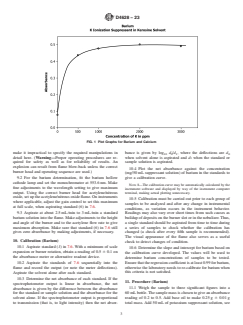
NOTE 6—The actual potassium concentration needed varies with the
source of potassium and perhaps the instrumental conditions as well. To
7.1 Base Oil, metal-free, with a viscosity of about 4 cSt at
determine the needed concentration, atomize solutions containing 0 ppm,
100 °C. A 100 neutral oil which provides good solvency for
500 ppm, 1000 ppm, 1500 ppm, 2000 ppm, 2500 ppm, and 3000 ppm
standards and additive concentrate is satisfactory. Highly
potassium with 25 ppm barium and 5 ppm calcium in each. Plot graphs of
paraffinic oils should be avoided.
barium and calcium absorbance versus potassium concentration as shown
in Fig. 1. The minimum concentration of potassium needed is that above
7.2 2-Ethyl Hexanoic Acid, which has been determined to be
the knee for both the barium and calcium curves.
free of interfering metals.
7.6 Working Standards—Freshly prepared by weighing into
7.3 Kerosene, Metal-Free—See Notes 2-4. (Warning—
six 60 mL bottles (1) 0.25 g, (2) 0.20 g, (3) 0.15 g, (4) 0.10 g,
Combustible. Vapor harmful.) Distillation range from 170 °C
(5) 0.05 g, and (6) 0 g of stock standard blend (see 7.4) to three
to 280 °C at 100 kPa (1 atm). When the kerosene solvent is
significant figures and add 0.0 g, 0.05 g, 0.10 g, 0.15 g, 0.20 g,
contaminated, it may be purified metal-free by running through
and 0.25 g 6 0.01 g of base oil, respectively. Add 50 mL of
attapulgus clay.
potassium ionization suppressant solution (see 7.5) to each
NOTE 2—Solvents other than kerosene, such as xylene MEK and so bottle and shake or stir to dissolve.
forth, may be used in this test method, however, the precision data quoted
NOTE 7—Many modern AAS instruments can store up to 3 or 4
in Section 17 was obtained using kerosene.
calibration standards in memory. In such cases, follow the manufacturer’s
NOTE 3—Metal-free kerosene can be obtained from most laboratory
instructions, ensuring that the unknown sample’s absorbance is in the
supply houses, but should be tested for metal content before using.
linear part of the calibration range used.
NOTE 4—Satisfactory results have been obtained in this test method by
using Baker “kerosene” (deodorized) which has typical initial and end
7.7 Quality Control (QC) Samples, preferably are portions
boiling points of 191 °C and 240 °C, respectively, and a typical compo-
of one or more liquid petroleum materials that are stable and
sition of 96.7 % by volume saturates, 0.1 % by volume olefins, and a
representative of the samples of interest. These QC samples
maximum of 3.2 % by volume aromatics. If the kerosene used by an
can be used to check the validity of the testing process as
operator deviates appreciably from this composition, there may be
significant error.
described in Section 17.
7.4 Oil-Soluble Metal Compounds, stock standard blend in
8. Sampling
base oil. A 0.25 g 6 0.01 g portion of this stock standard blend
8.1 Shake the sample thoroughly before sampling to ensure
diluted with 50 mL of the potassium ionization suppressant
obtaining a representative sample.
solution (see 7.5) shall yield a reading of 0.5 6 0.1 absorbance
units for each of the elements barium, calcium, magnesium,
9. Preparation of Apparatus
and zinc using a minimum of scale expansion or burner
rotation. The concentrations of the metal should be blended 9.1 Consult the manufacturer’s instructions for the opera-
accurately to three significant figures. The actual concentra- tion of the atomic absorption spectrophotometer. The present
tions should be chosen to conform to the optimum working test method assumes that good operating procedures are
range of the particular instrument being used, but as a guide followed. Design differences between spectrophotometers
D4628 − 23
FIG. 1 Plot Graphs for Barium and Calcium
make it impractical to specify the required manipulations in bance is given by log d /d , where the deflections are d
10 0 1 0
detail here. (Warning—Proper operating procedures are re- when solvent alone is aspirated and d when the standard or
quired for safety as well as for reliability of results. An sample solution is aspirated.
explosion can result from flame blow-back unless the correct
10.4 Plot the net absorbance against the concentration
burner head and operating sequence are used.)
(mg/50 mL suppressant solution) of barium in the standards to
9.2 For the barium determination, fit the barium hollow give a calibration curve.
cathode lamp and set the monochromator at 553.6 nm. Make
NOTE 8—The calibration curve may be automatically calculated by the
fine adjustments to the wavelength setting to give maximum
instrument software and displayed by way of the instrument computer
output. Using the correct burner head for acetylene/nitrous
terminal, making actual plotting unnecessary.
oxide, set up the acetylene/nitrous oxide flame. On instruments
10.5 Calibration must be carried out prior to each group of
where applicable, adjust the gain control to set this maximum
samples to be analyzed and after any change in instrumental
at full scale, when aspirating standard (6) in 7.6.
conditions, as variation occurs in the instrument behavior.
9.3 Aspirate at about 2.5 mL ⁄min to 3 mL ⁄min a standard Readings may also vary over short times from such causes as
barium solution into the flame. Make adjustments to the height buildup of deposits on the burner slot or in the nebulizer. Thus,
and angle of the burner and to the acetylene flow rate to give a single standard should be aspirated from time to time during
maximum absorption. Make sure that standard (6) in 7.6 still a series of samples to check whether the calibration has
gives zero absorbance by making adjustments, if necessary. changed (a check after every fifth sample is recommended).
The visual appearance of the flame also serves as a useful
10. Calibration (Barium)
check to detect changes of condition.
10.1 Aspirate standard (1) in 7.6. With a minimum of scale
10.6 Determine the slope and intercept for barium based on
expansion or burner rotation, obtain a reading of 0.5 6 0.1 on
the calibration curve developed. The values will be used to
the absorbance meter or alternative readout device.
determine barium concentrations of samples to be tested.
10.2 Aspirate the standards of 7.6 sequentially into the Ensure that the regression coefficient is at least 0.99 for barium,
otherwise the laboratory needs to re-calibrate for barium when
flame and record the output (or note the meter deflections).
Aspirate the solvent alone after each standard. this criteria is not satisfied.
10.3 Determine the net absorbance of each standard. If the
11. Procedure (Barium)
spectrophotometer output is linear in absorbance, the net
absorbance is given by the difference between the absorbance 11.1 Weigh the sample to three significant figures into a
for the standard or sample solution and the absorbance for the 60 mL bottle. The sample mass is chosen to give an absorbance
solvent alone. If the spectrophotometer output is proportional reading of 0.2 to 0.5. Add base oil to make 0.25 g 6 0.01 g
to transmission (that is, to light intensity) then the net absor- total mass. Add 50 mL of potassium suppressant solution, see
D4628 − 23
TABLE 2 Repeatability
7.5, and dissolve. The maximum sample size to be used is
0.25 g, and the minimum is 0.05 g. Element Range, Repeatability
Mass %
11.1.1 To hazy samples add 0.25 mL 6 0.01 mL of 2-ethyl
Barium 0.005–1.0 0.0478x ⁄3
hexanoic acid and shake. If this clears up the haze, the analysis
Calcium 0.002–0.3 0.0227x ⁄3
is run, and the dilution error is corrected by multiplying the
Magnesium 0.002–0.3 0.0168x ⁄3
found results by 1.005. If the sample remains hazy, the sample Zinc 0.002–0.2 0.0247X ⁄3
Calcium 1.7 0.032
is not suitable to be analyzed by this test method.
Zinc 1.0 0.025
11.2 Samples yielding absorbances greater than 0.5 even
with the minimum sample s
...
This document is not an ASTM standard and is intended only to provide the user of an ASTM standard an indication of what changes have been made to the previous version. Because
it may not be technically possible to adequately depict all changes accurately, ASTM recommends that users consult prior editions as appropriate. In all cases only the current version
of the standard as published by ASTM is to be considered the official document.
Designation: D4628 − 16 D4628 − 23
Standard Test Method for
Analysis of Barium, Calcium, Magnesium, and Zinc in
Unused Lubricating Oils by Atomic Absorption
Spectrometry
This standard is issued under the fixed designation D4628; the number immediately following the designation indicates the year of
original adoption or, in the case of revision, the year of last revision. A number in parentheses indicates the year of last reapproval. A
superscript epsilon (´) indicates an editorial change since the last revision or reapproval.
This standard has been approved for use by agencies of the U.S. Department of Defense.
1. Scope*
1.1 This test method is applicable for the determination of mass percent barium from 0.005 % to 1.0 %, calcium and magnesium
from 0.002 % to 0.3 %, and zinc from 0.002 % to 0.2 % in lubricating oils.
1.2 Higher concentrations can be determined by appropriate dilution. Lower concentrations of metals such as barium, calcium,
magnesium, and zinc at about 10 ppm level can also be determined by this test method. Use of this test method for the
determination at these lower concentrations should be by agreement between the buyer and the seller.
1.3 Lubricating oils that contain viscosity index improvers may give low results when calibrations are performed using standards
that do not contain viscosity index improvers.
1.4 The values stated in SI units are to be regarded as standard. No other units of measurement are included in this standard.
1.5 This standard does not purport to address all of the safety concerns, if any, associated with its use. It is the responsibility
of the user of this standard to establish appropriate safety and healthsafety, health, and environmental practices and determine
the applicability of regulatory limitations prior to use. Specific warning statements are given in 3.14.1, 6.37.3, and 8.19.1.
1.6 This international standard was developed in accordance with internationally recognized principles on standardization
established in the Decision on Principles for the Development of International Standards, Guides and Recommendations issued
by the World Trade Organization Technical Barriers to Trade (TBT) Committee.
2. Referenced Documents
2.1 ASTM Standards:
D4175 Terminology Relating to Petroleum Products, Liquid Fuels, and Lubricants
D6299 Practice for Applying Statistical Quality Assurance and Control Charting Techniques to Evaluate Analytical Measure-
ment System Performance
3. Terminology
3.1 Definitions:
This test method is under the jurisdiction of ASTM Committee D02 on Petroleum Products, Liquid Fuels, and Lubricants and is the direct responsibility of Subcommittee
D02.03 on Elemental Analysis.
Current edition approved Dec. 1, 2016May 1, 2023. Published January 2017June 2023. Originally approved in 1986. Last previous edition approved in 20142016 as
D4628 – 14.D4628 – 16. DOI: 10.1520/D4628-16.10.1520/D4628-23.
For referenced ASTM standards, visit the ASTM website, www.astm.org, or contact ASTM Customer Service at service@astm.org. For Annual Book of ASTM Standards
volume information, refer to the standard’s Document Summary page on the ASTM website.
*A Summary of Changes section appears at the end of this standard
Copyright © ASTM International, 100 Barr Harbor Drive, PO Box C700, West Conshohocken, PA 19428-2959. United States
D4628 − 23
TABLE 1 Lubricants and Additive Materials
Element Compounds Purpose/Application
Barium Sulfonates, phenates Detergent inhibitors, corrosion inhibitors, detergents, rust
inhibitors, automatic transmission fluids
Calcium Sulfonates, phenates Detergent inhibitors, dispersants
Magnesium Sulfonates, phenates Detergent inhibitors
Zinc Dialkyldithiophosphates, dithiocarbamates, Anti-oxidant, corrosion inhibitors, antiwear additives,
phenolates carboxylates detergents, crankcase oils, hypoid gear lubricants, aircraft
piston engine oils, turbine oils, automatic transmission
fluids, railroad diesel engine oils, brake lubricants
3.1.1 For definitions of terms used in this test method, refer to Terminology D4175.
4. Summary of Test Method
4.1 A sample is weighed and base oil is added to 0.25 g 6 0.01 g total mass. Fifty millilitres of a kerosene solution, containing
potassium as an ionization suppressant, are added, and the sample and oil are dissolved. (Warning—Hazardous. Potentially toxic
and explosive.) Standards are similarly prepared, always adding oil if necessary to yield a total mass of 0.25 g. These solutions
are burned in the flame of an atomic absorption spectrophotometer. An acetylene/nitrous oxide flame is used. (Warning—
Combustible. Vapor harmful.)
5. Significance and Use
5.1 Some oils are formulated with metal-containing additives that act as detergents, antioxidants, antiwear agents, etc. Some of
these additives contain one or more of these metals: barium, calcium, zinc, and magnesium. This test method provides a means
of determining the concentration of these metals that gives an indication of the additive content in these oils.
5.2 Several additive metals and their compounds are added to the lubricating oils to give beneficial performance. (See Table 1.)
6. Apparatus
6.1 Atomic Absorption Spectrophotometer.
6.2 Analytical Balance.
6.3 Automatic Measuring Pipet or Volumetric Class A Pipet, 50 mL capacity.
6.4 Bottles with Screw Caps, 60 mL.
NOTE 1—Suitable volumetric flasks or plastic bottles may be substituted.
6.5 Shaker, Mechanical Stirrer, or Ultrasonic Bath, capable of handling 60 mL bottles.
7. Reagents
7.1 Base Oil, metal-free, with a viscosity of about 4 cSt at 100 °C. A 100 neutral oil which provides good solvency for standards
and additive concentrate is satisfactory. Highly paraffinic oils should be avoided.
7.2 2-Ethyl Hexanoic Acid, which has been determined to be free of interfering metals.
7.3 Kerosene, Metal-Free—See Notes 2-4. (Warning—Combustible. Vapor harmful.) Distillation range from 170 °C to 280 °C at
100 kPa (1 atm). When the kerosene solvent is contaminated, it may be purified metal-free by running through attapulgus clay.
D4628 − 23
FIG. 1 Plot Graphs for Barium and Calcium
NOTE 2—Solvents other than kerosene, such as xylene MEK and so forth, may be used in this test method, however, the precision data quoted in Section
1617 was obtained using kerosene.
NOTE 3—Metal-free kerosene can be obtained from most laboratory supply houses, but should be tested for metal content before using.
NOTE 4—Satisfactory results have been obtained in this test method by using Baker “kerosene” (deodorized) which has typical initial and end boiling
points of 191 °C and 240 °C, respectively, and a typical composition of 96.7 volume % saturates, 0.1 volume % 96.7 % by volume saturates, 0.1 % by
volume olefins, and a maximum of 3.2 volume % 3.2 % by volume aromatics. If the kerosene used by an operator deviates appreciably from this
composition, there may be significant error.
7.4 Oil-Soluble Metal Compounds, stock standard blend in base oil. A 0.25 g 6 0.01 g portion of this stock standard blend diluted
with 50 mL of the potassium ionization suppressant solution (see 6.57.5) shall yield a reading of 0.5 6 0.1 absorbance units for
each of the elements barium, calcium, magnesium, and zinc using a minimum of scale expansion or burner rotation. The
concentrations of the metal should be blended accurately to three significant figures. The actual concentrations should be chosen
to conform to the optimum working range of the particular instrument being used, but as a guide one cooperator used 0.4 % barium,
0.03 % calcium, 0.03 % magnesium, and 0.06 % zinc. The stock standard blend should be heated and stirred to ensure a
homogeneous solution.
NOTE 5—In addition to the calibration standards identified in 6.47.4, single-element or multielement calibration standards may also be prepared from
materials similar to the samples being analyzed, provided the calibration standards to be used have previously been characterized by independent, primary
(for example, gravimetric or volumetric), and analytical techniques to establish the elemental concentration mass percent levels.
7.5 Potassium Ionization Suppressant Solution—containing an oil-soluble potassium compound in kerosene at 2.0 g 6 0.1 g
potassium/litre of solution.
NOTE 6—The actual potassium concentration needed varies with the source of potassium and perhaps the instrumental conditions as well. To determine
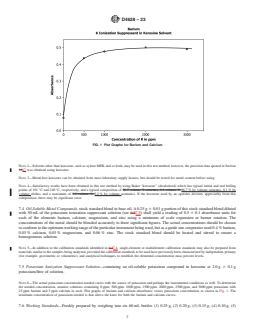
the needed concentration, atomize solutions containing 0 ppm, 500 ppm, 1000 ppm, 1500 ppm, 2000 ppm, 2500 ppm, and 3000 ppm potassium with
25 ppm barium and 5 ppm calcium in each. Plot graphs of barium and calcium absorbance versus potassium concentration as shown in Fig. 1. The
minimum concentration of potassium needed is that above the knee for both the barium and calcium curves.
7.6 Working Standards—Freshly prepared by weighing into six 60 mL bottles (1) 0.25 g, (2) 0.20 g, (3) 0.15 g, (4) 0.10 g, (5)
D4628 − 23
0.05 g, and (6) 0 g of stock standard blend (see 6.47.4) to three significant figures and add 0.0 g, 0.05 g, 0.10 g, 0.15 g, 0.20 g, and
0.25 g 6 0.01 g of base oil, respectively. Add 50 mL of potassium ionization suppressant solution (see 6.57.5) to each bottle and
shake or stir to dissolve.
NOTE 7—Many modern AAS instruments can store up to 3 or 4 calibration standards in memory. In such cases, follow the manufacturer’s instructions,
ensuring that the unknown sample’s absorbance is in the linear part of the calibration range used.
7.7 Quality Control (QC) Samples, preferably are portions of one or more liquid petroleum materials that are stable and
representative of the samples of interest. These QC samples can be used to check the validity of the testing process as described
in Section 1617.
8. Sampling
8.1 Shake the sample thoroughly before sampling to ensure obtaining a representative sample.
9. Preparation of Apparatus
9.1 Consult the manufacturer’s instructions for the operation of the atomic absorption spectrophotometer. The present test method
assumes that good operating procedures are followed. Design differences between spectrophotometers make it impractical to
specify the required manipulations in detail here. (Warning—Proper operating procedures are required for safety as well as for
reliability of results. An explosion can result from flame blow-back unless the correct burner head and operating sequence are
used.)
9.2 For the barium determination, fit the barium hollow cathode lamp and set the monochromator at 553.6 nm. Make fine
adjustments to the wavelength setting to give maximum output. Using the correct burner head for acetylene/nitrous oxide, set up
the acetylene/nitrous oxide flame. On instruments where applicable, adjust the gain control to set this maximum at full scale, when
aspirating standard (6) in 6.67.6.
9.3 Aspirate at about 2.5 mL ⁄min to 3 mL ⁄min a standard barium solution into the flame. Make adjustments to the height and
angle of the burner and to the acetylene flow rate to give maximum absorption. Make sure that standard (6) in 6.67.6 still gives
zero absorbance by making adjustments, if necessary.
10. Calibration (Barium)
10.1 Aspirate standard (1) in 6.67.6. With a minimum of scale expansion or burner rotation, obtain a reading of 0.5 6 0.1 on the
absorbance meter or alternative readout device.
10.2 Aspirate the standards of 6.67.6 sequentially into the flame and record the output (or note the meter deflections). Aspirate
the solvent alone after each standard.
10.3 Determine the net absorbance of each standard. If the spectrophotometer output is linear in absorbance, the net absorbance
is given by the difference between the absorbance for the standard or sample solution and the absorbance for the solvent alone.
If the spectrophotometer output is proportional to transmission (that is, to light intensity) then the net absorbance is given by log
d /d , where the deflections are d when solvent alone is aspirated and d when the standard or sample solution is aspirated.
0 1 0 1
10.4 Plot the net absorbance against the concentration (mg/50 mL suppressant solution) of barium in the standards to give a
calibration curve.
NOTE 8—The calibration curve may be automatically calculated by the instrument software and displayed by way of the instrument computer terminal,
making actual plotting unnecessary.
10.5 Calibration must be carried out prior to each group of samples to be analyzed and after any change in instrumental conditions,
as variation occurs in the instrument behavior. Readings may also vary over short times from such causes as buildup of deposits
on the burner slot or in the nebulizer. Thus, a single standard should be aspirated from time to time during a series of samples to
check whether the calibration has changed (a check after every fifth sample is recommended). The visual appearance of the flame
also serves as a useful check to detect changes of condition.
D4628 − 23
10.6 Determine the slope and intercept for barium based on the calibration curve developed. The values will be used to determine
barium concentrations of samples to be tested. Ensure that the regression coefficient is at least 0.99 for barium, otherwise the
laboratory needs to re-calibrate for barium when this criteria is not satisfied.
11. Procedure (Barium)
11.1 Weigh the sample to three significant figures into a 60 mL bottle. The sample mass is chosen to give an absorbance reading
of 0.2 to 0.5. Add base oil to make 0.25 g 6 0.01 g total mass. Add 50 mL of potassium suppressant solution, see 6.57.5, and
dissolve. The maximum sample size to be used is 0.25 g, and the minimum is 0.05 g.
11.1.1 To hazy samples add 0.25 mL 6 0.01 mL of 2-ethyl hexanoic acid and shake. If this clears up the haze, the analysis is run,
and the dilution error is corrected by multiplying the found results by 1.005. If the sample remains hazy, the sample is not suitable
to be analyzed by this test method.
11.2 Samples yielding absorbances greater than 0.5 even with the minimum sample size can be accurately diluted with new base
oil to a suitable concentration. Make sure the new solution is homogeneous before proceeding as instructed in 10.111.1.
11.3 Aspirate the sample solution and determine the absorbance, aspirating
...