

ASTM F1735-21
(Specification)Standard Specification for Poly (Vinyl Chloride) (PVC) Profile Strip for PVC Liners for Rehabilitation of Existing Man-Entry Sewers and Conduits
General Information
- Abstract
ABSTRACT
This specification covers the requirements and test methods for materials, dimensions, workmanship, extrusion quality, and form of marking for extruded poly(vinyl chloride) (PVC) profile strips used for field fabrication of PVC liners for existing man-entry sewer and conduit rehabilitation. The strips shall be subjected to acetone immersion, elasticity, and hydrostatic pressure tests in the standard laboratory atmosphere under specific temperature and relative humidity conditions to determine conformance to extrusion quality, flexural rigidity, and joint leakage requirements, respectively. The extruded profile strips shall be homogeneous throughout and free from visible cracks, holes, foreign inclusions, or other injurious defects and shall be as uniform as commercially practical in color, opacity, density, and other physical properties.
SCOPE
1.1 This specification covers requirements and test methods for materials, dimensions, workmanship, extrusion quality, and a form of marking for extruded poly (vinyl chloride) (PVC) profile strips used for field fabrication of PVC liners for existing man-entry (36 in. to 144 in. (900 mm to 3650 mm) in vertical dimension) sewer and conduit rehabilitation.
1.2 Profile strip produced to this specification is for use in field fabrication of PVC liners in non-pressure pipe and conduit rehabilitation where the liner is installed into the existing sewer or conduit and the annular space between the liner and the existing sewer or conduit is grouted with cementitious grout.
Note 1: The practice for the installation of PVC liner covered by this specification is Practice F1698.
1.3 This specification includes extruded profile strips made only from materials specified in 6.1.
1.4 The values stated in inch-pound units are to be regarded as standard. The values given in parentheses are mathematical conversions to SI units that are provided for information only and are not considered standard.
1.5 This standard does not purport to address all of the safety concerns, if any, associated with its use. It is the responsibility of the user of this standard to establish appropriate safety, health, and environmental practices and determine the applicability of regulatory limitations prior to use.
1.6 This international standard was developed in accordance with internationally recognized principles on standardization established in the Decision on Principles for the Development of International Standards, Guides and Recommendations issued by the World Trade Organization Technical Barriers to Trade (TBT) Committee.
- Status
- Published
- Publication Date
- 14-Feb-2021
- Technical Committee
- F17 - Plastic Piping Systems
- Drafting Committee
- F17.67 - Trenchless Plastic Pipeline Technology
Buy Documents
ASTM F1735-21 - Standard Specification for Poly (Vinyl Chloride) (PVC) Profile Strip for PVC Liners for Rehabilitation of Existing Man-Entry Sewers and Conduits
REDLINE ASTM F1735-21 - Standard Specification for Poly (Vinyl Chloride) (PVC) Profile Strip for PVC Liners for Rehabilitation of Existing Man-Entry Sewers and Conduits
Overview
ASTM F1735-21 sets forth the specification for poly (vinyl chloride) (PVC) profile strips used to fabricate PVC liners intended for the rehabilitation of existing man-entry sewers and conduits. Published by ASTM International, this standard details the essential requirements and test methods for materials, dimensions, manufacturing quality, and product marking. It is specifically applicable to non-pressure pipelines and conduits ranging from 36 inches to 144 inches (900 mm to 3650 mm) in vertical dimension. The standard ensures that PVC profile strip products used in infrastructure rehabilitation are fit for use, offering consistent quality and performance for major municipal, industrial, and environmental projects.
Key Topics
- Material Requirements: Specifies the use of PVC compounds meeting minimum cell classification 12344 or higher, as per ASTM D1784, for both former and joiner strips. Elastomer seals must be made from extrusion-grade elastomer with specific hardness requirements.
- Testing and Quality Control:
- Acetone Immersion: Ensures proper fusion of PVC material to avoid quality defects.
- Flexural Rigidity: Profiles are tested for stiffness and mechanical strength, crucial for underground installations.
- Impact Resistance: Ensures profile strips can withstand handling and installation stresses.
- Joint Leakage: Asserts tightness of joints when exposed to hydrostatic pressure, which is critical for sewer lining performance.
- Heat Reversion: Evaluates the stability and homogeneity of the extruded profiles.
- Dimensional Tolerances: Establishes minimum strip heights, wall thickness, and tolerances for width and elastomer seals to promote installation compatibility and liner integrity.
- Workmanship and Marking: Requires profile strips to be homogeneous, free from defects, and marked at specific intervals with manufacturer and product information as well as the ASTM F1735 designation.
Applications
- Sewer and Conduit Rehabilitation: Used for field fabrication of PVC liners for gravity-flow sewers and conduits, especially where trenchless technology is preferred for minimal service disruption.
- Municipal Infrastructure: Supports cities and utility providers in restoring aging sewers, stormwater systems, and process flow conduits.
- Industrial Retrofits: Suitable for process lines and conduits handling non-pressurized fluids, contingent on proper chemical and temperature evaluation.
- Installation Practices: Practice for the installation of these liners is covered under ASTM F1698, ensuring the seamless integration of ASTM F1735-compliant profile strips into existing piping infrastructure.
- Project Quality Assurance: Provides guidelines for material sampling, inspection, and certification, which are essential for project documentation and regulatory compliance.
Related Standards
- ASTM D1784: Classification system for rigid PVC compounds.
- ASTM D2122: Test methods for thermoplastic pipe and fittings dimensions.
- ASTM D2152: Acetone immersion testing for fusion adequacy.
- ASTM D2240: Rubber property - Durometer hardness test method.
- ASTM D4226: Impact resistance test methods for building products.
- ASTM D618: Conditioning plastics for testing.
- ASTM F1057: Heat reversion testing for extruded PVC.
- ASTM F1698: Installation practice for PVC profile strip liners in sewer rehabilitation.
- Federal and Military Standards: Marking and packaging for U.S. government procurement (Fed. Std. No. 123 and MIL-STD-129).
Keywords: ASTM F1735, PVC profile strip, sewer rehabilitation, PVC liners, ASTM standard, conduit lining, trenchless pipe repair, infrastructure rehabilitation, profile strip testing, liner installation, municipal sewer lining.
Relations
- Effective Date
- 01-Feb-2024
- Effective Date
- 01-Nov-2023
- Effective Date
- 01-Nov-2023
- Effective Date
- 01-Apr-2020
- Effective Date
- 15-Jan-2020
- Effective Date
- 01-Jan-2020
- Effective Date
- 01-Nov-2019
- Effective Date
- 01-Nov-2019
- Effective Date
- 01-Aug-2019
- Effective Date
- 15-Apr-2019
- Effective Date
- 01-Feb-2019
- Effective Date
- 01-Jan-2019
- Effective Date
- 01-Dec-2018
- Effective Date
- 01-Nov-2018
- Refers
ASTM D1600-18 - Standard Terminology for Abbreviated Terms Relating to Plastics (Withdrawn 2024) - Effective Date
- 01-Jan-2018
Buy Documents
ASTM F1735-21 - Standard Specification for Poly (Vinyl Chloride) (PVC) Profile Strip for PVC Liners for Rehabilitation of Existing Man-Entry Sewers and Conduits
REDLINE ASTM F1735-21 - Standard Specification for Poly (Vinyl Chloride) (PVC) Profile Strip for PVC Liners for Rehabilitation of Existing Man-Entry Sewers and Conduits
Get Certified
Connect with accredited certification bodies for this standard

DIN CERTCO
DIN Group product certification.
Institut za varilstvo d.o.o. (Welding Institute)
Slovenia's leading welding institute since 1952. ISO 3834, EN 1090, pressure equipment certification, NDT personnel, welder qualification. Only IIW Au

Smithers Quality Assessments
US management systems and product certification.
Sponsored listings
Frequently Asked Questions
ASTM F1735-21 is a technical specification published by ASTM International. Its full title is "Standard Specification for Poly (Vinyl Chloride) (PVC) Profile Strip for PVC Liners for Rehabilitation of Existing Man-Entry Sewers and Conduits". This standard covers: ABSTRACT This specification covers the requirements and test methods for materials, dimensions, workmanship, extrusion quality, and form of marking for extruded poly(vinyl chloride) (PVC) profile strips used for field fabrication of PVC liners for existing man-entry sewer and conduit rehabilitation. The strips shall be subjected to acetone immersion, elasticity, and hydrostatic pressure tests in the standard laboratory atmosphere under specific temperature and relative humidity conditions to determine conformance to extrusion quality, flexural rigidity, and joint leakage requirements, respectively. The extruded profile strips shall be homogeneous throughout and free from visible cracks, holes, foreign inclusions, or other injurious defects and shall be as uniform as commercially practical in color, opacity, density, and other physical properties. SCOPE 1.1 This specification covers requirements and test methods for materials, dimensions, workmanship, extrusion quality, and a form of marking for extruded poly (vinyl chloride) (PVC) profile strips used for field fabrication of PVC liners for existing man-entry (36 in. to 144 in. (900 mm to 3650 mm) in vertical dimension) sewer and conduit rehabilitation. 1.2 Profile strip produced to this specification is for use in field fabrication of PVC liners in non-pressure pipe and conduit rehabilitation where the liner is installed into the existing sewer or conduit and the annular space between the liner and the existing sewer or conduit is grouted with cementitious grout. Note 1: The practice for the installation of PVC liner covered by this specification is Practice F1698. 1.3 This specification includes extruded profile strips made only from materials specified in 6.1. 1.4 The values stated in inch-pound units are to be regarded as standard. The values given in parentheses are mathematical conversions to SI units that are provided for information only and are not considered standard. 1.5 This standard does not purport to address all of the safety concerns, if any, associated with its use. It is the responsibility of the user of this standard to establish appropriate safety, health, and environmental practices and determine the applicability of regulatory limitations prior to use. 1.6 This international standard was developed in accordance with internationally recognized principles on standardization established in the Decision on Principles for the Development of International Standards, Guides and Recommendations issued by the World Trade Organization Technical Barriers to Trade (TBT) Committee.
ABSTRACT This specification covers the requirements and test methods for materials, dimensions, workmanship, extrusion quality, and form of marking for extruded poly(vinyl chloride) (PVC) profile strips used for field fabrication of PVC liners for existing man-entry sewer and conduit rehabilitation. The strips shall be subjected to acetone immersion, elasticity, and hydrostatic pressure tests in the standard laboratory atmosphere under specific temperature and relative humidity conditions to determine conformance to extrusion quality, flexural rigidity, and joint leakage requirements, respectively. The extruded profile strips shall be homogeneous throughout and free from visible cracks, holes, foreign inclusions, or other injurious defects and shall be as uniform as commercially practical in color, opacity, density, and other physical properties. SCOPE 1.1 This specification covers requirements and test methods for materials, dimensions, workmanship, extrusion quality, and a form of marking for extruded poly (vinyl chloride) (PVC) profile strips used for field fabrication of PVC liners for existing man-entry (36 in. to 144 in. (900 mm to 3650 mm) in vertical dimension) sewer and conduit rehabilitation. 1.2 Profile strip produced to this specification is for use in field fabrication of PVC liners in non-pressure pipe and conduit rehabilitation where the liner is installed into the existing sewer or conduit and the annular space between the liner and the existing sewer or conduit is grouted with cementitious grout. Note 1: The practice for the installation of PVC liner covered by this specification is Practice F1698. 1.3 This specification includes extruded profile strips made only from materials specified in 6.1. 1.4 The values stated in inch-pound units are to be regarded as standard. The values given in parentheses are mathematical conversions to SI units that are provided for information only and are not considered standard. 1.5 This standard does not purport to address all of the safety concerns, if any, associated with its use. It is the responsibility of the user of this standard to establish appropriate safety, health, and environmental practices and determine the applicability of regulatory limitations prior to use. 1.6 This international standard was developed in accordance with internationally recognized principles on standardization established in the Decision on Principles for the Development of International Standards, Guides and Recommendations issued by the World Trade Organization Technical Barriers to Trade (TBT) Committee.
ASTM F1735-21 is classified under the following ICS (International Classification for Standards) categories: 23.040.45 - Plastics fittings; 83.080.20 - Thermoplastic materials. The ICS classification helps identify the subject area and facilitates finding related standards.
ASTM F1735-21 has the following relationships with other standards: It is inter standard links to ASTM D883-24, ASTM D2152-23, ASTM D883-23, ASTM F412-20, ASTM D1784-20, ASTM D883-20, ASTM D4226-19e1, ASTM D4226-19, ASTM D883-19c, ASTM D883-19a, ASTM D883-19, ASTM F412-19, ASTM D883-18a, ASTM D883-18, ASTM D1600-18. Understanding these relationships helps ensure you are using the most current and applicable version of the standard.
ASTM F1735-21 is available in PDF format for immediate download after purchase. The document can be added to your cart and obtained through the secure checkout process. Digital delivery ensures instant access to the complete standard document.
Standards Content (Sample)
This international standard was developed in accordance with internationally recognized principles on standardization established in the Decision on Principles for the
Development of International Standards, Guides and Recommendations issued by the World Trade Organization Technical Barriers to Trade (TBT) Committee.
Designation:F1735 −21
Standard Specification for
Poly (Vinyl Chloride) (PVC) Profile Strip for PVC Liners for
Rehabilitation of Existing Man-Entry Sewers and Conduits
This standard is issued under the fixed designation F1735; the number immediately following the designation indicates the year of
original adoption or, in the case of revision, the year of last revision.Anumber in parentheses indicates the year of last reapproval.A
superscript epsilon (´) indicates an editorial change since the last revision or reapproval.
1. Scope* 2. Referenced Documents
1.1 This specification covers requirements and test methods 2.1 ASTM Standards:
formaterials,dimensions,workmanship,extrusionquality,and D618Practice for Conditioning Plastics for Testing
a form of marking for extruded poly (vinyl chloride) (PVC) D790Test Methods for Flexural Properties of Unreinforced
profile strips used for field fabrication of PVC liners for and Reinforced Plastics and Electrical Insulating Materi-
existing man-entry (36 in. to 144 in. (900 mm to 3650 mm) in als
vertical dimension) sewer and conduit rehabilitation. D883Terminology Relating to Plastics
D1600TerminologyforAbbreviatedTermsRelatingtoPlas-
1.2 Profile strip produced to this specification is for use in
tics
fieldfabricationofPVClinersinnon-pressurepipeandconduit
D1784Classification System and Basis for Specification for
rehabilitationwherethelinerisinstalledintotheexistingsewer
Rigid Poly(Vinyl Chloride) (PVC) Compounds and Chlo-
or conduit and the annular space between the liner and the
rinated Poly(Vinyl Chloride) (CPVC) Compounds
existing sewer or conduit is grouted with cementitious grout.
D2122Test Method for Determining Dimensions of Ther-
NOTE 1—The practice for the installation of PVC liner covered by this
moplastic Pipe and Fittings
specification is Practice F1698.
D2152Test Method for Adequacy of Fusion of Extruded
1.3 This specification includes extruded profile strips made
Poly(Vinyl Chloride) (PVC) Pipe and Molded Fittings by
only from materials specified in 6.1.
Acetone Immersion
D2240TestMethodforRubberProperty—DurometerHard-
1.4 Thevaluesstatedininch-poundunitsaretoberegarded
ness
as standard. The values given in parentheses are mathematical
D4226Test Methods for Impact Resistance of Rigid Poly-
conversions to SI units that are provided for information only
(Vinyl Chloride) (PVC) Building Products
and are not considered standard.
F412Terminology Relating to Plastic Piping Systems
1.5 This standard does not purport to address all of the
F1057Practice for Estimating the Quality of Extruded Poly
safety concerns, if any, associated with its use. It is the
(Vinyl Chloride) (PVC) Pipe by the Heat Reversion
responsibility of the user of this standard to establish appro-
Technique
priate safety, health, and environmental practices and deter-
F1698 Practice for Installation of Poly(Vinyl Chlo-
mine the applicability of regulatory limitations prior to use.
ride)(PVC)ProfileStripLinerandCementitiousGroutfor
1.6 This international standard was developed in accor-
Rehabilitation of Existing Man-Entry Sewers and Con-
dance with internationally recognized principles on standard-
duits
ization established in the Decision on Principles for the
2.2 Federal Standard:
Development of International Standards, Guides and Recom-
Federal Standard No. 123Marking For Shipment (Civil
mendations issued by the World Trade Organization Technical
Agencies)
Barriers to Trade (TBT) Committee.
1 2
This specification is under the jurisdiction ofASTM Committee F17 on Plastic For referenced ASTM standards, visit the ASTM website, www.astm.org, or
Piping Systems and is the direct responsibility of Subcommittee F17.67 on contact ASTM Customer Service at service@astm.org. For Annual Book of ASTM
Trenchless Plastic Pipeline Technology. Standards volume information, refer to the standard’s Document Summary page on
Current edition approved Feb. 15, 2021. Published March 2021. Originally the ASTM website.
approved in 1996. Last previous edition approved in 2015 as F1735-09(2015). Available from DLA Document Services, Building 4/D, 700 Robbins Ave.,
DOI: 10.1520/F1735-21. Philadelphia, PA 19111-5094, http://quicksearch.dla.mil.
*A Summary of Changes section appears at the end of this standard
Copyright © ASTM International, 100 Barr Harbor Drive, PO Box C700, West Conshohocken, PA 19428-2959. United States
F1735−21
2.3 Military Standard: conduits conveying sewage, process flow and storm water
MIL-STD-129Marking for Shipment and Storage under gravity flow conditions.
NOTE 2—Industrial waste disposal lines shall be installed only with the
3. Terminology
specific approval of the cognizant code authority since chemicals not
commonly found in drains and sewers and temperatures in excess of
3.1 General—Definitions are in accordance with Terminol-
140°F (60°C) may be encountered.
ogy D883 and Terminology F412.Abbreviations are in accor-
dance with Terminology D1600, unless otherwise indicated.
5. Application of Materials
3.2 Definitions of Terms Specific to This Standard:
5.1 Theprofilestripspecifiedhereincanbeusedforarange
3.2.1 See Fig. 1 to clarify terminology.
of existing sewer and conduit diameters. The selection of the
3.2.2 coextruded elastomer seal, n—a elastomer coextruded
annulus between the PVC liner and the host structure shall be
in the joiner strip to provide compression sealing of the
determined based on analysis of installation conditions.
mechanical joint made when the joiner strip locks adjacent
edges of former strip.
6. Materials and Manufacture
3.2.3 extruded PVC joiner strip, n—acompanionproductto
6.1 The extruded profile former and joiner strips shall be
the profile former strip of such configuration as to provide the
made from PVC compound meeting all the minimum require-
locking mechanism at the edges of the former strips.
ments for cell classification 12344 or higher as defined in
3.2.4 extruded PVC profile former strip, n—a product,
Specification D1784.
available in various sizes, consisting of a smooth inner surface
6.2 The elastomer seal shall be made from extrusion grade
and a ribbed outer surface (profile) with edge configurations to
elastomer with Shore A durometer of 65 (+5 to –5), when
allow mechanical locking of adjacent strips.
measured in accordance with Test Method D2240.
3.2.5 production run, n—a continuous extrusion of a given
6.3 Rework Material—Clean rework material generated
profile type.
from the manufacturer’s own extruded PVC strip production
3.2.6 PVC liner, n—aproductfieldfabricatedfromextruded
may be used by the same manufacturer provided extruded
PVC profile strip into a shape which substantially conforms to
profile strip produced meets all the requirements of this
the shape of the inner surface of the existing pipe or conduit
specification.
over some portion or all of its inner circumference.
7. Other Requirements
4. Significance and Use
7.1 Acetone Immersion—The profile strip shall not flake or
4.1 The requirements of this specification are intended to
disintegrate when tested in accordance with 11.3.
provide extruded PVC profile suitable for the field fabrication
of PVC liner for the rehabilitation of existing pipelines and NOTE 3—This is intended only for use as a quality control test and not
FIG. 1An Example of A Profile PVC Strip
F1735−21
for use as a simulated service test.
test shall be terminated at the end of any 1-h period during
whichthisrequirementissatisfied.Thistestshallbeconducted
7.2 Heat Reversion—The profile strip shall not show any
on each production run of extruded PVC joiner strip with
visual signs of incomplete processing (fishscaling, wall
samples from the extruded PVC former strip intended for use
separation, or blisters) in the profile.
with that production run of joiner strip. If higher hydrostatic
7.3 Impact—The profile strip shall be impacted in accor-
testing pressures are required by the buyer, additional testing,
dance with 11.5 at a minimum of two (2) test locations. The
asagreedbetweenthebuyerandsellershallbeperformed.The
impactresultsshallbenon-failure,orifafailureoccursitshall
test fixture used for this test shall provide for the pressurized
be ductile; brittle failures are not allowed.
water to interface with the joint on the ribbed side of the PVC
7.4 Flexural (Bending) Properties—The flexural rigidity
panels such that the leakage flow is from the ribbed side to the
(stiffness factor) shall be determined in accordance with Test
smooth (inner) side of the PVC panels, that is, simulates
Methods D790, Section on Tangent Modulus of Elasticity,
ground water into liner. Means shall be provided to continu-
Procedure B, where the equation for E is replaced by EI =
B ously measure and regulate the water pressure to within 1 psig
L m/48 h. Procedure B of Test Methods D790 shall be used in
(6.9 kPa) of the specified 15 psig (103.5 kPa) during the test
these tests. This is a qualification test that shall be performed
period.
on each distinct profile product; separate tests shall be per-
formed for each PVC compound used in each distinct profile
8. Dimensions, Mass, and Permissible Variation
product. The test specimens shall be made from a flat sample
8.1 Height of Profile Former Strip—Theminimumheightof
profile former strip at least 12 in. (300 mm) long, split as near
theformerstripshallbe0.488in.(12.4mm)whenmeasuredin
themiddleofitswidthaspossiblewithoutcuttingthrougharib
accordance with 11.2.1
and the outer edges joined in a joint (approximately in the
center of the width of the specimen and running lengthwise)
8.2 Wall Thickness of Profile Former Strip—The minimum
with the joiner strip installed in the joint. The load shall be
average (arithmetic mean) wall thickness (between ribs) of
applied to the profiled (ribbed) side of the specimens. See Fig.
each extruded former strip sample shall be 0.060 in. (1.5 mm)
2. The minimum flexural rigidity (stiffness factor) sha
...
This document is not an ASTM standard and is intended only to provide the user of an ASTM standard an indication of what changes have been made to the previous version. Because
it may not be technically possible to adequately depict all changes accurately, ASTM recommends that users consult prior editions as appropriate. In all cases only the current version
of the standard as published by ASTM is to be considered the official document.
Designation: F1735 − 09 (Reapproved 2015) F1735 − 21
Standard Specification for
Poly (Vinyl Chloride) (PVC) Profile Strip for PVC Liners for
Rehabilitation of Existing Man-Entry Sewers and Conduits
This standard is issued under the fixed designation F1735; the number immediately following the designation indicates the year of
original adoption or, in the case of revision, the year of last revision. A number in parentheses indicates the year of last reapproval. A
superscript epsilon (´) indicates an editorial change since the last revision or reapproval.
1. Scope*
1.1 This specification covers requirements and test methods for materials, dimensions, workmanship, extrusion quality, and a form
of marking for extruded poly (vinyl chloride) (PVC) profile strips used for field fabrication of PVC liners for existing man-entry
(36 in. to 144 in. (900 mm to 3650 mm) in vertical dimension) sewer and conduit rehabilitation.
1.2 Profile strip produced to this specification is for use in field fabrication of PVC liners in non-pressure pipe and conduit
rehabilitation where the liner is installed into the existing sewer or conduit and the annular space between the liner and the existing
sewer or conduit is grouted with cementitious grout.
NOTE 1—The practice for the installation of PVC liner covered by this specification is Practice F1698.
1.3 This specification includes extruded profile strips made only from materials specified in 6.1.
1.4 The values stated in inch-pound units are to be regarded as standard. The values given in parentheses are mathematical
conversions to SI units that are provided for information only and are not considered standard.
1.5 This standard does not purport to address all of the safety concerns, if any, associated with its use. It is the responsibility
of the user of this standard to establish appropriate safety safety, health, and healthenvironmental practices and determine the
applicability of regulatory limitations prior to use.
1.6 This international standard was developed in accordance with internationally recognized principles on standardization
established in the Decision on Principles for the Development of International Standards, Guides and Recommendations issued
by the World Trade Organization Technical Barriers to Trade (TBT) Committee.
2. Referenced Documents
2.1 ASTM Standards:
D618 Practice for Conditioning Plastics for Testing
D790 Test Methods for Flexural Properties of Unreinforced and Reinforced Plastics and Electrical Insulating Materials
D883 Terminology Relating to Plastics
D1600 Terminology for Abbreviated Terms Relating to Plastics
This specification is under the jurisdiction of ASTM Committee F17 on Plastic Piping Systems and is the direct responsibility of Subcommittee F17.67 on Trenchless
Plastic Pipeline Technology.
Current edition approved March 1, 2015Feb. 15, 2021. Published April 2015March 2021. Originally approved in 1996. Last previous edition approved in 20092015 as
F1735 - 09.F1735 - 09(2015). DOI: 10.1520/F1735-09R15.10.1520/F1735-21.
For referenced ASTM standards, visit the ASTM website, www.astm.org, or contact ASTM Customer Service at service@astm.org. For Annual Book of ASTM Standards
volume information, refer to the standard’s Document Summary page on the ASTM website.
*A Summary of Changes section appears at the end of this standard
Copyright © ASTM International, 100 Barr Harbor Drive, PO Box C700, West Conshohocken, PA 19428-2959. United States
F1735 − 21
D1784 Classification System and Basis for Specification for Rigid Poly(Vinyl Chloride) (PVC) Compounds and Chlorinated
Poly(Vinyl Chloride) (CPVC) Compounds
D2122 Test Method for Determining Dimensions of Thermoplastic Pipe and Fittings
D2152 Test Method for Adequacy of Fusion of Extruded Poly(Vinyl Chloride) (PVC) Pipe and Molded Fittings by Acetone
Immersion
D2240 Test Method for Rubber Property—Durometer Hardness
D4226 Test Methods for Impact Resistance of Rigid Poly(Vinyl Chloride) (PVC) Building Products
F412 Terminology Relating to Plastic Piping Systems
F1057 Practice for Estimating the Quality of Extruded Poly (Vinyl Chloride) (PVC) Pipe by the Heat Reversion Technique
F1698 Practice for Installation of Poly(Vinyl Chloride)(PVC) Profile Strip Liner and Cementitious Grout for Rehabilitation of
Existing Man-Entry Sewers and Conduits
2.2 Federal Standard:
Federal Standard No. 123 Marking For Shipment (Civil Agencies)
2.3 Military Standard:
MIL-STD-129 Marking for Shipment and Storage
3. Terminology
3.1 General—Definitions are in accordance with Terminology D883 and Terminology F412. Abbreviations are in accordance with
Terminology D1600, unless otherwise indicated.
3.2 Definitions of Terms Specific to This Standard:
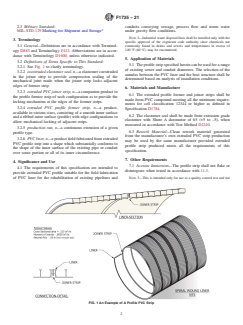
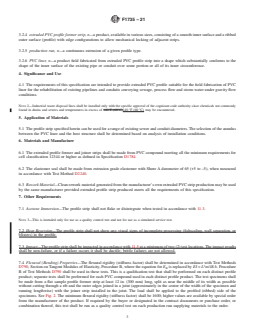
3.2.1 See Fig. 1 to clarify terminology.
3.2.2 coextruded elastomer seal, n—a elastomer coextruded in the joiner strip to provide compression sealing of the mechanical
joint made when the joiner strip locks adjacent edges of former strip.
3.2.3 extruded PVC joiner strip, n—a companion product to the profile former strip of such configuration as to provide the locking
mechanism at the edges of the former strips.
FIG. 1 An Example of A Profile PVC Strip
Available from DLA Document Services, Building 4/D, 700 Robbins Ave., Philadelphia, PA 19111-5094, http://quicksearch.dla.mil.
F1735 − 21
3.2.4 extruded PVC profile former strip, n—a product, available in various sizes, consisting of a smooth inner surface and a ribbed
outer surface (profile) with edge configurations to allow mechanical locking of adjacent strips.
3.2.5 production run, n—a continuous extrusion of a given profile type.
3.2.6 PVC liner, n—a product field fabricated from extruded PVC profile strip into a shape which substantially conforms to the
shape of the inner surface of the existing pipe or conduit over some portion or all of its inner circumference.
4. Significance and Use
4.1 The requirements of this specification are intended to provide extruded PVC profile suitable for the field fabrication of PVC
liner for the rehabilitation of existing pipelines and conduits conveying sewage, process flow and storm water under gravity flow
conditions.
NOTE 2—Industrial waste disposal lines shall be installed only with the specific approval of the cognizant code authority since chemicals not commonly
found in drains and sewers and temperatures in excess of 140°F (60°C)140 °F (60 °C) may be encountered.
5. Application of Materials
5.1 The profile strip specified herein can be used for a range of existing sewer and conduit diameters. The selection of the annulus
between the PVC liner and the host structure shall be determined based on analysis of installation conditions.
6. Materials and Manufacture
6.1 The extruded profile former and joiner strips shall be made from PVC compound meeting all the minimum requirements for
cell classification 12344 or higher as defined in Specification D1784.
6.2 The elastomer seal shall be made from extrusion grade elastomer with Shore A durometer of 65 (+5 to –5), when measured
in accordance with Test Method D2240.
6.3 Rework Material—Clean rework material generated from the manufacturer’s own extruded PVC strip production may be used
by the same manufacturer provided extruded profile strip produced meets all the requirements of this specification.
7. Other Requirements
7.1 Acetone Immersion—The profile strip shall not flake or disintegrate when tested in accordance with 11.3.
NOTE 3—This is intended only for use as a quality control test and not for use as a simulated service test.
7.2 Heat Reversion—The profile strip shall not show any visual signs of incomplete processing (fishscaling, wall separation, or
blisters) in the profile.
7.3 Impact—The profile strip shall be impacted in accordance with 11.5 at a minimum of two (2) test locations. The impact results
shall be non-failure, or if a failure occurs it shall be ductile; brittle failures are not allowed.
7.4 Flexural (Bending) Properties—The flexural rigidity (stiffness factor) shall be determined in accordance with Test Methods
D790, Section on Tangent Modulus of Elasticity, Procedure B, where the equation for E is replaced by EI = L m/48 h. Procedure
B
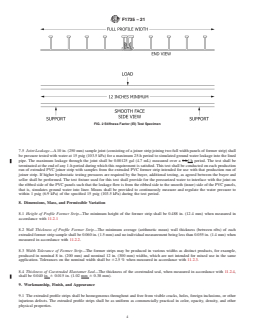
B of Test Methods D790 shall be used in these tests. This is a qualification test that shall be performed on each distinct profile
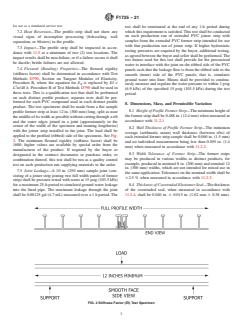
product; separate tests shall be performed for each PVC compound used in each distinct profile product. The test specimens shall
be made from a flat sample profile former strip at least 12 in. (300 mm) long, split as near the middle of its width as possible
without cutting through a rib and the outer edges joined in a joint (approximately in the center of the width of the specimen and
running lengthwise) with the joiner strip installed in the joint. The load shall be applied to the profiled (ribbed) side of the
specimens. See Fig. 2. The minimum flexural rigidity (stiffness factor) shall be 1600; higher values are available by special order
from the manufacturer of the product. If required by the buyer or designated in the contract documents or purchase order, or
combination thereof, this test shall be run as a quality control test on each production run supplying materials to the order.
F1735 − 21
FIG. 2 Stiffness Factor (EI) Test Specimen
7.5 Joint Leakage—A 10 in. (250 mm) sample joint (consisting of a joiner strip joining two full width panels of former strip) shall
be pressure tested with water at 15 psig (103.5 kPa) for a maximum 25-h period to simulated ground water leakage into the lined
pipe. The maximum leakage through the joint shall be 0.00125 gal (4.7 mL) measured over a 1-h1 h period. The test shall be
terminated at the end of any 1-h period during which this requirement is satisfied. This test shall be conducted on each production
run of extruded PVC joiner strip with samples from the extruded PVC former strip intended for use with that production run of
joiner strip. If higher hydrostatic testing pressures are required by the buyer, additional testing, as agreed between the buyer and
seller shall be performed. The test fixture used for this test shall provide for the pressuriz
...