

ASTM C349-18
(Test Method)Standard Test Method for Compressive Strength of Hydraulic-Cement Mortars (Using Portions of Prisms Broken in Flexure)
General Information
- Abstract
SIGNIFICANCE AND USE
4.1 This method provides a means of obtaining compressive strength values from the same specimens previously used for flexural strength determinations by Test Method C348. The compressive strength values are for reference purposes, and not as substitutes for values obtained by Test Method C109/C109M for cement acceptance.
SCOPE
1.1 This test method covers the determination of the compressive strength of hydraulic-cement mortars, using for the test specimens portions of prisms made and broken in flexure in accordance with Test Method C348.
1.2 The values stated in SI units are to be regarded as standard. No other units of measurement are included in this standard.
1.3 Values in SI units shall be obtained by measurement in SI units or by appropriate conversion, using the Rules for Conversion and rounding given in Standard IEEE/ASTM SI 10, of measurements made in other units.
1.4 This standard does not purport to address all of the safety concerns, if any, associated with its use. It is the responsibility of the user of this standard to establish appropriate safety, health, and environmental practices and determine the applicability of regulatory limitations prior to use. (Warning—Fresh hydraulic cementitious mixtures are caustic and may cause chemical burns to skin and tissue upon prolonged exposure.2)
1.5 This international standard was developed in accordance with internationally recognized principles on standardization established in the Decision on Principles for the Development of International Standards, Guides and Recommendations issued by the World Trade Organization Technical Barriers to Trade (TBT) Committee.
- Status
- Published
- Publication Date
- 30-Nov-2018
- Technical Committee
- C01 - Cement
- Drafting Committee
- C01.27 - Strength
Buy Documents

ASTM C349-18 - Standard Test Method for Compressive Strength of Hydraulic-Cement Mortars<brk/> (Using Portions of Prisms Broken in Flexure)

REDLINE ASTM C349-18 - Standard Test Method for Compressive Strength of Hydraulic-Cement Mortars<brk/> (Using Portions of Prisms Broken in Flexure)
Overview
ASTM C349-18: Standard Test Method for Compressive Strength of Hydraulic-Cement Mortars (Using Portions of Prisms Broken in Flexure) provides a standardized procedure for determining the compressive strength of hydraulic-cement mortars. This test specifically uses portions of mortar prisms that have previously been tested for flexural strength according to ASTM C348. The compressive strength results gained from this method are intended for reference and should not replace values obtained by the primary method, ASTM C109/C109M, which is required for cement acceptance purposes.
By employing the same specimens used in flexural testing, laboratories can efficiently gather additional strength data, improving quality control and research workflows in cementitious materials testing.
Key Topics
- Test Scope: Covers the measurement of compressive strength on parts of prisms previously used in flexural strength testing of hydraulic-cement mortars.
- Specimen Requirements: Only specimens free from cracks, chipped surfaces, or other defects and with a minimum length of 65 mm are suitable.
- Apparatus: Requires hardened steel bearing plates and a hydraulic testing machine compliant with ASTM C109/C109M specifications for accurate load application.
- SI Units: All test results must be reported in SI units (megapascals); no other measurement systems are included.
- Safety Considerations: Fresh hydraulic cementitious mixtures can be caustic and may cause chemical burns. Users must follow proper safety protocols to mitigate health risks associated with handling mortar samples.
- Precision and Bias: The test method includes precision statements for both single-laboratory and multi-laboratory conditions, helping laboratories evaluate the repeatability and reproducibility of their results.
Applications
- Reference Testing: This method is ideally suited for reference testing to gain additional compressive strength data from prisms already utilized for flexural tests, maximizing specimen usage.
- Quality Control: Offers construction material laboratories an efficient means to assess both flexural and compressive properties from the same mortar batch, aiding in quality assurance processes in cement and mortar production.
- Research and Development: Useful for research institutions and material scientists evaluating the properties of new or modified hydraulic-cement formulations.
- Educational Purposes: Provides a practical approach for academic environments demonstrating strength testing techniques for hydraulic-cement mortars.
It is important to note that compressive strength values obtained from ASTM C349-18 are not acceptable substitutes for those generated by the reference standard ASTM C109/C109M for the purposes of cement acceptance or conformity to contractual specifications.
Related Standards
- ASTM C109/C109M: Test Method for Compressive Strength of Hydraulic Cement Mortars (using 2-inch or 50-mm cube specimens)
- ASTM C348: Test Method for Flexural Strength of Hydraulic-Cement Mortars (the initial test from which specimens are taken)
- ASTM C125: Terminology Relating to Concrete and Concrete Aggregates
- ASTM C219: Terminology Relating to Hydraulic Cement
- ASTM C670: Practice for Preparing Precision and Bias Statements for Test Methods for Construction Materials
- IEEE/ASTM SI 10: Standard for Use of the International System of Units (SI)
These related standards support a comprehensive approach to testing and reporting mechanical properties of hydraulic-cement mortars, ensuring reliable and repeatable results across applications.
Summary
ASTM C349-18 enables efficient compressive strength testing of hydraulic-cement mortars using portions of prisms post-flexural testing. This standard supports laboratory efficiency, quality control, and research into cement-based materials, while maintaining compatibility with international measurement and safety standards. For cement acceptance, users must still rely on the results from ASTM C109/C109M.
Relations
- Effective Date
- 01-Dec-2018
- Effective Date
- 01-Apr-2024
- Effective Date
- 01-Feb-2024
- Effective Date
- 01-Jan-2024
- Effective Date
- 15-Dec-2023
- Effective Date
- 01-Aug-2020
- Effective Date
- 01-Apr-2020
- Effective Date
- 15-Dec-2019
- Effective Date
- 15-Nov-2019
- Effective Date
- 01-Oct-2019
- Effective Date
- 01-Jun-2019
- Effective Date
- 01-Jan-2019
- Effective Date
- 01-Dec-2018
- Effective Date
- 01-Oct-2018
- Effective Date
- 01-Jul-2018
Buy Documents
ASTM C349-18 - Standard Test Method for Compressive Strength of Hydraulic-Cement Mortars<brk/> (Using Portions of Prisms Broken in Flexure)
REDLINE ASTM C349-18 - Standard Test Method for Compressive Strength of Hydraulic-Cement Mortars<brk/> (Using Portions of Prisms Broken in Flexure)
Get Certified
Connect with accredited certification bodies for this standard

DIBt (Deutsches Institut für Bautechnik)
German Institute for Building Technology.
DIN CERTCO
DIN Group product certification.

Aboma Certification B.V.
Specialized in construction, metal, and transport sectors.
Sponsored listings
Frequently Asked Questions
ASTM C349-18 is a standard published by ASTM International. Its full title is "Standard Test Method for Compressive Strength of Hydraulic-Cement Mortars<brk/> (Using Portions of Prisms Broken in Flexure)". This standard covers: SIGNIFICANCE AND USE 4.1 This method provides a means of obtaining compressive strength values from the same specimens previously used for flexural strength determinations by Test Method C348. The compressive strength values are for reference purposes, and not as substitutes for values obtained by Test Method C109/C109M for cement acceptance. SCOPE 1.1 This test method covers the determination of the compressive strength of hydraulic-cement mortars, using for the test specimens portions of prisms made and broken in flexure in accordance with Test Method C348. 1.2 The values stated in SI units are to be regarded as standard. No other units of measurement are included in this standard. 1.3 Values in SI units shall be obtained by measurement in SI units or by appropriate conversion, using the Rules for Conversion and rounding given in Standard IEEE/ASTM SI 10, of measurements made in other units. 1.4 This standard does not purport to address all of the safety concerns, if any, associated with its use. It is the responsibility of the user of this standard to establish appropriate safety, health, and environmental practices and determine the applicability of regulatory limitations prior to use. (Warning—Fresh hydraulic cementitious mixtures are caustic and may cause chemical burns to skin and tissue upon prolonged exposure.2) 1.5 This international standard was developed in accordance with internationally recognized principles on standardization established in the Decision on Principles for the Development of International Standards, Guides and Recommendations issued by the World Trade Organization Technical Barriers to Trade (TBT) Committee.
SIGNIFICANCE AND USE 4.1 This method provides a means of obtaining compressive strength values from the same specimens previously used for flexural strength determinations by Test Method C348. The compressive strength values are for reference purposes, and not as substitutes for values obtained by Test Method C109/C109M for cement acceptance. SCOPE 1.1 This test method covers the determination of the compressive strength of hydraulic-cement mortars, using for the test specimens portions of prisms made and broken in flexure in accordance with Test Method C348. 1.2 The values stated in SI units are to be regarded as standard. No other units of measurement are included in this standard. 1.3 Values in SI units shall be obtained by measurement in SI units or by appropriate conversion, using the Rules for Conversion and rounding given in Standard IEEE/ASTM SI 10, of measurements made in other units. 1.4 This standard does not purport to address all of the safety concerns, if any, associated with its use. It is the responsibility of the user of this standard to establish appropriate safety, health, and environmental practices and determine the applicability of regulatory limitations prior to use. (Warning—Fresh hydraulic cementitious mixtures are caustic and may cause chemical burns to skin and tissue upon prolonged exposure.2) 1.5 This international standard was developed in accordance with internationally recognized principles on standardization established in the Decision on Principles for the Development of International Standards, Guides and Recommendations issued by the World Trade Organization Technical Barriers to Trade (TBT) Committee.
ASTM C349-18 is classified under the following ICS (International Classification for Standards) categories: 91.100.10 - Cement. Gypsum. Lime. Mortar. The ICS classification helps identify the subject area and facilitates finding related standards.
ASTM C349-18 has the following relationships with other standards: It is inter standard links to ASTM C349-14, ASTM C219-24, ASTM C670-24a, ASTM C670-24, ASTM C109/C109M-23, ASTM C219-20a, ASTM C219-20, ASTM C125-19a, ASTM C219-19a, ASTM C348-19, ASTM C219-19, ASTM C125-19, ASTM C348-18, ASTM C125-18b, ASTM C125-18a. Understanding these relationships helps ensure you are using the most current and applicable version of the standard.
ASTM C349-18 is available in PDF format for immediate download after purchase. The document can be added to your cart and obtained through the secure checkout process. Digital delivery ensures instant access to the complete standard document.
Standards Content (Sample)
This international standard was developed in accordance with internationally recognized principles on standardization established in the Decision on Principles for the
Development of International Standards, Guides and Recommendations issued by the World Trade Organization Technical Barriers to Trade (TBT) Committee.
Designation: C349 −18
Standard Test Method for
Compressive Strength of Hydraulic-Cement Mortars
(Using Portions of Prisms Broken in Flexure)
This standard is issued under the fixed designation C349; the number immediately following the designation indicates the year of
original adoption or, in the case of revision, the year of last revision. A number in parentheses indicates the year of last reapproval. A
superscript epsilon (´) indicates an editorial change since the last revision or reapproval.
1. Scope* Hydraulic Cement Mortars (Using 2-in. or [50-mm] Cube
Specimens)
1.1 This test method covers the determination of the com-
C125 Terminology Relating to Concrete and Concrete Ag-
pressive strength of hydraulic-cement mortars, using for the
gregates
test specimens portions of prisms made and broken in flexure
C219 Terminology Relating to Hydraulic Cement
in accordance with Test Method C348.
C348 Test Method for Flexural Strength of Hydraulic-
1.2 The values stated in SI units are to be regarded as
Cement Mortars
standard. No other units of measurement are included in this
C670 Practice for Preparing Precision and Bias Statements
standard.
for Test Methods for Construction Materials
IEEE/ASTM SI 10 Standard for Use of the International
1.3 Values in SI units shall be obtained by measurement in
SI units or by appropriate conversion, using the Rules for System of Units (SI): The Modern Metric System
Conversion and rounding given in Standard IEEE/ASTM SI
3. Terminology
10, of measurements made in other units.
3.1 Definitions:
1.4 This standard does not purport to address all of the
3.1.1 For definitions of terms used in this test method, refer
safety concerns, if any, associated with its use. It is the
to Terminology C125 and C219.
responsibility of the user of this standard to establish appro-
priate safety, health, and environmental practices and deter-
4. Significance and Use
mine the applicability of regulatory limitations prior to use.
(Warning—Fresh hydraulic cementitious mixtures are caustic
4.1 This method provides a means of obtaining compressive
and may cause chemical burns to skin and tissue upon strength values from the same specimens previously used for
prolonged exposure. )
flexural strength determinations by Test Method C348. The
1.5 This international standard was developed in accor- compressivestrengthvaluesareforreferencepurposes,andnot
dance with internationally recognized principles on standard-
as substitutes for values obtained by Test Method C109/
ization established in the Decision on Principles for the C109M for cement acceptance.
Development of International Standards, Guides and Recom-
5. Apparatus
mendations issued by the World Trade Organization Technical
Barriers to Trade (TBT) Committee.
5.1 Bearing Plates—The bearing plates shall be ≥25 mm in
thicknessandshallbemadeofahardmetal.Thesurfacesofthe
2. Referenced Documents
bearing plates that are placed in contact with the specimens
shall be 40.0 6 0.1-mm by 50.8-mm rectangles, with the
2.1 ASTM Standards:
50.8-mm dimension at right angles to the longitudinal axis of
C109/C109M Test Method for Compressive Strength of
the prism. The bearing plate surfaces in contact with the
specimen shall have a Rockwell hardness of not less than 60
HRC. These surfaces shall not depart from plane surfaces by
This test method is under the jurisdiction ofASTM Committee C01 on Cement
more than 0.01 mm when the plates are new and shall be
and is the direct responsibility of Subcommittee C01.27 on Strength.
maintained within a permissible variation of 0.03 mm.
Current edition approved Dec. 1, 2018. Published December 2018. Originally
approved in 1954. Last previous edition approved in 2014 as C349 – 14. DOI:
5.2 Device for Aligning Bearing Plates—Adevice for align-
10.1520/C0349-18.
ing the bearing plates to ensure the proper location of the upper
See the section on Safety, Manual of Cement Testing, Annual Book of ASTM
Standards, Vol 04.01.
plate with reference to the lower plate is shown in Fig. 1.Ifthe
For referenced ASTM standards, visit the ASTM website, www.astm.org, or
upper bearing plate does not have free movement within the
contact ASTM Customer Service at service@astm.org. For Annual Book of ASTM
aligning plates, these shall be separated from the bottom plate
Standards volume information, refer to the standard’s Document Summary page on
the ASTM website. by insertion of 0.05-mm shims on each side of the bottom
*A Summary of Changes section appears at the end of this standard
Copyright © ASTM International, 100 Barr Harbor Drive, PO Box C700, West Conshohocken, PA 19428-2959. United States
C349 − 18
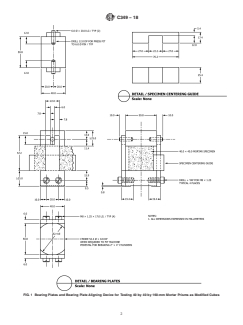
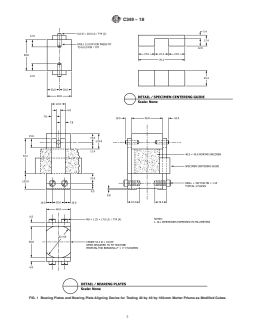
FIG. 1 Bearing Plates and Bearing Plate Aligning Device for Testing 40 by 40 by 160-mm Mortar Prisms as Modified Cubes
C349 − 18
that where more than this is found necessary, the specimen be discarded.
bearingplate,andthetwo6-mmpinsintheupperbearingplate
filed down just sufficiently to permit free up and down
8. Calculation
movement in the slots at the top of the aligning plates.
8.1 Record the total maximum load indicated by the testing
5.3 Testing Machine—The testing machine shall conform to
machineandcalculatethecompressivestrengthinmegapascals
the requirements prescribed in Test Method C109/C109M,
to the nearest 0.1 MPa, as follows:
except that the testing machine shall be of the hydraulic type.
S 5 0.00062P (1)
c
6. Test Specimens
where:
6.1 Bothportionsfromeachprismbrokeninflexureshallbe
S = compressive strength, MPa, and
c
usedforcompressiontesting,exceptthatthebrokenportionsof
P = total maximum load, N.
prisms selected for the compression test shall have a length of
9. Faulty Specimens and Retests
not less than 65 mm and shall be free of cracks, chipped
surfaces, or other obvious defects. 9.1 Specimens that are manifestly faulty or that result in
strengths differing by more than 10 % from the average value
7. Procedure
of all test specimens made from the same sample and tested at
the same period shall not be considered in determining the
7.1 Determination of Compressive Strength—During the
compressive strength. After discarding strength values, if less
interval between flexure tests of the prisms and testing the
than two strength values are left for determining the compres-
broken portions as modified cubes, cover the specimens for the
...
This document is not an ASTM standard and is intended only to provide the user of an ASTM standard an indication of what changes have been made to the previous version. Because
it may not be technically possible to adequately depict all changes accurately, ASTM recommends that users consult prior editions as appropriate. In all cases only the current version
of the standard as published by ASTM is to be considered the official document.
Designation: C349 − 14 C349 − 18
Standard Test Method for
Compressive Strength of Hydraulic-Cement Mortars
(Using Portions of Prisms Broken in Flexure)
This standard is issued under the fixed designation C349; the number immediately following the designation indicates the year of
original adoption or, in the case of revision, the year of last revision. A number in parentheses indicates the year of last reapproval. A
superscript epsilon (´) indicates an editorial change since the last revision or reapproval.
1. Scope*
1.1 This test method covers the determination of the compressive strength of hydraulic-cement mortars, using for the test
specimens portions of prisms made and broken in flexure in accordance with Test Method C348.
1.2 The values stated in SI units are to be regarded as standard. No other units of measurement are included in this standard.
1.3 Values in SI units shall be obtained by measurement in SI units or by appropriate conversion, using the Rules for Conversion
and rounding given in Standard IEEE/ASTM SI 10, of measurements made in other units.
1.4 This standard does not purport to address all of the safety concerns, if any, associated with its use. It is the responsibility
of the user of this standard to establish appropriate safety safety, health, and healthenvironmental practices and determine the
applicability of regulatory limitations prior to use. (Warning—Fresh hydraulic cementitious mixtures are caustic and may cause
chemical burns to skin and tissue upon prolonged exposure. )(Warning—Fresh hydraulic cementitious mixtures are caustic and
may cause chemical burns to skin and tissue upon prolonged exposure. )
1.5 This international standard was developed in accordance with internationally recognized principles on standardization
established in the Decision on Principles for the Development of International Standards, Guides and Recommendations issued
by the World Trade Organization Technical Barriers to Trade (TBT) Committee.
2. Referenced Documents
2.1 ASTM Standards:
C109/C109M Test Method for Compressive Strength of Hydraulic Cement Mortars (Using 2-in. or [50-mm] Cube Specimens)
C125 Terminology Relating to Concrete and Concrete Aggregates
C219 Terminology Relating to Hydraulic Cement
C348 Test Method for Flexural Strength of Hydraulic-Cement Mortars
C670 Practice for Preparing Precision and Bias Statements for Test Methods for Construction Materials
IEEE/ASTM SI 10 Standard for Use of the International System of Units (SI): The Modern Metric System
3. Terminology
3.1 Definitions:
3.1.1 For definitions of terms used in this test method, refer to Terminology C125 and C219.
4. Significance and Use
4.1 This method provides a means of obtaining compressive strength values from the same specimens previously used for
flexural strength determinations by Test Method C348. The compressive strength values are for reference purposes, and not as
substitutes for values obtained by Test Method C109/C109M for cement acceptance.
5. Apparatus
5.1 Bearing Plates—The bearing plates shall be ≥25 mm in thickness and shall be made of a hard metal. The surfaces of the
bearing plates that are placed in contact with the specimens shall be 40.0 6 0.1-mm by 50.8-mm rectangles, with the 50.8-mm
This test method is under the jurisdiction of ASTM Committee C01 on Cement and is the direct responsibility of Subcommittee C01.27 on Strength.
Current edition approved Dec. 1, 2014Dec. 1, 2018. Published January 2015December 2018. Originally approved in 1954. Last previous edition approved in 20082014
as C349 – 08.C349 – 14. DOI: 10.1520/C0349-14.10.1520/C0349-18.
See the section on Safety, Manual of Cement Testing, Annual Book of ASTM Standards, Vol 04.01.
For referenced ASTM standards, visit the ASTM website, www.astm.org, or contact ASTM Customer Service at service@astm.org. For Annual Book of ASTM Standards
volume information, refer to the standard’s Document Summary page on the ASTM website.
*A Summary of Changes section appears at the end of this standard
Copyright © ASTM International, 100 Barr Harbor Drive, PO Box C700, West Conshohocken, PA 19428-2959. United States
C349 − 18
dimension at right angles to the longitudinal axis of the prism. The bearing plate surfaces in contact with the specimen shall have
a Rockwell hardness of not less than 60 HRC. These surfaces shall not depart from plane surfaces by more than 0.01 mm when
the plates are new and shall be maintained within a permissible variation of 0.03 mm.
5.2 Device for Aligning Bearing Plates—A device for aligning the bearing plates to ensure the proper location of the upper plate
with reference to the lower plate is shown in Fig. 1. If the upper bearing plate does not have free movement within the aligning
plates, these shall be separated from the bottom plate by insertion of 0.05-mm shims on each side of the bottom bearing plate, and
the two 6-mm pins in the upper bearing plate filed down just sufficiently to permit free up and down movement in the slots at the
top of the aligning plates.
5.3 Testing Machine—The testing machine shall conform to the requirements prescribed in Test Method C109/C109M, except
that the testing machine shall be of the hydraulic type.
6. Test Specimens
6.1 Both portions from each prism broken in flexure shall be used for compression testing, except that the broken portions of
prisms selected for the compression test shall have a length of not less than 65 mm and shall be free of cracks, chipped surfaces,
or other obvious defects.
7. Procedure
7.1 Determination of Compressive Strength—During the interval between flexure tests of the prisms and testing the broken
portions as modified cubes, cover the specimens for the 24-h test with waterproof plastic and completely immerse all other
specimens in water at a temperature of 23 6 2.0°C until the time of testing. Wipe the specimen to a surface-dry condition, and
remove any sand grains or incrustations from the faces that will be in contact with the bearing plates of the testing apparatus. Check
these faces by application of a straightedge. If there is appreciable curvature, grind the face or faces to plane surfaces or discard
the specimen (Note 1). Center the pedestal usually provided for breaking 50 by 100-mm cylinders on the base bearing block of
the machine, and center the bearing plate assembly on top of this pedestal. If the testing machine has no provisions for automatic
accurate centering of a pedestal exactly below the center of its upper spherical bearing head, a hardened s
...