

ASTM C806-23
(Test Method)Standard Test Method for Restrained Expansion of Expansive Cement Mortar
General Information
- Abstract
ABSTRACT
This test method covers the standard procedure for determination of length changes of expansive cement mortar, while under restraint, due to the development of internal forces resulting from hydration of the cement. The test apparatus is comprised of the following: molds for casting test specimens; restraining cage which consists of a threaded steel rod with steel end plates held in place by cap nuts for corrosion prevention; length comparator; tamper which shall be made of nonabsorptive, nonabrasive material such as medium-hard rubber or seasoned oak wood; device for demolding specimens; weights and weighing devices; glass graduates to measure the mixing water in a single operation; an electrically driven mechanical mixer equipped with paddle and mixing bowl; and trowel which shall have a steel blade with straight edges. The sand to be used shall comply with the graded sand requirement and shall be handled in such a manner as to prevent segregation. Details on preparation and assembly of specimen molds and restraining cage, proportioning and mixing of mortars, molding, and curing of specimens are discussed. The expansion and shrinkage of the test specimens at any age shall be calculated and the length-change data, expressed as linear expansion or contraction based on the length of the specimen at any time of molding, shall be reported. Bias and precision in the batch, single, and multi-laboratory operation shall also be identified.
SCOPE
1.1 This test method covers the determination of length changes of expansive cement mortar, while under restraint, due to the development of internal forces resulting from hydration of the cement.
1.2 The values stated in inch-pound units are to be regarded as standard. The values given in parentheses are mathematical conversions to SI units that are provided for information only and are not considered standard.
1.3 The text of this standard references notes and footnotes which provide explanatory material. These notes and footnotes (excluding those in tables and figures) shall not be considered as requirements of this standard.
1.4 This standard does not purport to address all of the safety concerns, if any, associated with its use. It is the responsibility of the user of this standard to establish appropriate safety, health, and environmental practices and determine the applicability of regulatory limitations prior to use. (Warning—Fresh hydraulic cement mixtures are caustic and may cause burns to skin and tissue upon prolonged exposure.2)
1.5 This international standard was developed in accordance with internationally recognized principles on standardization established in the Decision on Principles for the Development of International Standards, Guides and Recommendations issued by the World Trade Organization Technical Barriers to Trade (TBT) Committee.
- Status
- Published
- Publication Date
- 14-Dec-2023
- Technical Committee
- C01 - Cement
- Drafting Committee
- C01.13 - Special Cements

Overview
ASTM C806-23: Standard Test Method for Restrained Expansion of Expansive Cement Mortar establishes a laboratory procedure to determine the length changes-specifically, restrained expansion-of expansive cement mortar resulting from internal forces generated during cement hydration. This test is critical for understanding how expansive cement mortars behave when subjected to restraint, helping manufacturers, engineers, and quality control professionals evaluate material performance in real-world applications. The standard specifies apparatus, specimen preparation, mixing, molding, curing, measurement, and reporting methods to ensure precise, reproducible results.
Key Topics
- Restrained Expansion Testing: ASTM C806-23 provides a method for measuring the linear change in length (expansion or contraction) of a mortar specimen when its movement is restricted by a restraining cage.
- Apparatus and Materials: The test requires precise equipment, including:
- Molds for test specimen casting
- Threaded steel rod restraining cages
- Length comparators for measurement
- Tampers and trowels of specified materials
- Glass graduates, mechanical mixers, and demolding devices
- Specimen Preparation and Curing: Detailed steps ensure uniformity:
- Consistent mixing in accordance with referenced ASTM practices
- Placement and compaction procedures to minimize variability
- Controlled curing conditions for reproducibility, including temperature and humidity specifications
- Measurement and Calculation: Expansion or shrinkage is calculated at various ages of the specimen, providing essential data to assess performance against required standards.
- Precision and Bias: Includes requirements regarding batch precision, single-operator consistency, and inter-laboratory reliability, underlining its robust validation.
Applications
The ASTM C806-23 standard is widely applied in:
- Construction Materials Testing: Ensures expansive cements used in structural and non-structural elements perform as expected when subject to restraint, reducing the risk of cracking or unwanted movement due to expansion.
- Quality Control: Manufacturers and research labs use the method to verify compliance of expansive cement or mortars with industry requirements, improving confidence in their products.
- Specification Compliance: Designers, contractors, and regulatory bodies reference ASTM C806-23 to confirm that expansive cement mortars meet contractual and regulatory standards for expansion control.
- Development of Shrinkage-Compensating Concrete: Data from this test method support the design of concretes that counteract shrinkage, critical in large slabs, industrial flooring, and infrastructure projects.
Related Standards
Several other ASTM and industry standards are related to or referenced by ASTM C806-23:
- ASTM C109/C109M: Test Method for Compressive Strength of Hydraulic Cement Mortars
- ASTM C150: Specification for Portland Cement
- ASTM C157/C157M: Test Method for Length Change of Hardened Hydraulic-Cement Mortar and Concrete
- ASTM C305: Practice for Mechanical Mixing of Hydraulic Cement Pastes and Mortars
- ASTM C490/C490M: Practice for Use of Apparatus for Determination of Length Change of Hardened Cement Paste, Mortar, and Concrete
- ASTM C595: Specification for Blended Hydraulic Cements
- ASTM C778: Specification for Standard Sand
- ASTM C845: Specification for Expansive Hydraulic Cement
- ACI 223: Guide for Shrinkage-Compensating Concrete
These documents provide essential definitions, methods, and requirements ensuring the standardized testing and evaluation of cementitious materials.
Keywords: ASTM C806-23, restrained expansion, expansive cement mortar, cement testing standards, material performance, precision and bias, construction quality control.
Relations
- Effective Date
- 15-Dec-2023
- Effective Date
- 01-Apr-2024
- Effective Date
- 01-Feb-2024
- Effective Date
- 01-Jan-2024
- Effective Date
- 15-Dec-2023
- Effective Date
- 15-Jul-2021
- Effective Date
- 01-Aug-2020
- Effective Date
- 15-Jun-2015
- Referred By
ASTM C183/C183M-23 - Standard Practice for Sampling and the Amount of Testing of Hydraulic Cement - Effective Date
- 15-Dec-2023
- Effective Date
- 15-Dec-2023
- Effective Date
- 15-Dec-2023
Get Certified
Connect with accredited certification bodies for this standard

DIBt (Deutsches Institut für Bautechnik)
German Institute for Building Technology.
DIN CERTCO
DIN Group product certification.

Aboma Certification B.V.
Specialized in construction, metal, and transport sectors.
Sponsored listings
Frequently Asked Questions
ASTM C806-23 is a standard published by ASTM International. Its full title is "Standard Test Method for Restrained Expansion of Expansive Cement Mortar". This standard covers: ABSTRACT This test method covers the standard procedure for determination of length changes of expansive cement mortar, while under restraint, due to the development of internal forces resulting from hydration of the cement. The test apparatus is comprised of the following: molds for casting test specimens; restraining cage which consists of a threaded steel rod with steel end plates held in place by cap nuts for corrosion prevention; length comparator; tamper which shall be made of nonabsorptive, nonabrasive material such as medium-hard rubber or seasoned oak wood; device for demolding specimens; weights and weighing devices; glass graduates to measure the mixing water in a single operation; an electrically driven mechanical mixer equipped with paddle and mixing bowl; and trowel which shall have a steel blade with straight edges. The sand to be used shall comply with the graded sand requirement and shall be handled in such a manner as to prevent segregation. Details on preparation and assembly of specimen molds and restraining cage, proportioning and mixing of mortars, molding, and curing of specimens are discussed. The expansion and shrinkage of the test specimens at any age shall be calculated and the length-change data, expressed as linear expansion or contraction based on the length of the specimen at any time of molding, shall be reported. Bias and precision in the batch, single, and multi-laboratory operation shall also be identified. SCOPE 1.1 This test method covers the determination of length changes of expansive cement mortar, while under restraint, due to the development of internal forces resulting from hydration of the cement. 1.2 The values stated in inch-pound units are to be regarded as standard. The values given in parentheses are mathematical conversions to SI units that are provided for information only and are not considered standard. 1.3 The text of this standard references notes and footnotes which provide explanatory material. These notes and footnotes (excluding those in tables and figures) shall not be considered as requirements of this standard. 1.4 This standard does not purport to address all of the safety concerns, if any, associated with its use. It is the responsibility of the user of this standard to establish appropriate safety, health, and environmental practices and determine the applicability of regulatory limitations prior to use. (Warning—Fresh hydraulic cement mixtures are caustic and may cause burns to skin and tissue upon prolonged exposure.2) 1.5 This international standard was developed in accordance with internationally recognized principles on standardization established in the Decision on Principles for the Development of International Standards, Guides and Recommendations issued by the World Trade Organization Technical Barriers to Trade (TBT) Committee.
ABSTRACT This test method covers the standard procedure for determination of length changes of expansive cement mortar, while under restraint, due to the development of internal forces resulting from hydration of the cement. The test apparatus is comprised of the following: molds for casting test specimens; restraining cage which consists of a threaded steel rod with steel end plates held in place by cap nuts for corrosion prevention; length comparator; tamper which shall be made of nonabsorptive, nonabrasive material such as medium-hard rubber or seasoned oak wood; device for demolding specimens; weights and weighing devices; glass graduates to measure the mixing water in a single operation; an electrically driven mechanical mixer equipped with paddle and mixing bowl; and trowel which shall have a steel blade with straight edges. The sand to be used shall comply with the graded sand requirement and shall be handled in such a manner as to prevent segregation. Details on preparation and assembly of specimen molds and restraining cage, proportioning and mixing of mortars, molding, and curing of specimens are discussed. The expansion and shrinkage of the test specimens at any age shall be calculated and the length-change data, expressed as linear expansion or contraction based on the length of the specimen at any time of molding, shall be reported. Bias and precision in the batch, single, and multi-laboratory operation shall also be identified. SCOPE 1.1 This test method covers the determination of length changes of expansive cement mortar, while under restraint, due to the development of internal forces resulting from hydration of the cement. 1.2 The values stated in inch-pound units are to be regarded as standard. The values given in parentheses are mathematical conversions to SI units that are provided for information only and are not considered standard. 1.3 The text of this standard references notes and footnotes which provide explanatory material. These notes and footnotes (excluding those in tables and figures) shall not be considered as requirements of this standard. 1.4 This standard does not purport to address all of the safety concerns, if any, associated with its use. It is the responsibility of the user of this standard to establish appropriate safety, health, and environmental practices and determine the applicability of regulatory limitations prior to use. (Warning—Fresh hydraulic cement mixtures are caustic and may cause burns to skin and tissue upon prolonged exposure.2) 1.5 This international standard was developed in accordance with internationally recognized principles on standardization established in the Decision on Principles for the Development of International Standards, Guides and Recommendations issued by the World Trade Organization Technical Barriers to Trade (TBT) Committee.
ASTM C806-23 is classified under the following ICS (International Classification for Standards) categories: 91.100.10 - Cement. Gypsum. Lime. Mortar. The ICS classification helps identify the subject area and facilitates finding related standards.
ASTM C806-23 has the following relationships with other standards: It is inter standard links to ASTM C806-18, ASTM C219-24, ASTM C670-24a, ASTM C670-24, ASTM C109/C109M-23, ASTM C109/C109M-21, ASTM C219-20a, ASTM C670-15, ASTM C183/C183M-23, ASTM C845/C845M-18, ASTM C878/C878M-22. Understanding these relationships helps ensure you are using the most current and applicable version of the standard.
ASTM C806-23 is available in PDF format for immediate download after purchase. The document can be added to your cart and obtained through the secure checkout process. Digital delivery ensures instant access to the complete standard document.
Standards Content (Sample)
This international standard was developed in accordance with internationally recognized principles on standardization established in the Decision on Principles for the
Development of International Standards, Guides and Recommendations issued by the World Trade Organization Technical Barriers to Trade (TBT) Committee.
Designation: C806 − 23
Standard Test Method for
Restrained Expansion of Expansive Cement Mortar
This standard is issued under the fixed designation C806; the number immediately following the designation indicates the year of
original adoption or, in the case of revision, the year of last revision. A number in parentheses indicates the year of last reapproval. A
superscript epsilon (´) indicates an editorial change since the last revision or reapproval.
1. Scope* Hydraulic Cement Mortars (Using 2-in. or [50 mm] Cube
Specimens)
1.1 This test method covers the determination of length
C150 Specification for Portland Cement
changes of expansive cement mortar, while under restraint, due
C157/C157M Test Method for Length Change of Hardened
to the development of internal forces resulting from hydration
Hydraulic-Cement Mortar and Concrete
of the cement.
C219 Terminology Relating to Hydraulic and Other Inor-
1.2 The values stated in inch-pound units are to be regarded
ganic Cements
as standard. The values given in parentheses are mathematical
C305 Practice for Mechanical Mixing of Hydraulic Cement
conversions to SI units that are provided for information only
Pastes and Mortars of Plastic Consistency
and are not considered standard.
C490/C490M Practice for Use of Apparatus for the Deter-
1.3 The text of this standard references notes and footnotes mination of Length Change of Hardened Cement Paste,
Mortar, and Concrete
which provide explanatory material. These notes and footnotes
(excluding those in tables and figures) shall not be considered C595 Specification for Blended Hydraulic Cements
C670 Practice for Preparing Precision and Bias Statements
as requirements of this standard.
for Test Methods for Construction Materials
1.4 This standard does not purport to address all of the
C778 Specification for Standard Sand
safety concerns, if any, associated with its use. It is the
C845 Specification for Expansive Hydraulic Cement
responsibility of the user of this standard to establish appro-
C1005 Specification for Reference Masses and Devices for
priate safety, health, and environmental practices and deter-
Determining Mass and Volume for Use in Physical Testing
mine the applicability of regulatory limitations prior to use.
of Hydraulic Cements
(Warning—Fresh hydraulic cement mixtures are caustic and
F606/F606M Test Methods for Determining the Mechanical
may cause burns to skin and tissue upon prolonged exposure. )
Properties of Externally and Internally Threaded
1.5 This international standard was developed in accor-
Fasteners, Washers, Direct Tension Indicators, and Rivets
dance with internationally recognized principles on standard-
ization established in the Decision on Principles for the
2.2 ACI Documents:
Development of International Standards, Guides and Recom- ACI 223 Shrinkage – Compensating Concrete – Guide
mendations issued by the World Trade Organization Technical
Barriers to Trade (TBT) Committee.
3. Terminology
3.1 Definitions of terms used in this test method are given in
2. Referenced Documents
Terminology C219.
2.1 ASTM Standards:
3.2 Definitions:
A307 Specification for Carbon Steel Bolts, Studs, and
3.2.1 expansive component system, n—a combination of
Threaded Rod 60 000 PSI Tensile Strength
portland cement conforming to Specification C150 or portland-
C109/C109M Test Method for Compressive Strength of
limestone cement conforming to Specification C595 and an
expansive component that, when mixed with water, forms a
paste that increases in volume after setting.
This test method is under the jurisdiction of ASTM Committee C01 on Cement
3.2.1.1 Discussion—The expansive component system is an
and is the direct responsibility of Subcommittee C01.13 on Special Cements.
Current edition approved Dec. 15, 2023. Published December 2023. Originally
alternate way to produce a cement that meets Specification
approved in 1975. Last previous edition approved in 2018 as C806 – 18. DOI:
C845 performance requirements. Expansive component system
10.1520/C0806-23.
is also defined in ACI 223.
Section of Safety, Manual of Cement Testing, Annual Book of ASTM Standards,
Vol 04.01.
For referenced ASTM standards, visit the ASTM website, www.astm.org, or
contact ASTM Customer Service at service@astm.org. For Annual Book of ASTM
Standards volume information, refer to the standard’s Document Summary page on Available from American Concrete Institute (ACI), 38800 Country Club Dr.,
the ASTM website. Farmington Hills, MI 48331-3439, http://www.concrete.org.
*A Summary of Changes section appears at the end of this standard
Copyright © ASTM International, 100 Barr Harbor Drive, PO Box C700, West Conshohocken, PA 19428-2959. United States
C806 − 23
4. Apparatus convenient length of about 6 in. (150 mm). The tamping face
of the tamper shall be flat and at right angles to the length of
4.1 Molds—The molds for casting test specimens, when
the tamper.
used in conjunction with the restraining cage described in 4.2,
shall provide for forming either 2-in. by 2-in. by 10-in. prisms 4.5 Apparatus for Demolding Specimens—Apparatus simi-
lar to that described in the Apparatus section of Test Method
having a 10-in. gage length, or 50 mm by 50 mm by 250 mm
prisms having a 250 mm gage length. The molds shall other- C157/C157M, may be found useful for demolding specimens.
wise conform to the requirements of Practice C490/C490M,
4.6 Weights and Weighing Devices—Scales used shall com-
except that the gage stud holder, gage studs, and spacer screws
ply with Specification C1005.
described in that specification will not be used.
4.7 Glass Graduate that conforms to the requirements of
4.2 Restraining Cage, consisting of a threaded steel rod
Test Method C109/C109M.
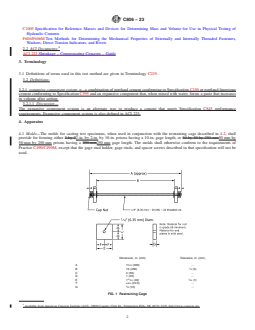
with steel end plates held in place by nuts as shown in Fig. 1.
4.8 Mixer, Bowl, and Paddle—The mixer shall be an elec-
The rod shall be provided with cap nuts for prevention of
trically driven mechanical mixer of the type equipped with
corrosion. The rod shall conform to Specification A307 Grade
paddle and mixing bowl, as specified in the Apparatus section
A except, it shall support 1180-lbf (5249 N) proof load when
of Practice C305.
tested in accordance with Method 1 of Test Methods F606/
F606M. 4.9 Trowel—The trowel shall have a steel blade 4 in. to 6 in.
(102 mm to 152 mm) in length, with straight edges.
4.3 Length Comparator—The length comparator for mea-
suring length shall conform to and be used in accordance with
5. Temperature and Humidity
the requirements of Practice C490/C490M. If the terminals of
the comparator are fitted with collars, they shall be such that
5.1 The temperature of the air in the vicinity of the mixing
the cap nuts on the ends of the threaded rod of the specimen do operation, the dry materials, mixing water, molds, base plates,
not rest on the collar during measuring.
mixing bowl, moist closet or moist room, and storage water
shall not vary from 73.4 °F (23 °C) by more than 63 °F
4.4 Tamper—The tamper shall be made of nonabsorptive,
(61.7 °C).
nonabrasive material such as medium-hard rubber or seasoned
oak wood, rendered nonabsorptive by immersion for 15 min in 5.2 The relative humidity of the laboratory shall be not less
paraffin at approximately 392 °F (200 °C), and shall have a than 50 %. The moist closet or moist room shall provide a
cross section of about ⁄2 in. by 1 in. (13 mm by 25 mm) and relative humidity of not less that 95 %.
Dimension, in. (mm) Tolerance, in. (mm)
A 11 ⁄4 (300) .
B 10 (250) ⁄8 (3)
C 2 (50) .
D 1 (25) .
31 1
E 1 ⁄32 (49) ⁄32 (1)
F ⁄64 (24.5) .
G ⁄8 (10) .
FIG. 1 Restraining Cage
C806 − 23
6. Graded Standard Sand Work the mortar into the corners, around the restraining rod,
without striking the rod, and along the surfaces of the mold
6.1 Sand used shall comply with the graded sand require-
with the tamper until a homogeneous specimen is obtained.
ment of Specification C778.
After the top layer has been compacted, strike-off the mortar
Passing Sieve Percentage Retained
flush with the top of the mold, and smooth the surface with a
No. 100 (150-μm) 98 ± 2 few strokes of the trowel.
No. 50 (300-μm) 72 ± 5
No. 30 (600-μm) 2 ± 2
11. Curing of Specimens
No. 16 (1.18-mm) non
...
This document is not an ASTM standard and is intended only to provide the user of an ASTM standard an indication of what changes have been made to the previous version. Because
it may not be technically possible to adequately depict all changes accurately, ASTM recommends that users consult prior editions as appropriate. In all cases only the current version
of the standard as published by ASTM is to be considered the official document.
Designation: C806 − 18 C806 − 23
Standard Test Method for
Restrained Expansion of Expansive Cement Mortar
This standard is issued under the fixed designation C806; the number immediately following the designation indicates the year of
original adoption or, in the case of revision, the year of last revision. A number in parentheses indicates the year of last reapproval. A
superscript epsilon (´) indicates an editorial change since the last revision or reapproval.
1. Scope Scope*
1.1 This test method covers the determination of length changes of expansive cement mortar, while under restraint, due to the
development of internal forces resulting from hydration of the cement.
1.2 The values stated in inch-pound units are to be regarded as standard. The values given in parentheses are mathematical
conversions to SI units that are provided for information only and are not considered standard.
1.3 The text of this standard references notes and footnotes which provide explanatory material. These notes and footnotes
(excluding those in tables and figures) shall not be considered as requirements of this standard.
1.4 This standard does not purport to address all of the safety concerns, if any, associated with its use. It is the responsibility
of the user of this standard to establish appropriate safety, health, and environmental practices and determine the applicability of
regulatory limitations prior to use. (Warning—Fresh hydraulic cement mixtures are caustic and may cause burns to skin and tissue
upon prolonged exposure. )
1.5 This international standard was developed in accordance with internationally recognized principles on standardization
established in the Decision on Principles for the Development of International Standards, Guides and Recommendations issued
by the World Trade Organization Technical Barriers to Trade (TBT) Committee.
2. Referenced Documents
2.1 ASTM Standards:
A307 Specification for Carbon Steel Bolts, Studs, and Threaded Rod 60 000 PSI Tensile Strength
C109/C109M Test Method for Compressive Strength of Hydraulic Cement Mortars (Using 2-in. or [50 mm] Cube Specimens)
C150 Specification for Portland Cement
C157/C157M Test Method for Length Change of Hardened Hydraulic-Cement Mortar and Concrete
C219 Terminology Relating to Hydraulic and Other Inorganic Cements
C305 Practice for Mechanical Mixing of Hydraulic Cement Pastes and Mortars of Plastic Consistency
C490/C490M Practice for Use of Apparatus for the Determination of Length Change of Hardened Cement Paste, Mortar, and
Concrete
C595 Specification for Blended Hydraulic Cements
C670 Practice for Preparing Precision and Bias Statements for Test Methods for Construction Materials
C778 Specification for Standard Sand
C845 Specification for Expansive Hydraulic Cement
This test method is under the jurisdiction of ASTM Committee C01 on Cement and is the direct responsibility of Subcommittee C01.13 on Special Cements.
Current edition approved July 1, 2018Dec. 15, 2023. Published July 2018December 2023. Originally approved in 1975. Last previous edition approved in 20122018 as
C806 – 12.C806 – 18. DOI: 10.1520/C0806-18.10.1520/C0806-23.
Section of Safety, Manual of Cement Testing, Annual Book of ASTM Standards, Vol 04.01.
For referenced ASTM standards, visit the ASTM website, www.astm.org, or contact ASTM Customer Service at service@astm.org. For Annual Book of ASTM Standards
volume information, refer to the standard’s Document Summary page on the ASTM website.
*A Summary of Changes section appears at the end of this standard
Copyright © ASTM International, 100 Barr Harbor Drive, PO Box C700, West Conshohocken, PA 19428-2959. United States
C806 − 23
C1005 Specification for Reference Masses and Devices for Determining Mass and Volume for Use in Physical Testing of
Hydraulic Cements
F606/F606M Test Methods for Determining the Mechanical Properties of Externally and Internally Threaded Fasteners,
Washers, Direct Tension Indicators, and Rivets
2.2 ACI Documents:
ACI 223 Shrinkage – Compensating Concrete – Guide
3. Terminology
3.1 Definitions of terms used in this test method are given in Terminology C219.
3.2 Definitions:
3.2.1 expansive component system, n—a combination of portland cement conforming to Specification C150 or portland-limestone
cement conforming to Specification C595 and an expansive component that, when mixed with water, forms a paste that increases
in volume after setting.
3.2.1.1 Discussion—
The expansive component system is an alternate way to produce a cement that meets Specification C845 performance
requirements. Expansive component system is also defined in ACI 223.
4. Apparatus
4.1 Molds—The molds for casting test specimens, when used in conjunction with the restraining cage described in 4.2, shall
provide for forming either 2 by 22-in. by 2-in. by 10-in. prisms having a 10-in. gage length, or 50 by 50 by 250-mm50 mm by
50 mm by 250 mm prisms having a 250-mm250 mm gage length. The molds shall otherwise conform to the requirements of
Practice C490/C490M, except that the gage stud holder, gage studs, and spacer screws described in that specification will not be
used.
Dimension, in. (mm) Tolerance, in. (mm)
A 11 ⁄4 (300) .
B 10 (250) ⁄8 (3)
C 2 (50) .
D 1 (25) .
31 1
E 1 ⁄32 (49) ⁄32 (1)
F ⁄64 (24.5) .
G ⁄8 (10) .
FIG. 1 Restraining Cage
Available from American Concrete Institute (ACI), 38800 Country Club Dr., Farmington Hills, MI 48331-3439, http://www.concrete.org.
C806 − 23
4.2 Restraining Cage, consisting of a threaded steel rod with steel end plates held in place by nuts as shown in Fig. 1. The rod
shall be provided with cap nuts for prevention of corrosion. The rod shall conform to Specification A307 Grade A except, it shall
support 1180-lbf (5249 N) proof load when tested in accordance with Method 1 of Test Methods F606/F606M.
4.3 Length Comparator—The length comparator for measuring length shall conform to and be used in accordance with the
requirements of Practice C490/C490M. If the terminals of the comparator are fitted with collars, they shall be such that the cap
nuts on the ends of the threaded rod of the specimen do not rest on the collar during measuring.
4.4 Tamper—The tamper shall be made of nonabsorptive, nonabrasive material such as medium-hard rubber or seasoned oak
wood, rendered nonabsorptive by immersion for 15 min in paraffin at approximately 392°F (200°C),392 °F (200 °C), and shall
have a cross section of about ⁄2 in. by 1 in. (13(13 mm by 25 mm) and convenient length of about 6 in. (150 mm). The tamping
face of the tamper shall be flat and at right angles to the length of the tamper.
4.5 Apparatus for Demolding Specimens—Apparatus similar to that described in the Apparatus section of Test Method
C157/C157M, may be found useful for demolding specimens.
4.6 Weights and Weighing Devices—Scales used shall comply with Specification C1005.
4.7 Glass Graduate that conforms to the requirements of Test Method C109/C109M.
4.8 Mixer, Bowl, and Paddle—The mixer shall be an electrically driven mechanical mixer of the type equipped with paddle and
mixing bowl, as specified in the Apparatus section of Practice C305.
4.9 Trowel—The trowel shall have a steel blade 44 in. to 6 in. (102(102 mm to 152 mm) in length, with straight edges.
5. Temperature and Humidity
5.1 The temperature of the air in the vicinity of the mixing operation, the dry materials, mixing water, molds, base plates, mixing
bowl, moist closet or moist room, and storage water shall not vary from 73.4°F (23°C)73.4 °F (23 °C) by more than 63°F
(61.7°C).63 °F (61.7 °C).
5.2 The relative humidity of the laboratory shall be not less than 50 %. The moist closet or moist room shall provide a relative
humidity of not less that 95 %.
6. Graded Standard Sand
6.1 Sand used shall comply with the graded sand requirement of Specification C778.
Passing Sieve Percentage Retained
No. 100 (150-μm) 98 ± 2
No. 50 (300-μm) 72 ± 5
No. 30 (600-μm) 2 ± 2
No. 16 (1.18-mm) none
NOTE 1—Segregation of Graded Sand—The graded standard sand should be handled in such a manner as to prevent segregation, since variations in the
grading of the sand cause variations in the consistency of the mortar. In emptying sacks of sand into bins or in scooping sand out of bins or sacks, care
should be exercised to prevent the formation of mounds of sand or craters in the sand, down the slopes of whi
...