

ASTM C10/C10M-24
(Specification)Standard Specification for Natural Cement
General Information
- Abstract
ABSTRACT
This specification covers natural cement. The chemical requirements and the physical requirements are detailed in the specification. The natural cement shall be subjected to fitness, autoclave expansion, time of setting, air content of mortar, and compressive strength tests using specified methods.
SCOPE
1.1 This specification covers natural cement and quick-setting natural cement.
Note 1: Examples of typical past uses of natural cement include unit masonry mortar, cement plaster, grout, whitewash, and concrete.
1.2 The values stated in either SI units or inch-pound units are to be regarded separately as standard. The values stated in each system may not be exact equivalents; therefore, each system shall be used independently of the other. Combining values from the two systems may result in non-conformance with the standard. Values in SI units [or inch-pound units] shall be obtained by measurement in SI units [or inch-pound units] or by appropriate conversion, using the Rules for Conversion and Rounding given in IEEE/ASTM SI 10, of measurements made in other units [or SI units]. Values are stated in only SI units when inch-pound units are not used in practice.
1.3 The text of this standard references notes and footnotes which provide explanatory material. These notes and footnotes (excluding those in tables and figures) shall not be considered as requirements of the standard.
1.4 This international standard was developed in accordance with internationally recognized principles on standardization established in the Decision on Principles for the Development of International Standards, Guides and Recommendations issued by the World Trade Organization Technical Barriers to Trade (TBT) Committee.
- Status
- Published
- Publication Date
- 31-Dec-2023
- Technical Committee
- C01 - Cement
- Drafting Committee
- C01.10 - Hydraulic Cements for General Concrete Construction
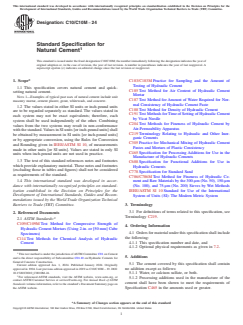
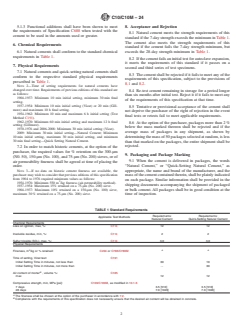


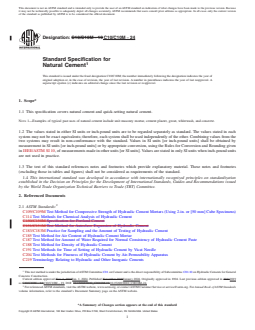
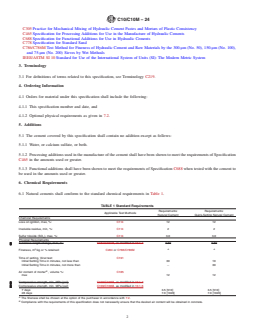
Overview
ASTM C10/C10M-24: Standard Specification for Natural Cement sets forth requirements and guidelines for the quality and testing of natural cement and quick-setting natural cement. This international standard, published by ASTM International, defines both chemical and physical property criteria for these hydraulic cements, providing a consistent framework for material selection, performance, and verification. The specification ensures the suitability of natural cement for construction and restoration applications, offering both SI and inch-pound units for global relevance.
Natural cement is a hydraulic binder produced by calcining naturally occurring limestone and clay materials. It has a longstanding record of use in unit masonry mortars, cement plaster, grout, whitewash, and concrete, making it essential for traditional construction and historic restoration projects.
Key Topics
- Scope: Applies to both natural cement and quick-setting natural cement, with provisions for modern and historical applications.
- Chemical Requirements: Outlines permissible limits for loss on ignition, insoluble residue, sulfur trioxide content, and more, tested under referenced ASTM methods.
- Physical Requirements: Includes fineness, autoclave expansion, setting times, air content of mortar, and compressive strength.
- Testing Methods: Specifies sampling, testing for chemical composition (ASTM C114), physical properties like compressive strength (ASTM C109/C109M), setting times (ASTM C191), and air content (ASTM C185), among others.
- Packaging and Marking: Sets marking, labeling, and documentation requirements to ensure traceability and compliance.
- Acceptance and Rejection: Details testing intervals, retesting protocols, and rejection criteria for failed batches or nonconforming units.
Applications
Natural cement as covered by ASTM C10/C10M-24 can be used in a variety of modern and historically significant construction contexts, including:
- Unit Masonry Mortar: Preferred for restoration of historic masonry due to its compatibility with older structures.
- Cement Plaster & Stucco: Offers traditional finish and physical properties suitable for heritage buildings.
- Grout: Utilized for filling gaps in masonry or between stones.
- Whitewash and Concrete: Valuable in applications where chemical makeup and strength must replicate those of older construction materials.
By adhering to the test protocols and requirements within this standard, manufacturers, contractors, and preservation specialists ensure the performance, durability, and authenticity of cementitious materials in both new and restoration construction.
Related Standards
Several ASTM standards are referenced within ASTM C10/C10M-24, supporting the comprehensive assessment of natural cement:
- ASTM C109/C109M - Test Method for Compressive Strength of Hydraulic Cement Mortars
- ASTM C114 - Test Methods for Chemical Analysis of Hydraulic Cement
- ASTM C150/C150M - Specification for Portland Cement
- ASTM C151/C151M - Test Method for Autoclave Expansion of Hydraulic Cement
- ASTM C183/C183M - Practice for Sampling and the Amount of Testing of Hydraulic Cement
- ASTM C185 - Test Method for Air Content of Hydraulic Cement Mortar
- ASTM C187 - Test Method for Water Required for Normal Consistency of Hydraulic Cement Paste
- ASTM C188, C191, C204, C305, C465, C688, C778, C786/C786M - Additional physical testing and processing standards
- IEEE/ASTM SI 10 - Standard for Use of the International System of Units (SI)
These related documents ensure reliable procedures for sampling, analysis, and performance testing, supporting the compliant use of natural cement in diverse applications.
Keywords: ASTM C10/C10M-24, natural cement, quick-setting cement, hydraulic cement, cement specification, cement testing, construction materials standard, mortar, plaster, restoration cement, compressive strength, standardization, ASTM International
Relations
- Effective Date
- 01-Jan-2024
- Effective Date
- 01-Apr-2024
- Effective Date
- 15-Dec-2023
- Refers
ASTM C204-23 - Standard Test Methods for Fineness of Hydraulic Cement by Air-Permeability Apparatus - Effective Date
- 01-Apr-2023
- Effective Date
- 15-Jul-2021
- Effective Date
- 01-Aug-2020
- Referred By
ASTM C688-22 - Standard Specification for Functional Additions for Use in Hydraulic Cements - Effective Date
- 01-Jan-2024
- Referred By
ASTM C183/C183M-23 - Standard Practice for Sampling and the Amount of Testing of Hydraulic Cement - Effective Date
- 01-Jan-2024
- Effective Date
- 01-Jan-2024
Get Certified
Connect with accredited certification bodies for this standard

DIBt (Deutsches Institut für Bautechnik)
German Institute for Building Technology.
DIN CERTCO
DIN Group product certification.

Aboma Certification B.V.
Specialized in construction, metal, and transport sectors.
Sponsored listings
Frequently Asked Questions
ASTM C10/C10M-24 is a technical specification published by ASTM International. Its full title is "Standard Specification for Natural Cement". This standard covers: ABSTRACT This specification covers natural cement. The chemical requirements and the physical requirements are detailed in the specification. The natural cement shall be subjected to fitness, autoclave expansion, time of setting, air content of mortar, and compressive strength tests using specified methods. SCOPE 1.1 This specification covers natural cement and quick-setting natural cement. Note 1: Examples of typical past uses of natural cement include unit masonry mortar, cement plaster, grout, whitewash, and concrete. 1.2 The values stated in either SI units or inch-pound units are to be regarded separately as standard. The values stated in each system may not be exact equivalents; therefore, each system shall be used independently of the other. Combining values from the two systems may result in non-conformance with the standard. Values in SI units [or inch-pound units] shall be obtained by measurement in SI units [or inch-pound units] or by appropriate conversion, using the Rules for Conversion and Rounding given in IEEE/ASTM SI 10, of measurements made in other units [or SI units]. Values are stated in only SI units when inch-pound units are not used in practice. 1.3 The text of this standard references notes and footnotes which provide explanatory material. These notes and footnotes (excluding those in tables and figures) shall not be considered as requirements of the standard. 1.4 This international standard was developed in accordance with internationally recognized principles on standardization established in the Decision on Principles for the Development of International Standards, Guides and Recommendations issued by the World Trade Organization Technical Barriers to Trade (TBT) Committee.
ABSTRACT This specification covers natural cement. The chemical requirements and the physical requirements are detailed in the specification. The natural cement shall be subjected to fitness, autoclave expansion, time of setting, air content of mortar, and compressive strength tests using specified methods. SCOPE 1.1 This specification covers natural cement and quick-setting natural cement. Note 1: Examples of typical past uses of natural cement include unit masonry mortar, cement plaster, grout, whitewash, and concrete. 1.2 The values stated in either SI units or inch-pound units are to be regarded separately as standard. The values stated in each system may not be exact equivalents; therefore, each system shall be used independently of the other. Combining values from the two systems may result in non-conformance with the standard. Values in SI units [or inch-pound units] shall be obtained by measurement in SI units [or inch-pound units] or by appropriate conversion, using the Rules for Conversion and Rounding given in IEEE/ASTM SI 10, of measurements made in other units [or SI units]. Values are stated in only SI units when inch-pound units are not used in practice. 1.3 The text of this standard references notes and footnotes which provide explanatory material. These notes and footnotes (excluding those in tables and figures) shall not be considered as requirements of the standard. 1.4 This international standard was developed in accordance with internationally recognized principles on standardization established in the Decision on Principles for the Development of International Standards, Guides and Recommendations issued by the World Trade Organization Technical Barriers to Trade (TBT) Committee.
ASTM C10/C10M-24 is classified under the following ICS (International Classification for Standards) categories: 91.100.10 - Cement. Gypsum. Lime. Mortar. The ICS classification helps identify the subject area and facilitates finding related standards.
ASTM C10/C10M-24 has the following relationships with other standards: It is inter standard links to ASTM C10/C10M-19, ASTM C219-24, ASTM C109/C109M-23, ASTM C204-23, ASTM C109/C109M-21, ASTM C219-20a, ASTM C688-22, ASTM C183/C183M-23, ASTM C1713-23. Understanding these relationships helps ensure you are using the most current and applicable version of the standard.
ASTM C10/C10M-24 is available in PDF format for immediate download after purchase. The document can be added to your cart and obtained through the secure checkout process. Digital delivery ensures instant access to the complete standard document.
Standards Content (Sample)
This international standard was developed in accordance with internationally recognized principles on standardization established in the Decision on Principles for the
Development of International Standards, Guides and Recommendations issued by the World Trade Organization Technical Barriers to Trade (TBT) Committee.
Designation: C10/C10M − 24
Standard Specification for
Natural Cement
This standard is issued under the fixed designation C10/C10M; the number immediately following the designation indicates the year of
original adoption or, in the case of revision, the year of last revision. A number in parentheses indicates the year of last reapproval. A
superscript epsilon (´) indicates an editorial change since the last revision or reapproval.
1. Scope* C183/C183M Practice for Sampling and the Amount of
Testing of Hydraulic Cement
1.1 This specification covers natural cement and quick-
C185 Test Method for Air Content of Hydraulic Cement
setting natural cement.
Mortar
NOTE 1—Examples of typical past uses of natural cement include unit
C187 Test Method for Amount of Water Required for Nor-
masonry mortar, cement plaster, grout, whitewash, and concrete.
mal Consistency of Hydraulic Cement Paste
1.2 The values stated in either SI units or inch-pound units
C188 Test Method for Density of Hydraulic Cement
are to be regarded separately as standard. The values stated in
C191 Test Methods for Time of Setting of Hydraulic Cement
each system may not be exact equivalents; therefore, each
by Vicat Needle
system shall be used independently of the other. Combining
C204 Test Methods for Fineness of Hydraulic Cement by
values from the two systems may result in non-conformance
Air-Permeability Apparatus
with the standard. Values in SI units [or inch-pound units] shall
C219 Terminology Relating to Hydraulic and Other Inor-
be obtained by measurement in SI units [or inch-pound units]
ganic Cements
or by appropriate conversion, using the Rules for Conversion
C305 Practice for Mechanical Mixing of Hydraulic Cement
and Rounding given in IEEE/ASTM SI 10, of measurements
Pastes and Mortars of Plastic Consistency
made in other units [or SI units]. Values are stated in only SI
C465 Specification for Processing Additions for Use in the
units when inch-pound units are not used in practice.
Manufacture of Hydraulic Cements
1.3 The text of this standard references notes and footnotes
C688 Specification for Functional Additions for Use in
which provide explanatory material. These notes and footnotes
Hydraulic Cements
(excluding those in tables and figures) shall not be considered
C778 Specification for Standard Sand
as requirements of the standard.
C786/C786M Test Method for Fineness of Hydraulic Ce-
1.4 This international standard was developed in accor- ment and Raw Materials by the 300-μm (No. 50), 150-μm
dance with internationally recognized principles on standard- (No. 100), and 75-μm (No. 200) Sieves by Wet Methods
ization established in the Decision on Principles for the
IEEE/ASTM SI 10 Standard for Use of the International
Development of International Standards, Guides and Recom- System of Units (SI): The Modern Metric System
mendations issued by the World Trade Organization Technical
Barriers to Trade (TBT) Committee.
3. Terminology
3.1 For definitions of terms related to this specification, see
2. Referenced Documents
Terminology C219.
2.1 ASTM Standards:
C109/C109M Test Method for Compressive Strength of
4. Ordering Information
Hydraulic Cement Mortars (Using 2-in. or [50 mm] Cube
4.1 Orders for material under this specification shall include
Specimens)
the following:
C114 Test Methods for Chemical Analysis of Hydraulic
4.1.1 This specification number and date, and
Cement
4.1.2 Optional physical requirements as given in 7.2.
This test method is under the jurisdiction of ASTM Committee C01 on Cement
5. Additions
and is the direct responsibility of Subcommittee C01.10 on Hydraulic Cements for
General Concrete Construction.
5.1 The cement covered by this specification shall contain
Current edition approved Jan. 1, 2024. Published January 2024. Originally
no addition except as follows:
approved in 1904. Last previous edition approved in 2019 as C10/C10M – 19. DOI:
10.1520/C0010_C0010M-24.
5.1.1 Water, or calcium sulfate, or both.
For referenced ASTM standards, visit the ASTM website, www.astm.org, or
5.1.2 Processing additions used in the manufacture of the
contact ASTM Customer Service at service@astm.org. For Annual Book of ASTM
cement shall have been shown to meet the requirements of
Standards volume information, refer to the standard’s Document Summary page on
the ASTM website. Specification C465 in the amounts used or greater.
*A Summary of Changes section appears at the end of this standard
Copyright © ASTM International, 100 Barr Harbor Drive, PO Box C700, West Conshohocken, PA 19428-2959. United States
C10/C10M − 24
5.1.3 Functional additions shall have been shown to meet 8. Acceptance and Rejection
the requirements of Specification C688 when tested with the
8.1 Natural cement meets the strength requirements of this
cement to be used in the amounts used or greater.
standard if the 7-day strength exceeds the minimum in Table 1.
The cement also meets the strength requirements of this
6. Chemical Requirements
standard if the cement fails the 7-day strength minimum, but
6.1 Natural cements shall conform to the standard chemical
exceeds the 28-day strength minimum in Table 1.
requirements in Table 1.
8.2 If the cement fails an initial test for autoclave expansion,
it meets the requirements of this standard if it passes on a
7. Physical Requirements
second and third series of test specimens.
7.1 Natural cements and quick-setting natural cements shall
8.3 The cement shall be rejected if it fails to meet any of the
conform to the respective standard physical requirements
requirements of this specification, subject to the provisions of
prescribed in Table 1.
8.1 and 8.2.
NOTE 2—Time of setting requirements for natural cements have
changed over time. Requirements of previous editions of this standard are
8.4 Re-test cement remaining in storage for a period longer
as follows:
than six months after initial test. Reject it if it fails to meet any
1904-1937: Minimum 10 min initial setting, minimum 30 min final
of the requirements of this specification at that time.
setting.
1937-1954: Minimum 10 min initial setting (Vicat) or 20 min (Gill-
8.5 Tentative or provisional acceptance of the cement shall
more) and maximum 10 h final setting.
not deprive the purchaser of the right of rejection in the event
1954-1962: Minimum 10 min and maximum 6 h initial setting (Test
final tests or retests fail to meet applicable requirements.
Method C191).
1962-1970: Minimum 60 min initial setting and maximum 12 h final
8.6 At the option of the purchaser, pac
...
This document is not an ASTM standard and is intended only to provide the user of an ASTM standard an indication of what changes have been made to the previous version. Because
it may not be technically possible to adequately depict all changes accurately, ASTM recommends that users consult prior editions as appropriate. In all cases only the current version
of the standard as published by ASTM is to be considered the official document.
Designation: C10/C10M − 19 C10/C10M − 24
Standard Specification for
Natural Cement
This standard is issued under the fixed designation C10/C10M; the number immediately following the designation indicates the year of
original adoption or, in the case of revision, the year of last revision. A number in parentheses indicates the year of last reapproval. A
superscript epsilon (´) indicates an editorial change since the last revision or reapproval.
1. Scope*
1.1 This specification covers natural cement and quick-setting natural cement.
NOTE 1—Examples of typical past uses of natural cement include unit masonry mortar, cement plaster, grout, whitewash, and concrete.
1.2 The values stated in either SI units or inch-pound units are to be regarded separately as standard. The values stated in each
system may not be exact equivalents; therefore, each system shall be used independently of the other. Combining values from the
two systems may result in non-conformance with the standard. Values in SI units [or inch-pound units] shall be obtained by
measurement in SI units [or inch-pound units] or by appropriate conversion, using the Rules for Conversion and Rounding given
in IEEE/ASTM SI 10, of measurements made in other units [or SI units]. Values are stated in only SI units when inch-pound units
are not used in practice.
1.3 The text of this standard references notes and footnotes which provide explanatory material. These notes and footnotes
(excluding those in tables and figures) shall not be considered as requirements of the standard.
1.4 This international standard was developed in accordance with internationally recognized principles on standardization
established in the Decision on Principles for the Development of International Standards, Guides and Recommendations issued
by the World Trade Organization Technical Barriers to Trade (TBT) Committee.
2. Referenced Documents
2.1 ASTM Standards:
C109/C109M Test Method for Compressive Strength of Hydraulic Cement Mortars (Using 2-in. or [50 mm] Cube Specimens)
C114 Test Methods for Chemical Analysis of Hydraulic Cement
C150/C150M Specification for Portland Cement
C151/C151M Test Method for Autoclave Expansion of Hydraulic Cement
C183/C183M Practice for Sampling and the Amount of Testing of Hydraulic Cement
C185 Test Method for Air Content of Hydraulic Cement Mortar
C187 Test Method for Amount of Water Required for Normal Consistency of Hydraulic Cement Paste
C188 Test Method for Density of Hydraulic Cement
C191 Test Methods for Time of Setting of Hydraulic Cement by Vicat Needle
C204 Test Methods for Fineness of Hydraulic Cement by Air-Permeability Apparatus
C219 Terminology Relating to Hydraulic and Other Inorganic Cements
This test method is under the jurisdiction of ASTM Committee C01 on Cement and is the direct responsibility of Subcommittee C01.10 on Hydraulic Cements for General
Concrete Construction.
Current edition approved Nov. 1, 2019Jan. 1, 2024. Published November 2019January 2024. Originally approved in 1904. Last previous edition approved in 20142019
as C10/C10M – 14.C10/C10M – 19. DOI: 10.1520/C0010_C0010M-19.10.1520/C0010_C0010M-24.
For referenced ASTM standards, visit the ASTM website, www.astm.org, or contact ASTM Customer Service at service@astm.org. For Annual Book of ASTM Standards
volume information, refer to the standard’s Document Summary page on the ASTM website.
*A Summary of Changes section appears at the end of this standard
Copyright © ASTM International, 100 Barr Harbor Drive, PO Box C700, West Conshohocken, PA 19428-2959. United States
C10/C10M − 24
C305 Practice for Mechanical Mixing of Hydraulic Cement Pastes and Mortars of Plastic Consistency
C465 Specification for Processing Additions for Use in the Manufacture of Hydraulic Cements
C688 Specification for Functional Additions for Use in Hydraulic Cements
C778 Specification for Standard Sand
C786/C786M Test Method for Fineness of Hydraulic Cement and Raw Materials by the 300-μm (No. 50), 150-μm (No. 100),
and 75-μm (No. 200) Sieves by Wet Methods
IEEE/ASTM SI 10 Standard for Use of the International System of Units (SI): The Modern Metric System
3. Terminology
3.1 For definitions of terms related to this specification, see Terminology C219.
4. Ordering Information
4.1 Orders for material under this specification shall include the following:
4.1.1 This specification number and date, and
4.1.2 Optional physical requirements as given in 7.2.
5. Additions
5.1 The cement covered by this specification shall contain no addition except as follows:
5.1.1 Water, or calcium sulfate, or both.
5.1.2 Processing additions used in the manufacture of the cement shall have been shown to meet the requirements of Specification
C465 in the amounts used or greater.
5.1.3 Functional additions shall have been shown to meet the requirements of Specification C688 when tested with the cement to
be used in the amounts used or greater.
6. Chemical Requirements
6.1 Natural cements shall conform to the standard chemical requirements in Table 1.
TABLE 1 Standard Requirements
Requirements: Requirements:
Applicable Test Methods
Natural Cement Quick-Setting Natural Cement
Chemical Requirements
Loss on ignition, max, %: C114 12 12
Insoluble residue, min, %: C114 2 2
Sulfur trioxide (SO ), max, %: C114 3.0 3.0
Physical Requirements
Autoclave length change, max, %: C151/C151M, as modified in 10.1.4 0.80 0.80
2 A A
Fineness, m /kg or % retained: C204 or C786/C786M
Time of setting, Vicat test: C191
Initial Setting Time in minutes, not less than 30 10
Initial Setting Time in minutes, not more than . 30
B
Air content of mortar , volume %: C185
max 12 12
Compressive strength, min, MPa [psi]: C109/C109M, as modified in 10.1.7
Compressive strength, min, MPa [psi]: C109/C109M, as modified in 10.1.6
7 days 3.5 [510] 3.5 [510]
28 days 7.0 [1020] 7.0 [1020]
A
The fineness shall be chosen at the option of the purchaser in accordance with 7.2.
B
Compliance with the requirements of this specification does not necessarily ensure that the desired air content will be obtained in concrete.
C10/C10M − 24
7. Physical Requirements
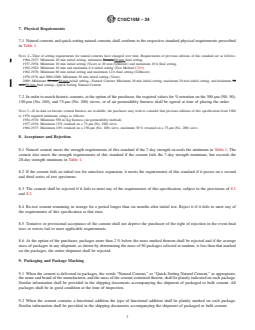
7.1 Natural cements and quick-setting natural cements shall conform to the respective standard physical requirements prescribed
in Table 1.
NOTE 2—Time of setting requirements for natural cements have changed over time. Requirements of previous editions of this standard are as follows:
1904-1937: Minimum 10 min initial setting, minimum 30 min 30 min final setting.
1937-1954: Minimum 10 min initial setting (Vicat) or 20 min (Gillmore) and maximum 10 h final setting.
1954-1962: Minimum 10 min and maximum 6 h initial setting (Test Method C191).
1962-1970: Minimum 60 min initial setting and maximum 12 h final setting (Gillmore).
1970-1976 and 2006-2008: Minimum 30 min initial setting (Vicat).
2009: Minimum 30 min 30 min initial setting—Natural Cement; Minimum 10 min initial setting, maximum 30 min
...