

ASTM D1929-23
(Test Method)Standard Test Method for Determining Ignition Temperature of Plastics
General Information
- Abstract
SIGNIFICANCE AND USE
4.1 Tests made under conditions herein prescribed can be of considerable value in comparing the relative ignition characteristics of different materials. Values obtained represent the lowest ambient air temperature that will cause ignition of the material under the conditions of this test. Test values are expected to rank materials according to ignition susceptibility under actual use conditions.
4.2 This test is not intended to be the sole criterion for fire hazard. In addition to ignition temperatures, fire hazards include other factors such as burning rate or flame spread, intensity of burning, fuel contribution, products of combustion, and others.
SCOPE
1.1 This fire test response test method2 covers a laboratory determination of the flash ignition temperature and spontaneous ignition temperature of plastics using a hot-air furnace.
1.2 The values stated in SI units are to be regarded as standard. No other units of measurement are included in this standard.
1.3 Caution—During the course of combustion, gases or vapors, or both, are evolved that have the potential to be hazardous to personnel.
1.4 This standard is used to measure and describe the response of materials, products, or assemblies to heat and flame under controlled conditions, but does not by itself incorporate all factors required for fire-hazard or fire-risk assessment of the materials, products, or assemblies under actual fire conditions.
1.5 Fire testing is inherently hazardous. Adequate safeguards for personnel and property shall be employed in conducting these tests.
1.6 This standard does not purport to address all of the safety concerns, if any, associated with its use. It is the responsibility of the user of this standard to establish appropriate safety, health, and environmental practices and determine the applicability of regulatory limitations prior to use. Specific precautionary statements are given in 1.3 and 1.4.
Note 1: This test method and ISO 871-2022 (Option 1) are similar in all technical details.
1.7 This international standard was developed in accordance with internationally recognized principles on standardization established in the Decision on Principles for the Development of International Standards, Guides and Recommendations issued by the World Trade Organization Technical Barriers to Trade (TBT) Committee.
- Status
- Published
- Publication Date
- 30-Apr-2023
- Technical Committee
- D20 - Plastics
- Drafting Committee
- D20.30 - Thermal Properties
Overview
ASTM D1929-23: Standard Test Method for Determining Ignition Temperature of Plastics is a widely recognized standard developed by ASTM International. This test method specifies laboratory procedures for determining both the flash ignition temperature and spontaneous ignition temperature of plastic materials using a hot-air furnace. These test values facilitate the comparison of plastics by identifying the lowest air temperature required to initiate ignition under the specified conditions.
The standard plays a significant role in fire safety evaluation, enabling manufacturers, researchers, and regulatory authorities to assess the ignition characteristics of plastics. However, it is important to note that ASTM D1929-23 focuses solely on ignition temperature and should not be used as the only indicator for overall fire hazard, as real-world fire scenarios involve additional factors such as burning rate, flame spread, and combustion products.
Key Topics
- Ignition Temperature Determination: Outlines procedures for measuring both flash ignition temperature (FIT) and spontaneous ignition temperature (SIT) of plastics.
- Hot-Air Furnace Method: Specifies the use of a controlled laboratory hot-air furnace for consistent and reproducible results.
- Test Specimen Preparation: Details the conditioning, form, and mass requirements for a diverse range of plastic formats, including pellets, powders, films, and cellular materials.
- Test Apparatus: Describes the design and operation of the furnace, specimen holder, pilot igniter, thermocouples, and other essential equipment.
- Test Procedure: Provides step-by-step instructions for conducting the test, including temperature settings, ignition detection criteria, and data recording.
- Safety and Precautions: Emphasizes necessary safeguards for personnel and property during testing, given the hazardous nature of fire testing and potential emission of harmful gases or vapors.
- Reporting Requirements: Specifies data that must be included in test reports, such as material details, test conditions, type of combustion observed, and measured ignition temperatures.
Applications
Fire Safety Engineering
ASTM D1929-23 is crucial for evaluating the ignition resistance of plastic materials in various applications, including:
- Building and Construction: Selecting materials with appropriate ignition characteristics for insulation, interior finishes, and structural elements.
- Automotive and Aerospace: Assessing plastics used in vehicle interiors and aircraft components to meet safety regulations.
- Consumer Products: Ensuring the safety of electronic device enclosures, packaging, and household goods by understanding ignition risks.
Regulatory Compliance
The test method supports compliance with industry fire safety regulations. By providing standardized ignition temperature data, manufacturers can meet certification requirements and demonstrate product safety.
Research and Development
R&D teams use ASTM D1929-23 when developing new plastic formulations or improving existing materials, enabling accurate benchmarking against industry norms for fire performance.
Related Standards
- ISO 871:2022 - Plastics - Determination of Ignition Temperature Using a Hot-Air Furnace: Technically similar to ASTM D1929-23, providing an equivalent method for determining ignition temperatures.
- ASTM D618: Practice for Conditioning Plastics for Testing, referenced for specimen preparation.
- ASTM D883: Standard Terminology Relating to Plastics, foundational for definitions used in D1929-23.
- ASTM E176: Terminology of Fire Standards, for standardized fire-related terms.
- ISO 13943: Fire Safety - Vocabulary, cited for harmonized terminology.
- IEC 60584-2: Thermocouples - Part 2: Tolerances, for temperature measurement equipment specifications.
Keywords: ASTM D1929, ignition temperature of plastics, flash ignition temperature, spontaneous ignition temperature, fire test method, fire safety, plastics testing, standard test method, hot-air furnace, plastic materials, fire hazard assessment.
Relations
- Effective Date
- 01-Feb-2024
- Effective Date
- 01-Jan-2024
- Effective Date
- 01-Nov-2023
- Effective Date
- 01-Apr-2022
- Effective Date
- 01-Jan-2020
- Effective Date
- 01-Aug-2019
- Effective Date
- 15-Apr-2019
- Effective Date
- 01-Feb-2019
- Effective Date
- 15-Dec-2018
- Effective Date
- 01-Dec-2018
- Effective Date
- 01-Nov-2018
- Effective Date
- 01-Mar-2018
- Effective Date
- 01-Oct-2017
- Effective Date
- 01-Oct-2017
- Refers
ASTM E2935-17 - Standard Practice for Conducting Equivalence Testing in Laboratory Applications - Effective Date
- 01-Oct-2017
Get Certified
Connect with accredited certification bodies for this standard

DIN CERTCO
DIN Group product certification.
CIS Institut d.o.o.
Personal Protective Equipment (PPE) certification body. Notified Body NB-2890 for EU Regulation 2016/425 PPE.

Kiwa BDA Testing
Building and construction product certification.
Sponsored listings
Frequently Asked Questions
ASTM D1929-23 is a standard published by ASTM International. Its full title is "Standard Test Method for Determining Ignition Temperature of Plastics". This standard covers: SIGNIFICANCE AND USE 4.1 Tests made under conditions herein prescribed can be of considerable value in comparing the relative ignition characteristics of different materials. Values obtained represent the lowest ambient air temperature that will cause ignition of the material under the conditions of this test. Test values are expected to rank materials according to ignition susceptibility under actual use conditions. 4.2 This test is not intended to be the sole criterion for fire hazard. In addition to ignition temperatures, fire hazards include other factors such as burning rate or flame spread, intensity of burning, fuel contribution, products of combustion, and others. SCOPE 1.1 This fire test response test method2 covers a laboratory determination of the flash ignition temperature and spontaneous ignition temperature of plastics using a hot-air furnace. 1.2 The values stated in SI units are to be regarded as standard. No other units of measurement are included in this standard. 1.3 Caution—During the course of combustion, gases or vapors, or both, are evolved that have the potential to be hazardous to personnel. 1.4 This standard is used to measure and describe the response of materials, products, or assemblies to heat and flame under controlled conditions, but does not by itself incorporate all factors required for fire-hazard or fire-risk assessment of the materials, products, or assemblies under actual fire conditions. 1.5 Fire testing is inherently hazardous. Adequate safeguards for personnel and property shall be employed in conducting these tests. 1.6 This standard does not purport to address all of the safety concerns, if any, associated with its use. It is the responsibility of the user of this standard to establish appropriate safety, health, and environmental practices and determine the applicability of regulatory limitations prior to use. Specific precautionary statements are given in 1.3 and 1.4. Note 1: This test method and ISO 871-2022 (Option 1) are similar in all technical details. 1.7 This international standard was developed in accordance with internationally recognized principles on standardization established in the Decision on Principles for the Development of International Standards, Guides and Recommendations issued by the World Trade Organization Technical Barriers to Trade (TBT) Committee.
SIGNIFICANCE AND USE 4.1 Tests made under conditions herein prescribed can be of considerable value in comparing the relative ignition characteristics of different materials. Values obtained represent the lowest ambient air temperature that will cause ignition of the material under the conditions of this test. Test values are expected to rank materials according to ignition susceptibility under actual use conditions. 4.2 This test is not intended to be the sole criterion for fire hazard. In addition to ignition temperatures, fire hazards include other factors such as burning rate or flame spread, intensity of burning, fuel contribution, products of combustion, and others. SCOPE 1.1 This fire test response test method2 covers a laboratory determination of the flash ignition temperature and spontaneous ignition temperature of plastics using a hot-air furnace. 1.2 The values stated in SI units are to be regarded as standard. No other units of measurement are included in this standard. 1.3 Caution—During the course of combustion, gases or vapors, or both, are evolved that have the potential to be hazardous to personnel. 1.4 This standard is used to measure and describe the response of materials, products, or assemblies to heat and flame under controlled conditions, but does not by itself incorporate all factors required for fire-hazard or fire-risk assessment of the materials, products, or assemblies under actual fire conditions. 1.5 Fire testing is inherently hazardous. Adequate safeguards for personnel and property shall be employed in conducting these tests. 1.6 This standard does not purport to address all of the safety concerns, if any, associated with its use. It is the responsibility of the user of this standard to establish appropriate safety, health, and environmental practices and determine the applicability of regulatory limitations prior to use. Specific precautionary statements are given in 1.3 and 1.4. Note 1: This test method and ISO 871-2022 (Option 1) are similar in all technical details. 1.7 This international standard was developed in accordance with internationally recognized principles on standardization established in the Decision on Principles for the Development of International Standards, Guides and Recommendations issued by the World Trade Organization Technical Barriers to Trade (TBT) Committee.
ASTM D1929-23 is classified under the following ICS (International Classification for Standards) categories: 13.220.40 - Ignitability and burning behaviour of materials and products; 83.080.01 - Plastics in general. The ICS classification helps identify the subject area and facilitates finding related standards.
ASTM D1929-23 has the following relationships with other standards: It is inter standard links to ASTM D883-24, ASTM E176-24, ASTM D883-23, ASTM E456-13a(2022)e1, ASTM D883-20, ASTM D883-19c, ASTM D883-19a, ASTM D883-19, ASTM E176-18a, ASTM D883-18a, ASTM D883-18, ASTM E176-18, ASTM E456-13A(2017)e3, ASTM E456-13A(2017)e1, ASTM E2935-17. Understanding these relationships helps ensure you are using the most current and applicable version of the standard.
ASTM D1929-23 is available in PDF format for immediate download after purchase. The document can be added to your cart and obtained through the secure checkout process. Digital delivery ensures instant access to the complete standard document.
Standards Content (Sample)
This international standard was developed in accordance with internationally recognized principles on standardization established in the Decision on Principles for the
Development of International Standards, Guides and Recommendations issued by the World Trade Organization Technical Barriers to Trade (TBT) Committee.
Designation: D1929 − 23
Standard Test Method for
Determining Ignition Temperature of Plastics
This standard is issued under the fixed designation D1929; the number immediately following the designation indicates the year of
original adoption or, in the case of revision, the year of last revision. A number in parentheses indicates the year of last reapproval. A
superscript epsilon (´) indicates an editorial change since the last revision or reapproval.
1. Scope* Development of International Standards, Guides and Recom-
mendations issued by the World Trade Organization Technical
1.1 This fire test response test method covers a laboratory
Barriers to Trade (TBT) Committee.
determination of the flash ignition temperature and spontane-
ous ignition temperature of plastics using a hot-air furnace.
2. Referenced Documents
1.2 The values stated in SI units are to be regarded as
2.1 ASTM Standards:
standard. No other units of measurement are included in this
D618 Practice for Conditioning Plastics for Testing
standard.
D883 Terminology Relating to Plastics
1.3 Caution—During the course of combustion, gases or
E176 Terminology of Fire Standards
vapors, or both, are evolved that have the potential to be
E456 Terminology Relating to Quality and Statistics
hazardous to personnel.
E691 Practice for Conducting an Interlaboratory Study to
Determine the Precision of a Test Method
1.4 This standard is used to measure and describe the
E2653 Practice for Conducting an Interlaboratory Study to
response of materials, products, or assemblies to heat and
Determine Precision Estimates for a Test Method with
flame under controlled conditions, but does not by itself
Fewer Than Six Participating Laboratories
incorporate all factors required for fire-hazard or fire-risk
E2935 Practice for Evaluating Equivalence of Two Testing
assessment of the materials, products, or assemblies under
Processes
actual fire conditions.
4,5
2.2 International Standards:
1.5 Fire testing is inherently hazardous. Adequate safe-
ISO 871-2022 Plastics—Determination of Ignition Tempera-
guards for personnel and property shall be employed in
ture Using a Hot-Air Furnace
conducting these tests.
ISO 5725-2 (2019) Accuracy (trueness and precision) of
1.6 This standard does not purport to address all of the
Measurement Methods and Results—Part 2: Basic method
safety concerns, if any, associated with its use. It is the
for the determination of repeatability and reproducibility
responsibility of the user of this standard to establish appro-
of a standard measurement method
priate safety, health, and environmental practices and deter-
ISO 13943:2017 Fire Safety—Vocabulary
mine the applicability of regulatory limitations prior to use.
IEC 60584-2 (1982) Thermocouples—Part 2: Tolerances
Specific precautionary statements are given in 1.3 and 1.4.
IEC 60584-3 (2013) Thermocouples—Part 1: EMF specifi-
NOTE 1—This test method and ISO 871-2022 (Option 1) are similar in
cations and tolerances
all technical details.
1.7 This international standard was developed in accor-
3. Terminology
dance with internationally recognized principles on standard-
3.1 For definitions of terms relating to plastics, the defini-
ization established in the Decision on Principles for the
tions in this test method are in accordance with Terminology
D883. For terms relating to fire, the definitions in this test
This test method is under the jurisdiction of ASTM Committee D20 on Plastics method are in accordance with Terminology E176 and
and is the direct responsibility of Subcommittee D20.30 on Thermal Proper-
ties.30.03).
Current edition approved May 1, 2023. Published June 2023. Originally
approved in 1962. Last previous edition approved in 2020 as D1929 – 20. For referenced ASTM standards, visit the ASTM website, www.astm.org, or
DOI:10.1520 ⁄D1929-23. contact ASTM Customer Service at service@astm.org. For Annual Book of ASTM
In 1996, this test method was totally revised to be technically equal to ISO Standards volume information, refer to the standard’s Document Summary page on
871-1996, and a specific air velocity is specified, which eliminates the need for the ASTM website.
approximations. Available from American National Standards Institute (ANSI), 25 W. 43rd St.,
The following reference may be of interest in connection with this test method: 4th Floor, New York, NY 10036, http://www.ansi.org.
Stetchkin, N. P., “A Method and Apparatus for Determining the Ignition Charac- Available from International Organization for Standardization (ISO), ISO
teristics of Plastics,” Journal of Research, National Institute of Standards and Central Secretariat, BIBC II, Chemin de Blandonnet 8, CP 401, 1214 Vernier,
Technology, Vol 43, No. 6, December 1949 (RP 2052), p. 591. Geneva, Switzerland, http://www.iso.org.
*A Summary of Changes section appears at the end of this standard
Copyright © ASTM International, 100 Barr Harbor Drive, PO Box C700, West Conshohocken, PA 19428-2959. United States
D1929 − 23
ISO 13943. In case of conflict, the definitions given in Termi- through a copper tube at a steady and controllable rate. Air
nology E176 shall prevail. For terms relating to precision and shall be heated and circulated in the space between the two
bias and associated issues, the terms used in this test method tubes and enter the inner furnace tube at the bottom. Air shall
are in accordance with the definitions in Terminology E456. be metered by a rotameter or other suitable device.
3.2 Definitions of Terms Specific to This Standard:
5.5 Electrical Heating Unit, contained within the mineral
3.2.1 flash ignition temperature (FIT)—the minimum tem-
fiber sleeve and constructed of 50 turns of 1.3 6 0.1 mm
perature at which, under specified test conditions, sufficient
Nichrome V alloy wire, wound around the furnace tube and
flammable gases are emitted to ignite momentarily upon
embedded in heat-resistant cement.
application of a small external pilot flame.
NOTE 3—Other constructions such as finely coiled wire embedded in
3.2.2 glowing combustion—combustion of a material in the
molded ceramic fiber have also been found to be acceptable.
solid phase without flame but with emission of light from the
5.6 Insulation, consisting of a layer of mineral fiber, ap-
combustion zone, caused by slow decomposition and carbon-
proximately 60-mm thick, and covered by a metal jacket.
ization at various points in the specimen, without general
ignition occurring. 5.7 Pilot Igniter, consisting of a nominal 1.8 6 0.3-mm
inside diameter (ID) copper tubing attached to a gas supply of
3.2.3 spontaneous ignition temperature or self-ignition tem-
94 % minimum purity propane and placed horizontally 5 6 1
perature (SIT)—the minimum temperature at which the self-
mm above the top surface of the disk cover. The pilot flame
heating properties of the specimen lead to ignition or ignition
shall be adjusted to 20 6 2 mm in length and centered above
occurs of itself, under specified test conditions, in the absence
the opening in the disk cover.
of any additional flame ignition source.
5.8 Specimen Support and Holder—The specimen pan con-
4. Significance and Use
sists of a metal container of approximately 0.5-mm thick steel
measuring 406 2 mm in diameter by 15 6 2 mm in depth. It
4.1 Tests made under conditions herein prescribed can be of
considerable value in comparing the relative ignition charac- is held in a ring of approximately 2.0-mm diameter stainless
steel welding rod. The ring is welded to a length of the same
teristics of different materials. Values obtained represent the
lowest ambient air temperature that will cause ignition of the type of rod extending through the cover of the furnace, as
material under the conditions of this test. Test values are shown in Fig. 1. The bottom of the specimen pan shall be
expected to rank materials according to ignition susceptibility located 185 6 5 mm down from the top of the inner furnace
under actual use conditions. tube.
4.2 This test is not intended to be the sole criterion for fire
5.9 Thermocouples, 0.5-mm diameter, Chromel-Alumel
hazard. In addition to ignition temperatures, fire hazards
(Type K) or Iron-Constantan (Type J), for temperature mea-
include other factors such as burning rate or flame spread,
surement connected to a calibrated recording instrument with a
intensity of burning, fuel contribution, products of combustion,
tolerance not exceeding 62°C. The thermocouple tolerance
and others.
shall be in accordance with IEC 60584-2 (1982), Table 1, Class
2, or IEC 60584-3 (2013), Table 12, Class 2, or better.
5. Apparatus
5.10 Heating Control—A suitable variable transformer or an
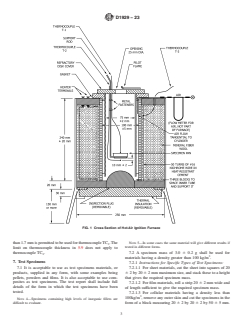
5.1 Hot-Air Ignition Furnace—A furnace similar to that
automatic controller connected in series with the heating coils.
shown in Fig. 1, consisting primarily of an electrical heating
5.11 Timing Device, having an accuracy of at least 1 s.
unit and specimen holder.
5.2 Furnace Tube—A vertical tube with an inside diameter
6. Location of Thermocouples
of 100 6 5 mm and a length of 230 6 20 mm, made of a
6.1 Thermocouple TC measures the temperature, T , of the
ceramic that will withstand at least 750°C. The vertical tube
1 1
specimen. It is located as close as possible to the center of the
stands on the furnace floor, fitted with a plug for the removal of
upper surface of the specimen when the specimen is in place
accumulated residue.
within the furnace. The thermocouple wire is attached to the
5.3 Inner Ceramic Tube—A ceramic tube that will withstand
specimen support rod.
at least 750°C, with an inside diameter of 75 6 5 mm, length
of 2306 20 mm, and thickness of approximately 3 mm, placed 6.2 Thermocouple TC gives some indication of the
inside the furnace tube and positioned 20 6 2 mm above the temperature, T , of the air traveling past the specimen. It is
furnace floor on three small spacer blocks. The top is covered located 10 6 2 mm below the center of the specimen pan. The
thermocouple wire is attached to the specimen support rod.
by a disk of heat-resistant material with a 25 6 2-mm diameter
opening in the center that is used for observation and passage
6.2.1 It is acceptable to install thermocouple TC2 through a
of smoke and gases. The pilot flame is located immediately
hole drilled adjacent to the inspection plug below the specimen
above the opening.
pan, instead of introducing it from the top, as shown in Fig. 1.
NOTE 2—Fire resistant materials such as silica glass and stainless steel
6.3 Thermocouple TC measures the temperature, T , of the
3 3
have also been found suitable for this application.
heating coil. It is located adjacent to the furnace heating coil
5.4 Air Source—An outside air source to supply clean air and is used as a reference for temperature adjustment purposes.
near the top of the annular space between the ceramic tubes, A metallic sheathed thermocouple with a diameter not greater
D1929 − 23
FIG. 1 Cross Section of Hot-Air Ignition Furnace
NOTE 5—In some cases the same material will give different results if
than 1.7 mm is permitted to be used for thermocouple TC . The
tested in different forms.
limit on thermocouple thickness in 5.9 does not apply to
thermocouple TC .
7.2 A specimen mass of 3.0 6 0.2 g shall be used for
materials having a density gr
...
This document is not an ASTM standard and is intended only to provide the user of an ASTM standard an indication of what changes have been made to the previous version. Because
it may not be technically possible to adequately depict all changes accurately, ASTM recommends that users consult prior editions as appropriate. In all cases only the current version
of the standard as published by ASTM is to be considered the official document.
Designation: D1929 − 20 D1929 − 23
Standard Test Method for
Determining Ignition Temperature of Plastics
This standard is issued under the fixed designation D1929; the number immediately following the designation indicates the year of
original adoption or, in the case of revision, the year of last revision. A number in parentheses indicates the year of last reapproval. A
superscript epsilon (´) indicates an editorial change since the last revision or reapproval.
1. Scope*
1.1 This fire test response test method covers a laboratory determination of the flash ignition temperature and spontaneous
ignition temperature of plastics using a hot-air furnace.
1.2 The values stated in SI units are to be regarded as standard. No other units of measurement are included in this standard.
1.3 Caution—During the course of combustion, gases or vapors, or both, are evolved that have the potential to be hazardous to
personnel.
1.4 This standard is used to measure and describe the response of materials, products, or assemblies to heat and flame under
controlled conditions, but does not by itself incorporate all factors required for fire-hazard or fire-risk assessment of the materials,
products, or assemblies under actual fire conditions.
1.5 Fire testing is inherently hazardous. Adequate safeguards for personnel and property shall be employed in conducting these
tests.
1.6 This standard does not purport to address all of the safety concerns, if any, associated with its use. It is the responsibility
of the user of this standard to establish appropriate safety, health, and environmental practices and determine the applicability of
regulatory limitations prior to use. Specific precautionary statements are given in 1.3 and 1.4.
NOTE 1—This test method and ISO 871-1996 871-2022 (Option 1) are similar in all technical details.
1.7 This international standard was developed in accordance with internationally recognized principles on standardization
established in the Decision on Principles for the Development of International Standards, Guides and Recommendations issued
by the World Trade Organization Technical Barriers to Trade (TBT) Committee.
2. Referenced Documents
2.1 ASTM Standards:
D618 Practice for Conditioning Plastics for Testing
D883 Terminology Relating to Plastics
This test method is under the jurisdiction of ASTM Committee D20 on Plastics and is the direct responsibility of Subcommittee D20.30 on Thermal Properties.30.03).
Current edition approved Jan. 1, 2020May 1, 2023. Published January 2020June 2023. Originally approved in 1962. Last previous edition approved in 20192020 as
D1929 – 19.D1929 – 20. DOI:10.1520/D1929-20.DOI:10.1520 ⁄D1929-23.
In 1996, this test method was totally revised to be technically equal to ISO 871-1996, and a specific air velocity is specified, which eliminates the need for approximations.
The following reference may be of interest in connection with this test method: Stetchkin, N. P., “A Method and Apparatus for Determining the Ignition Characteristics
of Plastics,” Journal of Research, National Institute of Standards and Technology, Vol 43, No. 6, December 1949 (RP 2052), p. 591.
For referenced ASTM standards, visit the ASTM website, www.astm.org, or contact ASTM Customer Service at service@astm.org. For Annual Book of ASTM Standards
volume information, refer to the standard’s Document Summary page on the ASTM website.
*A Summary of Changes section appears at the end of this standard
Copyright © ASTM International, 100 Barr Harbor Drive, PO Box C700, West Conshohocken, PA 19428-2959. United States
D1929 − 23
E176 Terminology of Fire Standards
E456 Terminology Relating to Quality and Statistics
E691 Practice for Conducting an Interlaboratory Study to Determine the Precision of a Test Method
E2653 Practice for Conducting an Interlaboratory Study to Determine Precision Estimates for a Test Method with Fewer Than
Six Participating Laboratories
E2935 Practice for Evaluating Equivalence of Two Testing Processes
4,5
2.2 International Standards:
ISO 871-1996871-2022 Plastics—Determination of Ignition Temperature Using a Hot-Air Furnace
ISO 5725:19945725-2 (2019) Accuracy (trueness and precision) of Measurement Methods and ResultsResults—Part 2: Basic
method for the determination of repeatability and reproducibility of a standard measurement method
ISO 13943:2017 Fire Safety—Vocabulary
IEC 584-260584-2 (1982) Thermocouples—Part 2: Tolerances
IEC 60584-3 (2013) Thermocouples—Part 1: EMF specifications and tolerances
3. Terminology
3.1 For definitions of terms relating to plastics, the definitions in this test method are in accordance with Terminology D883. For
terms relating to fire, the definitions in this test method are in accordance with Terminology E176 and ISO 13943. In case of
conflict, the definitions given in Terminology E176 shall prevail. For terms relating to precision and bias and associated issues, the
terms used in this test method are in accordance with the definitions in Terminology E456.
3.2 Definitions of Terms Specific to This Standard:
3.2.1 flash ignition temperature (FIT)—the minimum temperature at which, under specified test conditions, sufficient flammable
gases are emitted to ignite momentarily upon application of a small external pilot flame.
3.2.2 glowing combustion—combustion of a material in the solid phase without flame but with emission of light from the
combustion zone, caused by slow decomposition and carbonization at various points in the specimen, without general ignition
occurring.
3.2.3 spontaneous ignition temperature or self-ignition temperature (SIT)—the minimum temperature at which the self-heating
properties of the specimen lead to ignition or ignition occurs of itself, under specified test conditions, in the absence of any
additional flame ignition source.
4. Significance and Use
4.1 Tests made under conditions herein prescribed can be of considerable value in comparing the relative ignition characteristics
of different materials. Values obtained represent the lowest ambient air temperature that will cause ignition of the material under
the conditions of this test. Test values are expected to rank materials according to ignition susceptibility under actual use
conditions.
4.2 This test is not intended to be the sole criterion for fire hazard. In addition to ignition temperatures, fire hazards include other
factors such as burning rate or flame spread, intensity of burning, fuel contribution, products of combustion, and others.
5. Apparatus
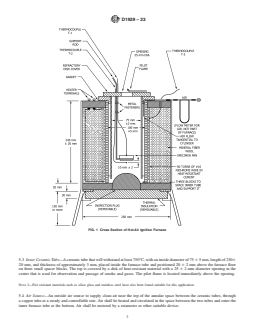
5.1 Hot-Air Ignition Furnace—A furnace similar to that shown in Fig. 1, consisting primarily of an electrical heating unit and
specimen holder.
5.2 Furnace Tube—A vertical tube with an inside diameter of 100 6 5 mm and a length of 230 6 20 mm, made of a ceramic that
will withstand at least 750°C. The vertical tube stands on the furnace floor, fitted with a plug for the removal of accumulated
residue.
Available from American National Standards Institute (ANSI), 25 W. 43rd St., 4th Floor, New York, NY 10036, http://www.ansi.org.
Available from International Organization for Standardization (ISO), ISO Central Secretariat, BIBC II, Chemin de Blandonnet 8, CP 401, 1214 Vernier, Geneva,
Switzerland, http://www.iso.org.
D1929 − 23
FIG. 1 Cross Section of Hot-Air Ignition Furnace
5.3 Inner Ceramic Tube—A ceramic tube that will withstand at least 750°C, with an inside diameter of 75 6 5 mm, length of 2306
20 mm, and thickness of approximately 3 mm, placed inside the furnace tube and positioned 20 6 2 mm above the furnace floor
on three small spacer blocks. The top is covered by a disk of heat-resistant material with a 25 6 2-mm diameter opening in the
center that is used for observation and passage of smoke and gases. The pilot flame is located immediately above the opening.
NOTE 2—Fire resistant materials such as silica glass and stainless steel have also been found suitable for this application.
5.4 Air Source—An outside air source to supply clean air near the top of the annular space between the ceramic tubes, through
a copper tube at a steady and controllable rate. Air shall be heated and circulated in the space between the two tubes and enter the
inner furnace tube at the bottom. Air shall be metered by a rotameter or other suitable device.
D1929 − 23
5.5 Electrical Heating Unit, contained within the mineral fiber sleeve and constructed of 50 turns of 1.3 6 0.1 mm Nichrome V
alloy wire, wound around the furnace tube and embedded in heat-resistant cement.
NOTE 3—Other constructions such as finely coiled wire embedded in molded ceramic fiber have also been found to be acceptable.
5.6 Insulation, consisting of a layer of mineral fiber, approximately 60-mm thick, and covered by a metal jacket.
5.7 Pilot Igniter, consisting of a nominal 1.8 6 0.3-mm inside diameter (ID) copper tubing attached to a gas supply of 94 %
minimum purity propane and placed horizontally 5 6 1 mm above the top surface of the disk cover. The pilot flame shall be
adjusted to 20 6 2 mm in length and centered above the opening in the disk cover.
5.8 Specimen Support and Holder—The specimen pan consists of a metal container of approximately 0.5-mm thick steel
measuring 406 2 mm in diameter by 15 6 2 mm in depth. It is held in a ring of approximately 2.0-mm diameter stainless steel
welding rod. The ring is welded to a length of the same type of rod extending through the cover of the furnace, as shown in Fig.
1. The bottom of the specimen pan shall be located 185 6 5 mm down from the top of the inner furnace tube.
5.9 Thermocouples, 0.5-mm diameter, Chromel-Alumel (Type K) or Iron-Constantan (Type J), for temperature measurement
connected to a calibrated recording instrument with a tolerance not exceeding 62°C. The thermocouple tolerance shall be in
accordance with IEC 584-2, 60584-2 (1982), Table 1, Class 2 or 2, or IEC 60584-3 (2013), Table 12, Class 2, or better.
5.10 Heating Control—A suitable variable transformer or an automatic controller connected in series with the heating coils.
5.11 Timing Device, having an accuracy of at least 1 s.
6. Location of Thermocouples
6.1 Thermocouple TC measures the temperature, T , of the specimen. It is located as close as possible to the center of the upper
1 1
surface of the specimen when the specimen is in place within the furnace. The thermocouple wire is attached to the specimen
support rod.
6.2 Thermocouple TC gives some indication of the temperature, T , of the air traveling past the specimen. It is located 10 6 2
2 2
mm below the center of the specimen pan. The thermocouple wire is attached to the specimen support rod.
6.2.1 It is acceptable to install thermocouple TC2 through a hole drilled adjacent to the inspection plug below the specimen pan,
instead of introducing it from the top, as shown in Fig. 1.
6.3 Thermocouple TC measures the temperature, T , of the heating coil. It is located adjacent to the furnace heating coil and is
3 3
used as a reference for temperature adjustment purposes. A metallic sheathed thermocouple with a diameter not greater than 1.7
mm is permitted to be used for thermocouple TC . The limit on thermocouple thickness in 5.9 does not apply to thermocouple TC .
3 3
7. Test Specimens
7.1 It is acceptable to use as test specimens materials, or products, supplied in any form, with some examples being pellets,
powders and films. It is also acceptable to use composites as test specimens. The test report shall include full details of the form
in which the test specimens have been tested.
NOTE 4—Specimens containing high levels of inorganic fillers are difficult to evaluate.
NOTE 5—In some cases the same material will give different results if tested in different forms.
7.2 A specimen mass of 3.0 6 0.2 g shall be used for materials having a density greater than 100 kg/m .
7.
...