

ASTM D635-22
(Test Method)Standard Test Method for Rate of Burning and/or Extent and Time of Burning of Plastics in a Horizontal Position
General Information
- Abstract
SIGNIFICANCE AND USE
5.1 Tests made on a material under conditions herein prescribed are of value in comparing the rate of burning or extent and time of burning characteristics, or both, of different materials, in controlling manufacturing processes, or as a measure of deterioration or change in these burning characteristics prior to or during use. Correlation with flammability under actual use conditions is not implied.
5.2 The rate of burning and other burning phenomena will be affected by such factors as density, pigments, any anisotropy of the material and the thickness of the specimen. Test data shall be compared only for specimens of similar thickness, whether comparisons are being made with the same or different materials. The rate of burning and other burning phenomena will vary with thickness.
5.3 It is feasible that sheet materials that have been stretched during processing will relax during burning and give erratic results unless they are first heated above their deflection temperature, in accordance with Test Method D648, for a time sufficient to permit complete relaxation.
5.4 Burning tests require that certain variables be arbitrarily fixed, for example, specimen size, energy source and application time, and end points. Materials will be found that are unusually sensitive to one or more of the conditions chosen for this method leading to highly variable results. Additional burning characterization by other methods is highly desirable in such cases (see Note 2).
5.5 In this procedure, the specimens are subjected to specific laboratory test conditions. If different test conditions are substituted or the end-use conditions are changed, it will not always be possible by or from this test to predict changes in the fire-test-response characteristics measured. Therefore, the results are valid only for the fire-test-exposure conditions described in this procedure.
SCOPE
1.1 This fire-test-response test method covers a small-scale laboratory screening procedure for comparing the relative linear rate of burning or extent and time of burning, or both, of plastics in the form of bars, molded or cut from sheets, plates, or panels, and tested in the horizontal position.
Note 1: This test method, and test method A of IEC 60695-11-10 are technically equivalent.
Note 2: For additional information on materials which do not burn to the first reference mark by this test, see Test Method D3801.
1.2 This test method was developed for polymeric materials used for parts in devices and appliances. The results are intended to serve as a preliminary indication of their acceptability with respect to flammability for a particular application. The final acceptance of the material is dependent upon its use in complete equipment that conforms with the standard applicable to such equipment.
1.3 The classification system described in Appendix X1 is intended for quality assurance and the preselection of component materials for products.
1.4 The values stated in SI units are to be regarded as standard. No other units of measurement are included in this standard.
1.5 This standard is used to measure and describe the response of materials, products, or assemblies to heat and flame under controlled conditions, but does not by itself incorporate all factors required for fire hazards or fire risk assessment of materials, products, or assemblies under actual fire conditions.
1.6 This standard does not purport to address all of the safety concerns, if any, associated with its use. It is the responsibility of the user of this standard to establish appropriate safety, health, and environmental practices and determine the applicability of regulatory limitations prior to use. For specific hazards statements, see 9.2.
1.7 This international standard was developed in accordance with internationally recognized principles on standardization established in the Decision on Principles for the Development of Internati...
- Status
- Published
- Publication Date
- 30-Jun-2022
- Technical Committee
- D20 - Plastics
- Drafting Committee
- D20.30 - Thermal Properties
Buy Documents
ASTM D635-22 - Standard Test Method for Rate of Burning and/or Extent and Time of Burning of Plastics in a Horizontal Position
REDLINE ASTM D635-22 - Standard Test Method for Rate of Burning and/or Extent and Time of Burning of Plastics in a Horizontal Position
Overview
ASTM D635-22 is the internationally recognized standard test method for determining the rate, extent, and time of burning of plastics positioned horizontally. Developed by ASTM International, this laboratory-based procedure provides a consistent approach for evaluating the flammability characteristics of polymeric materials. Testing is performed on plastic samples shaped as bars, which are either molded or cut from sheets, plates, or panels. The results offer a useful comparison between different plastics regarding their burning behavior under controlled conditions.
While this standard serves as a valuable screening tool in material selection and quality control, it is important to note that it does not provide a direct correlation to actual use conditions or comprehensive fire hazard assessments.
Keywords: ASTM D635, burning rate, horizontal burning, plastics, flammability test, fire-test-response, material screening
Key Topics
Purpose and Scope
- Provides a standardized laboratory method to compare the rate of burning and the extent and time of burning of plastics in a horizontal orientation.
- Designed primarily for polymeric materials used in devices, appliances, and building products.
Relevance of Test Conditions
- Results depend on sample characteristics such as thickness, density, pigmentation, and anisotropy.
- Test comparisons are valid only for specimens of similar thickness and under the prescribed conditions.
Limitations
- Not intended to replicate real-world fire scenarios; correlation with end-use flammability is not implied.
- Results are valid strictly for the laboratory conditions defined in the test method.
Classification
- Materials are classified as HB (horizontal burning) based on their performance in this test.
- Category codes can be used to describe material properties for preselection and quality assurance.
Applicability
- Useful as a preliminary indicator of suitability for applications where fire resistance is critical.
- Final material acceptance must consider complete equipment safety standards and other flammability requirements.
Applications
ASTM D635-22 is widely used in the plastics and manufacturing industries for:
Material Selection
- Helps manufacturers choose materials that meet flammability requirements for specific applications, such as in electrical appliances, building products, automotive parts, and lighting.
Quality Control
- Assists in monitoring consistency and changes in burning performance during production processes.
Regulatory Compliance
- Referenced in building codes (e.g., the International Building Code) for light-transmitting plastics and signs, establishing minimum flammability criteria.
- Supports preselection of component materials for assemblies requiring fire safety verification.
Research and Development
- Used in comparative studies of new polymer formulations or additives impacting burning rates or combustion behaviors.
Note: For comprehensive flammability assessment or alternate test orientations (such as vertical burning), complementary methods like ASTM D3801 may be required.
Related Standards
Understanding ASTM D635-22 in context enhances its practical value. Relevant standards include:
- ASTM D3801: Test Method for Measuring Comparative Burning Characteristics of Solid Plastics in a Vertical Position
- ASTM D618: Practice for Conditioning Plastics for Testing
- ASTM D648: Test Method for Deflection Temperature of Plastics Under Flexural Load
- ASTM D1929: Test Method for Determining Ignition Temperature of Plastics
- ASTM D2843: Test Method for Density of Smoke from the Burning or Decomposition of Plastics
- IEC 60695-11-10: Equivalent international fire hazard testing method for plastics
- E84 (ASTM): Test Method for Surface Burning Characteristics of Building Materials
These and other fire-testing standards provide a robust suite of benchmarking tools for evaluating the fire performance of plastics, supporting safer product design and regulatory compliance.
Relations
- Effective Date
- 01-Feb-2024
- Effective Date
- 01-Jan-2024
- Effective Date
- 01-Dec-2023
- Effective Date
- 01-Nov-2023
- Effective Date
- 01-Sep-2023
- Effective Date
- 01-Apr-2022
- Effective Date
- 01-Mar-2020
- Effective Date
- 01-Feb-2020
- Effective Date
- 01-Jan-2020
- Effective Date
- 01-Dec-2019
- Effective Date
- 01-Dec-2019
- Effective Date
- 01-Aug-2019
- Effective Date
- 01-Jul-2019
- Effective Date
- 15-Apr-2019
- Effective Date
- 15-Apr-2019
Buy Documents
ASTM D635-22 - Standard Test Method for Rate of Burning and/or Extent and Time of Burning of Plastics in a Horizontal Position
REDLINE ASTM D635-22 - Standard Test Method for Rate of Burning and/or Extent and Time of Burning of Plastics in a Horizontal Position
Get Certified
Connect with accredited certification bodies for this standard

DIN CERTCO
DIN Group product certification.
CIS Institut d.o.o.
Personal Protective Equipment (PPE) certification body. Notified Body NB-2890 for EU Regulation 2016/425 PPE.

Kiwa BDA Testing
Building and construction product certification.
Sponsored listings
Frequently Asked Questions
ASTM D635-22 is a standard published by ASTM International. Its full title is "Standard Test Method for Rate of Burning and/or Extent and Time of Burning of Plastics in a Horizontal Position". This standard covers: SIGNIFICANCE AND USE 5.1 Tests made on a material under conditions herein prescribed are of value in comparing the rate of burning or extent and time of burning characteristics, or both, of different materials, in controlling manufacturing processes, or as a measure of deterioration or change in these burning characteristics prior to or during use. Correlation with flammability under actual use conditions is not implied. 5.2 The rate of burning and other burning phenomena will be affected by such factors as density, pigments, any anisotropy of the material and the thickness of the specimen. Test data shall be compared only for specimens of similar thickness, whether comparisons are being made with the same or different materials. The rate of burning and other burning phenomena will vary with thickness. 5.3 It is feasible that sheet materials that have been stretched during processing will relax during burning and give erratic results unless they are first heated above their deflection temperature, in accordance with Test Method D648, for a time sufficient to permit complete relaxation. 5.4 Burning tests require that certain variables be arbitrarily fixed, for example, specimen size, energy source and application time, and end points. Materials will be found that are unusually sensitive to one or more of the conditions chosen for this method leading to highly variable results. Additional burning characterization by other methods is highly desirable in such cases (see Note 2). 5.5 In this procedure, the specimens are subjected to specific laboratory test conditions. If different test conditions are substituted or the end-use conditions are changed, it will not always be possible by or from this test to predict changes in the fire-test-response characteristics measured. Therefore, the results are valid only for the fire-test-exposure conditions described in this procedure. SCOPE 1.1 This fire-test-response test method covers a small-scale laboratory screening procedure for comparing the relative linear rate of burning or extent and time of burning, or both, of plastics in the form of bars, molded or cut from sheets, plates, or panels, and tested in the horizontal position. Note 1: This test method, and test method A of IEC 60695-11-10 are technically equivalent. Note 2: For additional information on materials which do not burn to the first reference mark by this test, see Test Method D3801. 1.2 This test method was developed for polymeric materials used for parts in devices and appliances. The results are intended to serve as a preliminary indication of their acceptability with respect to flammability for a particular application. The final acceptance of the material is dependent upon its use in complete equipment that conforms with the standard applicable to such equipment. 1.3 The classification system described in Appendix X1 is intended for quality assurance and the preselection of component materials for products. 1.4 The values stated in SI units are to be regarded as standard. No other units of measurement are included in this standard. 1.5 This standard is used to measure and describe the response of materials, products, or assemblies to heat and flame under controlled conditions, but does not by itself incorporate all factors required for fire hazards or fire risk assessment of materials, products, or assemblies under actual fire conditions. 1.6 This standard does not purport to address all of the safety concerns, if any, associated with its use. It is the responsibility of the user of this standard to establish appropriate safety, health, and environmental practices and determine the applicability of regulatory limitations prior to use. For specific hazards statements, see 9.2. 1.7 This international standard was developed in accordance with internationally recognized principles on standardization established in the Decision on Principles for the Development of Internati...
SIGNIFICANCE AND USE 5.1 Tests made on a material under conditions herein prescribed are of value in comparing the rate of burning or extent and time of burning characteristics, or both, of different materials, in controlling manufacturing processes, or as a measure of deterioration or change in these burning characteristics prior to or during use. Correlation with flammability under actual use conditions is not implied. 5.2 The rate of burning and other burning phenomena will be affected by such factors as density, pigments, any anisotropy of the material and the thickness of the specimen. Test data shall be compared only for specimens of similar thickness, whether comparisons are being made with the same or different materials. The rate of burning and other burning phenomena will vary with thickness. 5.3 It is feasible that sheet materials that have been stretched during processing will relax during burning and give erratic results unless they are first heated above their deflection temperature, in accordance with Test Method D648, for a time sufficient to permit complete relaxation. 5.4 Burning tests require that certain variables be arbitrarily fixed, for example, specimen size, energy source and application time, and end points. Materials will be found that are unusually sensitive to one or more of the conditions chosen for this method leading to highly variable results. Additional burning characterization by other methods is highly desirable in such cases (see Note 2). 5.5 In this procedure, the specimens are subjected to specific laboratory test conditions. If different test conditions are substituted or the end-use conditions are changed, it will not always be possible by or from this test to predict changes in the fire-test-response characteristics measured. Therefore, the results are valid only for the fire-test-exposure conditions described in this procedure. SCOPE 1.1 This fire-test-response test method covers a small-scale laboratory screening procedure for comparing the relative linear rate of burning or extent and time of burning, or both, of plastics in the form of bars, molded or cut from sheets, plates, or panels, and tested in the horizontal position. Note 1: This test method, and test method A of IEC 60695-11-10 are technically equivalent. Note 2: For additional information on materials which do not burn to the first reference mark by this test, see Test Method D3801. 1.2 This test method was developed for polymeric materials used for parts in devices and appliances. The results are intended to serve as a preliminary indication of their acceptability with respect to flammability for a particular application. The final acceptance of the material is dependent upon its use in complete equipment that conforms with the standard applicable to such equipment. 1.3 The classification system described in Appendix X1 is intended for quality assurance and the preselection of component materials for products. 1.4 The values stated in SI units are to be regarded as standard. No other units of measurement are included in this standard. 1.5 This standard is used to measure and describe the response of materials, products, or assemblies to heat and flame under controlled conditions, but does not by itself incorporate all factors required for fire hazards or fire risk assessment of materials, products, or assemblies under actual fire conditions. 1.6 This standard does not purport to address all of the safety concerns, if any, associated with its use. It is the responsibility of the user of this standard to establish appropriate safety, health, and environmental practices and determine the applicability of regulatory limitations prior to use. For specific hazards statements, see 9.2. 1.7 This international standard was developed in accordance with internationally recognized principles on standardization established in the Decision on Principles for the Development of Internati...
ASTM D635-22 is classified under the following ICS (International Classification for Standards) categories: 13.220.40 - Ignitability and burning behaviour of materials and products; 83.080.01 - Plastics in general. The ICS classification helps identify the subject area and facilitates finding related standards.
ASTM D635-22 has the following relationships with other standards: It is inter standard links to ASTM D883-24, ASTM E176-24, ASTM E84-23d, ASTM D883-23, ASTM E84-23c, ASTM E456-13a(2022)e1, ASTM D5025-20a, ASTM D5025-20, ASTM D883-20, ASTM D1929-19, ASTM D3801-19a, ASTM D883-19c, ASTM E84-19b, ASTM E84-19a, ASTM D883-19a. Understanding these relationships helps ensure you are using the most current and applicable version of the standard.
ASTM D635-22 is available in PDF format for immediate download after purchase. The document can be added to your cart and obtained through the secure checkout process. Digital delivery ensures instant access to the complete standard document.
Standards Content (Sample)
This international standard was developed in accordance with internationally recognized principles on standardization established in the Decision on Principles for the
Development of International Standards, Guides and Recommendations issued by the World Trade Organization Technical Barriers to Trade (TBT) Committee.
Designation: D635 − 22
Standard Test Method for
Rate of Burning and/or Extent and Time of Burning of
Plastics in a Horizontal Position
This standard is issued under the fixed designation D635; the number immediately following the designation indicates the year of
original adoption or, in the case of revision, the year of last revision.Anumber in parentheses indicates the year of last reapproval.A
superscript epsilon (´) indicates an editorial change since the last revision or reapproval.
This standard has been approved for use by agencies of the U.S. Department of Defense.
1. Scope* mine the applicability of regulatory limitations prior to use.
For specific hazards statements, see 9.2.
1.1 This fire-test-response test method covers a small-scale
1.7 This international standard was developed in accor-
laboratory screening procedure for comparing the relative
linearrateofburningorextentandtimeofburning,orboth,of dance with internationally recognized principles on standard-
plastics in the form of bars, molded or cut from sheets, plates, ization established in the Decision on Principles for the
or panels, and tested in the horizontal position.
Development of International Standards, Guides and Recom-
mendations issued by the World Trade Organization Technical
NOTE 1—This test method, and test methodAof IEC60695-11-10 are
Barriers to Trade (TBT) Committee.
technically equivalent.
NOTE 2—For additional information on materials which do not burn to
the first reference mark by this test, see Test Method D3801.
2. Referenced Documents
1.2 Thistestmethodwasdevelopedforpolymericmaterials
2.1 ASTM Standards:
used for parts in devices and appliances. The results are
D618Practice for Conditioning Plastics for Testing
intended to serve as a preliminary indication of their accept-
D648Test Method for Deflection Temperature of Plastics
abilitywithrespecttoflammabilityforaparticularapplication.
Under Flexural Load in the Edgewise Position
The final acceptance of the material is dependent upon its use
D883Terminology Relating to Plastics
in complete equipment that conforms with the standard appli-
D1929Test Method for Determining Ignition Temperature
cable to such equipment.
of Plastics
1.3 The classification system described in Appendix X1 is
D2843Test Method for Density of Smoke from the Burning
intended for quality assurance and the preselection of compo-
or Decomposition of Plastics
nent materials for products.
D3801TestMethodforMeasuringtheComparativeBurning
1.4 The values stated in SI units are to be regarded as
Characteristics of Solid Plastics in a Vertical Position
standard. No other units of measurement are included in this
D5025Specification for Laboratory Burner Used for Small-
standard.
Scale Burning Tests on Plastic Materials
1.5 This standard is used to measure and describe the D5207Practice for Confirmation of 20-mm (50-W) and
response of materials, products, or assemblies to heat and
125-mm (500-W) Test Flames for Small-Scale Burning
flame under controlled conditions, but does not by itself Tests on Plastic Materials
incorporate all factors required for fire hazards or fire risk
E84Test Method for Surface Burning Characteristics of
assessment of materials, products, or assemblies under actual
Building Materials
fire conditions.
E176Terminology of Fire Standards
E456Terminology Relating to Quality and Statistics
1.6 This standard does not purport to address all of the
safety concerns, if any, associated with its use. It is the E691Practice for Conducting an Interlaboratory Study to
responsibility of the user of this standard to establish appro- Determine the Precision of a Test Method
priate safety, health, and environmental practices and deter-
E2935Practice for Evaluating Equivalence of Two Testing
Processes
ThistestmethodisunderthejurisdictionofASTMCommitteeD20onPlastics
and is the direct responsibility of Subcommittee D20.30 on Thermal Properties
(Section D20.30.03). For referenced ASTM standards, visit the ASTM website, www.astm.org, or
CurrenteditionapprovedJuly1,2022.PublishedJuly2022.Originallyapproved contact ASTM Customer Service at service@astm.org. For Annual Book of ASTM
in 1941. Last previous edition approved in 2018 as D635–18. DOI: 10.1520/ Standards volume information, refer to the standard’s Document Summary page on
D0635-22. the ASTM website.
*A Summary of Changes section appears at the end of this standard
Copyright © ASTM International, 100 Barr Harbor Drive, PO Box C700, West Conshohocken, PA 19428-2959. United States
D635 − 22
2.2 IEC Standards: burning characterization by other methods is highly desirable
IEC 60695-11-10 Fire Hazard Testing—Part 11-10 Test in such cases (see Note 2).
Flames—50W Horizontal and Vertical Flame Test Meth-
5.5 Inthisprocedure,thespecimensaresubjectedtospecific
ods
laboratory test conditions. If different test conditions are
2.3 ICC Codes:
substituted or the end-use conditions are changed, it will not
IBCInternational Building Code (2024)
alwaysbepossiblebyorfromthistesttopredictchangesinthe
fire-test-response characteristics measured. Therefore, the re-
3. Terminology
sults are valid only for the fire-test-exposure conditions de-
3.1 Definitions: scribed in this procedure.
3.1.1 Terms used in this test method are in accordance with
the definitions in Terminology D883, unless otherwise speci-
6. Apparatus
fied. For terms relating to fire, the terms used in this test
6.1 Test Chamber, enclosed laboratory hood, or chamber
method are in accordance with the definitions in Terminology
free of induced or forced draft during test, having an inside
E176. For terms relating to precision and bias and associated
volume of at least 0.5 m .An enclosed laboratory hood with a
issues, the terms used in this test method are in accordance
heat-resistant glass window for observing the test and an
with the definitions in Terminology E456.
exhaust fan for removing the products of combustion after the
tests is recommended. The atmosphere in and around the test
4. Summary of Test Method
chamber shall be maintained between 15 to 35°C and ≤75%
4.1 Abar specimen of the material to be tested is supported
relative humidity.
horizontally at one end. The free end is exposed to a specified
NOTE 3—The amount of oxygen available to support combustion is
gas flame for 30 s. Time and extent of burning are measured
naturally important for the conduct of these fire-test-response tests. For
and reported if the specimen does not burn 100 mm. An
tests conducted by this test method when burning times are protracted,
average burning rate is reported for a material if it burns to the
chamber sizes less than 1 m may not provide accurate results.
100 mm mark from the ignited end.
NOTE 4—Some laboratory hoods have induced drafts even with the
exhaust fan off. A positive-closing damper is recommended.
5. Significance and Use
NOTE 5—A mirror in the chamber, to provide a rear view of the
specimen, has been found useful in some enclosures.
5.1 Tests made on a material under conditions herein
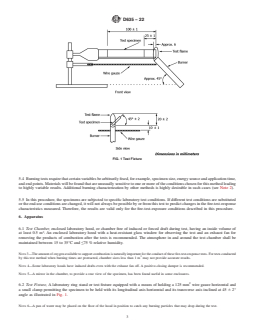
6.2 Test Fixture, A laboratory ring stand or test fixture
prescribed are of value in comparing the rate of burning or
extent and time of burning characteristics, or both, of different equipped with a means of holding a 125 mm wire gauze
horizontal and a small clamp permitting the specimen to be
materials, in controlling manufacturing processes, or as a
measure of deterioration or change in these burning character- heldwithitslongitudinalaxishorizontalanditstransverseaxis
inclined at 45 62° angle as illustrated in Fig. 1.
istics prior to or during use. Correlation with flammability
under actual use conditions is not implied.
NOTE 6—A pan of water may be placed on the floor of the hood in
position to catch any burning particles that may drop during the test.
5.2 The rate of burning and other burning phenomena will
beaffectedbysuchfactorsasdensity,pigments,anyanisotropy
6.3 Laboratory Burner, constructed in accordance with
of the material and the thickness of the specimen. Test data
Specification D5025.
shall be compared only for specimens of similar thickness,
6.4 Gas Supply, a supply of technical-grade methane gas
whethercomparisonsarebeingmadewiththesameordifferent
withsuitableregulatorandmeterforuniformgasflow.Natural
materials. The rate of burning and other burning phenomena
gas mixtures having an energy density of approximately 37
will vary with thickness.
MJ/m have been found to provide similar results. However,
5.3 Itisfeasiblethatsheetmaterialsthathavebeenstretched
technical-grade methane gas shall be used as the referee in
during processing will relax during burning and give erratic
cases of dispute.
results unless they are first heated above their deflection
6.5 Wire Gauze, 20-mesh (approximately 20 openings per
temperature, in accordance with Test Method D648, for a time
25 mm), made with 0.43 60.03 mm diameter iron wire cut to
sufficient to permit complete relaxation.
approximately 125 mm , to sustain burning or glowing par-
5.4 Burning tests require that certain variables be arbitrarily
ticles falling from the specimens.
fixed, for example, specimen size, energy source and applica-
tion time, and end points. Materials will be found that are
6.6 Timing Device, accurate to 0.5 s.
unusuallysensitivetooneormoreoftheconditionschosenfor
6.7 Scale, graduated in millimeters.
this method leading to highly variable results. Additional
6.8 Micrometer, accurate to 0.05 mm.
6.9 Conditioning Room or Chamber,capableofbeingmain-
Publications of the International Electrotechnical Commission (IEC) and
tained at 23 62°C and 50 610% relative humidity.
International Organization for Standardization (ISO) are available from American
National Standards Institute (ANSI), 25 W. 43rd St., 4th Floor, New York, NY
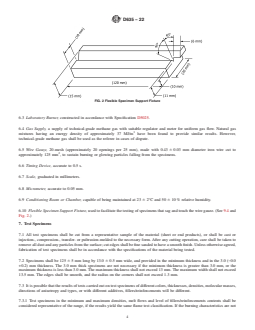
6.10 Flexible Specimen Support Fixture, used to facilitate
10036.
thetestingofspecimensthatsagandtouchthewiregauze.(See
Available from International Code Council (ICC), 500 New Jersey Ave., NW,
6th Floor, Washington, DC 20001, http://www.iccsafe.org. 9.4 and Fig. 2.)
D635 − 22
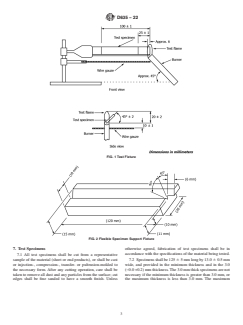
FIG. 1 Test Fixture
FIG. 2 Flexible Specimen Support Fixture
7. Test Specimens otherwise agreed, fabrication of test specimens shall be in
accordance with the specifications of the material being tested.
7.1 All test specimens shall be cut from a representative
sample of the material (sheet or end products), or shall be cast 7.2 Specimensshallbe125 65mmlongby13.0 60.5mm
or injection-, compression-, transfer- or pultrusion-molded to wide, and provided in the minimum thickness and in the 3.0
the necessary form. After any cutting operation, care shall be (−0.0+0.2)mmthickness.The3.0mmthickspecimensarenot
takentoremovealldustandanyparticlesfromthesurface;cut necessary if the minimum thickness is greater than 3.0 mm, or
edges shall be fine sanded to have a smooth finish. Unless the maximum thickness is less than 3.0 mm. The maximum
D635 − 22
thickness shall not exceed 13 mm. The maximum width shall of the specimen even with the edge of the gauze.Any material
notexceed13.5mm.Theedgesshallbesmooth,andtheradius remaining on the wire gauze from the previous test must be
on the corners shall not exceed 1.3 mm. burned off or a new section of wire gauze used for each test.
7.3 It is possible that the results of tests carried out on test 9.4 If the specimen sags at its free end during the initial set
specimens of different colors, thicknesses, densities, molecular up and is not able to maintain the distance of 10 61mmas
masses, directions of anisotropy and types, or with different specifiedin9.2,theflexiblespecimensupportfixtureillustrated
additives, fillers/reinforcements will be different. in Fig. 2 shall be used. Position the support fixture under the
7.3.1 Test specimens in the minimum and maximum specimen with the small extending portion of the support
densities, melt flows and level of fillers/reinforcements con- fixture at least 20 mm from the free end of the specimen.
tents shall be considered representative of the range, if the Provide enough clearance at the clamped end of the specimen
results yield the same flame test classification. If the burning so that the support fixture can be moved freely sidewards. As
characteristics are not essentially the same for all specimens the flame front progresses along the specimen, withdraw the
representing the range, the evaluation is to be limited only to support fixture at the same approximate rate, preventing the
the materials in the densities, melt flows, and fillers/ flame front from contacting the flexible specimen support
reinforcements contents tested. Additional specimens in the fixture, so that there is no effect on the test flame or on the
intermediate densities, melt flows, and fillers/reinforcements
burning of the specimen.
contents are to be tested.
9.5 With the central axis of the burner tube in the vertical
7.3.2 Uncolored test specimens and test specimens with the
position, place the burner remote from the specimen, ignite,
highest level of organic and inorganic pigment loading by
and adjust it to produce a blue flame 20 mm high. Adjust the
weight are considered representative of the color range, if the
gas supply and the air ports of the burner until a 20-mm
testresultsareessentiallythesame.Whencertainpigmentsare
yellow-tippedblueflameisproduced,andthenincreasetheair
knowntoaffectflammabilitycharacteristics,theyarealsotobe
supply until the yellow tip just disappears. Measure the height
tested. Specimens to be tested are those that:
of the flame. If the flame height is not 20 62 mm, adjust the
(a)contain no coloring
burner gas supply to give the proper flame height. Once the
(b)contain the highest level of organic pigments
flame has been properly set to a height of 20 62 mm wait for
(c)contain the highest level of inorganic pigments
at least 5 min to allow the burner conditions to reach
(d)contain pigments which are known to adversely affect
equilibrium.
flammability characteristics
NOTE7—SeePracticeD5207forrecommendedbackpressureandflow
rate for the gas supply and calibration procedure for the 20 mm flame.
8. Conditioning
9.6 Place the burner so that the test flame impinges on the
8.1 Condition ten bar specimens for each material and
freeendofthetestspecimentoadepthofapproximately6mm
thickness to be tested in accordance with Procedure A of
starting the timing device simultaneously. The central axis of
PracticeD618foraminimumof48hours.Onceremovedfrom
the burner tube is to be in the same vertical plane as the
the conditioning atmosphere test the specimens within 1 h.
longitudinal bottom edge of the specimen and inclined toward
Temperature and humidity tolerances shall be in accordance
the end of the specimen at an angle of approximately 45 62
with Section 7 of Practice D618.
degrees to the horizontal. See Fig. 1. Apply the flame for
8.2 Conduct testing in a laboratory atmosphere of 15 to
30 61 s without changing its position. If the test specimen
35°C and ≤75% relative humidity.
shrinks from the applied flame without ignition, the material is
not suitable for evaluation by these test methods. Excessive
9. Procedure
distortion of the specimen during the test will invalidate the
9.1 Prepare at least ten bar specimens.After measuring and
results.Withdraw the test
...
This document is not an ASTM standard and is intended only to provide the user of an ASTM standard an indication of what changes have been made to the previous version. Because
it may not be technically possible to adequately depict all changes accurately, ASTM recommends that users consult prior editions as appropriate. In all cases only the current version
of the standard as published by ASTM is to be considered the official document.
Designation: D635 − 18 D635 − 22
Standard Test Method for
Rate of Burning and/or Extent and Time of Burning of
Plastics in a Horizontal Position
This standard is issued under the fixed designation D635; the number immediately following the designation indicates the year of
original adoption or, in the case of revision, the year of last revision. A number in parentheses indicates the year of last reapproval. A
superscript epsilon (´) indicates an editorial change since the last revision or reapproval.
This standard has been approved for use by agencies of the U.S. Department of Defense.
1. Scope*
1.1 This fire-test-response test method covers a small-scale laboratory screening procedure for comparing the relative linear rate
of burning or extent and time of burning, or both, of plastics in the form of bars, molded or cut from sheets, plates, or panels, and
tested in the horizontal position.
NOTE 1—This test method, and test method A of IEC 60695-11-10 are technically equivalent.
NOTE 2—For additional information on materials which do not burn to the first reference mark by this test, see Test Method D3801.
1.2 This test method was developed for polymeric materials used for parts in devices and appliances. The results are intended to
serve as a preliminary indication of their acceptability with respect to flammability for a particular application. The final acceptance
of the material is dependent upon its use in complete equipment that conforms with the standard applicable to such equipment.
1.3 The classification system described in Appendix X1 is intended for quality assurance and the preselection of component
materials for products.
1.4 The values stated in SI units are to be regarded as standard. No other units of measurement are included in this standard.
1.5 This standard is used to measure and describe the response of materials, products, or assemblies to heat and flame under
controlled conditions, but does not by itself incorporate all factors required for fire hazards or fire risk assessment of materials,
products, or assemblies under actual fire conditions.
1.6 This standard does not purport to address all of the safety concerns, if any, associated with its use. It is the responsibility
of the user of this standard to establish appropriate safety, health, and environmental practices and determine the applicability of
regulatory limitations prior to use. For specific hazards statements, see 9.2.
1.7 This international standard was developed in accordance with internationally recognized principles on standardization
established in the Decision on Principles for the Development of International Standards, Guides and Recommendations issued
by the World Trade Organization Technical Barriers to Trade (TBT) Committee.
This test method is under the jurisdiction of ASTM Committee D20 on Plastics and is the direct responsibility of Subcommittee D20.30 on Thermal Properties (Section
D20.30.03).
Current edition approved Nov. 1, 2018July 1, 2022. Published November 2018July 2022. Originally approved in 1941. Last previous edition approved in 20142018 as
D635 – 14.D635 – 18. DOI: 10.1520/D0635-18.10.1520/D0635-22.
*A Summary of Changes section appears at the end of this standard
Copyright © ASTM International, 100 Barr Harbor Drive, PO Box C700, West Conshohocken, PA 19428-2959. United States
D635 − 22
2. Referenced Documents
2.1 ASTM Standards:
D618 Practice for Conditioning Plastics for Testing
D648 Test Method for Deflection Temperature of Plastics Under Flexural Load in the Edgewise Position
D883 Terminology Relating to Plastics
D1929 Test Method for Determining Ignition Temperature of Plastics
D2843 Test Method for Density of Smoke from the Burning or Decomposition of Plastics
D3801 Test Method for Measuring the Comparative Burning Characteristics of Solid Plastics in a Vertical Position
D5025 Specification for Laboratory Burner Used for Small-Scale Burning Tests on Plastic Materials
D5207 Practice for Confirmation of 20-mm (50-W) and 125-mm (500-W) Test Flames for Small-Scale Burning Tests on Plastic
Materials
E84 Test Method for Surface Burning Characteristics of Building Materials
E176 Terminology of Fire Standards
E456 Terminology Relating to Quality and Statistics
E691 Practice for Conducting an Interlaboratory Study to Determine the Precision of a Test Method
E2935 Practice for Evaluating Equivalence of Two Testing Processes
2.2 IEC Standards:
IEC 60695-11-10 Fire Hazard Testing—Part 11-10 Test Flames—50W Horizontal and Vertical Flame Test Methods
2.3 ICC Codes:
IBC International Building Code (2018)(2024)
3. Terminology
3.1 Definitions:
3.1.1 Terms used in this test method are in accordance with the definitions in Terminology D883, unless otherwise specified. For
terms relating to fire, the terms used in this test method are in accordance with the definitions in Terminology E176. For terms
relating to precision and bias and associated issues, the terms used in this test method are in accordance with the definitions in
Terminology E456.
4. Summary of Test Method
4.1 A bar specimen of the material to be tested is supported horizontally at one end. The free end is exposed to a specified gas
flame for 30 s. Time and extent of burning are measured and reported if the specimen does not burn 100 mm. An average burning
rate is reported for a material if it burns to the 100 mm mark from the ignited end.
5. Significance and Use
5.1 Tests made on a material under conditions herein prescribed are of value in comparing the rate of burning or extent and time
of burning characteristics, or both, of different materials, in controlling manufacturing processes, or as a measure of deterioration
or change in these burning characteristics prior to or during use. Correlation with flammability under actual use conditions is not
implied.
5.2 The rate of burning and other burning phenomena will be affected by such factors as density, pigments, any anisotropy of the
material and the thickness of the specimen. Test data shall be compared only for specimens of similar thickness, whether
comparisons are being made with the same or different materials. The rate of burning and other burning phenomena will vary with
thickness.
5.3 It is feasible that sheet materials that have been stretched during processing will relax during burning and give erratic results
unless they are first heated above their deflection temperature, in accordance with Test Method D648, for a time sufficient to permit
complete relaxation.
For referenced ASTM standards, visit the ASTM website, www.astm.org, or contact ASTM Customer Service at service@astm.org. For Annual Book of ASTM Standards
volume information, refer to the standard’s Document Summary page on the ASTM website.
Publications of the International Electrotechnical Commission (IEC) and International Organization for Standardization (ISO) are available from American National
Standards Institute (ANSI), 25 W. 43rd St., 4th Floor, New York, NY 10036.
Available from International Code Council (ICC), 500 New Jersey Ave., NW, 6th Floor, Washington, DC 20001, http://www.iccsafe.org.
D635 − 22
FIG. 1 Test Fixture
5.4 Burning tests require that certain variables be arbitrarily fixed, for example, specimen size, energy source and application time,
and end points. Materials will be found that are unusually sensitive to one or more of the conditions chosen for this method leading
to highly variable results. Additional burning characterization by other methods is highly desirable in such cases (see Note 2).
5.5 In this procedure, the specimens are subjected to specific laboratory test conditions. If different test conditions are substituted
or the end-use conditions are changed, it will not always be possible by or from this test to predict changes in the fire-test-response
characteristics measured. Therefore, the results are valid only for the fire-test-exposure conditions described in this procedure.
6. Apparatus
6.1 Test Chamber, enclosed laboratory hood, or chamber free of induced or forced draft during test, having an inside volume of
at least 0.5 m . An enclosed laboratory hood with a heat-resistant glass window for observing the test and an exhaust fan for
removing the products of combustion after the tests is recommended. The atmosphere in and around the test chamber shall be
maintained between 15 to 35°C and ≤75 % relative humidity.
NOTE 3—The amount of oxygen available to support combustion is naturally important for the conduct of these fire-test-response tests. For tests conducted
by this test method when burning times are protracted, chamber sizes less than 1 m may not provide accurate results.
NOTE 4—Some laboratory hoods have induced drafts even with the exhaust fan off. A positive-closing damper is recommended.
NOTE 5—A mirror in the chamber, to provide a rear view of the specimen, has been found useful in some enclosures.
6.2 Test Fixture, A laboratory ring stand or test fixture equipped with a means of holding a 125 mm wire gauze horizontal and
a small clamp permitting the specimen to be held with its longitudinal axis horizontal and its transverse axis inclined at 45 6 2°
angle as illustrated in Fig. 1.
NOTE 6—A pan of water may be placed on the floor of the hood in position to catch any burning particles that may drop during the test.
D635 − 22
FIG. 2 Flexible Specimen Support Fixture
6.3 Laboratory Burner, constructed in accordance with Specification D5025.
6.4 Gas Supply, a supply of technical-grade methane gas with suitable regulator and meter for uniform gas flow. Natural gas
mixtures having an energy density of approximately 37 MJ/m have been found to provide similar results. However,
technical-grade methane gas shall be used as the referee in cases of dispute.
6.5 Wire Gauze, 20-mesh (approximately 20 openings per 25 mm), made with 0.43 6 0.03 mm diameter iron wire cut to
approximately 125 mm , to sustain burning or glowing particles falling from the specimens.
6.6 Timing Device, accurate to 0.5 s.
6.7 Scale, graduated in millimeters.
6.8 Micrometer, accurate to 0.05 mm.
6.9 Conditioning Room or Chamber, capable of being maintained at 23 6 2°C and 50 6 10 % relative humidity.
6.10 Flexible Specimen Support Fixture, used to facilitate the testing of specimens that sag and touch the wire gauze. (See 9.4 and
Fig. 2.)
7. Test Specimens
7.1 All test specimens shall be cut from a representative sample of the material (sheet or end products), or shall be cast or
injection-, compression-, transfer- or pultrusion-molded to the necessary form. After any cutting operation, care shall be taken to
remove all dust and any particles from the surface; cut edges shall be fine sanded to have a smooth finish. Unless otherwise agreed,
fabrication of test specimens shall be in accordance with the specifications of the material being tested.
7.2 Specimens shall be 125 6 5 mm long by 13.0 6 0.5 mm wide, and provided in the minimum thickness and in the 3.0 (−0.0
+0.2) mm thickness. The 3.0 mm thick specimens are not necessary if the minimum thickness is greater than 3.0 mm, or the
maximum thickness is less than 3.0 mm. The maximum thickness shall not exceed 13 mm. The maximum width shall not exceed
13.5 mm. The edges shall be smooth, and the radius on the corners shall not exceed 1.3 mm.
7.3 It is possible that the results of tests carried out on test specimens of different colors, thicknesses, densities, molecular masses,
directions of anisotropy and types, or with different additives, fillers/reinforcements will be different.
7.3.1 Test specimens in the minimum and maximum densities, melt flows and level of fillers/reinforcements contents shall be
considered representative of the range, if the results yield the same flame test classification. If the burning characteristics are not
D635 − 22
essentially the same for all specimens representing the range, the evaluation is to be limited only to the materials in the densities,
melt flows, and fillers/reinforcements contents tested. Additional specimens in the intermediate densities, melt flows, and
fillers/reinforcements contents are to be tested.
7.3.2 Uncolored test specimens and test specimens with the highest level of organic and inorganic pigment loading by weight are
considered representative of the color range, if the test results are essentially the same. When certain pigments are known to affect
flammability characteristics, they are also to be tested. Specimens to be tested are those that:
(a) contain no coloring
(b) contain the highest level of organic pigments
(c) contain the highest level of inorganic pigments
(d) contain pigments which are known to adversely affect flammability characteristics
8. Conditioning
8.1 Condition ten bar specimens for each material and thickness to be tested in accordance with Procedure A of Practice D618
for a minimum of 48 hours. Once removed from the conditioning atmosphere test the specimens within 1 h. Temperature and
humidity tolerances shall be in accordance with Section 7 of Practice D618.
8.2 Conduct testing in a laboratory atmosphere of 15 to 35°C and ≤75 % relative humidity.
9. Procedure
9.1 Prepare at least ten bar specimens. After measuring and recording the specimen thickness, mark each specimen with two lines
perpendicular to the longitudinal axis of the bar, 25 6 1 and 100 6 1 mm from the end that is to be ignited.
9.2 Conduct the burning test in a chamber, enclosure, or laboratory hood free of induced or forced draft. (Warning—Products of
combustion are potentially toxic. An enclosed laboratory hood and an exhaust fan for removing the products of combustion after
the tests are recommended. The exhaust fan is turned off during the test and turned on immediately following the test in order to
remove products of combustion.)
9.3 Clamp the specimen at the end farthest from the 25 mm reference mark, in a support with its longitudinal axis horizontal and
its transverse axis inclined at 45 6 2° as illustrated in Fig. 1. Clamp the wire gauze horizontally beneath the specimen, with a
distance of 10 6 1 mm between the lowest edge of the specimen and the wire gauze, and with the free end of the specimen even
with the edge of the gauze. Any material remaining on the wire gauze from the previous test must be burned off or a new section
of wire gauze used for each test.
9.4 If the specimen sags at its free end during the initial set up and is not able to maintain the distance of 10 6 1 mm as specified
in 9.2, the flexible specimen support fixture illustrated in Fig. 2 shall be used. Position the support fixture under the specimen with
the small extending portion of the support fixture at least 20 mm from the free end of the specimen. Provide enough clearance at
the clamped end of the specimen so that the support fixture can be moved freely sidewards. As the flame front progresses along
the specimen, withdraw the support fixture at the same approximate rate, preventing the flame front from contacting the flexible
specimen support fixture, so that there is no effect on the test flame or on the burning of the specimen.
9.5 With the central axis of the burner tube in the vertical position, place the burner remote from the specimen, ignite, and adjust
it to produce a blue flame 20 mm high. Adjust the gas supply and the air ports of the burner until a 20-mm yellow-tipped blue flame
is produced, and then increase the air supply until the yellow tip just disappears. Measure the height of the flame. If the flame height
is not 20 6 2 mm, adjust the burner gas supply to give the proper flame heigh
...