

ASTM D5048-20a
(Test Method)Standard Test Method for Measuring the Comparative Burning Characteristics and Resistance to Burn-Through of Solid Plastics Using a 125-mm Flame
General Information
- Abstract
SIGNIFICANCE AND USE
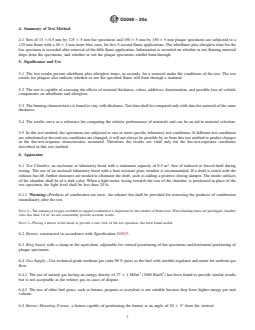
5.1 The test results present afterflame plus afterglow times, in seconds, for a material under the conditions of the test. The test results for plaques also indicate whether or not the specified flame will burn through a material.
5.2 The test is capable of assessing the effects of material thickness, colors, additives, deterioration, and possible loss of volatile components on afterflame and afterglow.
5.3 The burning characteristics is found to vary with thickness. Test data shall be compared only with data for material of the same thickness.
5.4 The results serve as a reference for comparing the relative performance of materials and can be an aid in material selection.
5.5 In this test method, the specimens are subjected to one or more specific laboratory test conditions. If different test conditions are substituted or the end-use conditions are changed, it will not always be possible by or from this test method to predict changes in the fire-test-response characteristics measured. Therefore, the results are valid only for the fire-test-exposure conditions described in this test method.
SCOPE
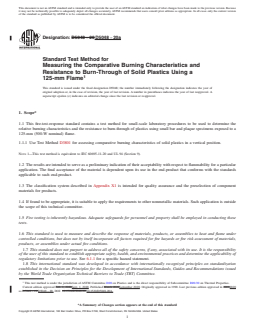
1.1 This fire-test-response standard contains a test method for small-scale laboratory procedures to be used to determine the relative burning characteristics and the resistance to burn-through of plastics using small bar and plaque specimens exposed to a 125-mm (500-W nominal) flame.
1.1.1 Use Test Method D3801 for assessing comparative burning characteristics of solid plastics in a vertical position.
Note 1: This test method is equivalent to IEC 60695-11-20 and UL 94 (Section 9).
1.2 The results are intended to serve as a preliminary indication of their acceptability with respect to flammability for a particular application. The final acceptance of the material is dependent upon its use in the end-product that conforms with the standards applicable to such end-product.
1.3 The classification system described in Appendix X1 is intended for quality assurance and the preselection of component materials for products.
1.4 If found to be appropriate, it is suitable to apply the requirements to other nonmetallic materials. Such application is outside the scope of this technical committee.
1.5 Fire testing is inherently hazardous. Adequate safeguards for personnel and property shall be employed in conducting these tests.
1.6 This standard is used to measure and describe the response of materials, products, or assemblies to heat and flame under controlled conditions, but does not by itself incorporate all factors required for fire hazards or fire risk assessment of materials, products, or assemblies under actual fire conditions.
1.7 This standard does not purport to address all of the safety concerns, if any, associated with its use. It is the responsibility of the user of this standard to establish appropriate safety, health, and environmental practices and determine the applicability of regulatory limitations prior to use. See 6.1.1 for a specific hazard statement.
1.8 This international standard was developed in accordance with internationally recognized principles on standardization established in the Decision on Principles for the Development of International Standards, Guides and Recommendations issued by the World Trade Organization Technical Barriers to Trade (TBT) Committee.
- Status
- Published
- Publication Date
- 31-Aug-2020
- Technical Committee
- D20 - Plastics
- Drafting Committee
- D20.30 - Thermal Properties
Buy Documents
ASTM D5048-20a - Standard Test Method for Measuring the Comparative Burning Characteristics and Resistance to Burn-Through of Solid Plastics Using a 125-mm Flame
REDLINE ASTM D5048-20a - Standard Test Method for Measuring the Comparative Burning Characteristics and Resistance to Burn-Through of Solid Plastics Using a 125-mm Flame
Overview
ASTM D5048-20a: Standard Test Method for Measuring the Comparative Burning Characteristics and Resistance to Burn-Through of Solid Plastics Using a 125-mm Flame is a widely recognized fire-test-response standard developed by ASTM International. This test method provides small-scale laboratory procedures to evaluate the burning behavior and burn-through resistance of solid plastics when exposed to a specified 125-mm (500-W nominal) flame. It is an essential tool for material pre-selection, quality assurance, and comparing the relative flammability of plastic materials.
The standard is designed to present results such as afterflame and afterglow times (in seconds) for materials under strictly controlled laboratory conditions. In addition, it indicates whether the test flame will burn through a plastic plaque specimen. ASTM D5048-20a is equivalent to IEC 60695-11-20 and UL 94 (Section 9), ensuring international relevance and alignment with other leading fire safety testing procedures.
Key Topics
- Comparative Burning Characteristics: Measures afterflame and afterglow times following exposure to a 125-mm standardized flame.
- Resistance to Burn-Through: Evaluates whether the flame can burn entirely through a plastic plaque under defined conditions.
- Material Influence Factors: Assesses the impact of specimen thickness, colorants, additives, and deterioration on burning behavior.
- Classification System: Offers a system for categorizing materials based on their flammability performance, aiding in pre-selection and compliance assessment.
- Laboratory Test Scope: Highlights that results are specific to the test conditions described and may not predict real-world fire scenarios.
- Sample Preparation and Conditioning: Details requirements for specimen dimensions, surface quality, aging, and environmental conditioning prior to testing.
Applications
ASTM D5048-20a is applied in a range of industries and scenarios where understanding plastic flammability and burn-through resistance is critical for safety and regulatory compliance:
- Material Selection: Facilitates the comparison of various plastics’ fire properties during product development for automotive, electronics, construction, and consumer goods.
- Quality Assurance: Provides a standardized method for verifying consistent flammability performance in production batches.
- Preliminary Flammability Assessment: Offers an initial indication of material suitability for end-use applications requiring fire safety considerations.
- Component Certification: Supports manufacturers in achieving certification marks by complying with recognized fire safety testing standards.
- Research and Development: Enables the investigation of how modifications in polymer composition, the addition of fire retardants, or aging affects fire response.
Related Standards
For comprehensive evaluations of plastics’ flammability and burning behavior, ASTM D5048-20a should be used in conjunction with or referenced alongside these related standards:
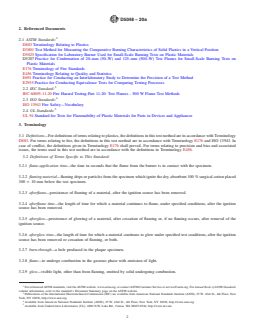
- ASTM D3801: Test Method for Comparative Burning Characteristics of Solid Plastics in a Vertical Position.
- IEC 60695-11-20: Fire Hazard Testing-500 W Flame Test Methods.
- UL 94: Tests for Flammability of Plastic Materials for Parts in Devices and Appliances.
- ASTM D883: Terminology Relating to Plastics.
- ASTM D5025: Specification for Laboratory Burner Used for Small-Scale Burning Tests on Plastic Materials.
- ASTM D5207: Practice for Confirmation of 20-mm (50-W) and 125-mm (500-W) Test Flames for Small-Scale Burning Tests on Plastic Materials.
- ISO 13943: Fire Safety-Vocabulary.
By adhering to ASTM D5048-20a and its related test methods, manufacturers and researchers can ensure a robust, reliable approach to assessing the fire performance of plastic materials in a controlled, standardized manner, ultimately supporting enhanced fire safety in end-use applications.
Relations
- Effective Date
- 01-Feb-2024
- Effective Date
- 01-Jan-2024
- Effective Date
- 01-Nov-2023
- Effective Date
- 01-Apr-2022
- Effective Date
- 01-Mar-2020
- Effective Date
- 01-Feb-2020
- Effective Date
- 01-Jan-2020
- Effective Date
- 01-Dec-2019
- Effective Date
- 01-Aug-2019
- Effective Date
- 15-Apr-2019
- Effective Date
- 01-Feb-2019
- Effective Date
- 15-Jan-2019
- Effective Date
- 15-Dec-2018
- Effective Date
- 01-Dec-2018
- Effective Date
- 01-Nov-2018
Buy Documents
ASTM D5048-20a - Standard Test Method for Measuring the Comparative Burning Characteristics and Resistance to Burn-Through of Solid Plastics Using a 125-mm Flame
REDLINE ASTM D5048-20a - Standard Test Method for Measuring the Comparative Burning Characteristics and Resistance to Burn-Through of Solid Plastics Using a 125-mm Flame
Get Certified
Connect with accredited certification bodies for this standard

DIN CERTCO
DIN Group product certification.
CIS Institut d.o.o.
Personal Protective Equipment (PPE) certification body. Notified Body NB-2890 for EU Regulation 2016/425 PPE.

Kiwa BDA Testing
Building and construction product certification.
Sponsored listings
Frequently Asked Questions
ASTM D5048-20a is a standard published by ASTM International. Its full title is "Standard Test Method for Measuring the Comparative Burning Characteristics and Resistance to Burn-Through of Solid Plastics Using a 125-mm Flame". This standard covers: SIGNIFICANCE AND USE 5.1 The test results present afterflame plus afterglow times, in seconds, for a material under the conditions of the test. The test results for plaques also indicate whether or not the specified flame will burn through a material. 5.2 The test is capable of assessing the effects of material thickness, colors, additives, deterioration, and possible loss of volatile components on afterflame and afterglow. 5.3 The burning characteristics is found to vary with thickness. Test data shall be compared only with data for material of the same thickness. 5.4 The results serve as a reference for comparing the relative performance of materials and can be an aid in material selection. 5.5 In this test method, the specimens are subjected to one or more specific laboratory test conditions. If different test conditions are substituted or the end-use conditions are changed, it will not always be possible by or from this test method to predict changes in the fire-test-response characteristics measured. Therefore, the results are valid only for the fire-test-exposure conditions described in this test method. SCOPE 1.1 This fire-test-response standard contains a test method for small-scale laboratory procedures to be used to determine the relative burning characteristics and the resistance to burn-through of plastics using small bar and plaque specimens exposed to a 125-mm (500-W nominal) flame. 1.1.1 Use Test Method D3801 for assessing comparative burning characteristics of solid plastics in a vertical position. Note 1: This test method is equivalent to IEC 60695-11-20 and UL 94 (Section 9). 1.2 The results are intended to serve as a preliminary indication of their acceptability with respect to flammability for a particular application. The final acceptance of the material is dependent upon its use in the end-product that conforms with the standards applicable to such end-product. 1.3 The classification system described in Appendix X1 is intended for quality assurance and the preselection of component materials for products. 1.4 If found to be appropriate, it is suitable to apply the requirements to other nonmetallic materials. Such application is outside the scope of this technical committee. 1.5 Fire testing is inherently hazardous. Adequate safeguards for personnel and property shall be employed in conducting these tests. 1.6 This standard is used to measure and describe the response of materials, products, or assemblies to heat and flame under controlled conditions, but does not by itself incorporate all factors required for fire hazards or fire risk assessment of materials, products, or assemblies under actual fire conditions. 1.7 This standard does not purport to address all of the safety concerns, if any, associated with its use. It is the responsibility of the user of this standard to establish appropriate safety, health, and environmental practices and determine the applicability of regulatory limitations prior to use. See 6.1.1 for a specific hazard statement. 1.8 This international standard was developed in accordance with internationally recognized principles on standardization established in the Decision on Principles for the Development of International Standards, Guides and Recommendations issued by the World Trade Organization Technical Barriers to Trade (TBT) Committee.
SIGNIFICANCE AND USE 5.1 The test results present afterflame plus afterglow times, in seconds, for a material under the conditions of the test. The test results for plaques also indicate whether or not the specified flame will burn through a material. 5.2 The test is capable of assessing the effects of material thickness, colors, additives, deterioration, and possible loss of volatile components on afterflame and afterglow. 5.3 The burning characteristics is found to vary with thickness. Test data shall be compared only with data for material of the same thickness. 5.4 The results serve as a reference for comparing the relative performance of materials and can be an aid in material selection. 5.5 In this test method, the specimens are subjected to one or more specific laboratory test conditions. If different test conditions are substituted or the end-use conditions are changed, it will not always be possible by or from this test method to predict changes in the fire-test-response characteristics measured. Therefore, the results are valid only for the fire-test-exposure conditions described in this test method. SCOPE 1.1 This fire-test-response standard contains a test method for small-scale laboratory procedures to be used to determine the relative burning characteristics and the resistance to burn-through of plastics using small bar and plaque specimens exposed to a 125-mm (500-W nominal) flame. 1.1.1 Use Test Method D3801 for assessing comparative burning characteristics of solid plastics in a vertical position. Note 1: This test method is equivalent to IEC 60695-11-20 and UL 94 (Section 9). 1.2 The results are intended to serve as a preliminary indication of their acceptability with respect to flammability for a particular application. The final acceptance of the material is dependent upon its use in the end-product that conforms with the standards applicable to such end-product. 1.3 The classification system described in Appendix X1 is intended for quality assurance and the preselection of component materials for products. 1.4 If found to be appropriate, it is suitable to apply the requirements to other nonmetallic materials. Such application is outside the scope of this technical committee. 1.5 Fire testing is inherently hazardous. Adequate safeguards for personnel and property shall be employed in conducting these tests. 1.6 This standard is used to measure and describe the response of materials, products, or assemblies to heat and flame under controlled conditions, but does not by itself incorporate all factors required for fire hazards or fire risk assessment of materials, products, or assemblies under actual fire conditions. 1.7 This standard does not purport to address all of the safety concerns, if any, associated with its use. It is the responsibility of the user of this standard to establish appropriate safety, health, and environmental practices and determine the applicability of regulatory limitations prior to use. See 6.1.1 for a specific hazard statement. 1.8 This international standard was developed in accordance with internationally recognized principles on standardization established in the Decision on Principles for the Development of International Standards, Guides and Recommendations issued by the World Trade Organization Technical Barriers to Trade (TBT) Committee.
ASTM D5048-20a is classified under the following ICS (International Classification for Standards) categories: 13.220.40 - Ignitability and burning behaviour of materials and products; 83.080.01 - Plastics in general. The ICS classification helps identify the subject area and facilitates finding related standards.
ASTM D5048-20a has the following relationships with other standards: It is inter standard links to ASTM D883-24, ASTM E176-24, ASTM D883-23, ASTM E456-13a(2022)e1, ASTM D5025-20a, ASTM D5025-20, ASTM D883-20, ASTM D3801-19a, ASTM D883-19c, ASTM D883-19a, ASTM D883-19, ASTM D3801-19, ASTM E176-18a, ASTM D883-18a, ASTM D883-18. Understanding these relationships helps ensure you are using the most current and applicable version of the standard.
ASTM D5048-20a is available in PDF format for immediate download after purchase. The document can be added to your cart and obtained through the secure checkout process. Digital delivery ensures instant access to the complete standard document.
Standards Content (Sample)
This international standard was developed in accordance with internationally recognized principles on standardization established in the Decision on Principles for the
Development of International Standards, Guides and Recommendations issued by the World Trade Organization Technical Barriers to Trade (TBT) Committee.
Designation: D5048 − 20a
Standard Test Method for
Measuring the Comparative Burning Characteristics and
Resistance to Burn-Through of Solid Plastics Using a
125-mm Flame
This standard is issued under the fixed designation D5048; the number immediately following the designation indicates the year of
original adoption or, in the case of revision, the year of last revision. A number in parentheses indicates the year of last reapproval. A
superscript epsilon (´) indicates an editorial change since the last revision or reapproval.
1. Scope* priate safety, health, and environmental practices and deter-
mine the applicability of regulatory limitations prior to use.
1.1 This fire-test-response standard contains a test method
See 6.1.1 for a specific hazard statement.
for small-scale laboratory procedures to be used to determine
1.8 This international standard was developed in accor-
the relative burning characteristics and the resistance to burn-
dance with internationally recognized principles on standard-
through of plastics using small bar and plaque specimens
ization established in the Decision on Principles for the
exposed to a 125-mm (500-W nominal) flame.
Development of International Standards, Guides and Recom-
1.1.1 Use Test Method D3801 for assessing comparative
mendations issued by the World Trade Organization Technical
burning characteristics of solid plastics in a vertical position.
Barriers to Trade (TBT) Committee.
NOTE 1—This test method is equivalent to IEC 60695-11-20 and UL 94
(Section 9).
2. Referenced Documents
1.2 The results are intended to serve as a preliminary
2.1 ASTM Standards:
indicationoftheiracceptabilitywithrespecttoflammabilityfor
D883 Terminology Relating to Plastics
a particular application. The final acceptance of the material is
D3801 TestMethodforMeasuringtheComparativeBurning
dependent upon its use in the end-product that conforms with
Characteristics of Solid Plastics in a Vertical Position
the standards applicable to such end-product.
D5025 Specification for Laboratory Burner Used for Small-
1.3 The classification system described in Appendix X1 is
Scale Burning Tests on Plastic Materials
intended for quality assurance and the preselection of compo-
D5207 Practice for Confirmation of 20–mm (50–W) and
nent materials for products.
125–mm (500–W) Test Flames for Small-Scale Burning
Tests on Plastic Materials
1.4 If found to be appropriate, it is suitable to apply the
E176 Terminology of Fire Standards
requirements to other nonmetallic materials. Such application
E456 Terminology Relating to Quality and Statistics
is outside the scope of this technical committee.
E691 Practice for Conducting an Interlaboratory Study to
1.5 Fire testing is inherently hazardous. Adequate safe-
Determine the Precision of a Test Method
guards for personnel and property shall be employed in
E2935 Practice for Conducting Equivalence Tests for Com-
conducting these tests.
paring Testing Processes
1.6 This standard is used to measure and describe the
2.2 IEC Standard:
response of materials, products, or assemblies to heat and
IEC 60695-11-20 Fire Hazard Testing-Part 11-20: Test
flame under controlled conditions, but does not by itself
Flames - 500 W Flame Test Methods
incorporate all factors required for fire hazards or fire risk
2.3 ISO Standards:
assessment of materials, products, or assemblies under actual
ISO 13943 Fire Safety—Vocabulary
fire conditions.
1.7 This standard does not purport to address all of the
safety concerns, if any, associated with its use. It is the
For referenced ASTM standards, visit the ASTM website, www.astm.org, or
responsibility of the user of this standard to establish appro-
contact ASTM Customer Service at service@astm.org. For Annual Book of ASTM
Standards volume information, refer to the standard’s Document Summary page on
the ASTM website.
1 3
This test method is under the jurisdiction ofASTM Committee D20 on Plastics Publications of the International Electrotechnical Commission (IEC) are
and is the direct responsibility of Subcommittee D20.30 on Thermal Properties. available from American National Standards Institute (ANSI), 25 W. 43rd St., 4th
Current edition approved Sept. 1, 2020. Published September 2020. Originally Floor, New York, NY 10036, http://www.ansi.org.
approved in 1990. Last previous edition approved in 2020 as D5048 – 20. DOI: Available fromAmerican National Standards Institute (ANSI), 25 W. 43rd St.,
10.1520/D5048-20A. 4th Floor, New York, NY 10036, http://www.ansi.org.
*A Summary of Changes section appears at the end of this standard
Copyright © ASTM International, 100 Barr Harbor Drive, PO Box C700, West Conshohocken, PA 19428-2959. United States
D5048 − 20a
2.4 UL Standards: test results for plaques also indicate whether or not the
UL 94 Standard for Tests for Flammability of Plastic Mate- specified flame will burn through a material.
rials for Parts in Devices and Appliances
5.2 The test is capable of assessing the effects of material
thickness, colors, additives, deterioration, and possible loss of
3. Terminology
volatile components on afterflame and afterglow.
3.1 Definitions—For definitions of terms relating to plastics,
5.3 The burning characteristics is found to vary with thick-
the definitions in this test method are in accordance with
ness.Test data shall be compared only with data for material of
Terminology D883. For terms relating to fire, the definitions in
the same thickness.
this test method are in accordance with Terminology E176 and
5.4 The results serve as a reference for comparing the
ISO 13943. In case of conflict, the definitions given in
relative performance of materials and can be an aid in material
TerminologyE176shallprevail.Fortermsrelatingtoprecision
selection.
and bias and associated issues, the terms used in this test
method are in accordance with the definitions in Terminology
5.5 In this test method, the specimens are subjected to one
E456.
or more specific laboratory test conditions. If different test
conditions are substituted or the end-use conditions are
3.2 Definitions of Terms Specific to This Standard:
changed, it will not always be possible by or from this test
3.2.1 flame-application time—the time in seconds that the
method to predict changes in the fire-test-response character-
flame from the burner is in contact with the specimen.
istics measured. Therefore, the results are valid only for the
3.2.2 flaming material—flaming drips or particles from the
fire-test-exposure conditions described in this test method.
specimenwhichignitethedry,absorbent100 %surgicalcotton
placed 300 6 10 mm below the test specimen.
6. Apparatus
3.2.3 afterflame—persistence of flaming of a material, after
6.1 Test Chamber, an enclosure or laboratory hood with a
the ignition source has been removed.
minimum capacity of 0.5 m , free of induced or forced draft
3.2.4 afterflame time—the length of time for which a mate-
during testing. The use of an enclosed laboratory hood with a
rial continues to flame, under specified conditions, after the
heat-resistant glass window is recommended. If a draft is noted
ignition source has been removed.
with the exhaust fan off, further measures are needed to
3.2.5 afterglow—persistence of glowing of a material, after
eliminate the draft, such as adding a positive closing damper.
cessation of flaming or, if no flaming occurs, after removal of
The inside surfaces of the chamber shall be of a dark color.
the ignition source.
When a light meter, facing towards the rear of the chamber, is
3.2.6 afterglow time—the length of time for which a mate- positioned in place of the test specimen, the light level shall be
less than 20 lx.
rial continues to glow under specified test conditions, after the
ignition source has been removed or cessation of flaming, or 6.1.1 Warning—Products of combustion are toxic. An ex-
haust fan shall be provided for removing the products of
both.
combustion immediately after the test.
3.2.7 burn-through—a hole produced in the plaque speci-
men.
NOTE 2—The amount of oxygen available to support combustion is
important for the conduct of flame tests. When burning times are
3.2.8 flame—to undergo combustion in the gaseous phase
prolonged, chamber sizes less than 1.0 m do not consistently provide
with emission of light.
accurate results.
NOTE 3—Placing a mirror in the hood, to provide a rear view of the test
3.2.9 glow—visible light, other than from flaming, emitted
specimen, has been found useful.
by solid undergoing combustion.
6.2 Burner, constructed in accordance with Specification
4. Summary of Test Method
D5025.
4.1 Setsof13 6 0.5mmby125 6 5mmbarspecimensand
6.3 Ring Stand, with a clamp or the equivalent, adjustable
150 65mmby150 6 5 mm plaque specimens are subjected
for vertical positioning of bar specimens and horizontal posi-
to a 125 mm flame with a 40 6 2 mm inner blue cone, for five
tioning of plaque specimens.
5-second flame applications. The afterflame plus afterglow
6.4 Gas Supply—Use technical-grade methane gas (min
time for the bar specimen is recorded after removal of the fifth
98 % pure) as the fuel with suitable regulator and meter for
flame application. Information is recorded on whether or not
uniform gas flow.
flaming material drips from the specimens, and whether or not
6.4.1 The use of natural gas having an energy density of 37
the plaque specimens exhibit burn-through.
3 3
6 1 MJ/m (1000 Btu/ft ) has been found to provide similar
results but is not acceptable as the referee gas in cases of
5. Significance and Use
dispute.
5.1 The test results present afterflame plus afterglow times,
6.4.2 Theuseofotherfuelgases,suchasbutane,propaneor
in seconds, for a material under the conditions of the test. The
acetylene is not suitable because they have higher energy per
unit volume.
6.5 Burner Mounting Fixture, a fixture capable of position-
Available from Underwriters Laboratories (UL), 2600 N.W. Lake Rd., Camas,
WA 98607-8542, http://www.ul.com. ing the burner at an angle of 20 6 5° from the vertical.
D5048 − 20a
6.6 Timing Device, stop watch or other suitable timing corresponding to the highest level and that corresponding to no
device capable of timing to the nearest 0.5 seconds. pigment. Testing as follows is required and is likely to cover
the range of flammability performance:
6.7 Cotton, a supply of dry, absorbent 100 % surgical
(a) contain no pigments (natural)
cotton.
(b) contain the highest level of organic pigments
6.8 Desiccator, containing anhydrous calcium chloride or
(c) contain the highest level of inorganic pigments
other suitable drying agent, capable of maintaining a relative
(d) contain the highest level of carbon black (if carbon
humidity not exceeding 20 % at 23 6 2°C.
black is one of the additives in a pigment package)
(e) contain pigments which are known to adversely affect
6.9 Conditioning Room or Chamber, capable of being main-
tained at 23 6 2°C and a relative humidity of 50 6 10 %. flammability characteristics
6.10 Conditioning Oven, a full-draft circulating air oven
9. Conditioning
capable of being maintained at 70 6 2°C.
9.1 Conditiononesetoffivebarspecimensandthreeplaque
6.11 Micrometer, capable of being read to 0.01 mm.
specimens for at least 48 h at a temperature of 23 6 2°C and
6.12 Weighing Scale or Balance, having an accuracy and
a relative humidity of 50 6 10 % prior to testing.
resolution of 0.01 g.
9.2 Condition a second set of five bar specimens and three
6.13 Flame Clearance Gauge, (optional) used to determine
plaquespecimensinacirculatingairovenforadurationof168
flame position on specimen during testing. See Appendix X2.
hat70 6 2°C, and then cool in a desiccator over anhydrous
calcium chloride for at least4hat room temperature prior to
7. Sampling
testing. The desiccator should be capable of maintaining a
relative humidity not exceeding 20 % at 23 6 2°C.
7.1 Unless otherwise agreed upon, the test specimen mate-
rial shall be sampled in accordance with good statistical
9.3 Upon removal from the conditioning environment,
practice.
specimens shall be tested within 30 minutes.
9.4 All specimens shall be tested in a laboratory atmosphere
8. Test Specimens
of 15 to 35°C and ≤75 % relative humidity.
8.1 The standard bar specimen shall be 13 6 0.5 by 125 6
9.5 Cotton shall be conditioned in the desiccator for at least
5 mm. The standard plaque specimen shall be 150 65by150
24 hours prior to use. Once removed from the desiccator, the
6 5 mm. Bar and plaque specimens shall be in the thickness
cotton shall be used within 30 minutes.
appropriate to the objectives of the determination. Do not use
this test method for materials thicker than 13 mm.
10. Procedure
8.2 Surfaces must be smooth and unbroken. Corner radius
10.1 Procedure A—Test of Bar Specimens:
shall not exceed 1.3 mm. After any cutting operation, remove
10.1.1 Conduct the burning test in a chamber, enclosure, or
all dust and any particles from the surface; cut edges are to
laboratory hood free of induced or forced draft.
have a smooth finish.
10.1.2 Support a specimen from the upper 6 mm of the
8.3 Sincetheresultsoftestscarriedoutontestspecimensof
specimen, with the longitudinal axis vertical, by the clamp on
different colors, thicknesses, densities, molecular masses, di-
the ring stand so that the lower end of the specimen is 300 6
rections of orientation, or containing different levels or
10mmaboveahorizontallayerofcotton,approximately50by
amounts of additives, fillers or reinforcements are potentially
50 mm, thinned to a maximum uncompressed thickness of 6
different, the additional considerations indicated in sections
mm, maximum weight of 0.05 g to 0.08 grams.
8.3.1 through 8.3.2 shall apply.
NOTE 4—To form the horizontal layer, it is acceptable to pull a small
8.3.1 When conducting tests on test specimens at the
portion (approximately 13 by 25 mm of cotton from the supply with the
minimum and maximum densities, melt
...
This document is not an ASTM standard and is intended only to provide the user of an ASTM standard an indication of what changes have been made to the previous version. Because
it may not be technically possible to adequately depict all changes accurately, ASTM recommends that users consult prior editions as appropriate. In all cases only the current version
of the standard as published by ASTM is to be considered the official document.
Designation: D5048 − 20 D5048 − 20a
Standard Test Method for
Measuring the Comparative Burning Characteristics and
Resistance to Burn-Through of Solid Plastics Using a
125-mm Flame
This standard is issued under the fixed designation D5048; the number immediately following the designation indicates the year of
original adoption or, in the case of revision, the year of last revision. A number in parentheses indicates the year of last reapproval. A
superscript epsilon (´) indicates an editorial change since the last revision or reapproval.
1. Scope*
1.1 This fire-test-response standard contains a test method for small-scale laboratory procedures to be used to determine the
relative burning characteristics and the resistance to burn-through of plastics using small bar and plaque specimens exposed to a
125-mm (500-W nominal) flame.
1.1.1 Use Test Method D3801 for assessing comparative burning characteristics of solid plastics in a vertical position.
NOTE 1—This test method is equivalent to IEC 60695-11-20 and UL 94 (Section 9).
1.2 The results are intended to serve as a preliminary indication of their acceptability with respect to flammability for a particular
application. The final acceptance of the material is dependent upon its use in the end-product that conforms with the standards
applicable to such end-product.
1.3 The classification system described in Appendix X1 is intended for quality assurance and the preselection of component
materials for products.
1.4 If found to be appropriate, it is suitable to apply the requirements to other nonmetallic materials. Such application is outside
the scope of this technical committee.
1.5 Fire testing is inherently hazardous. Adequate safeguards for personnel and property shall be employed in conducting these
tests.
1.6 This standard is used to measure and describe the response of materials, products, or assemblies to heat and flame under
controlled conditions, but does not by itself incorporate all factors required for fire hazards or fire risk assessment of materials,
products, or assemblies under actual fire conditions.
1.7 This standard does not purport to address all of the safety concerns, if any, associated with its use. It is the responsibility
of the user of this standard to establish appropriate safety, health, and environmental practices and determine the applicability of
regulatory limitations prior to use. See 6.1.1 for a specific hazard statement.
1.8 This international standard was developed in accordance with internationally recognized principles on standardization
established in the Decision on Principles for the Development of International Standards, Guides and Recommendations issued
by the World Trade Organization Technical Barriers to Trade (TBT) Committee.
This test method is under the jurisdiction of ASTM Committee D20 on Plastics and is the direct responsibility of Subcommittee D20.30 on Thermal Properties.
Current edition approved Feb. 1, 2020Sept. 1, 2020. Published March 2020September 2020. Originally approved in 1990. Last previous edition approved in 20192020
as D5048 – 19.D5048 – 20. DOI: 10.1520/D5048-20.10.1520/D5048-20A.
*A Summary of Changes section appears at the end of this standard
Copyright © ASTM International, 100 Barr Harbor Drive, PO Box C700, West Conshohocken, PA 19428-2959. United States
D5048 − 20a
2. Referenced Documents
2.1 ASTM Standards:
D883 Terminology Relating to Plastics
D3801 Test Method for Measuring the Comparative Burning Characteristics of Solid Plastics in a Vertical Position
D5025 Specification for Laboratory Burner Used for Small-Scale Burning Tests on Plastic Materials
D5207 Practice for Confirmation of 20–mm (50–W) and 125–mm (500–W) Test Flames for Small-Scale Burning Tests on
Plastic Materials
E176 Terminology of Fire Standards
E456 Terminology Relating to Quality and Statistics
E691 Practice for Conducting an Interlaboratory Study to Determine the Precision of a Test Method
E2935 Practice for Conducting Equivalence Tests for Comparing Testing Processes
2.2 IEC Standard:
IEC 60695-11-20 Fire Hazard Testing-Part 11-20: Test Flames - 500 W Flame Test Methods
2.3 ISO Standards:
ISO 13943 Fire Safety—Vocabulary
2.4 UL Standards:
UL 94 Standard for Tests for Flammability of Plastic Materials for Parts in Devices and Appliances
3. Terminology
3.1 Definitions—For definitions of terms relating to plastics, the definitions in this test method are in accordance with Terminology
D883. For terms relating to fire, the definitions in this test method are in accordance with Terminology E176 and ISO 13943. In
case of conflict, the definitions given in Terminology E176 shall prevail. For terms relating to precision and bias and associated
issues, the terms used in this test method are in accordance with the definitions in Terminology E456.
3.2 Definitions of Terms Specific to This Standard:
3.2.1 flame-application time—the time in seconds that the flame from the burner is in contact with the specimen.
3.2.2 flaming material—flaming drips or particles from the specimen which ignite the dry, absorbent 100 % surgical cotton placed
300 6 10 mm below the test specimen.
3.2.3 afterflame—persistence of flaming of a material, after the ignition source has been removed.
3.2.4 afterflame time—the length of time for which a material continues to flame, under specified conditions, after the ignition
source has been removed.
3.2.5 afterglow—persistence of glowing of a material, after cessation of flaming or, if no flaming occurs, after removal of the
ignition source.
3.2.6 afterglow time—the length of time for which a material continues to glow under specified test conditions, after the ignition
source has been removed or cessation of flaming, or both.
3.2.7 burn-through—a hole produced in the plaque specimen.
3.2.8 flame—to undergo combustion in the gaseous phase with emission of light.
3.2.9 glow—visible light, other than from flaming, emitted by solid undergoing combustion.
For referenced ASTM standards, visit the ASTM website, www.astm.org, or contact ASTM Customer Service at service@astm.org. For Annual Book of ASTM Standards
volume information, refer to the standard’s Document Summary page on the ASTM website.
Publications of the International Electrotechnical Commission (IEC) are available from American National Standards Institute (ANSI), 25 W. 43rd St., 4th Floor, New
York, NY 10036, http://www.ansi.org.
Available from American National Standards Institute (ANSI), 25 W. 43rd St., 4th Floor, New York, NY 10036, http://www.ansi.org.
Available from Underwriters Laboratories (UL), 2600 N.W. Lake Rd., Camas, WA 98607-8542, http://www.ul.com.
D5048 − 20a
4. Summary of Test Method
4.1 Sets of 13 6 0.5 mm by 125 6 5 mm bar specimens and 150 6 5 mm by 150 6 5 mm plaque specimens are subjected to a
125 mm flame with a 40 6 2 mm inner blue cone, for five 5-second flame applications. The afterflame plus afterglow time for the
bar specimen is recorded after removal of the fifth flame application. Information is recorded on whether or not flaming material
drips from the specimens, and whether or not the plaque specimens exhibit burn-through.
5. Significance and Use
5.1 The test results present afterflame plus afterglow times, in seconds, for a material under the conditions of the test. The test
results for plaques also indicate whether or not the specified flame will burn through a material.
5.2 The test is capable of assessing the effects of material thickness, colors, additives, deterioration, and possible loss of volatile
components on afterflame and afterglow.
5.3 The burning characteristics is found to vary with thickness. Test data shall be compared only with data for material of the same
thickness.
5.4 The results serve as a reference for comparing the relative performance of materials and can be an aid in material selection.
5.5 In this test method, the specimens are subjected to one or more specific laboratory test conditions. If different test conditions
are substituted or the end-use conditions are changed, it will not always be possible by or from this test method to predict changes
in the fire-test-response characteristics measured. Therefore, the results are valid only for the fire-test-exposure conditions
described in this test method.
6. Apparatus
6.1 Test Chamber, an enclosure or laboratory hood with a minimum capacity of 0.5 m , free of induced or forced draft during
testing. The use of an enclosed laboratory hood with a heat-resistant glass window is recommended. If a draft is noted with the
exhaust fan off, further measures are needed to eliminate the draft, such as adding a positive closing damper. The inside surfaces
of the chamber shall be of a dark color. When a light meter, facing towards the rear of the chamber, is positioned in place of the
test specimen, the light level shall be less than 20 lx.
6.1.1 Warning—Products of combustion are toxic. An exhaust fan shall be provided for removing the products of combustion
immediately after the test.
NOTE 2—The amount of oxygen available to support combustion is important for the conduct of flame tests. When burning times are prolonged, chamber
sizes less than 1.0 m do not consistently provide accurate results.
NOTE 3—Placing a mirror in the hood, to provide a rear view of the test specimen, has been found useful.
6.2 Burner, constructed in accordance with Specification D5025.
6.3 Ring Stand, with a clamp or the equivalent, adjustable for vertical positioning of bar specimens and horizontal positioning of
plaque specimens.
6.4 Gas Supply—Use technical-grade methane gas (min 98 % pure) as the fuel with suitable regulator and meter for uniform gas
flow.
3 3
6.4.1 The use of natural gas having an energy density of 37 6 1 MJ/m (1000 Btu/ft ) has been found to provide similar results
but is not acceptable as the referee gas in cases of dispute.
6.4.2 The use of other fuel gases, such as butane, propane or acetylene is not suitable because they have higher energy per unit
volume.
6.5 Burner Mounting Fixture, a fixture capable of positioning the burner at an angle of 20 6 5° from the vertical.
D5048 − 20a
6.6 Timing Device, stop watch or other suitable timing device capable of timing to the nearest 0.5 seconds.
6.7 Cotton, a supply of dry, absorbent 100 % surgical cotton.
6.8 Desiccator, containing anhydrous calcium chloride or other suitable drying agent, capable of maintaining a relative humidity
not exceeding 20 % at 23 6 2°C.
6.9 Conditioning Room or Chamber, capable of being maintained at 23 6 2°C and a relative humidity of 50 6 10 %.
6.10 Conditioning Oven, a full-draft circulating air oven capable of being maintained at 70 6 2°C.
6.11 Micrometer, capable of being read to 0.01 mm.
6.12 Weighing Scale or Balance, having an accuracy and resolution of 0.01 g.
6.13 Flame Clearance Gauge, (optional) used to determine flame position on specimen during testing. See Appendix X2.
7. Sampling
7.1 Unless otherwise agreed upon, the test specimen material shall be sampled in accordance with good statistical practice.
8. Test Specimens
8.1 The standard bar specimen shall be 13 6 0.5 by 125 6 5 mm. The standard plaque specimen shall be 150 6 5 by 150 6 5
mm. Bar and plaque specimens shall be in the thickness appropriate to the objectives of the determination. Do not use this test
method for materials thicker than 13 mm.
8.2 Surfaces must be smooth and unbroken. Corner radius shall not exceed 1.3 mm. After any cutting operation, remove all dust
and any particles from the surface; cut edges are to have a smooth finish.
8.3 Since the results of tests carried out on test specimens of different colors, thicknesses, densities, molecular masses, directions
of orientation, or containing different levels or amounts of additives, fillers or reinforcements are potentially different, the
additional considerations indicated in sections 8.3.1 through 8.3.2 shall apply.
8.3.1 When conducting tests on test specimens at the minimum and maximum densities, melt flows and levels of fillers or of
reinforcements, the test results shall only be considered representative of the complete range, if the results yield the same burning
characteristics, including the same flame test classification.
8.3.2 If the burning characteristics, including the flame test classification, are not essentially the same for all specimens
representing the range tested, the test results shall be considered to apply only to those materials for which the actual color,
thickness, density, molecular mass, melt flow characteristics and level of additives, fillers and or reinforcements have been tested.
Additional specimens shall be tested for intermediate ranges of each property.
8.4 The range of flammability characteristics is likely to be affected by the pigments and for each individual type of pigment, the
flammability is likely to range between that corresponding to the highest level and that corresponding to no pigment. Testing as
follows is required and is likely to cover the range of flammability performance:
(a) contain no pigments (natural)
(b) contain the highest level of organic pigments
(c) contain the highest level of inorganic pigments
(d) contain the highest level of carbon black (if carbon black is one of the additives in a pigment package)
(e) contain pigments which are known to adversely affect flammability characteristics
D5048 − 20a
9. Conditioning
9.1 Condition one set of five bar specimens and three plaque specimens for at least 48 h at a temperature of 23 6 2°C and a relative
humidity of 50 6 10 % prior to testing.
9.2 Condition a second set of five bar specimens and three plaque specimens in a circulating air oven for a duration of 168 h at
70 6 2°C, and then cool in a desiccator over anhydrous calcium chloride for at least 4 h at room temperature prior to testing. The
desiccator should be capable of maintaining a relative humidity not exceeding 20 % at 23 6 2°C.
9.3 Upon removal from the conditioning environment, specimens shall be tested within 30 minutes.
9.4 All s
...