

ASTM D5752-10(2017)
(Specification)Standard Specification for Supplemental Coolant Additives (SCAs) for Use in Precharging Coolants for Heavy-Duty Engines
General Information
- Abstract
ABSTRACT
This specification covers the general, physical, chemical, and performance requirements for supplemental coolant additives for use as precharging coolants in the cooling systems of heavy-duty engines. Test solutions shall be standard corrosive water, ethylene or propylene glycol in standard corrosive water, and NaCl dissolved in a solution of glycol in deionized water. These test solutions shall comply to the specific limits for the following requirements: corrosion in glassware mass loss; simulated service test mass loss; foaming; water pump cavitation erosion-corrosion rating; corrosion of cast aluminum alloys at heat-rejecting surfaces; ultrasonic cavitation resistance; supplemental coolant additive-glycol base coolant compatibility; hot surface scaling and deposits resistance; effect on nonmetals; storage stability; ash, chloride ion, and silicon contents; pH in distilled water; reserve alkalinity; and the effect on vehicle finish.
SCOPE
1.1 This specification covers the general, physical, chemical, and performance requirements for Supplemental Coolant Additives (SCAs) at a precharged level in the cooling systems of heavy-duty engines.
Note 1: After precharging, SCAs are customarily used periodically to service cooling systems at 1/4 to 1/3 the precharged dosage to compensate for additives lost through dilution and depletion.
1.2 The SCA products meeting this specification are intended for use with water, with recommended dilutions of coolant concentrates, with prediluted engine coolants, or to upgrade the performance of light-duty engine coolants to meet the heav-duty requirements of Specification D6210. Engine coolant products shall be of the low-silicate type and, if ethylene glycol based, shall meet Specification D4985. Propylene glycol base low-silicate type coolant products may also be used, if these materials meet the chemical and performance requirements of Specification D4985.
1.3 The SCA concentrate, before dissolution, may be in either liquid, solid, or slurry form. The form is as agreed upon between the manufacturer and the user.
1.4 The values stated in SI units are to be regarded as standard. The inch-pound units in parentheses are approximate equivalents provided for information only.
1.5 This standard does not purport to address all of the safety concerns, if any, associated with its use. It is the responsibility of the user of this standard to establish appropriate safety and health practices and determine the applicability of regulatory limitations prior to use.
1.6 This international standard was developed in accordance with internationally recognized principles on standardization established in the Decision on Principles for the Development of International Standards, Guides and Recommendations issued by the World Trade Organization Technical Barriers to Trade (TBT) Committee.
- Status
- Published
- Publication Date
- 31-Mar-2017
- Technical Committee
- D15 - Engine Coolants and Related Fluids
- Drafting Committee
- D15.07 - Specifications
Overview
ASTM D5752-10(2017) is the internationally recognized standard specifying the requirements for Supplemental Coolant Additives (SCAs) used in precharging engine coolants for heavy-duty engines. Developed by ASTM International, this standard defines the general, physical, chemical, and performance criteria for SCAs to ensure optimal protection and performance of engine cooling systems. It assures industry professionals that tested additives meet stringent requirements for use in water, glycol-based coolant concentrates, and prediluted coolants, providing an added layer of protection against corrosion, scaling, and cavitation.
Key Topics
General Requirements
The standard covers the acceptable forms of SCA concentrates, which may be liquid, solid, or slurry, and ensures they are stable and effective during storage and use.Performance and Chemical Criteria
SCAs must meet defined limits for:- Corrosion protection (tested on metals such as copper, aluminum, brass, steel, cast iron)
- Simulated service mass loss
- Foaming tendencies
- Water pump cavitation and erosion-corrosion protection
- Stability against scaling and deposits on hot surfaces
- Compatibility with glycol-based coolants
- Impact on nonmetals and vehicle finishes
- Key chemical properties: ash, chloride ion, silicon content, pH, and reserve alkalinity
Testing Methods State-of-the-art ASTM test methods such as D1384, D2809, D1881, D5828, and others are referenced, ensuring standardized evaluation across properties like corrosion resistance, foaming, and chemical compatibility.
Storage and Stability The specification provides guidance on SCA storage temperature ranges, ensuring the product remains effective throughout its lifecycle.
Applications
Heavy-Duty Engine Cooling Systems
SCAs conforming to ASTM D5752 are intended for use in heavy-duty engine applications, including trucks, buses, construction, and industrial equipment. These additives are crucial for extending coolant life and ensuring consistent engine protection.Coolant Maintenance Programs
When incorporated at the precharged level or for regular coolant maintenance (at 1/4 to 1/3 the precharge dose), SCAs help compensate for additive depletion, keeping cooling systems effective and minimizing risks such as scaling, cavitation, and metal pitting.Upgrading Light-Duty Coolants
The standard allows for the enhancement of light-duty engine coolants, enabling them to meet heavy-duty engine requirements and providing greater flexibility for mixed fleets.Compatibility with Glycol Types
Both ethylene glycol and propylene glycol-based coolants can benefit from approved SCAs, provided they meet related specifications for low-silicate content and other performance criteria.
Related Standards
Professionals using ASTM D5752-10(2017) often reference the following related ASTM standards:
- ASTM D4985: Specification for Low Silicate Ethylene Glycol Base Engine Coolant for Heavy-Duty Engines
- ASTM D6210: Specification for Fully-Formulated Glycol-Based Engine Coolant for Heavy-Duty Engines
- ASTM D1384, D4340, D2570, D2809: Core test methods for coolant corrosion and cavitation protection
- ASTM D5828: Method for Testing Compatibility of Supplemental Coolant Additives and Engine Coolant Concentrates
- ASTM D1881: Method for Foaming Tendencies of Engine Coolants
- ASTM D1119, D1121, D1287, D6129, D6130: Methods for measuring chemical properties like ash, pH, reserve alkalinity, and silicon levels
Practical Value
Adhering to ASTM D5752-10(2017) ensures that heavy-duty engine cooling systems are protected from corrosion, scale, cavitation, and deposits-critical factors for engine reliability and service life. The standard supports manufacturers and fleet operators in selecting effective precharging supplemental coolant additives, maintaining coolant quality, and optimizing engine performance.
Keywords: ASTM D5752, supplemental coolant additives, SCAs, heavy-duty engine coolant, precharging coolant, engine cooling system, corrosion protection, scaling, cavitation protection, coolant maintenance, glycol compatibility.
Relations
- Effective Date
- 01-Apr-2017
- Effective Date
- 01-Jan-2024
- Refers
ASTM D1121-11(2020) - Standard Test Method for Reserve Alkalinity of Engine Coolants and Antirusts - Effective Date
- 01-Jan-2020
- Effective Date
- 01-Jan-2020
- Refers
ASTM D1384-05(2019) - Standard Test Method for Corrosion Test for Engine Coolants in Glassware - Effective Date
- 01-Oct-2019
- Effective Date
- 01-Oct-2019
- Effective Date
- 01-May-2019
- Effective Date
- 01-Mar-2018
- Effective Date
- 01-Nov-2017
- Effective Date
- 01-Nov-2014
- Effective Date
- 01-Feb-2014
- Effective Date
- 01-Dec-2012
- Refers
ASTM D1384-05(2012) - Standard Test Method for Corrosion Test for Engine Coolants in Glassware - Effective Date
- 01-Apr-2012
- Effective Date
- 01-Mar-2012
- Effective Date
- 01-Jan-2012
Get Certified
Connect with accredited certification bodies for this standard

ECOCERT
Organic and sustainability certification.

Eurofins Food Testing Global
Global leader in food, environment, and pharmaceutical product testing.

Intertek Bangladesh
Intertek certification and testing services in Bangladesh.
Sponsored listings
Frequently Asked Questions
ASTM D5752-10(2017) is a technical specification published by ASTM International. Its full title is "Standard Specification for Supplemental Coolant Additives (SCAs) for Use in Precharging Coolants for Heavy-Duty Engines". This standard covers: ABSTRACT This specification covers the general, physical, chemical, and performance requirements for supplemental coolant additives for use as precharging coolants in the cooling systems of heavy-duty engines. Test solutions shall be standard corrosive water, ethylene or propylene glycol in standard corrosive water, and NaCl dissolved in a solution of glycol in deionized water. These test solutions shall comply to the specific limits for the following requirements: corrosion in glassware mass loss; simulated service test mass loss; foaming; water pump cavitation erosion-corrosion rating; corrosion of cast aluminum alloys at heat-rejecting surfaces; ultrasonic cavitation resistance; supplemental coolant additive-glycol base coolant compatibility; hot surface scaling and deposits resistance; effect on nonmetals; storage stability; ash, chloride ion, and silicon contents; pH in distilled water; reserve alkalinity; and the effect on vehicle finish. SCOPE 1.1 This specification covers the general, physical, chemical, and performance requirements for Supplemental Coolant Additives (SCAs) at a precharged level in the cooling systems of heavy-duty engines. Note 1: After precharging, SCAs are customarily used periodically to service cooling systems at 1/4 to 1/3 the precharged dosage to compensate for additives lost through dilution and depletion. 1.2 The SCA products meeting this specification are intended for use with water, with recommended dilutions of coolant concentrates, with prediluted engine coolants, or to upgrade the performance of light-duty engine coolants to meet the heav-duty requirements of Specification D6210. Engine coolant products shall be of the low-silicate type and, if ethylene glycol based, shall meet Specification D4985. Propylene glycol base low-silicate type coolant products may also be used, if these materials meet the chemical and performance requirements of Specification D4985. 1.3 The SCA concentrate, before dissolution, may be in either liquid, solid, or slurry form. The form is as agreed upon between the manufacturer and the user. 1.4 The values stated in SI units are to be regarded as standard. The inch-pound units in parentheses are approximate equivalents provided for information only. 1.5 This standard does not purport to address all of the safety concerns, if any, associated with its use. It is the responsibility of the user of this standard to establish appropriate safety and health practices and determine the applicability of regulatory limitations prior to use. 1.6 This international standard was developed in accordance with internationally recognized principles on standardization established in the Decision on Principles for the Development of International Standards, Guides and Recommendations issued by the World Trade Organization Technical Barriers to Trade (TBT) Committee.
ABSTRACT This specification covers the general, physical, chemical, and performance requirements for supplemental coolant additives for use as precharging coolants in the cooling systems of heavy-duty engines. Test solutions shall be standard corrosive water, ethylene or propylene glycol in standard corrosive water, and NaCl dissolved in a solution of glycol in deionized water. These test solutions shall comply to the specific limits for the following requirements: corrosion in glassware mass loss; simulated service test mass loss; foaming; water pump cavitation erosion-corrosion rating; corrosion of cast aluminum alloys at heat-rejecting surfaces; ultrasonic cavitation resistance; supplemental coolant additive-glycol base coolant compatibility; hot surface scaling and deposits resistance; effect on nonmetals; storage stability; ash, chloride ion, and silicon contents; pH in distilled water; reserve alkalinity; and the effect on vehicle finish. SCOPE 1.1 This specification covers the general, physical, chemical, and performance requirements for Supplemental Coolant Additives (SCAs) at a precharged level in the cooling systems of heavy-duty engines. Note 1: After precharging, SCAs are customarily used periodically to service cooling systems at 1/4 to 1/3 the precharged dosage to compensate for additives lost through dilution and depletion. 1.2 The SCA products meeting this specification are intended for use with water, with recommended dilutions of coolant concentrates, with prediluted engine coolants, or to upgrade the performance of light-duty engine coolants to meet the heav-duty requirements of Specification D6210. Engine coolant products shall be of the low-silicate type and, if ethylene glycol based, shall meet Specification D4985. Propylene glycol base low-silicate type coolant products may also be used, if these materials meet the chemical and performance requirements of Specification D4985. 1.3 The SCA concentrate, before dissolution, may be in either liquid, solid, or slurry form. The form is as agreed upon between the manufacturer and the user. 1.4 The values stated in SI units are to be regarded as standard. The inch-pound units in parentheses are approximate equivalents provided for information only. 1.5 This standard does not purport to address all of the safety concerns, if any, associated with its use. It is the responsibility of the user of this standard to establish appropriate safety and health practices and determine the applicability of regulatory limitations prior to use. 1.6 This international standard was developed in accordance with internationally recognized principles on standardization established in the Decision on Principles for the Development of International Standards, Guides and Recommendations issued by the World Trade Organization Technical Barriers to Trade (TBT) Committee.
ASTM D5752-10(2017) is classified under the following ICS (International Classification for Standards) categories: 71.100.45 - Refrigerants and antifreezes. The ICS classification helps identify the subject area and facilitates finding related standards.
ASTM D5752-10(2017) has the following relationships with other standards: It is inter standard links to ASTM D5752-10, ASTM D1384-24, ASTM D1121-11(2020), ASTM D1287-11(2020), ASTM D1384-05(2019), ASTM E1177-19, ASTM D4340-19, ASTM D6130-11(2018), ASTM D1881-17, ASTM E1177-14, ASTM E1177-09(2014), ASTM D1882-96(2012), ASTM D1384-05(2012), ASTM D1126-12, ASTM D1293-12. Understanding these relationships helps ensure you are using the most current and applicable version of the standard.
ASTM D5752-10(2017) is available in PDF format for immediate download after purchase. The document can be added to your cart and obtained through the secure checkout process. Digital delivery ensures instant access to the complete standard document.
Standards Content (Sample)
This international standard was developed in accordance with internationally recognized principles on standardization established in the Decision on Principles for the
Development of International Standards, Guides and Recommendations issued by the World Trade Organization Technical Barriers to Trade (TBT) Committee.
Designation:D5752 −10 (Reapproved 2017)
Standard Specification for
Supplemental Coolant Additives (SCAs) for Use in
1,2
Precharging Coolants for Heavy-Duty Engines
This standard is issued under the fixed designation D5752; the number immediately following the designation indicates the year of
original adoption or, in the case of revision, the year of last revision.Anumber in parentheses indicates the year of last reapproval.A
superscript epsilon (´) indicates an editorial change since the last revision or reapproval.
1. Scope* mendations issued by the World Trade Organization Technical
Barriers to Trade (TBT) Committee.
1.1 This specification covers the general, physical,
chemical, and performance requirements for Supplemental
2. Referenced Documents
CoolantAdditives (SCAs) at a precharged level in the cooling
systems of heavy-duty engines. 2.1 ASTM Standards:
D512Test Methods for Chloride Ion In Water
NOTE 1—After precharging, SCAs are customarily used periodically to
D516Test Method for Sulfate Ion in Water
1 1
service cooling systems at ⁄4 to ⁄3 the precharged dosage to compensate
D1119Test Method for Percent Ash Content of Engine
for additives lost through dilution and depletion.
Coolants
1.2 The SCA products meeting this specification are in-
D1121Test Method for Reserve Alkalinity of Engine Cool-
tended for use with water, with recommended dilutions of
ants and Antirusts
coolant concentrates, with prediluted engine coolants, or to
D1126Test Method for Hardness in Water
upgrade the performance of light-duty engine coolants to meet
D1193Specification for Reagent Water
the heav-duty requirements of Specification D6210. Engine
D1287TestMethodforpHofEngineCoolantsandAntirusts
coolant products shall be of the low-silicate type and, if
D1293Test Methods for pH of Water
ethyleneglycolbased,shallmeetSpecificationD4985.Propyl-
D1384Test Method for Corrosion Test for Engine Coolants
ene glycol base low-silicate type coolant products may also be
in Glassware
used, if these materials meet the chemical and performance
D1881Test Method for Foaming Tendencies of Engine
requirements of Specification D4985.
Coolants in Glassware
1.3 The SCA concentrate, before dissolution, may be in
D1882Test Method for Effect of Cooling System Chemical
either liquid, solid, or slurry form. The form is as agreed upon
Solutions on Organic Finishes for Automotive Vehicles
between the manufacturer and the user.
D2570TestMethodforSimulatedServiceCorrosionTesting
of Engine Coolants
1.4 The values stated in SI units are to be regarded as
standard.The inch-pound units in parentheses are approximate D2809Test Method for Cavitation Corrosion and Erosion-
Corrosion Characteristics of Aluminum Pumps With En-
equivalents provided for information only.
gine Coolants
1.5 This standard does not purport to address all of the
D3634Test Method for Trace Chloride Ion in Engine Cool-
safety concerns, if any, associated with its use. It is the
ants
responsibility of the user of this standard to establish appro-
D4327Test Method forAnions in Water by Suppressed Ion
priate safety and health practices and determine the applica-
Chromatography
bility of regulatory limitations prior to use.
D4340Test Method for Corrosion of CastAluminumAlloys
1.6 This international standard was developed in accor-
in Engine Coolants Under Heat-Rejecting Conditions
dance with internationally recognized principles on standard-
D4985Specification for Low Silicate Ethylene Glycol Base
ization established in the Decision on Principles for the
Engine Coolant for Heavy Duty Engines Requiring a
Development of International Standards, Guides and Recom-
Pre-Charge of Supplemental Coolant Additive (SCA)
D5827Test Method for Analysis of Engine Coolant for
Chloride and Other Anions by Ion Chromatography
ThisspecificationisunderthejurisdictionofASTMCommitteeD15onEngine
Coolants and Related Fluids and is the direct responsibility of Subcommittee
D15.07 on Specifications.
Current edition approved April 1, 2017. Published April 2017. Originally
approved in 1995. Last previous edition approved in 2010 as D5752-10. DOI: For referenced ASTM standards, visit the ASTM website, www.astm.org, or
10.1520/D5752-10R17. contact ASTM Customer Service at service@astm.org. For Annual Book of ASTM
Supporting data have been filed atASTM International Headquarters and may Standards volume information, refer to the standard’s Document Summary page on
be obtained by requesting Research Report: RR:D15-1024. the ASTM website.
*A Summary of Changes section appears at the end of this standard
Copyright © ASTM International, 100 Barr Harbor Drive, PO Box C700, West Conshohocken, PA 19428-2959. United States
D5752−10 (2017)
D5828Test Method for Compatibility of Supplemental SCAs be used only in conjunction with coolant products
Coolant Additives (SCAs) and Engine Coolant Concen- meeting Specification D4985.
trates
4. Preparation of Test Solutions
D6129Test Method for Silicon in Engine Coolant Concen-
4.1 The preparation of test solutions for this specification is
trates by Atomic Absorption Spectroscopy
listed in Table 1. The glycol used, either ethylene glycol or
D6130Test Method for Determination of Silicon and Other
propylene glycol, shall meet Specification E1177. Where
Elements in Engine Coolant by Inductively Coupled
distilled water is required, it shall conform to Type IV of
Plasma-Atomic Emission Spectroscopy
Specification D1193.
D6210Specification for Fully-Formulated Glycol Base En-
gine Coolant for Heavy-Duty Engines
4.2 The quantity of any freshly prepared test solution
D6471Specification for Recycled Prediluted Aqueous Gly-
required in this specification shall be sufficient to perform the
col Base Engine Coolant (50 Volume % Minimum) for
specific tests. However, no test solution shall be stored longer
Automobile and Light-Duty Service
than 96 h before initiation of a specific procedure.
D6472SpecificationforRecycledGlycolBaseEngineCool-
5. Detailed Requirements
ant Concentrate for Automobile and Light-Duty Service
E1177Specification for Engine Coolant Grade Glycol
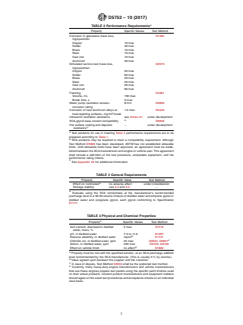
5.1 Test solutions prepared according to Table 1 shall meet
G32Test Method for Cavitation Erosion Using Vibratory
the performance requirements in Table 2, the general require-
Apparatus
ments in Table 3, and the physical and chemical requirements
2.2 Other Document:
in Table 4.
Federal Method 2540BTotal Dissolved Solids Dried at
5.2 TheSCAsshalladditionallyprovideaddedprotectionin
103–105°C
operating engines against cavitation corrosion (also termed
liner pitting) and against scaling of internal engine hot sur-
3. General Requirements
faces. Hot surfaces are typically within the engine head, head
3.1 The SCA concentrate upon addition to water or water/
spacer, or liquid-cooled exhaust manifold, oil coolers, after
glycol mixtures at the SCA manufacturer’s recommended
coolers, and exhaust gas recirculation (EGR) coolers. The
addition level shall provide the same performance as coolants
American Society for Testing and Materials has test methods
meeting Specification D6210, except for freeze and boil
under development for both cavitation corrosion and hot
protection.
surfaces scaling. Until these procedures are adopted asASTM
3.2 Liquid SCAconcentrates shall be storable in the manu- standards, the mandatory requirements of Annex A1 shall
facturer’soriginalcontainerattemperaturesfrom−7to+55°C apply.
(20 to 130°F) without chemical change. Any precipitation of
6. Keywords
ingredientsevidencedbythedropoutofsolidmaterialorliquid
6.1 heavy-duty engine coolants; precharging heavy-duty
turbidity shall disappear upon agitation and warming of the
engines; SCA; supplemental coolant additives
solution to a temperature exceeding 2°C (35°F).
3.3 Solid, slurry, and paste forms of SCA concentrate shall
TABLE 1 Composition of Test Solutions for Table 2 Performance
A
be so formulated and packaged as to prevent chemical or Requirements
physical change during storage before use. This requirement Test Method SCA Concentrate Solvent Mixture
B
applies to storage temperatures of −7 to+55°C (20 to 130°F), D1384 one-half manufacturer’s standard corrosive water
recommended precharged
regardless of humidity.
level
D1384 three times manufacturer’s 33 vol % glycol in standard
3.4 The SCA concentrates, when used according to the
B, C
recommended precharged corrosive water
manufacturer’s recommendations, shall dissolve totally in the
level
test solutions required in this specification. A light haze is
D1881 manufacturer’s recommended 33 vol % glycol in standard
B, C
precharge level corrosive water
permitted.
D2570 manufacturer’s recommended 44 vol % glycol in standard
B, C
3.5 If an engine, vehicle, or servicing organization recom- precharge level corrosive water
D2809 manufacturer’s recommended 16.7 vol % glycol in standard
mends adding a precharge dosage of an SCAproduct to a fully
B, C
precharge level corrosive water
formulated coolant governed by Specification D6210, that
D4340 manufacturer’s recommended 165-mg/L NaCl dissolved in a
organization assumes responsibility for determining the com- precharge level 1-L solution of 25 vol %
C, D
glycol in deionized water
patibilityandconductingsuitabletests.ASTMhasdevelopeda
A
Test solution to be prepared according to Section 4.
compatibility test (Test Method D5828), which may be used.
B
See Section 7 of Test Method D2570 for composition and method of preparation
At the present time, it is recommended that precharge doses of
of standard corrosive water.
C
The glycol used shall be ethylene glycol or propylene glycol and each shall meet
Specification E1177.
D
Standard Method for the Examination of Water and Wastewater, American Water conforming to Type IV of Specification D1193 is acceptable.
Public Health Association, et al, 1015 15th Street, N.W. Washington, DC 20005.
D5752−10 (2017)
A
TABLE 2 Performance Requirements
Property Specific Values Test Method
Corrosion in glassware mass loss, D1384
mg/specimen
Copper 10 max
Solder 30 max
Brass 10 max
Steel 10 max
Cast iron 10 max
Aluminum 30 max
Simulated service test mass loss, D2570
mg/specimen
Copper 20 max
Solder 60 max
Brass 20 max
Steel 20 max
Cast iron 20 max
Aluminum 60 max
Foaming D1881
Volume, mL 150 max
Break time, s 5 max
Water pump cavitation erosion- 8min D2809
corrosion rating
Corrosion of cast aluminum alloys at 1.0 max D4340
heat-rejecting surfaces, mg/cm /week
Ultrasonic cavitation resistance see Annex A1 under development
B
SCA-glycol base coolant compatibility D5828
Hot surface scaling and deposits . under development
C
resistance
A
Test solutions for use in meeting Table 2 performance requirements are to be
prepared according to Table 1.
B
SCA products may be required to meet a compatibility requirement. Although
Test Method D5828 has been developed, ASTM has not established allowable
limits. Until allowable limits have been approved, an agreement must be estab-
lished between the SCA manufacturer and engine or vehicle user. This agreement
shall include a definition of the test procedure, acceptable equipment, and the
performance rating criteria.
C
See Appendix X2 for additional information.
TABLE 3 General Requirements
Property Specific Value Test Method
A
Effect on nonmetals no adverse effect under consideration
Storage stability see 3.2 and 3.3 .
A
Evaluate using the SCA concentrate at the manufacturer’s recommended
precharge level in a 50:50 volume mixture of distilled water and ethylene glycol or
distilled water and propylene glycol, each glycol conforming to Specification
E1177.
TABLE 4 Physical and Chemical Properties
A
Property Specific Values Test Method
Ash content, dissolved in distilled 5 max D1119
water, mass, %
pH, in distilled water 7.5 to 11.0 D1287
B
Reserve alkalinity, in distilled water report D1121
C
Chloride ion, in distilled water, ppm 25 max D3634, D5827
Silicon, in distilled water, ppm 250 max D6129, D6130
D
Effect on vehicle finish no effect D1882
A
Property must be met with the specified solution, at an SCA precharge addition
level recommended by the SCA manufacturer. (This is usually 3 % by volume.)
B
Value agreed upon between the supplier and the customer.
C
In case of dispute, Test Method D3634 shall be the preferred test method.
D
Currently, many heavy-duty engine manufacturers and vehicle manufacturers
that use these engines prepare test panels using the specific paint finishes used
on their actual products. Coolant product manufacturers and equipment builders
should agree on the exact test procedures and acceptance criteria on an individual
case basis.
D5752−10 (2017)
ANNEX
(Mandatory Information)
A1. CHEMICAL REQUIREMENTS FOR SCAs
A1.1 Test methods to determine cavitation corrosion resis- A1.2.3 In-service qualification tests may consist of single-
tance are under development. Several chemical compositions ormultiple-cylinderenginetests.Attheoptionoftheengineor
of SCAs have been extensively tested by producers and users vehicle manufacturer, such testing may be conducted in “loose
andfoundtominimizesatisfactorilycylinderlinercavitationin engines” or in engines fully integrated into an application such
actual test engines. Until such time as an ASTM procedure is as a vehicle, a power boat, or a stationary power source. One
adopted that effectively evaluates cylinder liner cavitation such test has been developed.
corrosion, SCA formulations under this specification shall
A1.3 Chemical composition requirements for cavitation
provide the following when used at the SCA manufacturer’s
corrosion protection will be removed from this specification
recommended precharge addition level:
and replaced with anASTM test method when a test method is
−
A1.1.1 Aminimumconcentrationofnitriteas(NO )inthe
developed and adopted.
cooling system of 1200 ppm, or
A1.4 No specific chemical composition requirements for
A1.1.2 A minimum combined concentration of nitrite as
− −2
hot surface scaling and deposit resistance have been estab-
(NO ) plus molybdate as (MoO ) in the cooling system of
2 4
− −2
lished at this time. A test procedure for this property is under
780ppm.Atleast300ppme
...