

ASTM E2375-22
(Practice)Standard Practice for Ultrasonic Testing of Wrought Products
General Information
- Abstract
SIGNIFICANCE AND USE
4.1 This practice is intended primarily for the examination of wrought metals, forged, rolled, machined parts or components to an ultrasonic class most typically specified in the purchase order or other contract document.
SCOPE
1.1 Purpose—This practice establishes the minimum requirements for ultrasonic examination of wrought products.
Note 1: This practice was adopted to replace MIL-STD-2154, 30 Sept. 1982. This practice is intended to be used for the same applications as the document which it replaced. Users should carefully review its requirements when considering its use for new, or different applications, or both.
1.2 Application—This practice is applicable for examination of materials such as, wrought metals and wrought metal products having a thickness or cross section equal to 0.250 in. (6.35 mm) or greater.
1.2.1 Wrought Aluminum Alloy Products—Examination shall be in accordance with Practice B594. Angle beam scans of wrought aluminum alloy products shall be performed in accordance with this practice as agreed upon by the purchaser and supplier.
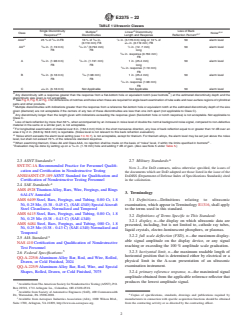
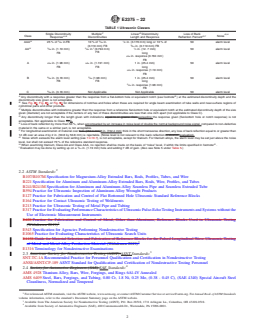
1.3 Acceptance Class—When examination is performed in accordance with this practice, engineering drawings, specifications, or other applicable documents shall indicate the acceptance criteria. Five ultrasonic acceptance classes are defined in Table 1. One or more of these classes may be used to establish the acceptance criteria or additional or alternate criteria may be specified.
1.4 Order of Precedence—Contractual requirements and authorized direction from the cognizant engineering organization may add to or modify the requirements of this practice. Otherwise, in the event of conflict between the text of this practice and the references cited herein, the text of this practice takes precedence. Nothing in this practice, however, supersedes applicable laws and regulations unless a specific exemption has been obtained.
1.5 Measurement Values—The values stated in inch-pounds are to be regarded as standard. The metric equivalents are in parentheses.
1.6 This standard does not purport to address all of the safety concerns, if any, associated with its use. It is the responsibility of the user of this standard to establish appropriate safety, health, and environmental practices and determine the applicability of regulatory limitations prior to use.
1.7 This international standard was developed in accordance with internationally recognized principles on standardization established in the Decision on Principles for the Development of International Standards, Guides and Recommendations issued by the World Trade Organization Technical Barriers to Trade (TBT) Committee.
- Status
- Published
- Publication Date
- 30-Nov-2022
- Technical Committee
- E07 - Nondestructive Testing
- Drafting Committee
- E07.06 - Ultrasonic Method
Overview
ASTM E2375-22: Standard Practice for Ultrasonic Testing of Wrought Products is a key international standard developed by ASTM International. This standard specifies the minimum requirements and recommended practices for conducting ultrasonic testing on wrought metals such as forged, rolled, or machined parts. Ultrasonic testing (UT) is a widely-used nondestructive testing (NDT) technique that enables professionals to detect internal defects and assess the quality and integrity of metallic products without causing damage.
ASTM E2375-22 is applicable to wrought metal products with thickness or cross-sections of 0.250 inches (6.35 mm) or greater. It provides a systematic approach for selecting ultrasonic examination methods, acceptance criteria, reference standards, and necessary qualifications for personnel performing UT. Originally developed to replace MIL-STD-2154, this standard continues to serve industries where product reliability and safety are paramount.
Key Topics
Scope and Applicability
- Applies to wrought metals and products ≥ 0.250 in. (6.35 mm) thick.
- Covers examination of aluminum alloys, magnesium alloys, titanium, and various steels and specialty alloys.
Ultrasonic Examination Classes
- Defines five ultrasonic acceptance classes, enabling tailored criteria for different product applications.
- Acceptance criteria are specified by engineering drawings or contract documents.
Personnel Qualification
- Requires examiners to be qualified and certified according to internationally recognized standards such as ANSI/ASNT-CP-189, NAS-410, or SNT-TC-1A.
Written Examination Procedures
- Mandates detailed documentation of procedures, including equipment, scanning plans, reference standards, and acceptance levels.
- Procedures must be approved by appropriately qualified Level III personnel.
Reference Standards and Blocks
- Provides guidance on fabricating and certifying reference blocks, including requirements for material type, size, surface finish, and calibration.
Equipment and Couplants
- Describes requirements for ultrasonic examination equipment, including performance checks, calibration, and maintenance.
- Guidance on couplants compatible with test materials and surface conditions is included.
Applications
ASTM E2375-22 is essential in industries where the integrity of wrought metal components is critical. Key applications include:
- Aerospace and Defense: Testing of structural aircraft components, turbine engine parts, and machined elements for critical roles.
- Automotive: Verification of rolled or forged elements such as axles, connecting rods, and chassis components.
- Energy Sector: Inspection of pressure vessels, piping, and safety-critical parts in power generation and oil & gas.
- Manufacturing: Quality assurance in the production of bars, rods, tubes, and plates for further fabrication.
By following ASTM E2375-22, organizations can assure compliance with contract and regulatory requirements, reduce the risk of in-service failures, and ensure public safety.
Related Standards
For comprehensive ultrasonic testing of wrought metals, users should be familiar with these related standards:
- ASTM B594 - Practice for Ultrasonic Inspection of Aluminum-Alloy Wrought Products
- ASTM E127 - Practice for Fabrication and Control of Flat Bottomed Hole Ultrasonic Standard Reference Blocks
- ASTM E164 - Practice for Contact Ultrasonic Testing of Weldments
- ASTM E213 - Practice for Ultrasonic Testing of Metal Pipe and Tubing
- ASTM E428 - Practice for Metal Reference Blocks Used in Ultrasonic Testing
- ASTM E543 - Specification for Agencies Performing Nondestructive Testing
- ANSI/ASNT-CP-189, NAS-410, SNT-TC-1A - Personnel qualification standards from ASNT and AIA
Adhering to ASTM E2375-22 and its referenced documents helps manufacturers, suppliers, and purchasers ensure a high level of quality control and reliability through effective ultrasonic nondestructive evaluation. This standard is recognized by agencies such as the U.S. Department of Defense and is developed according to WTO principles for international standards development.
Relations
- Effective Date
- 01-Feb-2024
- Effective Date
- 01-Dec-2019
- Effective Date
- 01-Mar-2019
- Effective Date
- 01-Jan-2018
- Effective Date
- 15-Jun-2017
- Effective Date
- 01-Feb-2017
- Effective Date
- 01-Aug-2016
- Effective Date
- 01-Feb-2016
- Effective Date
- 01-Dec-2015
- Effective Date
- 01-Sep-2015
- Effective Date
- 01-Jun-2014
- Effective Date
- 01-Jun-2014
- Effective Date
- 01-Dec-2013
- Effective Date
- 15-Jun-2013
- Effective Date
- 01-Jun-2013
Get Certified
Connect with accredited certification bodies for this standard

ECOCERT
Organic and sustainability certification.

Eurofins Food Testing Global
Global leader in food, environment, and pharmaceutical product testing.

Intertek Bangladesh
Intertek certification and testing services in Bangladesh.
Sponsored listings
Frequently Asked Questions
ASTM E2375-22 is a standard published by ASTM International. Its full title is "Standard Practice for Ultrasonic Testing of Wrought Products". This standard covers: SIGNIFICANCE AND USE 4.1 This practice is intended primarily for the examination of wrought metals, forged, rolled, machined parts or components to an ultrasonic class most typically specified in the purchase order or other contract document. SCOPE 1.1 Purpose—This practice establishes the minimum requirements for ultrasonic examination of wrought products. Note 1: This practice was adopted to replace MIL-STD-2154, 30 Sept. 1982. This practice is intended to be used for the same applications as the document which it replaced. Users should carefully review its requirements when considering its use for new, or different applications, or both. 1.2 Application—This practice is applicable for examination of materials such as, wrought metals and wrought metal products having a thickness or cross section equal to 0.250 in. (6.35 mm) or greater. 1.2.1 Wrought Aluminum Alloy Products—Examination shall be in accordance with Practice B594. Angle beam scans of wrought aluminum alloy products shall be performed in accordance with this practice as agreed upon by the purchaser and supplier. 1.3 Acceptance Class—When examination is performed in accordance with this practice, engineering drawings, specifications, or other applicable documents shall indicate the acceptance criteria. Five ultrasonic acceptance classes are defined in Table 1. One or more of these classes may be used to establish the acceptance criteria or additional or alternate criteria may be specified. 1.4 Order of Precedence—Contractual requirements and authorized direction from the cognizant engineering organization may add to or modify the requirements of this practice. Otherwise, in the event of conflict between the text of this practice and the references cited herein, the text of this practice takes precedence. Nothing in this practice, however, supersedes applicable laws and regulations unless a specific exemption has been obtained. 1.5 Measurement Values—The values stated in inch-pounds are to be regarded as standard. The metric equivalents are in parentheses. 1.6 This standard does not purport to address all of the safety concerns, if any, associated with its use. It is the responsibility of the user of this standard to establish appropriate safety, health, and environmental practices and determine the applicability of regulatory limitations prior to use. 1.7 This international standard was developed in accordance with internationally recognized principles on standardization established in the Decision on Principles for the Development of International Standards, Guides and Recommendations issued by the World Trade Organization Technical Barriers to Trade (TBT) Committee.
SIGNIFICANCE AND USE 4.1 This practice is intended primarily for the examination of wrought metals, forged, rolled, machined parts or components to an ultrasonic class most typically specified in the purchase order or other contract document. SCOPE 1.1 Purpose—This practice establishes the minimum requirements for ultrasonic examination of wrought products. Note 1: This practice was adopted to replace MIL-STD-2154, 30 Sept. 1982. This practice is intended to be used for the same applications as the document which it replaced. Users should carefully review its requirements when considering its use for new, or different applications, or both. 1.2 Application—This practice is applicable for examination of materials such as, wrought metals and wrought metal products having a thickness or cross section equal to 0.250 in. (6.35 mm) or greater. 1.2.1 Wrought Aluminum Alloy Products—Examination shall be in accordance with Practice B594. Angle beam scans of wrought aluminum alloy products shall be performed in accordance with this practice as agreed upon by the purchaser and supplier. 1.3 Acceptance Class—When examination is performed in accordance with this practice, engineering drawings, specifications, or other applicable documents shall indicate the acceptance criteria. Five ultrasonic acceptance classes are defined in Table 1. One or more of these classes may be used to establish the acceptance criteria or additional or alternate criteria may be specified. 1.4 Order of Precedence—Contractual requirements and authorized direction from the cognizant engineering organization may add to or modify the requirements of this practice. Otherwise, in the event of conflict between the text of this practice and the references cited herein, the text of this practice takes precedence. Nothing in this practice, however, supersedes applicable laws and regulations unless a specific exemption has been obtained. 1.5 Measurement Values—The values stated in inch-pounds are to be regarded as standard. The metric equivalents are in parentheses. 1.6 This standard does not purport to address all of the safety concerns, if any, associated with its use. It is the responsibility of the user of this standard to establish appropriate safety, health, and environmental practices and determine the applicability of regulatory limitations prior to use. 1.7 This international standard was developed in accordance with internationally recognized principles on standardization established in the Decision on Principles for the Development of International Standards, Guides and Recommendations issued by the World Trade Organization Technical Barriers to Trade (TBT) Committee.
ASTM E2375-22 is classified under the following ICS (International Classification for Standards) categories: 71.040.99 - Other standards related to analytical chemistry. The ICS classification helps identify the subject area and facilitates finding related standards.
ASTM E2375-22 has the following relationships with other standards: It is inter standard links to ASTM E1316-24, ASTM E1316-19b, ASTM E1316-19, ASTM E1316-18, ASTM E1316-17a, ASTM E1316-17, ASTM E1316-16a, ASTM E1316-16, ASTM E1316-15a, ASTM E1316-15, ASTM E1316-14, ASTM E1316-14e1, ASTM E1316-13d, ASTM E1316-13c, ASTM E1316-13b. Understanding these relationships helps ensure you are using the most current and applicable version of the standard.
ASTM E2375-22 is available in PDF format for immediate download after purchase. The document can be added to your cart and obtained through the secure checkout process. Digital delivery ensures instant access to the complete standard document.
Standards Content (Sample)
This international standard was developed in accordance with internationally recognized principles on standardization established in the Decision on Principles for the
Development of International Standards, Guides and Recommendations issued by the World Trade Organization Technical Barriers to Trade (TBT) Committee.
Designation: E2375 − 22
Standard Practice for
Ultrasonic Testing of Wrought Products
This standard is issued under the fixed designation E2375; the number immediately following the designation indicates the year of
original adoption or, in the case of revision, the year of last revision.Anumber in parentheses indicates the year of last reapproval.A
superscript epsilon (´) indicates an editorial change since the last revision or reapproval.
This standard has been approved for use by agencies of the U.S. Department of Defense.
1. Scope* 1.6 This standard does not purport to address all of the
safety concerns, if any, associated with its use. It is the
1.1 Purpose—This practice establishes the minimum re-
responsibility of the user of this standard to establish appro-
quirements for ultrasonic examination of wrought products.
priate safety, health, and environmental practices and deter-
NOTE1—ThispracticewasadoptedtoreplaceMIL-STD-2154,30Sept.
mine the applicability of regulatory limitations prior to use.
1982.This practice is intended to be used for the same applications as the
1.7 This international standard was developed in accor-
document which it replaced. Users should carefully review its require-
ments when considering its use for new, or different applications, or both.
dance with internationally recognized principles on standard-
ization established in the Decision on Principles for the
1.2 Application—Thispracticeisapplicableforexamination
Development of International Standards, Guides and Recom-
of materials such as, wrought metals and wrought metal
mendations issued by the World Trade Organization Technical
products having a thickness or cross section equal to 0.250 in.
Barriers to Trade (TBT) Committee.
(6.35 mm) or greater.
1.2.1 Wrought Aluminum Alloy Products—Examination
2. Referenced Documents
shall be in accordance with Practice B594. Angle beam scans
2.1 The following documents form a part of this practice to
of wrought aluminum alloy products shall be performed in
the extent specified herein:
accordance with this practice as agreed upon by the purchaser
and supplier.
2.2 ASTM Standards:
B107/B107MSpecification for Magnesium-Alloy Extruded
1.3 Acceptance Class—When examination is performed in
Bars, Rods, Profiles, Tubes, and Wire
accordance with this practice, engineering drawings,
B221Specification forAluminum andAluminum-Alloy Ex-
specifications, or other applicable documents shall indicate the
truded Bars, Rods, Wire, Profiles, and Tubes
acceptance criteria. Five ultrasonic acceptance classes are
B241/B241MSpecification for Aluminum and Aluminum-
defined in Table 1. One or more of these classes may be used
Alloy Seamless Pipe and Seamless Extruded Tube
to establish the acceptance criteria or additional or alternate
B594Practice for Ultrasonic Inspection ofAluminum-Alloy
criteria may be specified.
Wrought Products
1.4 Order of Precedence—Contractual requirements and
E127Practice for Fabrication and Control of Flat Bottomed
authorized direction from the cognizant engineering organiza-
Hole Ultrasonic Standard Reference Blocks
tion may add to or modify the requirements of this practice.
E164Practice for Contact Ultrasonic Testing of Weldments
Otherwise, in the event of conflict between the text of this
E213Practice for Ultrasonic Testing of Metal Pipe and
practiceandthereferencescitedherein,thetextofthispractice
Tubing
takes precedence. Nothing in this practice, however, super-
E317PracticeforEvaluatingPerformanceCharacteristicsof
sedes applicable laws and regulations unless a specific exemp-
Ultrasonic Pulse-Echo Testing Instruments and Systems
tion has been obtained.
without the Use of Electronic Measurement Instruments
E543Specification forAgencies Performing Nondestructive
1.5 Measurement Values—The values stated in inch-pounds
Testing
are to be regarded as standard. The metric equivalents are in
E1065Practice for Evaluating Characteristics of Ultrasonic
parentheses.
Search Units
E1316Terminology for Nondestructive Examinations
This practice is under the jurisdiction of ASTM Committee E07 on Nonde-
structive Testing and is the direct responsibility of Subcommittee E07.06 on
Ultrasonic Method. For referenced ASTM standards, visit the ASTM website, www.astm.org, or
Current edition approved Dec. 1, 2022. Published January 2023. Originally contact ASTM Customer Service at service@astm.org. For Annual Book of ASTM
approved in 2004. Last previous edition approved in 2016 as E2375–16. DOI: Standards volume information, refer to the standard’s Document Summary page on
10.1520/E2375-22. the ASTM website.
*A Summary of Changes section appears at the end of this standard
Copyright © ASTM International, 100 Barr Harbor Drive, PO Box C700, West Conshohocken, PA 19428-2959. United States
E2375 − 22
TABLE 1 Ultrasonic Classes
C D
Single Discontinuity Loss of Back
Multiple Linear Discontinuity G,H
Class Noise
A,B E,F
Response Discontinuities Length and Response Reflection Percent
H
3 3 1
AAA 25 % of ⁄64 in.FB 10 % of ⁄64 in. ⁄8 in. (3.176 mm) long or 10 % of 50 alarm level
(0.119 mm) FB ⁄64 in. (0.119 mm) FB
H I
3 2 1
AA ⁄64 in. (1.19 mm) ⁄64 in. (0.794 mm) ⁄2 in. (12. 7 mm) 50 alarm level
FB
FB long
⁄64 in. response (0.794 mm)
FB
5 3
A ⁄64 in. (1.98 mm) ⁄64 in. (1.191 mm) 1 in. (25.4 mm) 50 alarm level
FB FB long
⁄64 in. response (1.19 mm)
FB
8 5
B ⁄64 in. (3.18 mm) ⁄64 (1.98 mm) 1 in. (25.4 mm) 50 alarm level
FB FB long
⁄64 in. response (1.98 mm)
FB
C ⁄64 in. (3.18 mm) Not Applicable Not Applicable 50 alarm level
A B
Any discontinuity with a response greater than the response from a flat-bottom hole or equivalent notch (see footnote ) at the estimated discontinuity depth and the
discontinuity size given is not acceptable.
B
SeeFig.2,Fig.3,orFig.4fordimensionsofnotchesandholeswhenthesearerequiredforanglebeamexaminationoftubewallsandnear-surfaceregionsofcylindrical
parts and other products.
C
Multiple discontinuities with indications greater than the response from a reference flat-bottom hole or equivalent notch at the estimated discontinuity depth of the size
given (diameter) are not acceptable if the centers of any two of these discontinuities are less than one inch apart (not applicable to Class C).
D
Any discontinuity longer than the length given with indications exceeding the response given (flat-bottom hole or notch response) is not acceptable. Not applicable to
Class C.
E
Loss of back reflection by more than 50 %, when accompanied by an increase in noise level of double the normal background noise signal, compared to non-defective
material in the same or a similar part, is not acceptable.
F
For longitudinal examination of material over 6 in. (152.4 mm) thick in the short transverse direction, any loss of back reflection equal to or greater than 12 dB over an
area 2 by 2 in. (50.8 by 50.8 mm) is rejectable. (Noise level is not relevant to this back reflection evaluation).
G
Noise which exceeds the alarm level setting (see 7.4.10.7), is not acceptable, except for titanium. For titanium alloys, the alarm level may be set just above the noise
level, but shall not exceed 70 % of the reference standard response.
H G
When examining titanium, Class AA and Class AAA, no rejection shall be made on the basis of “noise” level, if within the limits specified in footnote .
I 3
Evaluation may be done by setting up on a ⁄64 in. (1.19 mm) hole and adding 7 dB of gain. (Also see Note 5 under Table 5.)
3 6
2.3 ASNT Standards: 2.7 Military Standards:
SNT-TC-1ARecommended Practice for Personnel Qualifi-
NOTE 2—For DoD contracts, unless otherwise specified, the issues of
cation and Certification in Nondestructive Testing
the documents which are DoD adopted are those listed in the issue of the
ANSI/ASNT-CP-189ASNT Standard for Qualification and
DoDISS (Department of Defense Index of Specifications Standards) cited
in the solicitation.
Certification of Nondestructive Testing Personnel
2.4 SAE Standards:
AMS 4928TitaniumAlloy, Bars, Wire, Forgings, and Rings
3. Terminology
6Al-4V Annealed
AMS 6409Steel, Bars, Forgings, and Tubing, 0.80 Cr, 1.8 3.1 Definitions—Definitions relating to ultrasonic
Ni, 0.25 Mo, (0.38 - 0.45 C), (SAE 4340) SpecialAircraft examination, which appear in Terminology E1316, shall apply
Steel Cleanliness, Normalized and Tempered to the terms used in this standard.
AMS 6415Steel, Bars, Forgings, and Tubing, 0.80 Cr, 1.8
3.2 Definitions of Terms Specific to This Standard:
Ni, 0.25 Mo (0.38 - 0.43 C) (SAE 4340)
3.2.1 display, n—the display on which ultrasonic data are
AMS 6484Steel, Bars, Forgings, and Tubing, 080 Cr, 1.8
presented, including, but is not limited to, cathode ray tubes,
Ni, 0.25 Mo (0.38 - 0.43 C) (SAE 4340) Normalized and
liquid crystals, electro-luminescent phosphors, or plasmas.
Tempered
3.2.2 full scale deflection (FSD), n—the maximum display-
2.5 AIA Standard:
able signal amplitude on the display device, or any signal
NAS 410Certification and Qualification of Nondestructive
reaching or exceeding the 100% amplitude scale graduation.
Test Personnel
3.2.3 horizontal limit, n—the maximum readable length of
2.6 Federal Specifications:
horizontal position that is determined either by electrical or a
QQ-A-225/6Aluminum Alloy Bar, Rod, and Wire, Rolled,
physical limit in the A-scan presentation of an ultrasonic
Drawn, or Cold Finished, 2024
examination instrument.
QQ-A-225/9Aluminum Alloy Bar, Rod, Wire, and Special
Shapes, Rolled, Drawn, or Cold Finished, 7075 3.2.4 primary reference response, n—the maximized signal
amplitude obtained from the applicable reference reflector that
produces the lowest amplitude signal.
AvailablefromTheAmericanSocietyforNondestructiveTesting(ASNT),P.O.
Box 28518, 1711 Arlingate Ln., Columbus, OH 43228-0518.
Available from Society of Automotive Engineers (SAE), 400 Commonwealth
Dr., Warrendale, PA 15096-0001. Copies of specifications, standards, drawings and publications required by
Available from Aerospace Industries Association (AIA), 1000 Wilson Blvd., manufacturers in connection with specific acquisition functions should be obtained
Suite 1700, Arlington, VA 22209, http://www.aia-aerospace.org. from the contracting activity or as directed by the contracting officer.
E2375 − 22
4. Significance and Use 6.4.7 Manufacturer and model numbers of any instrumen-
tation to be used in the examination. Any external recording
4.1 This practice is intended primarily for the examination
equipment,alarmequipmentandelectronicdistance-amplitude
of wrought metals, forged, rolled, machined parts or compo-
correction equipment shall be included.
nents to an ultrasonic class most typically specified in the
6.4.8 Type and size of search unit. Include frequency, focal
purchase order or other contract document.
length, as applicable, manufacturer, sound beam angle and
5. Basis of Application
description of any wedges, shoes, saddles, stand-off
attachments, bubblers, or squirters.
5.1 Basis of Application—There are areas in this practice
6.4.9 Description of manipulating and scanning equipment.
thatmayrequireagreementbetweenthecognizantengineering
organization and the supplier, or specific direction from the 6.4.10 Couplant: type and manufacturer.
cognizant engineering organization. 6.4.11 Scanning plan which describes, for each portion of
the examination, the surfaces from which the examination will
6. General Requirements
beperformed,theultrasonicmodes,anddirectionsofthesound
6.1 Specifying—Whenultrasonicexaminationisspecifiedin
beam.
accordance with this practice, the ultrasonic technique
6.4.12 Method of applying transfer (see 7.4.10.4), if ap-
(immersion, contact, angle beam, straight beam, and so forth)
plied.
and acceptance criteria should be specified. Suggested classes
6.4.13 Reference blocks, water path (if applicable) and
in Table 1 may be specified to establish acceptance criteria.A
methods of standardization and scan index determination,
contract document shall specify zones, when applicable, to
maximum scanning speed, and minimum pulse repetition rate.
indicate different quality level acceptance criteria based on the
6.4.14 Method of establishing scan sensitivity for concave
criticalityofeachzone.Whendirectionsofmaximumstressing
and convex surfaces, if applicable.
areindicatedonacontractdocumentandconfigurationallows,
6.4.15 Discontinuity evaluation procedure.
ultrasonic examination shall be performed to locate disconti-
6.4.16 Any other pertinent data which would be needed to
nuities oriented perpendicular to the directions of maximum
duplicate the original examination.
stressing.
6.5 General Procedures—General procedures are accept-
6.2 Personnel Qualification/Certification—Personnel per-
able for common product forms such as plate, bar stock,
forming examinations to this practice shall be qualified in
extrusions, forgings, tubing and cylindrical stock, and desig-
accordance with ANSI/ASNT-CP-189, NAS-410, or SNT-
natedthicknessranges.Thegeneralprocedureshallincludethe
TC-1A and certified by the employer or certifying agency as
applicable items of 6.4.
applicable. Other equivalent qualification documents may be
used when specified in the contract or purchase order.
7. Detail Requirements
6.3 Agency Evaluation—If required by contract, evaluation
7.1 Couplants:
of the agency performing examination shall be in accordance
7.1.1 Immersion Method—For the immersion method (see
with Specification E543.
7.2.9), water shall be free of air bubbles and other foreign
6.4 Written Procedure—A detailed procedure (general
material that could interfere with ultrasonic examinations. A
procedure,orpartspecifictechnique,orboth)shallbeprepared
suitable corrosion inhibiting agent, or a wetting agent, or both,
for each part and type of examination to be performed. The
shallbeaddedtothewater,ifnecessary.Thespecificinhibiting
procedureshallmeettherequirementsofthispracticeandshall
and wetting agents including mixing concentrations shall have
provide consistency for producing the results and quality level
beenpreviouslydeterminedtobecompatiblewiththematerials
required by this practice and other contractual documents.The
to be examined.
procedure shall be approved by an individual qualified and
7.1.2 Contact Method—For the contact method, a liquid or
certifiedasaLevelIIIinthepracticeofultrasonicexamination.
semi-liquid that forms a thin film between the search unit and
The procedure shall be submitted upon request to the contract-
the part is required. The couplant material used shall not be
ing agency for approval, or review, or both (see 8.1). The
injurious to the material to be examined and will permit
procedureshallcoverallofthespecificinformationrequiredto
detection of applicable discontinuity sizes. Glycerin (Pure),
set-up and perform the examination, such as the following:
silicones and graphite greases shall not be used as couplants,
6.4.1 Name and address of examination facility,
unless specifically permitted by the cognizant engineering
6.4.2 Number of the procedure including latest revision
organization.
designation, if applicable, and date.
6.4.3 Number of this standard including latest revision 7.2 Equipment:
designation letter, if applicable, and date. 7.2.1 Electronic Equipment—The equipment when used
6.4.4 Examination method and acceptance criteria to be with appropriate search units shall be capable of producing
applied. ultrasonic examination frequencies as required by the applica-
6.4.5 Examination zones, if applicable. tion. The electronic equipment shall be calibrated after any
6.4.6 Specific part number and configuration or product repair or part/component replacement which could affect its
form for which the procedure is being prepared, including the response characteristics, or once each year, whichever occurs
surface condition of the product and any special handling first. Records of the current calibration shall be retained and
requirements. available for review.
E2375 − 22
7.2.1.1 The equipment shall meet the following require- 7.2.5.1 A method shall be established for determining a
ments as directed in Practice E317 or other approved proce- sensitivityprofilealongthemajoraxisofthebeamtolocatethe
least sensitive area. Scan sensitivity must be based upon this
dure:
(1)Vertical Limit—100% of full scale. least sensitive location on the search unit for each portion of
the DAC curve to be used.
(2)Horizontal Limit—100% of full scale.
7.2.5.2 A method may be established for masking the ends
(3)Vertical Linearity Limit Range—The vertical linearity
of the instrument shall meet the requirements of A3.3. of the search unit, if required, to eliminate over-sensitive
responses as determined in the sensitivity profile, see A4.1.3.
(4)Horizontal Linearity Limit Range—The instrument
7.2.5.3 Amethodshallbeestablishedfordeterminingeffec-
shall be linear within 65% of full scale between 0 and 85%
of the horizontal limit. This step may be omitted if the tive beam width. The scan index established in accordance
with 7.4.10.8 shall be based on the beam width so determined.
instrument is used within a limited depth of material and is
7.2.5.4 Thereferencestandardshallprovideauniformentry
verified on standards of that depth at each standardization.
surface for the full extent of the sound beam for equipment
(5)Calibrated gain controls shall meet the requirements of
standardization.
A3.2.2 unless an alternate method for verification has been
7.2.5.5 Amethod shall be established to use the least active
approved by the cognizant engineering organization.
portion of the search unit to adjust scan sensitivity at each
7.2.1.2 Attenuator and decade switches as applicable shall
portion of the DAC (DistanceAmplitude Correction) curve to
meet the requirements of A3.2.
be used.
7.2.2 Alarm—An instrument used for other than manual
7.2.5.6 Search units meeting the requirements of 7.2.4 shall
scanning of a part with constant visual observation of the
be used for evaluations of indications detected while scanning
instrument display shall contain a means for automatically
with paintbrush search units.
indicating the presence of a signal that exceeds a predeter-
7.2.6 Array Search Units—Array search units (multiple-
mined amplitude threshold within a gated time period. The
element) may be used for initial immersion scanning provided
alarmthresholdlevelshallbeadjustable.Thealarmmeansmay
eachelementispulsedindependentlyandproducesabeamthat
be an amplitude, visual, stop-on-defect, part marking or
sufficiently overlaps each adjacent beam so that the maximum
sorting, analog or digital recording, or other form of indication
allowable drop in signal amplitude between elements is not
of the presence of potential defects. If automatic means are
more than 3 dB from the peak response (when the peak is set
used for detection of rejectable discontinuities, it shall be
to 80% of full scale using the primary reference response for
demonstrated during initial standardization that the speed of
the applicable examination as the reference reflector).
response of such means is adequate to detect, at actual
7.2.7 Phased Array Search Units—Linear phased array
scanning speeds, a rejectable amplitude from a target at any
probes may be used for scanning and evaluation of wrought
depth in the examination range.
metals.The written procedure shall include at least the follow-
7.2.3 Voltage Regulator—If fluctuations in line voltage
ingadditionalcontrolstoallowtheuseofphasedarrayprobes:
causeanamplitudechangegreaterthan 62.5%offullscaleof
7.2.7.1 Virtual probes within the array shall meet the re-
a signal of half full-scale amplitude, a voltage regulator shall
quirements for minimum effective beam width as given in
be required on the power source.
7.2.5.3 in both the scan and index directions.
7.2.4 Search Units—Search units are acceptable if they
7.2.7.2 Each virtual probe in the array shall meet the
provide the required examination characteristics including
applicable requirements of a conventional probe as defined in
sensitivity, resolution, and penetration. Search units shall have
7.2.4.
active dimensions (diameter for circular elements, length for
7.2.7.3 There shall be no more than one dead element in a
rectangular elements) equal to or greater than 0.25 in. (6.35
virtual probe and the array shall not have two adjacent dead
mm). For contact examination of all convex surfaces of 1.5 in.
elements.
(38.1 mm) radius or less, and all concave surfaces of 4 in.
7.2.7.4 All virtual probes in the array shall exhibit an
(101.6 mm) radius or less, a curved shoe or wedge, made to
amplitude response within 1dB of the mean amplitude.
match as closely as possible the radius of the part being
7.2.8 Focused Search Units—Focused search units may be
examined, shall be required for examination. All search units
used unless otherwise specified in the contract or purchase
shall be serialized. General search unit characteristics are
order documentation.
typically evaluated by the methods described in Guide E1065.
7.2.9 Tank—Tanksusedforimmersionexaminationshallbe
Recordsoftheevaluationshallbemaintained.Suchevaluation
of sufficient size to permit submersion of the part, material, or
does not necessarily determine suitability for any specific
the area of interest to be examined with proper orientation of
material evaluation.
the search unit and allow sufficient water path.
7.2.5 Rectangular “Paintbrush” Search Units—
7.2.9.1 Attachments—For special applications attachments
Rectangular “paintbrush” search units shall be allowed for may be used with the search unit to provide the required water
straight beam longitudinal immersion scanning if it is demon-
path distances or coupling.
strated that the search unit provides the required examination
7.2.10 Manipulating Equipment—For immersion
characteristics specified in this practice or the contract docu- examination,manipulatingequipmentshalladequatelysupport
ment.Thewrittenprocedures(see6.4)shallincludeatleastthe
a search unit and shall provide angular adjustment within one
additional items specified in 7.2.5.1 through 7.2.5.3. degree in two planes and demonstrate control for following
E2375 − 22
part geometry. Examinations not requiring angulation shall be examination. Transfer in accordance with 7.4.10.4 is not
documented on the scan plan. The bridge shall have sufficient allowed if the differences are greater than these limits unless a
strength to provide rigid support for the manipulator and shall documented plan adequately compensates for the cause and is
allow smooth, accurate positioning of the search unit. The approved by the cognizant engineering organization.
scanning accuracy of the apparatus shall permit adjustment of 7.3.1.2 Material to be used for the fabrication of reference
the scan index distance within 60.1 in. (2.54 mm), or unless blocksshallbescannedultrasonicallyinthemode(s)tobeused
otherwise specified by the cognizant engineering organization. in the examination at a sufficiently high sensitivity to detect
Water travel distance shall be adjustable. When part size, or any existing anomalies that might produce signals that could
configuration, or both, prevent the use of manipulating obscure, or be confused with, those from holes, notches or
equipment,searchunitstand-offattachmentswhichprovidefor other targets in the reference block to be fabricated.
control of water travel distance and sound beam angle shall be 7.3.2 Alternate Flat-bottom Hole Sizes—If blocks with the
used. Provisions shall be made to ascertain that wear of specified flat-bottom hole sizes are not available, alternative
stand-off attachments does not exceed limits which will de- sizes may be used provided the instrument gain is changed by
grade the examination. afactorgivenbytheratiooftheareasofthetworelevantholes.
Forcaseswhereonlyalargersizeisavailable,thegainmustbe
7.3 Reference Block Fabrication—Reference blocks with
increasedbytheratio(d /d ) ,whered andd arerespectively
r a r a
flat-bottom holes with diameters equal to those specified in the
the diameters of the reference and specified acceptance flat-
acceptance criteria shall be used for defect detection and
bottom holes (see Table 5, Note 1). With instruments having
evaluation unless alternate hole sizes are used in accordance
gain controls calibrated in dB, the required change is given by
with 7.3.2. The blocks shall meet the response characteristics
40 × log(d /d ) dB. Table 5 can be used for the extrapolation
r a
of and be certified to the requirements of Practice E127,as
of gain between any standard hole sizes in the range of ⁄64
specified in 7.3.1 through 7.3.9.6 of this practice, or to the
through ⁄64. Gain extrapolation shall be restricted to hole
documented requirements of the cognizant engineering orga-
diameters having ratios no greater than 2:1, requiring gain
nization.IIW-typeblocksshallbecertifiedwithrespecttoalloy
changes no greater than 12 dB. For class AAA only, gain
and dimensions specified on the purchase order.
extrapolationshallberestrictedtoholediametershavingratios
7.3.1 Reference Block Materials—Reference blocks should
no greater than 3:1, requiring gain changes no greater than 19
be fabricated from the same alloy, surface finish and heat
dB.
treatment as the part to be examined. Where this is not
7.3.3 Curved Surface Reference Blocks—Blocks used on
available,orpractical,referenceblocksmaybefabricatedfrom
cylindrically or irregularly shaped products shall meet the
materials listed in Table 2 so that any ultrasonic transmission
following requirements:
differences are minimized. Other material may be used for
7.3.3.1 Examination of Cylindrical Parts of Greater Than 4
reference blocks provided the velocity and attenuation differ-
in. (101.6 mm) Radius—Reference blocks shall be of material
encebetweenthereferenceblockandtheexaminationmaterial
specified in 7.3.1 and may be either flat blocks manufactured
are within the limits shown below:
according to Practice E127 or they may be the stepped type
7.3.1.1 The back or end surface reflections of the examina-
showninFig.1(withcorrespondinglylargerdimensions)or,of
tion material shall be within +4 dB (160%) to −12 dB (25%)
the type specified in 7.3.2 machined to within 10% of the
of the reference block material corrected to the depth of
radius of curvature of the part being examined, or of the
alternatetypedescribedin7.3.7inwhichcaselargerholesmay
be used to clear a holding fixture for the flat-bottom hole drill
TABLE 2 Recommended Reference Block Material
as described in 7.3.3.2.
Reference Typical
Material to be
7.3.3.2 Examination of Cylindrical Parts of Less Than 4 in.
Material Specification
(101.6 mm) Radius—Reference blocks shall have a radius of
Aluminum 7075-T6 ASTM B221
ASTM B241/
curvature within 10% of those parts. The blocks shall be,
B241M
where practical, of full round cross-section. Reference holes
QQ-A225/9
may be drilled by using a larger diameter hole drilled to no
2024 ASTM B221
ASTM B241/
closer than 0.5 in. (12.7 mm) to the final depth of the
B241M
flat-bottom hole, permitting the use of a holding fixture for the
QQ-A225/6
drill for the flat-bottom holes. An acceptable alternate to full
Magnesium ZK60 ASTM B107/
B107M
round blocks is the stepped type shown in Fig. 1. Flat-bottom
Titanium T1-6A1-4V annealed AMS 4928
Low-Alloy Steels 4340 annealed AMS 6484
(4130, 4340); AMS 6415
TABLE 3 Surface Resolution Requirements
High-Strength Low- AMS 6409
Steels
Resolution Requirements
Material Thickness (t)
(such as NAX,
Forgings/Re-Forgings Other Product Forms
T-300M);
Up to 1.25 in. (31.75
1 1
⁄4 in. (6.35 mm) ⁄8 in. (3.05 mm)
Straight Carbon and
mm)
H-11 Tool 1 1
1.25 in.(31.75) and over ⁄4 in. (6.35 mm) ⁄10 t
2.5 in. (63.5 mm) and
1 1
⁄10tor ⁄2 in. (12.7 mm), whichever is less
NOTE1—Othermaterialsmaybeusedwhendocumentedandapproved over
by the cognizant engineering organization.
NOTE 1—Unless otherwise specified in a contract document.
E2375 − 22
TABLE 4 Flat Surface Reference Standard Metal Travel
7.3.7 Alternate Reference Blocks—Other reference
Depth of Reference Standard Metal reflectors, as approved by the cognizant engineering organiza-
Discontinuity, Travel Distance Tolerance,
tion may be used.
in. (mm) in. (mm)
7.3.8 Alternate Reference Block Fabrication—Ifothertypes
1 1
Up to ⁄4 (6.35) ± ⁄16 (1.59)
1 of reference blocks, reflectors and materials are used as
0.250 (6.35) to 1.0 (25.4) ± ⁄8 (3.18)
1.0 (25.4) to 3 (76.2) ± ⁄4 (6.35)
approved by the cognizant engineering organization, material
3.0 (76.2) to 6 (152.4) ± ⁄2 (12.7)
for these blocks shall meet the requirements of 7.3.1 and,
Over 6.0 (152.4) ±10 % of metal travel
whereapplicable,referencetargetsshallmeettherequirements
of 7.3.7.
7.3.9 Additional Fabrication Requirements—The following
additional fabrication/verification requirements apply to refer-
holes, of the sizes required for the appropriate examination
ence blocks specified herein:
class in accordance with Table 1, shall be placed in the block
7.3.9.1 Flat-bottom holes shall be dimensionally evaluated
at the metal travel distances specified in 7.4.7.1. The sizes and
in accordance with Practice E127.
depths of the flat-bottom holes shall be verified by calibrated
7.3.9.2 The angular alignment of holes in reference blocks
measuring instruments and the holes should be plugged to
shall have a tolerance of 630 min and be perpendicular to the
prevent water entry and to create an air interface at the hole
beam entry surface or other surface or direction as required or
bottom. If it is not possible to use the same material for
intended by the governing specification.
reference blocks, the provisions of 7.3.1 shall apply.
7.3.9.3 Reference standards shall be clearly identified so
7.3.3.3 Alternate Tolerances for Straight-Beam Examina-
that the hole size, depth and material type (refracted angle, if
tion of Cylindrical Parts—In the case of straight-beam exami-
used) are discerned on the block or a drawing of the block. If
nation only, where detection of indications of the class speci-
this data is only on the drawing then the reference standard
fied is demonstrated to the satisfaction of the cognizant
shall be traceable to its drawing.
engineering organization, the cognizant Level 3, and
7.3.9.4 Allreferenceblocksshallbevisuallyexaminedprior
documented, the use of reference standards with greater
to each use for signs of surface and sealing-plug damage or
departureofradiusfromthatofthetestmaterialthanthatlisted
deterioration. Any block which exhibits significant rusting,
above, may be permitted.
corrosion or surface damage, which may interfere with the
NOTE 3—The use of round cross-section blocks allows the dynamic
examination process, shall be either discarded and replaced, or
verification of instrument and system standardization. Such dynamic
cleanedandrecertifiedinaccordancewithPracticeE127orthe
verification may be difficult, or not possible, using stepped blocks.
original surface finish requirements as appropriate.
7.3.4 Rectangular Angle Beam Reference Blocks—Fig. 2 is
7.3.9.5 After all flat-bottom holes are verified, they shall be
the configuration for rectangular angle beam blocks using
plugged as specified in Practice E127 to protect the hole from
flat-bottom holes for use with contact examination only.
corrosion when that is a potential problem.
Side-drilled holes may be used to obtain graphic distance-
7.3.9.6 Reference standards shall be dried, or couplant
amplitude curves with sensitivity corrected by using the
removed, or both, after use. Reference standards shall be
end-drilled holes of the applicable ultrasonic class size (see
handled and stored in a manner to preclude damage.
A1.3.4).Otherblockconfigurationsandreflectorsmaybeused
7.4 Examination Procedures:
if they meet the requirements of 7.3.7 and 7.3.8, or comply
7.4.1 Visual Examination—Prior to ultrasonic examination
with documented requirements approved by the cognizant
visually examine the part or material for cleanliness, surface
engineering organization. The vee-path options illustrated in
roughness, cracks, burrs, nicks, gouges, raised areas, irregular
Fig. A1.4 shall not be used to obtain standardization of
machining and tool tears. Any surface anomalies that will
immersionexaminationsbecauseofthelossofsoundenergyat
impair ultrasonic examination shall be removed prior to
the apex of the vee-paths if the block is immersed.
examination. If removal is not possible or practical, mark such
7.3.5 Hollow Cylindrical Angle Beam Reference Blocks—
discrepanciesonthepartforlateranalysisduringevaluationof
Reference blocks for shear wave examination of tubing and
ultrasonic indications.
ring forgings shall have an outer ring diameter that is within
7.4.2 Coverage—The sound beam direction required for
65% of the outside diameter of the examination material and
examination of various wrought shapes shall be in accordance
the thickness shall be 610% of the examination material.The
with Figs. 5 and 6. Additional coverage requirements shall be
reference block shall contain reference reflector notches in
as specified below:
accordance with Fig. 3 based on the applicable class of
examination in accordance with Table 1. 7.4.2.1 Whendirectionsofmaximumstressingareindicated
on contract documents, scanning shall be performed to locate
7.3.6 International Institute of Welding (IIW) Type Refer-
ence Block—Blocks derived from the International Institute of discontinuities that are oriented perpendicular to the specified
directions (see 6.1).
Welding(IIW),ReferenceBlock,PracticeE164AnnexA,shall
beusedforevaluationofcontactanglebeamsearchunitsasan 7.4.2.2 When entry surface resolution is not sufficient to
aid in determining proper positioning for contact angle beam resolve discontinuities near the part surface, as required by
examination, and to determine beam exit point from the search Table3,whileachievingatleasta2:1orgreatersignal-to-noise
units and angle of the sound beam. The material from which ratio, additional examinations shall be performed from the
the blocks are to be made must be specified by the purchaser. opposite side, or, different examination zone depths shall be
E2375 − 22
TABLE 5 Appropriate dB Gain Changes between Flat-Bottom Hole (FBH) Sizes
Reference Flat-Bottom Hole Diameter, ⁄64 in. (mm)
Acceptable Flat-Bottom
Hole Diameter,
1 2 3 4 5 6 7 8
⁄64 in. (mm)
(0.4) (0.8) (1.2) (1.6) (2.0) (2.4) (2.8) (3.2)
1 0 dB +12 dB
(0.4)
2 −12 dB 0 dB +7 dB +12 dB
(0.8)
3 −7 dB 0 dB +5 dB +9 dB +12 dB
(1.2)
4 −12 dB −5 dB 0 dB +4 dB +7 dB +10 dB +12 dB
(1.6)
5 −9 dB −4 dB 0 dB +3 dB +6 dB +8 dB
(2.0)
6 −12 dB −7 dB −3 dB 0 dB +3 dB +5 dB
(2.4)
7 −10 dB −6 dB −3 dB 0 dB +2 dB
(2.8)
8 −12 dB −8 dB −5 dB −2 dB 0 dB
(3.2)
NOTE 1—Blank areas contain absolute values of gain changes greater than 612 dB and are not applicable, see 7.3.1.1.
NOTE2—ReferenceFBHdiameterreferstothesizeoftheFBHinthereferenceblocks.AcceptanceFBHdiameterreferstotheextrapolatedFBH.Table
entries are calculated as follows:
referenceFBHdiameter
40log 5dB
S D
acceptanceFBHdiameter
NOTE 3—+dB = instrument gain increase; −dB = instrument gain decrease.
NOTE 4—If the dB control has a minimum incremental change of 2 dB and the extrapolation requires an uneven dB change, the dB control shall be
adjusted for 1 dB more gain than required. For instance, in this case note the dB control in Note 5 would be increased by +10 dB instead of +9 dB.
5 3
NOTE 5—Explanation of Extrapolation: With a reference FBH of ⁄64 in. (1.98 mm) and an acceptance FBH of ⁄64 in. (1.191 mm), the difference is
+9 dB. Since the acceptance FBH is smaller than the reference FBH, the gain must be increased by 9 dB from the reference FBH setting.
NOTE6—Thistableassumesalinearrelationshipbetweentheamplitudeoftheresponseofaninstrumentandtheareaofaflat-bottomholetarget.This
assumption is approximately valid only for certain material configurations and combinations of search units and instrument parameters.
established, or the examination frequency may be changed as For tuned systems, the operating system frequency is estab-
long as all other requirements are met. Also, for each exami- lishedbyeitherthetransmittingorreceivingsystemwhichever
nationdirection,examinationsfromoppositesidesarerequired
is tuned.
when the maximum metal travel distance is such that the
7.4.5 Water Travel Path for Immersion Method—The dis-
minimum size discontinuity of the applicable class cannot be
tance from the face of the search unit to the front surface of a
detected by examination from only one side.
part shall be such that the second front reflection from the
7.4.2.3 When the length of any of the examination dimen-
examination material does not appear between the first front
sions (distance sound beam travels through the material)
and first back reflections. This distance (water travel) must be
exceeds 18 in. (457 mm) supplementary examinations may be
the same within 60.25 in. (66.35 mm) for standardization,
additionally required to locate discontinuities that are not
initial scanning and final evaluation. When possible, examina-
detectable by straight beam examination. This is based on the
tion shall be performed using water paths that result in
fact that it would be very difficult to detect discontinuities
examinations being performed in the far field of the search
greater than 9 in. (228 mm) in depth for a Class A, or higher,
unit, or in the depth of field of a focused search unit approved
examination. It shall be verified that the side walls do not give
by the cognizant engineering organization. When focused
erroneous examination results.
search units are used, the distance shall be such that the search
7.4.3 Scanning Speed—Thescanningspeedshallnotexceed
unit focus is within the material at the depth required to meet
the maximum scanning speed which provides for detection of
front surface resolution requirements. For angle beam exami-
thereferencereflectorsinthereferencestandardsusedtosetup
nation of curved or cylindrical parts the water path distance
the examination.
must be maintained at a length which does not vary during
7.4.4 Ultrasonic Frequency—Standardization and examina-
materialexaminationorbetweenstandardizationandexamina-
tion shall be performed at the ultrasonic frequency which will
tion by more than 60.02 times the radius of curvature of the
provide the penetration and resolution required for valid
material.
examination of the production material. Examination per-
formedwithtransmittingandreceivingsearchunitsofdifferent 7.4.6 Lateral Position Stability for Examination of Cylindri-
cal Parts—During dynamic scanning, variation in position of
frequencies shall be considered to be performed at the fre-
quency of the transmitting search unit for broadband systems. theverticalcenterlineofaflatorfocusedsearchunitbeamwith
E2375 − 22
NOTE 1—Primary units are inches, ( ) are millimetres.
NOTE 2—An approved alternate configuration to that of Fig. 1 is to divide and construct each of the ten reference blocks as three separate blocks; one
containingthe“C”dimensions,onecontainingthe“B”dimensions,andonecontainingthe“A”dimensions.Forthisalternateconstruction,alldimensions
of Fig. 1 apply except as follows:
(1)For each C block, the F dimension shall equal the listed E dimension.
(2)For each B block, the F dimension and the sketched 0.5 in. (12.7 mm) dimension shall be 1.0 in. (25.4 mm).
(3)For each A block, the sketched 0.5 in. (12.7 mm) dimension shall be 1.0 in. (25.4 mm).
(4)The I thickness shows an alternate design based on the H dimension.
NOTE3—Alternateformsanddimensionsofreferencestandardsmaybeusedinaccordancewith7.3.3thatcontainonlytheflat-bottomholediameter(s)
necessary to meet Table 1 requirements for the specified examination class and which contain metal travel distances to meet 7.4.7.1 and that have radii
of curvature to meet 7.3.1.1.
FIG. 1 Typical Convex Reference Block Configuration for Longitudinal Wave Examination
respect to a radius perpendicular to that centerline shall not (Table1).Diametersotherthanspecifiedmaybeusedprovided
exceed 60.02 times the radius of curvature. the diameters are within a factor of two and, after the response
7.4.7 Reference Blocks—Select reference blocks that have from the reflector is set to be not less than 80% FSD, or other
been prepared in accordance with 7.3 with flat-bottom-hole amplitudeapprovedbythecognizantengineeringorganization,
(FBH)diametersorreferencereflectorsfortheapplicableclass and the gain is adjusted by an amount equal to the ratio of the
E2375 − 22
NOTE 1—Ablock fabricated with flat-bottom holes with diameters as shown will cover all classes in this practice.Anarrower block with fewer holes
may be used if the block is to be used for a fewer number of classes.
NOTE 2—Side-drilled holes shall not be used for T less than ⁄4 in. (19.05 mm).
NOTE 3—A shorter block than shown may be used for thicker materials when only ⁄2 or 1 vee-path examining distance is to be used. For shorter
reference blocks the side-drilled holes shall be relocated along Lso that each hole lies at least ⁄4 in. from all sound beam paths used for the other holes.
NOTE 4—D = hole diameter for applicable class.
NOTE 5—θ is the nominal angle of the sound beam in the part with respect to the normal to the sound entry surface. Typical examples: θ = 60° for
T=( ⁄2 in. (12.7 mm) to 1 in. (25.4 mm)) and θ = 45° for T = (Over 1 in.).
NOTE 6—φ is the angle of the entering sound beam with respect to the normal to the sound entry surface.
NOTE 7—Primary dimensions are in inches, metric (XX mm).
NOTE 8—All dimensions 6 0.03 in. (0.762 mm) except for hole diameters which are 63% of diameter specified.
NOTE 9—Surface A and Surface B must be flat and within 0.001 in. per in. (0.025 mm per mm).
NOTE 10—For blocks thicker than one inch, additional ⁄64 in. (1.98 mm) diameter side-drilled holes shall be drilled from Surface C with the axes of
1 1 1
the holes located ⁄4 in. (6.35 mm), ⁄2 in. (12.7 mm), 1 in. (25.4 mm), 1- ⁄2 in. (38.1 mm) and so forth, from surfaceAuntil the T/4 distance is reached.
No specific location along L is required for these holes except that they shall be located at least ⁄4 in. (19.05 mm) from the sound beam paths used for
other side-drilled holes.
NOTE 11—All holes should be permanently plugged in a manner to ensure that they are water-tight and that an air-metal interface is preserved.
FIG. 2 Typical Reference Block for Angle Beam Examination
Notch Size Notch Size
UT Class (Solid Bars) (Tubes)
A B A B
Depth × Length, in. (mm) Depth × Length, in. (mm)
C
AAA 0.004 (0.10) × 0.188 (4.76) 3 % of Wall ×0.063±0.005(1.60±0.13)
D
AA 0.005 (0.13) × 0.250 (6.35) 5 % of Wall × 0.250 (6.35)
E
A 0.010 (0.25) × 0.500 (12.7) 10 % of Wall × 0.500 (12.7)
F
B 0.015 (0.38) × 1.000 (25.4) 12.5 % of Wall × 1.000 (25.4)
C Not Applicable Not Applicable
A
Depth tolerance = ±0.0005 in. (± 0.013 mm) for notches 0.005 in. (0.13 mm) or less in depth, and = +10 %, −15 % for notches over 0.005 in. (0.13 mm) depth, except
as noted.
B
Length tolerance=±0.010in.(±0.254mm) except as noted.
C
3 % of wall or 0.003 in. (0.076 mm) whichever is greater.
D
5 % of wall or 0.004 in. (0.102 mm) whichever is greater.
E
10 % of wall or 0.004 in. (0.102 mm) whichever is greater.
F
12.5 % of wall or 0.004 in. (0.102 mm) whichever is greater.
NOTE 1—Notch width to be as small as practical but shall not exceed twice the nominal notch depth.
FIG. 3 Rectangular Notch for Angular Beam Reference Reflectors
areasofthetworeflectors.Theexaminationshallbeperformed 7.4.7.1 Reference Block Metal Path Increments—Select ref-
at the equivalent gain level for the specified hole. erence block(s) containing at least three of the following metal
E2375 − 22
Hole Diameter / Depth, in. (mm)
UT
Class
Multiple Single
A 0.020 (0.508) diameter / 0.25 (6.35) depth 0.020 (0.508) diameter / 0.50 (12.70) depth
B 0.020 (0.508) diameter / 0.50 (12.70) depth 0.047 (1.19) diameter / 1.00 (25.4) depth
C Not Applicable 0.047 (1.19) diameter / 1.00 (25.4) depth
NOTE 1—Tolerance for location of side-drilled holes is 60.010 in. (0.254 mm).
NOTE 2—All surfaces Roughness = 125 Ra.
NOTE 3—Multiple and single discontinuity size and spacing requirements are defined in Table 1.
NOTE 4—Since reflections are from the hole side, hole botto
...
This document is not an ASTM standard and is intended only to provide the user of an ASTM standard an indication of what changes have been made to the previous version. Because
it may not be technically possible to adequately depict all changes accurately, ASTM recommends that users consult prior editions as appropriate. In all cases only the current version
of the standard as published by ASTM is to be considered the official document.
Designation: E2375 − 16 E2375 − 22
Standard Practice for
Ultrasonic Testing of Wrought Products
This standard is issued under the fixed designation E2375; the number immediately following the designation indicates the year of
original adoption or, in the case of revision, the year of last revision. A number in parentheses indicates the year of last reapproval. A
superscript epsilon (´) indicates an editorial change since the last revision or reapproval.
This standard has been approved for use by agencies of the U.S. Department of Defense.
1. Scope Scope*
1.1 Purpose—This practice establishes the minimum requirements for ultrasonic examination of wrought products.
NOTE 1—This standardpractice was adopted to replace MIL-STD-2154, 30 Sept. 1982. This standardpractice is intended to be used for the same
applications as the document which it replaced. Users should carefully review its requirements when considering its use for new, or different applications,
or both.
1.2 Application—This practice is applicable for examination of materials such as, wrought metals and wrought metal products
having a thickness or cross section equal to 0.250 in. (6.35 mm) or greater.
1.2.1 Wrought Aluminum Alloy Products—Examination shall be in accordance with Practice B594. Angle beam scans of wrought
aluminum alloy products shall be performed in accordance with this practice as agreed upon by the purchaser and supplier.
1.3 Acceptance Class—When examination is performed in accordance with this practice, engineering drawings, specifications, or
other applicable documents shall indicate the acceptance criteria. Five ultrasonic acceptance classes are defined in Table 1. One
or more of these classes may be used to establish the acceptance criteria or additional or alternate criteria may be specified.
1.4 Order of Precedence—Contractual requirements and authorized direction from the cognizant engineering organization may
add to or modify the requirements of this practice. Otherwise, in the event of conflict between the text of this practice and the
references cited herein, the text of this practice takes precedence. Nothing in this practice, however, supersedes applicable laws
and regulations unless a specific exemption has been obtained.
1.5 Measurement Values—The values stated in inch-pounds are to be regarded as standard. The metric equivalents are in
parentheses.
1.6 This standard does not purport to address all of the safety concerns, if any, associated with its use. It is the responsibility
of the user of this standard to establish appropriate safety safety, health, and healthenvironmental practices and determine the
applicability of regulatory limitations prior to use.
1.7 This international standard was developed in accordance with internationally recognized principles on standardization
established in the Decision on Principles for the Development of International Standards, Guides and Recommendations issued
by the World Trade Organization Technical Barriers to Trade (TBT) Committee.
2. Referenced Documents
2.1 The following documents form a part of this practice to the extent specified herein:
This practice is under the jurisdiction of ASTM Committee E07 on Nondestructive Testing and is the direct responsibility of Subcommittee E07.06 on Ultrasonic Method.
Current edition approved Dec. 1, 2016Dec. 1, 2022. Published January 2017January 2023. Originally approved in 2004. Last previous edition approved in 20132016 as
E2375 - 08E2375 – 16.(2013). DOI: 10.1520/E2375-16.10.1520/E2375-22.
*A Summary of Changes section appears at the end of this standard
Copyright © ASTM International, 100 Barr Harbor Drive, PO Box C700, West Conshohocken, PA 19428-2959. United States
E2375 − 22
TABLE 1 Ultrasonic Classes
C D
Single Discontinuity Loss of Back
Multiple Linear Discontinuity G,H
Class Noise
A,B E,F
Response Discontinuities Length and Response Reflection Percent
H
3 3 1
AAA 25 % of ⁄64 in.FB 10 % of ⁄64 in. ⁄8 in. (3.176 mm) long or 10 % of 50 alarm level
(0.119 mm) FB ⁄64 in. (0.119 mm) FB
H I
3 2 1
AA ⁄64 in. (1.19 mm) ⁄64 in. (0.794 mm) ⁄2 in. (12. 7 mm) 50 alarm level
FB
FB long
⁄64 in. response (0.794 mm)
FB
5 3
A ⁄64 in. (1.98 mm) ⁄64 in. (1.191 mm) 1 in. (25.4 mm) 50 alarm level
FB FB long
⁄64 in. response (1.19 mm)
FB
8 5
B ⁄64 in. (3.18 mm) ⁄64 (1.98 mm) 1 in. (25.4 mm) 50 alarm level
FB FB long
⁄64 in. response (1.98 mm)
FB
C ⁄64 in. (3.18 mm) Not Applicable Not Applicable 50 alarm level
A B
Any discontinuity with a response greater than the response from a flat-bottom hole or equivalent notch (see footnote ) at the estimated discontinuity depth and the
discontinuity size given is not acceptable.
B
See Fig. 32, Fig. 43, or Fig. 54 for dimensions of notches and holes when these are required for angle beam examination of tube walls and near-surface regions of
cylindrical parts and other products.
C
Multiple discontinuities with indications greater than the response from a reference flat-bottom hole or equivalent notch at the estimated discontinuity depth of the size
given (diameter) are not acceptable if the centers of any two of these discontinuities are less than one inch apart (not applicable to Class C).
D
Any discontinuity longer than the length given with indications equal to or greater than exceeding the response given (flat-bottom hole or notch response) is not
acceptable. Not applicable to Class C).C.
E
Loss of back reflection by more than 50 %, when accompanied by an increase in noise level of double the normal background noise signal, compared to non-defective
material in the same or a similar part, is not acceptable.
F
For longitudinal examination of material over 6-in. (152.4-mm)6 in. (152.4 mm) thick in the short transverse direction, any loss of back reflection equal to or greater than
12 dB over an area 2 by 2 in. (50.8 by 50.8 mm) is rejectable. (Noise level is not relevant to this back reflection evaluation.evaluation).
G
Noise which exceeds the alarm level setting (see 7.4.10.7), is not acceptable, except for titanium. For titanium alloys, the alarm level may be set just above the noise
level, but shall not exceed 70 % of the reference standard response.
H G
When examining titanium, Class AA and Class AAA, no rejection shall be made on the basis of “noise” level, if within the limits specified in footnote .
I
Evaluation may be done by setting up on a ⁄64 in. (1.19 mm) hole and adding 7 dB of gain. (Also see Note 5 under Table 5.)
2.2 ASTM Standards:
B107/B107M Specification for Magnesium-Alloy Extruded Bars, Rods, Profiles, Tubes, and Wire
B221 Specification for Aluminum and Aluminum-Alloy Extruded Bars, Rods, Wire, Profiles, and Tubes
B241/B241M Specification for Aluminum and Aluminum-Alloy Seamless Pipe and Seamless Extruded Tube
B594 Practice for Ultrasonic Inspection of Aluminum-Alloy Wrought Products
E127 Practice for Fabrication and Control of Flat Bottomed Hole Ultrasonic Standard Reference Blocks
E164 Practice for Contact Ultrasonic Testing of Weldments
E213 Practice for Ultrasonic Testing of Metal Pipe and Tubing
E317 Practice for Evaluating Performance Characteristics of Ultrasonic Pulse-Echo Testing Instruments and Systems without the
Use of Electronic Measurement Instruments
E428 Practice for Fabrication and Control of Metal, Other than Aluminum, Reference Blocks Used in Ultrasonic Testing
(Withdrawn 2019)
E543 Specification for Agencies Performing Nondestructive Testing
E1065 Practice for Evaluating Characteristics of Ultrasonic Search Units
E1158 Guide for Material Selection and Fabrication of Reference Blocks for the Pulsed Longitudinal Wave Ultrasonic Testing
of Metal and Metal Alloy Production Material (Withdrawn 2019)
E1316 Terminology for Nondestructive Examinations
2.3 American Society for Nondestructive Testing (ASNT) ASNT Standards:
SNT-TC-1A Recommended Practice for Personnel Qualification and Certification in Nondestructive Testing
ANSI/ASNT-CP-189 ASNT Standard for Qualification and Certification of Nondestructive Testing Personnel
2.4 Society for Automotive Engineers (SAE) SAE Standards:
AMS 4928 Titanium Alloy, Bars, Wire, Forgings, and Rings 6Al-4V Annealed
AMS 6409 Steel, Bars, Forgings, and Tubing, 0.80 Cr, 1.8 Ni, 0.25 Mo, (0.38 - 0.45 C), (SAE 4340) Special Aircraft Steel
Cleanliness, Normalized and Tempered
For referenced ASTM standards, visit the ASTM website, www.astm.org, or contact ASTM Customer Service at service@astm.org. For Annual Book of ASTM Standards
volume information, refer to the standard’s Document Summary page on the ASTM website.
Available from The American Society for Nondestructive Testing (ASNT), P.O. Box 28518, 1711 Arlingate Ln., Columbus, OH 43228-0518.
Available from Society of Automotive Engineers (SAE), 400 Commonwealth Dr., Warrendale, PA 15096-0001.
E2375 − 22
AMS 6415 Steel, Bars, Forgings, and Tubing, 0.80 Cr, 1.8 Ni, 0.25 Mo (0.38 - 0.43 C) (SAE 4340)
AMS 6484 Steel, Bars, Forgings, and Tubing, 080 Cr, 1.8 Ni, 0.25 Mo (0.38 - 0.43 C) (SAE 4340) Normalized and Tempered
2.5 Aerospace Industries Association AIA Standard:
NAS 410 Certification and Qualification of Nondestructive Test Personnel
2.6 Federal Specifications:
QQ-A-225/6 Aluminum Alloy Bar, Rod, and Wire, Rolled, Drawn, or Cold Finished, 2024
QQ-A-225/9 Aluminum Alloy Bar, Rod, Wire, and Special Shapes, Rolled, Drawn, or Cold Finished, 7075
2.7 Military Standards:
NOTE 2—For DoD contracts, unless otherwise specified, the issues of the documents which are DoD adopted are those listed in the issue of the DoDISS
(Department of Defense Index of Specifications Standards) cited in the solicitation.
3. Terminology
3.1 Definitions—Definitions relating to ultrasonic examination, which appear in Terminology E1316, shall apply to the terms used
in this standard.
3.2 Definitions of Terms Specific to This Standard:
3.2.1 display—display, n—the display on which ultrasonic data are presented, including, but is not limited to, cathode ray tubes,
liquid crystals, electro-luminescent phosphors, or plasmas.
3.2.2 full scale deflection (FSD)—(FSD), n—the maximum displayable signal amplitude on the display device, or any signal
reaching or exceeding the 100 % amplitude scale graduation.
3.2.3 horizontal limit—limit, n—the maximum readable length of horizontal position that is determined either by electrical or a
physical limit in the A-scan presentation of an ultrasonic examination instrument.
3.2.4 primary reference response—response, n—the maximized signal amplitude obtained from the applicable reference reflector
that produces the lowest amplitude signal.
4. Significance and Use
4.1 This practice is intended primarily for the examination of wrought metals, forged, rolled, machined parts or components to
an ultrasonic class most typically specified in the purchase order or other contract document.
5. Basis of Application
5.1 Basis of Application—There are areas in this practice that may require agreement between the cognizant engineering
organization and the supplier, or specific direction from the cognizant engineering organization.
6. General Requirements
6.1 Specifying—When ultrasonic examination is specified in accordance with this practice, the ultrasonic technique (immersion,
contact, angle beam, straight beam, and so forth) and acceptance criteria should be specified. Suggested classes in Table 1 may
be specified to establish acceptance criteria. A contract document shall specify zones, when applicable, to indicate different quality
level acceptance criteria based on the criticality of each zone. When directions of maximum stressing are indicated on a contract
document and configuration allows, ultrasonic examination shall be performed to locate discontinuities oriented perpendicular to
the directions of maximum stressing.
6.2 Personnel Qualification/Certification—Personnel performing examinations to this practice shall be qualified in accordance
Available from Aerospace Industries Association of America, Inc., 1250 Eye Street NW, Washington, DC 20005.(AIA), 1000 Wilson Blvd., Suite 1700, Arlington, VA
22209, http://www.aia-aerospace.org.
Copies of specifications, standards, drawings and publications required by manufacturers in connection with specific acquisition functions should be obtained from the
contracting activity or as directed by the contracting officer.
E2375 − 22
with ANSI/ASNT-CP-189, NAS-410, or SNT-TC-1A and certified by the employer or certifying agency as applicable. Other
equivalent qualification documents may be used when specified in the contract or purchase order.
6.3 Agency Evaluation—If required by contract, evaluation of the agency performing examination shall be in accordance with
PracticeSpecification E543.
6.4 Written Procedure—A detailed procedure (general procedure, or part specific technique, or both) shall be prepared for each
part and type of examination to be performed. The procedure shall meet the requirements of this practice and shall provide
consistency for producing the results and quality level required by this practice and other contractual documents. The procedure
shall be approved by an individual qualified and certified as a Level III in the practice of ultrasonic examination. The procedure
shall be submitted upon request to the contracting agency for approval, or review, or both (see 8.1). The procedure shall cover all
of the specific information required to set-up and perform the examination, such as the following:
6.4.1 Name and address of examination facility,
6.4.2 Number of the procedure including latest revision designation, if applicable, and date.
6.4.3 Number of this standard including latest revision designation letter, if applicable, and date.
6.4.4 Examination method and acceptance criteria to be applied.
6.4.5 Examination zones, if applicable.
6.4.6 Specific part number and configuration or product form for which the procedure is being prepared.prepared, including the
surface condition of the product and any special handling requirements.
6.4.7 Manufacturer and model numbers of any instrumentation to be used in the examination. Any external recording equipment,
alarm equipment and electronic distance-amplitude correction equipment shall be included.
6.4.8 Type and size of search unit. Include frequency, focal length, as applicable, manufacturer, sound beam angle and description
of any wedges, shoes, saddles, stand-off attachments, bubblers, or squirters.
6.4.9 Description of manipulating and scanning equipment.
6.4.10 Couplant: type and manufacturer.
6.4.11 Scanning plan which describes, for each portion of the examination, the surfaces from which the examination will be
performed, the ultrasonic modes, and directions of the sound beam.
6.4.12 Method of applying transfer (see 7.4.10.4), if applied.
6.4.13 Reference blocks, water path (if applicable) and methods of standardization and scan index determination, maximum
scanning speed, and minimum pulse repetition rate.
6.4.14 Method of establishing scan sensitivity for concave and convex surfaces, if applicable.
6.4.15 Discontinuity evaluation procedure.
6.4.16 Any other pertinent data which would be needed to duplicate the original examination.
6.5 General Procedures—General procedures are acceptable for common product forms such as plate, bar stock, extrusions,
forgings, tubing and cylindrical stock, and designated thickness ranges. The general procedure shall include the applicable items
of 6.4.
7. Detail Requirements
7.1 Couplants:
E2375 − 22
7.1.1 Immersion Method—For the immersion method (see 7.2.87.2.9), water shall be free of air bubbles and other foreign material
that could interfere with ultrasonic examinations. A suitable corrosion inhibiting agent, or a wetting agent, or both, shall be added
to the water, if necessary. The specific inhibiting and wetting agents including mixing concentrations shall have been previously
determined to be compatible with the materials to be examined.
7.1.2 Contact Method—For the contact method, a liquid or semi-liquid that forms a thin film between the search unit and the part
is required. The couplant material used shall not be injurious to the material to be examined and will permit detection of applicable
discontinuity sizes. Glycerin (Pure), silicones and graphite greases shall not be used as couplants, unless specifically permitted by
the cognizant engineering organization.
7.2 Equipment:
7.2.1 Electronic Equipment—The equipment when used with appropriate search units shall be capable of producing ultrasonic
examination frequencies as required by the application. The electronic equipment shall be calibrated after any repair or
part/component replacement which could affect its response characteristics, or once each year, whichever occurs first. Records of
the current calibration shall be retained and available for review.
7.2.1.1 The equipment shall meet the following requirements as directed in Practice E317 or other approved procedure:
(1) Vertical Limit—100 % of full scale.
(2) Horizontal Limit—100 % of full scale.
(3) Vertical Linearity Limit Range—The vertical linearity of the instrument shall meet the requirements of A3.3.
(4) Horizontal Linearity Limit Range—The instrument shall be linear within 65 % of full scale between 0 and 85 % of the
horizontal limit. This step may be omitted if the instrument is used within a limited depth of material and is verified on standards
of that depth at each standardization.
(5) Calibrated gain controls shall meet the requirements of A3.2.2 unless an alternate method for verification has been approved
by the cognizant engineering organization.
7.2.1.2 Attenuator and decade switches as applicable shall meet the requirements of A3.2.
7.2.1.3 If automatic means are used for detection of loss-of-back reflection amplitude, it shall be demonstrated that the speed of
response of such means is adequate to detect, at actual scanning speeds, at least a −6 dB reduction in back reflection signal from
an area no larger than the theoretical area of search unit beam intersection on the near surface of the material. An alternate method
such as a near zone FBH with only the back wall gated may be used if approved by the Level III of the cognizant engineering
organization.
NOTE 3—This shall be demonstrated by one of the following techniques or a technique approved by the Level III of the cognizant engineering
organization.
(1) Place on the surface of the material a temporary spot, consisting of a double layer of masking tape, or other absorptive material, nominally equal
to the area of the beam intersection on the near surface. The spot shall be passed through the search unit beam at full scanning speed. When this is done
the means used for loss- of-back signal shall indicate at least 50 % reduction in back signal amplitude.
(2) An alternate method is to use a near zone FBH with only the back wall gated
7.2.2 Alarm—An instrument used for other than manual scanning of a part with constant visual observation of the instrument
display shall contain a means for automatically indicating the presence of a signal that exceeds a predetermined amplitude
threshold within a gated time period. The alarm threshold level shall be adjustable. The alarm means may be an amplitude, visual,
stop-on-defect, part marking or sorting, analog or digital recording, or other form of indication of the presence of potential defects.
If automatic means are used for detection of rejectable discontinuities, it shall be demonstrated during initial standardization that
the speed of response of such means is adequate to detect, at actual scanning speeds, a rejectable amplitude from a target at any
depth in the examination range.
7.2.3 Voltage Regulator—If fluctuations in line voltage cause an amplitude change greater than 62.5 % of full scale of a signal
of half full-scale amplitude, a voltage regulator shall be required on the power source.
7.2.4 Search Units—Search units are acceptable if they provide the required examination characteristics including sensitivity,
resolution, and penetration. Search units shall have active dimensions (diameter for circular elements, length for rectangular
elements) equal to or greater than 0.25 in. (6.35 mm). For contact examination of all convex surfaces of 1.5 in. (38.1 mm) radius
or less, and all concave surfaces of 4 in. (101.6 mm) radius or less, a curved shoe or wedge, made to match as closely as possible
E2375 − 22
the radius of the part being examined, shall be required for examination. All search units shall be serialized. General search unit
characteristics are typically evaluated by the methods described in Guide E1065. Records of the evaluation shall be maintained.
Such evaluation does not necessarily determine suitability for any specific material evaluation.
7.2.5 Rectangular “Paintbrush” Search Units—Rectangular “paintbrush” search units shall be allowed for straight beam
longitudinal immersion scanning if it is demonstrated that the search unit provides the required examination characteristics
specified in this practice or the contract document. The written procedures (see 6.4) shall include at least the additional items
specified in 7.2.5.1 through 7.2.5.3.
7.2.5.1 A method shall be established for determining that the a sensitivity profile along the major axis of the search unit does not
vary more than 610 % of the vertical limit when the sensitivity is adjusted to provide a nominal 50 % response from a reference
reflector (either a steel ball, wire, or flat-bottom hole) as shown in beam to locate the least sensitive area. Scan sensitivity must
be based upon this least sensitive location on the search unit for each portion of the DAC curve to be used.Fig. 1. The profile shall
have been verified within a period not exceeding twelve months prior to the date of use of the search unit, unless masking is used
to suppress the peaks. If masking is used, the search unit profile shall have been verified within a period not exceeding three months
prior to the date of use.
7.2.5.2 A method shallmay be established for masking the ends of the search unit, if required, to eliminate over-sensitive responses
as determined in the sensitivity profile, see A4.1.3.
7.2.5.3 A method shall be established for determining effective beam width. The scan index established in accordance with
7.4.10.8 shall be based on the beam width so determined.
7.2.5.4 The reference standard shall provide a uniform entry surface for the full extent of the sound beam for equipment
standardization.
7.2.5.5 A method shall be established to use the least active portion of the search unit to adjust scan sensitivity at each portion
of the DAC (Distance Amplitude Correction) curve to be used.
7.2.5.6 Search units meeting the requirements of 7.2.4 shall be used for evaluations of indications detected while scanning with
paintbrush search units.
7.2.6 Array Search Units—Array search units (multiple-element) may be used for initial immersion scanning provided each
element is pulsed independently and produces a beam that sufficiently overlaps each adjacent beam so that the maximum allowable
drop in signal amplitude between elements is not more than 3 dB from the peak response (when the peak is set to 80 % of full
scale using the primary reference response for the applicable examination as the reference reflector). Variations from these
requirements are acceptable for phased array search units.
7.2.7 Phased Array Search Units—Linear phased array probes may be used for scanning and evaluation of wrought metals. The
written procedure shall include at least the following additional controls to allow the use of phased array probes:
7.2.7.1 Virtual probes within the array shall meet the requirements for minimum effective beam width as given in 7.2.5.3 in both
the scan and index directions.
7.2.7.2 Each virtual probe in the array shall meet the applicable requirements of a conventional probe as defined in 7.2.4.
7.2.7.3 There shall be no more than one dead element in a virtual probe and the array shall not have two adjacent dead elements.
7.2.7.4 All virtual probes in the array shall exhibit an amplitude response within 1 dB of the mean amplitude.
7.2.8 Focused Search Units—Focused search units may be used unless otherwise specified in the contract or purchase order
documentation.
7.2.9 Tank—Tanks used for immersion examination shall be of sufficient size to permit submersion of the part, material, or the area
of interest to be examined with proper orientation of the search unit and allow sufficient water path.
7.2.9.1 Attachments—For special applications attachments may be used with the search unit to provide the required water path
distances or coupling.
E2375 − 22
7.2.10 Manipulating Equipment—For immersion examination, manipulating equipment shall adequately support a search unit and
shall provide angular adjustment within one degree in two planes and demonstrate control for following part geometry.
Examinations not requiring angulation shall be documented on the scan plan. The bridge shall have sufficient strength to provide
rigid support for the manipulator and shall allow smooth, accurate positioning of the search unit. The scanning accuracy of the
apparatus shall permit adjustment of the scan index distance within 60.1 in. (2.54 mm), or unless otherwise specified by the
cognizant engineering organization. Water travel distance shall be adjustable. When part size, or configuration, or both, prevent
the use of manipulating equipment, search unit stand-off attachments which provide for control of water travel distance and sound
beam angle shall be used. Provisions shall be made to ascertain that wear of stand-off attachments does not exceed limits which
will degrade the examination.
7.3 Reference Block Fabrication—Reference blocks with flat-bottom holes with diameters equal to those specified in the
acceptance criteria shall be used for defect detection and evaluation unless alternate hole sizes are used in accordance with 7.3.2.
The blocks shall meet the response characteristics of and be certified to the requirements of Practice E127, E428, E1158, as
specified in 7.3.1 through 7.3.9.6 of this practice, or to the documented requirements of the cognizant engineering organization.
IIW-type blocks shall be certified with respect to alloy and dimensions specified on the purchase order.
7.3.1 Reference Block Materials—Reference blocks should be fabricated from the same alloy, surface finish and heat treatment as
the part to be examined. Where this is not available, or practical, reference blocks may be fabricated from materials listed in Table
2 so that any ultrasonic transmission differences are minimized. Other material may be used for working reference blocks provided
the velocity and attenuation difference between the reference block and the examination material are within the limits shown
below:
7.3.1.1 The longitudinal wave velocity of the material for a reference standard for straight beam (normalized longitudinal wave)
shall be within 610 % of the velocity of the examination material. Material for reference standards to be used for angle beam
examination shall have a velocity, in the propagation mode to be employed, that is within 65 % of that of the examination material.
This may be determined by comparing the sweep distance, on the ultrasonic instrument display, of back or end reflections from
equal thicknesses of reference block and examination material.
7.3.1.1 The back or end surface reflections of the examination material shall be within +4 dB (160 %) to −12 dB (25 %) of the
reference block material corrected to the depth of examination. Transfer in accordance with 7.4.10.4 is not allowed if the
differences are greater than these limits unless a documented plan adequately compensates for the cause and is approved by the
cognizant engineering organization.
TABLE 2 Recommended Reference Block Material
Reference Typical
Material to be
Material Specification
Aluminum 7075-T6 ASTM B221
ASTM B241/
B241M
QQ-A225/9
2024 ASTM B221
ASTM B241/
B241M
QQ-A225/6
Magnesium ZK60 ASTM B107/
B107M
Titanium T1-6A1-4V annealed AMS 4928
Low-Alloy Steels 4340 annealed AMS 6484
(4130, 4340); AMS 6415
High-Strength Low- AMS 6409
Steels
(such as NAX,
T-300M);
Straight Carbon and
H-11 Tool
NOTE 1—Other materials may be used when documented and approved by
the cognizant engineering organization.
E2375 − 22
7.3.1.2 Material to be used for the fabrication of reference blocks shall be scanned ultrasonically in the mode(s) to be used in the
examination at a sufficiently high sensitivity to detect any existing anomalies that might produce signals that could obscure, or be
confused with, those from holes, notches or other targets in the reference block to be fabricated.
7.3.2 Alternate Flat-bottom Hole Sizes—If blocks with the specified flat-bottom hole sizes are not available, alternative sizes may
be used provided the instrument gain is changed by a factor given by the ratio of the areas of the two relevant holes. For cases
where only a larger size is available, the gain must be increased by the ratio (d / d ) , where d and d are respectively the diameters
r a r a
of the reference and specified acceptance flat-bottom holes (see Table 5, Note 1). With instruments having gain controls calibrated
in dB, the required change is given by 40 × log(d / d ) dB. Table 5 can be used for the extrapolation of gain between any standard
r a
1 8
hole sizes in the range of ⁄64 through ⁄64. Gain extrapolation shall be restricted to hole diameters having ratios no greater than 2:1,
requiring gain changes no greater than 12 dB. For class AAA only, gain extrapolation shall be restricted to hole diameters having
ratios no greater than 3:1, requiring gain changes no greater than 19 dB.
7.3.3 Curved Surface Reference Blocks—Blocks used on cylindrically or irregularly shaped products shall meet the following
requirements:
7.3.3.1 Examination of Cylindrical Parts of Greater Than 4 in. (101.6 mm) Radius—Reference blocks shall be of material
specified in 7.3.1 and shall be may be either flat blocks manufactured according to Practice E127 or they may be the stepped type
shown in Fig. 21 (with correspondingly larger dimensions) or, of the type specified in 7.3.2 machined to within 10 % of the radius
of curvature of the part being examined, or of the alternate type described in 7.3.7 in which case larger holes may be used to clear
a holding fixture for the flat-bottom hole drill as described in 7.3.3.2.
7.3.3.2 Examination of Cylindrical Parts of Less Than 4 in. (101.6 mm) Radius—Reference blocks shall have a radius of curvature
within 10 % of those parts. The blocks shall be, where practical, of full round cross-section. Reference holes may be drilled by
using a larger diameter hole drilled to no closer than 0.5 in. (12.7 mm) to the final depth of the flat-bottom hole, permitting the
use of a holding fixture for the drill for the flat-bottom holes. An acceptable alternate to full round blocks is the stepped type shown
in Fig. 21. Flat-bottom holes, of the sizes required for the appropriate examination class in accordance with Table 1, shall be placed
in the block at the metal travel distances specified in 7.4.7.1. The sizes and depths of the flat-bottom holes shall be verified by
calibrated measuring instruments and the holes should be plugged to prevent water entry and to create an air interface at the hole
bottom. If it is not possible to use the same material for reference blocks, the provisions of 7.3.1 shall apply.
7.3.3.3 Alternate Tolerances for Straight-Beam Examination of Cylindrical Parts—In the case of straight-beam examination only,
where detection of indications of the class specified is demonstrated to the satisfaction of the cognizant engineering organization,
the cognizant Level 3, and documented, the use of reference standards with greater departure of radius from that of the test material
than that listed above, may be permitted.
NOTE 3—The use of round cross-section blocks allows the dynamic verification of instrument and system standardization. Such dynamic verification may
be difficult, or not possible, using stepped blocks.
7.3.4 Rectangular Angle Beam Reference Blocks—Fig. 32 is the configuration for rectangular angle beam blocks using flat-bottom
holes for use with contact examination only. Side-drilled holes may be used to obtain graphic distance-amplitude curves with
sensitivity corrected by using the end-drilled holes of the applicable ultrasonic class size (see A1.3.4). Other block configurations
and reflectors may be used if they meet the requirements of 7.3.7 and 7.3.8, or comply with documented requirements approved
by the cognizant engineering organization. The vee-path options illustrated in Fig. A1.4 shall not be used to obtain standardization
of immersion examinations because of the loss of sound energy at the apex of the vee-paths if the block is immersed.
TABLE 3 Surface Resolution Requirements
Resolution Requirements
Material Thickness (t)
Forgings/Re-Forgings Other Materials
Forgings/Re-Forgings Other Product Forms
Up to 1.25 in. (31.75
1 1
⁄4 in. (6.35 mm) ⁄8 in. (3.05 mm)
mm)
1 1
1.25 in.(31.75) and over ⁄4 in. (6.35 mm) ⁄10 t
2.5 in. (63.5 mm) and
1 1
⁄10 t or ⁄2 in. (12.7 mm), whichever is less
over
NOTE 1—Unless otherwise specified in a contract document.
E2375 − 22
TABLE 4 Flat Surface Reference Standard Metal Travel
Depth of Reference Standard Metal
Discontinuity, Travel Distance Tolerance,
in. (mm) in. (mm)
1 1
Up to ⁄4 (6.35) ± ⁄16 (1.59)
0.250 (6.35) to 1.0 (25.4) ± ⁄8 (3.18)
1.0 (25.4) to 3 (76.2) ± ⁄4 (6.35)
3.0 (76.2) to 6 (152.4) ± ⁄2 (12.7)
Over 6.0 (152.4) ±10 % of metal travel
7.3.5 Hollow Cylindrical Angle Beam Reference Blocks—Reference blocks for shear wave examination of tubing and ring forgings
shall have an outer ring diameter that is within 65 % of the outside diameter of the examination material and the thickness shall
be 610 % of the examination material. The reference block shall contain reference reflector notches in accordance with Fig. 43
based on the applicable class of examination in accordance with Table 1.
7.3.6 International Institute of Welding (IIW) Type Reference Block—Blocks derived from the International Institute of Welding
(IIW), Reference Block, Practice E164 Annex A, shall be used for evaluation of contact angle beam search units as an aid in
determining proper positioning for contact angle beam examination, and to determine beam exit point from the search units and
angle of the sound beam. The material from which the blocks are to be made must be specified by the purchaser.
7.3.7 Alternate Reference Blocks—Other reference reflectors, as approved by the cognizant engineering organization may be used.
7.3.8 Alternate Reference Block Fabrication—If other types of reference blocks, reflectors and materials are used as approved by
the cognizant engineering organization, material for these blocks shall meet the requirements of 7.3.1 and, where applicable,
reference targets shall meet the requirements of 7.3.7.
7.3.9 Additional Fabrication Requirements—The following additional fabrication/verification requirements apply to reference
blocks specified herein:
7.3.9.1 Flat-bottom holes shall be dimensionally evaluated in accordance with Practice E428. As an alternate, the holes may be
verified in accordance with Practice E127.
7.3.9.2 The angular alignment of holes in reference blocks shall have a tolerance of 630 min and be perpendicular to the beam
entry surface or other surface or direction as required or intended by the governing specification.
7.3.9.3 Reference standards shall be clearly identified so that the hole size, depth and material type (refracted angle, if used) are
discerned on the block or a drawing of the block. If this data is only on the drawing then the reference standard shall be traceable
to its drawing.
7.3.9.4 All reference blocks shall be visually examined prior to each use for signs of surface and sealing-plug damage or
deterioration. Any block which exhibits significant rusting, corrosion or surface damage, which may interfere with the examination
process, shall be either discarded and replaced, or cleaned and recertified in accordance with Practice E127, E428, or the original
surface finish requirements as appropriate.
7.3.9.5 After all flat-bottom holes are verified, they shall be plugged as specified in Practice E127 or E428, to protect the hole from
corrosion when that is a potential problem.
7.3.9.6 Reference standards shall be dried, or couplant removed, or both, after use. Reference standards shall be handled and stored
in a manner to preclude damage.
7.4 Examination Procedures:
7.4.1 Visual Examination—Prior to ultrasonic examination visually examine the part or material for cleanliness, surface roughness,
cracks, burrs, nicks, gouges, raised areas, irregular machining and tool tears. Any surface anomalies that will impair ultrasonic
examination shall be removed prior to examination. If removal is not possible or practical, mark such discrepancies on the part
for later analysis during evaluation of ultrasonic indications.
E2375 − 22
TABLE 5 Appropriate dB Gain Changes between Flat-Bottom Hole (FBH) Sizes
Reference Flat-Bottom Hole Diameter, ⁄64 in. (mm)
Acceptable Flat-Bottom
Hole Diameter,
1 2 3 4 5 6 7 8
⁄64 in. (mm)
(0.4) (0.8) (1.2) (1.6) (2.0) (2.4) (2.8) (3.2)
1 0 dB +12 dB
(0.4)
2 −12 dB 0 dB +7 dB +12 dB
(0.8)
3 −7 dB 0 dB +5 dB +9 dB +12 dB
(1.2)
4 −12 dB −5 dB 0 dB +4 dB +7 dB +10 dB +12 dB
(1.6)
5 −9 dB −4 dB 0 dB +3 dB +6 dB +8 dB
(2.0)
6 −12 dB −7 dB −3 dB 0 dB +3 dB +5 dB
(2.4)
7 −10 dB −6 dB −3 dB 0 dB +2 dB
(2.8)
8 −12 dB −8 dB −5 dB −2 dB 0 dB
(3.2)
NOTE 1—Blank areas contain absolute values of gain changes greater than 612 dB and are not applicable, see 7.3.1.1.
NOTE 2—Reference FBH diameter refers to the size of the FBH in the reference blocks. Acceptance FBH diameter refers to the extrapolated FBH. Table
entries are calculated as follows:
reference FBH diameter
40 log 5 dB
S D
acceptance FBH diameter
NOTE 3—+dB = instrument gain increase; −dB = instrument gain decrease.
NOTE 4—If the dB control has a minimum incremental change of 2 dB and the extrapolation requires an uneven dB change, the dB control shall be
adjusted for 1 dB more gain than required. For instance, in this case note the dB control in Note 5 would be increased by +10 dB instead of +9 dB.
5 3
NOTE 5—Explanation of Extrapolation: With a reference FBH of ⁄64 in. (1.98 mm) and an acceptance FBH of ⁄64 in. (1.191 mm), the difference is +9
dB. Since the acceptance FBH is smaller than the reference FBH, the gain must be increased by 9 dB from the reference FBH setting.
NOTE 6—This table assumes a linear relationship between the amplitude of the response of an instrument and the area of a flat-bottom hole target. This
assumption is approximately valid only for certain material configurations and combinations of search units and instrument parameters.
7.4.2 Coverage—The sound beam direction required for examination of various wrought shapes shall be in accordance with Figs.
65 and 76. Additional coverage requirements shall be as specified below:
7.4.2.1 When directions of maximum stressing are indicated on contract documents, scanning shall be performed to locate
discontinuities that are oriented perpendicular to the specified directions (see 6.1).
7.4.2.2 When entry surface resolution is not sufficient to resolve discontinuities near the part surface, as required by Table 3, while
achieving at least a 2:1 or greater signal-to-noise ratio, additional examinations shall be performed from the opposite side, or,
different examination zone depths shall be established, or the examination frequency may be changed as long as all other
requirements are met. Also, for each examination direction, examinations from opposite sides are required when the maximum
metal travel distance is such that the minimum size discontinuity of the applicable class cannot be detected by examination from
only one side.
E2375 − 22
NOTE 1—Primary units are inches, ( ) are millimetres.
NOTE 2—An approved alternate configuration to that of Fig. 21 is to divide and construct each of the ten reference blocks as three separate blocks;
one containing the “C” dimensions, one containing the “B” dimensions, and one containing the “A” dimensions. For this alternate construction, all
dimensions of Fig. 21 apply except as follows:
(1) For each C block, the F dimension shall equal the listed E dimension.
(2) For each B block, the F dimension and the sketched 0.5 in. (12.7 mm) dimension shall be 1.0 in. (25.4 mm).
(3) For each A block, the sketched 0.5 in. (12.7 mm) dimension shall be 1.0 in. (25.4 mm).
(4) The I thickness shows an alternate design based on the H dimension.
NOTE 3—Alternate forms and dimensions of reference standards may be used in accordance with 7.3.3 that contain only the flat-bottom hole diameter(s)
necessary to meet Table 1 requirements for the specified examination class and which contain metal travel distances to meet 7.4.7.1 and that have radii
of curvature to meet 7.3.1.27.3.1.1.
FIG. 21 Typical Convex Reference Block Configuration for Longitudinal Wave Examination
7.4.2.3 When the length of any of the examination dimensions (distance sound beam travels through the material) exceeds 18 in.
(457 mm) supplementary examinations may be additionally required to locate discontinuities that are not detectable by straight
beam examination. This is based on the fact that it would be very difficult to detect discontinuities greater than 9 in. (228 mm)
in depth for a Class A, or higher, examination. It shall be verified that the side walls do not give erroneous examination results.
E2375 − 22
NOTE 1—A block fabricated with flat-bottom holes with diameters as shown will cover all classes in this practice. A narrower block with fewer holes
may be used if the block is to be used for a fewer number of classes.
NOTE 2—Side-drilled holes shall not be used for T less than ⁄4 in. (19.05 mm).
NOTE 3—A shorter block than shown may be used for thicker materials when only ⁄2 or 1 vee-path examining distance is to be used. For shorter
reference blocks the side-drilled holes shall be relocated along L so that each hole lies at least ⁄4 in. from all sound beam paths used for the other holes.
NOTE 4—D = hole diameter for applicable class.
NOTE 5—θ is the nominal angle of the sound beam in the part with respect to the normal to the sound entry surface. Typical examples: θ = 60° for
T = ( ⁄2 in. (12.7 mm) to 1 in. (25.4 mm)) and θ = 45° for T = (Over 1 in.).
NOTE 6—φ is the angle of the entering sound beam with respect to the normal to the sound entry surface.
NOTE 7—Primary dimensions are in inches, metric (XX mm).
NOTE 8—All dimensions 6 0.03 in. (0.762 mm) except for hole diameters which are 63 % of diameter specified.
NOTE 9—Surface A and Surface B must be flat and within 0.001 in. per in. (0.025 mm per mm).
NOTE 10—For blocks thicker than one inch, additional ⁄64 in. (1.98 mm) diameter side-drilled holes shall be drilled from Surface C with the axes of
1 1 1
the holes located ⁄4 in. (6.35 mm), ⁄2 in. (12.7 mm), 1 in. (25.4 mm), 1- ⁄2 in. (38.1 mm) and so forth, from surface A until the T/4 distance is reached.
No specific location along L is required for these holes except that they shall be located at least ⁄4 in. (19.05 mm) from the sound beam paths used for
other side-drilled holes.
NOTE 11—All holes should be permanently plugged in a manner to ensure that they are water-tight and that an air-metal interface is preserved.
FIG. 32 Typical Reference Block for Angle Beam Examination
Notch Size Notch Size
UT Class (Solid Bars) (Tubes)
A B A B
Depth × Length, in. (mm) Depth × Length, in. (mm)
C
AAA 0.004 (0.10) × 0.188 (4.76) 3 % of Wall × 0.063 ± 0.005 (1.60 ± 0.13)
D
AA 0.005 (0.13) × 0.250 (6.35) 5 % of Wall × 0.250 (6.35)
E
A 0.100 (2.54) × 0.500 (12.7) 10 % of Wall × 0.500 (
...