

ASTM E2311-04(2021)
(Practice)Standard Practice for QCM Measurement of Spacecraft Molecular Contamination in Space
General Information
- Abstract
SIGNIFICANCE AND USE
5.1 Spacecraft have consistently had the problem of contamination of thermal control surfaces from line-of-sight warm surfaces on the vehicle, outgassing of materials and subsequent condensation on critical surfaces, such as solar arrays, moving mechanical assemblies, cryogenic insulation schemes, and electrical contacts, control jet effects, and other forms of expelling molecules in a vapor stream. To this has been added the need to protect optical components, either at ambient or cryogenic temperatures, from the minutest deposition of contaminants because of their absorptance, reflectance or scattering characteristics. Much progress has been accomplished in this area, such as the careful testing of each material for outgassing characteristics before the material is used on the spacecraft (following Test Methods E595 and E1559), but measurement and control of critical surfaces during spaceflight still can aid in the determination of location and behavior of outgassing materials.
SCOPE
1.1 This practice provides guidance for making decisions concerning the use of a quartz crystal microbalance (QCM) and a thermoelectrically cooled quartz crystal microbalance (TQCM) in space where contamination problems on spacecraft are likely to exist. Careful adherence to this document should ensure adequate measurement of condensation of molecular constituents that are commonly termed “contamination” on spacecraft surfaces.
1.2 A corollary purpose is to provide choices among the flight-qualified QCMs now existing to meet specific needs.
1.3 The values stated in SI units are to be regarded as the standard. The values given in parentheses are for information only.
1.4 This standard does not purport to address all of the safety concerns, if any, associated with its use. It is the responsibility of the user of this standard to establish appropriate safety, health, and environmental practices and determine the applicability of regulatory limitations prior to use.
1.5 This international standard was developed in accordance with internationally recognized principles on standardization established in the Decision on Principles for the Development of International Standards, Guides and Recommendations issued by the World Trade Organization Technical Barriers to Trade (TBT) Committee.
- Status
- Published
- Publication Date
- 31-Mar-2021
- Technical Committee
- E21 - Space Simulation and Applications of Space Technology
- Drafting Committee
- E21.05 - Contamination
Overview
ASTM E2311-04(2021): Standard Practice for QCM Measurement of Spacecraft Molecular Contamination in Space is an internationally recognized guideline developed by ASTM International. This standard offers comprehensive procedures for the use of Quartz Crystal Microbalances (QCMs) and Thermoelectrically Cooled Quartz Crystal Microbalances (TQCMs) to measure molecular contamination on spacecraft. Outgassing from spacecraft materials can cause condensation on critical surfaces, impacting thermal control, optical components, solar arrays, and mechanical systems. By employing QCM techniques, aerospace engineers and mission designers can accurately detect, monitor, and control the deposition of molecular contaminants, thereby preserving spacecraft performance and maximizing operational lifespan.
Key Topics
- Molecular Contamination: Concerns substances that deposit on spacecraft surfaces through outgassing, adversely affecting surface properties such as absorptance, reflectance, and scattering.
- QCM and TQCM Use: Guidance on the selection and application of flight-qualified Quartz Crystal Microbalance sensors for in-situ contamination monitoring at ambient and cryogenic temperatures.
- Critical Surface Protection: Emphasizes preventing molecular contamination on sensitive areas, including solar panels, optical systems, cryogenic insulation, and mechanical assemblies.
- Measurement Procedures: Describes the method of continuous or periodic monitoring of molecular deposition rates using QCM sensors placed at strategic locations on the spacecraft.
- Material Testing Correlation: Supports decisions on material selection based on established outgassing test methods (e.g., ASTM E595, E1559).
- View Factor and Sensor Placement: Details the importance of positioning QCMs to accurately reflect contamination on surfaces of interest.
Applications
ASTM E2311-04(2021) is essential for spacecraft engineering teams and contamination control specialists aiming to:
- Monitor Contamination in Space: Detect real-time molecular deposition during pre-launch phases, in-orbit operation, or within ground-based test facilities.
- Select and Qualify Materials: Utilize outgassing data in material selection processes to minimize sources of contamination, thereby ensuring long-term space mission integrity.
- Protect Critical Components: Shield sensitive spacecraft subsystems-such as optics, solar panels, and mechanical linkages-from performance degradation due to molecular films.
- Diagnose Contamination Sources: Deploy QCMs at various locations to identify and trace contamination origins, allowing for targeted mitigation strategies.
- Support Compliance: Satisfy cleanliness requirements set by mission stakeholders and comply with international standards for space hardware contamination control.
Related Standards
For organizations implementing ASTM E2311-04(2021), consideration of referenced and related standards will enhance contamination management strategies:
- ASTM E595: Standard Test Method for Total Mass Loss and Collected Volatile Condensable Materials from Outgassing in a Vacuum Environment
- ASTM E1559: Standard Test Method for Contamination Outgassing Characteristics of Spacecraft Materials
- ISO 14644-1 and ISO 14644-2: Cleanrooms and Associated Controlled Environments-Part 1 (air cleanliness classification) and Part 2 (testing and monitoring for continued compliance)
- MIL-STD-883: Standard Test Method for Microcircuits
- FED-STD-209E: Airborne Particulate Cleanliness Classes in Cleanrooms and Clean Zones
By adhering to ASTM E2311-04(2021) and its associated standards, spacecraft designers and mission operators can effectively control and mitigate molecular contamination risks, ensuring robust mission success and compliance with global aerospace industry requirements.
Relations
- Effective Date
- 01-Apr-2009
- Effective Date
- 01-Dec-2007
- Effective Date
- 01-Nov-2006
- Effective Date
- 10-Oct-2003
- Effective Date
- 01-Oct-2003
- Effective Date
- 01-Oct-2003
- Effective Date
- 10-Oct-2000
- Effective Date
- 10-Apr-1999
Get Certified
Connect with accredited certification bodies for this standard

ECOCERT
Organic and sustainability certification.

Eurofins Food Testing Global
Global leader in food, environment, and pharmaceutical product testing.

Intertek Bangladesh
Intertek certification and testing services in Bangladesh.
Sponsored listings
Frequently Asked Questions
ASTM E2311-04(2021) is a standard published by ASTM International. Its full title is "Standard Practice for QCM Measurement of Spacecraft Molecular Contamination in Space". This standard covers: SIGNIFICANCE AND USE 5.1 Spacecraft have consistently had the problem of contamination of thermal control surfaces from line-of-sight warm surfaces on the vehicle, outgassing of materials and subsequent condensation on critical surfaces, such as solar arrays, moving mechanical assemblies, cryogenic insulation schemes, and electrical contacts, control jet effects, and other forms of expelling molecules in a vapor stream. To this has been added the need to protect optical components, either at ambient or cryogenic temperatures, from the minutest deposition of contaminants because of their absorptance, reflectance or scattering characteristics. Much progress has been accomplished in this area, such as the careful testing of each material for outgassing characteristics before the material is used on the spacecraft (following Test Methods E595 and E1559), but measurement and control of critical surfaces during spaceflight still can aid in the determination of location and behavior of outgassing materials. SCOPE 1.1 This practice provides guidance for making decisions concerning the use of a quartz crystal microbalance (QCM) and a thermoelectrically cooled quartz crystal microbalance (TQCM) in space where contamination problems on spacecraft are likely to exist. Careful adherence to this document should ensure adequate measurement of condensation of molecular constituents that are commonly termed “contamination” on spacecraft surfaces. 1.2 A corollary purpose is to provide choices among the flight-qualified QCMs now existing to meet specific needs. 1.3 The values stated in SI units are to be regarded as the standard. The values given in parentheses are for information only. 1.4 This standard does not purport to address all of the safety concerns, if any, associated with its use. It is the responsibility of the user of this standard to establish appropriate safety, health, and environmental practices and determine the applicability of regulatory limitations prior to use. 1.5 This international standard was developed in accordance with internationally recognized principles on standardization established in the Decision on Principles for the Development of International Standards, Guides and Recommendations issued by the World Trade Organization Technical Barriers to Trade (TBT) Committee.
SIGNIFICANCE AND USE 5.1 Spacecraft have consistently had the problem of contamination of thermal control surfaces from line-of-sight warm surfaces on the vehicle, outgassing of materials and subsequent condensation on critical surfaces, such as solar arrays, moving mechanical assemblies, cryogenic insulation schemes, and electrical contacts, control jet effects, and other forms of expelling molecules in a vapor stream. To this has been added the need to protect optical components, either at ambient or cryogenic temperatures, from the minutest deposition of contaminants because of their absorptance, reflectance or scattering characteristics. Much progress has been accomplished in this area, such as the careful testing of each material for outgassing characteristics before the material is used on the spacecraft (following Test Methods E595 and E1559), but measurement and control of critical surfaces during spaceflight still can aid in the determination of location and behavior of outgassing materials. SCOPE 1.1 This practice provides guidance for making decisions concerning the use of a quartz crystal microbalance (QCM) and a thermoelectrically cooled quartz crystal microbalance (TQCM) in space where contamination problems on spacecraft are likely to exist. Careful adherence to this document should ensure adequate measurement of condensation of molecular constituents that are commonly termed “contamination” on spacecraft surfaces. 1.2 A corollary purpose is to provide choices among the flight-qualified QCMs now existing to meet specific needs. 1.3 The values stated in SI units are to be regarded as the standard. The values given in parentheses are for information only. 1.4 This standard does not purport to address all of the safety concerns, if any, associated with its use. It is the responsibility of the user of this standard to establish appropriate safety, health, and environmental practices and determine the applicability of regulatory limitations prior to use. 1.5 This international standard was developed in accordance with internationally recognized principles on standardization established in the Decision on Principles for the Development of International Standards, Guides and Recommendations issued by the World Trade Organization Technical Barriers to Trade (TBT) Committee.
ASTM E2311-04(2021) is classified under the following ICS (International Classification for Standards) categories: 71.040.99 - Other standards related to analytical chemistry. The ICS classification helps identify the subject area and facilitates finding related standards.
ASTM E2311-04(2021) has the following relationships with other standards: It is inter standard links to ASTM E1559-09, ASTM E595-07, ASTM E595-06, ASTM E1559-03, ASTM E595-93(2003)e2, ASTM E595-93(2003)e1, ASTM E1559-00, ASTM E595-93(1999). Understanding these relationships helps ensure you are using the most current and applicable version of the standard.
ASTM E2311-04(2021) is available in PDF format for immediate download after purchase. The document can be added to your cart and obtained through the secure checkout process. Digital delivery ensures instant access to the complete standard document.
Standards Content (Sample)
This international standard was developed in accordance with internationally recognized principles on standardization established in the Decision on Principles for the
Development of International Standards, Guides and Recommendations issued by the World Trade Organization Technical Barriers to Trade (TBT) Committee.
Designation: E2311 − 04 (Reapproved 2021)
Standard Practice for
QCM Measurement of Spacecraft Molecular Contamination
in Space
This standard is issued under the fixed designation E2311; the number immediately following the designation indicates the year of
original adoption or, in the case of revision, the year of last revision.Anumber in parentheses indicates the year of last reapproval.A
superscript epsilon (´) indicates an editorial change since the last revision or reapproval.
1. Scope E1559Test Method for Contamination Outgassing Charac-
teristics of Spacecraft Materials
1.1 This practice provides guidance for making decisions
2.2 U.S. Federal Standards:
concerningtheuseofaquartzcrystalmicrobalance(QCM)and
MIL-STD-883Standard Test Method, Microcircuits
a thermoelectrically cooled quartz crystal microbalance
MIL-S-45743 Soldering, Manual Type, High Reliability
(TQCM)inspacewherecontaminationproblemsonspacecraft
Electrical and Electronic Equipment
are likely to exist. Careful adherence to this document should
FED-STD-209EAirborne Particulate Cleanliness Classes in
ensure adequate measurement of condensation of molecular
Cleanrooms and Clean Zones
constituents that are commonly termed “contamination” on
spacecraft surfaces.
NOTE 1—Although FED-STD-209E has been cancelled, it still may be
used and designations in FED-STD-209E may be used in addition to the
1.2 A corollary purpose is to provide choices among the
ISO designations.
flight-qualified QCMs now existing to meet specific needs.
2.3 ISO Standards:
1.3 The values stated in SI units are to be regarded as the
ISO 14644-1 Cleanrooms and Associated Controlled
standard. The values given in parentheses are for information
Environments—Part 1: Classification of Air Cleanliness
only.
ISO 14644-2 Cleanrooms and Associated Controlled
1.4 This standard does not purport to address all of the
Environments—Part 2: Specifications for Testing and
safety concerns, if any, associated with its use. It is the
Monitoring to Prove Continued Compliance with ISO
responsibility of the user of this standard to establish appro-
14644-1
priate safety, health, and environmental practices and deter-
mine the applicability of regulatory limitations prior to use.
3. Terminology
1.5 This international standard was developed in accor-
3.1 Definitions:
dance with internationally recognized principles on standard-
3.1.1 absorptance, α,n—ratio of the absorbed radiant or
ization established in the Decision on Principles for the
luminous flux to the incident flux.
Development of International Standards, Guides and Recom-
3.1.2 activity coeffıcient of crystal, Q, n—energy stored
mendations issued by the World Trade Organization Technical
during a cycle divided by energy lost during a cycle, or the
Barriers to Trade (TBT) Committee.
quality factor of a crystal.
2. Referenced Documents 3.1.3 crystallographic cut,Φ,n—rotationanglebetweenthe
optical axis and the plane of the crystal at which the quartz is
2.1 ASTM Standards:
cut;typically35°18'ATcutforambienttemperatureuseor39°
E595Test Method for Total Mass Loss and Collected Vola-
40' cut for cryogenic temperature use.
tile Condensable Materials from Outgassing in a Vacuum
3.1.4 collected volatile condensable materials, (CVCM),
Environment
n—tested per Test Method E595.
3.1.5 equivalent monomolecular layer, (EML), n—single
-8
This practice is under the jurisdiction of ASTM Committee E21 on Space layer of molecules, each3×10 cm in diameter, placed with
Simulation andApplications of SpaceTechnology and is the direct responsibility of
centers on a square pattern. This results in an EML of
Subcommittee E21.05 on Contamination. 15 2
approximately1×10 molecules/cm .
Current edition approved April 1, 2021. Published May 2021. Originally
approved in 2004. Last previous edition approved in 2016 as E2311–04(2016).
DOI: 10.1520/E2311-04R21.
2 3
For referenced ASTM standards, visit the ASTM website, www.astm.org, or AvailablefromU.S.GovernmentPrintingOfficeSuperintendentofDocuments,
contact ASTM Customer Service at service@astm.org. For Annual Book of ASTM 732 N. Capitol St., NW, Mail Stop: SDE, Washington, DC 20401.
Standards volume information, refer to the standard’s Document Summary page on Available fromAmerican National Standards Institute (ANSI), 25 W. 43rd St.,
the ASTM website. 4th Floor, New York, NY 10036.
Copyright © ASTM International, 100 Barr Harbor Drive, PO Box C700, West Conshohocken, PA 19428-2959. United States
E2311 − 04 (2021)
3.1.6 field of view, (FOV), n—the line of sight from the 3.2.1 density of quartz—at T = 25°C, ρ = 2.6485 g/cm
q
5 3
surface of the QCM that is directly exposed to mass flux. (1);at T=77K, ρ = 2.664 g/cm (2).
q
3.1.7 irradiance at a point on a surface, n—E , E(E = 3.2.2 mass sensitivity—AT or rotated cut crystal (3).
e e
-2
dI /dA),(wattpersquaremetre,Wm ),ratiooftheradiantflux
e
4. Summary of Practice
incident on an element of the surface containing the point, to
the area of that element. 4.1 Measurement of molecular contamination on spacecraft
can be performed in a variety of ways. The specific methods
3.1.8 mass sensitivity, S, n—relationship between the fre-
depend upon such factors as knowing its contamination source
quency shift and the arriving or departing mass on the sensing
andtheapproximatelevelofoutgassing,theabilityorinability
crystal of a QCM. As defined by theory:
to place a sensor in the immediate area of concern, the
∆m/A 5 ~ρ c/2f ! ∆f (1)
q
variation of the solar thermal radiation striking the sensor, the
powerdissipationoftheQCMandhowitaffectscertaincritical
where:
spacecraft cooling requirements, cost to the program, and the
∆m = mass change, g,
schedule.Therefore,itisnotdesirableorpossibletoincludeall
A = area on which the deposit occurs, cm ,
QCMtestinginonetestmethod.Theengineersmustdetermine
f = fundamental frequency of the QCM, Hz,
and provide the detailed monitoring procedure that will satisfy
ρ = density of quartz, g/cm , and
q
their particular requirements and be fully aware of the effects
c = shear wave velocity of quartz, cm/s.
of any necessary deviations from the ideal.
3.1.9 molecular contamination, n—molecules that remain
on a surface with sufficiently long residence times to affect the
5. Significance and Use
surface properties to a sensible degree.
5.1 Spacecraft have consistently had the problem of con-
3.1.10 optical polish, n—the topology of the quartz crystal
taminationofthermalcontrolsurfacesfromline-of-sightwarm
surface as it affects its light reflective properties, for example,
surfacesonthevehicle,outgassingofmaterialsandsubsequent
specular (sometimes called “clear polish”) or diffuse polish.
condensation on critical surfaces, such as solar arrays, moving
3.1.11 optical solar reflector, (OSR), n—a term used to
mechanical assemblies, cryogenic insulation schemes, and
designate thermal control surfaces on a spacecraft incorporat-
electrical contacts, control jet effects, and other forms of
ing second surface mirrors.
expelling molecules in a vapor stream. To this has been added
the need to protect optical components, either at ambient or
3.1.12 quartz crystal microbalance (QCM), n—a piezoelec-
cryogenic temperatures, from the minutest deposition of con-
tric quartz crystal that is driven by an external electronic
taminants because of their absorptance, reflectance or scatter-
oscillator whose frequency is determined by the total crystal
ing characteristics. Much progress has been accomplished in
thickness plus the mass deposited on the crystal surface.
this area, such as the careful testing of each material for
3.1.13 reflectance, ρ,n—ratio of the reflected radiant or
outgassing characteristics before the material is used on the
luminous flux to the incident flux.
spacecraft (following Test Methods E595 and E1559), but
3.1.14 surface of interest, n—any immediate surface on
measurementandcontrolofcriticalsurfacesduringspaceflight
which contamination can be formed.
still can aid in the determination of location and behavior of
3.1.15 super-polish, n—polish of a quartz crystal that pro- outgassing materials.
duces less than 10Å root mean square (rms) roughness on the
6. General Considerations
surface.
6.1 A QCM sensor is used to measure the molecular
3.1.16 QCM thermogravimetric analysis, (QTGA),
contamination of critical surfaces on spacecraft at one or more
n—raising the temperature of the QCM deposition surface
temperatures for an extended period of time. A piezoelectric
causes contaminants to evaporate, changing the QCM fre-
crystalisexposednexttoa“surfaceofinterest”orintheplane
quencyasafunctionoftimeandthemassloss.Relevantvapor
where molecular flux is expected. It is then cooled to the
pressurescanbecalculatedforvariousspeciesandcanbeused
temperature at which the crystal should condense whatever
to identify the molecular species.
molecular contaminant exists at that temperature (according to
3.1.17 total mass loss, (TML), n—when tested per Test
the vapor-pressure characteristics of that constituent). By
Method E595.
measuring the frequency-shift of the crystal and knowing the
3.1.18 thermoelectric quartz crystal microbalance,
mass sensitivity (frequency to mass-added factor for that
(TQCM), n—The temperature of the crystal is controlled with
crystal), the mass accumulated can be determined. Sunlight
a thermoelectric element so that the rate of deposition and the
striking the solar panels may cause outgassing that intercepts
species that condense onto the QCM can be related to the
temperature.
Theboldfacenumbersinparenthesesrefertothelistofreferencesattheendof
3.2 Constants: this practice.
E2311 − 04 (2021)
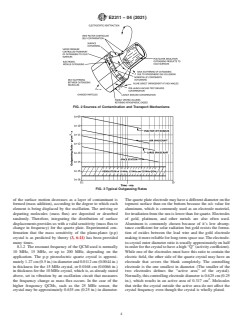
the surface of interest. The probable source and extent of Fig. 3. Some actual deposition rate conditions on a spacecraft
-12 -2 -1
contamination can be determined from known components of have been observed to be 1.2 × 10 gcm s for a sunlit
-13 -2 -1
the spacecraft and probable sources. vent-viewing OSR (4),2×10 gcm s for a mature large
-14
satellite (4), and a projected Space Station budget of1×10
6.2 PotentialcontaminationproblemareasareshowninFig.
-2 -1
gcm s (daily average) (5).
1.
6.2.1 The performance of thermal control surfaces is de-
7. Defining Molecular Contamination
graded as a result of the accumulation of contaminants, which
7.1 The process termed outgassing is a combination of
may increase the surfaces’ solar absorptance;
events (Fig. 4) including the solid state diffusion of molecules
6.2.2 Optics may be degraded by increasing “light” scatter-
to the surface, followed by desorption into the high-vacuum
ing or reflectance loss;
environment of space.When those molecules reach a sensitive
6.2.3 Electronic modules with high rates of outgassing
surface, either by line-of-sight or indirect (non-line-of-sight)
components may have voltage arc-over;
transport and deposit, the deposit is termed “molecular con-
6.2.4 Internal to the spacecraft there may be outgassing
tamination.” At low altitudes atmospheric molecules some-
sources which will degrade (for instance, mass spectrometer
times play a role in these processes by scattering or deflecting
causing signal overload conditions);
molecular contamination.
6.2.5 Windows and optical elements may be degraded by
adsorption of a contaminant film leading to a loss of
7.2 The definition of equivalent monomolecular layer
transmittance,reflectance,oranincreaseinscatteredlight;and
(EML)ofwateronasurface(Fig.5)isbasedontheconceptof
-8
6.2.6 Solar arrays are adversely affected by the absorptance
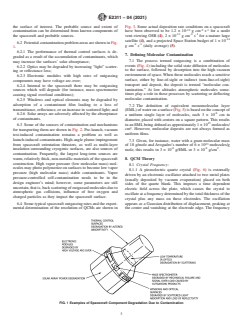
a uniform single layer of molecules, each3×10 cm in
of contaminants.
diameter, placed with centers on a square pattern. This results
inanEMLbeingdefinedasapproximately1×10 molecules/
6.3 Some of the sources of contamination and mechanisms
cm . However, molecular deposits are not always formed as
for transporting them are shown in Fig. 2. Pre-launch, vacuum
uniform films.
test-induced contamination remains a problem as well as
launch-induced contaminants. High-angle plume impingement
7.3 Given, for instance, water with a gram molecular mass
from spacecraft orientation thrusters, as well as multi-layer
of 18 g/mole andAvogadro’s number of6×10 molecules/g
-8 -8 2
insulation surrounding cryogenic surfaces, are also sources of
mole, this results in3×10 g/EML or3×10 g/cm .
contamination. Frequently, the largest long-term sources are
warm,relativelythick,non-metallicmaterialsofthespacecraft 8. QCM Theory
construction. High vapor pressure (low molecular mass) mol-
8.1 Crystal Frequency:
eculesmayphotopolymerizeonsurfacestobecomelowvapor
8.1.1 A piezoelectric quartz crystal (Fig. 6) is externally
pressure (high molecular mass) stable contaminants. Vapor
driven by an electronic oscillator attached to two metal plates
pressure-controlled self-contamination needs to be in the
(usually deposited by vacuum evaporation) placed on both
design engineer’s mind; however, some parameters are still
sides of the quartz blank. This imposes a time dependent
uncertain,thatis,backscatteringofoutgassedmoleculesdueto
electric field across the plate, which causes the crystal to
atmospheric gas collisions, influence of free oxygen and
oscillateatafrequencydeterminedbythetotalthicknessofthe
charged particles as they impact the spacecraft surface.
crystal plus any mass on these electrodes. The oscillation
6.4 Sometypicalspacecraftoutgassingratesandtheexperi- appears as a Gaussian distribution of displacement, peaking at
mental determination of the resolution of QCMs are shown in the center and vanishing at the electrode edge. The frequency
FIG. 1 Examples of Spacecraft Component Degradation Due to Contamination
E2311 − 04 (2021)
FIG. 2 Sources of Contamination and Transport Mechanisms
FIG. 3 Typical Outgassing Rates
of the surface motion decreases as a layer of contaminant is Thequartzplateelectrodemayhaveadifferentdiameteronthe
formed (mass addition), according to the degree to which each topmost surface than on the bottom because the α/ε value for
element is being displaced by the oscillation. The arriving or aluminum, which is commonly used as an electrode material,
departing molecules (mass flux) are deposited or desorbed forirradiationfromthesunislowerthanforquartz.Electrodes
randomly. Therefore, integrating the distribution of surface of gold, platinum, and other metals are also often used.
displacementsprovidesuswithavalidsensitivity(massfluxto Aluminum is commonly chosen because of it’s low absorp-
change in frequency) for the quartz plate. Experimental con- tance coefficient for solar radiation but gold resists the forma-
firmation that the mass sensitivity of the plano-plano (p-p) tion of oxides between the lead wire and the gold electrode
crystal is as predicted by theory (3, 6-11) has been provided makingitmorereliableforlong-termspaceuse.Theelectrode-
many times. to-crystal outer diameter ratio is usually approximately on half
8.1.2 The resonant frequency of the QCM used is normally inorderforthecrystaltohaveahigh“Q”(activitycoefficient).
10 MHz, 15 MHz, or up to 200 MHz, depending on the While one of the electrodes must have this ratio to contain the
application. The p-p piezoelectric quartz crystal is approxi- electric field, the other side of the quartz crystal may have an
mately1.27cm(0.5in.)indiameterand0.0112cm(0.0044in.) electrode that covers the blank completely. The controlling
in thickness for the 15 MHz crystal, or 0.0168 cm (0.0066 in.) electrode is the one smallest in diameter. (The smaller of the
inthicknessforthe10MHzcrystal,whichis,asalreadystated two electrodes defines the “active area” of the crystal).
above, set in vibration by an oscillation circuit that measures Normally,thiscontrollingelectrodediameteris0.625cm(0.25
the frequency change as mass flux occurs. In the case of the in.), which results in an active area of 0.317 cm . Molecules
higher frequency QCMs, such as the 25 MHz sensor, the that strike the crystal outside the active area do not affect the
crystal may be approximately 0.635 cm (0.25 in.) in diameter. crystal frequency even though the crystal is wholly plated.
E2311 − 04 (2021)
FIG. 4 Outgassing Combination of Events from Atmospheric Molecules on External Surfaces
8.2 Sensitivity: 8.2.6 The mass sensitivity, S, is cited in Table 1 for 5, 10,
8.2.1 The integration sensitivity of a quartz plate (mass flux and 15 MHz p-p crystals, and in Table 2, further approximate
to change in frequency) is a function of Φ (cut angle of the
sensitivities for 1 to 25 MHz are given.
crystal), ρ (crystal density) and the transverse shear wave
q
8.3 Overcoating the Electrodes—An overcoating of dielec-
velocity, c, through the quartz plate (12) (see 3.1.8).
triclayersmaybeplacedovertheelectrodesifdesired,usually
8.2.2 The frequency to mass relationship is:
up to a thickness of approximately 800 nm (8000 Å). When
d~2∆f!/d~∆m/A! 52f /ρ c 5 S (2)
q
used, overcoating is intended to simulate the material of the
surfaceofinterestorattempttomatchthevanderWaals’force
where:
effectswhenthefirstdepositedmoleculesstrikethesurface.An
f = crystal resonant frequency,
overcoating of magnesium fluoride (MgF), silicon dioxide
∆f = change in frequency due to a change in mass per unit
area on the crystal ∆m/A, (SiO ), aluminum oxide (Al O ), zinc sulfide (ZnS) and
2 2 3
ρ = density of the quartz,
indium oxide (In O ), to name a few, may be made over the
q
2 3
c = shear wave velocity perpendicular to the crystal
aluminum or gold electrode. When deposited, SiO first forms
surface, and
SiOx which, with exposure to ultra-violet, becomes SiO .
S = sensitivity.
However, since this molecular transformation results in mass
8.2.3 The machined properties of quartz due to it’s hexago- being added to the crystal; this needs to be considered if
nal structure are characterized by six independent stress long-term stability is a requirement.
constants, C , where ij = 11, 13, 14, 33, 44 and 66. The shear
ij
8.4 Radiation Effects—Natural quartz contains minute
wave velocity, c, can then be determined from:
amountsofunwantedmaterialsthatcausedetrimentaleffectsin
2 10 2 2
ρ c 5 C 10.76311 310 cos Φ1C sin Φ12C sinΦcosΦ
~ !
q 66 44 14
the processing of quartz blanks, for example, etch channels, in
completed crystal performance, there may be high-energy
8.2.4 The density of the quartz also varies from 2.6485
3 3
electron and photon effects. Crystal vendors, when required,
g/cm at room temperature to 2.664 g/cm at 77K (see 3.2.1).
apply high temperatures along with high voltage (electrodiffu-
8.2.5 The usual practice is to use a p-p AT or rotated cut
sionor“sweeping”)tothecrystalblanktogreatlydiminishthis
crystal (thickness shear vibration) at 35° 18’ to 39° 40’
effect. Swept crystals are normally ⁄200 as sensitive to induced
crystallographic cut angle (13, 14) (Fig. 7) for use in a QCM
over the wide temperature range to which it will be applied. frequency changes from radiation. Therefore, in the space
E2311 − 04 (2021)
FIG. 5 Equivalent Monomolecular Layer (EML)
environment, especially in the case of polar orbits, swept temperature of the crystal from the deposition temperature, a
crystals are recommended.
QCM Thermogravimetric Analysis (QCM TGA) can be ob-
tained. At increasing temperatures the contaminants tend to
8.5 Mass Sensor Range—The usual stated mass sensor
1 evaporate,andfromthefrequencychangeasafunctionoftime
dynamic range is ⁄100 of the resonant fundamental frequency,
the mass change and the relevant vapor pressures can be
that is, 100000 Hz for a 10 MHz crystal and 150000 Hz for a
calculated for the actual temperature. If the vapor-pressure
15MHzcrystal.Thismeansthatthesensitivitycanbeassumed
versus temperature of the candidate molecules is known,
to be essentially constant over that range. This is true only if
the deposit is a solid polycrystalline or amorphous layer, for identification of one or more molecular species may be made
example, water vapor, carbon dioxide, oxygen or nitrogen. (see 12.3).
However, if the deposit consists of liquid or droplets (as can
occur in the case of plasticizers and solvents from polymeric
9. Configuration of a QCM
materials, nucleation of outgassed products, evaporating
9.1 View Factor Effects:
liquids, and so forth, onto a “warm” crystal) this range may be
9.1.1 Most molecules arrive at an exterior QCM along
considerably reduced due to damping of the crystal oscillation
line-of-sight trajectories from warm surfaces or vent apertures
15-18).
on the spacecraft.The flux density will depend on the “field of
8.6 QCM Thermogravimetric Analysis—The QCM mea-
view” (FOV) the QCM has with these sources.To measure the
surestheamountofmassfluxonthecrystal.Itcanalsobeused
to do an elemental analysis on the mass. By raising the
E2311 − 04 (2021)
FIG. 6 Piezoelectric Quartz Crystal
mass flux from any surface of interest on the spacecraft, align the mixer output (beat frequency clean) at some particular
the normal of the crystal with the surface plane to minimize temperature with the output at the same temperature when the
view factor effects. crystal becomes “contaminated” (see 12.3).
9.1.2 Amuch smaller flux density will arrive at an exterior 9.2.3 The beat frequency versus temperature for the clean
QCM along non-line-of-sight trajectories. A cold (or non- condition is never ideally matched (Fig. 11), although usually
sunlit) QCM surface may indicate a measurable deposition a simple polynomial equation can be used to describe the
rate, even when it is not in line-of-sight. (17, 19, 20). QCM’s behavior if it is repeatable. A thoroughly repeatable
9.1.3 The FOV of a crystal, flush with the surface, is 2π thermal-vacuum test in a “contamination-free” environment
steradian, as shown in Fig. 8. In practice, the FOV of the willassurefrequencyrepeatabilitywithtemperature,evenwith
crystal is usually partially restricted by the mounting arrange- hysteresis effects, that is, when decreasing temperature does
ment. Therefore its Clausing (21, 22) conductance factor re- not give the same frequency as increasing temperature. This
sults in less than one. The different FOV can reduce the hysteresisresults,atleastinpart,whenthesenseandreference
effective mass sensitivity for each QCM design, even though crystals are not isothermal. Obviously, good thermal contact
crystal performance is unchanged. between the crystals and temperature sensor is important if the
sensor is to portray the actual temperature of the crystals.
9.2 Sense and Reference Crystals:
9.2.1 Acrystal’s frequency is temperature sensitive as well 9.3 Insolation Effect:
as mass sensitive, as illustrated in Fig. 9. A cubic curve, 9.3.1 Exposure of the crystals to thermal radiation from the
centeredaround25°Cinthisexample,describesthefrequency sun or other IR sources, termed “insolation,” effects the
versus temperature variation. The sensitivity of the QCM to frequency of oscillation of the crystals by imposing a tempera-
temperature is minimized by matching two crystals and mea- ture gradient across the diameter, as shown in Fig. 12(a). Each
suring their beat frequency. time the sun comes into the field of view of the QCM the
9.2.2 The reference and the sense crystals (Fig. 10a) are crystalwillreflectsomeoftheradiation,butalsopartlyabsorb
usually selected such that the beat frequency of the clean the radiation, causing a thermal gradient and thus a frequency
two-crystal assembly at the desired “center” temperature is in change.Thesizeofthiseffectisinfluencedbytheα /ε ratioof
s η
the range of 2 to 5 KHz to avoid any “lock-on” of two themetalelectrode,thecrystalthicknessandthemannerofthe
oscillators. The sense crystal assembly should have the lower crystal mount. In most validated configurations the sense
frequencywithrespecttothereferencecrystal,asillustratedin crystal and the reference crystal are in line so that the outside
Fig. 10b, since added mass on the crystal lowers the frequency case dimensions are minimized. Therefore, the sense crystal is
of oscillation. Otherwise, the beat frequency will not be a the crystal that is exposed to thermal radiation and thus its
monotonic function of mass. Matching the frequency of the frequency changes, but the reference crystal, protected from
sense and reference crystals, while “clean” of contamination, the incoming mass flux, is not affected. This effect, treated by
overthetemperaturerangeofinterestfacilitatescomparisonof WarnerandStockbridge (23)andWallace (24),hasbeenfound
E2311 − 04 (2021)
FIG. 7 Locus of First Order Zero Temperature Coefficient of Frequency for Crystals in Thickness-Shear Oscillation
TABLE 1 Mass Sensitivity of Crystals TABLE 2 Approximate Sensitivities of Various P-P Crystals
Crystal Mass Crystal Oscillator Approximate Sensitivity
f = 5 MHz f=10MHz f=15MHz
2 -1
Temp. Sensitivity Frequency (MHz) at 20°C (cm g Hz)
2 7 8 8 6
25°C S ' Hz/g/cm 5.6569 × 10 2.2627 × 10 5.0912 × 10 1 2.26×10
2 -8 -9 -9 6
1/S ' g/cm -Hz 1.7677 × 10 4.4195 × 10 1.9642 × 10 2 9.05×10
7 8 8 7
LN -LHe S 5.6417 × 10 2.2566 × 10 5.0775 × 10 5 5.66×10
-8 -9 8
1/S 1.7725 × 10 4.43124 × 1.9695 × 10 10 2.26 × 10
-9 8
10 15 5.09 × 10
20 9.05 × 10
25 1.41 × 10
to be in the range of 40 to 150 Hz change, depending on the
crystal’s initial temperature. The sense crystal’s frequency
tance quartz window, for example, suprasil, is placed in front
must always be less than that of the reference crystal and an
of the reference crystal so that mass flux is rejected while still
increase in its frequency will decrease the beat frequency.
passing through the solar radiation.
9.3.2 An alternate QCM design is a side-by-side configura-
tion of the sense and reference electrodes on the same quartz 9.4 Temperature Sensor:
blank, as shown in Fig. 12(b). Both receive the same solar 9.4.1 The crystal temperature of the QCM needs to be
(thermal) radiation so they have the same imposed thermal known within as little as 0.25 K at each point in the QCM’s
gradients on their electrodes, and thus frequency additions on temperaturerangesothatthefrequency/temperaturecorrection
the two electrodes are approximately canceled out when beat canbeaccuratelyappliedandthepreciseadsorption/desorption
frequency is measured, as shown in the figure. A low absorp- measurements can be made. Thus, the heat transfer path
E2311 − 04 (2021)
FIG. 8 Influence of View Factor on Effective Crystal Sensitivity
9.4.3 The Calendar-Van Dusen equation approximates the
resistance, R, versus temperature, T, for the PRT and is given
below:
R /R 511α T 2δ T/100 21 T/100 2β T/100 21 T/100
@ ~ ! ~ !~ ! #
T O
(3)
where α, β, and δ are constants, T is in degrees Celsius, and
R is the resistance at 0° C.
O
9.4.4 Inthecaseofthesilicondiodetemperaturesensor,the
greatestsourceoferrorisaninabilitytoprovide10µAconstant
current to the sensor rather than measurement inaccuracies in
output voltage of the silicon diode.
9.5 QCM Electronics:
9.5.1 As previously discussed, the sense and reference
crystals are individually driven by two oscillators with their
FIG. 9 Temperature Effect on a Single AT Cut Crystal
output entering a mixer circuit which results in a beat fre-
quency. The electronics should be manufactured with at least
between the crystal and the temperature sensor needs to be
MIL-STD-883 level parts and according to some published
thermally highly conductive. One way to accomplish this is to
specifications, S-level parts are required.
spring load the quartz crystals against gold-plated rings which
9.6 Flight-Qualified Specifications for QCM Sensor
are bolted to a gold-plated spacer that holds the temperature
Heads—Recommended specifications for fully flight-qualified
sensor.
QCMs:
9.4.2 The temperature sensor may be a four-wire PRT
(platinum resistance thermometer) element (Fig. 13a) or a 9.6.1 Material selection according to Test Method E595
four-wire silicon diode (Fig. 13b) or an RTD (resistance
(<1% TML and <0.1% CVCM) and Test Method E1559.
temperaturedetector).TheaccuracyofthePRTcalibrationcan
9.6.2 Component parts certified by lots and traced through
be improved after the temperature sensor has been installed in
travelers in the subassembly and assembly stages.
the QCM plate holder.
9.6.3 Contamination Control—Assembled on an ISO Class
5 (FED-STD-209E Class 100) Clean Bench.
Thesolesourcesofsupplyoftheapparatusknowntothecommitteeatthistime 9.6.4 Workmanship and soldering per MIL-S-45743.
are Therm-X of California, 31363 Medallion Dr., Hayward, CA 94544; and
9.6.5 Crystals inspected and selected by impedance meter,
Translogic, Inc., 5641 Edinger Dr., Huntington Beach, CA92649. If you are aware
measured Q of each crystal; “swept” to 1 Mrd (impervious to
of alternative suppliers, please provide this information to ASTM International
Headquarters.Your comments will receive careful consideration at a meeting of the
radiation even in Polar Orbit).
responsible technical committee, which you may attend.
9.6.6 Temperature Sensor—Each PRT sensor calibrated af-
Thesolesourcesofsupplyoftheapparatusknowntothecommitteeatthistime
ter it has been mounted in the QCM spacer, Alpha, Beta and
are Omega Engineering, Inc., One Omega Dr., P.O. Box 4047, Stamford, CT
06907–0047; and Lake Shore Cryotronics, Inc., 64 E. Walnut St., Westerville, OH
Gamma measured in Callendar-Van Dusen Equation deter-
43081-2399. If you are aware of alternative suppliers, please provide this informa-
mines exact temperature, error determined to be less than
tion to ASTM International Headquarters. Your comments will receive careful
0.25°C. Each silicon diode sensor is supplied with a 10 µA
consideration at a meeting of the responsible technical committee, which you may
attend. constant current.
E2311 − 04 (2021)
FIG. 10 (a) Relationship Between Reference and Sense Frequency
(b) Typical Response of the Sense Crystal to Outgassing Exposure from External Surfaces and the Result of Sudden Heating on the
Sense Crystal
FIG. 11 Rationale
...