

ASTM F2549-22
(Specification)Standard Consumer Safety Specification for Frame Child Carriers
General Information
- Abstract
ABSTRACT
This consumer safety specification is intended to address incidents reported by the U.S. Consumer Product Safety Commission (CPSC) relating to frame child carriers. In response to the incident data compiled by the CPSC, this consumer safety specification attempts to minimize the hazards associated with these products from the following: occupant retention, structural integrity, and deficiency of consumer education regarding product use. This consumer safety specification is intended to deal with reasonably foreseeable use and misuse of the products. Performance requirements of the frame child carriers shall be determined by subjecting them to the following tests: leg opening test, dynamic strength test, static load test, stability test, locking device test, unintentional folding test, and removal of protective components test such as torque test and tension test. Instructions shall be provided with the product and shall be easy to read and understand. Instructions for assembly, use, maintenance, and cleaning of the product, and warnings, where applicable, shall be included.
SCOPE
1.1 This consumer safety specification covers performance requirements, test methods, and marking requirements to promote safe use of frame child carriers.
1.2 This consumer safety specification is intended to minimize the risk of injury to a child from the normal use and reasonably foreseeable misuse of these products.
1.3 For the purposes of this consumer safety specification, a frame child carrier is a product, normally of sewn fabric construction on a tubular metal or other frame, which is designed to carry a child, in an upright position, on the back of the caregiver. A frame child carrier is intended for use with a child that is able to sit upright unassisted and weighs between 16 lb and 50 lb (7.3 kg and 22.7 kg). The frame child carrier is intended to be worn on the back of the caregiver’s body, with the carrier, and thus the child, suspended from both shoulders of the caregiver. The seated position of the child is either facing towards or away from the caregiver.
1.4 No frame child carrier produced after the approval date of this consumer safety specification shall, either by label or other means, indicate compliance with the specification unless it complies with all of the requirements contained herein.
1.5 This consumer safety specification is not intended to address incidents and injuries resulting from the interaction of other persons or objects with the caregiver and child while the frame child carrier is in use.
1.6 The values stated in inch-pound units are to be regarded as standard. The values given in parentheses are mathematical conversions to SI units that are provided for information only and are not considered standard.
1.7 The following precautionary caveat pertains only to the test method portion, Section 7, of this specification. This standard does not purport to address all of the safety concerns, if any, associated with its use. It is the responsibility of the user of this standard to establish appropriate safety, health, and environmental practices and determine the applicability of regulatory limitations prior to use.
1.8 This international standard was developed in accordance with internationally recognized principles on standardization established in the Decision on Principles for the Development of International Standards, Guides and Recommendations issued by the World Trade Organization Technical Barriers to Trade (TBT) Committee.
- Status
- Published
- Publication Date
- 31-Mar-2022
- Technical Committee
- F15 - Consumer Products
- Drafting Committee
- F15.21 - Infant Carriers, Bouncers and Baby Swings
Buy Documents
ASTM F2549-22 - Standard Consumer Safety Specification for Frame Child Carriers
REDLINE ASTM F2549-22 - Standard Consumer Safety Specification for Frame Child Carriers
Overview
ASTM F2549-22: Standard Consumer Safety Specification for Frame Child Carriers is a comprehensive safety standard developed by ASTM International. This specification is designed to reduce hazards and address safety incidents related to frame child carriers, as identified by the U.S. Consumer Product Safety Commission (CPSC). The standard outlines performance, labelling, and testing requirements to help manufacturers, buyers, and regulators ensure these products are safe for children and caregivers in normal and reasonably foreseeable misuse.
Frame child carriers are typically constructed of sewn fabric mounted on a tubular metal (or similar) frame and are designed to carry a child on the caregiver’s back. ASTM F2549-22 focuses on hazards related to occupant retention, structural integrity, and sufficient consumer education. The specification applies to products for children able to sit upright unassisted and weighing between 16 lb and 50 lb (7.3 kg and 22.7 kg).
Key Topics
Hazard Minimization
- Preventing injury from leg openings and falls
- Ensuring no hazardous sharp edges, small parts, or flammable materials
- Protection from scissoring, shearing, and pinching hazards
- Requirement for occupant retention systems that secure the child safely
Testing and Performance Requirements
- Leg opening tests
- Dynamic and static load tests to evaluate frame integrity
- Stability and handle integrity tests
- Locking device and unintentional folding tests
- Tests for permanence of warning labels and protective components
Labeling and Instructions
- Warning statements in prominent, permanent contrasting fonts
- Specific warnings about falls, weight limits, and safe usage practices
- Clear identification of manufacturer and date of manufacture
- Instructional literature for assembly, use, maintenance, and cleaning
Material Safety
- Compliance with federal regulations for lead, flammability, and hazardous substances
- Smooth, splinter-free wooden parts
- Protective coverings on exposed coil springs
Applications
ASTM F2549-22 is vital in the design, manufacture, and regulatory compliance of frame child carriers. Practical applications include:
- Product Design & Development: Manufacturers integrate these requirements into design, material selection, and construction to ensure child safety and regulatory compliance.
- Quality Assurance & Testing: Test laboratories and manufacturers use the prescribed methods to routinely verify product safety and performance before launching to market.
- Retail & Regulatory Oversight: Retailers and importers verify compliance to reduce distribution of non-conforming or unsafe products, ensuring adherence to both U.S. and international safety standards for child carriers.
- Consumer Education: The standard emphasizes accurate and visible warnings, as well as user-friendly instructional manuals, contributing to safer everyday use and fewer misuse-related incidents.
Related Standards
ASTM F2549-22 references several related standards and regulatory requirements that provide additional context and harmonization:
- ASTM F2236 - Safety specification for soft infant and toddler carriers
- ASTM F2907 - Safety specification for sling carriers
- ASTM F963 - Consumer safety specification for toy safety
- EN 13209 - European standard for child use and care articles-child carriers
- 16 CFR 1303, 1500, 1501, 1610 - U.S. federal regulations on hazardous substances, small parts, lead content, and flammability
- ANSI Z535 Series - Standards for product safety labels and instructions
By adhering to ASTM F2549-22, manufacturers not only improve product safety for children but also facilitate international trade and market acceptance, ensuring their frame child carriers meet recognized benchmarks for quality and safety.
Relations
- Effective Date
- 01-Aug-2023
- Effective Date
- 01-Sep-2016
- Effective Date
- 01-Aug-2016
- Effective Date
- 01-May-2016
- Effective Date
- 15-Oct-2015
- Effective Date
- 01-Jul-2014
- Effective Date
- 15-Feb-2014
- Effective Date
- 01-Jan-2014
- Effective Date
- 01-Jan-2014
- Effective Date
- 01-Nov-2013
- Effective Date
- 01-Oct-2013
- Effective Date
- 01-Aug-2013
- Effective Date
- 15-Apr-2013
- Effective Date
- 01-Mar-2013
- Effective Date
- 01-May-2012
Buy Documents
ASTM F2549-22 - Standard Consumer Safety Specification for Frame Child Carriers
REDLINE ASTM F2549-22 - Standard Consumer Safety Specification for Frame Child Carriers
Frequently Asked Questions
ASTM F2549-22 is a technical specification published by ASTM International. Its full title is "Standard Consumer Safety Specification for Frame Child Carriers". This standard covers: ABSTRACT This consumer safety specification is intended to address incidents reported by the U.S. Consumer Product Safety Commission (CPSC) relating to frame child carriers. In response to the incident data compiled by the CPSC, this consumer safety specification attempts to minimize the hazards associated with these products from the following: occupant retention, structural integrity, and deficiency of consumer education regarding product use. This consumer safety specification is intended to deal with reasonably foreseeable use and misuse of the products. Performance requirements of the frame child carriers shall be determined by subjecting them to the following tests: leg opening test, dynamic strength test, static load test, stability test, locking device test, unintentional folding test, and removal of protective components test such as torque test and tension test. Instructions shall be provided with the product and shall be easy to read and understand. Instructions for assembly, use, maintenance, and cleaning of the product, and warnings, where applicable, shall be included. SCOPE 1.1 This consumer safety specification covers performance requirements, test methods, and marking requirements to promote safe use of frame child carriers. 1.2 This consumer safety specification is intended to minimize the risk of injury to a child from the normal use and reasonably foreseeable misuse of these products. 1.3 For the purposes of this consumer safety specification, a frame child carrier is a product, normally of sewn fabric construction on a tubular metal or other frame, which is designed to carry a child, in an upright position, on the back of the caregiver. A frame child carrier is intended for use with a child that is able to sit upright unassisted and weighs between 16 lb and 50 lb (7.3 kg and 22.7 kg). The frame child carrier is intended to be worn on the back of the caregiver’s body, with the carrier, and thus the child, suspended from both shoulders of the caregiver. The seated position of the child is either facing towards or away from the caregiver. 1.4 No frame child carrier produced after the approval date of this consumer safety specification shall, either by label or other means, indicate compliance with the specification unless it complies with all of the requirements contained herein. 1.5 This consumer safety specification is not intended to address incidents and injuries resulting from the interaction of other persons or objects with the caregiver and child while the frame child carrier is in use. 1.6 The values stated in inch-pound units are to be regarded as standard. The values given in parentheses are mathematical conversions to SI units that are provided for information only and are not considered standard. 1.7 The following precautionary caveat pertains only to the test method portion, Section 7, of this specification. This standard does not purport to address all of the safety concerns, if any, associated with its use. It is the responsibility of the user of this standard to establish appropriate safety, health, and environmental practices and determine the applicability of regulatory limitations prior to use. 1.8 This international standard was developed in accordance with internationally recognized principles on standardization established in the Decision on Principles for the Development of International Standards, Guides and Recommendations issued by the World Trade Organization Technical Barriers to Trade (TBT) Committee.
ABSTRACT This consumer safety specification is intended to address incidents reported by the U.S. Consumer Product Safety Commission (CPSC) relating to frame child carriers. In response to the incident data compiled by the CPSC, this consumer safety specification attempts to minimize the hazards associated with these products from the following: occupant retention, structural integrity, and deficiency of consumer education regarding product use. This consumer safety specification is intended to deal with reasonably foreseeable use and misuse of the products. Performance requirements of the frame child carriers shall be determined by subjecting them to the following tests: leg opening test, dynamic strength test, static load test, stability test, locking device test, unintentional folding test, and removal of protective components test such as torque test and tension test. Instructions shall be provided with the product and shall be easy to read and understand. Instructions for assembly, use, maintenance, and cleaning of the product, and warnings, where applicable, shall be included. SCOPE 1.1 This consumer safety specification covers performance requirements, test methods, and marking requirements to promote safe use of frame child carriers. 1.2 This consumer safety specification is intended to minimize the risk of injury to a child from the normal use and reasonably foreseeable misuse of these products. 1.3 For the purposes of this consumer safety specification, a frame child carrier is a product, normally of sewn fabric construction on a tubular metal or other frame, which is designed to carry a child, in an upright position, on the back of the caregiver. A frame child carrier is intended for use with a child that is able to sit upright unassisted and weighs between 16 lb and 50 lb (7.3 kg and 22.7 kg). The frame child carrier is intended to be worn on the back of the caregiver’s body, with the carrier, and thus the child, suspended from both shoulders of the caregiver. The seated position of the child is either facing towards or away from the caregiver. 1.4 No frame child carrier produced after the approval date of this consumer safety specification shall, either by label or other means, indicate compliance with the specification unless it complies with all of the requirements contained herein. 1.5 This consumer safety specification is not intended to address incidents and injuries resulting from the interaction of other persons or objects with the caregiver and child while the frame child carrier is in use. 1.6 The values stated in inch-pound units are to be regarded as standard. The values given in parentheses are mathematical conversions to SI units that are provided for information only and are not considered standard. 1.7 The following precautionary caveat pertains only to the test method portion, Section 7, of this specification. This standard does not purport to address all of the safety concerns, if any, associated with its use. It is the responsibility of the user of this standard to establish appropriate safety, health, and environmental practices and determine the applicability of regulatory limitations prior to use. 1.8 This international standard was developed in accordance with internationally recognized principles on standardization established in the Decision on Principles for the Development of International Standards, Guides and Recommendations issued by the World Trade Organization Technical Barriers to Trade (TBT) Committee.
ASTM F2549-22 is classified under the following ICS (International Classification for Standards) categories: 97.190 - Equipment for children. The ICS classification helps identify the subject area and facilitates finding related standards.
ASTM F2549-22 has the following relationships with other standards: It is inter standard links to ASTM F963-23, ASTM F2236-16a, ASTM F963-16, ASTM F2236-16, ASTM F2907-15, ASTM F2907-14b, ASTM F2907-14a, ASTM F2907-14, ASTM F2236-14, ASTM F2236-13a, ASTM F2907-13b, ASTM F2907-13a, ASTM F2907-13, ASTM F2236-13, ASTM F2236-12. Understanding these relationships helps ensure you are using the most current and applicable version of the standard.
ASTM F2549-22 is available in PDF format for immediate download after purchase. The document can be added to your cart and obtained through the secure checkout process. Digital delivery ensures instant access to the complete standard document.
Standards Content (Sample)
This international standard was developed in accordance with internationally recognized principles on standardization established in the Decision on Principles for the
Development of International Standards, Guides and Recommendations issued by the World Trade Organization Technical Barriers to Trade (TBT) Committee.
Designation: F2549 −22
Standard Consumer Safety Specification for
Frame Child Carriers
This standard is issued under the fixed designation F2549; the number immediately following the designation indicates the year of
original adoption or, in the case of revision, the year of last revision. A number in parentheses indicates the year of last reapproval. A
superscript epsilon (´) indicates an editorial change since the last revision or reapproval.
INTRODUCTION
This consumer safety specification addresses incidents associated with frame child carriers
identified by the U.S. Consumer Product Safety Commission (CPSC).
In response to incident data compiled by the CPSC, this specification attempts to minimize fall
hazards associated with occupant retention and structural integrity of the product(s), as well as the
deficiency of consumer education regarding product use.
This specification is intended to cover normal use and reasonably foreseeable misuse or abuse of
the product(s).
This specification is written within the current state-of-the-art of frame child carrier technology and
will be updated whenever substantive information becomes available that necessitates additional
requirements or justifies the revision of existing requirements.
1. Scope other persons or objects with the caregiver and child while the
frame child carrier is in use.
1.1 This consumer safety specification covers performance
requirements, test methods, and marking requirements to 1.6 The values stated in inch-pound units are to be regarded
promote safe use of frame child carriers.
as standard. The values given in parentheses are mathematical
conversions to SI units that are provided for information only
1.2 This consumer safety specification is intended to mini-
and are not considered standard.
mize the risk of injury to a child from the normal use and
reasonably foreseeable misuse of these products. 1.7 The following precautionary caveat pertains only to the
test method portion, Section 7, of this specification. This
1.3 For the purposes of this consumer safety specification, a
standard does not purport to address all of the safety concerns,
frame child carrier is a product, normally of sewn fabric
if any, associated with its use. It is the responsibility of the user
construction on a tubular metal or other frame, which is
of this standard to establish appropriate safety, health, and
designed to carry a child, in an upright position, on the back of
environmental practices and determine the applicability of
the caregiver. A frame child carrier is intended for use with a
regulatory limitations prior to use.
child that is able to sit upright unassisted and weighs between
1.8 This international standard was developed in accor-
16 lb and 50 lb (7.3 kg and 22.7 kg). The frame child carrier is
dance with internationally recognized principles on standard-
intended to be worn on the back of the caregiver’s body, with
ization established in the Decision on Principles for the
the carrier, and thus the child, suspended from both shoulders
Development of International Standards, Guides and Recom-
ofthecaregiver.Theseatedpositionofthechildiseitherfacing
mendations issued by the World Trade Organization Technical
towards or away from the caregiver.
Barriers to Trade (TBT) Committee.
1.4 No frame child carrier produced after the approval date
of this consumer safety specification shall, either by label or
2. Referenced Documents
other means, indicate compliance with the specification unless
2.1 ASTM Standards:
it complies with all of the requirements contained herein.
F2236 Consumer Safety Specification for Soft Infant and
1.5 This consumer safety specification is not intended to
Toddler Carriers
address incidents and injuries resulting from the interaction of
D3359 Test Methods for Rating Adhesion by Tape Test
F963 Consumer Safety Specification for Toy Safety
This specification is under the jurisdiction of ASTM Committee F15 on
Consumer Products and is the direct responsibility of Subcommittee F15.21 on
Infant Carriers, Bouncers and Baby Swings. For referenced ASTM standards, visit the ASTM website, www.astm.org, or
Current edition approved April 1, 2022. Published May 2022. Originally contact ASTM Customer Service at service@astm.org. For Annual Book of ASTM
approved in 2006. Last previous edition approved in 2014 as F2549 – 14a. DOI: Standards volume information, refer to the standard’s Document Summary page on
10.1520/F2549-22. the ASTM website.
Copyright © ASTM International, 100 Barr Harbor Drive, PO Box C700, West Conshohocken, PA 19428-2959. United States
F2549 − 22
F2907 Consumer Safety Specification for Sling Carriers ANSI Z535.6 Product Safety Information in Product
Manuals, Instructions, and Other Collateral Materials
2.2 EN Standard:
EN 13209 Child Use and Care Articles (Child Carriers
3. Terminology
Safety Requirements and Test Methods)
2.3 Federal Regulations:
3.1 Definitions:
16 CFR 1303 Ban of Lead Containing Paint and Certain
3.1.1 attachment system, n—a system provided to secure the
Consumer Products Bearing Lead-Containing Paint
product to the caregiver’s torso in any of the manufacturer’s
16 CFR 1500 Hazardous Substance Act regulations includ-
recommended use positions.
ing:
3.1.2 conspicuous, adj—visible when the product is in the
1500.3 (c) (6) (vi) Definition of “Flammable Solid”
manufacturer’s use position to a caregiver who is placing the
1500.44 Method for Determining Extremely Flammable and
occupantintheframechildcarrierorwhenthecaregiverplaces
Flammable Solids
the product on his or her body.
1500.48 Technical Requirements for Determining a Sharp
3.1.3 cord, n—length of slender, flexible material including
Point in Toys or Other Articles Intended for Use By
monofilaments, rope, woven and twisted cord, plastic or textile
Children Under Eight Years of Age
tapes, ribbons, and those fibrous materials commonly called
1500.49 Technical Requirements for Determining a Sharp
string.
MetalorGlassEdgeinToysorOtherArticlesIntendedfor
Use By Children Under Eight Years of Age 3.1.4 fabric, n—any woven, knit, coated, laminated,
16 CFR 1501 Method for Identifying Toys and Other Ar-
extruded, or calendered flexible material that is intended to be
ticles Intended for Use by Children Under Three Years of sewn, welded, heat sealed, or glued together as an assembly.
Age Which Present Choking, Aspiration or Ingestion
3.1.5 handle, n—a component intended to facilitate lifting
Hazards Because of Small Parts
of the frame child carrier.
16 CFR 1610 Standard for the Flammability of Clothing
3.1.6 kickstand, n—a hinged frame member designed to
Textiles
deploy and allow the child carrier to stand freely, in the upright
2.4 Other Document:
position, for loading of child. The frame member can then be
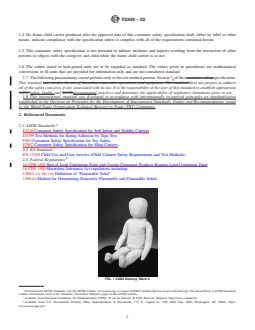
CAMI Infant Dummy, Mark II (see Fig. 1)
retracted when the carrier is in use.
2.5 ANSI Standards:
3.1.7 leg opening, n—the opening in the frame child carrier
ANSI Z535.1 Safety Colors
through which the occupant’s legs extend when the product is
ANSI Z535.4 Product Safety Signs and Labels
used in any of the manufacturer’s recommended use positions.
3.1.8 manufacturer’s recommended use position(s), n— any
position that is presented as a normal, allowable, or acceptable
Available from European Committee for Standardization (CEN), 36 rue de
configuration for use of the product by the manufacturer in any
Stassart, B-1050, Brussels, Belgium, http://www.cenorm.be.
descriptive or instructional literature. This specifically ex-
AvailablefromU.S.GovernmentPrintingOfficeSuperintendentofDocuments,
cludes positions that the manufacturer shows in a like manner
732 N. Capitol St., NW, Mail Stop: SDE, Washington, DC 20401, http://
www.access.gpo.gov.
in its literature to be unacceptable, unsafe, or not recom-
Available from American National Standards Institute (ANSI), 25 W. 43rd St.,
mended.
4th Floor, New York, NY 10036, http://www.ansi.org.
3.1.9 occupant, n—that individual who is restrained in a
seated position inside the frame child carrier in one of the
manufacturer’s recommended use positions.
3.1.10 occupant retention system, n—a system provided to
secure the occupant in a seated position in any of the
manufacturer’s recommended use positions.
3.1.11 non-paper label, n—any label material (such as
plasticormetal)thateitherwillnottearwithouttheaidoftools
or tears, leaving a sharply defined edge.
3.1.12 paper label, n—any label material that tears without
the aid of tools and leaves a fibrous edge.
3.1.13 seam, n—ameansofjoiningfabriccomponents,such
as sewing, welding, heat sealing, or gluing.
3.1.14 staticload,n—averticallydownwardloadappliedby
weights or other means.
4. Calibration and Standardization
4.1 The product shall be completely assembled in accor-
FIG. 1 CAMI Dummy, Mark II dance with the manufacturer’s instructions.
F2549 − 22
4.2 No testing shall be conducted within 48 h of manufac- 5.9 Unintentional Folding—If the frame child carrier is
ture. designed to allow it to stand freely in the upright position by
utilizing a kickstand or other means, the carrier shall remain in
4.3 The product to be tested shall be at an ambient tempera-
the manufacturer’s recommended use position before and after
ture of 73 6 9°F (23 6 5°C) for at least 1 h before testing.All
completion of all tests in 7.9.
testing shall be conducted in this temperature range.
5.10 Labeling—Warning labels (whether paper or non-
4.4 All testing required by this consumer safety specifica-
paper) shall be permanent when tested in accordance with 7.7.
tion shall be conducted on the same unit in the order presented
5.10.1 Warning statements applied directly onto the surface
in this specification.
of the product by hot stamping, heat transfer, printing, wood
burning, and so forth shall be permanent when tested in
5. General Requirements
accordance with 7.7.
5.1 Hazardous Sharp Points or Edges—There shall be no
5.10.2 Non-paper labels shall not liberate small parts when
sharp points or edges as defined by 16 CFR 1500.48 and 16
tested in accordance with 7.7.
CFR 1500.49 before and after testing.
5.11 Protective Components—If the child can grasp protec-
5.2 Small Parts—Thereshallbenosmallpartsasdefinedby
tive components between the thumb and forefinger, or teeth, or
16 CFR 1501 before testing or liberated as a result of testing to
if there is at least a 0.04 in. (1.0 mm) gap between the
this specification.
componentanditsadjacentparentcomponent,suchcomponent
5.3 Lead in Paint—The paint or surface coating on the
shall not be removed when tested in accordance with 7.10.All
product shall comply with 16 CFR 1303.
protective components that are accessible to a child in the
product shall be evaluated.
5.4 Wood Parts—Prior to testing, any wooden parts shall be
smooth and free of splinters.
5.12 Flammability of Frame Child Carriers:
5.12.1 There shall be no Class 2 or 3 fabrics used in the
5.5 Scissoring, Shearing, and Pinching—The product, when
construction of a frame child carrier when the fabrics are
in the manufacturer’s recommended use position(s), shall be
evaluated against the requirements of 16 CFR 1610.
designed and constructed to prevent injury to the occupant
from any scissoring, shearing, or pinching when members or
NOTE 1—The exemptions listed in 16 CFR sections 1610.1(d) and
components rotate about a common axis or fastening point,
1610.6(a)(1)(vi) apply when a fabric is evaluated against the requirements
of 16 CFR 1610.
slide, pivot, fold, or otherwise move relative to one another.
Scissoring, shearing, or pinching that may cause injury exists
5.12.2 There shall be no flammable solids as defined in
when the edges of the rigid parts admit a probe greater than
16 CFR 1500.3(c)(6)(vi) before or after testing in accordance
0.210 in. (5.33 mm) and less than 0.375 in. (9.53 mm) in
with this specification.
diameter at any accessible point throughout the range of
5.12.3 Non-toy accessories that are sold with and intended
motion of such parts.
to be attached to the product shall also meet the requirements
5.6 Openings—Holes or slots that extend entirely through a of 5.12.
wall section of any rigid material less than 0.375 in. (9.53 mm)
5.13 Toys—Toy accessories attached to, removable from, or
thick and admit a 0.210 in. (5.33 mm) diameter rod shall also
sold with a child frame carrier, as well as their means of
admit a 0.375 in. (9.53 mm) diameter rod. Holes or slots that
attachment, shall comply with the applicable requirements of
are between 0.210 in. (5.33 mm) and 0.375 in. (9.53 mm) and
Consumer Safety Specification F963.
have a wall thickness less than 0.375 in. (9.53 mm), but are
limited in depth to 0.375 in. (9.53 mm) maximum by another
6. Performance Requirements
rigidsurfaceshallbepermissible(seeFig.2).Theproductshall
6.1 Leg Openings—Leg openings shall not permit the pas-
be evaluated in all manufacturers’ recommended use positions.
sage of the Leg Opening Test Sphere when tested in accor-
5.7 Exposed Coil Springs—Any exposed coil spring which
dance with 7.1.
is accessible to the occupant, having or capable of generating
6.2 Dynamic Strength—The carrier shall not create a haz-
a space between coils of 0.210 in. (5.33 mm) or greater during
static load testing (see 7.3) shall be covered or otherwise ardous condition, such as frame or fasteners breaking or
disengaging or seams separating, and shall show no damage
designed to prevent injury.
that will impair its function, when tested in accordance with
5.8 Locking and Latching—Any frame child carrier that
7.2. Seams of pockets, pouches, and other carrying receptacles
folds, for storage or transport, shall have a latching or locking
are exempt from these requirements.Adjustable components in
deviceorotherprovisioninthedesignthatwillpreventtheunit
the occupant retention system and attachment system shall not
from unintentionally folding when properly placed in the
slip more than 1 in. (25.4 mm) per strap as a result of the
manufacturer’s recommended use position. The unit shall
dynamic testing in accordance with 7.2.4 and 7.2.5.
remain in its manufacturer’s recommended use position during
and upon completion of the test in accordance with 7.8.Ifa 6.3 Static Load—The carrier shall not create a hazardous
unit is designed with a latching or locking device, that device condition, such as not supporting the test weight, frame or
shall remain engaged and operative after testing. This require- fasteners breaking or disengaging, or seams separating, when
ment does not apply to the carrier kickstand. tested in accordance with 7.3. Adjustable elements in the
F2549 − 22
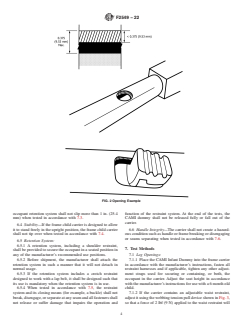
FIG. 2 Opening Example
occupant retention system shall not slip more than 1 in. (25.4 function of the restraint system. At the end of the tests, the
mm) when tested in accordance with 7.3. CAMI dummy shall not be released fully or fall out of the
carrier.
6.4 Stability—If the frame child carrier is designed to allow
it to stand freely in the upright position, the frame child carrier 6.6 Handle Integrity—The carrier shall not create a hazard-
shall not tip over when tested in accordance with 7.4. ous condition such as handle or frame breaking or disengaging
or seams separating when tested in accordance with 7.6.
6.5 Retention System:
6.5.1 A retention system, including a shoulder restraint,
7. Test Methods
shall be provided to secure the occupant in a seated position in
any of the manufacturer’s recommended use positions. 7.1 Leg Openings:
6.5.2 Before shipment, the manufacturer shall attach the 7.1.1 Place the CAMI Infant Dummy into the frame carrier
retention system in such a manner that it will not detach in in accordance with the manufacturer’s instructions, fasten all
normal usage. restraint harnesses and if applicable, tighten any other adjust-
6.5.3 If the retention system includes a crotch restraint ment straps used for securing or containing, or both, the
designed to work with a lap belt, it shall be designed such that occupant in the carrier. Adjust the seat height in accordance
its use is mandatory when the retention system is in use. with the manufacturer’s instructions for use with a 6 month old
6.5.4 When tested in accordance with 7.5, the restraint child.
system and its closing means (for example, a buckle) shall not 7.1.2 If the carrier contains an adjustable waist restraint,
break,disengage,orseparateatanyseamandallfastenersshall adjust it using the webbing tension pull device shown in Fig. 3,
not release or suffer damage that impairs the operation and so that a force of 2 lbf (9 N) applied to the waist restraint will
F2549 − 22
that the carrier has all of the same adjustment positions set in
7.1.1 – 7.1.3. For any straps or restraints that need to be
loosened in order to remove CAMI, mark the webbing of the
straps/restraints before loosening to help ensure that the same
adjustment position can be repeated.
7.1.5 Place the Leg Opening Test Sphere (Fig. 4)inthe
carrier leg opening and gradually tilt the carrier, over a period
of 5 s, in a manner such that the leg opening of the carrier is
horizontal.
7.1.6 Allow the sphere to rest in the opening for an
additional 1 min.
7.1.7 Repeat 7.1.5 and 7.1.6 for the other leg opening.
7.2 Dynamic Strength Test:
7.2.1 Position, secure, and adjust the frame child carrier
onto the test torso (see Fig. 5) in accordance with the
manufacturer’s instructions.
7.2.2 Position a weight of 40 lb (18.1 kg) or the manufac-
turer’s maximum recommended weight for the occupant,
whichever is greater, using a 6 in. to 8 in. (152 mm to 203 mm)
diameter shot bag in the seat of the frame child carrier. Adjust
FIG. 3 Tension Test Adapter/Clamp
all straps to firmly retain the shot bag in the same or similar
manner as the instruction manual directs that the straps should
1 1
provide between ⁄4 in. and ⁄2 in. (6 mm and 12.7 mm) space
be adjusted on the child occupant during actual use. If
between the waist restraint and the CAMI Dummy.
necessary, the test mass may be retained within the carrier
7.1.3 Repeat 7.1.2 with the both shoulder restraints and any
using any suitable means that does not affect the test results.
adjustment straps, if applicable.
7.2.3 Pockets, pouches, and other carrying receptacles of
NOTE 2—The webbing tension pull device is required to determine
the product shall be loaded with weight(s) up to the manufac-
proper restraint system fit in the waist and shoulder straps.
turer’s maximum recommended weight(s), in such a way that
7.1.4 Unfasten all restraints and straps, taking care as to not will create the most onerous test condition. The most onerous
change the settings at which they were adjusted, and remove test condition may include no weight(s) or lower than maxi-
CAMI from the frame carrier. Re-fasten all the restraints so mum weight(s) in some receptacles.
NOTE 1—Sphere shall be fabricated from a smooth, rigid material weighted to 7.0 lb (3.20 kg). Sphere is machined to 16.5 in. (419.1 mm)
circumference.
FIG. 4 Leg Opening Test Sphere
F2549 − 22
NOTE 1—A rigid torso with dimensions as specified in the figure is fitted to a rigid plate.
FIG. 5 Test Torso
7.2.4 Conduct ten cycles of alternating vertical sinusoidal 7.2.7 If the frame child carrier is designed to allow it to
movement through 4.75 in. 6 0.25 in. at a frequency of 2 Hz stand freely in the upright position, the following test will be
(610 %). Mark the position of all adjustable components performed.
comprising the occupant retention system and attachment 7.2.7.1 Secure the frame child carrier in the manufacturer’s
system. use position to a horizontal test plane.
7.2.7.2 Position a weight of 40 lb (18.1 kg) or the manu-
7.2.5 Conduct an additional 90 cycles and measure the
facturer’s maximum recommended weight for the occupant,
slippage of all adjustable components comprising the occupant
whichever is greater, using a 6 in. to 8 in. (152 mm to 203 mm)
retention system and attachment system.
diameter shot bag, in the seat of the frame child carrier.
7.2.6 Readjust the adjustable components to the position(s)
7.2.7.3 Lift the weight a vertical distance of 3 in. (75 mm)
marked in 7.2.4. Prevent any slippage of the adjustable
from the seat surface and drop onto the seat. Perform the drop
components by any suitable means such as a clamp or other
test a total of 500 times with a cycle time of 4 6 1 s/cycle. If
device that will not affect the outcome of the test. Conduct an
required, adjust the drop height to maintain the 3 in. (75 mm).
additional 49 900 cycles. Evaluate the product condition with
respect to the hazards prohibited by 6.2. 7.3 Static Load Test:
F2549 − 22
7.3.1 Position, secure, and adjust the frame child carrier
onto the test torso (see Fig. 5) in accordance with the
manufacturer’s instructions.
7.3.2 Using a 6 in. (150 mm) Standard Weld Cap (see Fig.
6), center a weight equal to three times the maximum manu-
facturer’s recommended weight in the seat area of the frame
child carrier. Include the weight of the weld cap. Gradually
apply the weight withina5s period and maintain for an
additional 1 min.
7.3.3 If the frame child carrier is designed to allow it to
stand freely in the upright position, repeat the Static Load Test
of 7.3.2 with the frame child carrier placed on a concrete floor
that may be covered with ⁄8 in. (3 mm) thick vinyl floor
covering.
7.4 Stability Test:
FIG. 7 Weight Vest
7.4.1 Place the
...
This document is not an ASTM standard and is intended only to provide the user of an ASTM standard an indication of what changes have been made to the previous version. Because
it may not be technically possible to adequately depict all changes accurately, ASTM recommends that users consult prior editions as appropriate. In all cases only the current version
of the standard as published by ASTM is to be considered the official document.
Designation: F2549 − 14a F2549 − 22
Standard Consumer Safety Specification for
Frame Child Carriers
This standard is issued under the fixed designation F2549; the number immediately following the designation indicates the year of
original adoption or, in the case of revision, the year of last revision. A number in parentheses indicates the year of last reapproval. A
superscript epsilon (´) indicates an editorial change since the last revision or reapproval.
INTRODUCTION
This consumer safety specification is intended to address incidents reported addresses incidents
associated with frame child carriers identified by the U.S. Consumer Product Safety Commission
(CPSC) relating to frame child carriers.(CPSC).
In response to the incident data compiled by the CPSC, this consumer safety specification attempts
to minimize thefall hazards associated with these products from the following: (1)occupant
retention,retention (2)and structural integrity, andintegrity of (3)the product(s), as well as the
deficiency of consumer education regarding product use. This consumer safety specification is
intended to deal with reasonably foreseeable use and misuse of the products. This consumer safety
specification does not apply to products that are blatantly misused, nor does it apply to products used
by consumers in a careless manner, violating normal practice or disregarding the instructions or
warnings provided with the product, or both.
This specification is intended to cover normal use and reasonably foreseeable misuse or abuse of
the product(s).
This specification is written within the current state-of-the-art of frame child carrier technology and
will be updated whenever substantive information becomes available that necessitates additional
requirements or justifies the revision of existing requirements.
1. Scope
1.1 This consumer safety specification covers performance requirements, test methods, and marking requirements to promote safe
use of frame child carriers.
1.2 This consumer safety specification is intended to minimize the risk of injury to a child from the normal use and reasonably
foreseeable misuse of these products.
1.3 For the purposes of definition, this consumer safety specification, a frame child carrier is a product, normally of sewn fabric
construction on a tubular metal or other frame, which is designed to carry a child, in an upright position, on the back of the
caregiver. A frame child carrier is intended for use with a child that is able to sit upright unassisted and weighs between 16 and
50 lb (7.3 and 18.1 kg). 16 lb and 50 lb (7.3 kg and 22.7 kg). The frame child carrier is intended to be worn on the back of the
caregiver’s body, with the carrier, and thus the child, suspended from both shoulders of the caregiver. The seated position of the
child is either facing towards or away from the caregiver.
This specification is under the jurisdiction of ASTM Committee F15 on Consumer Products and is the direct responsibility of Subcommittee F15.21 on Infant Carriers,
Bouncers and Baby Swings.
Current edition approved July 1, 2014April 1, 2022. Published August 2014May 2022. Originally approved in 2006. Last previous edition approved in 2014 as
F2549 – 14.F2549 – 14a. DOI: 10.1520/F2549-14A.10.1520/F2549-22.
Copyright © ASTM International, 100 Barr Harbor Drive, PO Box C700, West Conshohocken, PA 19428-2959. United States
F2549 − 22
1.4 No frame child carrier produced after the approval date of this consumer safety specification shall, either by label or other
means, indicate compliance with the specification unless it complies with all of the requirements contained herein.
1.5 This consumer safety specification is not intended to address incidents and injuries resulting from the interaction of other
persons or objects with the caregiver and child while the frame child carrier is in use.
1.6 The values stated in inch-pound units are to be regarded as standard. The values given in parentheses are mathematical
conversions to SI units that are provided for information only and are not considered standard.
1.7 The following precautionary caveat pertains only to the test method portion, Section 7, of this consumer safety specification.
This standard may involve the use of hazardous materials, operations, and equipment. This standard does not purport to address
all of the safety concerns, if any, associated with its use. It is the responsibility of the user of this standard to establish appropriate
safety safety, health, and healthenvironmental practices and determine the applicability of regulatory limitations prior to use.
1.8 This international standard was developed in accordance with internationally recognized principles on standardization
established in the Decision on Principles for the Development of International Standards, Guides and Recommendations issued
by the World Trade Organization Technical Barriers to Trade (TBT) Committee.
2. Referenced Documents
2.1 ASTM Standards:
F2236 Consumer Safety Specification for Soft Infant and Toddler Carriers
D3359 Test Methods for Rating Adhesion by Tape Test
F963 Consumer Safety Specification for Toy Safety
F2907 Consumer Safety Specification for Sling Carriers
2.2 EN Standard:
EN 13209 Child Use and Care Articles (Child Carriers Safety Requirements and Test Methods)
2.3 Federal Regulations:
16 CFR 1303 Ban of Lead Containing Paint and Certain Consumer Products Bearing Lead-Containing Paint
16 CFR 1500 Hazardous Substance Act regulations including:
1500.3 (c) (6) (vi) Definition of “Flammable Solid”
1500.44 Method for Determining Extremely Flammable and Flammable Solids
FIG. 1 CAMI Dummy, Mark II
For referenced ASTM standards, visit the ASTM website, www.astm.org, or contact ASTM Customer Service at service@astm.org. For Annual Book of ASTM Standards
volume information, refer to the standard’s Document Summary page on the ASTM website.
Available from European Committee for Standardization (CEN), 36 rue de Stassart, B-1050, Brussels, Belgium, http://www.cenorm.be.
Available from U.S. Government Printing Office Superintendent of Documents, 732 N. Capitol St., NW, Mail Stop: SDE, Washington, DC 20401, http://
www.access.gpo.gov.
F2549 − 22
1500.48 Technical Requirements for Determining a Sharp Point in Toys or Other Articles Intended for Use By Children Under
Eight Years of Age
1500.49 Technical Requirements for Determining a Sharp Metal or Glass Edge in Toys or Other Articles Intended for Use By
Children Under Eight Years of Age
1500.50-52 Test Methods for Simulating Use and Abuse of Toys and Other Articles for Use by Children
16 CFR 1501 Method for Identifying Toys and Other Articles Intended for Use by Children Under Three Years of Age Which
Present Choking, Aspiration or Ingestion Hazards Because of Small Parts
16 CFR 13031610 Ban of Lead Containing Paint and Certain Consumer Products Bearing Lead-Containing PaintStandard for
the Flammability of Clothing Textiles
2.4 Other Document:
CAMI Infant Dummy, Mark II (see Fig. 1)
2.5 ANSI Standards:
ANSI Z535.1 Safety Colors
ANSI Z535.4 Product Safety Signs and Labels
ANSI Z535.6 Product Safety Information in Product Manuals, Instructions, and Other Collateral Materials
3. Terminology
3.1 Definitions:
3.1.1 attachment system, n—a system provided to secure the product to the caregiver’s torso in any of the manufacturer’s
recommended use positions.
3.1.2 conspicuous—conspicuous, adj—visible when the product is in the manufacturer’s use position to a caregiver who is placing
the occupant in the frame child carrier or when the caregiver places the product on his or her body.
3.1.3 cord—cord, n—length of slender, flexible material including monofilaments, rope, woven and twisted cord, plastic or textile
tapes, ribbons, and those fibrous materials commonly called string.
3.1.4 fabric—fabric, n—any woven, knit, coated, laminated, extruded, or calendered flexible material that is intended to be sewn,
welded, heat sealed, or glued together as an assembly.
3.1.5 handle—handle, n—a component intended to facilitate lifting of the frame child carrier.
3.1.6 kickstand—kickstand, n—a hinged frame member designed to deploy and allow the child carrier to stand freely, in the upright
position, for loading of child. The frame member can then be retracted when the carrier is in use.
3.1.7 leg opening—opening, n—the opening in the frame child carrier through which the occupant’s legs extend when the product
is used in any of the manufacturer’s recommended use positions.
3.1.8 manufacturer’s recommended use position(s)—position(s), n— any position that is presented as a normal, allowable, or
acceptable configuration for use of the product by the manufacturer in any descriptive or instructional literature. This specifically
excludes positions that the manufacturer shows in a like manner in its literature to be unacceptable, unsafe, or not recommended.
3.1.9 occupant—occupant, n—that individual who is restrained in a seated position inside the frame child carrier in one of the
manufacturer’s recommended use positions.
3.1.10 occupant retention system—system, n—a system provided to secure the occupant in a seated position in any of the
manufacturer’s recommended use positions.
3.1.11 non-paper label—label, n—any label material (such as plastic or metal) that either will not tear without the aid of tools or
tears, leaving a sharply defined edge.
3.1.12 paper label—label, n—any label material that tears without the aid of tools and leaves a fibrous edge.
Available from American National Standards Institute (ANSI), 25 W. 43rd St., 4th Floor, New York, NY 10036, http://www.ansi.org.
F2549 − 22
3.1.13 seam—seam, n—a means of joining fabric components, such as sewing, welding, heat sealing, or gluing.
3.1.14 static load—load, n—a vertically downward forceload applied by a calibrated force gage or by dead weights.weights or
other means.
4. Calibration and Standardization
4.1 The product shall be completely assembled in accordance with the manufacturer’s instructions.
4.2 No testing shall be conducted within 48 h of manufacture.
4.3 The product to be tested shall be at an ambient temperature of 73 6 9°F (23 6 5°C) for at least 1 h before testing. All testing
shall be conducted in this temperature range.
4.4 All testing required by this consumer safety specification shall be conducted on the same unit in the order presented in this
specification.
5. General Requirements
5.1 Hazardous Sharp Points or Edges—There shall be no sharp points or edges as defined by 16 CFR 1500.48 and 16 CFR
1500.49 before and after testing.
5.2 Small Parts—There shall be no small parts as defined by 16 CFR 1501 before testing or liberated as a result of testing to this
specification.
5.3 Lead in Paint—The paint or surface coating on the product shall comply with 16 CFR 1303.
5.4 Wood Parts—Prior to testing, any wooden parts shall be smooth and free of splinters.
5.5 Scissoring, Shearing, and Pinching—AThe product, when in athe manufacturer’s recommended use position,position(s), shall
be designed and constructed so as to prevent injury to the occupant from anany scissoring, shearing, or pinching when members
or components rotate about a common axis or fastening point, slide, pivot, fold, or otherwise move relative to one another.
Scissoring, shearing, or pinching that may cause injury shall not be permissible exists when the edges of anythe rigid parts admit
a probe greater than 0.210 in. (5.30(5.33 mm) and less than 0.375 in. (9.50(9.53 mm) in diameter at any accessible point throughout
the range of motion of such parts.
5.6 Openings—Holes or slots that extend entirely through a wall section of any rigid material less than 0.375 in. (9.53 mm) thick
and admit a 0.210 in. (5.33 mm) diameter rod shall also admit a 0.375 in. (9.53 mm) diameter rod. Holes or slots that are between
0.210 in. (5.33 mm) and 0.375 in. (9.53 mm) and have a wall thickness less than 0.375 in. (9.53 mm), but are limited in depth
to 0.375 in. (9.53 mm) maximum by another rigid surface shall be permissible (see Fig. 2). The product shall be evaluated in all
manufacturers’ recommended use positions.
5.7 Exposed Coil Springs—Any exposed coil spring which is accessible to the occupant, having or capable of generating a space
between coils of 0.210 in. (5.33 mm) or greater during static load testing (see 7.3) shall be covered or otherwise designed to prevent
injury.
5.8 Locking and Latching—Any frame child carrier that folds, for storage or transport, shall have a latching or locking device or
other provision in the design that will prevent the unit from unintentionally folding when properly placed in the manufacturer’s
recommended use position. The unit shall remain in its manufacturer’s recommended use position during and upon completion of
the test in accordance with 7.107.8. If a unit is designed with a latching or locking device, that device shall remain engaged and
operative after testing. This requirement does not apply to the carrier kickstand.
NOTE 1—This requirement does not apply to the carrier kickstand.
F2549 − 22
FIG. 2 Opening Example
5.9 Unintentional Folding—If the frame child carrier is designed to allow it to stand freely in the upright position, position by
utilizing a kickstand or other means, the carrier shall remain in the manufacturer’s recommended use position before and after
completion of all tests in 7.117.9.
5.10 Labeling—Warning labels (whether paper or non-paper) shall be permanent when tested in accordance with 7.7, 7.8, and 7.9.
5.10.1 Warning statements applied directly onto the surface of the product by hot stamping, heat transfer, printing, wood burning,
and so forth shall be permanent when tested in accordance with 7.87.7.
5.10.2 Non-paper labels shall not liberate small parts when tested in accordance with 7.97.7.
5.11 Protective Components—If athe child can grasp protective components between the thumb and forefinger or teeth (such as
caps, sleeves, or plugs used for protection from sharp edges, points, or entrapment of fingers or toes), or forefinger, or teeth, or
if there is at least a 0.0400.04 in. (1.00(1.0 mm) gap between the component and its adjacent parent component, such component
shall not be removed when tested in accordance with 7.127.10. All protective components that are accessible to a child in the
product shall be evaluated.
F2549 − 22
5.12 There shall be no flammable solids as defined in 16 CFR 1500.3 (c) (6) (vi) before or after testing in accordance with this
specification.Flammability of Frame Child Carriers:
5.12.1 There shall be no Class 2 or 3 fabrics used in the construction of a frame child carrier when the fabrics are evaluated against
the requirements of 16 CFR 1610.
NOTE 1—The exemptions listed in 16 CFR sections 1610.1(d) and 1610.6(a)(1)(vi) apply when a fabric is evaluated against the requirements of 16 CFR
1610.
5.12.2 There shall be no flammable solids as defined in 16 CFR 1500.3(c)(6)(vi) before or after testing in accordance with this
specification.
5.12.3 Non-toy accessories that are sold with and intended to be attached to the product shall also meet the requirements of 5.12.
5.13 Toys—Toy accessories attached to, removable from, or sold with a child frame carrier, as well as their means of attachment,
must meet shall comply with the applicable requirements of Consumer Safety Specification F963.
6. Performance Requirements
6.1 Leg Openings—Leg openings shall not permit the passage of the Leg Opening Test Sphere when tested in accordance with
7.1.
6.2 Dynamic Strength—The carrier shall not create a hazardous condition, such as frame or fasteners breaking or disengaging or
seams separating, and shall show no damage that will impair its function, when tested in accordance with 7.2. Adjustable
elementsSeams of pockets, pouches, and other carrying receptacles are exempt from these requirements. Adjustable components
in the occupant retention system and attachment system shall not slip more than 1 in. (25.4 mm) per strap as a result of the dynamic
testing in accordance with 7.27.2.4 and 7.2.5.
6.3 Static Load—The carrier shall not create a hazardous condition, such as not supporting the test weight, frame or fasteners
breaking or disengaging, or seams separating, when tested in accordance with 7.3. Adjustable elements in the occupant retention
system shall not slip more than 1 in. (25.4 mm) when tested in accordance with 7.3.
6.4 Stability—If the frame child carrier is designed to allow it to stand freely in the upright position, the frame child carrier shall
not tip over when tested in accordance with 7.4.
6.5 Retention System:
6.5.1 A retention system, including a shoulder restraint, shall be provided to secure the occupant in a seated position in any of the
manufacturer’s recommended use positions.
6.5.2 Before shipment, the manufacturer shall attach the retention system in such a manner that it will not detach in normal usage.
6.5.3 If the retention system includes a crotch restraint designed to work with a lap belt, it shall be designed such that its use is
mandatory when the retention system is in use.
6.5.4 When tested in accordance with 7.5, the restraint system and its closing means (for example, a buckle) shall not break,
disengage, or separate at any seam and all fasteners shall not release or suffer damage that impairs the operation and function of
the restraint system. At the end of the tests, the CAMI dummy shall not be released fully or fall out of the carrier.
6.6 Handle Integrity—The carrier shall not create a hazardous condition such as handle or frame breaking or disengaging or seams
separating when tested in accordance with 7.6.
7. Test Methods
7.1 Leg Openings:
F2549 − 22
7.1.1 Place the CAMI Infant Dummy into the frame carrier in accordance with the manufacturer’s instructions, fasten all restraint
harnesses and if applicable, tighten any other adjustment straps used for securing or containing, or both, the occupant in the carrier.
Adjust the seat height in accordance with the manufacturer’s instructions for use with a 6 month old child.
NOTE 2—If the manufacturer does not provide instructions for seat height, adjust the seat so that it results in CAMI’s chin resting right above the edge
of the frame carrier.
7.1.2 If the carrier contains a an adjustable waist restraint, adjust it using the webbing tension pull device shown in Fig. 3, so that
1 1
a force of 2 lbf (9 N) applied to the waist restraint will provide between ⁄4 in. and ⁄2 in. (6 and 12.7 mm) in. (6 mm and 12.7 mm)
space between the waist restraint and the CAMI Dummy.
7.1.3 Repeat 7.1.2 with the both shoulder restraints and any adjustment straps, if applicable.
NOTE 2—The webbing tension pull device is required to determine proper restraint system fit in the waist and shoulder straps. Thus, 7.1.2 and 7.1.3 are
required only for carriers that have active restraint systems or adjustment straps. Passive adjustment straps or restraint systems, designed such that they
do not require any adjustment by a caregiver, are excluded from 7.1.2.
7.1.4 Unfasten all restraints and straps, taking care as to not change the settings at which they were adjusted, and remove CAMI
from the frame carrier. Re-fasten all the restraints so that the carrier has all of the same adjustment positions set in 7.1.1 – 7.1.3.
For any straps or restraints that need to be loosened in order to remove CAMI, mark the webbing of the straps/restraints before
loosening to help ensure that the same adjustment position can be repeated.
NOTE 4—For any straps or restraints that need to be loosened in order to remove CAMI, mark the webbing of the straps/restraints before loosening to
help assure that the same adjustment position can be repeated.
7.1.5 Place the Leg Opening Test Sphere (Fig. 4) in the carrier leg opening and gradually tilt the carrier, over a period of 5 s, in
a manner such that the leg opening of the carrier is horizontal.
7.1.6 Allow the sphere to rest in the opening for an additional 1 min.
7.1.7 Repeat 7.1.5 and 7.1.6 for the other leg opening.
7.2 Dynamic Strength Test:
FIG. 3 Tension Test Adapter/Clamp
F2549 − 22
NOTE 1—Sphere shall be fabricated from a smooth, rigid material weighted to 7.0 lb (3.20 kg). Sphere is machined to 16.5 in. (419.1 mm)
circumference.
FIG. 4 Leg Opening Test Sphere
7.2.1 Fasten Position, secure, and adjust the frame child carrier to aonto the test torso (see Fig. 5) in the same or similar manner
as the instruction manual directs the carrier should be attached to the human torso during actual use.accordance with the
manufacturer’s instructions.
7.2.2 Position a weight of 40 lb (18.1 kg) or the manufacturer’s maximum recommended weight for the occupant, whichever is
greater, using a 6 to 8 in. (150 to 200 mm) diameter shot bag,6 in. to 8 in. (152 mm to 203 mm) diameter shot bag in the seat of
the frame child carrier. Adjust all straps to firmly retain the shot bag in the same or similar manner as the instruction manual directs
that the straps should be adjusted on the child occupant during actual use. If necessary, the test mass may be retained within the
carrier using any suitable means that does not affect the test results.
7.2.3 Pockets, pouches, and other carrying receptacles of the product shall be loaded with weight(s) up to the manufacturer’s
maximum recommended weight(s), in such a way that will create the most onerous test condition. The most onerous test condition
may include no weight(s) or lower than maximum weight(s) in some receptacles.
7.2.4 CompleteConduct ten cycles of alternating vertical movement at amplitude of 4.7 in. (120.0 mm) and sinusoidal movement
through 4.75 in. 6 0.25 in. at a frequency of 2 cycles/s 620 % (2 Hz). 2 Hz (610 %). Mark the position of the adjustment
hardware.all adjustable components comprising the occupant retention system and attachment system.
7.2.5 CompleteConduct an additional 90 cycles and measure the slippage, if any. If during testing, the adjustment straps allow
significant slippage, causing the frame child carrier to be tested in an unrealistic position, the adjustment straps may be secured
to prevent further movement.slippage of all adjustable components comprising the occupant retention system and attachment
system.
7.2.6 Complete Readjust the adjustable components to the position(s) marked in 7.2.4. Prevent any slippage of the adjustable
components by any suitable means such as a clamp or other device that will not affect the outcome of the test. Conduct an
additional 49 900 cycles. VerifyEvaluate the general condition of the frame child carrier in accordance with product condition with
respect to the hazards prohibited by 6.2.
7.2.7 If the frame child carrier is designed to allow it to stand freely in the upright position, the following test will be performed.
7.2.7.1 Secure the frame child carrier in the manufacturer’s use position to a horizontal test plane.
F2549 − 22
NOTE 1—This figure illustrates typical device that is acceptable.A rigid torso with dimensions as specified in the figure is fitted to a rigid plate.
FIG. 5 Test Torso
7.2.7.2 Position a weight of 40 lb (18.1 kg) or the manufacturer’s maximum recommended weight for the occupant, whichever
is greater, using a 6 to 8 in. (150 to 200 mm) 6 in. to 8 in. (152 mm to 203 mm) diameter shot bag, in the seat of the frame child
carrier.
7.2.7.3 Lift the weight a vertical distance of 3 in. (75 mm) from the seat surface and drop onto the seat. Perform the drop test a
total of 500 times with a cycle time of 4 6 1 s/cycle. If required, adjust the drop height to maintain the 3 in. (75 mm).
7.3 Static Load Test:
7.3.1 Fasten Position, secure, and adjust the frame child carrier to aonto the test torso (see Fig. 5) in the same or similar manner
as the instruction manual directs the carrier should be attached to the human torso during actual use.accordance with the
manufacturer’s instructions.
7.3.2 Using a 6 in. (150 mm) Standard Weld Cap (see Fig. 6), center a weight equal to three times the maximum manufacturer’s
recommended weight in the seat area of the frame child carrier. Include the weight of the weld cap. Gradually apply the weight
within a 5 s period and maintain for an additional 1 min.
F2549 − 22
FIG. 6 Standard 6 in. (150 mm) Weld Cap
7.3.3 If the frame child carrier is designed to allow it to stand freely in the upright position, repeat the Static Load Test of 7.3.2
with the frame child carrier placed on a concrete floor that may be covered with ⁄8 in. (3 mm) thick vinyl floor covering.
7.4 Stability Test:
7.4.1 Place the frame child carrier in the manufacturer’s use position with all frame members on a 12
...