

ASTM E2142-08(2023)
(Test Method)Standard Test Methods for Rating and Classifying Inclusions in Steel Using the Scanning Electron Microscope
General Information
- Abstract
SIGNIFICANCE AND USE
5.1 This test method is established to cover automated SEM/EDX-based procedures for:
5.1.1 Rating the inclusion content of steels based on procedures listed in Standards E45 and E1245, with the significant difference that the composition of the individual inclusions, as determined by X-ray analysis, is utilized to sort them into chemical classes.
5.1.2 Determining the number, size and morphological distribution of inclusions in steels sorted by chemical class.
5.2 Methods 1 and 2 of this test method are primarily intended for rating the inclusion content of steels deoxidized with silicon or aluminum, both silicon and aluminum, or vacuum-treated steels without either silicon or aluminum additions. Guidelines are provided to rate inclusions in steel treated with rare earth additions or calcium-bearing compounds (13.4). When such steels are evaluated, the test report should describe the nature of the inclusions rated according to each inclusion category (A, B, C, D).
5.3 Methods 1 and 2 will provide a quantitative rating of the inclusion content in half-severity number increments from 0 to 5 for each inclusion type and thickness (Method D of Test Method E45), and in tabulated in Table 2. Test Method E45 ratings by SEM may differ from those determined following E45 because of the use of chemistry in the classifications. In order to differentiate E45 ratings obtained using the SEM from traditional ratings using light microscopy, the ratings obtained using Method 1 or 2 of this Test Method shall be identified as E45-SEM1 and E45-SEM2, respectively.
5.4 Method 3 defines procedures to analyze and report inclusions by arbitrary size distribution and chemical classifications. It may be made applicable to any material by appropriate choice of these classifications.
5.4.1 Method 3 determines and reports basic (as used in Test Method E1245) stereological measurements (for example, volume fraction of sulfides and oxides, the number of sulfides or oxides per sq...
SCOPE
1.1 This test method covers procedures to obtain particle size distribution, chemical classification, and Test Methods E45 ratings of inclusions in steels using an automated scanning electron microscope (SEM) with X-ray analysis and automatic image analysis capabilities.
1.2 There are three discrete methods described. Method 1 is the SEM analog of Test Method E45, which uses image analysis and light microscopy to produce automated Test Methods E45 ratings. Method 2 produces similar ratings based predominantly on sorting inclusions by chemistry into the traditional classes defined in Test Methods E45. Method 3 is recommended when explicit detail is needed on particular inclusion types, not necessarily defined in Test Methods E45, such as to verify the composition of inclusions in inclusion-engineered steel. Method 3 reports stereological parameters such as volume or number fraction, rather than Test Methods E45 type ratings.
1.3 This test method deals only with the recommended test methods and nothing in it should be construed as defining or establishing limits of acceptability for any grade of steel or other alloy where the method is appropriate.
1.4 The values stated in SI units are to be regarded as standard. No other units of measurement are included in this standard.
1.5 This standard does not purport to address all of the safety concerns, if any, associated with its use. It is the responsibility of the user of this standard to establish appropriate safety, health, and environmental practices and determine the applicability of regulatory limitations prior to use.
1.6 This international standard was developed in accordance with internationally recognized principles on standardization established in the Decision on Principles for the Development of International Standards, Guides and Recommendations issued by the World Trade Organization Technical Barriers to Trade (TBT) Committee.
- Status
- Published
- Publication Date
- 31-Oct-2023
- Technical Committee
- E04 - Metallography
- Drafting Committee
- E04.11 - X-Ray and Electron Metallography
Overview
ASTM E2142-08(2023), published by ASTM International, details standardized test methods for rating and classifying inclusions in steel using a scanning electron microscope (SEM) equipped with X-ray analysis (EDX) and automatic image analysis. This standard is particularly significant for quality control and material characterization in the steel industry, providing an automated, quantitative, and chemistry-based approach to analyzing and categorizing non-metallic inclusions. The methods established here serve to enhance precision compared to traditional light microscopy, offering improved accuracy for size distribution, morphological assessment, and chemical classification of inclusions.
Key Topics
- Automated SEM/EDX Testing: Provides procedures for using automated scanning electron microscopy and energy-dispersive X-ray spectroscopy to detect, analyze, and classify steel inclusions.
- Inclusion Rating by Standards: Introduces three core methods:
- Method 1: SEM analog of ASTM E45, relying primarily on morphology for inclusion classification, supplemented by chemical data.
- Method 2: Ratings based chiefly on chemical sorting, aligning with the traditional ASTM E45 inclusion classes but segregated by composition.
- Method 3: Customizable approach for explicit detail or specialized applications, focusing on stereological parameters like volume and number fraction.
- Morphology and Chemistry Integration: Enables classification of inclusions into categories based on both shape (aspect ratio, stringer formation) and chemical type (e.g., sulfide, oxide, silicate, aluminate).
- Quantitative Analysis: Facilitates accurate determination and reporting of the number, size, and distribution of inclusions by chemical class, providing quantitative results in half-severity increments for inclusion ratings.
- Adaptability: While focused on silicon- and aluminum-deoxidized or vacuum-treated steels, the methodology can be tailored for steels containing rare earth or calcium-bearing inclusions and other specialized alloy systems.
Applications
- Steel Cleanliness Assessment: Supports steel manufacturers in ensuring product quality by quantifying and classifying non-metallic inclusions that affect material performance, such as fatigue resistance and machinability.
- Process Optimization: Allows producers to monitor and control deoxidation and refining practices by providing inclusion composition and distribution feedback.
- Custom Material Characterization: Method 3 enables detailed study of unique or engineered inclusion populations, particularly in advanced steels or specialized products like tire cords or stainless steels.
- Verification and Reporting: Facilitates compliance reporting with customer specifications or industry standards, as data can distinctly identify ratings derived from SEM (E45-SEM1/SEM2) and include comprehensive descriptive and numerical outputs.
- Research and Development: Useful in metallurgical laboratories for inclusion analysis, aiding the development of improved steelmaking processes or inclusion engineering methods.
Related Standards
The procedures within ASTM E2142 are closely connected to several referenced ASTM standards, including:
- ASTM E45: Test Methods for Determining the Inclusion Content of Steel
- ASTM E1245: Practice for Determining Inclusion or Second-Phase Constituent Content of Metals by Automatic Image Analysis
- ASTM E3: Guide for Preparation of Metallographic Specimens
- ASTM E7: Terminology Relating to Metallography
- ASTM E766: Practice for Calibrating the Magnification of a Scanning Electron Microscope
- ASTM E768: Guide for Preparing and Evaluating Specimens for Automatic Inclusion Assessment of Steel
- ASTM E1508: Guide for Quantitative Analysis by Energy-Dispersive Spectroscopy
ASTM E2142-08(2023) is a valuable tool for laboratories and quality assurance departments seeking a robust, automated, and inclusive methodology for the rating, classification, and analysis of steel inclusions, strengthening the link between metallurgical analysis and practical steelmaking outcomes.
Keywords: ASTM E2142, steel inclusion analysis, scanning electron microscope, SEM/EDX, ASTM E45, automatic image analysis, inclusion classification, non-metallic inclusions, steel quality control, materials characterization.
Relations
- Effective Date
- 01-Nov-2023
- Effective Date
- 01-Nov-2023
- Effective Date
- 01-Jun-2018
Get Certified
Connect with accredited certification bodies for this standard

Element Materials Technology
Materials testing and product certification.

Inštitut za kovinske materiale in tehnologije
Institute of Metals and Technology. Materials testing, metallurgical analysis, NDT.
Sponsored listings
Frequently Asked Questions
ASTM E2142-08(2023) is a standard published by ASTM International. Its full title is "Standard Test Methods for Rating and Classifying Inclusions in Steel Using the Scanning Electron Microscope". This standard covers: SIGNIFICANCE AND USE 5.1 This test method is established to cover automated SEM/EDX-based procedures for: 5.1.1 Rating the inclusion content of steels based on procedures listed in Standards E45 and E1245, with the significant difference that the composition of the individual inclusions, as determined by X-ray analysis, is utilized to sort them into chemical classes. 5.1.2 Determining the number, size and morphological distribution of inclusions in steels sorted by chemical class. 5.2 Methods 1 and 2 of this test method are primarily intended for rating the inclusion content of steels deoxidized with silicon or aluminum, both silicon and aluminum, or vacuum-treated steels without either silicon or aluminum additions. Guidelines are provided to rate inclusions in steel treated with rare earth additions or calcium-bearing compounds (13.4). When such steels are evaluated, the test report should describe the nature of the inclusions rated according to each inclusion category (A, B, C, D). 5.3 Methods 1 and 2 will provide a quantitative rating of the inclusion content in half-severity number increments from 0 to 5 for each inclusion type and thickness (Method D of Test Method E45), and in tabulated in Table 2. Test Method E45 ratings by SEM may differ from those determined following E45 because of the use of chemistry in the classifications. In order to differentiate E45 ratings obtained using the SEM from traditional ratings using light microscopy, the ratings obtained using Method 1 or 2 of this Test Method shall be identified as E45-SEM1 and E45-SEM2, respectively. 5.4 Method 3 defines procedures to analyze and report inclusions by arbitrary size distribution and chemical classifications. It may be made applicable to any material by appropriate choice of these classifications. 5.4.1 Method 3 determines and reports basic (as used in Test Method E1245) stereological measurements (for example, volume fraction of sulfides and oxides, the number of sulfides or oxides per sq... SCOPE 1.1 This test method covers procedures to obtain particle size distribution, chemical classification, and Test Methods E45 ratings of inclusions in steels using an automated scanning electron microscope (SEM) with X-ray analysis and automatic image analysis capabilities. 1.2 There are three discrete methods described. Method 1 is the SEM analog of Test Method E45, which uses image analysis and light microscopy to produce automated Test Methods E45 ratings. Method 2 produces similar ratings based predominantly on sorting inclusions by chemistry into the traditional classes defined in Test Methods E45. Method 3 is recommended when explicit detail is needed on particular inclusion types, not necessarily defined in Test Methods E45, such as to verify the composition of inclusions in inclusion-engineered steel. Method 3 reports stereological parameters such as volume or number fraction, rather than Test Methods E45 type ratings. 1.3 This test method deals only with the recommended test methods and nothing in it should be construed as defining or establishing limits of acceptability for any grade of steel or other alloy where the method is appropriate. 1.4 The values stated in SI units are to be regarded as standard. No other units of measurement are included in this standard. 1.5 This standard does not purport to address all of the safety concerns, if any, associated with its use. It is the responsibility of the user of this standard to establish appropriate safety, health, and environmental practices and determine the applicability of regulatory limitations prior to use. 1.6 This international standard was developed in accordance with internationally recognized principles on standardization established in the Decision on Principles for the Development of International Standards, Guides and Recommendations issued by the World Trade Organization Technical Barriers to Trade (TBT) Committee.
SIGNIFICANCE AND USE 5.1 This test method is established to cover automated SEM/EDX-based procedures for: 5.1.1 Rating the inclusion content of steels based on procedures listed in Standards E45 and E1245, with the significant difference that the composition of the individual inclusions, as determined by X-ray analysis, is utilized to sort them into chemical classes. 5.1.2 Determining the number, size and morphological distribution of inclusions in steels sorted by chemical class. 5.2 Methods 1 and 2 of this test method are primarily intended for rating the inclusion content of steels deoxidized with silicon or aluminum, both silicon and aluminum, or vacuum-treated steels without either silicon or aluminum additions. Guidelines are provided to rate inclusions in steel treated with rare earth additions or calcium-bearing compounds (13.4). When such steels are evaluated, the test report should describe the nature of the inclusions rated according to each inclusion category (A, B, C, D). 5.3 Methods 1 and 2 will provide a quantitative rating of the inclusion content in half-severity number increments from 0 to 5 for each inclusion type and thickness (Method D of Test Method E45), and in tabulated in Table 2. Test Method E45 ratings by SEM may differ from those determined following E45 because of the use of chemistry in the classifications. In order to differentiate E45 ratings obtained using the SEM from traditional ratings using light microscopy, the ratings obtained using Method 1 or 2 of this Test Method shall be identified as E45-SEM1 and E45-SEM2, respectively. 5.4 Method 3 defines procedures to analyze and report inclusions by arbitrary size distribution and chemical classifications. It may be made applicable to any material by appropriate choice of these classifications. 5.4.1 Method 3 determines and reports basic (as used in Test Method E1245) stereological measurements (for example, volume fraction of sulfides and oxides, the number of sulfides or oxides per sq... SCOPE 1.1 This test method covers procedures to obtain particle size distribution, chemical classification, and Test Methods E45 ratings of inclusions in steels using an automated scanning electron microscope (SEM) with X-ray analysis and automatic image analysis capabilities. 1.2 There are three discrete methods described. Method 1 is the SEM analog of Test Method E45, which uses image analysis and light microscopy to produce automated Test Methods E45 ratings. Method 2 produces similar ratings based predominantly on sorting inclusions by chemistry into the traditional classes defined in Test Methods E45. Method 3 is recommended when explicit detail is needed on particular inclusion types, not necessarily defined in Test Methods E45, such as to verify the composition of inclusions in inclusion-engineered steel. Method 3 reports stereological parameters such as volume or number fraction, rather than Test Methods E45 type ratings. 1.3 This test method deals only with the recommended test methods and nothing in it should be construed as defining or establishing limits of acceptability for any grade of steel or other alloy where the method is appropriate. 1.4 The values stated in SI units are to be regarded as standard. No other units of measurement are included in this standard. 1.5 This standard does not purport to address all of the safety concerns, if any, associated with its use. It is the responsibility of the user of this standard to establish appropriate safety, health, and environmental practices and determine the applicability of regulatory limitations prior to use. 1.6 This international standard was developed in accordance with internationally recognized principles on standardization established in the Decision on Principles for the Development of International Standards, Guides and Recommendations issued by the World Trade Organization Technical Barriers to Trade (TBT) Committee.
ASTM E2142-08(2023) is classified under the following ICS (International Classification for Standards) categories: 77.140.01 - Iron and steel products in general. The ICS classification helps identify the subject area and facilitates finding related standards.
ASTM E2142-08(2023) has the following relationships with other standards: It is inter standard links to ASTM E2142-08(2015), ASTM E45-18a(2023), ASTM E45-18a. Understanding these relationships helps ensure you are using the most current and applicable version of the standard.
ASTM E2142-08(2023) is available in PDF format for immediate download after purchase. The document can be added to your cart and obtained through the secure checkout process. Digital delivery ensures instant access to the complete standard document.
Standards Content (Sample)
This international standard was developed in accordance with internationally recognized principles on standardization established in the Decision on Principles for the
Development of International Standards, Guides and Recommendations issued by the World Trade Organization Technical Barriers to Trade (TBT) Committee.
Designation: E2142 − 08 (Reapproved 2023)
Standard Test Methods for
Rating and Classifying Inclusions in Steel Using the
Scanning Electron Microscope
This standard is issued under the fixed designation E2142; the number immediately following the designation indicates the year of
original adoption or, in the case of revision, the year of last revision. A number in parentheses indicates the year of last reapproval. A
superscript epsilon (´) indicates an editorial change since the last revision or reapproval.
1. Scope mendations issued by the World Trade Organization Technical
Barriers to Trade (TBT) Committee.
1.1 This test method covers procedures to obtain particle
size distribution, chemical classification, and Test Methods
2. Referenced Documents
E45 ratings of inclusions in steels using an automated scanning
2.1 ASTM Standards:
electron microscope (SEM) with X-ray analysis and automatic
E3 Guide for Preparation of Metallographic Specimens
image analysis capabilities.
E7 Terminology Relating to Metallography
1.2 There are three discrete methods described. Method 1 is
E45 Test Methods for Determining the Inclusion Content of
the SEM analog of Test Method E45, which uses image
Steel
analysis and light microscopy to produce automated Test
E766 Practice for Calibrating the Magnification of a Scan-
Methods E45 ratings. Method 2 produces similar ratings based
ning Electron Microscope
predominantly on sorting inclusions by chemistry into the
E768 Guide for Preparing and Evaluating Specimens for
traditional classes defined in Test Methods E45. Method 3 is
Automatic Inclusion Assessment of Steel
recommended when explicit detail is needed on particular
E1245 Practice for Determining the Inclusion or Second-
inclusion types, not necessarily defined in Test Methods E45,
Phase Constituent Content of Metals by Automatic Image
such as to verify the composition of inclusions in inclusion-
Analysis
engineered steel. Method 3 reports stereological parameters
E1508 Guide for Quantitative Analysis by Energy-
such as volume or number fraction, rather than Test Methods
Dispersive Spectroscopy
E45 type ratings.
2.2 Adjuncts:
1.3 This test method deals only with the recommended test
ANSI/IEEE STD 759 IEEE Standard Test Procedure for
methods and nothing in it should be construed as defining or
Semiconductor X-Ray Energy Spectrometers
establishing limits of acceptability for any grade of steel or
other alloy where the method is appropriate. 3. Terminology
1.4 The values stated in SI units are to be regarded as
3.1 Definitions—For definitions of terms used in this test
standard. No other units of measurement are included in this method, see Terminology E7.
standard.
3.2 Definitions of Terms Specific to This Standard:
1.5 This standard does not purport to address all of the
3.2.1 Analysis Rules—
safety concerns, if any, associated with its use. It is the
3.2.1.1 acquisition analysis rules—include the criteria to
responsibility of the user of this standard to establish appro-
terminate X-ray collection (counts or time, or both), the list of
priate safety, health, and environmental practices and deter-
elements to be analyzed, the number of fields or particles to be
mine the applicability of regulatory limitations prior to use.
analyzed, morphologies of particles from which spectra will be
1.6 This international standard was developed in accor-
collected, etc. (see Appendix X1 for a more complete listing of
dance with internationally recognized principles on standard-
typical Acquisition Rules).
ization established in the Decision on Principles for the
3.2.1.2 post-acquisition analysis rules—define ratios of
Development of International Standards, Guides and Recom-
X-ray intensities or elemental compositions required to identify
1 2
These test methods are under the jurisdiction of ASTM Committee E04 on For referenced ASTM standards, visit the ASTM website, www.astm.org, or
Metallography and are the direct responsibility of Subcommittee E04.11 on X-Ray contact ASTM Customer Service at service@astm.org. For Annual Book of ASTM
and Electron Metallography. Standards volume information, refer to the standard’s Document Summary page on
Current edition approved Nov. 1, 2023. Published November 2023. Originally the ASTM website.
approved in 2001. Last previous edition approved in 2015 as E2142–08(2015). DOI: Available from Institute of Electrical and Electronics Engineers, Inc. (IEEE),
10.1520/E2142-08R23. 445 Hoes Ln., P.O. Box 1331, Piscataway, NJ 08854-1331, http://www.ieee.org.
Copyright © ASTM International, 100 Barr Harbor Drive, PO Box C700, West Conshohocken, PA 19428-2959. United States
E2142 − 08 (2023)
an inclusion as belonging to a particular chemical classification vided as thin, heavy and oversized, according to their width
and, for Methods 1 and 2 herein, define the main inclusion (tabulated in Table 1). E45-equivalent ratings are determined
class (A, B, or C) to which each chemical classification and recorded, and reported particles are usually limited to those
belongs. ≥ 2 μm in size.
4.3.2 The inclusion classification strategy in Method 2 is
3.2.2 chemical classification—defined compositional cat-
based predominantly on chemistry, but uses morphology when
egories in which inclusions are placed according to the analysis
necessary, such as to classify Type D (globular) inclusions and
rules. Categories may be broad (for example, sulfide,
to compute severity ratings for Type B and C inclusions (which
aluminate, silicate) or more precise (for example, calcium
require determination of stringer lengths). Method 2 is based
sulfide, calcium silicate, anorthite, etc.).
on the underlying intention of Test Method E45, namely, that
3.2.3 critical aspect ratio—the aspect ratio of a single
Type A inclusions are deformable sulfides, Type B inclusions
inclusion that defines the boundary between “globular” and
are non-deformable oxides (typically alumina), and Type C
“elongated”.
inclusions are deformable oxides (typically silicates). Each
3.2.4 discontinuous stringer—two or more Type C or three
defined chemical class is assigned to one of these categories.
or more Type B inclusions aligned in a plane parallel to the hot
Once classifications are made based on chemistry, the globular
working axis and offset from the stringer centerline by no more
particles from each classification, or from designated
than 15 μm, with a separation of < 40 μm between any two
classifications, can be re-classified as Type D inclusions.
nearest neighbor inclusions.
E45-equivalent ratings are determined and recorded, and re-
3.2.5 stringer—an individual oxide inclusion that is highly ported particles are usually limited to those ≥ 2 μm in size.
4.3.3 Method 3 allows inclusions to be analyzed and re-
elongated in the deformation direction; or two or more Type C,
or three or more Type B, inclusions aligned in a plane parallel ported in a manner individualized to the material and applica-
tion of interest. It allows complete freedom in formulating
to the hot working axis and offset (from the stringer centerline)
by no more than 15 μm, with a separation of < 40 μm between chemical classes. Aspect ratio definitions can be chosen appro-
priately for the application. Termination of the analysis can be
any two nearest neighbor inclusions.
based on detecting a certain number of inclusions rather than
4. Summary of Test Method
sample area. Size and morphology distributions of all inclu-
sions by chemical class are determined. Indirect terminology
4.1 A properly prepared as-polished metallographic speci-
such as “Type A, B, C and D” and “thin” and “heavy” is not
men is mounted in a computer-controlled SEM equipped with
used; rather, inclusions are classified directly by chemical class
image analysis and X-ray analysis subsystems such that
and size range of interest. Particles may be further subdivided
inclusions intersecting the plane of polish can be imaged and
by morphology. Method 3, as in Practice E1245, reports basic
analyzed.
stereological parameters, such as volume and number fractions
4.2 During analysis, an inclusion is detected by its gray
of inclusions within each field, as well the maximum Feret’s
level in the back-scattered electron signal. Once detected, size
diameter for each inclusion. This method would be used for
parameters of the inclusion are automatically determined and
custom analyses, such to report all non-sulfide particles by
its X-ray spectrum collected. Particle morphology, chemistry,
thickness, as may be useful in tire cord applications.
and location are stored in the computer, allowing re-
examination of the data or the particle itself. In this manner, a
5. Significance and Use
complete or partial size distribution of inclusions by chemical
5.1 This test method is established to cover automated
class can be determined.
SEM/EDX-based procedures for:
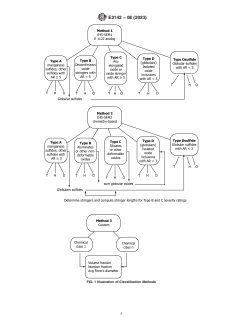
4.3 There are three methods described (see Fig. 1):
5.1.1 Rating the inclusion content of steels based on proce-
4.3.1 Method 1 is most similar to Test Methods E45 which
dures listed in Standards E45 and E1245, with the significant
uses light microscopy, and is intended to be its SEM analog. As
difference that the composition of the individual inclusions, as
such, it uses morphology as the primary basis for sorting
determined by X-ray analysis, is utilized to sort them into
particles into classes. As in Test Methods E45, a critical aspect
chemical classes.
ratio of 2 is defined. Chemistry is used to identify sulfide
5.1.2 Determining the number, size and morphological dis-
inclusions and to discriminate among sulfides when more than
tribution of inclusions in steels sorted by chemical class.
one type is present, as well as to ensure that exogenous
5.2 Methods 1 and 2 of this test method are primarily
inclusions and surface scratches and debris are not included in
intended for rating the inclusion content of steels deoxidized
the ratings. Inclusions will be classified into four categories,
with silicon or aluminum, both silicon and aluminum, or
Types A, B, C and D as described in Test Methods E45.
vacuum-treated steels without either silicon or aluminum
Elongated sulfides are Type A. Other inclusions are oxides and
additions. Guidelines are provided to rate inclusions in steel
are classified as Types B, C or D, depending on their
treated with rare earth additions or calcium-bearing compounds
morphology, as follows: discontinuous stringers of three or
(13.4). When such steels are evaluated, the test report should
more inclusions with member particles having low aspect ratio
describe the nature of the inclusions rated according to each
are Type B; discontinuous stringers of two or more inclusions
inclusion category (A, B, C, D).
with member particles having high aspect ratio and single
elongated oxide inclusions are Type C; remaining isolated 5.3 Methods 1 and 2 will provide a quantitative rating of the
inclusions are Type D. The categories will be further subdi- inclusion content in half-severity number increments from 0 to
E2142 − 08 (2023)
FIG. 1 Illustration of Classification Methods
E2142 − 08 (2023)
TABLE 1 Inclusion Width Parameters
Thin Heavy Oversize
Inclusion Minimum Maximum Minimum Maximum Minimum
Type Width (μm) Width (μm) Width (μm) Width (μm) Width (μm)
A $2 4 >4 12 >12
B $2 9 >9 15 >15
C $2 5 >5 12 >12
D $2 8 >8 13 >13
5 for each inclusion type and thickness (Method D of Test Therefore, an automated stage, although not essential, is highly
Method E45), and in tabulated in Table 2. Test Method E45 recommended and is assumed throughout this document.
ratings by SEM may differ from those determined following 6.1.3 Energy Dispersive X-Ray (EDX) Analyzer. A “light
E45 because of the use of chemistry in the classifications. In element detector” (one equipped with a sufficiently thin win-
order to differentiate E45 ratings obtained using the SEM from dow to effectively transmit the low energy X rays characteristic
traditional ratings using light microscopy, the ratings obtained of the elements below sodium) is required if oxygen is to be
using Method 1 or 2 of this Test Method shall be identified as
discretely measured, or if analysis of carbides, borides, or
E45-SEM1 and E45-SEM2, respectively. nitrides is to be included. The EDX detector must have
resolution better than 155 eV as measured in accordance with
5.4 Method 3 defines procedures to analyze and report
ANSI/IEEE STD 759.
inclusions by arbitrary size distribution and chemical classifi-
6.1.4 Backscattered Electron Detector and electronics with
cations. It may be made applicable to any material by appro-
ability to set one or more thresholds to enable discrimination
priate choice of these classifications.
between inclusions and matrix.
5.4.1 Method 3 determines and reports basic (as used in Test
6.1.5 Control and Image Collection Software to control the
Method E1245) stereological measurements (for example,
beam and stage and to collect images and spectra according to
volume fraction of sulfides and oxides, the number of sulfides
user-specified parameters.
or oxides per square millimeter, and so forth). This test method,
however, does not address the measurement of such param-
6.2 Automated Feature-Analysis Software, capable of:
eters. E45 ratings are not produced in Method 3 because the
6.2.1 Allowing analysis rules to be set such that chemical
inclusion classifications do not follow those defined in Test
classifications can be made and features sorted according to
Method E45.
chemistry as well as size and morphology.
6.2.2 Distinguishing between elongated and globular par-
5.5 The quantitative results are intended to provide a de-
ticles based on aspect ratio.
scription of the types and amounts of inclusions in a heat of
6.2.3 Separating the stringered oxides according to the
steel. This test method contains no guidelines for such use.
difference in morphology (Type B or C) and measuring the
stringer lengths per field of each type.
6. Apparatus
6.2.4 Connecting stringers which cross field boundaries.
6.1 An automated computer-controlled Scanning Electron
6.2.5 Generating standardized reports.
Microscope equipped with the following accessories:
6.3 Special Considerations—The environment housing the
6.1.1 Digital Imaging hardware and software.
6.1.2 Computer-Controlled Motorized X-Y Stage. It is con- equipment must be controlled. Computer equipment, SEMs
and EDX systems all require control of temperature and
ceivable that the method described in this standard may be
performed without an automated stage. Performing this method humidity and the air must be relatively dust free.
with a manual stage will be tedious, and accuracy will suffer
due to difficulty in tracking inclusions across field boundaries. 7. Sampling
7.1 Sampling is done in accordance with the guidelines
given in Test Method E45.
TABLE 2 Minimum Values for Inclusion Severity Rating Levels
for Measurements in Micrometers (For expression in other units,
8. Test Specimens
see Test Methods E45, Table 2)
Test Method E45 Rating Limits (μm at 1× or count)
8.1 The location and orientation of test specimens shall be
Severity A B C D
as described in Test Method E45. In all cases, the polished
0.5 37.0 17.2 17.8 1
surface shall be parallel to the hot-working axis. Studies have
1.0 127.0 76.8 75.6 2
demonstrated that inclusion length measurements are signifi-
1.5 261.0 184.2 176.0 4
cantly affected if the plane of polish is angled more than 6
2.0 436.1 342.7 320.5 9
2.5 649.0 554.7 510.3 16
degrees from the longitudinal hot-working direction. Test
3.0 898.0 822.2 746.1 25
specimens should not be cut from areas influenced by shearing
3.5 1181.0 1147.0 1029.0 36
which alters the true orientation of the inclusions.
4.0 1498.0 1530.0 1359.0 49
4.5 1898.0 1973.0 1737.0 81
8.2 The surface to be polished must be at least 160 mm
5.0 2230.0 2476.0 2163.0 100
(0.25 in ) in area. It is recommended that a significantly large
E2142 − 08 (2023)
area should be obtained so that the measurement may be made voltage will give rise to an (unwanted) increase in matrix
within the defined area away from the edges of the sample. contribution to the spectrum. Use of 10–15 kV is typical,
although slightly lower or higher voltages may be appropriate
9. Specimen Preparation depending on the particular application. Use the microscope
manufacturer’s procedures for saturating the filament, aligning
9.1 Metallographic specimen preparation must be carefully
the column and setting other parameters to optimize image
controlled to produce acceptable quality surfaces for image
quality.
analysis. Guidelines and recommendations are given in
Method E3 and Standards E45 and E768. 11.4 Calibrate the X-ray analyzer such that the collected
spectrum will include all the elements of interest; 0–10 keV is
9.2 Polishing must reveal the inclusions without interfer-
recommended. If there are X rays of interest above 10 keV
ence from artifacts, foreign matter, or scratches, although the
(such as Pb L lines), use 0–20 keV.
use of chemistry will minimize the errors associated with these
features. Polishing must not alter the true appearance of the 11.5 Set electron probe current by direct measurement using
inclusions by excessive relief, pitting, and pull-out. Use of a pico-ammeter and Faraday cup, if the optimum probe current
has previously been determined. Alternatively, the current can
automatic grinding and polishing devices is recommended.
be set by moving the aluminum tape under the beam and
9.3 Inclusion retention is generally easier to accomplish in
recording X-ray counts. Probe current (or “spot size”, which is
specimens that are hardened rather than in annealed condition.
proportional to probe current) is adjusted until approximately
If inclusion retention is inadequate in annealed specimens, they
40 % dead time, if possible, is achieved. The steel matrix itself
should be subjected to a standard heat treatment cycle using a
may be used as the basis of current setting in place of the tape,
relatively low tempering temperature. After heat treatment, the
but this will likely result in the least consistent setting of the
specimen must be descaled and the longitudinal plane must be
described methods.
reground below any decarburization. This recommendation
only applies to heat-treatable steel grades. 11.6 Select the BSE imaging mode, which is used because
the brightness of a feature in the BSE image is directly related
9.4 Mounting of specimens is not required if unmounted
to its average atomic number. The matrix, which consists
specimens can be properly polished.
primarily of iron, will be brighter than some inclusions (for
9.5 Polishing practice should follow Practice E768.
example, MnS) and darker than other inclusions (for example,
Pb). Since inclusions are discriminated by the BSE gray level,
10. Calibration and Standardization
the threshold(s) must be set appropriately using the procedure
10.1 The SEM magnification should be calibrated according recommended by the manufacturer.
to E766. It is important to calibrate the magnification of the
11.7 Select and store the region of the sample to be
SEM to obtain accurate E45 ratings and to ensure that analysis
examined following the stage control manufacturer’s recom-
time is minimized. The number of particles of a given size
mended procedure. The region can be larger than but not
increases strongly as size decreases; if particles below the
smaller than 160 mm ; if the sample region is larger, then the
desired low size limit are included due to magnification error,
software shall select a contiguous area of exactly 160 mm
the number of spectra collected, and therefore the total analysis
wholly contained within the user-selected region to analyze. In
time, will increase significantly.
Method 3 of this Test Method, analysis can be based on the
number of inclusions detected rather than sample area.
10.2 The EDX energy calibration should be done according
to section 8.1 of E1508.
11.8 As the beam rasters the selected region, the software
recognizes features that fall within the previously defined range
10.3 The EDX energy resolution should be checked peri-
odically. The energy resolution, defined as the Full Width at of gray-levels. Morphological and chemical parameters are
immediately calculated and stored or, alternatively, raw data is
Half Maximum (FWHM) height of the Mn Kα X-ray line, after
background has been subtracted, should be measured accord- stored for off-line processing.
11.8.1 In Test Method E45 inclusions are examined using
ing to the practice suggested by the manufacturer, provided that
it is in accordance with the IEEE methodology. field areas of 0.50 mm and magnifications of 100×. The
inclusions can be examined and discriminated by type using
11. Procedure magnifications other than 100× and field areas other than 0.50
mm as long as the severity ratings (see Section 12) are based
11.1 Prepare specimens following the standard protocol set
on the required 0.50 mm field area.
forth in Practice E768. At this time, a small piece of aluminum
11.9 Define the Analysis Rules:
tape or other reference material may be placed on the edge of
the sample. The tape may later be used as a target in order to 11.9.1 The EDX acquisition should continue until sufficient
statistics are accumulated to classify the inclusion. For a
determine the proper setting of the electron probe current or to
discussion on X-ray counting and chemical classification
check its stability.
statistics, see Appendix X2 and standard text books. The
11.2 Position the sample in the SEM at a working distance
that is suitable for both BSE and EDX.
11.3 Set the beam accelerating voltage appropriately for the
Goldstein, et al, Scanning Electron Microscopy and X-Ray Microanalysis, 2nd
elemental range of interest, bearing in mind that excessive ed, Plenum Publishing Corporation, New York, NY, 1992 , pp 493-505.
E2142 − 08 (2023)
minimum number of counts in a peak necessary for peak from application of this Test Method shall be called E45-
identification must be entered. SEM1, if method 1 is used, and E45-SEM2, if method 2 is
used.
11.9.2 Define the relevant chemical classes and their analy-
sis rules. In Method 2, for example, at least three chemical
11.13 The acquired raw data should be saved, unaltered by
classes are defined: sulfides, aluminates, and silicates. Addi-
the application of any analysis software. The raw data can then
tional classes may be defined, depending on the application.
be used at a later time for re-classification of the inclusions
For example, a “calcium silicate” class may be defined and
based on different criteria.
included as Type B, as such inclusions appear similar to and
11.14 A critical parameter in the morphological character-
have the same detrimental effects as traditional Type B
ization of an inclusion is the Aspect Ratio (AR), at or above
inclusions. Each chemical class and the main inclusion class to
which an inclusion is considered elongated. In Test Methods
which it is assigned should be reported.
E45, which relies on morphology to distinguish oxide types, a
11.9.3 Define the measure of intensity in the X-ray spectrum
relatively high AR of 2 is used in order to more reliably
which must be met in order to identify the particle as belonging
differentiate silicates, which are generally highly elongated,
to a certain classification. Each class should be defined in terms
from aluminates, which are less elongated. In this Test Method,
of one or more of the following: (1) peak intensity range, (2)
the X-ray spectrum from the inclusion is directly obtained and
peak to background ratio, (3) peak intensity ratios, (4) elemen-
will serve to differentiate aluminates from silicates, reducing
tal percentage as calculated by established methods, or (5)
the dependence on morphology. In Method 2, used for
other chemical measurement(s) that characterizes a specific
“chemistry-based” E45 ratings, and Method 3, used for custom
type of inclusion. This choice is either narrowed or made by the
analyses, a critical AR of 2 is suggested for consistency with
system or software manufacturer.
E45, but other values of AR may be used. Inclusion analysis
11.10 Set the relevant imaging parameters such as the software must allow the critical AR to be selectable as an
magnification(s) to be used, the minimum and maximum Analysis Rule, with default settings as described above.
particle sizes to be recorded, and the critical aspect ratio
11.15 In Method 3, the analysis will automatically terminate
defining an elongated inclusion (see 11.14). Appendix X1
when a minimum number of inclusions has been classified (for
provides a more complete list of analysis rules.
example, 1000) or when a specified area of the sample has been
11.10.1 For the selected magnification, digital imaging reso-
examined (For example, 160 mm ), whichever occurs first. The
lution should be chosen such that there are an adequate number
use of this two-criteria approach to terminate analysis will
of pixels in each inclusion for the computer program to
ensure that steels with low inclusion content will be examined
accurately make measurements. In order to detect a 2 μm
over a representative area, and that a meaningful number of
particle, the step size of the electron probe, which is in fact the
inclusions will be classified in more typical products in a
pixel size, must be at most 2 μm. If a 256 × 256 image is
reasonable amount of time.
displayed on a 10 cm screen, the field of view is 512 μm w
...