

ASTM B666/B666M-20
(Practice)Standard Practice for Identification Marking of Aluminum and Magnesium Products
General Information
- Abstract
ABSTRACT
This practice establishes the requirements for physical item identification marking of aluminum and magnesium products. Package marking for shipment and inspection acceptance is not within the scope of this standard. Wrought aluminum and magnesium mill products shall be marked for identification purposes only with the following information on the product or on tags attached to the product: (1) name or registered trademark of the company, (2) alloy and temper of the product, (3) basic number of the specification to which the product was produced, (4) specified (ordered) dimensions of the following products: sheet and plate, coiled wire and spooled wire, straight length tube and coiled tube, and pipe, (5) lot number, and (6) the word "seamless" on certain tube or pipe. Spot marking requirements for the following wrought aluminum and magnesium mill products are detailed and illustrated: (1) coiled sheet, (2) flat sheet and plate, (3) circles, (4) tread plate, (5) foil, (6) rod, bar, and extruded profiles, (7) structural profiles, (8) tube and pipe, (9) wire, (10) bus bar, and (11) forgings such as hand and die forgings. Requirements for marking cast aluminum and magnesium products (castings, remelt ingot for castings, and ingot or billet for fabricating), unalloyed aluminum and magnesium ingot, and special products are specified.
SCOPE
1.1 This practice establishes the physical item marking requirements for identification purposes for aluminum and magnesium products. Package marking for shipment and inspection acceptance is not within the scope of this standard.
1.2 The values stated in either SI units or inch-pound units are to be regarded separately as standard. The values stated in each system are not necessarily exact equivalents; therefore, to ensure conformance with the standard, each system shall be used independently of the other, and values from the two systems shall not be combined.
1.3 This standard does not purport to address all of the safety concerns, if any, associated with its use. It is the responsibility of the user of this standard to establish appropriate safety, health, and environmental practices and determine the applicability of regulatory limitations prior to use.
1.4 This international standard was developed in accordance with internationally recognized principles on standardization established in the Decision on Principles for the Development of International Standards, Guides and Recommendations issued by the World Trade Organization Technical Barriers to Trade (TBT) Committee.
- Status
- Published
- Publication Date
- 31-Oct-2020
- Technical Committee
- B07 - Light Metals and Alloys
- Drafting Committee
- B07.03 - Aluminum Alloy Wrought Products
Buy Documents
ASTM B666/B666M-20 - Standard Practice for Identification Marking of Aluminum and Magnesium Products
REDLINE ASTM B666/B666M-20 - Standard Practice for Identification Marking of Aluminum and Magnesium Products
Overview
ASTM B666/B666M-20 is the international standard practice developed by ASTM International for the identification marking of aluminum and magnesium products. This standard defines the physical item marking requirements to ensure clear, permanent identification of various forms of wrought and cast aluminum and magnesium materials. Package marking for shipment or inspection acceptance is not included within the scope of this standard. Instead, the focus is on marking directly on products or attached tags for traceability, compliance, and ready identification through the supply chain.
Ensuring accurate and durable identification is critical for quality assurance, traceability, and compliance in the aluminum and magnesium industry. This standard is recognized and used by manufacturers, fabricators, and purchasers globally, including in defense and aerospace contracts, to maintain clear records of alloy, temper, and production information.
Key Topics
Marking Requirements:
The standard details mandatory product identification elements, including:- Company name or registered trademark
- Alloy and temper, per established designation systems
- Basic specification number of the product
- Ordered dimensions (e.g., thickness, diameter, width)
- Lot number for traceability
- The word "seamless" when required for certain tubes and pipes
Marking Methods:
Identification can be achieved through:- Spot marking (single location)
- Continuous marking (recurring at defined intervals)
- Perimeter marking (continuous near product edges)
- Tagging (for small or irregularly shaped items)
- Acceptable methods include printing, stamping, stenciling, or laser marking, with impression stamping limited by material and agreement.
Product-Specific Details:
The standard provides guidance and illustrations for:- Coiled sheet, flat sheet, and plate
- Circles, tread plate, and foil
- Rod, bar, and extruded profiles
- Structural profiles, tube, pipe, and wire
- Bus bar and forgings
- Castings, remelt ingot, and billets
Durability and Legibility:
Markings must remain readable and intact through normal handling, storage, and environmental exposure, and should not adversely affect subsequent product processing.Unit Consistency:
Values must be marked according to either SI units or inch-pound units-these are not interchangeable or to be combined.
Applications
ASTM B666/B666M-20 serves a broad range of industries utilizing aluminum and magnesium products, including:
Aerospace and Defense:
Clear identification ensures that structural and mechanical parts can be traced to their origin, alloy composition, and production batch, which is essential for regulatory compliance and safety.Automotive and Transportation:
Marking supports traceability of lightweight components used in production lines and assists in recall management when necessary.Construction and Industrial Manufacturing:
Marked products allow fabricators to quickly verify material specifications, improving process efficiency and reducing the risk of material substitution errors.Metal Supply and Distribution:
Warehouses and suppliers benefit from standardized product identification, simplifying inventory tracking and customer order fulfillment.Quality Assurance and Inspection:
Permanent, standardized markings facilitate product inspections and audits, supporting quality management systems and certification processes.
Related Standards
- ASTM B361: Specification for Factory-Made Wrought Aluminum and Aluminum-Alloy Welding Fittings
- ASTM B881: Terminology Relating to Aluminum- and Magnesium-Alloy Products
- ANSI H35.1/H35.1M: Alloy and Temper Designation Systems for Aluminum
- MIL-STD-409: Alloy Nomenclature and Temper Designation System for Magnesium Base Alloys
Keywords: aluminum product marking, magnesium identification marking, ASTM B666, standard for aluminum markings, traceability, alloy identification, permanent marking, industry compliance
By adhering to ASTM B666/B666M-20, stakeholders ensure that aluminum and magnesium products are consistently and clearly marked, supporting product quality, traceability, and global standards compliance across industries.
Relations
- Effective Date
- 01-Nov-2017
- Effective Date
- 01-Jun-2009
- Effective Date
- 01-Nov-2008
- Effective Date
- 01-Sep-2005
- Refers
ASTM B881-98a(2004) - Standard Terminology Relating to Aluminum- and Magnesium- Alloy Products - Effective Date
- 01-Apr-2004
- Effective Date
- 10-Oct-2002
- Effective Date
- 10-Jun-2002
- Effective Date
- 10-May-2000
- Effective Date
- 10-May-1998
Buy Documents
ASTM B666/B666M-20 - Standard Practice for Identification Marking of Aluminum and Magnesium Products
REDLINE ASTM B666/B666M-20 - Standard Practice for Identification Marking of Aluminum and Magnesium Products
Get Certified
Connect with accredited certification bodies for this standard

Element Materials Technology
Materials testing and product certification.

Inštitut za kovinske materiale in tehnologije
Institute of Metals and Technology. Materials testing, metallurgical analysis, NDT.
Sponsored listings
Frequently Asked Questions
ASTM B666/B666M-20 is a standard published by ASTM International. Its full title is "Standard Practice for Identification Marking of Aluminum and Magnesium Products". This standard covers: ABSTRACT This practice establishes the requirements for physical item identification marking of aluminum and magnesium products. Package marking for shipment and inspection acceptance is not within the scope of this standard. Wrought aluminum and magnesium mill products shall be marked for identification purposes only with the following information on the product or on tags attached to the product: (1) name or registered trademark of the company, (2) alloy and temper of the product, (3) basic number of the specification to which the product was produced, (4) specified (ordered) dimensions of the following products: sheet and plate, coiled wire and spooled wire, straight length tube and coiled tube, and pipe, (5) lot number, and (6) the word "seamless" on certain tube or pipe. Spot marking requirements for the following wrought aluminum and magnesium mill products are detailed and illustrated: (1) coiled sheet, (2) flat sheet and plate, (3) circles, (4) tread plate, (5) foil, (6) rod, bar, and extruded profiles, (7) structural profiles, (8) tube and pipe, (9) wire, (10) bus bar, and (11) forgings such as hand and die forgings. Requirements for marking cast aluminum and magnesium products (castings, remelt ingot for castings, and ingot or billet for fabricating), unalloyed aluminum and magnesium ingot, and special products are specified. SCOPE 1.1 This practice establishes the physical item marking requirements for identification purposes for aluminum and magnesium products. Package marking for shipment and inspection acceptance is not within the scope of this standard. 1.2 The values stated in either SI units or inch-pound units are to be regarded separately as standard. The values stated in each system are not necessarily exact equivalents; therefore, to ensure conformance with the standard, each system shall be used independently of the other, and values from the two systems shall not be combined. 1.3 This standard does not purport to address all of the safety concerns, if any, associated with its use. It is the responsibility of the user of this standard to establish appropriate safety, health, and environmental practices and determine the applicability of regulatory limitations prior to use. 1.4 This international standard was developed in accordance with internationally recognized principles on standardization established in the Decision on Principles for the Development of International Standards, Guides and Recommendations issued by the World Trade Organization Technical Barriers to Trade (TBT) Committee.
ABSTRACT This practice establishes the requirements for physical item identification marking of aluminum and magnesium products. Package marking for shipment and inspection acceptance is not within the scope of this standard. Wrought aluminum and magnesium mill products shall be marked for identification purposes only with the following information on the product or on tags attached to the product: (1) name or registered trademark of the company, (2) alloy and temper of the product, (3) basic number of the specification to which the product was produced, (4) specified (ordered) dimensions of the following products: sheet and plate, coiled wire and spooled wire, straight length tube and coiled tube, and pipe, (5) lot number, and (6) the word "seamless" on certain tube or pipe. Spot marking requirements for the following wrought aluminum and magnesium mill products are detailed and illustrated: (1) coiled sheet, (2) flat sheet and plate, (3) circles, (4) tread plate, (5) foil, (6) rod, bar, and extruded profiles, (7) structural profiles, (8) tube and pipe, (9) wire, (10) bus bar, and (11) forgings such as hand and die forgings. Requirements for marking cast aluminum and magnesium products (castings, remelt ingot for castings, and ingot or billet for fabricating), unalloyed aluminum and magnesium ingot, and special products are specified. SCOPE 1.1 This practice establishes the physical item marking requirements for identification purposes for aluminum and magnesium products. Package marking for shipment and inspection acceptance is not within the scope of this standard. 1.2 The values stated in either SI units or inch-pound units are to be regarded separately as standard. The values stated in each system are not necessarily exact equivalents; therefore, to ensure conformance with the standard, each system shall be used independently of the other, and values from the two systems shall not be combined. 1.3 This standard does not purport to address all of the safety concerns, if any, associated with its use. It is the responsibility of the user of this standard to establish appropriate safety, health, and environmental practices and determine the applicability of regulatory limitations prior to use. 1.4 This international standard was developed in accordance with internationally recognized principles on standardization established in the Decision on Principles for the Development of International Standards, Guides and Recommendations issued by the World Trade Organization Technical Barriers to Trade (TBT) Committee.
ASTM B666/B666M-20 is classified under the following ICS (International Classification for Standards) categories: 77.150.10 - Aluminium products; 77.150.99 - Other products of non-ferrous metals. The ICS classification helps identify the subject area and facilitates finding related standards.
ASTM B666/B666M-20 has the following relationships with other standards: It is inter standard links to ASTM B881-17, ASTM B881-09, ASTM B361-08, ASTM B881-05, ASTM B881-98a(2004), ASTM B404/B404M-02, ASTM B361-02, ASTM B404/B404M-00, ASTM B881-98a. Understanding these relationships helps ensure you are using the most current and applicable version of the standard.
ASTM B666/B666M-20 is available in PDF format for immediate download after purchase. The document can be added to your cart and obtained through the secure checkout process. Digital delivery ensures instant access to the complete standard document.
Standards Content (Sample)
This international standard was developed in accordance with internationally recognized principles on standardization established in the Decision on Principles for the
Development of International Standards, Guides and Recommendations issued by the World Trade Organization Technical Barriers to Trade (TBT) Committee.
Designation: B666/B666M −20
Standard Practice for
Identification Marking of Aluminum and Magnesium
Products
This standard is issued under the fixed designation B666/B666M; the number immediately following the designation indicates the year
of original adoption or, in the case of revision, the year of last revision. A number in parentheses indicates the year of last reapproval.
A superscript epsilon (´) indicates an editorial change since the last revision or reapproval.
This standard has been approved for use by agencies of the U.S. Department of Defense.
1. Scope* B404/B404M Specification for Aluminum and Aluminum-
Alloy Seamless Condenser and Heat-Exchanger Tubes
1.1 This practice establishes the physical item marking
with Integral Fins (Withdrawn 2006)
requirements for identification purposes for aluminum and
B881 Terminology Relating toAluminum- and Magnesium-
magnesium products. Package marking for shipment and
Alloy Products
inspection acceptance is not within the scope of this standard.
2.3 ANSI Standards:
1.2 The values stated in either SI units or inch-pound units
ANSI H35.1/H35.1M Alloy and Temper Designation Sys-
are to be regarded separately as standard. The values stated in
tems for Aluminum
each system are not necessarily exact equivalents; therefore, to
2.4 Military Standards:
ensure conformance with the standard, each system shall be
MIL-STD-409 Alloy Nomenclature and Temper Designa-
used independently of the other, and values from the two
tion System for Magnesium Base Alloys
systems shall not be combined.
1.3 This standard does not purport to address all of the 3. Terminology
safety concerns, if any, associated with its use. It is the
3.1 Definitions:
responsibility of the user of this standard to establish appro-
3.1.1 Refer to Terminology B881 for definitions of product
priate safety, health, and environmental practices and deter-
terms used in this practice.
mine the applicability of regulatory limitations prior to use.
3.2 Definitions of Terms Specific to This Standard:
1.4 This international standard was developed in accor-
3.2.1 Marking:
dance with internationally recognized principles on standard-
3.2.1.1 spot marking—marking the identification only once
ization established in the Decision on Principles for the
on the product.
Development of International Standards, Guides and Recom-
3.2.1.2 continuous marking—recurring marking of the iden-
mendations issued by the World Trade Organization Technical
tification in intervals not greater than 40 in. [1000 mm]
Barriers to Trade (TBT) Committee.
throughout the length of the product.
3.2.1.3 perimeter marking—marking continuously the iden-
2. Referenced Documents
tification in one or two rows adjacent to the four edges of the
2.1 The following documents of the issue in effect on the
product.
date of material purchase form a part of this practice to the
3.2.1.4 tagging—attaching tags bearing the required identi-
extent referenced herein:
fication markings to coils, bundles, or containers of items
2.2 ASTM Standards:
which are too small to mark or whose configuration preclude
B361 Specification for Factory-Made Wrought Aluminum
marking otherwise.
and Aluminum-Alloy Welding Fittings
4. Basic Marking Requirements and Application
4.1 When this practice is required by the material specifi-
This practice is under the jurisdiction of ASTM Committee B07 on Light
cation or specified in the contract or purchase order, wrought
Metals and Alloys and is the direct responsibility of Subcommittee B07.03 on
Aluminum Alloy Wrought Products.
Current edition approved Nov. 1, 2020. Published November 2020. Originally
approved in 1980. Last previous edition approved in 2019 as B666/B666M – 19. The last approved version of this historical standard is referenced on
DOI: 10.1520/B0666_B0666M-20. www.astm.org.
2 4
For referenced ASTM standards, visit the ASTM website, www.astm.org, or Available fromAluminumAssociation, 1400 Crystal Dr., Suite 430,Arlington,
contact ASTM Customer Service at service@astm.org. For Annual Book of ASTM VA 22202, http://www.aluminum.org.
Standards volume information, refer to the standard’s Document Summary page on Available from DLA Document Services, Building 4/D, 700 Robbins Ave.,
the ASTM website. Philadelphia, PA 19111-5094, http://quicksearch.dla.mil.
*A Summary of Changes section appears at the end of this standard
Copyright © ASTM International, 100 Barr Harbor Drive, PO Box C700, West Conshohocken, PA 19428-2959. United States
B666/B666M − 20
NOTE 2—The requirements specified in 4.1 are minimum; marking
aluminum and magnesium mill products shall be marked for
systems that involve additional information shall be as agreed upon
identification purposes only with the following information on
between the producer and the purchaser.
the product or on tags attached to the product:
4.1.1 Name or Registered Trademark of Company, which
4.2 When this practice is required by the material specifi-
performs the final processing or finishing operation such as
cationorspecifiedinthecontractorpurchaseorder,markingof
rolling, stretching, thermal treatment, etc., prior to marketing
cast aluminum products shall be in accordance with Section 6.
the product.
4.3 Product marking shall be such that it shall not rub off or
NOTE 1—The company that performs nothing more than a simple
be otherwise obliterated by contact arising from normal
shearing or sawing operation may be excluded from marking the product
handling, exposure to the elements, shipment, and storage.The
with its name.
height of the characters shall be commensurate with the size of
4.1.2 Alloy and Temper of Product—Designations shall be
the product being marked; for example, not less than 0.375 in.
in accordance with ANSI H35.1/H35.1M for aluminum and
[9 mm] for flat sheet and plate, not less than 0.250 in. [6 mm]
MIL-STD-409 for magnesium.
for hand forgings, and not less than 0.125 in. [3 mm] for
4.1.3 Basic Number of Specification to Which Product Was
tubular products. Legibility of all markings shall be such as
Produced—The basic number does not include the revision
required for ready readability and the required permanency of
indicator.
identification.
4.1.4 Specified (Ordered) Dimensions of Products:
4.1.4.1 Sheet and Plate—Thickness in inches [millimetres].
4.4 Product marking shall be accomplished in a manner that
4.1.4.2 Coiled Wire and Spooled Wire—Diameter in inches
will not adversely affect the subsequent fabrication of the
[millimetres].
material, or produce stresses that would be deleterious to the
4.1.4.3 Tube:
functioning of the finished product. Marking on the product
(1) Straight Lengths—Outside diameter and wall
shall be with marking fluid applied by printing, stamping,
thickness, in inches [millimetres].
stenciling, or by laser marking. Ghost images of the characters
(2) Coiled—Wall thickness, in inches [millimetres].
may remain upon the removal of marking applied. Impression
4.1.4.4 Pipe—Nominal pipe size and ANSI schedule num-
stampingisconsidereddetrimentalandshallnotbeusedexcept
ber.
on ingot, castings, forging, and certain tube products, or when
4.1.5 Lot Number shall be included in the product marking.
required by prior agreement between the producer and pur-
The definition of lot shall be that as defined in the material
chaser. Unless prohibited by the purchaser, edge faces (Fig. 1)
specification.
of plate product and ends of bar, rod, and profile products may
4.1.5.1 For magnesium products, the applicable lot number
be impression stamped as needed. Character size and depth
shall be marked on each piece in at least one location.
4.1.6 When required by the material specification, the word shall not exceed any purchaser or product tolerances, as
specified in the order or material specification.
“seamless” on certain tube or pipe.
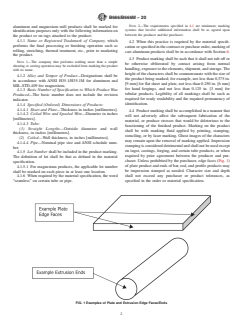
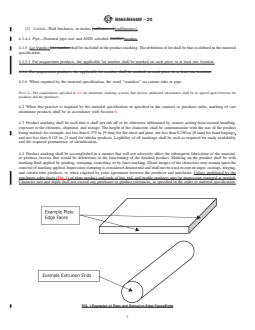
FIG. 1 Examples of Plate and Extrusion Edge Faces/Ends
B666/B666M − 20
5. Marking of Wrought Aluminum and Magnesium Mill two rows is chosen, one row shall contain the producer’s name
Products or trademark and the ordered thickness, and the second row
shall contain alloy and temper, and the specification number as
5.1 When this practice is required by the material specifi-
shown in Fig. 5 [Fig. 5M].
cation or specified in the contract or purchase order, wrought
aluminum and magnesium mill products shall be marked as
NOTE 3—If perimeter marking is applied to a full piece as produced but
partial sheets or plates are supplied, an arrow shall be applied near one
follows:
corner of each partial sheet or plate indicating the direction of rolling.
5.1.1 Lot Number, All Products—Spot marking the product.
5.1.2 Coiled Sheet—Spot marking in one or more rows near 5.1.4 Circles:
the outside end as shown in Fig. 2 [Fig. 2M]. 5.1.4.1 Circles 24 in. and Over [Over 600 mm] in
5.1.3 Flat Sheet and Plate: Diameter—Spot marking on each circle unless the circle was
5.1.3.1 Flat Sheet Less Than 0.012 in. [Up Through cut from sheet or plate having continuous marking, and
0.30 mm] (For O Temper, Less Than 0.020 in. [Up Through 5.1.4.2 Circles Less Than 24 in. [Up Through 600 mm] in
0.50 mm]) in Thickness—Spot marking near one end, Diameter—Tagging or marking of shipping container.
5.1.3.2 Plate and Flat Sheet 0.012 in. and Over [Over
NOTE 4—Alclad one side flat sheet, plate, circles, and coiled sheet shall
0.30 mm] (For O Temper, 0.020 in. and Over [Over 0.50 mm])
be marked on the bare side.
in Thickness and Less Than 6 in. [Up Through 150 mm]
5.1.5 Tread Plate—Spot marking near one end on the back
Wide—Continuous marking in one row,
side.
5.1.3.3 Plate Up Through 0.375 in. [10 mm] and Flat Sheet
5.1.6 Foil—Markingofthisproductisnotrequired.Package
0.012 in. and Over [Over 0.30 mm] (For O Temper, 0.020 in.
marking only.
...
This document is not an ASTM standard and is intended only to provide the user of an ASTM standard an indication of what changes have been made to the previous version. Because
it may not be technically possible to adequately depict all changes accurately, ASTM recommends that users consult prior editions as appropriate. In all cases only the current version
of the standard as published by ASTM is to be considered the official document.
Designation: B666/B666M − 19 B666/B666M − 20
Standard Practice for
Identification Marking of Aluminum and Magnesium
Products
This standard is issued under the fixed designation B666/B666M; the number immediately following the designation indicates the year
of original adoption or, in the case of revision, the year of last revision. A number in parentheses indicates the year of last reapproval.
A superscript epsilon (´) indicates an editorial change since the last revision or reapproval.
This standard has been approved for use by agencies of the U.S. Department of Defense.
1. Scope*
1.1 This practice establishes the physical item marking requirements for identification purposes for aluminum and magnesium
products. Package marking for shipment and inspection acceptance is not within the scope of this standard.
1.2 The values stated in either SI units or inch-pound units are to be regarded separately as standard. The values stated in each
system mayare not benecessarily exact equivalents; therefore, to ensure conformance with the standard, each system shall be used
independently of the other. Combiningother, and values from the two systems may result in non-conformance with the
standard.shall not be combined.
1.3 This standard does not purport to address all of the safety concerns, if any, associated with its use. It is the responsibility
of the user of this standard to establish appropriate safety, health, and environmental practices and determine the applicability of
regulatory limitations prior to use.
1.4 This international standard was developed in accordance with internationally recognized principles on standardization
established in the Decision on Principles for the Development of International Standards, Guides and Recommendations issued
by the World Trade Organization Technical Barriers to Trade (TBT) Committee.
2. Referenced Documents
2.1 The following documents of the issue in effect on the date of material purchase form a part of this specificationpractice to the
extent referenced herein:
2.2 ASTM Standards:
B361 Specification for Factory-Made Wrought Aluminum and Aluminum-Alloy Welding Fittings
B404/B404M Specification for Aluminum and Aluminum-Alloy Seamless Condenser and Heat-Exchanger Tubes with Integral
Fins (Withdrawn 2006)
B881 Terminology Relating to Aluminum- and Magnesium-Alloy Products
2.3 ANSI Standards:
ANSI H35.1/H35.1M Alloy and Temper Designation Systems for Aluminum
This practice is under the jurisdiction of ASTM Committee B07 on Light Metals and Alloys and is the direct responsibility of Subcommittee B07.03 on Aluminum Alloy
Wrought Products.
Current edition approved Nov. 1, 2019Nov. 1, 2020. Published November 2019November 2020. Originally approved in 1980. Last previous edition approved in 20152019
as B666/B666M – 15.B666/B666M – 19. DOI: 10.1520/B0666_B0666M-19.10.1520/B0666_B0666M-20.
For referenced ASTM standards, visit the ASTM website, www.astm.org, or contact ASTM Customer Service at service@astm.org. For Annual Book of ASTM Standards
volume information, refer to the standard’s Document Summary page on the ASTM website.
The last approved version of this historical standard is referenced on www.astm.org.
Available from Aluminum Association, Inc., 1400 Crystal Drive,Dr., Suite 430, Arlington, VA 22202 (http://www.aluminum.org).22202, http://www.aluminum.org.
*A Summary of Changes section appears at the end of this standard
Copyright © ASTM International, 100 Barr Harbor Drive, PO Box C700, West Conshohocken, PA 19428-2959. United States
B666/B666M − 20
2.4 Military Standards:
MIL-STD-409 Alloy Nomenclature and Temper Designation System for Magnesium Base Alloys
3. Terminology
3.1 DefinitionsDefinitions:—
3.1.1 Refer to Terminology B881 for definitions of product terms used in this practice.Refer to Terminology B881 for definitions
of product terms used in this specification.
3.2 Definitions of Terms Specific to This Standard:
3.2.1 Marking:
3.2.2 spot marking—marking the identification only once on the product.
3.2.3 continuous marking—recurring marking of the identification in intervals not greater than 40 in. [1000 mm] throughout the
length of the product.
3.2.4 perimeter marking—marking continuously the identification in one or two rows adjacent to the four edges of the product.
3.2.1 tagging—Marking: attaching tags bearing the required identification markings to coils, bundles, or containers of items which
are too small to mark or whose configuration preclude marking otherwise.
3.2.1.1 spot marking—marking the identification only once on the product.
3.2.1.2 continuous marking—recurring marking of the identification in intervals not greater than 40 in. [1000 mm] throughout
the length of the product.
3.2.1.3 perimeter marking—marking continuously the identification in one or two rows adjacent to the four edges of the product.
3.2.1.4 tagging—attaching tags bearing the required identification markings to coils, bundles, or containers of items which are
too small to mark or whose configuration preclude marking otherwise.
4. Basic Marking Requirements and Application
4.1 When this practice is required by the material specification or specified in the contract or purchase order, wrought aluminum
and magnesium mill products shall be marked for identification purposes only with the following information on the product or
on tags attached to the product:
4.1.1 Name or Registered Trademark of the Company, which performs the final processing or finishing operation such as rolling,
stretching, thermal treatment, etc., prior to marketing the product;product.
NOTE 1—The company that performs nothing more than a simple shearing or sawing operation may be excluded from marking the product with its name.
4.1.2 Alloy and Temper of the Product—Designations shall be in accordance with ANSI H35.1/H35.1M for aluminum and
MIL-STD-409 for magnesium;magnesium.
4.1.3 Basic Number of the Specification to which the Which Product wasWas Produced—The basic number does not include the
revision indicator;indicator.
4.1.4 Specified (Ordered) Dimensions of the Following Products:
4.1.4.1 Sheet and Plate—Thickness in inches [millimetres],[millimetres].
4.1.4.2 Coiled Wire and Spooled Wire—Diameter in inches [millimetres],[millimetres].
4.1.4.3 Tube:
(1) Straight Lengths—Outside diameter and wall thickness, in inches [millimetres],[millimetres].
Available from Standardization Documents Order Desk, DODSSP, Bldg. 4, Section D, DLA Document Services, Building 4/D, 700 Robbins Ave., Philadelphia, PA
19111-5098 (http://www.dodssp.daps.mil).19111-5094, http://quicksearch.dla.mil.
B666/B666M − 20
(2) Coiled—Wall thickness, in inches [millimetres],[millimetres].
4.1.4.4 Pipe—Nominal pipe size and ANSI schedule number;number.
4.1.5 Lot Number Lot number shall be included in the product marking. The definition of lot shall be that as defined in the material
specification.
4.1.5.1 For magnesium products, the applicable lot number shall be marked on each piece in at least one location.
4.1.6 For magnesium products, the applicable lot number shall be marked on each piece in at least one location.
4.1.6 When required by the material specification, the word “seamless” on certain tube or pipe.
NOTE 2—The requirements specified in 4.1 are minimum; marking systems that involve additional information shall be as agreed upon between the
producer and the purchaser.
4.2 When this practice is required by the material specification or specified in the contract or purchase order, marking of cast
aluminum products shall be in accordance with Section 6.
4.3 Product marking shall be such that it shall not rub off or be otherwise obliterated by contact arising from normal handling,
exposure to the elements, shipment, and storage. The height of the characters shall be commensurate with the size of the product
being marked; for example, not less than 0.375 in. [9 mm] for flat sheet and plate, not less than 0.250 in. [6 mm] for hand forgings,
and not less than 0.125 in. [3 mm] for tubular products. Legibility of all markings shall be such as required for ready readability
and the required permanency of identification.
4.4 Product marking shall be accomplished in a manner that will not adversely affect the subsequent fabrication of the material,
or produce stresses that would be deleterious to the functioning of the finished product. Marking on the product shall be with
marking fluid applied by printing, stamping, stenciling, or by laser marking. Ghost images of the characters may remain upon the
removal of marking applied. Impression stamping is considered detrimental and shall not be used except on ingot, castings, forging,
and certain tube products, or when required by prior agreement between the producer and purchaser. Unless prohibited by the
purchaser, edge faces (Fig. 1) of plate product and ends of bar, rod, and profile products may be impression stamped as needed.
Character size and depth shall not exceed any purchaser or product tolerances, as specified in the order or material specification.
FIG. 1 Examples of Plate and Extrusion Edge Faces/Ends
B666/B666M − 20
5. Marking of Wrought Aluminum and Magnesium Mill Products
5.1 When this practice is required by the material specification or specified in the contract or purchase order, wrought aluminum
and magnesium mill products shall be marked as follows:
5.1.1 Lot Number, All Products—Spot marking the product.
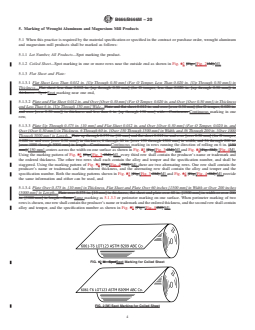
5.1.2 Coiled Sheet—Spot marking in one or more rows near the outside end as shown in Fig. 12 [Fig. [Fig. 21M].M].
5.1.3 Flat Sheet and Plate:
5.1.3.1 Flat Sheet Less Than 0.012 in. [Up Through 0.30 mm] (For O Temper, Less Than 0.020 in. [Up Through 0.50 mm]) in
Thickness—Flat sheet less than 0.012 in. [up through 0.30 mm] (for O temper, less than 0.020 in. [up through 0.50 mm]) in
thickness—Spot Spot marking near one end,
5.1.3.2 Plate and Flat Sheet 0.012 in. and Over [Over 0.30 mm] (For O Temper, 0.020 in. and Over [Over 0.50 mm]) in Thickness
and Less Than 6 in. [Up Through 150 mm] Wide—Plate and flat sheet 0.012 in. and over [over 0.30 mm] (for O temper, 0.020 in.
and over [over 0.50 mm]) in thickness and less than 6 in. [up through 150 mm] wide—Continuous Continuous marking in one
row,
5.1.3.3 Plate Up Through 0.375 in. [10 mm] and Flat Sheet 0.012 in. and Over [Over 0.30 mm] (For O Temper, 0.020 in. and
Over [Over 0.50 mm]) in Thickness, 6 Through 60 in. [Over 150 Through 1500 mm] in Width, and 36 Through 200 in. [Over 1000
Through 5000 mm] in Length—Plate up through 0.375 in. [10 mm] and flat sheet 0.012 in. and over [over 0.30 mm] (for O temper,
0.020 in. and over [over 0.50 mm]) in thickness, 6 through 60 in. [over 150 through 1500 mm] in width, and 36 through 200 in.
[over 1000 through 5000 mm] in length—Continuous Continuous marking in rows running the direction of rolling on 6 in. [150
mm] [150 mm] centers across the width on one surface as shown in Fig. 23 [Fig.[Fig. 3 2M] M] and Fig. 34[Fig. 3M]. [Fig. 4M].
Using the marking pattern of Fig. 23 [Fig.[Fig. 3 2M], M], every third row shall contain the producer’s name or trademark and
the ordered thickness. The other two rows shall each contain the alloy and temper and the specification number, and shall be
staggered. Using the marking pattern of Fig. 34 [Fig.[Fig. 4 3M], M], there are two alternating rows. One row shall contain the
producer’s name or trademark and the ordered thickness, and the alternating row shall contain the alloy and temper and the
specification number. Both the marking patterns shown in Fig. 23 [Fig.[Fig. 3 2M] M] and Fig. 34 [Fig.[Fig. 4 3M] M] provide
the same information and either can be used, and
5.1.3.4 Plate Over 0.375 in. [10 mm] in Thickness, Flat Sheet and Plate Over 60 inches [1500 mm] in Width or Over 200 inche
...