

ASTM E2226-23a
(Practice)Standard Practice for Application of Hose Stream
General Information
- Abstract
SIGNIFICANCE AND USE
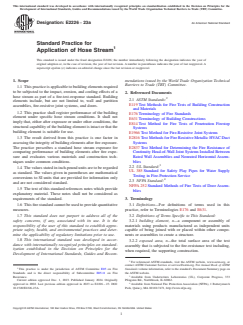
4.1 This practice is intended to standardize the apparatus used and the method or pattern of application of a standard hose stream to building elements as one part of the assessment and fire resistance of building elements.
4.1.1 This practice specifies the water pressure and duration of application of the hose stream to the test assembly.
4.2 This practice is intended to be used only after a test assembly has completed a prescribed standard fire-resistance test.
4.3 The practice exposes a test assembly to a standard hose stream under controlled laboratory conditions.
4.3.1 Pass/fail criteria are defined in the appropriate fire test method.
4.3.2 This exposure is not intended to replicate typical fire fighting operations or all applied or impact loads a system could be subjected to in field use and conditions.
4.4 Any variation from tested conditions has the potential of substantially changing the performance characteristics determined by this practice.
SCOPE
1.1 This practice is applicable to building elements required to be subjected to the impact, erosion, and cooling effects of a hose stream as part of a fire-test-response standard. Building elements include, but are not limited to, wall and partition assemblies, fire-resistive joint systems, and doors.
1.2 This practice shall register performance of the building element under specific hose stream conditions. It shall not imply that, either after exposure or under other conditions, the structural capability of the building element is intact or that the building element is suitable for use.
1.3 The result derived from this practice is one factor in assessing the integrity of building elements after fire exposure. The practice prescribes a standard hose stream exposure for comparing performance of building elements after fire exposure and evaluates various materials and construction techniques under common conditions.
1.4 The values stated in inch-pound units are to be regarded as standard. The values given in parentheses are mathematical conversions to SI units that are provided for information only and are not considered standard.
1.5 The text of this standard references notes which provide explanatory material. These notes shall not be considered as requirements of the standard.
1.6 This fire standard cannot be used to provide quantitative measures.
1.7 This standard does not purport to address all of the safety concerns, if any, associated with its use. It is the responsibility of the user of this standard to establish appropriate safety, health, and environmental practices and determine the applicability of regulatory limitations prior to use.
1.8 This international standard was developed in accordance with internationally recognized principles on standardization established in the Decision on Principles for the Development of International Standards, Guides and Recommendations issued by the World Trade Organization Technical Barriers to Trade (TBT) Committee.
- Status
- Published
- Publication Date
- 30-Nov-2023
- Technical Committee
- E05 - Fire Standards
- Drafting Committee
- E05.11 - Fire Resistance
Overview
ASTM E2226-23a - Standard Practice for Application of Hose Stream establishes uniform procedures and apparatus for applying a hose stream to building elements following a standard fire-resistance test. Developed by ASTM International, this practice plays an essential role in evaluating the integrity and resilience of a wide range of building assemblies, including wall and partition systems, fire-resistive joint systems, and door assemblies. The standard ensures that the assessment process is consistent, repeatable, and reliable by specifying water pressure, application duration, and procedural details for hose stream testing.
Key Topics
- Standardized Hose Stream Application: Describes the use of a solid stream of water, including the hose size, discharge tip, and pressure requirements, to ensure comparability across different tests and assemblies.
- Post-Fire Exposure Testing: Applies only after a building element has completed standard fire-resistance testing, serving as an additional assessment of durability and integrity.
- Test Configuration and Procedure:
- Placement and orientation of the nozzle in relation to the test assembly.
- Water pressure and duration defined according to the fire resistance period.
- Systematic movement of the hose across the assembly to cover the entire exposed face.
- Assessment Scope and Limitations:
- Records performance under specific hose stream conditions, considering impact, erosion, and cooling.
- Does not confirm continued structural integrity or suitability for use post-test.
- Exposure is not intended to simulate all field conditions or actual firefighting operations.
- Reporting Requirements: Specifies thorough documentation of test conditions, observations, and outcomes, especially relating to penetrations, cracks, and water passage.
Applications
ASTM E2226-23a provides vital value in the fields of building construction, fire safety engineering, and product certification, serving multiple practical applications:
- Fire Resistance Evaluation: Used in conjunction with fire-resistance test methods such as ASTM E119 and NFPA 252 to assess how well building elements resist structural failure, integrity loss, or excessive deformation after fire exposure and cooling by water streams.
- Material and Product Testing: Enables comparison of different construction materials and techniques, providing a benchmark for evaluating innovations in fire-resistant construction products.
- Code Compliance: Supports compliance with building codes and fire safety regulations that mandate hose stream testing of walls, partitions, doors, and joint systems.
- Quality Assurance: Assists manufacturers, inspectors, and regulatory bodies in verifying that products and systems meet industry safety standards regarding fire and post-fire performance.
Related Standards
For a comprehensive fire safety assessment, ASTM E2226-23a is commonly referenced alongside the following standards:
- ASTM E119: Standard Test Methods for Fire Tests of Building Construction and Materials
- ASTM E814: Test Method for Fire Tests of Penetration Firestop Systems
- ASTM E1966: Test Method for Fire-Resistive Joint Systems
- ASTM E2816: Methods for Fire-Resistive Metallic HVAC Duct Systems
- ASTM E2837: Test Method for Determining the Fire Resistance of Continuity Head-of-Wall Joint Systems
- NFPA 252: Standard Methods of Fire Tests of Door Assemblies
- UL 385: Standard for Safety Play Pipes for Water Supply Testing in Fire-Protection Service
Practical Value
By providing a uniform methodology for hose stream testing, ASTM E2226-23a ensures consistency when evaluating the fire-performance characteristics of building elements. Specifying apparatus setup, test procedures, and documentation requirements, the standard helps manufacturers, specifiers, code officials, and testing laboratories to:
- Promote construction safety and material reliability
- Achieve and demonstrate regulatory compliance
- Facilitate global harmonization of fire safety practices
Keywords: hose stream, fire resistance, building element, ASTM E2226, fire test, wall assemblies, fire-resistive joint, fire door, impact force, building safety, fire protection standards.
Relations
- Effective Date
- 01-Dec-2023
- Effective Date
- 01-Jan-2024
- Effective Date
- 01-Dec-2023
- Effective Date
- 01-Dec-2023
- Effective Date
- 01-Dec-2023
- Effective Date
- 01-Dec-2023
- Effective Date
- 01-Dec-2023
- Effective Date
- 01-Dec-2023
- Referred By
ASTM E119-22 - Standard Test Methods for Fire Tests of Building Construction and Materials - Effective Date
- 01-Dec-2023
Get Certified
Connect with accredited certification bodies for this standard

CIS Institut d.o.o.
Personal Protective Equipment (PPE) certification body. Notified Body NB-2890 for EU Regulation 2016/425 PPE.
Institut za varilstvo d.o.o. (Welding Institute)
Slovenia's leading welding institute since 1952. ISO 3834, EN 1090, pressure equipment certification, NDT personnel, welder qualification. Only IIW Au

Kiwa BDA Testing
Building and construction product certification.
Sponsored listings
Frequently Asked Questions
ASTM E2226-23a is a standard published by ASTM International. Its full title is "Standard Practice for Application of Hose Stream". This standard covers: SIGNIFICANCE AND USE 4.1 This practice is intended to standardize the apparatus used and the method or pattern of application of a standard hose stream to building elements as one part of the assessment and fire resistance of building elements. 4.1.1 This practice specifies the water pressure and duration of application of the hose stream to the test assembly. 4.2 This practice is intended to be used only after a test assembly has completed a prescribed standard fire-resistance test. 4.3 The practice exposes a test assembly to a standard hose stream under controlled laboratory conditions. 4.3.1 Pass/fail criteria are defined in the appropriate fire test method. 4.3.2 This exposure is not intended to replicate typical fire fighting operations or all applied or impact loads a system could be subjected to in field use and conditions. 4.4 Any variation from tested conditions has the potential of substantially changing the performance characteristics determined by this practice. SCOPE 1.1 This practice is applicable to building elements required to be subjected to the impact, erosion, and cooling effects of a hose stream as part of a fire-test-response standard. Building elements include, but are not limited to, wall and partition assemblies, fire-resistive joint systems, and doors. 1.2 This practice shall register performance of the building element under specific hose stream conditions. It shall not imply that, either after exposure or under other conditions, the structural capability of the building element is intact or that the building element is suitable for use. 1.3 The result derived from this practice is one factor in assessing the integrity of building elements after fire exposure. The practice prescribes a standard hose stream exposure for comparing performance of building elements after fire exposure and evaluates various materials and construction techniques under common conditions. 1.4 The values stated in inch-pound units are to be regarded as standard. The values given in parentheses are mathematical conversions to SI units that are provided for information only and are not considered standard. 1.5 The text of this standard references notes which provide explanatory material. These notes shall not be considered as requirements of the standard. 1.6 This fire standard cannot be used to provide quantitative measures. 1.7 This standard does not purport to address all of the safety concerns, if any, associated with its use. It is the responsibility of the user of this standard to establish appropriate safety, health, and environmental practices and determine the applicability of regulatory limitations prior to use. 1.8 This international standard was developed in accordance with internationally recognized principles on standardization established in the Decision on Principles for the Development of International Standards, Guides and Recommendations issued by the World Trade Organization Technical Barriers to Trade (TBT) Committee.
SIGNIFICANCE AND USE 4.1 This practice is intended to standardize the apparatus used and the method or pattern of application of a standard hose stream to building elements as one part of the assessment and fire resistance of building elements. 4.1.1 This practice specifies the water pressure and duration of application of the hose stream to the test assembly. 4.2 This practice is intended to be used only after a test assembly has completed a prescribed standard fire-resistance test. 4.3 The practice exposes a test assembly to a standard hose stream under controlled laboratory conditions. 4.3.1 Pass/fail criteria are defined in the appropriate fire test method. 4.3.2 This exposure is not intended to replicate typical fire fighting operations or all applied or impact loads a system could be subjected to in field use and conditions. 4.4 Any variation from tested conditions has the potential of substantially changing the performance characteristics determined by this practice. SCOPE 1.1 This practice is applicable to building elements required to be subjected to the impact, erosion, and cooling effects of a hose stream as part of a fire-test-response standard. Building elements include, but are not limited to, wall and partition assemblies, fire-resistive joint systems, and doors. 1.2 This practice shall register performance of the building element under specific hose stream conditions. It shall not imply that, either after exposure or under other conditions, the structural capability of the building element is intact or that the building element is suitable for use. 1.3 The result derived from this practice is one factor in assessing the integrity of building elements after fire exposure. The practice prescribes a standard hose stream exposure for comparing performance of building elements after fire exposure and evaluates various materials and construction techniques under common conditions. 1.4 The values stated in inch-pound units are to be regarded as standard. The values given in parentheses are mathematical conversions to SI units that are provided for information only and are not considered standard. 1.5 The text of this standard references notes which provide explanatory material. These notes shall not be considered as requirements of the standard. 1.6 This fire standard cannot be used to provide quantitative measures. 1.7 This standard does not purport to address all of the safety concerns, if any, associated with its use. It is the responsibility of the user of this standard to establish appropriate safety, health, and environmental practices and determine the applicability of regulatory limitations prior to use. 1.8 This international standard was developed in accordance with internationally recognized principles on standardization established in the Decision on Principles for the Development of International Standards, Guides and Recommendations issued by the World Trade Organization Technical Barriers to Trade (TBT) Committee.
ASTM E2226-23a is classified under the following ICS (International Classification for Standards) categories: 13.220.99 - Other standards related to protection against fire; 23.040.70 - Hoses and hose assemblies. The ICS classification helps identify the subject area and facilitates finding related standards.
ASTM E2226-23a has the following relationships with other standards: It is inter standard links to ASTM E2226-23, ASTM E176-24, ASTM E2816-20a, ASTM E176-21ae1, ASTM E814-23a, ASTM E3157-23, ASTM E2837-23a, ASTM E1966-15(2019), ASTM E119-22. Understanding these relationships helps ensure you are using the most current and applicable version of the standard.
ASTM E2226-23a is available in PDF format for immediate download after purchase. The document can be added to your cart and obtained through the secure checkout process. Digital delivery ensures instant access to the complete standard document.
Standards Content (Sample)
This international standard was developed in accordance with internationally recognized principles on standardization established in the Decision on Principles for the
Development of International Standards, Guides and Recommendations issued by the World Trade Organization Technical Barriers to Trade (TBT) Committee.
Designation: E2226 − 23a An American National Standard
Standard Practice for
Application of Hose Stream
This standard is issued under the fixed designation E2226; the number immediately following the designation indicates the year of
original adoption or, in the case of revision, the year of last revision. A number in parentheses indicates the year of last reapproval. A
superscript epsilon (´) indicates an editorial change since the last revision or reapproval.
1. Scope mendations issued by the World Trade Organization Technical
Barriers to Trade (TBT) Committee.
1.1 This practice is applicable to building elements required
to be subjected to the impact, erosion, and cooling effects of a
2. Referenced Documents
hose stream as part of a fire-test-response standard. Building
2.1 ASTM Standards:
elements include, but are not limited to, wall and partition
E119 Test Methods for Fire Tests of Building Construction
assemblies, fire-resistive joint systems, and doors.
and Materials
1.2 This practice shall register performance of the building
E176 Terminology of Fire Standards
element under specific hose stream conditions. It shall not
E631 Terminology of Building Constructions
imply that, either after exposure or under other conditions, the
E814 Test Method for Fire Tests of Penetration Firestop
structural capability of the building element is intact or that the
Systems
building element is suitable for use.
E1966 Test Method for Fire-Resistive Joint Systems
1.3 The result derived from this practice is one factor in E2816 Test Methods for Fire Resistive Metallic HVAC Duct
Systems
assessing the integrity of building elements after fire exposure.
The practice prescribes a standard hose stream exposure for E2837 Test Method for Determining the Fire Resistance of
Continuity Head-of-Wall Joint Systems Installed Between
comparing performance of building elements after fire expo-
sure and evaluates various materials and construction tech- Rated Wall Assemblies and Nonrated Horizontal Assem-
blies
niques under common conditions.
2.2 UL Standard:
1.4 The values stated in inch-pound units are to be regarded
UL 385 Standard for Safety Play Pipes for Water Supply
as standard. The values given in parentheses are mathematical
Testing in Fire-Protection Service
conversions to SI units that are provided for information only
2.3 NFPA Standard:
and are not considered standard.
NFPA 252 Standard Methods of Fire Tests of Door Assem-
1.5 The text of this standard references notes which provide
blies
explanatory material. These notes shall not be considered as
3. Terminology
requirements of the standard.
1.6 This fire standard cannot be used to provide quantitative 3.1 Definitions—For definitions of terms used in this
practice, refer to Terminologies E176 and E631.
measures.
1.7 This standard does not purport to address all of the
3.2 Definitions of Terms Specific to This Standard:
safety concerns, if any, associated with its use. It is the 3.2.1 building element, n—a component or assembly of
responsibility of the user of this standard to establish appro-
materials using products manufactured as independent units
priate safety, health, and environmental practices and deter- capable of being joined with or placed within other compo-
mine the applicability of regulatory limitations prior to use.
nents or assemblies to create a structure.
1.8 This international standard was developed in accor-
3.2.2 exposed area, n—the total surface area of the test
dance with internationally recognized principles on standard-
assembly that is subjected to the fire-resistance test including,
ization established in the Decision on Principles for the
when required, the supporting construction.
Development of International Standards, Guides and Recom-
For referenced ASTM standards, visit the ASTM website, www.astm.org, or
contact ASTM Customer Service at service@astm.org. For Annual Book of ASTM
This practice is under the jurisdiction of ASTM Committee E05 on Fire Standards volume information, refer to the standard’s Document Summary page on
Standards and is the direct responsibility of Subcommittee E05.11 on Fire the ASTM website.
Resistance. Available from Underwriters Laboratories (UL), Corporate Progress, 333
Current edition approved Dec. 1, 2023. Published January 2024. Originally Pfingsten Rd., Northbrook, IL 60062.
approved in 2002. Last previous edition approved in 2023 as E2226 – 23. DOI: Available from National Fire Protection Association (NFPA), 1 Batterymarch
10.1520/E2226-23A. Park, Quincy, MA 02169-7471, http://www.nfpa.org.
Copyright © ASTM International, 100 Barr Harbor Drive, PO Box C700, West Conshohocken, PA 19428-2959. United States
E2226 − 23a
3.2.3 fully developed stream, n—a coherent, forceful projec- 4.4 Any variation from tested conditions has the potential of
tion of water similar in shape and intensity to the stream being substantially changing the performance characteristics deter-
applied to the exposed side of the test assembly from the mined by this practice.
nozzle.
5. Apparatus
3.2.4 supporting construction, n—construction required for
the testing of some building elements into which the test
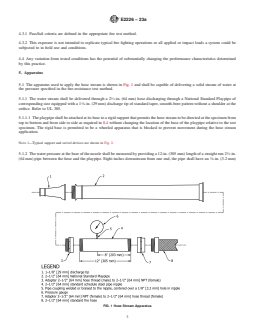
5.1 The apparatus used to apply the hose stream is shown in
specimen is assembled, for example, the wall into which a door
Fig. 1 and shall be capable of delivering a solid stream of water
is fitted.
at the pressure specified in the fire-resistance test method.
3.2.5 test assembly, n—the building element or elements 5.1.1 The water stream shall be delivered through a 2 ⁄2-in.
(64 mm) hose discharging through a National Standard Play-
being tested and, if applicable, the supporting construction.
pipe of corresponding size equipped with a 1 ⁄8-in. (29 mm)
4. Significance and Use
discharge tip of standard taper, smooth-bore pattern without a
shoulder at the orifice. Refer to UL 385.
4.1 This practice is intended to standardize the apparatus
5.1.1.1 The playpipe shall be attached at its base to a rigid
used and the method or pattern of application of a standard
support that permits the hose stream to be directed at the
hose stream to building elements as one part of the assessment
specimen from top to bottom and from side to side as required
and fire resistance of building elements.
in 8.4 without changing the location of the base of the playpipe
4.1.1 This practice specifies the water pressure and duration
relative to the test specimen. The rigid base is permitted to be
of application of the hose stream to the test assembly.
a wheeled apparatus that is blocked to prevent movement
4.2 This practice is intended to be used only after a test
during the hose stream application.
assembly has completed a prescribed standard fire-resistance
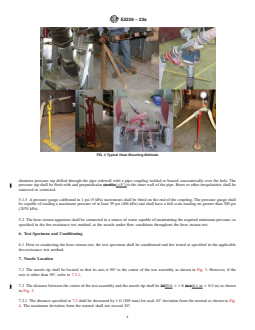
test. NOTE 1—Typical support and swivel devices are shown in Fig. 2.
4.3 The practice exposes a test assembly to a standard hose 5.1.2 The water pressure at the base of the nozzle shall be
stream under controlled laboratory conditions. measured by providing a 12-in. (305 mm) length of a straight
4.3.1 Pass/fail criteria are defined in the appropriate fire test run 2 ⁄2-in. (64 mm) pipe between the hose and the playpipe.
method. Eight inches downstream from one end, the pipe shall have an
4.3.2 This exposure is not intended to replicate typical fire ⁄8-in. (3.2 mm) diameter pressure tap drilled through the pipe
fighting operations or all applied or impact loads a system sidewall with a pipe coupling welded or brazed concentrically
could be subjected to in field use and conditions. over the hole. The pressure tap shall be flush with and
FIG. 1 Hose Stream Apparatus
E2226 − 23a
FIG. 2 Typical Hose Mounting Methods
perpendicular (65°) to the inner wall of the pipe. Burrs or 8. Procedure
other irregularities shall be removed or corrected.
8.1 Prior to the fire test, the laboratory shall ensure that the
5.1.3 A pressure gauge cal
...
This document is not an ASTM standard and is intended only to provide the user of an ASTM standard an indication of what changes have been made to the previous version. Because
it may not be technically possible to adequately depict all changes accurately, ASTM recommends that users consult prior editions as appropriate. In all cases only the current version
of the standard as published by ASTM is to be considered the official document.
Designation: E2226 − 23 E2226 − 23a An American National Standard
Standard Practice for
Application of Hose Stream
This standard is issued under the fixed designation E2226; the number immediately following the designation indicates the year of
original adoption or, in the case of revision, the year of last revision. A number in parentheses indicates the year of last reapproval. A
superscript epsilon (´) indicates an editorial change since the last revision or reapproval.
INTRODUCTION
Several fire-test-response standards (such as ASTM E119, E814, E2074, and E1966) in order to
assess the integrity of building elements after exposure to a specified test fire, require test specimens
to be evaluated by exposure to a hose stream. It is important to standardize certain elements of the hose
stream to promote uniformity in requirements. To attain this goal, this practice describes a standard
apparatus for delivering a solid stream of water and prescribes a standard method of subjecting
building elements to a hose stream after fire exposure.
1. Scope
1.1 This practice is applicable to building elements required to be subjected to the impact, erosion, and cooling effects of a hose
stream as part of a fire-test-response standard. Building elements include, but are not limited to, wall and partition assemblies,
fire-resistive joint systems, and doors.
1.2 This practice shall register performance of the building element under specific hose stream conditions. It shall not imply that,
either after exposure or under other conditions, the structural capability of the building element is intact or that the building element
is suitable for use.
1.3 The result derived from this practice is one factor in assessing the integrity of building elements after fire exposure. The
practice prescribes a standard hose stream exposure for comparing performance of building elements after fire exposure and
evaluates various materials and construction techniques under common conditions.
1.4 The values stated in inch-pound units are to be regarded as standard. The values given in parentheses are mathematical
conversions to SI units that are provided for information only and are not considered standard.
1.5 The text of this standard references notes which provide explanatory material. These notes shall not be considered as
requirements of the standard.
1.6 This fire standard cannot be used to provide quantitative measures.
1.7 This standard does not purport to address all of the safety concerns, if any, associated with its use. It is the responsibility
of the user of this standard to establish appropriate safety, health, and environmental practices and determine the applicability of
regulatory limitations prior to use.
This practice is under the jurisdiction of ASTM Committee E05 on Fire Standards and is the direct responsibility of Subcommittee E05.11 on Fire Resistance.
Current edition approved Oct. 15, 2023Dec. 1, 2023. Published October 2023January 2024. Originally approved in 2002. Last previous edition approved in 20192023 as
E2226 – 15b (2019).E2226 – 23. DOI: 10.1520/E2226-23.10.1520/E2226-23A.
Copyright © ASTM International, 100 Barr Harbor Drive, PO Box C700, West Conshohocken, PA 19428-2959. United States
E2226 − 23a
1.8 This international standard was developed in accordance with internationally recognized principles on standardization
established in the Decision on Principles for the Development of International Standards, Guides and Recommendations issued
by the World Trade Organization Technical Barriers to Trade (TBT) Committee.
2. Referenced Documents
2.1 ASTM Standards:
E119 Test Methods for Fire Tests of Building Construction and Materials
E176 Terminology of Fire Standards
E631 Terminology of Building Constructions
E814 Test Method for Fire Tests of Penetration Firestop Systems
E1966 Test Method for Fire-Resistive Joint Systems
E2074E2816 Test Method for Fire Tests of Door Assemblies, Including Positive Pressure Testing of Side-Hinged and Pivoted
Swinging Door AssembliesMethods for Fire Resistive Metallic HVAC Duct Systems (Withdrawn 2007)
E2837 Test Method for Determining the Fire Resistance of Continuity Head-of-Wall Joint Systems Installed Between Rated Wall
Assemblies and Nonrated Horizontal Assemblies
2.2 UL Standard:
UL 385 Standard for Safety Play Pipes for Water Supply Testing in Fire-Protection Service
2.3 NFPA Standard:
NFPA 252 Standard Methods of Fire Tests of Door Assemblies
3. Terminology
3.1 Definitions—For definitions of terms used in this practice, refer to Terminologies E176 and E631.
3.2 Definitions of Terms Specific to This Standard:
3.2.1 building element, n—a component or assembly of materials using products manufactured as independent units capable of
being joined with or placed within other components or assemblies to create a structure.
3.2.2 exposed area, n—the total surface area of the test assembly that is subjected to the fire-resistance test including, when
required, the supporting construction.
3.2.3 fully developed stream, n—a coherent, forceful projection of water similar in shape and intensity to the stream being applied
to the exposed side of the test assembly from the nozzle.
3.2.4 supporting construction, n—construction required for the testing of some building elements into which the test specimen is
assembled, for example, the wall into which a door is fitted.
3.2.5 test assembly, n—the building element or elements being tested and, if applicable, the supporting construction.
4. Significance and Use
4.1 This practice is intended to standardize the apparatus used and the method or pattern of application of a standard hose stream
to building elements as one part of the assessment and fire resistance of building elements.
4.1.1 This practice specifies the water pressure and duration of application of the hose stream to the test assembly.
4.2 This practice is intended to be used only after a test assembly has completed a prescribed standard fire-resistance test.
4.3 The practice exposes a test assembly to a standard hose stream under controlled laboratory conditions.
For referenced ASTM standards, visit the ASTM website, www.astm.org, or contact ASTM Customer Service at service@astm.org. For Annual Book of ASTM Standards
volume information, refer to the standard’s Document Summary page on the ASTM website.
Available from Underwriters Laboratories (UL), Corporate Progress, 333 Pfingsten Rd., Northbrook, IL 60062.
Available from National Fire Protection Association (NFPA), 1 Batterymarch Park, Quincy, MA 02169-7471, http://www.nfpa.org.
E2226 − 23a
4.3.1 Pass/fail criteria are defined in the appropriate fire test method.
4.3.2 This exposure is not intended to replicate typical fire fighting operations or all applied or impact loads a system could be
subjected to in field use and conditions.
4.4 Any variation from tested conditions has the potential of substantially changing the performance characteristics determined
by this practice.
5. Apparatus
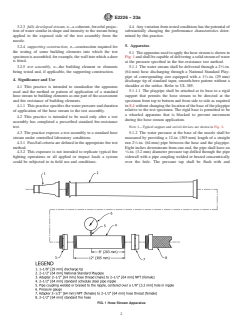
5.1 The apparatus used to apply the hose stream is shown in Fig. 1 and shall be capable of delivering a solid stream of water at
the pressure specified in the fire-resistance test method.
5.1.1 The water stream shall be delivered through a 2 ⁄2-in. (64 mm) hose discharging through a National Standard Playpipe of
corresponding size equipped with a 1 ⁄8-in. (29 mm) discharge tip of standard taper, smooth-bore pattern without a shoulder at the
orifice. Refer to UL 385.
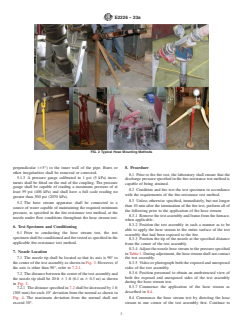
5.1.1.1 The playpipe shall be attached at its base to a rigid support that permits the hose stream to be directed at the specimen from
top to bottom and from side to side as required in 8.4 without changing the location of the base of the playpipe relative to the test
specimen. The rigid base is permitted to be a wheeled apparatus that is blocked to prevent movement during the hose stream
application.
NOTE 1—Typical support and swivel devices are shown in Fig. 2.
5.1.2 The water pressure at the base of the nozzle shall be measured by providing a 12-in. (305 mm) length of a straight run 2 ⁄2-in.
(64 mm) pipe between the hose and the playpipe. Eight inches downstream from one end, the pipe shall have an ⁄8-in. (3.2 mm)
FIG. 1 Hose Stream Apparatus
E2226 − 23a
FIG. 2 Typical Hos
...