

ASTM D6102-23
(Guide)Standard Guide for Installation of Geosynthetic Clay Liners
General Information
- Abstract
SIGNIFICANCE AND USE
4.1 For optimum performance, GCLs must be installed in a manner that does not impact their physical, mechanical, or hydraulic properties.
4.2 This guide identifies the proper installation procedures and equipment for use by GCL designers, inspectors, and installers.
SCOPE
1.1 This guide covers directions for the installation of geosynthetic clay liners (GCLs) under field conditions typically present in environmental lining applications.
1.2 This guide contains general installation guidelines. It is not intended to replace project-specific installation requirements as found in the contract drawings or specifications. In the event of a conflict, the requirement of the project specifications will supersede the requirements of this guide.
1.3 This guide does not purport to establish specific procedure for all climatic, geographical, hydraulic, or topographical conditions that may exist at a site. Appropriate installation procedures under atypical field conditions should be modified as necessary to maintain the integrity of the GCL and adjacent lining system components.
1.4 Different GCLs have different materials of construction with different physical properties. The procedures contained in this guide, therefore, may not be universally applicable to all GCLs under all field conditions.
1.5 The values stated in SI units are to be regarded as standard. No other units of measurement are included in this standard.
1.6 This standard does not purport to address all of the safety concerns, if any, associated with its use. It is the responsibility of the user of this standard to establish appropriate safety, health, and environmental practices and determine the applicability of regulatory limitations prior to use.
1.7 This international standard was developed in accordance with internationally recognized principles on standardization established in the Decision on Principles for the Development of International Standards, Guides and Recommendations issued by the World Trade Organization Technical Barriers to Trade (TBT) Committee.
- Status
- Published
- Publication Date
- 30-Apr-2023
- Technical Committee
- D35 - Geosynthetics
- Drafting Committee
- D35.04 - Geosynthetic Clay Liners
Overview
ASTM D6102-23, Standard Guide for Installation of Geosynthetic Clay Liners (GCLs), provides comprehensive guidelines for the proper installation of geosynthetic clay liners in environmental lining applications. Geosynthetic clay liners are manufactured hydraulic barriers comprised of clay bonded to one or more layers of geosynthetics. The correct installation of GCLs is critical for maintaining their intended physical, mechanical, and hydraulic properties in infrastructure and environmental projects.
This guide is intended for use by GCL designers, inspectors, and installers, outlining general installation practices and equipment selection. It is not a substitute for project-specific requirements, which should always take precedence in cases of conflict.
Key Topics
Subgrade Preparation:
- The subgrade must be properly prepared, smooth, and free from sharp materials, debris, and abrupt elevation changes.
- Surfaces should be compacted and any protrusions minimized or removed to prevent damage to the GCL.
Handling and Placement:
- All handling at the job site should follow recommended practices to avoid compromising GCL integrity.
- Packaging should be removed with care, and deployment must follow the engineer’s orientation specifications.
- Direct vehicle traffic on GCLs should be avoided.
Seaming and Overlaps:
- GCL seams are formed by overlapping edges, typically requiring at least 150 mm for longitudinal and 500 mm for end-of-roll overlaps.
- Overlaps must be clear of soil and debris, and may require additional bentonite to ensure effectiveness.
- Seams should be shingled in the direction of water flow to prevent leak pathways.
Sealing Around Structures:
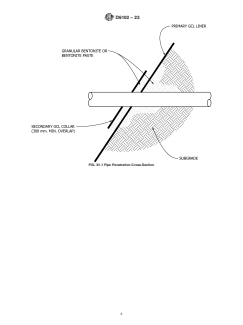
- Proper detailing is necessary around penetrations and embedded structures, often using bentonite-based materials.
- Only sharp utility knives should be used to cut GCLs, with frequent blade changes to avoid fraying.
Cover Placement and Protection:
- Cover soil must be approved, free of sharp objects, and be placed in a way that does not disturb the underlying GCL.
- A minimum 300 mm soil cover is recommended during the cover process.
- Temporary covers (such as tarpaulins) may be used overnight to protect exposed GCL.
Repair:
- Damaged GCLs need patching using new material with a 300 mm overlap and bentonite application to the affected area.
Applications
ASTM D6102-23 is broadly applicable to any project utilizing geosynthetic clay liners, especially in environmental containment systems such as:
- Landfill liners and caps
- Wastewater lagoon bases
- Secondary containment for storage tanks
- Stormwater ponds and canals
- Mining tailings impoundments
The guidance provided assists stakeholders in achieving reliable containment, extended service life, and regulatory compliance for engineered lining systems.
Related Standards
The following standards are referenced in and complement ASTM D6102-23:
- ASTM D5888: Guide for Storage and Handling of Geosynthetic Clay Liners
- ASTM D4439: Terminology for Geosynthetics
- ASTM D653: Terminology Relating to Soil, Rock, and Contained Fluids
- GRI-GCL-5: Standard Guide for Design Considerations for Geosynthetic Clay Liners in Various Applications
These documents collectively facilitate understanding, specifying, and installing GCLs effectively under diverse field and environmental conditions.
Keywords: geosynthetic clay liner installation, GCL installation guidelines, ASTM D6102-23, geosynthetic liner, environmental containment, subgrade preparation, GCL seaming, liner cover placement
Relations
- Effective Date
- 01-Feb-2024
- Effective Date
- 01-May-2019
- Effective Date
- 15-Apr-2018
- Effective Date
- 01-Aug-2017
- Effective Date
- 01-Jun-2016
- Effective Date
- 01-Sep-2015
- Effective Date
- 01-Jul-2015
- Effective Date
- 01-Aug-2014
- Effective Date
- 01-Mar-2014
- Effective Date
- 01-Oct-2011
- Effective Date
- 01-Sep-2011
- Effective Date
- 01-Jun-2011
- Effective Date
- 01-Jan-2009
- Effective Date
- 01-Dec-2008
- Effective Date
- 01-Nov-2008
Get Certified
Connect with accredited certification bodies for this standard

DIBt (Deutsches Institut für Bautechnik)
German Institute for Building Technology.
DIN CERTCO
DIN Group product certification.

Aboma Certification B.V.
Specialized in construction, metal, and transport sectors.
Sponsored listings
Frequently Asked Questions
ASTM D6102-23 is a guide published by ASTM International. Its full title is "Standard Guide for Installation of Geosynthetic Clay Liners". This standard covers: SIGNIFICANCE AND USE 4.1 For optimum performance, GCLs must be installed in a manner that does not impact their physical, mechanical, or hydraulic properties. 4.2 This guide identifies the proper installation procedures and equipment for use by GCL designers, inspectors, and installers. SCOPE 1.1 This guide covers directions for the installation of geosynthetic clay liners (GCLs) under field conditions typically present in environmental lining applications. 1.2 This guide contains general installation guidelines. It is not intended to replace project-specific installation requirements as found in the contract drawings or specifications. In the event of a conflict, the requirement of the project specifications will supersede the requirements of this guide. 1.3 This guide does not purport to establish specific procedure for all climatic, geographical, hydraulic, or topographical conditions that may exist at a site. Appropriate installation procedures under atypical field conditions should be modified as necessary to maintain the integrity of the GCL and adjacent lining system components. 1.4 Different GCLs have different materials of construction with different physical properties. The procedures contained in this guide, therefore, may not be universally applicable to all GCLs under all field conditions. 1.5 The values stated in SI units are to be regarded as standard. No other units of measurement are included in this standard. 1.6 This standard does not purport to address all of the safety concerns, if any, associated with its use. It is the responsibility of the user of this standard to establish appropriate safety, health, and environmental practices and determine the applicability of regulatory limitations prior to use. 1.7 This international standard was developed in accordance with internationally recognized principles on standardization established in the Decision on Principles for the Development of International Standards, Guides and Recommendations issued by the World Trade Organization Technical Barriers to Trade (TBT) Committee.
SIGNIFICANCE AND USE 4.1 For optimum performance, GCLs must be installed in a manner that does not impact their physical, mechanical, or hydraulic properties. 4.2 This guide identifies the proper installation procedures and equipment for use by GCL designers, inspectors, and installers. SCOPE 1.1 This guide covers directions for the installation of geosynthetic clay liners (GCLs) under field conditions typically present in environmental lining applications. 1.2 This guide contains general installation guidelines. It is not intended to replace project-specific installation requirements as found in the contract drawings or specifications. In the event of a conflict, the requirement of the project specifications will supersede the requirements of this guide. 1.3 This guide does not purport to establish specific procedure for all climatic, geographical, hydraulic, or topographical conditions that may exist at a site. Appropriate installation procedures under atypical field conditions should be modified as necessary to maintain the integrity of the GCL and adjacent lining system components. 1.4 Different GCLs have different materials of construction with different physical properties. The procedures contained in this guide, therefore, may not be universally applicable to all GCLs under all field conditions. 1.5 The values stated in SI units are to be regarded as standard. No other units of measurement are included in this standard. 1.6 This standard does not purport to address all of the safety concerns, if any, associated with its use. It is the responsibility of the user of this standard to establish appropriate safety, health, and environmental practices and determine the applicability of regulatory limitations prior to use. 1.7 This international standard was developed in accordance with internationally recognized principles on standardization established in the Decision on Principles for the Development of International Standards, Guides and Recommendations issued by the World Trade Organization Technical Barriers to Trade (TBT) Committee.
ASTM D6102-23 is classified under the following ICS (International Classification for Standards) categories: 91.100.15 - Mineral materials and products. The ICS classification helps identify the subject area and facilitates finding related standards.
ASTM D6102-23 has the following relationships with other standards: It is inter standard links to ASTM D4439-24, ASTM D5888-19, ASTM D4439-18, ASTM D4439-17, ASTM D5888-06(2016), ASTM D4439-15a, ASTM D4439-15, ASTM D653-14, ASTM D4439-14, ASTM D4439-11, ASTM D653-11, ASTM D5888-06(2011), ASTM D653-09, ASTM D653-08a, ASTM D653-08. Understanding these relationships helps ensure you are using the most current and applicable version of the standard.
ASTM D6102-23 is available in PDF format for immediate download after purchase. The document can be added to your cart and obtained through the secure checkout process. Digital delivery ensures instant access to the complete standard document.
Standards Content (Sample)
This international standard was developed in accordance with internationally recognized principles on standardization established in the Decision on Principles for the
Development of International Standards, Guides and Recommendations issued by the World Trade Organization Technical Barriers to Trade (TBT) Committee.
Designation: D6102 − 23
Standard Guide for
Installation of Geosynthetic Clay Liners
This standard is issued under the fixed designation D6102; the number immediately following the designation indicates the year of
original adoption or, in the case of revision, the year of last revision. A number in parentheses indicates the year of last reapproval. A
superscript epsilon (´) indicates an editorial change since the last revision or reapproval.
1. Scope 2. Referenced Documents
2.1 ASTM Standards:
1.1 This guide covers directions for the installation of
D653 Terminology Relating to Soil, Rock, and Contained
geosynthetic clay liners (GCLs) under field conditions typi-
Fluids
cally present in environmental lining applications.
D4439 Terminology for Geosynthetics
1.2 This guide contains general installation guidelines. It is
D5888 Guide for Storage and Handling of Geosynthetic
not intended to replace project-specific installation require-
Clay Liners
ments as found in the contract drawings or specifications. In
2.2 GRI Document:
the event of a conflict, the requirement of the project specifi-
GRI-GCL-5 Standard Guide for Design Considerations for
cations will supersede the requirements of this guide.
Geosynthetic Clay Liners (GCLs) in Various Applications
1.3 This guide does not purport to establish specific proce-
3. Terminology
dure for all climatic, geographical, hydraulic, or topographical
3.1 Definitions—For definitions of other geosynthetic terms
conditions that may exist at a site. Appropriate installation
used in this guide, refer to Terminology D4439. For definitions
procedures under atypical field conditions should be modified
of soils terms, refer to Terminology D653.
as necessary to maintain the integrity of the GCL and adjacent
lining system components. 3.2 Definitions of Terms Specific to This Standard:
3.2.1 fresh water, n—water with a salinity less than 0.5 parts
1.4 Different GCLs have different materials of construction
per thousand.
with different physical properties. The procedures contained in
3.2.2 geosynthetic clay liner (GCL), n—a manufactured
this guide, therefore, may not be universally applicable to all
hydraulic barrier consisting of clay bonded to a layer or layers
GCLs under all field conditions.
of geosynthetics.
1.5 The values stated in SI units are to be regarded as
4. Significance and Use
standard. No other units of measurement are included in this
standard.
4.1 For optimum performance, GCLs must be installed in a
manner that does not impact their physical, mechanical, or
1.6 This standard does not purport to address all of the
hydraulic properties.
safety concerns, if any, associated with its use. It is the
responsibility of the user of this standard to establish appro- 4.2 This guide identifies the proper installation procedures
priate safety, health, and environmental practices and deter- and equipment for use by GCL designers, inspectors, and
installers.
mine the applicability of regulatory limitations prior to use.
1.7 This international standard was developed in accor-
5. Procedure
dance with internationally recognized principles on standard-
5.1 The methods and equipment used for placement of the
ization established in the Decision on Principles for the
GCL can vary, but the primary objective of the process is to
Development of International Standards, Guides and Recom-
minimize the potential for GCL damage. The placement
mendations issued by the World Trade Organization Technical
methods and equipment should be evaluated appropriately
Barriers to Trade (TBT) Committee.
within this context.
1 2
This guide is under the jurisdiction of ASTM Committee D35 on Geosynthetics For referenced ASTM standards, visit the ASTM website, www.astm.org, or
and is the direct responsibility of Subcommittee D35.04 on Geosynthetic Clay contact ASTM Customer Service at service@astm.org. For Annual Book of ASTM
Liners. Standards volume information, refer to the standard’s Document Summary page on
Current edition approved May 1, 2023. Published May 2023. Originally the ASTM website.
approved in 1997. Last previous edition approved in 2020 as D6102 – 20. DOI: Available from Geosynthetic Institute, 475 Kedron Avenue, Folsom, PA
10.1520/D6102-23. 19033-1208, http://www.geosynthetic-institute.org.
Copyright © ASTM International, 100 Barr Harbor Drive, PO Box C700, West Conshohocken, PA 19428-2959. United States
D6102 − 23
engineer, construction quality assurance (CQA) inspector, and GCL
5.2 Subgrade Preparation:
supplier should be consulted for specific guidance if premature hydration
5.2.1 For projects where the GCL is to be placed over an
is suspected to have occurred.
earthen subgrade, the subgrade surface must be prepared and
5.3.9 The GCL should not be installed when it is frozen.
approved prior to installation in accordance either with project
5.3.10 If GCL is placed over geosynthetic, care must be
specifications or with this guide. The surface should be firm
taken so as to not damage underlying material with high
and unyielding, with no abrupt elevation changes, voids and
ground pressure equipment directly on the geosynthetic.
cracks, ice, or standing water.
5.2.2 The subgrade surface should be smooth and free of
5.4 Anchorage:
vegetation, sharp-edged rocks, stones, sticks, construction
5.4.1 At the top of a slope, the end of the GCL roll may be
debris, and other foreign matter that could contact the GCL.
placed in an anchor trench in accordance with the project
The subgrade surface shall be compacted in accordance with
drawings and specifications. The front edge of the trench
the project specifications. At a minimum, the subgrade should
should be rounded so as to eliminate any sharp corners that
be rolled with a smooth-drum compactor of sufficient weight to
could cause excessive stress on the GCL.
remove any excessive wheel ruts, footprints, or other abrupt
5.4.2 If a trench is used for anchoring the end of the GCL,
grade changes. Excessive rutting should be clearly defined and
soil backfill should be placed in the trench to provide resistance
quantified. In some cases 25 mm is the maximum rut depth
against pullout. The size and shape of the trench, as well as the
allowed. Furthermore, all protrusions extending more than
appropriate backfill procedures, should be in accordance with
12 mm from the subgrade surface shall either be removed,
the project drawings and specifications.
crushed, or pushed into the surface with a smooth-drum
5.5 Seaming:
compactor.
5.5.1 GCL seams are constructed by overlapping their
5.3 GCL Placement:
adjacent edges. Care should be taken to ensure that the overlap
5.3.1 All handling of the GCL at the job site should be
zone is not contaminated with loose soil or other debris. The
conducted in accordance with Guide D5888.
overlap may require supplemental (powdered or granular)
5.3.2 GCL rolls are to be delivered to the working area of
bentonite as directed by the project specifications.
the site in their original packaging. Immediately prior to
Geomembrane-based GCLs also may be welded together.
deployment, the packaging shall be carefully removed without
NOTE 2—Alternate seaming methods may be approved.
damaging the GCL.
5.5.2 Unless otherwise specified, the minimum dimension
5.3.3 The orientation of the GCL (that is, (1) which side
of the longitudinal overlap should be 150 mm. End-of-roll
faces up, and (2) latitudinal versus longitudinal) may be
overlapped seams should be constructed similarly but the
important and shall be in accordance with the engineer’s
minimum overlap should measure 500 mm. Care should be
requirements.
taken to maintain these overlap dimensions at the time of
5.3.4 No equipment that could damage the GCL shall be
covering in all climatic conditions.
allowed to travel directly on the GCL. Acceptable installation,
for example, may be accomplished such that the GCL is
NOTE 3—It has been documented that GCLs may have some propensity
unrolled in front of the backwards-moving deployment for shrinkage if they are left under an exposed (that is, no soil cover or
confining pressure) geomembrane for months or years. Additional infor-
equipment, such as a front-end loader or bulldozer. If the
mation related to potential shrinkage mechanisms, as well as suggested
equipment causes rutting of the subgrade, the subgrade must be
measures to mitigate shrinkage, are provided in two documents from the
restored to its originally accepted condition before placement 4,3
Geosynthetic Research Institute, GRI White Paper #5 (2005) and
continues.
Standard Guide GRI-GCL-5 (2011). This issue is not envisioned
...
This document is not an ASTM standard and is intended only to provide the user of an ASTM standard an indication of what changes have been made to the previous version. Because
it may not be technically possible to adequately depict all changes accurately, ASTM recommends that users consult prior editions as appropriate. In all cases only the current version
of the standard as published by ASTM is to be considered the official document.
Designation: D6102 − 20 D6102 − 23
Standard Guide for
Installation of Geosynthetic Clay Liners
This standard is issued under the fixed designation D6102; the number immediately following the designation indicates the year of
original adoption or, in the case of revision, the year of last revision. A number in parentheses indicates the year of last reapproval. A
superscript epsilon (´) indicates an editorial change since the last revision or reapproval.
1. Scope
1.1 This guide covers directions for the installation of geosynthetic clay liners (GCLs) under field conditions typically present in
environmental lining applications.
1.2 This guide contains general installation guidelines. It is not intended to replace project-specific installation requirements as
found in the contract drawings or specifications. In the event of a conflict, the requirement of the project specifications will
supersede the requirements of this guide.
1.3 This guide does not purport to establish specific procedure for all climatic, geographical, hydraulic, or topographical
conditions that may exist at a site. Appropriate installation procedures under atypical field conditions should be modified as
necessary to maintain the integrity of the GCL and adjacent lining system components.
1.4 Different GCLs have different materials of construction with different physical properties. The procedures contained in this
guide, therefore, may not be universally applicable to all GCLs under all field conditions.
1.5 The values stated in SI units are to be regarded as standard. No other units of measurement are included in this standard.
1.6 This standard does not purport to address all of the safety concerns, if any, associated with its use. It is the responsibility
of the user of this standard to establish appropriate safety, health, and environmental practices and determine the applicability of
regulatory limitations prior to use.
1.7 This international standard was developed in accordance with internationally recognized principles on standardization
established in the Decision on Principles for the Development of International Standards, Guides and Recommendations issued
by the World Trade Organization Technical Barriers to Trade (TBT) Committee.
2. Referenced Documents
2.1 ASTM Standards:
D653 Terminology Relating to Soil, Rock, and Contained Fluids
D4439 Terminology for Geosynthetics
D5888 Guide for Storage and Handling of Geosynthetic Clay Liners
2.2 GRI Document:
GRI-GCL-5 Standard Guide for Design Considerations for Geosynthetic Clay Liners (GCLs) in Various Applications
This guide is under the jurisdiction of ASTM Committee D35 on Geosynthetics and is the direct responsibility of Subcommittee D35.04 on Geosynthetic Clay Liners.
Current edition approved June 1, 2020May 1, 2023. Published June 2020May 2023. Originally approved in 1997. Last previous edition approved in 20152020 as
D6102 – 15.D6102 – 20. DOI: 10.1520/D6102-20.10.1520/D6102-23.
For referenced ASTM standards, visit the ASTM website, www.astm.org, or contact ASTM Customer Service at service@astm.org. For Annual Book of ASTM Standards
volume information, refer to the standard’s Document Summary page on the ASTM website.
Available from Geosynthetic Institute, 475 Kedron Avenue, Folsom, PA 19033-1208, http://www.geosynthetic-institute.org.
Copyright © ASTM International, 100 Barr Harbor Drive, PO Box C700, West Conshohocken, PA 19428-2959. United States
D6102 − 23
3. Terminology
3.1 Definitions—For definitions of other geosynthetic terms used in this guide, refer to Terminology D4439. For definitions of soils
terms, refer to Terminology D653.
3.2 Definitions of Terms Specific to This Standard:
3.2.1 fresh water, n—water with a salinity less than 0.5 parts per thousand.
3.2.2 geosynthetic clay liner (GCL), n—a manufactured hydraulic barrier consisting of clay bonded to a layer or layers of
geosynthetics.
4. Significance and Use
4.1 For optimum performance, GCLs must be installed in a manner that does not impact their physical, mechanical, or hydraulic
properties.
4.2 This guide identifies the proper installation procedures and equipment for use by GCL designers, inspectors, and installers.
5. Procedure
5.1 The methods and equipment used for placement of the GCL can vary, but the primary objective of the process is to minimize
the potential for GCL damage. The placement methods and equipment should be evaluated appropriately within this context.
5.2 Subgrade Preparation:
5.2.1 For projects where the GCL is to be placed over an earthen subgrade, the subgrade surface must be prepared and approved
prior to installation in accordance either with project specifications or with this guide. The surface should be firm and unyielding,
with no abrupt elevation changes, voids and cracks, ice, or standing water.
5.2.2 The subgrade surface should be smooth and free of vegetation, sharp-edged rocks, stones, sticks, construction debris, and
other foreign matter that could contact the GCL. The subgrade surface shall be compacted in accordance with the project
specifications. At a minimum, the subgrade should be rolled with a smooth-drum compactor of sufficient weight to remove any
excessive wheel ruts, footprints, or other abrupt grade changes. Excessive rutting should be clearly defined and quantified. In some
cases 25 mm is the maximum rut depth allowed. Furthermore, all protrusions extending more than 12 mm from the subgrade
surface shall either be removed, crushed, or pushed into the surface with a smooth-drum compactor.
5.3 GCL Placement:
5.3.1 All handling of the GCL at the job site should be conducted in accordance with Guide D5888.
5.3.2 GCL rolls are to be delivered to the working area of the site in their original packaging. Immediately prior to deployment,
the packaging shall be carefully removed without damaging the GCL.
NOTE 1—The orientation of the GCL (that is, which side faces up) may be important and shall be in accordance with the engineer’s requirements.
5.3.3 The orientation of the GCL (that is, (1) which side faces up, and (2) latitudinal versus longitudinal) may be important and
shall be in accordance with the engineer’s requirements.
5.3.4 No equipment that could damage the GCL shall be allowed to travel directly on the GCL. Acceptable installation, for
example, may be accomplished such that the GCL is unrolled in front of the backwards-moving deployment equipment, such as
a front-end loader or bulldozer. If the equipment causes rutting of the subgrade, the subgrade must be restored to its originally
accepted condition before placement continues.
5.3.5 Care must be taken to minimize the extent to which the GCL is repositioned across the subgrade in order to minimize damage
to the subgrade and to the bottom surface of the GCL. A temporary geosynthetic subgrade covering commonly known as a slip
sheet or rub sheet may be used to reduce friction damage during placement.
D6102 − 23
5.3.6 The GCL should be placed so that seams are parallel to the direction of the slope. Other industry-accepted practices for
installing geosynthetics on slopes shall be followed where appropriate, to help ensure that the stability and performance of the GCL
are adequate.
5.3.7 All GCL should lie flat on the underlying surface, with no wrinkles or folds, especially at the exposed edges of the panels.
5.3.8 Only as much GCL shall be deployed per working day as can be covered in accordance with 5.8. The GCL shall be covered
overnight.
NOTE 1—If the GCL is hydrated when no confining stress is present, it may be necessary to remove and replace the hydrated material. The project
engineer, construction quality assurance (CQA) inspector, and GCL supplier should be consulted for specific guidance if premature hydration is suspected
to have occurred.
5.3.9 The GCL should not be installed when it is frozen.
5.3.10 If GCL is placed over geosynthetic, care must be taken so as to not damage underlying material with high ground pressure
equipment directly on the geosynthetic.
5.4 Anchorage:
5.4.1 At the top of a slope, the end of the GCL roll may be placed in an anchor trench in accordance with the project drawings
and specifications. The front edge of the trench should be rounded so as to eliminate any sharp corners that could cause excessive
stress on the GCL.
5.4.2 If a trench is used for anchoring the end of the GCL, soil backfill should be placed in the trench to provide resistance against
pullout. The size and shape of the trench, as well as the appropriate backfill procedures, should be in accordance with the project
drawings and specificat
...