

ASTM E2306-18
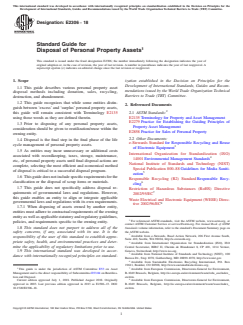
(Guide)Standard Guide for Disposal of Personal Property Assets
General Information
- Abstract
SIGNIFICANCE AND USE
5.1 Continuing emphasis by interested stakeholders demands that an entity dispose of surplus personal property assets in the most economical and efficient manner possible.
5.2 The selection of the disposal method may depend on regulatory, environmental, or safety concerns.
5.3 A personal property assets disposal program should be conducted in a manner consistent with the entity’s requirements, goals, and objectives.
SCOPE
1.1 This guide describes various personal property asset disposal methods including donation, sales, recycling, destruction, and abandonment.
1.2 This guide recognizes that while some entities distinguish between ‘excess’ and ‘surplus’ personal property assets, this guide will remain consistent with Terminology E2135 using those words as they are defined therein.
1.3 Prior to disposing of any personal property assets, consideration should be given to reutilization/reuse within the owning entity.
1.4 Disposal is the final step in the final phase of the life cycle management of personal property assets.
1.5 As entities may incur unnecessary or additional costs associated with recordkeeping, taxes, storage, maintenance, etc,. of personal property assets until final disposal actions are complete, selecting the most efficient and economical method of disposal is critical to a successful disposal program.
1.6 This guide does not include specific requirements for the classification or the disposal of scrap items or materials.
1.7 This guide does not specifically address disposal requirements of governmental laws and regulations. However, this guide enables an entity to align or integrate applicable governmental laws and regulations with its own requirements.
1.7.1 When disposing of assets owned by another entity, entities must adhere to contractual requirements of the owning entity as well as applicable statutory and regulatory guidelines, policies, and requirements specific to the owning entity.
1.8 This standard does not purport to address all of the safety concerns, if any, associated with its use. It is the responsibility of the user of this standard to establish appropriate safety, health, and environmental practices and determine the applicability of regulatory limitations prior to use.
1.9 This international standard was developed in accordance with internationally recognized principles on standardization established in the Decision on Principles for the Development of International Standards, Guides and Recommendations issued by the World Trade Organization Technical Barriers to Trade (TBT) Committee.
- Status
- Published
- Publication Date
- 30-Jun-2018
- Technical Committee
- E53 - Asset Management
- Drafting Committee
- E53.04 - Reutilization and Disposal


Overview
ASTM E2306-18: Standard Guide for Disposal of Personal Property Assets provides a comprehensive framework for organizations to dispose of surplus personal property assets in an efficient, economical, and compliant manner. Developed by ASTM International, this guide addresses the end-of-life phase of asset management, including methods such as donation, sale, recycling, destruction, and abandonment. The standard facilitates alignment with regulatory, safety, and environmental responsibilities, ensuring that disposal practices meet stakeholder expectations while minimizing costs and potential risks.
Key Topics
- Disposal Methods: The guide outlines multiple disposal routes for surplus or excess personal property assets, including donation to eligible entities, sales, recycling (with emphasis on environmental responsibility), destruction, and abandonment.
- Program Objectives: Emphasizes selecting the most efficient and cost-effective method, consistent with the entity’s objectives and regulatory landscape.
- Data Security: For assets capable of storing electronic data, secure sanitization is critical prior to disposal, as described in NIST 800–88.
- Documentation and Accountability: Stresses the importance of maintaining accurate records for each disposal action, ensuring traceability and audit-ability throughout the process.
- Compliance: While not prescriptive on legal or regulatory specifics, the standard supports integrating applicable local, national, or contractual requirements into an organization’s disposal program.
Applications
ASTM E2306-18 is applicable across a broad spectrum of organizations-including private companies, public agencies, educational institutions, and non-profit entities-that manage and dispose of personal property assets. Key practical applications include:
- Surplus Inventory Management: Identifying underutilized or unneeded property to optimize asset lifecycles and reduce carrying costs.
- Donation Programs: Establishing donation processes to benefit qualified entities, such as charities or non-profits, while maintaining compliance and public transparency.
- Environmentally Responsible Recycling: Partnering with certified recyclers (ISO 14001, R2, e-Stewards) to handle electronic waste and other recyclable materials, preventing unnecessary landfill and supporting sustainability efforts.
- Asset Sale and Transfer: Conducting cost-effective sales with proper documentation (titles, bills of sale, certificates of origin), considering both economic return and compliance obligations.
- Secure Destruction or Abandonment: Applying destruction or abandonment as a last resort, ensuring environmental and safety concerns are addressed, and providing an audit trail for due diligence.
- Data Protection: Sanitizing information from data-storing assets per recognized national standards before disposal to prevent data breaches.
Related Standards
Entities following ASTM E2306-18 benefit by referencing additional related guidance and standards:
- ASTM E2135: Terminology for Property and Asset Management
- ASTM E2279: Practice for Establishing Guiding Principles of Property Asset Management
- ASTM E2858: Practice for Sales of Personal Property
- NIST 800-88: Guidelines for Media Sanitization (data security)
- ISO 14001: Environmental Management Systems (sustainable asset disposal)
- R2 Standard: Responsible Recycling of electronics
- e-Stewards Standards: Responsible Recycling and Reuse of Electronic Equipment
- RoHS Directive: Restriction of Hazardous Substances in Electrical and Electronic Equipment
- WEEE Directive: Waste Electrical and Electronic Equipment management
Practical Value
By implementing ASTM E2306-18, organizations can streamline surplus property asset disposal, reduce holding and compliance costs, enhance environmental stewardship, and mitigate legal and reputational risks. This standard fosters transparent, accountable, and sustainable practices throughout the asset disposition lifecycle. Integrating ASTM E2306-18 into asset management policies enables organizations to achieve operational efficiency while maintaining regulatory and ethical obligations.
Relations
- Effective Date
- 01-Jul-2018
- Effective Date
- 01-May-2017
- Effective Date
- 01-Jan-2015
- Effective Date
- 01-Aug-2012
- Effective Date
- 15-Oct-2010
- Effective Date
- 15-Oct-2010
- Effective Date
- 15-Oct-2010
- Effective Date
- 01-Jul-2010
- Refers
ASTM E2279-09 - Standard Practice for Establishing the Guiding Principles of Property Management - Effective Date
- 01-Aug-2009
- Effective Date
- 15-Jun-2007
- Effective Date
- 15-Jun-2007
- Effective Date
- 15-Feb-2006
- Effective Date
- 01-Sep-2004
- Refers
ASTM E2279-03 - Standard Practice for Establishing the Guiding Principles of Property Management - Effective Date
- 10-May-2003
- Effective Date
- 10-Aug-2002
Get Certified
Connect with accredited certification bodies for this standard

BSI Group
BSI (British Standards Institution) is the business standards company that helps organizations make excellence a habit.

Bureau Veritas
Bureau Veritas is a world leader in laboratory testing, inspection and certification services.

DNV
DNV is an independent assurance and risk management provider.
Sponsored listings
Frequently Asked Questions
ASTM E2306-18 is a guide published by ASTM International. Its full title is "Standard Guide for Disposal of Personal Property Assets". This standard covers: SIGNIFICANCE AND USE 5.1 Continuing emphasis by interested stakeholders demands that an entity dispose of surplus personal property assets in the most economical and efficient manner possible. 5.2 The selection of the disposal method may depend on regulatory, environmental, or safety concerns. 5.3 A personal property assets disposal program should be conducted in a manner consistent with the entity’s requirements, goals, and objectives. SCOPE 1.1 This guide describes various personal property asset disposal methods including donation, sales, recycling, destruction, and abandonment. 1.2 This guide recognizes that while some entities distinguish between ‘excess’ and ‘surplus’ personal property assets, this guide will remain consistent with Terminology E2135 using those words as they are defined therein. 1.3 Prior to disposing of any personal property assets, consideration should be given to reutilization/reuse within the owning entity. 1.4 Disposal is the final step in the final phase of the life cycle management of personal property assets. 1.5 As entities may incur unnecessary or additional costs associated with recordkeeping, taxes, storage, maintenance, etc,. of personal property assets until final disposal actions are complete, selecting the most efficient and economical method of disposal is critical to a successful disposal program. 1.6 This guide does not include specific requirements for the classification or the disposal of scrap items or materials. 1.7 This guide does not specifically address disposal requirements of governmental laws and regulations. However, this guide enables an entity to align or integrate applicable governmental laws and regulations with its own requirements. 1.7.1 When disposing of assets owned by another entity, entities must adhere to contractual requirements of the owning entity as well as applicable statutory and regulatory guidelines, policies, and requirements specific to the owning entity. 1.8 This standard does not purport to address all of the safety concerns, if any, associated with its use. It is the responsibility of the user of this standard to establish appropriate safety, health, and environmental practices and determine the applicability of regulatory limitations prior to use. 1.9 This international standard was developed in accordance with internationally recognized principles on standardization established in the Decision on Principles for the Development of International Standards, Guides and Recommendations issued by the World Trade Organization Technical Barriers to Trade (TBT) Committee.
SIGNIFICANCE AND USE 5.1 Continuing emphasis by interested stakeholders demands that an entity dispose of surplus personal property assets in the most economical and efficient manner possible. 5.2 The selection of the disposal method may depend on regulatory, environmental, or safety concerns. 5.3 A personal property assets disposal program should be conducted in a manner consistent with the entity’s requirements, goals, and objectives. SCOPE 1.1 This guide describes various personal property asset disposal methods including donation, sales, recycling, destruction, and abandonment. 1.2 This guide recognizes that while some entities distinguish between ‘excess’ and ‘surplus’ personal property assets, this guide will remain consistent with Terminology E2135 using those words as they are defined therein. 1.3 Prior to disposing of any personal property assets, consideration should be given to reutilization/reuse within the owning entity. 1.4 Disposal is the final step in the final phase of the life cycle management of personal property assets. 1.5 As entities may incur unnecessary or additional costs associated with recordkeeping, taxes, storage, maintenance, etc,. of personal property assets until final disposal actions are complete, selecting the most efficient and economical method of disposal is critical to a successful disposal program. 1.6 This guide does not include specific requirements for the classification or the disposal of scrap items or materials. 1.7 This guide does not specifically address disposal requirements of governmental laws and regulations. However, this guide enables an entity to align or integrate applicable governmental laws and regulations with its own requirements. 1.7.1 When disposing of assets owned by another entity, entities must adhere to contractual requirements of the owning entity as well as applicable statutory and regulatory guidelines, policies, and requirements specific to the owning entity. 1.8 This standard does not purport to address all of the safety concerns, if any, associated with its use. It is the responsibility of the user of this standard to establish appropriate safety, health, and environmental practices and determine the applicability of regulatory limitations prior to use. 1.9 This international standard was developed in accordance with internationally recognized principles on standardization established in the Decision on Principles for the Development of International Standards, Guides and Recommendations issued by the World Trade Organization Technical Barriers to Trade (TBT) Committee.
ASTM E2306-18 is classified under the following ICS (International Classification for Standards) categories: 03.100.99 - Other standards related to company organization and management; 13.030.99 - Other standards related to wastes. The ICS classification helps identify the subject area and facilitates finding related standards.
ASTM E2306-18 has the following relationships with other standards: It is inter standard links to ASTM E2306-13, ASTM E2135-10a(2017), ASTM E2279-15, ASTM E2858-12, ASTM E2135-10a, ASTM E2135-10ae2, ASTM E2135-10ae1, ASTM E2135-10, ASTM E2279-09, ASTM E2135-07, ASTM E2135-07e1, ASTM E2135-06, ASTM E2135-04, ASTM E2279-03, ASTM E2135-02. Understanding these relationships helps ensure you are using the most current and applicable version of the standard.
ASTM E2306-18 is available in PDF format for immediate download after purchase. The document can be added to your cart and obtained through the secure checkout process. Digital delivery ensures instant access to the complete standard document.
Standards Content (Sample)
This international standard was developed in accordance with internationally recognized principles on standardization established in the Decision on Principles for the
Development of International Standards, Guides and Recommendations issued by the World Trade Organization Technical Barriers to Trade (TBT) Committee.
Designation: E2306 − 18
Standard Guide for
Disposal of Personal Property Assets
This standard is issued under the fixed designation E2306; the number immediately following the designation indicates the year of
original adoption or, in the case of revision, the year of last revision. A number in parentheses indicates the year of last reapproval. A
superscript epsilon (´) indicates an editorial change since the last revision or reapproval.
1. Scope ization established in the Decision on Principles for the
Development of International Standards, Guides and Recom-
1.1 This guide describes various personal property asset
mendations issued by the World Trade Organization Technical
disposal methods including donation, sales, recycling,
Barriers to Trade (TBT) Committee.
destruction, and abandonment.
1.2 This guide recognizes that while some entities distin-
2. Referenced Documents
guish between ‘excess’ and ‘surplus’ personal property assets,
2.1 ASTM Standards:
this guide will remain consistent with Terminology E2135
using those words as they are defined therein. E2135 Terminology for Property and Asset Management
E2279 Practice for Establishing the Guiding Principles of
1.3 Prior to disposing of any personal property assets,
Property Asset Management
consideration should be given to reutilization/reuse within the
E2858 Practice for Sales of Personal Property
owning entity.
2.2 Other Documents:
1.4 Disposal is the final step in the final phase of the life
e-Stewards Standard for Responsible Recycling and Reuse
cycle management of personal property assets.
of Electronic Equipment
1.5 As entities may incur unnecessary or additional costs
International Organization for Standardization (ISO)
associated with recordkeeping, taxes, storage, maintenance,
14001 Environmental Management Standards
etc,. of personal property assets until final disposal actions are
National Institute of Standards and Technology (NIST)
complete, selecting the most efficient and economical method
Special Publication 800–88 Guidelines for Media Saniti-
of disposal is critical to a successful disposal program.
zation
1.6 Thisguidedoesnotincludespecificrequirementsforthe
Responsible Recycling (R2) Standard Responsible Recy-
classification or the disposal of scrap items or materials. 6
cling
1.7 This guide does not specifically address disposal re-
Restriction of Hazardous Substances (RoHS) Directive
quirements of governmental laws and regulations. However,
2002/95/EC
this guide enables an entity to align or integrate applicable
Waste Electrical and Electronic Equipment (WEEE) Direc-
governmental laws and regulations with its own requirements. 8
tive 2002/96/EC
1.7.1 When disposing of assets owned by another entity,
entities must adhere to contractual requirements of the owning
entity as well as applicable statutory and regulatory guidelines,
For referenced ASTM standards, visit the ASTM website, www.astm.org, or
policies, and requirements specific to the owning entity.
contact ASTM Customer Service at service@astm.org. For Annual Book of ASTM
1.8 This standard does not purport to address all of the
Standards volume information, refer to the standard’s Document Summary page on
the ASTM website.
safety concerns, if any, associated with its use. It is the
Available from e-Stewards, Basel Action Network, 206 First Avenue South,
responsibility of the user of this standard to establish appro-
Suite 410, Seattle, WA 98104, http://e-stewards.org.
priate safety, health, and environmental practices and deter- 4
Available from International Organization for Standardization (ISO), ISO
mine the applicability of regulatory limitations prior to use. Central Secretariat, BIBC II, Chemin de Blandonnet 8, CP 401, 1214 Vernier,
Geneva, Switzerland, http://www.iso.org.
1.9 This international standard was developed in accor-
Available from National Institute of Standards and Technology (NIST), 100
dance with internationally recognized principles on standard-
Bureau Dr., Stop 1070, Gaithersburg, MD 20899-1070, http://www.nist.gov.
Available from Sustainable Electronics Recycling International, P.O. Box
19611, Boulder, CO 80308, http://www.sustainableelectronics.org.
1 7
This guide is under the jurisdiction of ASTM Committee E53 on Asset Available from European Commission, Directorate-General for Environment,
Management and is the direct responsibility of Subcommittee E53.04 on Reutiliza- B-1049 Brussels, Belgium, http://ec.europa.eu/environment/waste/rohs_eee/index_
tion and Disposal. en.htm.
Current edition approved July 1, 2018. Published August 2018. Originally Available from European Commission, Directorate-General for Environment,
approved in 2003. Last previous edition approved in 2013 as E2306–13. DOI: B-1049 Brussels, Belgium, http://ec.europa.eu/environment/waste/weee/index_
10.1520/E2306–18. en.htm.
Copyright © ASTM International, 100 Barr Harbor Drive, PO Box C700, West Conshohocken, PA 19428-2959. United States
E2306 − 18
3. Terminology 7. Donation of Surplus
3.1 Definitions—For definitions of additional terms, refer to 7.1 Entities should establish donation programs that comply
Terminology E2135. with applicable entity processes, policies, and procedures.
Donation programs should enable donation of surplus personal
3.2 Definitions of Terms Specific to This Standard:
property assets directly to eligible entities with the least
3.2.1 abandonment, n—to give up all and any future claim
amount of administrative effort/costs. Care must be used to
to rights or interest in personal property.
ensure donations stand up to public scrutiny.
3.2.2 destruction, n—the process of ruining the structure,
7.2 The donation of surplus property to non-profits or
organic existence, or physical condition of personal property
similar entities can meet disposal needs and bring goodwill to
rendering it unusable for its intended function or design.
the donating entity.
3.2.3 recycling, v—processing property and materials
7.3 Governmental entities must determine eligibility in
(scrap/waste) into new materials or products to prevent waste
accordance with the applicable federal statutes and regulations.
of potentially useful materials.
Each U.S. state and territory has a State Agency for Surplus
3.2.4 reutilization, n—transferring or reassigning personal
Property (SASP). These agencies were established to receive
property within an entity.
federal surplus personal property assets and to donate assets to
public entities and certain non-profit, tax-exempt agencies.The
4. Summary of Guide
General Services Administration (GSA) has
...
This document is not an ASTM standard and is intended only to provide the user of an ASTM standard an indication of what changes have been made to the previous version. Because
it may not be technically possible to adequately depict all changes accurately, ASTM recommends that users consult prior editions as appropriate. In all cases only the current version
of the standard as published by ASTM is to be considered the official document.
Designation: E2306 − 13 E2306 − 18
Standard PracticeGuide for
Disposal of Personal Property Assets
This standard is issued under the fixed designation E2306; the number immediately following the designation indicates the year of
original adoption or, in the case of revision, the year of last revision. A number in parentheses indicates the year of last reapproval. A
superscript epsilon (´) indicates an editorial change since the last revision or reapproval.
1. Scope
1.1 This practice describes various personal property disposal methods including donation, sales, recycling, destruction, and
abandonment.
1.2 This practice recognizes that while some entities distinguish between ‘excess’ and ‘surplus’ personal property, this practice
will remain consistent with Terminology E2135 using those words as they are defined therein.
1.3 Prior to disposing of any personal property, consideration should be given to reutilization/reuse within the owning entity.
1.4 Disposal is the final step in the final phase of the management of personal property.
1.5 As entities may incur unnecessary or additional costs associated with recordkeeping, taxes, storage, maintenance, etc,. of
personal property until final disposal actions are complete, selecting the most efficient and economical method of disposal is critical
to a successful disposal program.
1.6 This practice does not include specific requirements for the classification or the disposal of scrap items or materials.
1.7 This practice does not specifically address disposal requirements of governmental laws and regulations. However, this
practice enables an entity to align or integrate applicable governmental laws and regulations with its own requirements.
1.7.1 When disposing of property owned by another entity, entities must adhere to contractual requirements of the owning entity
as well as applicable statutory and regulatory guidelines, policies, and requirements specific to the owning entity.
1.8 This standard does not purport to address all of the safety concerns, if any, associated with its use. It is the responsibility
of the user of this standard to establish appropriate safety and health practices and determine the applicability of regulatory
limitations prior to use.
2. Referenced Documents
2.1 ASTM Standards:
E2135 Terminology for Property and Asset Management
2.2 Other Documents:
e-Stewards Standard for Responsible Recycling and Reuse of Electronic Equipment
ISO 14001 Environmental Management Standards
NIST 800–88 Guidelines for Media Sanitization
R2 Standard Recycling Responsibly
RoHS Directive Directive 2002/96/EC on the Restriction of the Use of Certain Hazardous Substances in Electrical and
Electronic Equipment
This practiceguide is under the jurisdiction of ASTM Committee E53 on Asset Management and is the direct responsibility of Subcommittee E53.04 on Reutilization
and Disposal.
Current edition approved March 1, 2013July 1, 2018. Published April 2013August 2018. Originally approved in 2003. Last previous edition approved in 20112013 as
E2306 – 11.E2306–13. DOI: 10.1520/E2306-13.10.1520/E2306–18.
For referenced ASTM standards, visit the ASTM website, www.astm.org, or contact ASTM Customer Service at service@astm.org. For Annual Book of ASTM Standards
volume information, refer to the standard’sstandard’s Document Summary page on the ASTM website.
Available from e-Stewards, Basel Action Network, 206 First Avenue South, Suite 410, Seattle, WA 98104, http://e-stewards.org.
Available from International Organization for Standardization (ISO), 1, ch. de la Voie-Creuse, CP 56, CH-1211 Geneva 20,ISO Central Secretariat, BIBC II, Chemin de
Blandonnet 8, CP 401, 1214 Vernier, Geneva, Switzerland, http://www.iso.org.
Available from National Institute of Standards and Technology (NIST), 100 Bureau Dr., Stop 1070, Gaithersburg, MD 20899-1070, http://www.nist.gov.
Available from R2 Solutions, 2075 Yarmouth Ave., Boulder, CO 80301, http://www.r2solutions.org.Sustainable Electronics Recycling International, P.O. Box 19611,
Boulder, CO 80308, http://www.sustainableelectronics.org.
Available from Environment Directorate-General, European Commission, Directorate-General for Environment, B-1049 Brussels, http://www.rohs-guide.com.Belgium,
http://ec.europa.eu/environment/waste/rohs_eee/index_en.htm.
Copyright © ASTM International, 100 Barr Harbor Drive, PO Box C700, West Conshohocken, PA 19428-2959. United States
E2306 − 18
WEEE Directive Directive 2002/96/EC on Waste Electrical and Electronic Equipment
3. Terminology
3.1 Definitions—For definitions of additional terms, refer to Terminology E2135.
3.2 Definitions of Terms Specific to This Standard:
3.2.1 abandonment, n—to give up all and any future claim to rights or interest in personal property.
3.2.2 destruction, n—the process of ruining the structure, organic existence, or physical condition of personal property rendering
it unusable for its intended design or function.
3.2.3 recycling, v—processing property and materials (scrap/waste) into new materials or products to prevent waste of
potentially useful materials.
3.2.4 reutilization, n—transferring or reassigning personal property within an entity.
4. Summary of Practice
4.1 Entities will determine disposal methods in accordance with this practice using terminology cited in Terminology E2135.
5. Significance and Use
5.1 Continuing emphasis by interested stakeholders demands that an entity dispose of surplus personal property in the most
economical and efficient manner possible.
5.2 The selection of the disposal method may depend on regulatory, environmental, or safety concerns.
5.3 A personal property disposal program should be conducted in a manner consistent with the entity’s requirements, goals, and
objectives.
6. Management of Surplus Personal Property
6.1 Entities shall establish policies and implement accountability systems to manage the disposal of surplus personal property.
6.2 Property management systems should be designed to identify underutilized equipment, rental/lease periods nearing
expiration, etc., to assist in determining what property may no longer be required by an entity.
6.3 Surplus personal property capable of storing electronic data should be sanitized prior to disposal to eliminate the possible
loss of control of data characterized by negative societal, safety, or security impact. NIST 800–88 describes practices to clean hard
drives and other storage devices in order to protect sensitive data and maximize reuse potential by using the least destructive
sanitization procedures wherever appropriate. The physical removal of hard drives or other data storage components prior to
disposal should usually be considered as a last resort. Follow your entities sanitization processes, policies, and procedures.
6.4 The disposal of surplus personal property may involve the following methods: donation, recycling, sale, destruction,
abandonment or any other appropriate method authorized by the property owner.
6.5 Entities should assure that they have sufficient rights to dispose of property prior to initiating disposal actions.
7. Donation of Surplus Personal Property
7.1 Entities should establish donation programs that comply with applicable entity processes, policies, and procedures. Donation
programs should enable donation of surplus property directly to eligible entities with the least amount of administrative effort/costs.
Care must be used to ensure donations stand up to public scrutiny.
7.2 The donation of surplus property to non-profits or similar entities can meet disposal needs and bring goodwill to the donating
entity.
7.3 Governmental entities must determine eligibility in accordance with the applicable federal statutes and regulations. Each
U.S. state and territory has a State Agency for Surplus Property (SASP). These agencies were established to receive federal surplus
personal property and to donate it to public agencies and certain non-profit, tax-exempt agencies. The General Services
Administration (GSA) has the responsibility of administering this program and has issued regulations for its implementation.
8. Recycling Surplus Personal Property
8.1 Recycling should be considered prior to declaring property as having disposal or sale value for material content only.
8.2 Consider the recycling of salvage and scrap materials after destruction.
Available from Environment Directorate-General, European Commission, Directorate-General for Environment, B-1049 Brussels, http://free.weee-guide.com/weee-
directive.html.Belgium, http://ec.europa.eu/environment/waste/weee/index_en.htm.
E2306 − 18
8.3 Recycling may be a cost effective, environmentally friendly way to dispose of surplus personal property. An effective
recycling program decreases material entering the waste stream and is sometimes required by statute or law.
8.4 Recyclers should be certified to comply with ISO 14001. Recycling certifications for electronic equipment disposal include
the R2 Standard, the e-Stewards Standard, WEEE Directive, or RoHS Directive, or a combination thereof.
9. Sale of Surplus Property
9.1 Property determined to be no longer needed by the owning entity may be considered for sale.
9.2 Entities should determine the most economical method to sell surplus property.
9.2.1 Sales should be planned and conducted in a manner that will maximize benefits and minimize risk to the entity.
9.2.2 When planning and conducting sales, entities should consider property characteristics, location, anticipated market,
duration of the sale and anticipated proceeds versus anticipated cost to conduct the sale.
9.2.3 Entities should consider other methods of disposal whenever anticipated cost of sale exceeds anticipated proceeds of the
sale.
9.3 Records must be updated to reflect the sale and that the property is no longer available.
9.4 Entities should ensure all necessary documentation such as Certificates of Origin, maintenance records, vehicle titles, etc.,
for the proper transfer of ownership to the successful buyer are available. Documents such as vehicle titles, bills of sale, etc., should
be authenticated by an authorized official of the selling entity (when required) and copies maintained as appropriate for audit trail
purposes.
9.5 Entities offering items considered sensitive or that may have other societal, safety or security implications should ensure all
necessary precautions are completed or in place prior to the sale.
9.6 Consider the sale of salvage and scrap materials after destruction.
10. Destruction or Abandonment of Surplus Personal Property
10.1 Surplus personal property that has not been otherwise disposed of should be considered for destruction or abandonment.
10.2 Destruction or abandonment of personal property must be fully documented and provide an audit trail.
10.3 In establishing justifications for destruction or abandonment actions, entities should conclude that property be destroyed
or abandoned for safety reasons or by law or a contractual arrangement and cannot be disposed of via another disposal method.
10.4 Destruction or abandonment must be performed in a manner that minimizes environmental impact. The destruction or
abandonment of contaminated or hazardous materials must be compliant with applicable governmental laws or regulations.
11. Summary
11.1 This practice promotes the importance of selecting the best method for the disposal of surplus personal property.
11.2 The central objective of this practice is to ensure the most efficient, timely, and economical process for disposal of personal
property is selected.
12. Keywords
12.1 abandonment; destruction; disposal; donation; reutilization; sale; surplus
ASTM International takes no position respecting the validity of any patent rights asserted in connection with any item mentioned
in this standard. Users of this standard are expressly advised that determination of the validity of any such patent rights, and the risk
of infringement of such rights, are entirely their own responsibility.
This standard is subject to revision at any time by the responsible technical committee and must be reviewed eve
...