

ASTM A278/A278M-01(2020)
(Specification)Standard Specification for Gray Iron Castings for Pressure-Containing Parts for Temperatures Up to 650 °F (350 °C)
General Information
- Abstract
ABSTRACT
This specification covers gray iron for castings suitable for pressure-containing parts at elevated temperatures. Castings shall be stress-relieved by placing them in a suitable furnace and heating them uniformly to the temperatures and for the times specified. Castings to be used at a particular temperature range shall undergo heat treatment and cooling. Chemical analysis shall be performed on each class of castings and shall meet the maximum requirement for carbon, phosphorus and sulfur. Iron used in supplying castings shall conform to the required tensile strength. Separately cast test bars having the required dimensions shall be poured from the same lot as the castings represented. The test bars shall be cast in dried siliceous sand molds maintained at approximately room temperature. Tension test shall be performed on each lot and materials shall conform to the tensile requirements specified.
SCOPE
1.1 This specification2 covers gray iron for castings suitable for pressure-containing parts for use at temperatures up to 650 °F (350 °C).
1.2 Classes of Iron:
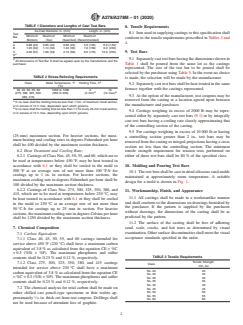
1.2.1 Castings of all classes are suitable for use up to 450 °F (230 °C). For temperatures above 450 °F and up to 650 °F, only Class 40, 45, 50, 55, and 60 castings are suitable.
1.2.2 Castings of all classes are suitable for use up to 230 °C. For temperatures above 230 °C and up to 350 °C, only Class 275, 300, 325, 350, 380, and 415 castings are suitable.
1.3 The values stated in either SI units or inch-pound units are to be regarded separately as standard. The values stated in each system may not be exact equivalents; therefore, each system shall be used independently of the other. Combining values from the two systems may result in nonconformance with the standard.
1.4 This international standard was developed in accordance with internationally recognized principles on standardization established in the Decision on Principles for the Development of International Standards, Guides and Recommendations issued by the World Trade Organization Technical Barriers to Trade (TBT) Committee.
- Status
- Published
- Publication Date
- 30-Apr-2020
- Technical Committee
- A04 - Iron Castings
- Drafting Committee
- A04.01 - Grey and White Iron Castings
Overview
ASTM A278/A278M-01(2020) - Standard Specification for Gray Iron Castings for Pressure-Containing Parts for Temperatures Up to 650°F (350°C) defines requirements for gray iron castings used in pressure-containing parts exposed to elevated temperatures. This international standard, developed by ASTM, focuses on castings intended for industrial applications where operating temperatures reach up to 650°F (350°C). It provides guidelines on the chemical composition, heat treatment, mechanical properties, and testing methods for gray iron, ensuring reliable performance and safety in elevated-temperature service.
Key Topics
- Material Scope: Covers gray iron castings suitable for pressure-containing parts for use up to 650°F (350°C).
- Classes of Iron:
- All classes may be used up to 450°F (230°C).
- For 450°F to 650°F (230°C to 350°C), only specific classes (40, 45, 50, 55, 60 in imperial; 275, 300, 325, 350, 380, 415 in metric) are suitable.
- Heat Treatment and Cooling:
- Stress relief by heating castings uniformly as specified.
- For higher temperature applications, detailed requirements for heat treatment and cooling rates are outlined to ensure structural integrity.
- Chemical Analysis:
- Strict limits for carbon, phosphorus, and sulfur to guarantee the desired properties in service.
- Chemical composition must be validated for each batch of castings.
- Mechanical Properties:
- Gray iron used must meet specified minimum tensile strength.
- Test bars poured from the same lot ensure representative sampling for quality assurance.
- Testing and Inspection:
- Tension testing using standards such as ASTM E8/E8M.
- Cast test bars and specimens must conform to dimensional and procedural requirements.
- Certifications and traceability are essential for compliance.
Applications
- Pressure-Containing Components: Used extensively in the manufacture of pressure vessels, valves, and fittings that operate in systems exposed to moderate and elevated temperatures.
- Industrial Equipment: Common in power generation, chemical processing, and oil and gas sectors where durability and resistance to thermal stresses are crucial.
- Boiler and Pressure Vessel Code Compliance: Recognized by regulatory bodies, including the U.S. Department of Defense and ASME Boiler and Pressure Vessel Code, for use in code-stamped components.
- High-Temperature Service: Ideal for applications requiring consistent mechanical properties and dimensional stability at temperatures up to 650°F (350°C), such as in pipelines and heat exchangers.
- Quality Assurance: Supports manufacturers and end-users in specifying, testing, and certifying gray iron castings for safety-critical service.
Related Standards
- ASTM A644: Terminology Relating to Iron Castings - Provides definitions for terms used within this and related specifications.
- ASTM E8/E8M: Test Methods for Tension Testing of Metallic Materials - Referenced for mechanical property testing.
- ASME SA-278: Specification for Gray Iron Castings for Pressure-Containing Parts (included in ASME Boiler and Pressure Vessel Code Section II).
Keywords: gray iron castings, pressure-containing parts, elevated temperature, ASTM A278, tensile strength, chemical composition, heat treatment, industrial applications
By adhering to ASTM A278/A278M-01(2020), suppliers and users of gray iron castings ensure compliance with internationally recognized quality and safety standards for critical pressure-containing applications operating at elevated temperatures.
Relations
- Effective Date
- 01-May-2020
- Effective Date
- 01-Jan-2024
- Effective Date
- 01-Nov-2017
- Effective Date
- 15-Jul-2016
- Effective Date
- 01-Feb-2015
- Effective Date
- 01-Oct-2014
- Effective Date
- 01-Jun-2013
- Effective Date
- 01-May-2013
- Effective Date
- 01-Dec-2011
- Effective Date
- 01-Jul-2009
- Effective Date
- 01-Jun-2009
- Effective Date
- 01-Nov-2005
- Effective Date
- 10-Dec-1998
- Effective Date
- 01-May-2020
- Effective Date
- 01-May-2020
Get Certified
Connect with accredited certification bodies for this standard

Element Materials Technology
Materials testing and product certification.

Inštitut za kovinske materiale in tehnologije
Institute of Metals and Technology. Materials testing, metallurgical analysis, NDT.
Sponsored listings
Frequently Asked Questions
ASTM A278/A278M-01(2020) is a technical specification published by ASTM International. Its full title is "Standard Specification for Gray Iron Castings for Pressure-Containing Parts for Temperatures Up to 650 °F (350 °C)". This standard covers: ABSTRACT This specification covers gray iron for castings suitable for pressure-containing parts at elevated temperatures. Castings shall be stress-relieved by placing them in a suitable furnace and heating them uniformly to the temperatures and for the times specified. Castings to be used at a particular temperature range shall undergo heat treatment and cooling. Chemical analysis shall be performed on each class of castings and shall meet the maximum requirement for carbon, phosphorus and sulfur. Iron used in supplying castings shall conform to the required tensile strength. Separately cast test bars having the required dimensions shall be poured from the same lot as the castings represented. The test bars shall be cast in dried siliceous sand molds maintained at approximately room temperature. Tension test shall be performed on each lot and materials shall conform to the tensile requirements specified. SCOPE 1.1 This specification2 covers gray iron for castings suitable for pressure-containing parts for use at temperatures up to 650 °F (350 °C). 1.2 Classes of Iron: 1.2.1 Castings of all classes are suitable for use up to 450 °F (230 °C). For temperatures above 450 °F and up to 650 °F, only Class 40, 45, 50, 55, and 60 castings are suitable. 1.2.2 Castings of all classes are suitable for use up to 230 °C. For temperatures above 230 °C and up to 350 °C, only Class 275, 300, 325, 350, 380, and 415 castings are suitable. 1.3 The values stated in either SI units or inch-pound units are to be regarded separately as standard. The values stated in each system may not be exact equivalents; therefore, each system shall be used independently of the other. Combining values from the two systems may result in nonconformance with the standard. 1.4 This international standard was developed in accordance with internationally recognized principles on standardization established in the Decision on Principles for the Development of International Standards, Guides and Recommendations issued by the World Trade Organization Technical Barriers to Trade (TBT) Committee.
ABSTRACT This specification covers gray iron for castings suitable for pressure-containing parts at elevated temperatures. Castings shall be stress-relieved by placing them in a suitable furnace and heating them uniformly to the temperatures and for the times specified. Castings to be used at a particular temperature range shall undergo heat treatment and cooling. Chemical analysis shall be performed on each class of castings and shall meet the maximum requirement for carbon, phosphorus and sulfur. Iron used in supplying castings shall conform to the required tensile strength. Separately cast test bars having the required dimensions shall be poured from the same lot as the castings represented. The test bars shall be cast in dried siliceous sand molds maintained at approximately room temperature. Tension test shall be performed on each lot and materials shall conform to the tensile requirements specified. SCOPE 1.1 This specification2 covers gray iron for castings suitable for pressure-containing parts for use at temperatures up to 650 °F (350 °C). 1.2 Classes of Iron: 1.2.1 Castings of all classes are suitable for use up to 450 °F (230 °C). For temperatures above 450 °F and up to 650 °F, only Class 40, 45, 50, 55, and 60 castings are suitable. 1.2.2 Castings of all classes are suitable for use up to 230 °C. For temperatures above 230 °C and up to 350 °C, only Class 275, 300, 325, 350, 380, and 415 castings are suitable. 1.3 The values stated in either SI units or inch-pound units are to be regarded separately as standard. The values stated in each system may not be exact equivalents; therefore, each system shall be used independently of the other. Combining values from the two systems may result in nonconformance with the standard. 1.4 This international standard was developed in accordance with internationally recognized principles on standardization established in the Decision on Principles for the Development of International Standards, Guides and Recommendations issued by the World Trade Organization Technical Barriers to Trade (TBT) Committee.
ASTM A278/A278M-01(2020) is classified under the following ICS (International Classification for Standards) categories: 77.140.80 - Iron and steel castings. The ICS classification helps identify the subject area and facilitates finding related standards.
ASTM A278/A278M-01(2020) has the following relationships with other standards: It is inter standard links to ASTM A278/A278M-01(2015), ASTM E8/E8M-24, ASTM A644-17, ASTM E8/E8M-16, ASTM E8/E8M-15, ASTM A644-14, ASTM E8/E8M-13, ASTM A644-13, ASTM E8/E8M-11, ASTM A644-09a, ASTM A644-09, ASTM A644-05, ASTM A644-98(2003), ASTM F1545-15a(2021), ASTM A834-95(2020). Understanding these relationships helps ensure you are using the most current and applicable version of the standard.
ASTM A278/A278M-01(2020) is available in PDF format for immediate download after purchase. The document can be added to your cart and obtained through the secure checkout process. Digital delivery ensures instant access to the complete standard document.
Standards Content (Sample)
This international standard was developed in accordance with internationally recognized principles on standardization established in the Decision on Principles for the
Development of International Standards, Guides and Recommendations issued by the World Trade Organization Technical Barriers to Trade (TBT) Committee.
Designation:A278/A278M −01 (Reapproved 2020)
Standard Specification for
Gray Iron Castings for Pressure-Containing Parts for
Temperatures Up to 650°F (350°C)
This standard is issued under the fixed designationA278/A278M; the number immediately following the designation indicates the year
of original adoption or, in the case of revision, the year of last revision. A number in parentheses indicates the year of last reapproval.
A superscript epsilon (´) indicates an editorial change since the last revision or reapproval.
This standard has been approved for use by agencies of the U.S. Department of Defense.
1. Scope 3. Terminology
1.1 This specification covers gray iron for castings suitable 3.1 Definitions of many terms common to gray iron castings
for pressure-containing parts for use at temperatures up to may be found in Terminology A644.
650 °F (350 °C).
4. Classification
1.2 Classes of Iron:
4.1 Classification by tensile strength.
1.2.1 Castings of all classes are suitable for use up to 450 °F
4.1.1 Castings ordered to this specification are classified
(230 °C). For temperatures above 450 °F and up to 650 °F,
based upon the minimum tensile strength of the iron in ksi, in
only Class 40, 45, 50, 55, and 60 castings are suitable.
English units. Class 25 has a minimum specified tensile
1.2.2 Castings of all classes are suitable for use up to
strength of 25 ksi.
230 °C. For temperatures above 230 °C and up to 350 °C, only
4.1.2 Castings ordered to this specification are classified
Class 275, 300, 325, 350, 380, and 415 castings are suitable.
based upon the minimum tensile strength of the iron in MPa, in
1.3 The values stated in either SI units or inch-pound units
Metric units. Class 150 has a minimum specified tensile
are to be regarded separately as standard. The values stated in
strength of 150 MPa.
each system may not be exact equivalents; therefore, each
system shall be used independently of the other. Combining
5. Ordering Information
values from the two systems may result in nonconformance
5.1 Orders for material in this specification should include
with the standard.
the following information:
1.4 This international standard was developed in accor-
5.1.1 ASTM designation and year date,
dance with internationally recognized principles on standard-
5.1.2 Class of iron required and service temperature,
ization established in the Decision on Principles for the
5.1.3 Quantity,
Development of International Standards, Guides and Recom-
5.1.4 Heat Treatment:
mendations issued by the World Trade Organization Technical
5.1.4.1 Whether or not heat treatment is required for Class
Barriers to Trade (TBT) Committee.
40, 45, 50, 55, and 60 castings to be used at temperatures at
450 °F or less (see 6.2),
2. Referenced Documents
5.1.4.2 Whether or not heat treatment is required for Class
2.1 ASTM Standards:
275, 300, 325, 350, 380, and 415 castings to be used at
A644 Terminology Relating to Iron Castings
temperatures at 230 °C or less (see 6.2),
E8/E8M Test Methods for Tension Testing of Metallic Ma-
5.1.5 The size of separately cast test bar to be poured (see
terials
Section 9 and Table 1),
5.1.6 The size of test specimen to be machined from test
barsCorS,and
This specification is under the jurisdiction of ASTM Committee A04 on Iron
5.1.7 Special requirements.
CastingsandisthedirectresponsibilityofSubcommitteeA04.01onGreyandWhite
Iron Castings.
6. Materials and Manufacture
Current edition approved May 1, 2020. Published May 2020. Originally
approved in 1944. Last previous edition approved in 2015 as A278/
6.1 Castings intended for use above 450 °F (230 °C) shall
A278M – 01 (2015). DOI: 10.1520/A0278_A0278M-01R20.
be stress-relieved by placing them in a suitable furnace at a
For ASME Boiler and Pressure Vessel Code applications, see related Specifi-
cation SA-278 in Section II of that Code.
temperature not exceeding 400 °F (200 °C) and heating them
For referenced ASTM standards, visit the ASTM website, www.astm.org, or
uniformly to the temperatures and for the times specified in
contact ASTM Customer Service at service@astm.org. For Annual Book of ASTM
Table 2. The heating and cooling rates shall be uniform and
Standards volume information, refer to the standard’s Document Summary page on
the ASTM website. shallnotbemorethan400 °F⁄h(250 °C⁄h)forcastingsof1-in.
Copyright © ASTM International, 100 Barr Harbor Drive, PO Box C700, West Conshohocken, PA 19428-2959. United States
A278/A278M−01 (2020)
TABLE 1 Diameters and Lengths of Cast Test Bars
8. Tensile Requirements
As-Cast Diameter, in. (mm) Length, in. (mm)
8.1 Iron used in supplying castings to this specification shall
Test
Minimum Maximum Minimum Maximum
Bar
conform to the tensile requirements prescribed in Tables 3 and
(Bottom) (Top) (Specified) (Recommended)
4.
A 0.88 (23) 0.85 (22) 0.96 (25) 5.0 (125) 6.0 (1.50)
B 1.20 (33) 1.14 (32) 1.32 (36) 7.0 (150) 9.0 (230)
C 2.00 (54) 1.90 (53) 2.10 (58) 6.0 (175) 10.0 (255)
9. Test Bars
A
S
9.1 Separatelycasttestbarshavingthedimensionsshownin
A
All dimensions of Test Bar S shall be agreed upon by the manufacturer and the
Table 1 shall be poured from the same lot as the castings
purchaser.
represented. The size of the test bar to be poured shall be
selected by the purchaser using Table 5. In the event no choice
TABLE 2 Stress-Relieving Requirements
is made, the selection will be made by the manufacturer.
A
Class Metal Temperature, °F Holding Time, h
9.2 Separately cast test bars shall be heat treated in the same
(°C)
furnace together with the castings represented.
40, 45, 50, 55, 60 1050 to 1200 2 12
B B
(275, 300, 325, 350, (565 to 650) (2 min) (12 max)
9.3 At the option of the manufacturer, test coupons may be
380, 415)
removed from the casting at a location agreed upon between
A
In no case shall the holding time be less than 1 h/in. of maximum metal section,
the manufacturer and purchaser.
or in excess of 12 h max, dependent upon which governs.
B
In no case shall the holding time be less than1hfor every 25-mm metal section,
9.4 Castings weighing in excess of 2000 lb may be repre-
or in excess of 12 h max, depending upon which governs.
sented either by separately cast test bars (9.1) or by integrally
cast test bars having a cooling rate closely approximating that
of the controlling section of the casting.
9.5 For castings weighing in excess of 10 000 lb or having
(25-mm) maximum section. For heavier sections, the maxi-
a controlling section greater than 2 in., test bars may be
mum heating and cooling rates in degrees Fahrenheit per hour
removed from the casting or integral projections having a cross
shall be 400 divided by the maximum section thickness.
section no less than the controlling section. The minimum
6.2 Heat Treatment and Cooling Rate: tensile strength requirement for tension tests performed on
either of these test bars shall be 80 % of the specified class.
6.2.1 CastingsofClassNos.45,50,55,and60,whichareto
be used at temperatures below 450 °F, may be heat treated in
accordance with 6.1 or they shall be cooled in the mold to 10. Molding and Pouring Test Bars
500 °F at an average rate of not more than 100 °F⁄h for
10.1 The test bars shall be cast in dried siliceous sand molds
castings up to 1 in. in section. For heavier sections, the
maintained at approximately room temperature. A suitable
maximum cooling rate in degrees Fahrenheit per hour shall be
design for a mold is shown in Fig. 1.
100 divided by the maximum section thickness.
6.2.2 Castings of Class Nos. 275, 300, 325, 350, 380, and
11. Workmanship, Finish, and Appearance
415, which are to be used at temperatures below 230 °C, may
11.1 All castings shall be made in a workmanlike manner
be heat treated in accordance with 6.1 or they shall be cooled
and shall conform to the dimensions on drawings furnished by
in the mold to 250 °C at an average rate of not more than
the purchaser. If the pattern is supplied by the purchaser
50 °C⁄h for castings up to 25 mm in section.
...