

ASTM F3222-16
(Terminology)Standard Terminology Relating to F32 Land Search and Rescue Standards and Guides
General Information
- Abstract
SIGNIFICANCE AND USE
3.1 The terminology in this document is applicable to the standards and guides published by ASTM Committee F32.
3.2 The definitions provided in this terminology standard shall be used when interpreting the meaning, purpose or applicability of a guide, standard, or a specific subsection therein.
SCOPE
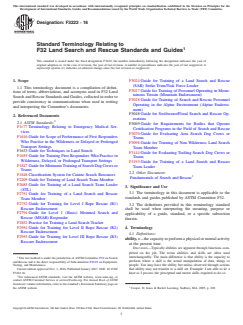
1.1 This terminology document is a compilation of definitions of terms, abbreviations, and acronyms used in F32 Land Search and Rescue Standards and Guides, collected in order to provide consistency in communications when used in writing and interpreting the Committee’s documents.
- Status
- Published
- Publication Date
- 31-Oct-2016
- Technical Committee
- F32 - Search and Rescue
- Drafting Committee
- F32.01 - Equipment, Testing, and Maintenance
Overview
ASTM F3222-16: Standard Terminology Relating to F32 Land Search and Rescue Standards and Guides provides a consolidated set of definitions, abbreviations, and acronyms used throughout ASTM Committee F32’s suite of Land Search and Rescue (SAR) standards and guides. Developed by ASTM International, this terminology standard is essential for ensuring clear communication, consistency, and understanding when referencing, interpreting, and applying F32 SAR documents.
The scope of ASTM F3222-16 encompasses all SAR terms used within applicable committee documents, supporting a unified language for land search and rescue practitioners, trainers, and organizations. Accurate terminology is central to effective incident management, resource categorization, operational guidelines, and training requirements in SAR operations.
Key Topics
- Consistent Communication: This standard compiles agreed definitions, reducing ambiguity and promoting precision in SAR documentation, training, and operations.
- Core Definitions: Key SAR concepts such as “ability,” “competency,” “certification,” “search area,” “rescue,” “wilderness,” and roles like “handler,” “tracker,” and “team leader” are clarified.
- Operational Terms: Terms crucial to fieldwork, such as “high angle,” “low angle,” “technical rescue,” “swiftwater,” “search area,” and “segment,” are included to standardize incident management vocabulary.
- Dog and Handler Terminology: Specialized definitions relating to search dogs, handlers, and canine team classifications ensure clarity for canine SAR operations.
- Applicability: All definitions in ASTM F3222-16 are intended for use when interpreting or applying other F32 guides and standards, such as those relating to mountain, alpine, non-wilderness, or rope rescue operations.
Applications
ASTM F3222-16 is a foundational reference for a wide spectrum of land search and rescue activities. Its applications include:
- Interpreting Standards and Guides: Practitioners and organizations rely on the precise terminology to accurately interpret the intent, scope, and requirements of F32 SAR standards.
- Training and Credentialing: Training programs reference these terms to ensure that SAR personnel are evaluated consistently, especially for roles such as search dog handlers, rope rescuers, or team leaders.
- Incident Command and Resource Management: Incident commanders and SAR coordinators use standardized terms to assign resources, define operational tasks, communicate expectations, and document activities.
- Certification and Qualification Programs: Certification bodies base assessment criteria on these terms, ensuring personnel, animals, and equipment meet standardized requirements.
- Development of Local Protocols: Local SAR teams utilize the terminology to develop protocols, ensuring alignment with national and international SAR practices.
Related Standards
ASTM F3222-16 serves as the terminology backbone for a comprehensive suite of SAR standards and guides. Key related documents include:
- ASTM F3024: Guide for Training of Land SAR Strike Team/Task Force Leader
- ASTM F3027/F3028: Guides for Training SAR Personnel in Mountain and Alpine Environments
- ASTM F3048: Guide for Swiftwater/Flood SAR Operations
- ASTM F3070/F3144: Guides for Search Dog and Trailing Dog Team Evaluations
- ASTM F3098: Guide for Training Non-Wilderness Land Search Team Members
- ASTM F2751/F2685/F3193: Guides for Land SAR Team Members and Leaders
- ASTM F2752/F2954/F2955: Rope Rescue Endorsement Guides
Additionally, terminology overlaps with other referenced ASTM standards such as F1177 (Emergency Medical Services) and F1616/F1655 (Wilderness EMS).
By providing a harmonized vocabulary, ASTM F3222-16 enhances the effectiveness, safety, and interoperability of land search and rescue operations worldwide. This standard is a critical reference for all SAR professionals, agencies, trainers, and certifying bodies involved in the planning, execution, and support of land-based search and rescue missions.
Relations
- Effective Date
- 01-Apr-2024
- Effective Date
- 01-Apr-2024
- Effective Date
- 01-Apr-2024
- Refers
ASTM F2794-09(2020) - Standard Guide for Level 1 (Basic) Mounted Search and Rescue (MSAR) Responder - Effective Date
- 01-Apr-2020
- Effective Date
- 01-Dec-2019
- Effective Date
- 01-Nov-2017
- Effective Date
- 01-Jul-2016
- Effective Date
- 01-Jun-2016
- Effective Date
- 01-Jun-2016
- Effective Date
- 01-Mar-2014
- Effective Date
- 01-Mar-2014
- Effective Date
- 01-Dec-2013
- Effective Date
- 01-Sep-2013
- Effective Date
- 01-Sep-2013
- Refers
ASTM F2955-12 - Standard Guide for Training for Level III Rope Rescue (R3) Rescuer Endorsement - Effective Date
- 01-Jun-2012
Get Certified
Connect with accredited certification bodies for this standard

BSI Group
BSI (British Standards Institution) is the business standards company that helps organizations make excellence a habit.

TÜV Rheinland
TÜV Rheinland is a leading international provider of technical services.

TÜV SÜD
TÜV SÜD is a trusted partner of choice for safety, security and sustainability solutions.
Sponsored listings
Frequently Asked Questions
ASTM F3222-16 is a standard published by ASTM International. Its full title is "Standard Terminology Relating to F32 Land Search and Rescue Standards and Guides". This standard covers: SIGNIFICANCE AND USE 3.1 The terminology in this document is applicable to the standards and guides published by ASTM Committee F32. 3.2 The definitions provided in this terminology standard shall be used when interpreting the meaning, purpose or applicability of a guide, standard, or a specific subsection therein. SCOPE 1.1 This terminology document is a compilation of definitions of terms, abbreviations, and acronyms used in F32 Land Search and Rescue Standards and Guides, collected in order to provide consistency in communications when used in writing and interpreting the Committee’s documents.
SIGNIFICANCE AND USE 3.1 The terminology in this document is applicable to the standards and guides published by ASTM Committee F32. 3.2 The definitions provided in this terminology standard shall be used when interpreting the meaning, purpose or applicability of a guide, standard, or a specific subsection therein. SCOPE 1.1 This terminology document is a compilation of definitions of terms, abbreviations, and acronyms used in F32 Land Search and Rescue Standards and Guides, collected in order to provide consistency in communications when used in writing and interpreting the Committee’s documents.
ASTM F3222-16 is classified under the following ICS (International Classification for Standards) categories: 01.040.11 - Health care technology (Vocabularies); 11.160 - First aid. The ICS classification helps identify the subject area and facilitates finding related standards.
ASTM F3222-16 has the following relationships with other standards: It is inter standard links to ASTM F3027-24, ASTM F3024-24, ASTM F3028-24, ASTM F2794-09(2020), ASTM F2852-19, ASTM F2852-17, ASTM F3098-16, ASTM F3193-16, ASTM F1616-95(2016), ASTM F2752-09(2014), ASTM F2794-09(2014), ASTM F3048-13, ASTM F3028-13, ASTM F3027-13, ASTM F2955-12. Understanding these relationships helps ensure you are using the most current and applicable version of the standard.
ASTM F3222-16 is available in PDF format for immediate download after purchase. The document can be added to your cart and obtained through the secure checkout process. Digital delivery ensures instant access to the complete standard document.
Standards Content (Sample)
This international standard was developed in accordance with internationally recognized principles on standardization established in the Decision on Principles for the
Development of International Standards, Guides and Recommendations issued by the World Trade Organization Technical Barriers to Trade (TBT) Committee.
Designation: F3222 − 16
Standard Terminology Relating to
F32 Land Search and Rescue Standards and Guides
This standard is issued under the fixed designation F3222; the number immediately following the designation indicates the year of
original adoption or, in the case of revision, the year of last revision. A number in parentheses indicates the year of last reapproval. A
superscript epsilon (´) indicates an editorial change since the last revision or reapproval.
1. Scope F3024 Guide for Training of a Land Search and Rescue
(SAR) Strike Team/Task Force Leader
1.1 This terminology document is a compilation of defini-
F3027 Guide for Training of Personnel Operating in Moun-
tions of terms, abbreviations, and acronyms used in F32 Land
tainous Terrain (Mountain Endorsement)
Search and Rescue Standards and Guides, collected in order to
F3028 Guide for Training of Search and Rescue Personnel
provide consistency in communications when used in writing
Operating in the Alpine Environment (Alpine Endorse-
and interpreting the Committee’s documents.
ment)
F3048 Guide for Swiftwater/Flood Search and Rescue Op-
2. Referenced Documents
erations
2.1 ASTM Standards:
F3069 Guide for Requirements for Bodies that Operate
F1177 Terminology Relating to Emergency Medical Ser-
Certification Programs in the Field of Search and Rescue
vices
F3070 Guide for Evaluating Area Search Dog Crews or
F1616 Guide for Scope of Performance of First Responders
Teams
Who Practice in the Wilderness or Delayed or Prolonged
F3098 Guide for Training of Non-Wilderness Land Search
Transport Settings
Team Member
F1633 Guide for Techniques in Land Search
F3144 Guide for Evaluating Trailing Search Dog Crews or
F1655 Guide for Training First Responders Who Practice in
Teams
Wilderness, Delayed, or Prolonged Transport Settings
F3193 Guide for Training of a Land Search and Rescue
F1847 GuideforMinimumTrainingofSearchDogCrewsor
Team Leader
Teams
2.2 Other Document:
F1848 Classification System for Canine Search Resources
Fundamentals of Search and Rescue
F2209 Guide for Training of Land Search Team Member
F2685 Guide for Training of a Land Search Team Leader
3. Significance and Use
(STL)
3.1 The terminology in this document is applicable to the
F2751 Guide for Training of a Land Search and Rescue
standards and guides published by ASTM Committee F32.
Team Member
F2752 Guide for Training for Level I Rope Rescue (R1)
3.2 The definitions provided in this terminology standard
Rescuer Endorsement
shall be used when interpreting the meaning, purpose or
F2794 Guide for Level 1 (Basic) Mounted Search and
applicability of a guide, standard, or a specific subsection
Rescue (MSAR) Responder
therein.
F2852 Practice for Training a Land Search Tracker
F2954 Guide for Training for Level II Rope Rescue (R2) 4. Terminology
Rescuer Endorsement
4.1 Definitions:
F2955 Guide for Training for Level III Rope Rescue (R3)
ability,n—thecapacitytoperformaphysicalormentalactivity
Rescuer Endorsement
at the present time.
DISCUSSION—Typically abilities are apparent through functions com-
pleted on the job. The terms abilities and skills are often used
interchangeably. The main difference is that ability is the capacity to
This test method is under the jurisdiction of ASTM Committee F32 on Search
perform where a skill is the actual manipulation of data, things or
and Rescue and is the direct responsibility of Subcommittee F32.01 on Equipment,
people. You may have the ability but unless observed through actions
Testing, and Maintenance.
Current edition approved Nov. 1, 2016. Published January 2017. DOI: 10.1520/ that ability may not transfer to a skill set. Example: I am able to tie a
F3222-16.
knot as I possess the perceptual and motor skills required to do so.
For referenced ASTM standards, visit the ASTM website, www.astm.org, or
contact ASTM Customer Service at service@astm.org. For Annual Book of ASTM
Standards volume information, refer to the standard’s Document Summary page on
the ASTM website. Cooper, D. Jones & Barlett Learning, Sudbury, MA, 2005, p. 229.
Copyright © ASTM International, 100 Barr Harbor Drive, PO Box C700, West Conshohocken, PA 19428-2959. United States
F3222 − 16
air scenting, v—a search dog action whereby a dog attempts to competency, n—a combination of knowledge, skills and abili-
detect the presence of human scent in the air and, if found, ties that, when acquired, allows a person to perform a task or
follow that airborne scent to its source. function at a defined level of proficiency.
air scent dog, n—a dog having the certified ability to detect competency-based qualification system, n—a system in
airborne human scent. which qualified evaluators document, in writing, in a stan-
dard form (such as a Position Task Book), that an individual
alert, n—relative to search dog crew or team, a repeatable,
has competently performed one or more tasks.
demonstrable change in a search dog’s behavior in response
to a specific scent, as defined and interpreted by the handler. confinement, n—the act of limiting the growth of the potential
search area by minimizing the likelihood that the subject(s)
alpine environment, n—mountainous terrain, typically above
can leave the search area undetected.
tree line, generally above 11,500 ft (3500 m), where the
ability to negotiate routes rated Class 2–5 is required and credential, n—documentation that identifies personnel and
where travel is further affected by combinations of altitude, authenticates and verifies the qualifications of such person-
extreme weather, extensive exposure to snow/ice obstacles, nel by ensuring that such personnel possess a minimum
avalanche risk, and crevasses.
common level of training, experience, physical and medical
fitness, and capability appropriate for a particular position.
alpine land search and rescuer, n—an individual who oper-
ates in the alpine environment, whose training meets or
effective sweep width (ESW), n—a measure of the range at
exceeds that defined in Guide F2751, and who has a Guide whichaparticularSARresourcecandetectaspecifiedobject
F3028 alpine endorsement.
under specific environmental conditions.
area search dog team or crew, n—an air scent dog and emergency medical services system (EMS), n—acoordinated
handler whose training meets or exceeds that defined in
arrangement of resources (including personnel, equipment,
Guide F3070. and facilities) organized to respond to medical emergencies,
regardless of the cause.
authority having jurisdiction (AHJ), n—(1) relative to gen-
eral use,anorganization,office,orindividualresponsiblefor endorsement, n—documentaion stating that an individual has
enforcing the requirements of a code or standard, or for
additional specialized knowledge, skills, and abilities be-
approving equipment, materials, an installation, or a proce- yond those associated with a specific certification.
dure; (2) relative to SAR operations, the federal, state, or
field, n—(1) the location, away from the base or command
local agency having statutory authority to manage the
post, in which personnel perform a task or tasks; (2) v—to
operations.
send personnel away from the base or command post to
certification, n—(1) a document of record stating that a perform a task or tasks.
product, process, system, or person has successfully com-
field operations, n—searches,rescues,orotherorganizedtasks
pleted a defined process administered by a certifying body;
performed away from the base or command post.
(2) the process of providing assurance that a product
conforms to a standard or specification or that a person is
first aid, n—the emergency care or treatment given to an ill or
competent to perform a certain task.
injured person before advanced life support can be provided
by emergency medical responders.
certified, adj—having received certification to a standard or
specification from a certifying body.
first aid training, n—(1) relative to F32 guides, a program
identified by the AHJ that provides an individual with the
certifying body, n—an organization which, having imple-
basic knowledge and skills required to provide first aid
mented a system for evaluating individuals, animals, or
within the scope determined by the AHJ; (2)relative to
equipment to determine if the individuals, animals, or
general use, a program that provides an individual with the
equipment meet the requirements defined in a specific
basic knowledge and skills required to provide first aid.
standard, attests that the individuals, animals, or equipment
meet the requirements defined in that standard.
flood, n—a great flowing or overflowing of water, especially
over land not usually submerged.
clue awareness, n—tobeawareofevidenceleftbyasubject(s)
which may help to ascertain their location or direction of
handler, n—anindividualwhosetrainingmeetsorexceedsthat
travel, or both.
defined in Guide F1847 and who has demonstrated the
certified ability to control and direct a trained search dog.
competent, adj—having the necessary knowledge, skills, and
abilities to perform a task or function at a defined level of
hasty search, v—(1) to quickly check a high probability area
proficiency.
(usually performed by a fast moving, well-trained search
Classification per Yosemite Decimal System in, Eng, R. C., and Van Pelt, J.,
eds., Mountaineering: The freedom of the hills, 8th ed., Mountaineers Books,
Seattle, WA, 2010, p. 564. Guideline for the Credentialing of Personnel, DHS, 2011.
5 8
NFPA Glossary of Terms, 2016 Edition. Terminology F1177.
6 9
NISTIR 6014, The ABC’s of the U. S. Conformity Assessment System. http://dictionary.reference.com/browse/flood?s=t.
F3222 − 16
team or crew); (2) n—a fast search of high probability area was established to oversee the national search and rescue
by a small team of trained searchers. plan and act as a coordinating forum for national SAR
matters.
high angle, adj—when the angle of the terrain becomes so
non-technical terrain, n—a tract of land characterized by
steep that the weight of the individual or the litter is
minimal slopes and little variation in elevation, where a
supported primarily by the rope rather than the feet.
person is able to move safely and effectively on two feet,
initial planning point (IPP), n—the point that is initially used
without handholds, and without the need for a belay.
to plan the search incident.
non-wilderness, n—(1) an area with relatively easy access
DISCUSSION—TheIPPmaybetheoriginalpointlastseen(PLS)orthe
from a road, where the knowledge, skills, and abilities
last known position (LKP). The IPP may also be a point entirely
needed to function in the wilderness are generally not
separate based on the best available investigative information. IPPdoes
not move after planning begins.
necessary; (2) an urban area with intact infrastructure that
supports emergency services.
investigation, n—the systematic collection and analysis of
non-wilderness land searcher, n—an individual who operates
information about a lost or missing subject(s) by interview-
innon-wildernessenvironmentsandwhosetrainingmeetsor
ing individual(s) and reviewing records and evidence, as
exceeds that defined in Guide F3098.
available.
normal area of operation, n—thegeographicarea(s)wherean
knowledge, n—an organized body of information, usually of a
AHJ or search and rescue entity usually performs search
factual or procedural nature, which if applied, makes ad-
and/or rescue operations.
equate performance on the job possible.
DISCUSSION—Example: I have the knowledge required to calculate
point last seen (PLS), n—the geographical location where a
the cumulative POD after multiple operational periods.
subject was last seen by a witness, or captured on video or
other verifiable means, at a specific time.
last know point (LKP), n—synonym for last known position.
position task book (PTB), n—a standard document adopted
last known
...