

ASTM F3528-21
(Test Method)Standard Test Method for Exoskeleton Use: Gait
General Information
- Abstract
SIGNIFICANCE AND USE
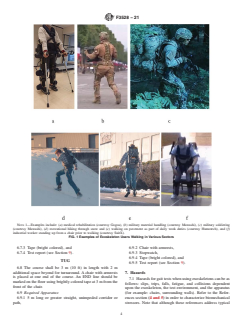
5.1 Exoskeletons are being used in the industrial/occupational, military, response, medical, and recreational sectors to enhance safety and effectiveness of the user to perform tasks. Gait is a component of many tasks that someone would do with an exoskeleton. For example, an exoskeleton may be used to help rehabilitate a patient who suffered a traumatic leg injury. In manufacturing, warehousing, military, and other similar environments, workers and soldiers in exoskeletons walk with and without carrying loads, many times over long distances, indoors or outdoors, as part of their daily activities. Fig. 1 shows examples of exoskeleton users walking, which, depending upon the task, may require people to traverse various ground surfaces while wearing an exoskeleton. The testing results of exoskeletons shall describe, in a statistically significant way, how reliably the exoskeleton is able to support tasks within the specified types of environments, confinements, and terrains, and thus provide sufficiently high levels of confidence to determine the applicability of the exoskeleton to a given task.
FIG. 1 Examples of Exoskeleton Users Walking in Various Sectors
Note 1: Examples include: (a) medical rehabilitation (courtesy Gogoa), (b) military material handling (courtesy Mawashi), (c) military soldiering (courtesy Mawashi), (d) recreational hiking through snow and (e) walking on pavement as part of daily work duties (courtesy Humotech), and (f) industrial worker standing up from a chair prior to walking (courtesy SuitX).
5.2 This test method addresses exoskeleton safety and performance requirements expressed by manufacturing, emergency responders, military, or other organizations requesting this test. The safety and performance data captured within this test method are indicative of the test exoskeleton’s and the exoskeleton user’s capabilities. Having available direct information from tested exoskeleton(s) with associated performance data to guide procurement and...
SCOPE
1.1 Purpose:
1.1.1 The purpose of this test method, as a part of a suite of exoskeleton use test methods, is to quantitatively evaluate an exoskeleton’s (see Terminology F3323) safety (see 1.4) or performance, or both, for gait.
1.1.2 Exoskeletons shall possess a certain set of allowable exoskeleton user movement capabilities, including user-motion adaptability, to suit operations such as: industrial/occupational, military, response, medical or recreational. Environments in these typical sectors often pose constraints to exoskeleton user movement to various degrees. Being able to walk, as intended by the user or test requestor, while using an exoskeleton is essential for exoskeleton deployment for a variety of tasks. This test method specifies test setup, procedure, and recording to standardize this gait task for testing exoskeleton user movement.
1.1.3 Exoskeletons shall be able to handle many types of task and terrain complexities. The required movement capabilities include, for example: walking, running, crawling, climbing, traversing gaps, hurdles, stairs, slopes, various types of floor surfaces or terrains, and confined spaces. Standard test methods are required to evaluate whether or not exoskeletons meet these requirements.
1.1.4 ASTM Subcommittee F48.03 develops and maintains international standards for task performance and environmental considerations that include but are not limited to, standards for safety, quality, and efficiency. This subcommittee aims to develop standards for any exoskeleton application, as exemplified as in 1.1.2. The F48.03 test suite consists of a set of test methods for evaluating exoskeleton capability requirements. This gait test method is a part of the test suite. The setup, procedure, and apparatuses associated with the test methods challenge specific exoskeleton capabilities in repeatable ways to facilitate comparison of different exoskeleton models or exoskeleton capa...
- Status
- Published
- Publication Date
- 30-Sep-2021
- Technical Committee
- F48 - Exoskeletons and Exosuits
- Drafting Committee
- F48.03 - Task Performance and Environmental Considerations
Overview
ASTM F3528-21: Standard Test Method for Exoskeleton Use-Gait is an internationally recognized standard developed by ASTM to evaluate the safety and performance of exoskeletons during gait-related tasks. Applicable across industrial, military, emergency response, medical, and recreational sectors, this standard provides a quantitative methodology for assessing how effectively an exoskeleton supports user movement, especially walking, in various environments and conditions. Its structured test methods aim to deliver reliable, repeatable results to enable users, manufacturers, and purchasers to make informed decisions about exoskeleton deployment, procurement, and training.
Key Topics
- Gait Assessment: The standard presents three primary tests-6 Minute Walk Test (6MWT), 10 Meter Walk Test (10MWT), and Timed Up and Go (TUG)-to measure aerobic capacity, walking speed, mobility, balance, and overall user performance while using an exoskeleton.
- Sector Versatility: Designed for industrial workers, soldiers, emergency responders, rehabilitation patients, and recreational users, ensuring that exoskeletons can handle sector-specific movement challenges.
- Environment & Terrain Considerations: The test method requires exoskeletons to demonstrate reliable performance on diverse surfaces, under varying environmental conditions, and while negotiating obstacles, confined spaces, or loads.
- Performance & Safety Metrics: The methodology captures metrics such as walking speed, distance, endurance, and stability, alongside data on falls, stumbles, or other anomalies. Safety concerns such as slips, trips, and fatigue are explicitly addressed.
- Standardization & Repeatability: The apparatus and procedures are specified to ensure self-evaluation and consistency, facilitating the comparison of different exoskeleton models or configurations.
Applications
ASTM F3528-21 is essential for organizations and individuals involved in:
- Product Development: Exoskeleton designers and manufacturers use these gait tests for iterative development, benchmarking, and validation to ensure products meet diverse operational requirements.
- Procurement & Deployment: Purchasing agents and end-users-such as factories, warehouses, hospitals, military units, or public safety agencies-rely on performance data from these standardized tests to guide investment and deployment decisions.
- Rehabilitation & Medical Evaluation: Clinicians and therapists assess patient progress and exoskeleton suitability for gait rehabilitation after injury or illness using these test protocols.
- Training and Proficiency: Standardized testing helps train exoskeleton users to achieve proficiency and provides feedback on performance under authentic environmental and operational conditions.
- Risk Assessment: The standard integrates protocols for identifying and mitigating biomechanical and environmental risks, promoting safer exoskeleton use.
Related Standards
For comprehensive evaluation and safe exoskeleton operation, consider these related international and ASTM standards:
- ASTM F3323: Terminology for Exoskeletons and Exosuits-Establishes common definitions.
- ASTM F3427: Practice for Documenting Environmental Conditions for Exoskeleton Test Methods-Ensures precise environmental reporting.
- ASTM F3443: Practice for Load Handling When Using an Exoskeleton-Covers scenarios where users bear loads.
- ASTM F3474: Practice for Establishing Exoskeleton Functional Ergonomic Parameters and Test Metrics.
- ASTM F3517: Practice for Movement Tests When Using an Exoskeleton.
- ASTM F3527: Guide for Assessing Risks Related to Implementation of Exoskeletons in Task-Specific Environments.
- ISO 13482: Robots and Robotic Devices-Safety Requirements for Personal Care Robots.
By adhering to ASTM F3528-21, stakeholders ensure exoskeleton gait performance is measured rigorously, consistently, and with a high degree of confidence, advancing both innovation and user safety in this rapidly growing field.
Relations
- Effective Date
- 15-Jun-2020
- Effective Date
- 01-Mar-2020
- Effective Date
- 01-Oct-2019
- Effective Date
- 01-Apr-2019
- Effective Date
- 01-Sep-2018
Get Certified
Connect with accredited certification bodies for this standard

BSI Group
BSI (British Standards Institution) is the business standards company that helps organizations make excellence a habit.

TÜV Rheinland
TÜV Rheinland is a leading international provider of technical services.

TÜV SÜD
TÜV SÜD is a trusted partner of choice for safety, security and sustainability solutions.
Sponsored listings
Frequently Asked Questions
ASTM F3528-21 is a standard published by ASTM International. Its full title is "Standard Test Method for Exoskeleton Use: Gait". This standard covers: SIGNIFICANCE AND USE 5.1 Exoskeletons are being used in the industrial/occupational, military, response, medical, and recreational sectors to enhance safety and effectiveness of the user to perform tasks. Gait is a component of many tasks that someone would do with an exoskeleton. For example, an exoskeleton may be used to help rehabilitate a patient who suffered a traumatic leg injury. In manufacturing, warehousing, military, and other similar environments, workers and soldiers in exoskeletons walk with and without carrying loads, many times over long distances, indoors or outdoors, as part of their daily activities. Fig. 1 shows examples of exoskeleton users walking, which, depending upon the task, may require people to traverse various ground surfaces while wearing an exoskeleton. The testing results of exoskeletons shall describe, in a statistically significant way, how reliably the exoskeleton is able to support tasks within the specified types of environments, confinements, and terrains, and thus provide sufficiently high levels of confidence to determine the applicability of the exoskeleton to a given task. FIG. 1 Examples of Exoskeleton Users Walking in Various Sectors Note 1: Examples include: (a) medical rehabilitation (courtesy Gogoa), (b) military material handling (courtesy Mawashi), (c) military soldiering (courtesy Mawashi), (d) recreational hiking through snow and (e) walking on pavement as part of daily work duties (courtesy Humotech), and (f) industrial worker standing up from a chair prior to walking (courtesy SuitX). 5.2 This test method addresses exoskeleton safety and performance requirements expressed by manufacturing, emergency responders, military, or other organizations requesting this test. The safety and performance data captured within this test method are indicative of the test exoskeleton’s and the exoskeleton user’s capabilities. Having available direct information from tested exoskeleton(s) with associated performance data to guide procurement and... SCOPE 1.1 Purpose: 1.1.1 The purpose of this test method, as a part of a suite of exoskeleton use test methods, is to quantitatively evaluate an exoskeleton’s (see Terminology F3323) safety (see 1.4) or performance, or both, for gait. 1.1.2 Exoskeletons shall possess a certain set of allowable exoskeleton user movement capabilities, including user-motion adaptability, to suit operations such as: industrial/occupational, military, response, medical or recreational. Environments in these typical sectors often pose constraints to exoskeleton user movement to various degrees. Being able to walk, as intended by the user or test requestor, while using an exoskeleton is essential for exoskeleton deployment for a variety of tasks. This test method specifies test setup, procedure, and recording to standardize this gait task for testing exoskeleton user movement. 1.1.3 Exoskeletons shall be able to handle many types of task and terrain complexities. The required movement capabilities include, for example: walking, running, crawling, climbing, traversing gaps, hurdles, stairs, slopes, various types of floor surfaces or terrains, and confined spaces. Standard test methods are required to evaluate whether or not exoskeletons meet these requirements. 1.1.4 ASTM Subcommittee F48.03 develops and maintains international standards for task performance and environmental considerations that include but are not limited to, standards for safety, quality, and efficiency. This subcommittee aims to develop standards for any exoskeleton application, as exemplified as in 1.1.2. The F48.03 test suite consists of a set of test methods for evaluating exoskeleton capability requirements. This gait test method is a part of the test suite. The setup, procedure, and apparatuses associated with the test methods challenge specific exoskeleton capabilities in repeatable ways to facilitate comparison of different exoskeleton models or exoskeleton capa...
SIGNIFICANCE AND USE 5.1 Exoskeletons are being used in the industrial/occupational, military, response, medical, and recreational sectors to enhance safety and effectiveness of the user to perform tasks. Gait is a component of many tasks that someone would do with an exoskeleton. For example, an exoskeleton may be used to help rehabilitate a patient who suffered a traumatic leg injury. In manufacturing, warehousing, military, and other similar environments, workers and soldiers in exoskeletons walk with and without carrying loads, many times over long distances, indoors or outdoors, as part of their daily activities. Fig. 1 shows examples of exoskeleton users walking, which, depending upon the task, may require people to traverse various ground surfaces while wearing an exoskeleton. The testing results of exoskeletons shall describe, in a statistically significant way, how reliably the exoskeleton is able to support tasks within the specified types of environments, confinements, and terrains, and thus provide sufficiently high levels of confidence to determine the applicability of the exoskeleton to a given task. FIG. 1 Examples of Exoskeleton Users Walking in Various Sectors Note 1: Examples include: (a) medical rehabilitation (courtesy Gogoa), (b) military material handling (courtesy Mawashi), (c) military soldiering (courtesy Mawashi), (d) recreational hiking through snow and (e) walking on pavement as part of daily work duties (courtesy Humotech), and (f) industrial worker standing up from a chair prior to walking (courtesy SuitX). 5.2 This test method addresses exoskeleton safety and performance requirements expressed by manufacturing, emergency responders, military, or other organizations requesting this test. The safety and performance data captured within this test method are indicative of the test exoskeleton’s and the exoskeleton user’s capabilities. Having available direct information from tested exoskeleton(s) with associated performance data to guide procurement and... SCOPE 1.1 Purpose: 1.1.1 The purpose of this test method, as a part of a suite of exoskeleton use test methods, is to quantitatively evaluate an exoskeleton’s (see Terminology F3323) safety (see 1.4) or performance, or both, for gait. 1.1.2 Exoskeletons shall possess a certain set of allowable exoskeleton user movement capabilities, including user-motion adaptability, to suit operations such as: industrial/occupational, military, response, medical or recreational. Environments in these typical sectors often pose constraints to exoskeleton user movement to various degrees. Being able to walk, as intended by the user or test requestor, while using an exoskeleton is essential for exoskeleton deployment for a variety of tasks. This test method specifies test setup, procedure, and recording to standardize this gait task for testing exoskeleton user movement. 1.1.3 Exoskeletons shall be able to handle many types of task and terrain complexities. The required movement capabilities include, for example: walking, running, crawling, climbing, traversing gaps, hurdles, stairs, slopes, various types of floor surfaces or terrains, and confined spaces. Standard test methods are required to evaluate whether or not exoskeletons meet these requirements. 1.1.4 ASTM Subcommittee F48.03 develops and maintains international standards for task performance and environmental considerations that include but are not limited to, standards for safety, quality, and efficiency. This subcommittee aims to develop standards for any exoskeleton application, as exemplified as in 1.1.2. The F48.03 test suite consists of a set of test methods for evaluating exoskeleton capability requirements. This gait test method is a part of the test suite. The setup, procedure, and apparatuses associated with the test methods challenge specific exoskeleton capabilities in repeatable ways to facilitate comparison of different exoskeleton models or exoskeleton capa...
ASTM F3528-21 is classified under the following ICS (International Classification for Standards) categories: 11.180.01 - Aids for disabled and handicapped persons in general; 25.040.30 - Industrial robots. Manipulators. The ICS classification helps identify the subject area and facilitates finding related standards.
ASTM F3528-21 has the following relationships with other standards: It is inter standard links to ASTM F3443-20, ASTM F3427-20, ASTM F3323-19a, ASTM F3323-19, ASTM F3323-18. Understanding these relationships helps ensure you are using the most current and applicable version of the standard.
ASTM F3528-21 is available in PDF format for immediate download after purchase. The document can be added to your cart and obtained through the secure checkout process. Digital delivery ensures instant access to the complete standard document.
Standards Content (Sample)
This international standard was developed in accordance with internationally recognized principles on standardization established in the Decision on Principles for the
Development of International Standards, Guides and Recommendations issued by the World Trade Organization Technical Barriers to Trade (TBT) Committee.
Designation: F3528 − 21
Standard Test Method for
Exoskeleton Use: Gait
This standard is issued under the fixed designation F3528; the number immediately following the designation indicates the year of
original adoption or, in the case of revision, the year of last revision. A number in parentheses indicates the year of last reapproval. A
superscript epsilon (´) indicates an editorial change since the last revision or reapproval.
1. Scope 1.1.5 This test method tests for generic gait exoskeleton
capability, with straight paths and no test course curves,
1.1 Purpose:
obstacles, or other complexities not described herein (see 4.6).
1.1.1 The purpose of this test method, as a part of a suite of
This test method is considered the basis for exoskeleton gait
exoskeleton use test methods, is to quantitatively evaluate an
capability testing.
exoskeleton’s (see Terminology F3323) safety (see 1.4)or
1.1.6 The test methods quantify elemental exoskeleton use
performance, or both, for gait.
capabilities necessary for sector applications listed in 1.1.2,
1.1.2 Exoskeletons shall possess a certain set of allowable
and perhaps others. As such, users of this standard should use
exoskeletonusermovementcapabilities,includinguser-motion
either the entire suite or a subset based on their particular
adaptability, to suit operations such as: industrial/occupational,
military, response, medical or recreational. Environments in requirements. Users are also allowed to weight particular test
these typical sectors often pose constraints to exoskeleton user methods or particular metrics within a test method differently
movement to various degrees. Being able to walk, as intended
based on their specific requirements. The testing results should
by the user or test requestor, while using an exoskeleton is
collectively represent an exoskeleton’s overall safety or
essential for exoskeleton deployment for a variety of tasks.
performance, or both, as required for the task. These perfor-
This test method specifies test setup, procedure, and recording
mance data can be used: to guide procurement specifications,
to standardize this gait task for testing exoskeleton user
for acceptance testing, and for training to use exoskeletons
movement.
intended for specified applications.
1.1.3 Exoskeletons shall be able to handle many types of
NOTE 1—Additional test methods within the suite are anticipated to be
task and terrain complexities. The required movement capa-
developed to address additional exoskeleton capability requirements,
bilities include, for example: walking, running, crawling,
including newly identified requirements and even for new application
climbing, traversing gaps, hurdles, stairs, slopes, various types
domains.
of floor surfaces or terrains, and confined spaces. Standard test
1.2 Performing Location—This test method shall be per-
methods are required to evaluate whether or not exoskeletons
formed in a testing laboratory or at a site that represents the
meet these requirements.
place where the exoskeleton will be used.
1.1.4 ASTM Subcommittee F48.03 develops and maintains
internationalstandardsfortaskperformanceandenvironmental
1.3 Units—The values stated in SI units are to be regarded
considerations that include but are not limited to, standards for
as the standard.The values given in parentheses are not precise
safety, quality, and efficiency. This subcommittee aims to
mathematical conversions to inch-pound units. They are close
develop standards for any exoskeleton application, as exem-
approximate equivalents for the purpose of specifying material
plified as in 1.1.2. The F48.03 test suite consists of a set of test
dimensions or quantities that are readily available to avoid
methods for evaluating exoskeleton capability requirements.
excessive fabrication costs of test apparatuses while maintain-
This gait test method is a part of the test suite. The setup,
ing repeatability and reproducibility of the test method results.
procedure, and apparatuses associated with the test methods
These values given in parentheses are provided for information
challenge specific exoskeleton capabilities in repeatable ways
only and are not considered standard.
to facilitate comparison of different exoskeleton models or
exoskeleton capabilities to tasks. Not all exoskeletons may
1.4 This standard does not purport to address all of the
have the capabilities needed to use this test method.
safety concerns, if any, associated with its use. It is the
responsibility of the user of this standard to establish appro-
priate safety, health, and environmental practices and deter-
mine the applicability of regulatory limitations prior to use.
This test method is under the jurisdiction of ASTM Committee F48 on
Exoskeletons and Exosuits and is the direct responsibility of Subcommittee F48.03
1.5 This international standard was developed in accor-
on Task Performance and Environmental Considerations.
dance with internationally recognized principles on standard-
Current edition approved Oct. 1, 2021. Published November 2021. DOI:
10.1520/F3528-21. ization established in the Decision on Principles for the
Copyright © ASTM International, 100 Barr Harbor Drive, PO Box C700, West Conshohocken, PA 19428-2959. United States
F3528 − 21
Development of International Standards, Guides and Recom- 10 m apart, both specified by the test supervisor. Two addi-
mendations issued by the World Trade Organization Technical tional lines are placed at 2 m and 8 m from the start line to
Barriers to Trade (TBT) Committee. allow measurement of the user’s steady state velocity between
the two lines.
2. Referenced Documents
4.1.3 TUG—This test is used to assess fall risk and measure
2.1 ASTM Standards: the progress of balance, sit-to-stand, and walking. A full TUG
F3323 Terminology for Exoskeletons and Exosuits test (see 9.20) can be performed as a single test in its entirety
where the user begins by sitting in a chair, stands when the test
F3427 Practice for Documenting Environmental Conditions
for Utilization with Exoskeleton Test Methods supervisor directs the user to begin the test, walks three (3)
meters, turns around 180°, walks back to the chair, turns back
F3443 Practice for Load Handling When Using an Exoskel-
eton around 180°, and sits in the chair. As some exoskeletons may
F3474 Practice for Establishing Exoskeleton Functional Er- not be able to perform a full TUG test, a phased TUG test (see
gonomic Parameters and Test Metrics 9.21) can instead be performed. The phased TUG test divides
F3517 Practice for Movement Tests When Using an Exo- the full TUG test into six independent phases where selected
skeleton TUG test phases (for example, phases 1 and 2; phases 1
F3527 Guide forAssessing Risks Related to Implementation through 5), which shall be selected prior to the test by the test
of Exoskeletons in Task-Specific Environments requestor, are to be performed by an exoskeleton user. The
phased TUG test divides the full TUG test as follows:
2.2 Other Standards:
ISO 13482 Robots and robotic devices — Safety require- 4.1.3.1 Phase 1—Stand up from a chair (or from an alter-
ments for personal care robots native position from sitting (for example, kneeling) as set by
the test requestor prior to the test);
3. Terminology
4.1.3.2 Phase 2—Walk3m;
3.1 General terminology for ASTM Committee F48 stan-
4.1.3.3 Phase 3—Turn around 180°;
dards is listed in Terminology F3323. Terminology specific to
4.1.3.4 Phase 4—Walk 3 m in the opposite direction from
this standard is shown in this section.
Phase 2;
4.1.3.5 Phase 5—Turn around 180°;
3.2 Definitions:
4.1.3.6 Phase 6—Sit down in a chair (or configure to an
3.2.1 apparatus, n—a structure, object, test component, or
artifactthereof,foundorplacedinanenvironmentandusedfor alternative position from sitting (for example, kneeling) as set
by the test requestor prior to the test).
a test.
3.2.2 test suite, n—designed collection of test methods that
4.2 For all tests, the specified path from the START point to
are used, collectively, to evaluate an exoskeleton’s safety
the END point, TURN point, or chair, as needed, shall be
and/or performance.
defined by the test requestor prior to the test. The required
apparatuses are described in Section 6.
4. Summary of Test Method
4.3 The exoskeleton’s capability is defined as the exoskel-
4.1 The task for this test method, exoskeleton-user walking,
eton’s ability to complete the gait task, where the exoskeleton
is defined as the exoskeleton-user performing all three of the
or user, or both, is capable of performing the 6MWT, 10MWT,
following tests: (1) 6 minute walking test (6MWT) (1) ; (2)
and full or phased TUG tests, as set by the test requestor and
10 meter walking test (10MWT) (2); and (3) timed up and go
can perform the test at the associated effective speed and
(TUG) test (3). The tests are described as follows:
stability. The average effective speed shall be used as the
4.1.1 6MWT—This test is used to assess aerobic capacity
exoskeleton-user’s capability and sustained speed.
and endurance, where the distance covered over a time period
4.4 The exoskeleton user is allowed to practice before the
of 6 min is used as the outcome. The user begins at a START
test.
point specified by the test supervisor and ends when the test
supervisor has timed 6 min. Two points, START and TURN,
4.5 Once the test begins, there shall be no verbal commu-
are spaced (for example, 30 m apart) for the user to walk and
nication between the exoskeleton user and the test supervisor
turn about such that the user continuously walks for 6 min
regarding the performance of a test repetition other than
between the two points.
instructionsonwhentostartandnotificationsoffaults,andany
4.1.2 10MWT—This test is used to assess functional
safety related conditions. The user shall have the full respon-
mobility,walkingspeed,andbalanceoverashortdistance.The
sibility to determine whether and when they have completed a
user begins at a STARTpoint and ends at an END point spaced
repetition, and notify the test supervisor accordingly. However,
it is the test supervisor’s authority to judge the completeness of
2 the repetition.
For referenced ASTM standards, visit the ASTM website, www.astm.org, or
contact ASTM Customer Service at service@astm.org. For Annual Book of ASTM
NOTE 2—Practice could help establish the applicability of the exoskel-
Standards volume information, refer to the standard’s Document Summary page on
eton for the given test method. It allows the operator to gain familiarity
the ASTM website.
with the standard setup, procedure, apparatus, and environmental condi-
Available fromAmerican National Standards Institute (ANSI), 25 W. 43rd St.,
tions. It also helps the test supervisor to establish the initial setup,
4th Floor, New York, NY 10036, http://www.ansi.org.
The boldface numbers in parentheses refer to the list of references at the end of procedure, including both the user and testing personnel, or apparatus
this standard. setting for the test, when applicable, or combinations thereof.
F3528 − 21
4.6 The test requestor has the authority to select the param- 6. Test Course and Apparatus
eters that may affect the user for the gait task. The test
6.1 The actual performance space where the exoskeleton is
requestor also has the authority to select test methods that
to be used or in-situ (that is, typically found in the
constitute the test event, to select one or more test site(s) at
environment, such as trees, loads, natural markings) apparatus
which the test methods are implemented, to determine the
of which will be used, as exemplified in Fig. 1, or both, may be
correspondingstatisticalreliabilityandconfidencelevelsofthe
usedforthistest.Intheeventthattheactualperformancespace
results for each of the test methods, and to establish the
or the in-situ apparatus, or both, is not available or the test is
participation rules including the testing schedules and the test
to be exactly replicated by others, or both, test setups and the
environmental conditions.
standard apparatus, as described in the following subsections,
4.7 Variations to this test method are also described in this shall be used. Refer to Fig. 2 for test course layouts.
standard and can include, for example:
6.2 Optional Equipment:
4.7.1 6MWT, 10MWT, or TUG while carrying a load(s);
6.2.1 Safety equipment, for example: heart rate monitor,
4.7.2 TUG from a squat position instead of a chair;
pulse oximeter, oxygen administration kit,
4.7.3 Environmental conditions including, for example,
sphygmomanometer, telephone, automated electronic
groundsurfacesthatarelevelorundulating,hardorsoft,dryor
defibrillator, and Borg breathlessness scale that can be at the
wet; temperatures and humidity levels that are normal or
ready as needed.
extreme; precipitation that is no, low, or high.
6.2.2 User measurement devices, for example: walkway
(that is, pressure mats) or force plates for human gait analysis;
5. Significance and Use
user tracking system; heart rate, pulse, and oxygen monitors.
6.2.3 Loads, for example: tools, crates, and bags (refer to
5.1 Exoskeletons are being used in the industrial/
Practice F3443).
occupational, military, response, medical, and recreational
sectors to enhance safety and effectiveness of the user to
6MWT
performtasks.Gaitisacomponentofmanytasksthatsomeone
would do with an exoskeleton. For example, an exoskeleton 6.3 The walking course shall be 30 m (98 ft) in length with
at least 2 m beyond the course on both ends for turnaround
may be used to help rehabilitate a patient who suffered a
traumatic leg injury. In manufacturing, warehousing, military, space. The length of the course should be marked every 3 m.
(A shorter corridor requires users to take more time to reverse
and other similar environments, workers and soldiers in exo-
skeletons walk with and without carrying loads, many times directions more often, reducing the 6MWT.) The turnaround
over long distances, indoors or outdoors, as part of their daily points at 30 m should be marked with a highly visible marker,
activities.Fig.1showsexamplesofexoskeletonuserswalking, such as an orange traffic cone.Astarting line, which marks the
which,dependinguponthetask,mayrequirepeopletotraverse START and END of each 60 m lap, should be marked on the
various ground surfaces while wearing an exoskeleton. The floor using brightly colored tape.
testing results of exoskeletons shall describe, in a statistically
6.4 The use of a treadmill is not recommended for the
significant way, how reliably the exoskeleton is able to support
6MWT as users are unable to pace themselves on a treadmill.
taskswithinthespecifiedtypesofenvironments,confinements,
Treadmill test results, therefore, are not interchangeable with
and terrains, and thus provide sufficiently high levels of
corridor tests.
confidence to determine the applicability of the exoskeleton to
6.5 Required Apparatus:
a given task.
6.5.1 34 m or greater straight, unimpeded corridor or path,
5.2 This test method addresses exoskeleton safety and
6.5.2 Countdown timer (or stopwatch),
performance requirements expressed by manufacturing, emer-
6.5.3 Lap counter,
gency responders, military, or other organizations requesting
6.5.4 Two small markers (for example, cones) to mark the
this test. The safety and performance data captured within this
turnaround points,
test method are indicative of the test exoskeleton’s and the
6.5.5 Tape (bright colored),
exoskeleton user’s capabilities. Having available direct infor-
6.5.6 A chair that can be easily moved along the walking
mationfromtestedexoskeleton(s)withassociatedperformance
course, and
data to guide procurement and deployment decisions is essen-
6.5.7 Test report (see Section 9).
tial for exoskeleton purchasers and users.
10MWT
5.3 The standard test setup and apparatus (see Section 6)is
specified to be easily fabricated to facilitate self-evaluation and 6.6 The walking course shall be 10 m (33 ft) in length with
replication of gait tests by exoskeleton designers, developers, at least 2 m additional space beyond the end for deceleration.
manufacturers,andusers.Thestandardtestsetupandapparatus A starting line should be marked on the floor using brightly
canalsobeusedtosupporttrainingandestablishproficiencyof coloredtape.Tapemarksshouldbeplacedat1mand9mfrom
exoskeleton users, as well as provide manufacturers with the START line.
information about the usefulness of their exoskeleton(s) for
6.7 Required Apparatus:
tasks.
6.7.1 Stopwatch,
5.4 Although the test method was developed for the sectors 6.7.2 12 m long or greater straight, unimpeded corridor or
listed in 5.1, it may be applicable to other operational domains. path,
F3528 − 21
NOTE 1—Examples include: (a) medical rehabilitation (courtesy Gogoa), (b) military material handling (courtesy Mawashi), (c) military soldiering
(courtesy Mawashi), (d) recreational hiking through snow and (e) walking on pavement as part of daily work duties (courtesy Humotech), and (f)
industrial worker standing up from a chair prior to walking (courtesy SuitX).
FIG. 1 Examples of Exoskeleton Users Walking in Various Sectors
6.7.3 Tape (bright colored), and 6.9.2 Chair with armrests,
6.7.4 Test report (see Section 9). 6.9.3 Stopwatch,
6.9.4 Tape (bright colored), and
TUG
6.9.5 Test report (see Section 9).
6.8 The course shall be 3 m (10 ft) in length with 2 m
additional space beyond for turnaround. A chair with armrests 7. Hazards
is placed at one end of the course. An END line should be
7.1 Hazardsforgaittestswhenusingexoskeletonscanbeas
marked on the floor using brightly colored tape at 3 m from the
follows: slips, trips, falls, fatigue, and collisions dependent
front of the chair.
upon the exoskeleton, the test environment, and the apparatus
6.9 Required Apparatus: (for example: chairs, surrounding walls). Refer to the Refer-
6.9.1 5 m long or greater straight, unimpeded corridor or ences section (4 and 5) in order to characterize biomechanical
path, stressors. Note that although these references address typical
F3528 − 21
FIG. 2 Gait Test Course Layouts for (a) 6MWT, (b) 10MWT, and (c) TUG test
risks and mitigation procedures, they may not address safety 7.2.5 ASTM Guide for General Guidelines to Risk Manage-
issues for an exoskeleton user. ment of Exoskeletons; and
7.2.6 ASTM Guide F3527 for Assessing Risks Related to
7.2 Safety standards providing risks and mitigation proce-
Implementation of Exoskeletons in Task-Specific Environ-
dures for hazards when using an exoskeleton are developed or
ments.
being developed, including:
7.2.1 ISO 13482 Robots and robotic devices — Safety
8. Calibration and Standardization
requirements for personal care robots;
8.1 The exoskeleton configuration as tested shall be de-
7.2.2 ASTM Guide for Safety Considerations in Designing
scribed in detail on the test form, including all subsystems and
and Selecting Exoskeletons for Industrial, Medical and Mili-
components, and their respective features and functionalities
tary Applications;
5 including version or iteration details as applicable. The con-
7.2.3 ASTM Guide for System Usefulness and Usability;
figuration shall be subjected to all the test suites, as defined in
7.2.4 ASTM Guide for Hazards for Consideration when
5 3.2.2, as appropriate. Any variation in the configuration shall
Designing Exoskeletons;
causetheresultingexoskeletonvarianttobere-testedacrossall
the test suites to provide a consistent and comprehensive
New standard under development. representation of the performance.
F3528 − 21
8.2 Once an exoskeleton user begins a test, by starting to tice for Documenting Exoskeleton Configuration and Practice
execute the task as specified in 4.1, the exoskeleton shall be for Documenting Exoskeleton Fit to the User shall be used to
used to perform the task for the specified number of repetitions record the exoskeleton configuration.
through completion without changing the exoskeleton or ap-
9.4 If a load (for example, tool, equipment, artifact load) is
paratus.
to be handled during the test, document the artifact or real load
8.3 A battery may be changed or charged between repeti-
using Practice F3443.
tions provided that other configurations remain unaltered, and
9.5 Thetestrequestorshallsetthenumberoftimeseachtest
if allowed by the test requestor. Battery changes/charging shall
is to be repeated. Refer to Appendix X1 for test data reliability
be noted on the test report. Unless otherwise stated by the
guidance.
requestor, during the test the exoskeleton shall not be allowed
9.6 The test administrator shall be consistent in their mea-
to have the energy/power source replenished nor shall the
surement technique. For example, measure all subjects in the
exoskeleton be allowed any human physical intervention,
same manner (for example, video cameras at the same loca-
including adjustment, maintenance, or repair.Any such actions
tions) and measure that the subject has fully crossed a line by
shall be considered a fault condition and the test should be
consistently measuring when the trailing foot crossed.
restarted from the beginning.
9.7 The test requestor shall establish the required measure-
8.4 The metric for this test method is the complete and
successful gait tests for the specified number of continuous ment uncertainty. Examples are as follows:
repetitions where a completed test is set by the test requestor 9.7.1 Less Certain—The test administrator watches the
(see Section 4). In addition, the elapsed time for the user to
exoskeleton user as they start, cross measurement markers, or
successfully complete all three gait tests (that is, 6MWT, stand up from/sit down in a chair. More Certain—Outfit the
10MWT, and TUG) is a performance proficiency index reflect-
test setup locations/apparatus (that is, distance markers, chair)
ing the combination of the exoskeleton’s capability and
and exoskeleton user with markers and using an optical
efficiency, and the user’s skill level. Therefore, this temporal
tracking system, measure and analyze user movements at
aspect is a part of the test and the results shall be recorded on
marker and chair locations in reference to the test setup
the test form. The average speed is specified as the sustained
locations/apparatus.
speed. Metrics shall also include any test anomalies or
9.7.2 Less Certain—Recordthetestusingoneormorevideo
occurrences, such as: stumbles, trips, falls, rests, variation in
cameras and subjectively review the recorded test video to
gait throughout the test, or from baseline (that is, no exoskel-
establish when the trailing foot crossed a line or when the
eton used) to exoskeleton test (exoskeleton is used).
exoskeleton user stood up from a chair. More Certain—
Calibrate all video cameras to the scene detecting markers or
8.5 The test requestor has the authority to specify the
exoskeleton users passing markers and using a computer
environmental variables, which may affect the test results. All
program, review the recorded test video using a computer
environmental settings shall be documented using Practice
program to determine with set uncertainty, when the user
F3427.
crossed lines or stood up from/sat down in a chair.
8.6 The test requestor has the authority to specify the
9.7.3 Less Certain—Use handheld stopwatch to record
number of repetitions required for each of the 6MWT,
when the exoskeleton user crosses a line or stands up from/sits
10MWT, and TUG tests. Considerations for user fatigue,
down in a chair. More Certain—Using recorded video of the
abilities, exoskeleton capabilities, and other characteristics that
test that includes the user movements, markings, and clock
may impact the tests shall be considered. Extending the
th
showing at least ⁄10 of a second resolution, review the test
duration of the test (for example, perform the 6MWT four
video using slow motion to determine the time when the
times over eight hours, separated by two hour rests, for several
trailing foot crossed the line or when the exoskeleton user
days and several weeks to achieve 30 repetitions) may also be
stood up from/sat down in a chair.
includedintheoveralltestconfidenceandshallbenotedonthe
9.8 User Preparation:
test report. Guidance on reliability of test data given the
number of repetitions is provided in Appendix X1. 9.8.1 The user should wear the appropriate, comfortable
clothing and shoes for walking in the chosen test environment.
Also, the exoskeleton user should use the appropriate walking
9. Procedure
aids normally needed by the user or needed for the test (cane,
9.1 A test requestor requests a gait test (that is, 6MWT,
walker, etc.).
10MWT,andTUG),includingalltestparameters(forexample,
9.8.2 The user should not have exercised vigorously within
test apparatus, environment, exoskeleton configuration, etc.) to
2 h of beginning the test. Prior to the test, the amount of typical
be recorded and documented.
weekly exercise, current pains, etc. shall be documented. Upon
9.2 For all tests, the environmental conditions of the space
publication and to ensure standardized documentation, a future
where the test will be performed shall be documented using
Practice for Documenting Exoskeleton User Information shall
Practice F3427, allowing test repeatability.
be used to record the exoskeleton user information.
9.3 The exoskeleton configuration is documented in full
6MWT
detail to ensure that repeatable tests can occur. Upon publica-
tion and to ensure standardized documentation, a future Prac- 9.9 Test Set-Up (see Fig. 2):
F3528 − 21
9.9.1 Place cones at either end of the 30 m stretch as turning repetitions and the average of the three or more repetitions are
points. calculated and documented.
9.9.2 Mark, using tape or other easily detected marker, 3 m
9.18 The test technician shall record all other paramet
...