

ASTM F3427-20
(Practice)Standard Practice for Documenting Environmental Conditions for Utilization with Exoskeleton Test Methods
General Information
- Abstract
SIGNIFICANCE AND USE
4.1 This section provides a description of the environmental conditions listed in Section 1 and describes the sub-conditions within each condition. Examples provided for many of the conditions and sub-conditions are provided as guidance only. Each of the conditions described should be evaluated and documented as set forth in Sections 5 – 7.
4.2 Environment Consistency: Static, Dynamic, Transitional
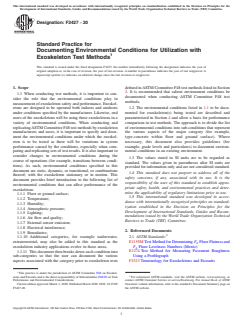
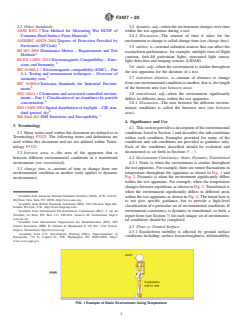
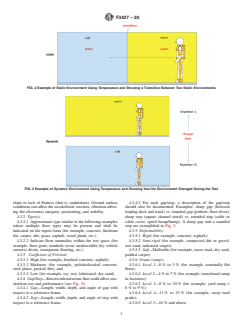
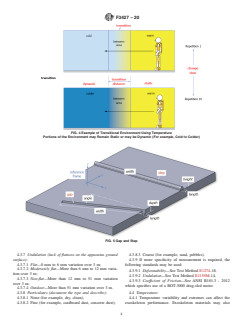
4.2.1 Static is when the environment is similar throughout the test apparatus. For example, there are minor fluctuations in temperature throughout the apparatus as shown in Fig. 1 and Fig. 2. Dynamic is when the environment significantly differs within the test apparatus. For example, when the temperature changes between repetitions as shown in Fig. 3. Transitional is when the environment significantly differs in different areas within the test apparatus as shown in Fig. 4. The intent here is to not give specific guidance, but to provide a high-level classification of a particular set of environmental conditions. If environment consistency is dynamic or transitional, or both, a report form (see Section 7) for each unique set of environmental conditions should be completed.
FIG. 1 Example of Static Environment Using Temperature
FIG. 2 Example of Static Environment Using Temperature and Showing a Transition Between Two Static Environments
FIG. 3 Example of Dynamic Environment Using Temperature and Showing that the Environment Changed During the Test
FIG. 4 Example of Transitional Environment Using Temperature Portions of the Environment may Remain Static or may be Dynamic (For example, Cold to Colder)
4.3 Floor or Ground Surface:
4.3.1 Exoskeleton mobility is affected by ground surface conditions including: surface texture/roughness, deformability, slope or lack of flatness (that is, undulation). Ground surface conditions can affect the exoskeleton: traction, vibration affecting the electronics integrity, positioning, and stability.
4.3.2 Type(s): ...
SCOPE
1.1 When conducting test methods, it is important to consider the role that the environmental conditions play in measurement of exoskeleton safety and performance. Exoskeletons are designed to be operated both indoors and outdoors under conditions specified by the manufacturer. Likewise, end users of the exoskeletons will be using these exoskeletons in a variety of environmental conditions. When conducting and replicating ASTM Committee F48 test methods by exoskeleton manufacturers and users, it is important to specify and document the environmental conditions under which the exoskeleton is to be tested as there will be variations in system performance caused by the conditions, especially when comparing and replicating sets of test results. It is also important to consider changes in environmental conditions during the course of operations (for example, transitions between conditions). As such, environmental conditions specified in this document are static, dynamic, or transitional, or combinations thereof; with the exoskeleton stationary or in motion. This document provides brief introduction to the following list of environmental conditions that can affect performance of the exoskeleton:
1.1.1 Floor or ground surface;
1.1.2 Temperature;
1.1.3 Humidity;
1.1.4 Atmospheric pressure;
1.1.5 Lighting;
1.1.6 Air flow and quality;
1.1.7 External sensor emission;
1.1.8 Electrical interference;
1.1.9 Boundaries;
1.1.10 Additional categories, for example underwater, extraterrestrial, may also be added to this standard as the exoskeleton industry applications evolve in these areas.
1.1.11 This document then breaks down each condition into sub-categories so that the user can document the various aspects associated with the category prior to exoskeleton tests defined in ASTM Committee F48 test methods listed in Section 2. It is recommended that salient environment conditions be documented when conduc...
- Status
- Published
- Publication Date
- 29-Feb-2020
- Technical Committee
- F48 - Exoskeletons and Exosuits
- Drafting Committee
- F48.03 - Task Performance and Environmental Considerations
Overview
ASTM F3427-20: Standard Practice for Documenting Environmental Conditions for Utilization with Exoskeleton Test Methods establishes a uniform approach for capturing and reporting environmental conditions during exoskeleton testing. Developed by ASTM Committee F48, this standard ensures that manufacturers, users, and researchers provide detailed, comparable documentation of test environments, allowing for accurate benchmarking and performance replication. By standardizing how environmental factors are measured and recorded, ASTM F3427-20 supports the evaluation of exoskeleton safety, functionality, and reliability across diverse indoor and outdoor settings.
Key Topics
Environmental Conditions: The standard outlines a comprehensive list of conditions that influence exoskeleton operation and testing, including:
- Floor or ground surface characteristics (e.g., type, texture, deformability, grade)
- Temperature ranges and fluctuations
- Humidity and dew point
- Atmospheric (barometric) pressure
- Lighting types, intensities, and sources
- Air flow and particulate quality
- External sensor emissions and electromagnetic interference
- Boundaries and environmental transitions
Environment Consistency Categories:
- Static: Environment remains uniform throughout the test apparatus.
- Dynamic: Environmental conditions change over time or test repetitions.
- Transitional: Different areas within the test space have differing conditions.
Reporting Requirements: Precise documentation is required for each unique set of environmental conditions, especially when multiple or changing environments are present within a single test.
Reporting Methodology:
- Use of standardized forms
- Dimensioned drawings of test configurations
- Annotations about measurement tools and techniques
Applications
The ASTM F3427-20 standard is crucial for improving the accuracy and reproducibility of exoskeleton test results. Its applications include:
- Product Development and Validation: Exoskeleton designers use this standard to simulate and assess product performance under real-world environmental conditions, helping to identify operational limits and necessary adaptations.
- Comparative Testing: By standardizing environmental documentation, the standard enables comparative studies across different exoskeleton models or iterations.
- Regulatory Compliance: Detailed documentation of testing environments supports compliance with industry, safety, and regulatory requirements.
- Research and Innovation: As exoskeletons are implemented in new sectors, such as healthcare, industry, or defense, the ability to document environmental impact fosters innovation and technology transfer.
- Reporting Consistency: Manufacturers and test facilities provide transparent, credible test data to stakeholders by following defined reporting guidelines.
Related Standards
ASTM F3427-20 refers to and aligns with several other standards to provide comprehensive environmental assessment:
- ASTM E1155M: Test method for determining floor flatness and levelness.
- ASTM E1274: Test method for measuring pavement roughness.
- ASTM F3323: Terminology for exoskeletons and exosuits.
- ANSI B101.3: Measurement of wet dynamic coefficient of friction on floor surfaces.
- BS EN 12895: Electromagnetic compatibility - emissions and immunity.
- IEC 61000 series: Electromagnetic compatibility (EMC) testing.
- ISO 14644-1: Cleanrooms - air cleanliness classification.
- ISO 15469: Spatial distribution of daylight conditions.
These referenced standards provide specialized methodologies for quantifying specific environmental aspects, enhancing the rigor of exoskeleton testing and documentation.
Keywords: exoskeleton testing, ASTM F3427, environmental documentation, exoskeleton safety, performance evaluation, industrial exoskeletons, test methods, environmental conditions, static environment, dynamic environment, test reporting, floor surface evaluation, exoskeleton standards.
Relations
- Effective Date
- 01-Oct-2019
- Effective Date
- 01-Apr-2019
- Effective Date
- 01-Sep-2018
- Effective Date
- 15-Jan-2008
- Effective Date
- 01-Jan-2001
- Effective Date
- 01-Jan-2001
- Effective Date
- 01-Mar-2020
- Effective Date
- 01-Mar-2020
- Referred By
ASTM F3523-21 - Standard Test Method for Exoskeleton Use: Confined Space: Horizontal Movement - Effective Date
- 01-Mar-2020
- Effective Date
- 01-Mar-2020
- Effective Date
- 01-Mar-2020
- Effective Date
- 01-Mar-2020
- Effective Date
- 01-Mar-2020
- Effective Date
- 01-Mar-2020
- Effective Date
- 01-Mar-2020
Get Certified
Connect with accredited certification bodies for this standard

BSI Group
BSI (British Standards Institution) is the business standards company that helps organizations make excellence a habit.

TÜV Rheinland
TÜV Rheinland is a leading international provider of technical services.

TÜV SÜD
TÜV SÜD is a trusted partner of choice for safety, security and sustainability solutions.
Sponsored listings
Frequently Asked Questions
ASTM F3427-20 is a standard published by ASTM International. Its full title is "Standard Practice for Documenting Environmental Conditions for Utilization with Exoskeleton Test Methods". This standard covers: SIGNIFICANCE AND USE 4.1 This section provides a description of the environmental conditions listed in Section 1 and describes the sub-conditions within each condition. Examples provided for many of the conditions and sub-conditions are provided as guidance only. Each of the conditions described should be evaluated and documented as set forth in Sections 5 – 7. 4.2 Environment Consistency: Static, Dynamic, Transitional 4.2.1 Static is when the environment is similar throughout the test apparatus. For example, there are minor fluctuations in temperature throughout the apparatus as shown in Fig. 1 and Fig. 2. Dynamic is when the environment significantly differs within the test apparatus. For example, when the temperature changes between repetitions as shown in Fig. 3. Transitional is when the environment significantly differs in different areas within the test apparatus as shown in Fig. 4. The intent here is to not give specific guidance, but to provide a high-level classification of a particular set of environmental conditions. If environment consistency is dynamic or transitional, or both, a report form (see Section 7) for each unique set of environmental conditions should be completed. FIG. 1 Example of Static Environment Using Temperature FIG. 2 Example of Static Environment Using Temperature and Showing a Transition Between Two Static Environments FIG. 3 Example of Dynamic Environment Using Temperature and Showing that the Environment Changed During the Test FIG. 4 Example of Transitional Environment Using Temperature Portions of the Environment may Remain Static or may be Dynamic (For example, Cold to Colder) 4.3 Floor or Ground Surface: 4.3.1 Exoskeleton mobility is affected by ground surface conditions including: surface texture/roughness, deformability, slope or lack of flatness (that is, undulation). Ground surface conditions can affect the exoskeleton: traction, vibration affecting the electronics integrity, positioning, and stability. 4.3.2 Type(s): ... SCOPE 1.1 When conducting test methods, it is important to consider the role that the environmental conditions play in measurement of exoskeleton safety and performance. Exoskeletons are designed to be operated both indoors and outdoors under conditions specified by the manufacturer. Likewise, end users of the exoskeletons will be using these exoskeletons in a variety of environmental conditions. When conducting and replicating ASTM Committee F48 test methods by exoskeleton manufacturers and users, it is important to specify and document the environmental conditions under which the exoskeleton is to be tested as there will be variations in system performance caused by the conditions, especially when comparing and replicating sets of test results. It is also important to consider changes in environmental conditions during the course of operations (for example, transitions between conditions). As such, environmental conditions specified in this document are static, dynamic, or transitional, or combinations thereof; with the exoskeleton stationary or in motion. This document provides brief introduction to the following list of environmental conditions that can affect performance of the exoskeleton: 1.1.1 Floor or ground surface; 1.1.2 Temperature; 1.1.3 Humidity; 1.1.4 Atmospheric pressure; 1.1.5 Lighting; 1.1.6 Air flow and quality; 1.1.7 External sensor emission; 1.1.8 Electrical interference; 1.1.9 Boundaries; 1.1.10 Additional categories, for example underwater, extraterrestrial, may also be added to this standard as the exoskeleton industry applications evolve in these areas. 1.1.11 This document then breaks down each condition into sub-categories so that the user can document the various aspects associated with the category prior to exoskeleton tests defined in ASTM Committee F48 test methods listed in Section 2. It is recommended that salient environment conditions be documented when conduc...
SIGNIFICANCE AND USE 4.1 This section provides a description of the environmental conditions listed in Section 1 and describes the sub-conditions within each condition. Examples provided for many of the conditions and sub-conditions are provided as guidance only. Each of the conditions described should be evaluated and documented as set forth in Sections 5 – 7. 4.2 Environment Consistency: Static, Dynamic, Transitional 4.2.1 Static is when the environment is similar throughout the test apparatus. For example, there are minor fluctuations in temperature throughout the apparatus as shown in Fig. 1 and Fig. 2. Dynamic is when the environment significantly differs within the test apparatus. For example, when the temperature changes between repetitions as shown in Fig. 3. Transitional is when the environment significantly differs in different areas within the test apparatus as shown in Fig. 4. The intent here is to not give specific guidance, but to provide a high-level classification of a particular set of environmental conditions. If environment consistency is dynamic or transitional, or both, a report form (see Section 7) for each unique set of environmental conditions should be completed. FIG. 1 Example of Static Environment Using Temperature FIG. 2 Example of Static Environment Using Temperature and Showing a Transition Between Two Static Environments FIG. 3 Example of Dynamic Environment Using Temperature and Showing that the Environment Changed During the Test FIG. 4 Example of Transitional Environment Using Temperature Portions of the Environment may Remain Static or may be Dynamic (For example, Cold to Colder) 4.3 Floor or Ground Surface: 4.3.1 Exoskeleton mobility is affected by ground surface conditions including: surface texture/roughness, deformability, slope or lack of flatness (that is, undulation). Ground surface conditions can affect the exoskeleton: traction, vibration affecting the electronics integrity, positioning, and stability. 4.3.2 Type(s): ... SCOPE 1.1 When conducting test methods, it is important to consider the role that the environmental conditions play in measurement of exoskeleton safety and performance. Exoskeletons are designed to be operated both indoors and outdoors under conditions specified by the manufacturer. Likewise, end users of the exoskeletons will be using these exoskeletons in a variety of environmental conditions. When conducting and replicating ASTM Committee F48 test methods by exoskeleton manufacturers and users, it is important to specify and document the environmental conditions under which the exoskeleton is to be tested as there will be variations in system performance caused by the conditions, especially when comparing and replicating sets of test results. It is also important to consider changes in environmental conditions during the course of operations (for example, transitions between conditions). As such, environmental conditions specified in this document are static, dynamic, or transitional, or combinations thereof; with the exoskeleton stationary or in motion. This document provides brief introduction to the following list of environmental conditions that can affect performance of the exoskeleton: 1.1.1 Floor or ground surface; 1.1.2 Temperature; 1.1.3 Humidity; 1.1.4 Atmospheric pressure; 1.1.5 Lighting; 1.1.6 Air flow and quality; 1.1.7 External sensor emission; 1.1.8 Electrical interference; 1.1.9 Boundaries; 1.1.10 Additional categories, for example underwater, extraterrestrial, may also be added to this standard as the exoskeleton industry applications evolve in these areas. 1.1.11 This document then breaks down each condition into sub-categories so that the user can document the various aspects associated with the category prior to exoskeleton tests defined in ASTM Committee F48 test methods listed in Section 2. It is recommended that salient environment conditions be documented when conduc...
ASTM F3427-20 is classified under the following ICS (International Classification for Standards) categories: 11.180.01 - Aids for disabled and handicapped persons in general; 25.040.30 - Industrial robots. Manipulators. The ICS classification helps identify the subject area and facilitates finding related standards.
ASTM F3427-20 has the following relationships with other standards: It is inter standard links to ASTM F3323-19a, ASTM F3323-19, ASTM F3323-18, ASTM E1155M-96(2008), ASTM E1155M-96(2001), ASTM E1155M-96, ASTM F3527-21, ASTM F3540-21, ASTM F3523-21, ASTM F3443-20, ASTM F3581-22, ASTM F3528-21, ASTM F3582-22, ASTM F3583-22, ASTM F3517-21. Understanding these relationships helps ensure you are using the most current and applicable version of the standard.
ASTM F3427-20 is available in PDF format for immediate download after purchase. The document can be added to your cart and obtained through the secure checkout process. Digital delivery ensures instant access to the complete standard document.
Standards Content (Sample)
This international standard was developed in accordance with internationally recognized principles on standardization established in the Decision on Principles for the
Development of International Standards, Guides and Recommendations issued by the World Trade Organization Technical Barriers to Trade (TBT) Committee.
Designation: F3427 − 20
Standard Practice for
Documenting Environmental Conditions for Utilization with
Exoskeleton Test Methods
This standard is issued under the fixed designation F3427; the number immediately following the designation indicates the year of
original adoption or, in the case of revision, the year of last revision. A number in parentheses indicates the year of last reapproval. A
superscript epsilon (´) indicates an editorial change since the last revision or reapproval.
1. Scope definedinASTMCommitteeF48testmethodslistedinSection
2. It is recommended that salient environment conditions be
1.1 When conducting test methods, it is important to con-
documented when conducting ASTM Committee F48 test
sider the role that the environmental conditions play in
methods.
measurement of exoskeleton safety and performance. Exoskel-
etons are designed to be operated both indoors and outdoors 1.2 The environmental conditions listed in 1.1 to be docu-
under conditions specified by the manufacturer. Likewise, end mented for exoskeleton(s) being tested are described and
users of the exoskeletons will be using these exoskeletons in a parameterized in Section 4 and allow a basis for performance
variety of environmental conditions. When conducting and comparison in test methods. The approach is to divide the list
replicatingASTMCommitteeF48testmethodsbyexoskeleton of environmental conditions into sub-conditions that represent
manufacturers and users, it is important to specify and docu- the various aspects of the major category (for example,
ment the environmental conditions under which the exoskel- type-concrete within floor and ground surface). Where
eton is to be tested as there will be variations in system necessary, this document also provides guidelines (for
performance caused by the conditions, especially when com- example, grade levels and particulates) to document environ-
paring and replicating sets of test results. It is also important to mental conditions in an existing environment.
consider changes in environmental conditions during the
1.3 The values stated in SI units are to be regarded as
course of operations (for example, transitions between condi-
standard. The values given in parentheses after SI units are
tions). As such, environmental conditions specified in this
provided for information only and are not considered standard.
document are static, dynamic, or transitional, or combinations
1.4 This standard does not purport to address all of the
thereof; with the exoskeleton stationary or in motion. This
safety concerns, if any, associated with its use. It is the
document provides brief introduction to the following list of
responsibility of the user of this standard to establish appro-
environmental conditions that can affect performance of the
priate safety, health, and environmental practices and deter-
exoskeleton:
mine the applicability of regulatory limitations prior to use.
1.1.1 Floor or ground surface;
1.5 This international standard was developed in accor-
1.1.2 Temperature;
dance with internationally recognized principles on standard-
1.1.3 Humidity;
ization established in the Decision on Principles for the
1.1.4 Atmospheric pressure;
Development of International Standards, Guides and Recom-
1.1.5 Lighting;
mendations issued by the World Trade Organization Technical
1.1.6 Air flow and quality;
Barriers to Trade (TBT) Committee.
1.1.7 External sensor emission;
1.1.8 Electrical interference;
2. Referenced Documents
1.1.9 Boundaries;
2.1 ASTM Standards:
1.1.10 Additional categories, for example underwater,
extraterrestrial, may also be added to this standard as the E1155M TestMethodforDetermining F FloorFlatnessand
F
F Floor Levelness Numbers (Metric)
exoskeleton industry applications evolve in these areas.
L
1.1.11 This document then breaks down each condition into E1274 Test Method for Measuring Pavement Roughness
Using a Profilograph
sub-categories so that the user can document the various
aspects associated with the category prior to exoskeleton tests F3323 Terminology for Exoskeletons and Exosuits
This practice is under the jurisdiction of ASTM Committee F48 on Exoskel-
etons and Exosuits and is the direct responsibility of Subcommittee F48.03 on Task For referenced ASTM standards, visit the ASTM website, www.astm.org, or
Performance and Environmental Considerations. contact ASTM Customer Service at service@astm.org. For Annual Book of ASTM
Current edition approved March 1, 2020. Published March 2020. DOI: 10.1520/ Standards volume information, refer to the standard’s Document Summary page on
F3427-20. the ASTM website.
Copyright © ASTM International, 100 Barr Harbor Drive, PO Box C700, West Conshohocken, PA 19428-2959. United States
F3427 − 20
2.2 Other Standards: 3.4 dynamic, adj—when the environment changes over time
ANSI B101.3 Test Method for Measuring Wet DCOF of within the test apparatus during a test.
Common Hard-Surface Floor Materials 3.4.1 Discussion—The amount of time it takes for the
ANSI/IEC 60529-2004 Degrees of Protection Provided by environmenttochangeiscalledchangetime(see change time).
Enclosures (IP Code)
3.5 emitter, n—external radiation sources that can affect the
BS 667:2005 Illuminance Meters – Requirements and Test
exoskeleton performance, for example: multiple time-of-flight
Methods
cameras, fork-lift pedestrian lights, structured light sensor,
BS EN 12895: 2015 Electromagnetic Compatibility – Emis-
light detection and ranging sensors (LIDAR).
sions and Immunity
3.6 static, adj—when the environment is similar throughout
IEC 61000-4-1 Electromagnetic compatibility (EMC) – Part
the test apparatus for the duration of a test.
4-1: Testing and measurement techniques – Overview of
3.7 transition distance, n—amount of distance to change
immunity tests
fromoneenvironmentalconditiontoanother,thatis,thelength
IEC 61000-6 Emission Standards for Industrial Environ-
of the between area (see between area).
ments
ISO 14644-1 Cleanrooms and associated controlled environ- 3.8 transitional, adj—when the environment significantly
ments – Part 1: Classification of air cleanliness by particle
differs in different areas within the test apparatus.
concentration 3.8.1 Discussion—The area between the different environ-
ISO 15469:2004 Spatial distribution of daylight – CIE stan-
mental conditions is called the between area (see between
dard general sky area).
Mil-Stnd-462 EMI Emissions and Susceptibility
4. Significance and Use
3. Terminology
4.1 This section provides a description of the environmental
3.1 Many terms used within this document are defined as in
conditions listed in Section 1 and describes the sub-conditions
Terminology F3323. The following terms and definitions are within each condition. Examples provided for many of the
used within this document and are not defined within Termi-
conditions and sub-conditions are provided as guidance only.
nology F3323.
Each of the conditions described should be evaluated and
documented as set forth in Sections5–7.
3.2 between area, n—the area of the apparatus that is
between different environmental conditions in a transitional
4.2 Environment Consistency: Static, Dynamic, Transitional
environment (see transitional).
4.2.1 Static is when the environment is similar throughout
the test apparatus. For example, there are minor fluctuations in
3.3 change time, n—amount of time to change from one
temperature throughout the apparatus as shown in Fig. 1 and
environmental condition to another (only applies to dynamic
Fig. 2. Dynamic is when the environment significantly differs
environments).
within the test apparatus. For example, when the temperature
changes between repetitions as shown in Fig. 3. Transitional is
when the environment significantly differs in different areas
Available fromAmerican National Standards Institute (ANSI), 25 W. 43rd St.,
within the test apparatus as shown in Fig. 4. The intent here is
4th Floor, New York, NY 10036, http://www.ansi.org.
to not give specific guidance, but to provide a high-level
Available from British Standards Institution (BSI), 389 Chiswick High Rd.,
classification of a particular set of environmental conditions. If
London W4 4AL, U.K., http://www.bsigroup.com.
environment consistency is dynamic or transitional, or both, a
Available from International Electrotechnical Commission (IEC), 3, rue de
Varembé, 1st floor, P.O. Box 131, CH-1211, Geneva 20, Switzerland, https://
report form (see Section 7) for each unique set of environmen-
www.iec.ch.
tal conditions should be completed.
Available from International Organization for Standardization (ISO), ISO
Central Secretariat, BIBC II, Chemin de Blandonnet 8, CP 401, 1214 Vernier,
4.3 Floor or Ground Surface:
Geneva, Switzerland, http://www.iso.org.
4.3.1 Exoskeleton mobility is affected by ground surface
Available from U.S. Government Printing Office, Superintendent of
conditions including: surface texture/roughness, deformability,
Documents, 732 N. Capitol St., NW, Washington, DC 20401-0001, http://
www.access.gpo.gov.
FIG. 1 Example of Static Environment Using Temperature
F3427 − 20
FIG. 2 Example of Static Environment Using Temperature and Showing a Transition Between Two Static Environments
FIG. 3 Example of Dynamic Environment Using Temperature and Showing that the Environment Changed During the Test
slope or lack of flatness (that is, undulation). Ground surface 4.3.4.3 For each gap/step, a description of the gap/step
conditions can affect the exoskeleton: traction, vibration affect- should also be documented. Examples: sharp gap (between
ing the electronics integrity, positioning, and stability. loading dock and truck) vs. rounded gap (pothole, floor divot);
4.3.2 Type(s): sharp step (square channel metal) vs. rounded step (cable or
4.3.2.1 Approximate type similar to the following examples cable cover, speed bump/hump). A sharp gap and a rounded
where multiple floor types may be present and shall be step are exemplified in Fig. 5.
indicated on the report form (for example, concrete, linoleum 4.3.5 Deformability:
tile, carpet, dirt, grass, asphalt, wood plank, etc.). 4.3.5.1 Rigid (for example, concrete, asphalt);
4.3.2.2 Indicate floor anomalies within the test space (for 4.3.5.2 Semi-rigid (for example, compacted dirt or gravel,
example, floor grate, manhole cover, undetectable (by vehicle wet sand, industrial carpet);
sensors) divots, transparent flooring, etc.). 4.3.5.3 Soft—Malleable (for example, snow, mud, dry sand,
4.3.3 Coeffıcient of Friction: padded carpet).
4.3.3.1 High (for example, brushed concrete, asphalt), 4.3.6 Grade (ramp):
4.3.3.2 Moderate (for example, polished/sealed concrete, 4.3.6.1 Level 1—0 % to 3 % (for example, nominally flat
steel plates, packed dirt), and floor);
4.3.3.3 Low (for example, icy, wet, lubricated, dry sand). 4.3.6.2 Level 2—4 % to 7 % (for example, transitional ramp
4.3.4 Gap/Step—Knowninfrastructurethatcouldaffectexo- in factories);
skeleton use and performance (see Fig. 5): 4.3.6.3 Level 3—8 % to 10 % (for example, yard ramp =
4.3.4.1 Gap—Length, width, depth, and angle of gap with 8 % to 9 %);
respect to a reference frame. 4.3.6.4 Level 4—11 % to 15 % (for example, steep road
4.3.4.2 Step—Length, width, depth, and angle of step with grade);
respect to a reference frame. 4.3.6.5 Level 5—16 % and above.
F3427 − 20
FIG. 4 Example of Transitional Environment Using Temperature
Portions of the Environment may Remain Static or may be Dynamic (For example, Cold to Colder)
FIG. 5 Gap and Step
4.3.7 Undulation (lack of flatness on the apparatus ground 4.3.8.3 Coarse (for example, sand, pebbles).
surface):
4.3.9 If more specificity of measurement is required, the
4.3.7.1 Flat—0 mm to 6 mm variation over 3 m;
following standards may be used:
4.3.7.2 Moderately flat—More than 6 mm to 12 mm varia-
4.3.9.1 Deformability—See Test Method E1274-18.
tion over 3 m;
4.3.9.2 Undulation—See Test Method E1155M-14.
4.3.7.3 Non-flat—More than 12 mm to 51 mm variation
4.3.9.3 Coeffıcient of Friction—See ANSI B101.3 - 2012
over 3 m;
which specifies use of a BOT-3000 drag-sled meter.
4.3.7.4 Outdoor—More than 51 mm variation over 3 m.
4.4 Temperature:
4.3.8 Particulates (document the type and describe):
4.3.8.1 None (for example, dry, clean); 4.4.1 Temperature variability and extremes can affect the
4.3.8.2 Fine (for example, cardboard dust, concrete dust); exoskeleton performance. Exoskeleton materials may also
F3427 − 20
react to temperature (for example, retract, melt, transfer heat). 4.7.2.1 Exposed bulb (for example, fluorescent, can lights);
The temperature exposure on the exoskeleton can be static, 4.7.2.2 Spotlight (for example, directed away from the
dynamic, or transitional, or combinations thereof while the exoskeleton);
exoskeleton is stationary or moving. Temperature ranges span 4.7.2.3 Sunlight (for example, the exoskeleton is tested in
from low to high extremes expressed in five categories. bright sunlight);
Temperature variations can affect onboard electronics, create 4.7.2.4 Reflected (for example, bulb directed at the ceiling);
condensation, cause hydraulic fluid viscosity, and reduce 4.7.2.5 Filtered (for example, diffused light through trans-
battery life and recharge rate. lucent glass).
4.7.3 Directed Lighting Type:
4.4.2 Temperature Levels (in °C):
4.4.2.1 Level 1—Below 0° (for example, freezer); 4.7.3.1 Exposed bulb (that is, no bulb cover);
4.7.3.2 Spotlight;
4.4.2.2 Level 2—0°to15°(forexample,perishablestorage);
4.7.3.3 Sunlight (for example, the exoskeleton faces/moves
4.4.2.3 Level 3—16° to 26° (for example, office, ware-
towards low sun position);
house);
4.7.3.4 Reflected;
4.4.2.4 Level 4—27° to 49° (for example, warehouse);
4.7.3.5 Filtered;
4.4.2.5 Level 5—Above 49° (for example, foundries,
4.7.3.6 Laser;
forges).
4.7.3.7 Light from another vehicle.
4.5 Humidity:
4.7.4 Ambient Lighting Source Location—Document light
4.5.1 Humidity refers to the amount of water vapor con-
source location and elevation with respect to the exoskeleton
tained in the air around the exoskeleton. High humidity
(refer to Fig. 6); add a light symbol on the test method drawing
combinedwithdewpointtemperaturecausescondensationthat
in the appropriate location.
can short electronics and affect other exoskeleton components.
4.7.4.1 Elevationwithrespecttotheexoskeletonorexoskel-
Greater than 60 % humidity causes a large increase in corro-
eton path.
sion of metallic parts. Low humidity, on the other hand, will
4.7.4.2 Location with respect to the exoskeleton (add a light
see a dramatic rise in static electricity and the need for
symbol on the test method drawing; for directional lighting
adequate discharge.
only).
4.5.2 Relative Humidity Level:
4.7.5 Lighting Levels:
4.5
...