

ASTM C1469-22
(Test Method)Standard Test Method for Shear Strength of Joints of Advanced Ceramics at Ambient Temperature
General Information
- Abstract
SIGNIFICANCE AND USE
5.1 Advanced ceramics can be candidate materials for structural applications requiring high degrees of wear and corrosion resistance, often at elevated temperatures.
5.2 Joints are produced to enhance the performance and applicability of materials. While the joints between similar materials are generally made for manufacturing complex parts and repairing components, those involving dissimilar materials usually are produced to exploit the unique properties of each constituent in the new component. Depending on the joining process, the joint region may be the weakest part of the component. Since under mixed-mode and shear loading the load transfer across the joint requires reasonable shear strength, it is important that the quality and integrity of joint under in-plane shear forces be quantified. Shear strength data are also needed to monitor the development of new and improved joining techniques.
5.3 Shear tests provide information on the strength and deformation of materials under shear stresses.
5.4 This test method may be used for material development, material comparison, quality assurance, characterization, and design data generation.
5.5 For quality control purposes, results derived from standardized shear test specimens may be considered indicative of the response of the material from which they were taken for given primary processing conditions and post-processing heat treatments.
SCOPE
1.1 This test method covers the determination of shear strength of joints in advanced ceramics at ambient temperature using asymmetrical four-point flexure. Test specimen geometries, test specimen fabrication methods, testing modes (that is, force or displacement control), testing rates (that is, force or displacement rate), data collection, and reporting procedures are addressed.
1.2 This test method is used to measure shear strength of ceramic joints in test specimens extracted from larger joined pieces by machining. Test specimens fabricated in this way are not expected to warp due to the relaxation of residual stresses but are expected to be much straighter and more uniform dimensionally than butt-jointed test specimens prepared by joining two halves, which is not recommended. In addition, this test method is intended for joints, which have either low or intermediate strengths with respect to the substrate material to be joined. Joints with high strengths should not be tested by this test method because of the high probability of invalid tests resulting from fractures initiating at the reaction points rather than in the joint. Determination of the shear strength of joints using this test method is appropriate particularly for advanced ceramic matrix composite materials but also may be useful for monolithic advanced ceramic materials.
1.3 Values expressed in this test method are in accordance with the International System of Units (SI) and IEEE/ASTM SI 10.
1.4 This standard does not purport to address all of the safety concerns, if any, associated with its use. It is the responsibility of the user of this standard to establish appropriate safety, health, and environmental practices and determine the applicability of regulatory limitations prior to use. Specific precautionary statements are noted in 8.1.
1.5 This international standard was developed in accordance with internationally recognized principles on standardization established in the Decision on Principles for the Development of International Standards, Guides and Recommendations issued by the World Trade Organization Technical Barriers to Trade (TBT) Committee.
- Status
- Published
- Publication Date
- 31-Jan-2022
- Technical Committee
- C28 - Advanced Ceramics
- Drafting Committee
- C28.07 - Ceramic Matrix Composites
Buy Documents
ASTM C1469-22 - Standard Test Method for Shear Strength of Joints of Advanced Ceramics at Ambient Temperature
REDLINE ASTM C1469-22 - Standard Test Method for Shear Strength of Joints of Advanced Ceramics at Ambient Temperature
Overview
ASTM C1469-22 is a standardized test method developed by ASTM International for the determination of shear strength in joints of advanced ceramics at ambient (room) temperature. This standard is essential for evaluating the mechanical integrity of ceramic joints, particularly where materials must demonstrate high wear and corrosion resistance. The document specifies procedures using asymmetrical four-point flexure, detailing specimen preparation, testing apparatus, and the calculation and reporting of results. Accurate shear strength data are crucial for structural and engineering applications, especially in the context of quality assurance, material comparison, joining techniques, and the development of advanced ceramic components.
Key Topics
- Shear Strength of Advanced Ceramics: Focuses on joints, often the weakest region in a component, especially under in-plane shear forces. Shear testing helps to quantify joint integrity.
- Test Specimen Preparation: Emphasizes extracting specimens from larger joined components by machining, resulting in straighter, uniform samples. Butt-joined test specimens are not recommended due to inconsistent results.
- Testing Procedure:
- Uses asymmetrical four-point flexure to apply and measure shear forces.
- Specifies geometry and alignment requirements for test specimens, with particular attention to notch placement and dimensions.
- Details environmental controls, including humidity and temperature monitoring during testing.
- Data Collection and Reporting: Outlines required data acquisition, including autographic force and displacement records, dimensional measurements, and statistical evaluation (mean, standard deviation, coefficient of variation).
- Quality Assurance and Comparative Data: Results from standardized tests can provide benchmarking for material properties, support the development of new joining techniques, and deliver valuable quality control data for manufacturers and researchers.
Applications
ASTM C1469-22 is widely used across industries engaged in the development and use of advanced ceramics. Key applications include:
- Material Development and Research: Ideal for generating design data and characterizing new ceramic matrix composites or monolithic ceramics for structural use.
- Manufacturing and Process Optimization: Assists in optimizing joining processes for similar and dissimilar materials, enabling the creation of complex parts or repair of components subjected to mechanical and environmental stressors.
- Quality Control and Assurance: Provides a reliable method for verifying the consistency and integrity of ceramic joints processed under specified manufacturing conditions or after post-processing treatments.
- Comparative Testing: Facilitates comparison between different materials and joining methods, supporting both product improvement and competitiveness in the advanced ceramics market.
Related Standards
ASTM C1469-22 should be considered alongside several related ASTM standards and terminology resources to achieve comprehensive material testing and evaluation:
- ASTM C1145: Terminology of Advanced Ceramics
- ASTM C1161: Test Method for Flexural Strength of Advanced Ceramics at Ambient Temperature
- ASTM C1211: Test Method for Flexural Strength of Advanced Ceramics at Elevated Temperatures
- ASTM C1275: Test Method for Monotonic Tensile Behavior of Continuous Fiber-Reinforced Advanced Ceramics at Ambient Temperature
- ASTM C1341: Test Method for Flexural Properties of Continuous Fiber-Reinforced Advanced Ceramic Composites
- ASTM D3878: Terminology for Composite Materials
- ASTM D5379/D5379M: Test Method for Shear Properties of Composite Materials by the V-Notched Beam Method
- ASTM E4: Practices for Force Calibration and Verification of Testing Machines
- ASTM E122: Practice for Calculating Sample Size to Estimate Characteristics with Specified Precision
- IEEE/ASTM SI 10: American National Standard for Use of the International System of Units (SI)
Adhering to these standards ensures accurate, repeatable, and internationally recognized test results, providing confidence in the performance of advanced ceramic joints under shear loading at room temperature.
Relations
- Effective Date
- 15-Oct-2019
- Effective Date
- 01-Jul-2019
- Effective Date
- 15-Apr-2019
- Effective Date
- 01-Apr-2018
- Effective Date
- 01-Jan-2018
- Effective Date
- 01-Dec-2016
- Effective Date
- 01-Aug-2016
- Effective Date
- 01-Jul-2015
- Effective Date
- 01-Jul-2015
- Effective Date
- 01-Jun-2014
- Effective Date
- 01-Aug-2013
- Effective Date
- 01-Aug-2013
- Effective Date
- 01-May-2013
- Effective Date
- 15-Feb-2013
- Effective Date
- 01-Feb-2013
Buy Documents
ASTM C1469-22 - Standard Test Method for Shear Strength of Joints of Advanced Ceramics at Ambient Temperature
REDLINE ASTM C1469-22 - Standard Test Method for Shear Strength of Joints of Advanced Ceramics at Ambient Temperature
Frequently Asked Questions
ASTM C1469-22 is a standard published by ASTM International. Its full title is "Standard Test Method for Shear Strength of Joints of Advanced Ceramics at Ambient Temperature". This standard covers: SIGNIFICANCE AND USE 5.1 Advanced ceramics can be candidate materials for structural applications requiring high degrees of wear and corrosion resistance, often at elevated temperatures. 5.2 Joints are produced to enhance the performance and applicability of materials. While the joints between similar materials are generally made for manufacturing complex parts and repairing components, those involving dissimilar materials usually are produced to exploit the unique properties of each constituent in the new component. Depending on the joining process, the joint region may be the weakest part of the component. Since under mixed-mode and shear loading the load transfer across the joint requires reasonable shear strength, it is important that the quality and integrity of joint under in-plane shear forces be quantified. Shear strength data are also needed to monitor the development of new and improved joining techniques. 5.3 Shear tests provide information on the strength and deformation of materials under shear stresses. 5.4 This test method may be used for material development, material comparison, quality assurance, characterization, and design data generation. 5.5 For quality control purposes, results derived from standardized shear test specimens may be considered indicative of the response of the material from which they were taken for given primary processing conditions and post-processing heat treatments. SCOPE 1.1 This test method covers the determination of shear strength of joints in advanced ceramics at ambient temperature using asymmetrical four-point flexure. Test specimen geometries, test specimen fabrication methods, testing modes (that is, force or displacement control), testing rates (that is, force or displacement rate), data collection, and reporting procedures are addressed. 1.2 This test method is used to measure shear strength of ceramic joints in test specimens extracted from larger joined pieces by machining. Test specimens fabricated in this way are not expected to warp due to the relaxation of residual stresses but are expected to be much straighter and more uniform dimensionally than butt-jointed test specimens prepared by joining two halves, which is not recommended. In addition, this test method is intended for joints, which have either low or intermediate strengths with respect to the substrate material to be joined. Joints with high strengths should not be tested by this test method because of the high probability of invalid tests resulting from fractures initiating at the reaction points rather than in the joint. Determination of the shear strength of joints using this test method is appropriate particularly for advanced ceramic matrix composite materials but also may be useful for monolithic advanced ceramic materials. 1.3 Values expressed in this test method are in accordance with the International System of Units (SI) and IEEE/ASTM SI 10. 1.4 This standard does not purport to address all of the safety concerns, if any, associated with its use. It is the responsibility of the user of this standard to establish appropriate safety, health, and environmental practices and determine the applicability of regulatory limitations prior to use. Specific precautionary statements are noted in 8.1. 1.5 This international standard was developed in accordance with internationally recognized principles on standardization established in the Decision on Principles for the Development of International Standards, Guides and Recommendations issued by the World Trade Organization Technical Barriers to Trade (TBT) Committee.
SIGNIFICANCE AND USE 5.1 Advanced ceramics can be candidate materials for structural applications requiring high degrees of wear and corrosion resistance, often at elevated temperatures. 5.2 Joints are produced to enhance the performance and applicability of materials. While the joints between similar materials are generally made for manufacturing complex parts and repairing components, those involving dissimilar materials usually are produced to exploit the unique properties of each constituent in the new component. Depending on the joining process, the joint region may be the weakest part of the component. Since under mixed-mode and shear loading the load transfer across the joint requires reasonable shear strength, it is important that the quality and integrity of joint under in-plane shear forces be quantified. Shear strength data are also needed to monitor the development of new and improved joining techniques. 5.3 Shear tests provide information on the strength and deformation of materials under shear stresses. 5.4 This test method may be used for material development, material comparison, quality assurance, characterization, and design data generation. 5.5 For quality control purposes, results derived from standardized shear test specimens may be considered indicative of the response of the material from which they were taken for given primary processing conditions and post-processing heat treatments. SCOPE 1.1 This test method covers the determination of shear strength of joints in advanced ceramics at ambient temperature using asymmetrical four-point flexure. Test specimen geometries, test specimen fabrication methods, testing modes (that is, force or displacement control), testing rates (that is, force or displacement rate), data collection, and reporting procedures are addressed. 1.2 This test method is used to measure shear strength of ceramic joints in test specimens extracted from larger joined pieces by machining. Test specimens fabricated in this way are not expected to warp due to the relaxation of residual stresses but are expected to be much straighter and more uniform dimensionally than butt-jointed test specimens prepared by joining two halves, which is not recommended. In addition, this test method is intended for joints, which have either low or intermediate strengths with respect to the substrate material to be joined. Joints with high strengths should not be tested by this test method because of the high probability of invalid tests resulting from fractures initiating at the reaction points rather than in the joint. Determination of the shear strength of joints using this test method is appropriate particularly for advanced ceramic matrix composite materials but also may be useful for monolithic advanced ceramic materials. 1.3 Values expressed in this test method are in accordance with the International System of Units (SI) and IEEE/ASTM SI 10. 1.4 This standard does not purport to address all of the safety concerns, if any, associated with its use. It is the responsibility of the user of this standard to establish appropriate safety, health, and environmental practices and determine the applicability of regulatory limitations prior to use. Specific precautionary statements are noted in 8.1. 1.5 This international standard was developed in accordance with internationally recognized principles on standardization established in the Decision on Principles for the Development of International Standards, Guides and Recommendations issued by the World Trade Organization Technical Barriers to Trade (TBT) Committee.
ASTM C1469-22 is classified under the following ICS (International Classification for Standards) categories: 81.060.30 - Advanced ceramics. The ICS classification helps identify the subject area and facilitates finding related standards.
ASTM C1469-22 has the following relationships with other standards: It is inter standard links to ASTM D3878-19a, ASTM C1145-19, ASTM D3878-19, ASTM D3878-18, ASTM C1275-18, ASTM C1275-16, ASTM D3878-16, ASTM D3878-15, ASTM C1275-15, ASTM E4-14, ASTM C1211-13, ASTM C1161-13, ASTM D3878-07(2013), ASTM C1341-13, ASTM C1145-06(2013). Understanding these relationships helps ensure you are using the most current and applicable version of the standard.
ASTM C1469-22 is available in PDF format for immediate download after purchase. The document can be added to your cart and obtained through the secure checkout process. Digital delivery ensures instant access to the complete standard document.
Standards Content (Sample)
This international standard was developed in accordance with internationally recognized principles on standardization established in the Decision on Principles for the
Development of International Standards, Guides and Recommendations issued by the World Trade Organization Technical Barriers to Trade (TBT) Committee.
Designation: C1469 − 22
Standard Test Method for
Shear Strength of Joints of Advanced Ceramics at Ambient
Temperature
This standard is issued under the fixed designation C1469; the number immediately following the designation indicates the year of
original adoption or, in the case of revision, the year of last revision. A number in parentheses indicates the year of last reapproval. A
superscript epsilon (´) indicates an editorial change since the last revision or reapproval.
1. Scope ization established in the Decision on Principles for the
Development of International Standards, Guides and Recom-
1.1 This test method covers the determination of shear
mendations issued by the World Trade Organization Technical
strength of joints in advanced ceramics at ambient temperature
Barriers to Trade (TBT) Committee.
using asymmetrical four-point flexure. Test specimen
geometries, test specimen fabrication methods, testing modes
2. Referenced Documents
(that is, force or displacement control), testing rates (that is,
2.1 ASTM Standards:
force or displacement rate), data collection, and reporting
C1145 Terminology of Advanced Ceramics
procedures are addressed.
C1161 Test Method for Flexural Strength of Advanced
1.2 This test method is used to measure shear strength of
Ceramics at Ambient Temperature
ceramic joints in test specimens extracted from larger joined
C1211 Test Method for Flexural Strength of Advanced
pieces by machining.Test specimens fabricated in this way are
Ceramics at Elevated Temperatures
not expected to warp due to the relaxation of residual stresses
C1275 Test Method for Monotonic Tensile Behavior of
but are expected to be much straighter and more uniform
Continuous Fiber-Reinforced Advanced Ceramics with
dimensionally than butt-jointed test specimens prepared by
Solid Rectangular Cross-Section Test Specimens at Am-
joining two halves, which is not recommended. In addition,
bient Temperature
this test method is intended for joints, which have either low or
C1341 Test Method for Flexural Properties of Continuous
intermediate strengths with respect to the substrate material to
Fiber-Reinforced Advanced Ceramic Composites
be joined. Joints with high strengths should not be tested by
D3878 Terminology for Composite Materials
this test method because of the high probability of invalid tests
D5379/D5379M Test Method for Shear Properties of Com-
resulting from fractures initiating at the reaction points rather
posite Materials by the V-Notched Beam Method
than in the joint. Determination of the shear strength of joints
E4 Practices for Force Calibration and Verification of Test-
using this test method is appropriate particularly for advanced
ing Machines
ceramic matrix composite materials but also may be useful for
E6 Terminology Relating to Methods of Mechanical Testing
monolithic advanced ceramic materials.
E122 Practice for Calculating Sample Size to Estimate,With
1.3 Values expressed in this test method are in accordance
Specified Precision, the Average for a Characteristic of a
withtheInternationalSystemofUnits(SI)andIEEE/ASTMSI Lot or Process
10.
E337 Test Method for Measuring Humidity with a Psy-
chrometer (the Measurement of Wet- and Dry-Bulb Tem-
1.4 This standard does not purport to address all of the
peratures)
safety concerns, if any, associated with its use. It is the
IEEE/ASTM SI 10 American National Standard for Metric
responsibility of the user of this standard to establish appro-
Practice
priate safety, health, and environmental practices and deter-
mine the applicability of regulatory limitations prior to use.
3. Terminology
Specific precautionary statements are noted in 8.1.
3.1 Definitions:
1.5 This international standard was developed in accor-
3.1.1 The definitions of terms relating to shear strength
dance with internationally recognized principles on standard-
testing appearing inTerminology E6 and to advanced ceramics
appearing in Terminologies C1145 and D3878 apply to the
This test method is under the jurisdiction of ASTM Committee C28 on
Advanced Ceramics and is the direct responsibility of Subcommittee C28.07 on
Ceramic Matrix Composites. For referenced ASTM standards, visit the ASTM website, www.astm.org, or
Current edition approved Feb. 1, 2022. Published February 2022. Originally contact ASTM Customer Service at service@astm.org. For Annual Book of ASTM
approved in 2000. Last previous edition approved in 2015 as C1469 – 10 (2015). Standards volume information, refer to the standard’s Document Summary page on
DOI: 10.1520/C1469-22. the ASTM website.
Copyright © ASTM International, 100 Barr Harbor Drive, PO Box C700, West Conshohocken, PA 19428-2959. United States
C1469 − 22
terms used in this test method. Additional terms used in material possessing certain properties or behavior not pos-
conjunction with this test method are defined as follows. sessed by the individual constituents. C1275
3.1.2 advanced ceramic, n—a highly engineered, high-
3.1.5 joining, n—controlled formation of chemical or me-
performance, predominately nonmetallic, inorganic, ceramic
chanical bond, or both, between similar or dissimilar materials.
material having specific functional attributes. C1145
3.1.6 shear strength [F/L ], n—maximum shear stress that a
3.1.3 breaking force [F], n—force at which fracture occurs.
material is capable of sustaining. Shear strength is calculated
3.1.4 ceramic matrix composite, n—material consisting of from breaking force in shear and shear area.
two or more materials (insoluble in one another) in which the
4. Summary of Test Method
major, continuous component (matrix component) is a ceramic
while the secondary component(s) may be ceramic, glass- 4.1 This test method describes an asymmetrical four-point
ceramic, glass, metal, or organic in nature. These components flexure test method to determine shear strengths of advanced
are combined on macroscale to form a useful engineering ceramic joints. Test specimens and test setup are shown
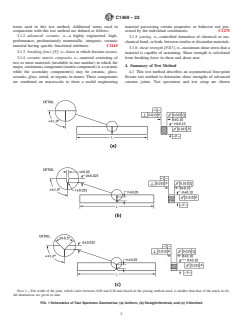
NOTE 1—The width of the joint, which varies between 0.05 and 0.20 mm based on the joining method used, is smaller than that of the notch in (b).
All dimensions are given in mm.
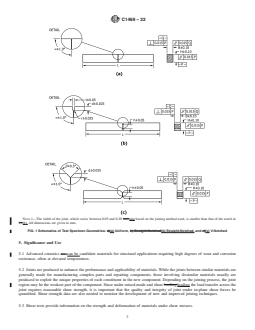
FIG. 1 Schematics of Test Specimen Geometries: (a) Uniform, (b) Straight-Notched, and (c) V-Notched
C1469 − 22
schematicallyinFig.1andFig.2,respectively.Selectionofthe
test specimen geometry depends on the bond strength of the
joint, which may be determined by preparing longer test
specimens of the same cross section and using a standard
four-point flexural strength test, for example, Test Method
C1161 for monolithic advanced ceramic base material andTest
Method C1341 for composite advanced ceramic base material.
If the joint flexural strength is low (that is, <25 % of the
flexural strength of the base material), the recommended test
specimen geometry for shear strength testing of the joint is the
uniform test specimen shown in Fig. 1(a). If the joint flexural
strength is moderate (that is, 25 to 50 % of the flexural strength
of the base material), the recommended test specimen geom-
etry for shear strength testing of the joint is the straight- or
V-notched test specimen shown in Fig. 1(b) and Fig. 1(c),
respectively. If the joint flexural strength is high (>50 % of the
flexural strength of the base material), this test method should
not be used to measure shear strength of advanced ceramic
joints because very high contact stresses at the reaction points
willprovideahighprobabilityofinvalidtests(thatis,fractures
not at the joint).
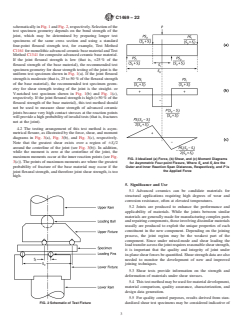
4.2 The testing arrangement of this test method is asym-
metrical flexure, as illustrated by the force, shear, and moment
diagrams in Fig. 3(a), Fig. 3(b), and Fig. 3(c), respectively.
Note that the greatest shear exists over a region of 6S/2
i
around the centerline of the joint (see Fig. 3(b)). In addition,
while the moment is zero at the centerline of the joint, the
maximum moments occur at the inner reaction points (see Fig.
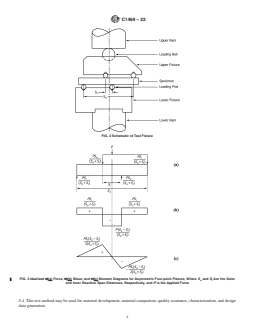
FIG. 3 Idealized (a) Force, (b) Shear, and (c) Moment Diagrams
3(c)). The points of maximum moments are where the greatest
for Asymmetric Four-point Flexure, Where S and S Are the
o i
probability of fracture of the base material may occur if the
Outer and Inner Reaction Span Distances, Respectively, and P is
the Applied Force
joint flexural strength, and therefore joint shear strength, is too
high.
5. Significance and Use
5.1 Advanced ceramics can be candidate materials for
structural applications requiring high degrees of wear and
corrosion resistance, often at elevated temperatures.
5.2 Joints are produced to enhance the performance and
applicability of materials. While the joints between similar
materials are generally made for manufacturing complex parts
and repairing components, those involving dissimilar materials
usually are produced to exploit the unique properties of each
constituent in the new component. Depending on the joining
process, the joint region may be the weakest part of the
component. Since under mixed-mode and shear loading the
loadtransferacrossthejointrequiresreasonableshearstrength,
it is important that the quality and integrity of joint under
in-plane shear forces be quantified. Shear strength data are also
needed to monitor the development of new and improved
joining techniques.
5.3 Shear tests provide information on the strength and
deformation of materials under shear stresses.
5.4 This test method may be used for material development,
material comparison, quality assurance, characterization, and
design data generation.
5.5 For quality control purposes, results derived from stan-
FIG. 2 Schematic of Test Fixture dardized shear test specimens may be considered indicative of
C1469 − 22
the response of the material from which they were taken for necessary to conduct preliminary tests to establish the appro-
given primary processing conditions and post-processing heat priate S and S distances for the fixture to be used.
o i
treatments.
6.4 The accuracy of insertion and alignment of the test
specimen with respect to the fixture is critical; therefore,
6. Interferences
preparations for testing should be done carefully to minimize
6.1 Fractures that initiate outside of the joint region may be
thebendingmomentatthejoint,whichstronglydependsonthe
due to factors such as localized stress concentrations, extrane-
inner and outer reaction spans, as seen in Fig. 3(c). See details
ous stresses introduced by improper force transfer. Such
in 10.4.
fractures will constitute invalid tests.
6.5 Test environment (vacuum, inert gas, ambient air, etc.),
6.2 Since the joint width is typically small, that is, 0.05 to
including moisture content, for example, relative humidity,
0.20 mm, the proper machining of the notches at the joint
may have an influence on the measured shear strength.
region is very critical (see Fig. 1). Improper machining of the
Conversely, testing can be conducted in environments and
notches can lead to undesired fracture at the reaction points.
testing modes and rates representative of service conditions to
Furthermore, nonsymmetrical machining of the notches can be
evaluate material performance under those conditions. When
decisive as to how the fracture occurs between the notches.
testing is conducted in uncontrolled ambient air with the
objective of evaluating maximum strength potential, relative
NOTE 1—Finite element stress analysis of nonsymmetrical notches
showed that when there is a misalignment between the notches and the humidity and temperature must be monitored and reported.
mid-plane of the joint, spurious normal (σ ) tensile stresses are generated
Testing at humidity levels >65 % RH is not recommended and
x
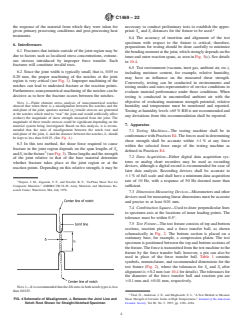
at the notches which tend to “tear” the joint and would artificially affect
any deviations from this recommendation shall be reported.
(reduce) the magnitude of shear strength measured from the joint. The
magnitude of these tensile stresses could be significant depending on the
7. Apparatus
material system being investigated. Based on this analysis, it is recom-
mended that the ratio of misalignment between the notch root and
7.1 Testing Machines—The testing machine shall be in
mid-plane of the joint, δ, and the distance between the notches, h, should
conformancewithPracticesE4.Theforcesusedindetermining
be kept to less than 0.0125. (See Fig. 4.)
shear strength shall be accurate within 61 % at any force
6.3 In this test method, the shear force required to cause
within the selected force range of the testing machine as
fracture in the joint region depends on the span lengths of S
o
defined in Practices E4.
andS inthefixture (seeFig.3).Theselengthsandthestrength
i
7.2 Data Acquisition—Either digital data acquisition sys-
of the joint relative to that of the base material determine
tems or analog chart recorders may be used as recording
whether fracture takes place at the joint region or at the
devices, although a digital record is recommended for ease of
reaction points. Depending on this relative strength, it may be
later data analysis. Recording devices shall be accurate to
61 % of full scale and shall have a minimum data acquisition
3 rate of 10 Hz, with a response of 50 Hz deemed more than
Slepetz, J. M., Zagaeski, T. F., and Novello, R. F., “In-Plane Shear Test for
sufficient.
Composite Materials,” AMMRC-TR-78-30, Army Materials and Mechanics Re-
search Center, Watertown, MA, July 1978.
7.3 Dimension-Measuring Devices—Micrometers and other
devices used for measuring linear dimensions must be accurate
and precise to at least 0.01 mm.
7.4 Combination Square—Used to draw perpendicular lines
to specimen axis at the locations of inner loading points. The
tolerance must be within 0.5°.
7.5 Test Fixture—The test fixture consists of top and bottom
sections, reaction pins, and a force transfer ball, as shown
schematically in Fig. 2. The bottom section is placed on a
stationary base, for example, a compression platen. The test
specimen is positioned between the top and bottom sections of
thefixture.Theforceistransmittedfromthetestmachinetothe
fixture by the force transfer ball; however, a pin can also be
used in place of the force transfer ball. Table 1 contains
symbols, nomenclature, and recommended dimensions for the
test fixture (Fig. 2), where the tolerances for S and S after
o i
alignment is 60.2 mm (see 10.4 for details).The tolerances for
the diameter of the force transfer ball and reaction pin are
60.1 mm and 60.01 mm, respectively.
NOTE 1—It is recommended that the δ/h ratio in both notch types is less
than 0.0125.
Ünal, Ö., Anderson, I. E., and Maghsoodi, S. I., “A Test Method to Measure
FIG. 4 Schematic of Misalignment, δ, Between the Joint Line and Shear Strength of Ceramic Joints at High Temperatures,” Journal of the American
Notch Root Shown for Straight-Notched Specimen Ceramic Society, Vol 80, No. 5, 1997, pp. 1281–1284.
C1469 − 22
TABLE 1 Recommended Dimensions for Test Fixture
show the tolerances for the test specimens, Table 2 shows
Nominal symbols, nomenclature, and recommended dimensions for the
Dimension Description Tolerance
Value
test specimen. If necessary, the test specimen dimensions, that
S Inner span 4.0 mm ±0.2 mm
i
is, length, height, width, and notch depth, if applicable) can be
S Outer span 30.0 mm ±0.2 mm
o
adjusted to meet special requirements. Report any deviation
Force transfer ball diameter 7.5 mm ±0.1 mm
Reaction pin diameter 3.00 mm ±0.01 mm from the recommended values of Table 2.
9.2 Test Specimen Preparation—Any machining procedure
may be used that is deemed satisfactory for a class of materials
NOTE2—Thereactionpindiameterinthisstandardi
...
This document is not an ASTM standard and is intended only to provide the user of an ASTM standard an indication of what changes have been made to the previous version. Because
it may not be technically possible to adequately depict all changes accurately, ASTM recommends that users consult prior editions as appropriate. In all cases only the current version
of the standard as published by ASTM is to be considered the official document.
Designation: C1469 − 10 (Reapproved 2015) C1469 − 22
Standard Test Method for
Shear Strength of Joints of Advanced Ceramics at Ambient
Temperature
This standard is issued under the fixed designation C1469; the number immediately following the designation indicates the year of
original adoption or, in the case of revision, the year of last revision. A number in parentheses indicates the year of last reapproval. A
superscript epsilon (´) indicates an editorial change since the last revision or reapproval.
1. Scope
1.1 This test method covers the determination of shear strength of joints in advanced ceramics at ambient temperature. temperature
using asymmetrical four-point flexure. Test specimen geometries, test specimen fabrication methods, testing modes (that is, force
or displacement control), testing rates (that is, force or displacement rate), data collection, and reporting procedures are addressed.
1.2 This test method is used to measure shear strength of ceramic joints in test specimens extracted from larger joined pieces by
machining. Test specimens fabricated in this way are not expected to warp due to the relaxation of residual stresses but are expected
to be much straighter and more uniform dimensionally than butt-jointed test specimens prepared by joining two halves, which areis
not recommended. In addition, this test method is intended for joints, which have either low or intermediate strengths with respect
to the substrate material to be joined. Joints with high strengths should not be tested by this test method because of the high
probability of invalid tests resulting from fractures initiating at the reaction points rather than in the joint. Determination of the
shear strength of joints using this test method is appropriate particularly for advanced ceramic matrix composite materials but also
may be useful for monolithic advanced ceramic materials.
1.3 Values expressed in this test method are in accordance with the International System of Units (SI) and IEEE/ASTM SI 10.
1.4 This test method standard does not purport to address all of the safety problems concerns, if any, associated with its use.
It is the responsibility of the user of this test method standard to establish appropriate safety safety, health, and healthenviron-
mental practices and determine the applicability of regulatory limitations prior to use. Specific precautionary statements are noted
in 8.1 and 8.2.
1.5 This international standard was developed in accordance with internationally recognized principles on standardization
established in the Decision on Principles for the Development of International Standards, Guides and Recommendations issued
by the World Trade Organization Technical Barriers to Trade (TBT) Committee.
2. Referenced Documents
2.1 ASTM Standards:
C1145 Terminology of Advanced Ceramics
C1161 Test Method for Flexural Strength of Advanced Ceramics at Ambient Temperature
C1211 Test Method for Flexural Strength of Advanced Ceramics at Elevated Temperatures
This test method is under the jurisdiction of ASTM Committee C28 on Advanced Ceramics and is the direct responsibility of Subcommittee C28.07 on Ceramic Matrix
Composites.
Current edition approved Jan. 1, 2015Feb. 1, 2022. Published April 2015February 2022. Originally approved in 2000. Last previous edition approved in 20102015 as
C1469 – 10.C1469 – 10 (2015). DOI: 10.1520/C1469-10R15.10.1520/C1469-22.
For referenced ASTM standards, visit the ASTM website, www.astm.org, or contact ASTM Customer Service at service@astm.org. For Annual Book of ASTM Standards
volume information, refer to the standard’s Document Summary page on the ASTM website.
Copyright © ASTM International, 100 Barr Harbor Drive, PO Box C700, West Conshohocken, PA 19428-2959. United States
C1469 − 22
C1275 Test Method for Monotonic Tensile Behavior of Continuous Fiber-Reinforced Advanced Ceramics with Solid
Rectangular Cross-Section Test Specimens at Ambient Temperature
C1341 Test Method for Flexural Properties of Continuous Fiber-Reinforced Advanced Ceramic Composites
D3878 Terminology for Composite Materials
D5379/D5379M Test Method for Shear Properties of Composite Materials by the V-Notched Beam Method
E4 Practices for Force Calibration and Verification of Testing Machines
E6 Terminology Relating to Methods of Mechanical Testing
E122 Practice for Calculating Sample Size to Estimate, With Specified Precision, the Average for a Characteristic of a Lot or
Process
E337 Test Method for Measuring Humidity with a Psychrometer (the Measurement of Wet- and Dry-Bulb Temperatures)
IEEE/ASTM SI 10 American National Standard for Use of the International System of Units (SI): The Modern Metric
SystemMetric Practice
3. Terminology
3.1 Definitions:
3.1.1 The definitions of terms relating to shear strength testing appearing in Terminology E6, and to advanced ceramics appearing
in Terminologies C1145 and D3878 apply to the terms used in this test method. Additional terms used in conjunction with this test
method are defined as follows.
3.1.2 advanced ceramic, n—highly-engineered, high-performance a highly engineered, high-performance, predominately
nonmetallic, inorganic, ceramic material having specific functional attributes. C1145
3.1.3 breaking force [F], n—force at which fracture occurs.
3.1.4 ceramic matrix composite, n—material consisting of two or more materials (insoluble in one another),another) in which the
major, continuous component (matrix component) is a ceramic while the secondary component(s) may be ceramic, glass-ceramic,
glass, metal, or organic in nature. These components are combined on macroscale to form a useful engineering material possessing
certain properties or behavior not possessed by the individual constituents. C1275
3.1.5 joining, n—controlled formation of chemical,chemical or mechanical bond, or both, between similar or dissimilar materials.
3.1.6 shear strength [F/L ], n—maximum shear stress that a material is capable of sustaining. Shear strength is calculated from
breaking force in shear and shear area.
4. Summary of Test Method
4.1 This test method describes an asymmetrical four-point flexure test method to determine shear strengths of advanced ceramic
joints. Test specimens and test setup are shown schematically in Fig. 1 and Fig. 2, respectively. Selection of the test specimen
geometry depends on the bond strength of the joint, which may be determined by preparing longer test specimens of the same
cross-section cross section and using a standard four-point flexural strength test, for example, Test Method C1161 for monolithic
advanced ceramic base material and Test Method C1341 for composite advanced ceramic base material. If the joint flexural
strength is low (that is, <25 % of the flexural strength of the base material), the recommended test specimen geometry for shear
strength testing of the joint is the uniform test specimen shown in Fig. 1a.(a). If the joint flexural strength is moderate (that is, 25
to 50 % of the flexural strength of the base material), the recommended test specimen geometry for shear strength testing of the
joint is the straight- or V-notched test specimen shown in Fig. 1b(b) and Fig. 1c,(c), respectively. If the joint flexural strength is
high (>50 % of the flexural strength of the base material)material), this test method should not be used to measure shear strength
of advanced ceramic joints because very high contact stresses at the reaction points will provide a high probability of invalid tests
(that is, fractures not at the joint).
4.2 The testing arrangement of this test method is asymmetrical flexure, as illustrated by the force, shear, and moment diagrams
in Fig. 3a,(a), Fig. 3b,(b), and Fig. 3c,(c), respectively. Note that the greatest shear exists over a region of 6S /2 around the
i
centerline of the joint (see Fig. 3b).(b)). In addition, while the moment is zero at the centerline of the joint, the maximum moments
occur at the inner reaction points (see Fig. 3c).(c)). The points of maximum moments are where the greatest probability of fracture
of the base material may occur if the joint flexural strength, and therefore,therefore joint shear strength, is too high.
C1469 − 22
NOTE 1—The width of the joint, which varies between 0.05 and 0.20 mm,mm based on the joining method used, is smaller than that of the notch in
b).(b). All dimensions are given in mm.
FIG. 1 Schematics of Test Specimen Geometries: a)(a) Uniform, b) Straight-Notched(b) Straight-Notched, and c)(c) V-Notched
5. Significance and Use
5.1 Advanced ceramics are can be candidate materials for structural applications requiring high degrees of wear and corrosion
resistance, often at elevated temperatures.
5.2 Joints are produced to enhance the performance and applicability of materials. While the joints between similar materials are
generally made for manufacturing complex parts and repairing components, those involving dissimilar materials usually are
produced to exploit the unique properties of each constituent in the new component. Depending on the joining process, the joint
region may be the weakest part of the component. Since under mixed-mode and shear loading,loading the load transfer across the
joint requires reasonable shear strength, it is important that the quality and integrity of joint under in-plane shear forces be
quantified. Shear strength data are also needed to monitor the development of new and improved joining techniques.
5.3 Shear tests provide information on the strength and deformation of materials under shear stresses.
C1469 − 22
FIG. 2 Schematic of Test Fixture
FIG. 3 Idealized a)(a) Force, b)(b) Shear, and c)(c) Moment Diagrams for Asymmetric Four-point Flexure, Where S and S Are the Outer
o i
and Inner Reaction Span Distances, Respectively, and P is the Applied Force
5.4 This test method may be used for material development, material comparison, quality assurance, characterization, and design
data generation.
C1469 − 22
5.5 For quality control purposes, results derived from standardized shear test specimens may be considered indicative of the
response of the material from which they were taken for given primary processing conditions and post-processing heat treatments.
6. Interferences
6.1 Fractures that initiate outside of the joint region may be due to factors,factors such as localized stress concentrations,
extraneous stresses introduced by improper force transfer. Such fractures will constitute invalid tests.
6.2 Since the joint width is typically small, that is, 0.05 to 0.20 mm, the proper machining of the notches at the joint region is
very critical (see Fig. 1). Improper machining of the notches can lead to undesired fracture at the reaction points. Furthermore,
nonsymmetrical machining of the nothcesnotches can be decisive as to how the fracture occurs between the notches.
NOTE 1—Finite element stress analysis of nonsymmetrical nothcesnotches showed that when there is a misalignment between the notches and the
mid-plane of the joint, spurious normal (σ ) tensile stresses are generated at the notches which tend to “tear” the joint and would artificially affect (reduce)
x
the magnitude of shear strength measured from the joint. The magnitude of these tensile stresses could be significant depending on the material system
being investigated. Based on this analysis, it is recommended that the ratio of misalignment between the notch root and mid-plane of the joint, δ, and
the distance between the notches, h, should be kept to less than 0.0125. (See Fig. 4.)
6.3 In this test method, the shear force required to cause fracture in the joint region depends on the span lengths of S and S in
o i
the fixture (see Fig. 3). These lengths and the strength of the joint relative to that of the base material determine whether fracture
takes place at the joint region or at the reaction points. Depending on this relative strength, it may be necessary to conduct
preliminary tests to establish the appropriate S and S distances for the fixture to be used.
o i
6.4 The accuracy of insertion and alignment of the test specimen with respect to the fixture is critical; therefore, preparations for
testing should be done carefully to minimize the bending moment at the joint, which strongly depends on the inner and outer
reaction spans, as seen in Fig. 3c.(c). See details in 10.4.
NOTE 1—It is recommended that the δ/h ratio in both notch types is less than 0.0125.
FIG. 4 Schematic of Misalignment, δ, betweenBetween the Joint Line and Notch Root Shown for Straight—NotchedStraight-Notched
Specimen
J.M. Slepetz, T.F. Zagaeski, and R.F. Novello, J. M., Zagaeski, T. F., and Novello, R. F., “In-Plane Shear Test for Composite MaterialMaterialss,”,” AMMRC-TR-78-30,
Army Materials and Mechanics Research Center, Watertown, MA, July 1978.
Ö. Ünal, I.E.Ö., Anderson, I. E., and S.I. Maghsoodi, S. I., “A Test Method to Measure Shear Strength of Ceramic Joints at High Temperatures,” J. Am. Ceram.
Soc.Journal of the American Ceramic Society, Vol 80, No. 805, 12811997 (, pp.1997 1281).–1284.
C1469 − 22
6.5 Test environment (vacuum, inert gas, ambient air, etc.)etc.), including moisture content, for example, relative humidity, may
have an influence on the measured shear strength. Conversely, testing can be conducted in environments and testing modes and
rates representative of service conditions to evaluate material performance under those conditions. When testing is conducted in
uncontrolled ambient air with the objective of evaluating maximum strength potential, relative humidity and temperature must be
monitored and reported. Testing at humidity levels >65 % RH is not recommended and any deviations from this recommendation
shall be reported.
7. Apparatus
7.1 Testing Machines—The testing machine shall be in conformance with Practices E4. The forces used in determining shear
strength shall be accurate within 61 % at any force within the selected force range of the testing machine as defined in Practices
E4.
7.2 Data Acquisition—At a minimum, autographic records of applied force and cross-head displacement versus time shall be
obtained. Either analog chart recorders or Either digital data acquisition systems or analog chart recorders may be used for this
purposeas recording devices, although a digital record is recommended for ease of later data analysis. Ideally, an analog chart
recorder or plotter should be used in conjunction with the digital data acquisition system to provide an immediate record of the
test as a supplement to the digital record. Recording devices shall be accurate to 61 % of full scale and shall have a minimum
data acquisition rate of 10 Hz, with a response of 50 Hz deemed more than sufficient.
7.3 Dimension-Measuring Devices—Micrometers and other devices used for measuring linear dimensions must be accurate and
precise to at least 0.01 mm.
7.4 Combination Square—Used to draw perpendicular lines to specimen axis at the locations of inner loading points. The tolerance
must be within 0.5°.
7.5 Test Fixture—The test fixture consists of top and bottom sections, reaction-pins, reaction pins, and a force transfer ball, as
shown schematically in Fig. 2. The bottom section is placed on a stationary base, for example, a compression platen. The test
specimen is positioned between the top and bottom sections of the fixture. The force is transmitted from the test machine to the
fixture by the force transfer ball; however, a pin also can also be used in place of the force transfer ball. Table 1 contains symbols,
nomenclature, and recommended dimensions for the test fixture (Fig. 2), where the tolerances for S and S after alignment is 60.2
o i
mm (see 10.4 for details). The tolerances for the diameter of the force transfer ball and reaction-pin are 60.1 mm reaction pin are
60.1 mm and 60.01 mm, respectively.
NOTE 2—The reaction-pin reaction pin diameter in this standard is 3 mm, unlike that in Test Method C1161 where it is a 4.5 mm. Unpublished finite
element analyses have indicated that the smaller pin diameter better approximates the “point loading”,loading,” thus the stress profile at the joint in Fig.
3.
NOTE 3—It should be indicated that when there are restrictions for pins to rotate freely, as in Fig. 2, the resulting friction may become a factor in the
measurements, as indicated in Test Method C1161. So far, however, no systematic study has been conducted
...