

ASTM C1869-18(2023)
(Test Method)Standard Test Method for Open-Hole Tensile Strength of Fiber-Reinforced Advanced Ceramic Composites
General Information
- Abstract
SIGNIFICANCE AND USE
5.1 Open-hole tests of composites are used for material and design development for the engineering application of composite materials (5-11). The presence of an open hole in a composite component reduces the cross-sectional area available to carry an applied force, creates stress concentrations, and creates new edges where delamination may occur. Standardized open-hole tests for composite materials can provide useful information about how a composite material may perform in an open-hole application and how to design the composite for notches and holes.
5.2 The test method defines two baseline test specimen geometries and a test procedure for producing comparable, reproducible OHT test data. The test method is designed to produce OHT strength data for structural design allowables, material specifications, material development and comparison, material characterization, and quality assurance. The mechanical properties that may be calculated from this test method include:
5.2.1 The open-hole (notched) tensile strength (SOHTx) for test specimen with a hole diameter x (mm).
5.2.2 The net section tensile strength (SNSx) for a test specimen with a hole diameter x (mm).
5.2.3 The proportional limit stress (σ0) for an OHT specimen with a given hole diameter.
5.2.4 The stress response of the OHT test specimen, as shown by the stress-time or stress-displacement plot.
5.3 Open-hole tensile tests provide information on the strength and deformation of materials with defined through-holes under uniaxial tensile stresses. Material factors that influence the OHT composite strength include the following: material composition, methods of composite fabrication, reinforcement architecture (including reinforcement volume, tow filament count and end-count, architecture structure, and laminate stacking sequence), and porosity content. Test specimen factors of influence are: specimen geometry (including hole diameter, width-to-diameter ratio, and diameter-to-thickness rati...
SCOPE
1.1 This test method determines the open-hole (notched) tensile strength of continuous fiber-reinforced ceramic matrix composite (CMC) test specimens with a single through-hole of defined diameter (either 6 mm or 3 mm). The open-hole tensile (OHT) test method determines the effect of the single through-hole on the tensile strength and stress response of continuous fiber-reinforced CMCs at ambient temperature. The OHT strength can be compared to the tensile strength of an unnotched test specimen to determine the effect of the defined open hole on the tensile strength and the notch sensitivity of the CMC material. If a material is notch sensitive, then the OHT strength of a material varies with the size of the through-hole. Commonly, larger holes introduce larger stress concentrations and reduce the OHT strength.
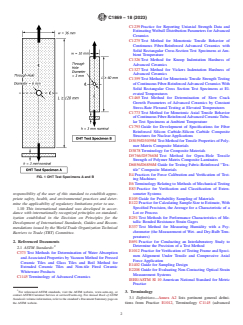
1.2 This test method defines two baseline OHT test specimen geometries and a test procedure, based on Test Methods C1275 and D5766/D5766M. A flat, straight-sided ceramic composite test specimen with a defined laminate fiber architecture contains a single through-hole (either 6 mm or 3 mm in diameter), centered by length and width in the defined gage section (Fig. 1). A uniaxial, monotonic tensile test is performed along the defined test reinforcement axis at ambient temperature, measuring the applied force versus time/displacement in accordance with Test Method C1275. Measurement of the gage length extension/strain is optional, using extensometer/displacement transducers. Bonded strain gages are optional for measuring localized strains and assessing bending strains in the gage section.
FIG. 1 OHT Test Specimens A and B
1.3 The open-hole tensile strength (SOHTx) for the defined hole diameter x (mm) is the calculated ultimate tensile strength based on the maximum applied force and the gross cross-sectional area, disregarding the presence of the hole, per common aerospace practice (see 4.4). The net section ...
- Status
- Published
- Publication Date
- 30-Apr-2023
- Technical Committee
- C28 - Advanced Ceramics
- Drafting Committee
- C28.07 - Ceramic Matrix Composites
Overview
ASTM C1869-18(2023) specifies the standard test method for determining the open-hole tensile strength (OHT) of continuous fiber-reinforced advanced ceramic matrix composites (CMCs). This test method is crucial for assessing how CMCs perform when engineered with features such as holes or notches, which are commonly encountered in structural applications across aerospace, automotive, and energy industries. The procedure examines how the introduction of a defined through-hole affects the tensile properties, strength, and deformation characteristics of composite materials.
Open-hole tensile testing is an essential tool for material selection, quality control, and structural design, especially when materials are expected to operate under uniaxial tensile stress and when geometric discontinuities are present due to notches or holes.
Key Topics
- Open-Hole Tensile Strength: The method evaluates the ultimate tensile strength and deformation behaviors of CMC test specimens featuring a centrally located through-hole, usually of 3 mm or 6 mm diameter.
- Test Specimen Geometry: Two primary specimen geometries are defined, both using flat, straight-sided coupons with the hole centered in the gage section for standardized comparison and reproducibility.
- Material and Structural Factors: The test considers the impact of ceramic composite architecture, fiber orientation, matrix characteristics, porosity, and processing methods. Specimen geometry factors such as hole size, width, thickness, and their ratios (e.g., width-to-diameter, diameter-to-thickness) also influence test outcomes.
- Mechanical Properties Measured:
- Open-hole (notched) tensile strength (SOHTx)
- Net section tensile strength (SNSx)
- Proportional limit stress (σ0)
- Full stress-time or stress-displacement response
- Notch Sensitivity: The method helps determine the degree to which the tensile strength of a material decreases due to the presence of a hole-a critical factor for design safety.
- Comparative Data: Results can be directly compared to unnotched tensile strength data, supporting evaluations of material performance and sensitivity to discontinuities.
Applications
The ASTM C1869-18(2023) open-hole tensile test has broad practical applications, including:
- Material Selection & Qualification: Enables engineers and manufacturers to compare different CMCs for suitability in high-performance components with required cutouts or fastener holes.
- Design Allowables Development: Provides credible baseline data for design engineers, particularly in aerospace and automotive structures where open-hole conditions are routine.
- Material Characterization: Assists R&D and materials science teams in understanding fiber orientation, laminate architecture, and fabrication effects on mechanical performance.
- Quality Assurance: Supports manufacturers and suppliers in verifying that their CMC products meet industry strength and durability standards when holes or notches are present.
- Process and Product Optimization: Guides the optimization of fabrication techniques and composite architectures to mitigate strength loss due to open holes.
- Research and Comparative Analysis: Useful for academic and industrial research to understand the interplay between composite microstructure, test conditions, and mechanical response.
Related Standards
The following ASTM standards are frequently used alongside C1869-18(2023) for comprehensive testing and materials qualification:
- ASTM C1275 – Test Method for Monotonic Tensile Behavior of Continuous Fiber-Reinforced Advanced Ceramics at Ambient Temperature
- ASTM D5766/D5766M – Test Method for Open-Hole Tensile Strength of Polymer Matrix Composite Laminates
- ASTM C1359 – Test Method for Monotonic Tensile Strength Testing at Elevated Temperatures
- ASTM C1239 – Practice for Reporting Uniaxial Strength Data for Advanced Ceramics
- ASTM D3039/D3039M – Test Method for Tensile Properties of Polymer Matrix Composite Materials
- ASTM C1145, D3878, E6 – Terminology standards for ceramics and composites
- ASTM E4, E83, E1012, E2208 – Practices related to mechanical test apparatus, calibration, and strain measurement
For those selecting, specifying, or qualifying fiber-reinforced advanced ceramics, ASTM C1869-18(2023) is a critical reference that supports robust engineering design and quality assurance in advanced composite applications.
Relations
- Effective Date
- 01-Jan-2024
- Effective Date
- 01-Nov-2023
- Refers
ASTM D6856/D6856M-23 - Standard Guide for Testing Fabric-Reinforced “Textile” Composite Materials - Effective Date
- 01-Nov-2023
- Effective Date
- 01-Jun-2020
- Effective Date
- 01-May-2020
- Effective Date
- 15-Oct-2019
- Effective Date
- 01-Jul-2019
- Refers
ASTM C1327-15(2019) - Standard Test Method for Vickers Indentation Hardness of Advanced Ceramics - Effective Date
- 01-Jul-2019
- Effective Date
- 01-Jul-2019
- Effective Date
- 15-Apr-2019
- Effective Date
- 01-Nov-2018
- Effective Date
- 01-Aug-2018
- Effective Date
- 01-Aug-2018
- Effective Date
- 01-Jul-2018
- Effective Date
- 01-May-2018
Frequently Asked Questions
ASTM C1869-18(2023) is a standard published by ASTM International. Its full title is "Standard Test Method for Open-Hole Tensile Strength of Fiber-Reinforced Advanced Ceramic Composites". This standard covers: SIGNIFICANCE AND USE 5.1 Open-hole tests of composites are used for material and design development for the engineering application of composite materials (5-11). The presence of an open hole in a composite component reduces the cross-sectional area available to carry an applied force, creates stress concentrations, and creates new edges where delamination may occur. Standardized open-hole tests for composite materials can provide useful information about how a composite material may perform in an open-hole application and how to design the composite for notches and holes. 5.2 The test method defines two baseline test specimen geometries and a test procedure for producing comparable, reproducible OHT test data. The test method is designed to produce OHT strength data for structural design allowables, material specifications, material development and comparison, material characterization, and quality assurance. The mechanical properties that may be calculated from this test method include: 5.2.1 The open-hole (notched) tensile strength (SOHTx) for test specimen with a hole diameter x (mm). 5.2.2 The net section tensile strength (SNSx) for a test specimen with a hole diameter x (mm). 5.2.3 The proportional limit stress (σ0) for an OHT specimen with a given hole diameter. 5.2.4 The stress response of the OHT test specimen, as shown by the stress-time or stress-displacement plot. 5.3 Open-hole tensile tests provide information on the strength and deformation of materials with defined through-holes under uniaxial tensile stresses. Material factors that influence the OHT composite strength include the following: material composition, methods of composite fabrication, reinforcement architecture (including reinforcement volume, tow filament count and end-count, architecture structure, and laminate stacking sequence), and porosity content. Test specimen factors of influence are: specimen geometry (including hole diameter, width-to-diameter ratio, and diameter-to-thickness rati... SCOPE 1.1 This test method determines the open-hole (notched) tensile strength of continuous fiber-reinforced ceramic matrix composite (CMC) test specimens with a single through-hole of defined diameter (either 6 mm or 3 mm). The open-hole tensile (OHT) test method determines the effect of the single through-hole on the tensile strength and stress response of continuous fiber-reinforced CMCs at ambient temperature. The OHT strength can be compared to the tensile strength of an unnotched test specimen to determine the effect of the defined open hole on the tensile strength and the notch sensitivity of the CMC material. If a material is notch sensitive, then the OHT strength of a material varies with the size of the through-hole. Commonly, larger holes introduce larger stress concentrations and reduce the OHT strength. 1.2 This test method defines two baseline OHT test specimen geometries and a test procedure, based on Test Methods C1275 and D5766/D5766M. A flat, straight-sided ceramic composite test specimen with a defined laminate fiber architecture contains a single through-hole (either 6 mm or 3 mm in diameter), centered by length and width in the defined gage section (Fig. 1). A uniaxial, monotonic tensile test is performed along the defined test reinforcement axis at ambient temperature, measuring the applied force versus time/displacement in accordance with Test Method C1275. Measurement of the gage length extension/strain is optional, using extensometer/displacement transducers. Bonded strain gages are optional for measuring localized strains and assessing bending strains in the gage section. FIG. 1 OHT Test Specimens A and B 1.3 The open-hole tensile strength (SOHTx) for the defined hole diameter x (mm) is the calculated ultimate tensile strength based on the maximum applied force and the gross cross-sectional area, disregarding the presence of the hole, per common aerospace practice (see 4.4). The net section ...
SIGNIFICANCE AND USE 5.1 Open-hole tests of composites are used for material and design development for the engineering application of composite materials (5-11). The presence of an open hole in a composite component reduces the cross-sectional area available to carry an applied force, creates stress concentrations, and creates new edges where delamination may occur. Standardized open-hole tests for composite materials can provide useful information about how a composite material may perform in an open-hole application and how to design the composite for notches and holes. 5.2 The test method defines two baseline test specimen geometries and a test procedure for producing comparable, reproducible OHT test data. The test method is designed to produce OHT strength data for structural design allowables, material specifications, material development and comparison, material characterization, and quality assurance. The mechanical properties that may be calculated from this test method include: 5.2.1 The open-hole (notched) tensile strength (SOHTx) for test specimen with a hole diameter x (mm). 5.2.2 The net section tensile strength (SNSx) for a test specimen with a hole diameter x (mm). 5.2.3 The proportional limit stress (σ0) for an OHT specimen with a given hole diameter. 5.2.4 The stress response of the OHT test specimen, as shown by the stress-time or stress-displacement plot. 5.3 Open-hole tensile tests provide information on the strength and deformation of materials with defined through-holes under uniaxial tensile stresses. Material factors that influence the OHT composite strength include the following: material composition, methods of composite fabrication, reinforcement architecture (including reinforcement volume, tow filament count and end-count, architecture structure, and laminate stacking sequence), and porosity content. Test specimen factors of influence are: specimen geometry (including hole diameter, width-to-diameter ratio, and diameter-to-thickness rati... SCOPE 1.1 This test method determines the open-hole (notched) tensile strength of continuous fiber-reinforced ceramic matrix composite (CMC) test specimens with a single through-hole of defined diameter (either 6 mm or 3 mm). The open-hole tensile (OHT) test method determines the effect of the single through-hole on the tensile strength and stress response of continuous fiber-reinforced CMCs at ambient temperature. The OHT strength can be compared to the tensile strength of an unnotched test specimen to determine the effect of the defined open hole on the tensile strength and the notch sensitivity of the CMC material. If a material is notch sensitive, then the OHT strength of a material varies with the size of the through-hole. Commonly, larger holes introduce larger stress concentrations and reduce the OHT strength. 1.2 This test method defines two baseline OHT test specimen geometries and a test procedure, based on Test Methods C1275 and D5766/D5766M. A flat, straight-sided ceramic composite test specimen with a defined laminate fiber architecture contains a single through-hole (either 6 mm or 3 mm in diameter), centered by length and width in the defined gage section (Fig. 1). A uniaxial, monotonic tensile test is performed along the defined test reinforcement axis at ambient temperature, measuring the applied force versus time/displacement in accordance with Test Method C1275. Measurement of the gage length extension/strain is optional, using extensometer/displacement transducers. Bonded strain gages are optional for measuring localized strains and assessing bending strains in the gage section. FIG. 1 OHT Test Specimens A and B 1.3 The open-hole tensile strength (SOHTx) for the defined hole diameter x (mm) is the calculated ultimate tensile strength based on the maximum applied force and the gross cross-sectional area, disregarding the presence of the hole, per common aerospace practice (see 4.4). The net section ...
ASTM C1869-18(2023) is classified under the following ICS (International Classification for Standards) categories: 81.060.30 - Advanced ceramics. The ICS classification helps identify the subject area and facilitates finding related standards.
ASTM C1869-18(2023) has the following relationships with other standards: It is inter standard links to ASTM C1793-15(2024), ASTM E1402-13(2023), ASTM D6856/D6856M-23, ASTM E251-20a, ASTM E251-20, ASTM D3878-19a, ASTM C1145-19, ASTM C1327-15(2019), ASTM C1465-08(2019), ASTM D3878-19, ASTM E1402-13(2018), ASTM C1359-18e1, ASTM C1359-18, ASTM C1239-13(2018), ASTM E2208-02(2018)e1. Understanding these relationships helps ensure you are using the most current and applicable version of the standard.
ASTM C1869-18(2023) is available in PDF format for immediate download after purchase. The document can be added to your cart and obtained through the secure checkout process. Digital delivery ensures instant access to the complete standard document.
Standards Content (Sample)
This international standard was developed in accordance with internationally recognized principles on standardization established in the Decision on Principles for the
Development of International Standards, Guides and Recommendations issued by the World Trade Organization Technical Barriers to Trade (TBT) Committee.
Designation: C1869 − 18 (Reapproved 2023)
Standard Test Method for
Open-Hole Tensile Strength of Fiber-Reinforced Advanced
Ceramic Composites
This standard is issued under the fixed designation C1869; the number immediately following the designation indicates the year of
original adoption or, in the case of revision, the year of last revision. A number in parentheses indicates the year of last reapproval. A
superscript epsilon (´) indicates an editorial change since the last revision or reapproval.
1. Scope strength (S ) is also calculated as a second strength property,
NSx
accounting for the effect of the hole on the cross-sectional area
1.1 This test method determines the open-hole (notched)
of the test specimen.
tensile strength of continuous fiber-reinforced ceramic matrix
1.4 This test method applies primarily to ceramic matrix
composite (CMC) test specimens with a single through-hole of
defined diameter (either 6 mm or 3 mm). The open-hole tensile composites with continuous fiber reinforcement in multiple
directions. The CMC material is typically a fiber-reinforced,
(OHT) test method determines the effect of the single through-
hole on the tensile strength and stress response of continuous 2-D, laminated composite in which the laminate is balanced
and symmetric with respect to the test direction. Composites
fiber-reinforced CMCs at ambient temperature. The OHT
with other types of reinforcement (1-D, 3-D, braided, unbal-
strength can be compared to the tensile strength of an un-
anced) may be tested with this method, with consideration of
notched test specimen to determine the effect of the defined
how the different architectures may affect the notch effect of
open hole on the tensile strength and the notch sensitivity of the
the hole on the OHT strength and the tensile stress-strain
CMC material. If a material is notch sensitive, then the OHT
response. This test method does not directly address discon-
strength of a material varies with the size of the through-hole.
tinuous fiber-reinforced, whisker-reinforced, or particulate-
Commonly, larger holes introduce larger stress concentrations
reinforced ceramics, although the test methods detailed here
and reduce the OHT strength.
may be equally applicable to these composites.
1.2 This test method defines two baseline OHT test speci-
1.5 This test method may be used for a wide range of CMC
men geometries and a test procedure, based on Test Methods
materials with different reinforcement fibers and ceramic
C1275 and D5766/D5766M. A flat, straight-sided ceramic
matrices (oxide-oxide composites, silicon carbide (SiC) fibers
composite test specimen with a defined laminate fiber archi-
in SiC matrices, carbon fibers in SiC matrices, and carbon-
tecture contains a single through-hole (either 6 mm or 3 mm in
carbon composites) and CMCs with different reinforcement
diameter), centered by length and width in the defined gage
architectures. It is also applicable to CMCs with a wide range
section (Fig. 1). A uniaxial, monotonic tensile test is performed
of porosities and densities.
along the defined test reinforcement axis at ambient
temperature, measuring the applied force versus time/
1.6 Annex A1 and Appendix X1 address how test specimens
displacement in accordance with Test Method C1275. Mea-
with different geometries and hole diameters may be prepared
surement of the gage length extension/strain is optional, using
and tested to determine how those changes will modify the
extensometer/displacement transducers. Bonded strain gages
OHT strength properties, determine the notch sensitivity, and
are optional for measuring localized strains and assessing
affect the stress-strain response.
bending strains in the gage section.
1.7 The test method may be adapted for elevated tempera-
1.3 The open-hole tensile strength (S ) for the defined
OHTx
ture OHT testing by modifying the test equipment, specimens,
hole diameter x (mm) is the calculated ultimate tensile strength
and procedures per Test Method C1359 and as described in
based on the maximum applied force and the gross cross-
Appendix X2. The test method may also be adapted for
sectional area, disregarding the presence of the hole, per
environmental testing (controlled atmosphere/humidity at
common aerospace practice (see 4.4). The net section tensile
moderate (<300 °C) temperatures) of the OHT properties by
the use of an environmental test chamber, per 7.6.
1.8 Values expressed in this test method are in accordance
This test method is under the jurisdiction of ASTM Committee C28 on
with the International System of Units (SI) and IEEE/ASTM SI
Advanced Ceramics and is the direct responsibility of Subcommittee C28.07 on
10.
Ceramic Matrix Composites.
Current edition approved May 1, 2023. Published June 2023. Originally
1.9 This standard does not purport to address all of the
approved in 2018. Last previous edition approved in 2018 as C1869 – 18. DOI:
10.1520/C1869-18R23. safety concerns, if any, associated with its use. It is the
Copyright © ASTM International, 100 Barr Harbor Drive, PO Box C700, West Conshohocken, PA 19428-2959. United States
C1869 − 18 (2023)
C1239 Practice for Reporting Uniaxial Strength Data and
Estimating Weibull Distribution Parameters for Advanced
Ceramics
C1275 Test Method for Monotonic Tensile Behavior of
Continuous Fiber-Reinforced Advanced Ceramics with
Solid Rectangular Cross-Section Test Specimens at Am-
bient Temperature
C1326 Test Method for Knoop Indentation Hardness of
Advanced Ceramics
C1327 Test Method for Vickers Indentation Hardness of
Advanced Ceramics
C1359 Test Method for Monotonic Tensile Strength Testing
of Continuous Fiber-Reinforced Advanced Ceramics With
Solid Rectangular Cross Section Test Specimens at El-
evated Temperatures
C1465 Test Method for Determination of Slow Crack
Growth Parameters of Advanced Ceramics by Constant
Stress-Rate Flexural Testing at Elevated Temperatures
C1773 Test Method for Monotonic Axial Tensile Behavior
of Continuous Fiber-Reinforced Advanced Ceramic Tubu-
lar Test Specimens at Ambient Temperature
C1793 Guide for Development of Specifications for Fiber
Reinforced Silicon Carbide-Silicon Carbide Composite
Structures for Nuclear Applications
D3039/D3039M Test Method for Tensile Properties of Poly-
mer Matrix Composite Materials
D3878 Terminology for Composite Materials
D5766/D5766M Test Method for Open-Hole Tensile
Strength of Polymer Matrix Composite Laminates
D6856/D6856M Guide for Testing Fabric-Reinforced “Tex-
tile” Composite Materials
E4 Practices for Force Calibration and Verification of Test-
FIG. 1 OHT Test Specimens A and B
ing Machines
E6 Terminology Relating to Methods of Mechanical Testing
E83 Practice for Verification and Classification of Exten-
someter Systems
responsibility of the user of this standard to establish appro-
E105 Guide for Probability Sampling of Materials
priate safety, health, and environmental practices and deter-
E122 Practice for Calculating Sample Size to Estimate, With
mine the applicability of regulatory limitations prior to use.
Specified Precision, the Average for a Characteristic of a
1.10 This international standard was developed in accor-
Lot or Process
dance with internationally recognized principles on standard-
E251 Test Methods for Performance Characteristics of Me-
ization established in the Decision on Principles for the
tallic Bonded Resistance Strain Gages
Development of International Standards, Guides and Recom-
E337 Test Method for Measuring Humidity with a Psy-
mendations issued by the World Trade Organization Technical
chrometer (the Measurement of Wet- and Dry-Bulb Tem-
Barriers to Trade (TBT) Committee.
peratures)
2. Referenced Documents E691 Practice for Conducting an Interlaboratory Study to
Determine the Precision of a Test Method
2.1 ASTM Standards:
E1012 Practice for Verification of Testing Frame and Speci-
C373 Test Methods for Determination of Water Absorption
men Alignment Under Tensile and Compressive Axial
and Associated Properties by Vacuum Method for Pressed
Force Application
Ceramic Tiles and Glass Tiles and Boil Method for
E1402 Guide for Sampling Design
Extruded Ceramic Tiles and Non-tile Fired Ceramic
E2208 Guide for Evaluating Non-Contacting Optical Strain
Whiteware Products
Measurement Systems
C1145 Terminology of Advanced Ceramics
IEEE/ASTM SI 10 American National Standard for Metric
Practice
For referenced ASTM standards, visit the ASTM website, www.astm.org, or 3. Terminology
contact ASTM Customer Service at service@astm.org. For Annual Book of ASTM
3.1 Definitions—Annex A2 lists pertinent general defini-
Standards volume information, refer to the standard’s Document Summary page on
the ASTM website. tions from Practice E1012, Terminology C1145 (advanced
C1869 − 18 (2023)
ceramics), Terminology D3878 (composite materials), and 3.2.7 principal structural axis, n—in a composite flat plate
Terminology E6 (tensile testing), with the appropriate source or rectangular bar, the composite coordinate axis/direction
given in bold font. with the maximum in-plane Young’s modulus (based on
Terminology D3878). This is commonly the axis with the
3.2 Definitions of Terms Specific to This Standard:
highest fiber fraction or the warp direction of the weave.
3.2.1 If the term represents a physical quantity, its analytical
3.2.8 test reinforcement axis alignment, n—the orientation/
dimensions are stated immediately following the term (or letter
alignment of the long tensile test axis of the test specimen with
symbol) in fundamental dimension form, using the following
respect to the principal structural axis.
ASTM standard symbology for fundamental dimensions,
3.2.8.1 Discussion—In composite testing, it is common
shown within square brackets: [M] for mass, [L] for length, [T]
practice to test specimens with different test axis alignments
for time, [θ] for thermodynamic temperature, and [nd] for
(0°, 90°, 645° to the principal structural axis) to determine the
nondimensional quantities. Use of these symbols is restricted
mechanical properties in the different anisotropic directions.
to analytical dimensions when used with square brackets, as
(See Fig. 2.)
the terms may have other definitions when used without the
brackets.
3.2.9 width-to-diameter ratio (w/D), [L/L]—in an open-hole
3.2.2 diameter-to-thickness ratio (D/h), [L/L], n—in an
tensile specimen, the ratio of the specimen width (w) to the
open-hole tensile specimen, the ratio of the hole diameter (D)
hole diameter (D).
to the specimen thickness (h).
3.2.9.1 Discussion—The width-to-diameter ratio may be
3.2.2.1 Discussion—The diameter-to-thickness ratio may be either a nominal value determined from nominal dimensions or
either a nominal value determined from nominal dimensions or
an actual value determined from measured dimensions.
an actual value determined from measured dimensions.
3.3 Symbols:
3.2.3 failure strength, n—the strength parameter (stress,
3.3.1 A—gross cross-sectional area of the test specimen,
torque, moment, force, etc.) that produces material failure in a
disregarding the presence of the through-hole (mm )
given test specimen in a given stress state and test orientation.
3.3.2 A —net cross-sectional area of the test specimen,
NS
3.2.3.1 Discussion—In mechanical testing of ceramic
considering the presence of the through-hole (mm )
composites, failure is often defined by a total or partial loss of
3.3.3 CV—coefficient of variation statistic of a sample
load carrying capacity, marked by the breaking or tearing apart
population for a given property (in percent)
of or damage to the test specimen (synonym—rupture). Failure
3.3.4 D—diameter of the through-hole (mm)
strength is typically defined for a given stress state (tensile,
compression, shear, flexure, torsion) and a given test orienta-
3.3.5 h—test specimen thickness (mm)
tion in the test specimen.
3.3.6 L—total length of the test specimen (mm)
3.2.4 material failure, n—in mechanical testing, the loss of
3.3.7 L —the nominal gage section length of the test
gage
or inability to meet the required load carrying capacity speci-
specimen (mm)
fied in the applicable material or performance requirement,
3.3.8 L —grip section length of the test specimen (mm)
grip
depending on the purpose of the test.
3.3.9 n—number of valid specimen data points for statistical
–2
3.2.5 net section tensile strength (S ), [FL ], n—in the
NSx
calculations
open-hole tensile test, the hole-diameter-adjusted maximum
3.3.10 N —total number of test specimens that were tested
tensile stress which the OHT test specimen (with a through- T
hole of defined diameter x (mm)) is capable of sustaining. The 3.3.11 N —number of valid test specimens
V
net section tensile strength is calculated from the maximum
3.3.12 P —maximum force carried by test specimen prior
max
force during the OHT test carried to failure/rupture and the
to failure (N)
reduced cross-sectional area of the specimen, considering the
presence of the hole.
–2
3.2.6 open-hole (notched) tensile strength (S ), [FL ],
OHTx
n—in the open-hole tensile test, the maximum tensile stress
that the OHT test specimen (with a through-hole of defined
diameter x (mm)) is capable of sustaining. The OHT strength is
calculated from the maximum force during the OHT test
carried to failure/rupture and the original/gross cross-sectional
area of the specimen, disregarding the presence of the hole.
3.2.6.1 Discussion—While the hole causes a stress concen-
tration and reduced net section, it is common aerospace
practice (per Test Method D5766/D5766M) to develop
notched-design allowable strengths, based on gross section
stress, to account for various stress concentrations (fastener
holes, free edges, flaws, damage, and so forth) not explicitly
modeled in the stress analysis. This gross section stress is also
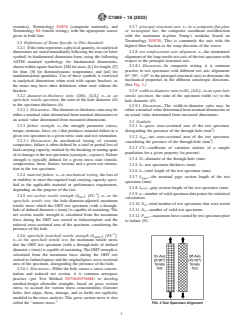
called the “remote stress.” FIG. 2 Test Specimen Alignment
C1869 − 18 (2023)
3.3.13 s.d.—standard deviation statistic of a sample popula- produce higher stress concentrations and reduce the tensile
tion for a given property strength of the CMC. For this reason, the open-hole tensile
(OHT) strength should be qualified by a hole size designator x
3.3.14 S —net section tensile strength in the test direction
NSx
(in mm), so that the test strength (S ) clearly shows what
OHTx
for a test specimen with a through-hole diameter of x mm
size hole was tested. (This is similar to how microhardness
(MPa)
numbers are identified per the type of indenter—HK = hard-
3.3.15 S —ultimate open-hole (notched) tensile strength
OHTx
ness by Knoop indenter (K for Knoop) and HV = hardness by
in the test direction for a test specimen with a through-hole
Vickers indenter (V for Vickers), per Test Methods C1326 and
diameter of x mm (MPa)
C1327.)
3.3.16 S —ultimate tensile strength of the unnotched (no-
U
4.4 The ultimate open-hole tensile (OHT) strength (S )
hole) test specimen in the test direction (MPa) OHTx
is calculated based on the gross cross-sectional area, disregard-
3.3.17 w—width of the gage section of the test specimen
ing the presence of the hole (per Test Method D5766/
(mm)
D5766M). While the hole causes a stress concentration and a
3.3.18 x—diameter of the through-hole in the test specimen
reduced net section, it is common aerospace practice to
(mm)
develop notched-design allowable strengths based on gross
¯
3.3.19 X—mean or average (estimate of mean) of a sample
section stress to account for various stress concentrations
data population for a given property
(fastener holes, free edges, flaws, damage, and so forth) not
explicitly modeled in the stress analysis. This gross section
3.3.20 X —test result for an individual specimen from the
i
stress value is also called the “remote stress.”
sample population for a given property
3.3.21 σ—engineering stress (MPa)
4.5 The net section tensile strength (S ) is also calculated
NSx
as a second strength property, considering the hole size.
3.3.22 σ —proportional limit stress (MPa)
Stress-time/extension plots are of value in determining the
4. Summary of Test Method
effect of the hole on the tensile stress response and fracture
modes.
4.1 A uniaxial tension test is performed on a flat, straight-
sided ceramic matrix composite test specimen with a defined
4.6 The only valid failure mode for open-hole tensile
fiber architecture and a single through-hole centered in the
strength is one in which the failure/fracture surface passes
gage section. Two geometries are defined as a baseline for test
through the center hole in the test specimen.
specimens: Test Specimen A with a single 6 mm diameter hole
centered in the gage section (36 mm by ≥60 mm) of the 4.7 Unnotched tensile specimens of the same geometry
should be tested to compare the OHT strength (S ) and net
specimen, and Test Specimen B with a single 3 mm diameter
OHTx
hole centered in the gage section (10 mm by ≥30 mm) of the section strength (S ) to the “no-notch” tensile strength (S ).
NSx U
specimen. The test specimen is loaded in uniaxial tension, per
4.8 The test specimen geometry and hole size may be
Test Method C1275, along a defined test reinforcement axis at
modified to determine the effect of different specimen
a constant displacement rate at ambient temperature until
geometries, hole sizes, and gage section widths and thicknesses
failure/rupture occurs. The applied force is measured as a
on OHT strength. These modifications are described in Annex
function of time/displacement. Measurement of the gage length
A1 and Appendix X1. The test may also be modified for
extension/ strain is optional, using extensometer transducers.
elevated temperature testing with appropriate heating
Bonded strain gages are optional for measuring localized
equipment, thermal measurement systems, and modified test
strains and bending strains in the gage section. If measured,
procedures (Appendix X2).
extension/strain is recorded against time.
4.2 There are typically two competing mechanisms operat-
5. Significance and Use
ing in the stress field around the hole/notch in a ceramic matrix
5.1 Open-hole tests of composites are used for material and
composite: the stress concentration effect of the hole, and the
design development for the engineering application of com-
redistribution of stress with the inelastic straining (1-4). The
posite materials (5-11). The presence of an open hole in a
relative effects of these two mechanisms can vary widely with
composite component reduces the cross-sectional area avail-
different CMC materials, depending on the reinforcement
able to carry an applied force, creates stress concentrations, and
architecture, the matrix microstructure, and the stress-strain-
creates new edges where delamination may occur. Standard-
damage mechanisms close to the hole. If there is a large
ized open-hole tests for composite materials can provide useful
amount of inelastic straining and stress redistribution in the
information about how a composite material may perform in an
CMC, the stress-concentration effect of the hole may be
open-hole application and how to design the composite for
essentially cancelled out and the CMC material will have little
notches and holes.
or no notch sensitivity.
5.2 The test method defines two baseline test specimen
4.3 If there is some degree of notch sensitivity for a given
geometries and a test procedure for producing comparable,
ceramic matrix composite material, larger holes will generally
reproducible OHT test data. The test method is designed to
produce OHT strength data for structural design allowables,
The boldface numbers in parentheses refer to a list of references at the end of
this standard. material specifications, material development and comparison,
C1869 − 18 (2023)
material characterization, and quality assurance. The mechani- 6.2 Hole Preparation—Since the hole/notch dominates the
cal properties that may be calculated from this test method strength, consistent preparation of the hole, without damage to
include: the composite, is important for reproducible, valid results.
5.2.1 The open-hole (notched) tensile strength (S ) for Variable damage due to hole preparation will affect strength
OHTx
test specimen with a hole diameter x (mm). results.
5.2.2 The net section tensile strength (S ) for a test
NSx
6.3 Hole Size—Depending on the degree of notch sensitivity
specimen with a hole diameter x (mm).
of the CMC material, different hole sizes will have different
5.2.3 The proportional limit stress (σ ) for an OHT speci-
stress concentrations. Variations in hole size may introduce
men with a given hole diameter.
data scatter in the test results.
5.2.4 The stress response of the OHT test specimen, as
6.3.1 One of the factors that must be considered and
shown by the stress-time or stress-displacement plot.
reported is the relative diameter of the through-hole against the
5.3 Open-hole tensile tests provide information on the
unit cell size of the fabric weave. If the diameter of the
strength and deformation of materials with defined through-
through-hole is of the same scale as the fabric unit cell size, the
holes under uniaxial tensile stresses. Material factors that
hole stress concentrations may interact with local weave
influence the OHT composite strength include the following:
variations to produce complex stress-strain variations. Care
material composition, methods of composite fabrication, rein-
should be taken in specimen design such that the hole diameter
forcement architecture (including reinforcement volume, tow
is not under a fabric unit cell size, unless the test is an analog
filament count and end-count, architecture structure, and lami-
for a real-world application. In general, effects associated with
nate stacking sequence), and porosity content. Test specimen
fabric unit cell size can be minimized by sizing the hole to
factors of influence are: specimen geometry (including hole
include at least one and preferably two fabric unit cells in the
diameter, width-to-diameter ratio, and diameter-to-thickness
diameter.
ratio), specimen preparation (especially of the hole), and
6.4 Specimen Geometry—Results may be affected by the
specimen conditioning. Test factors of influence are: specimen
ratio of specimen width to the hole diameter (w/D). This ratio
alignment and gripping, speed of testing, and test temperature/
shall be maintained at 6 or greater for Test Specimen A and at
environment. Controlled stress states are required to effectively
3 or greater for Test Specimen B, unless the experiment is
evaluate any nonlinear stress-strain behavior which may de-
investigating the influence of this ratio. Results may also be
velop as the result of cumulative damage processes (for
affected by the specimen thickness and the ratio of hole
example, matrix cracking, matrix/fiber debonding,
diameter to thickness (D/h). For Test Specimen A, the nominal
delamination, fiber pull-out and fracture, etc.) which may be
D/h ratio is 2. For Test Specimen B, the nominal D/h ratio is 1.
influenced by testing mode, testing rate, processing effects, or
But the D/h ratio may vary widely if the experiment is
environmental influences. Some of these effects may be con-
investigating hole size and thickness effects. OHT strength
sequences of stress corrosion or slow (subcritical) crack
results may also be affected by specimen length and gage
growth. Stress corrosion and slow crack growth factors can be
section length. Tables 1 and 2 list the recommended specimen
minimized by testing at sufficiently rapid rates as described in
lengths and gage lengths for Test Specimen A
12.1.7.
(120 mm ⁄60 mm) and Test Specimen B (60 mm ⁄30 mm).
Shorter specimens may not produce valid fracture through the
6. Interferences
center hole. Longer specimens may be necessary for certain
6.1 Material and Specimen Preparation—Inherent variabil-
types of CMC materials, if the nominal specimen lengths do
ity in constituents and their properties, variation in material
not produce valid fracture through the center hole.
fabrication practices, fiber alignment, delamination and inter-
nal porosity, and damage induced by improper specimen 6.5 Thickness Scaling Effects—Thick composite structures
machining are all known causes of data scatter in ceramic do not necessarily fail at the same strengths as thin structures
matrix composites. with the same laminate orientation (that is, strength does not
TABLE 1 Dimensions and Tolerances for OHT Test Specimen A
Test Specimen A – 6-mm hole in 36-mm wide gage section
Shape and orientation: Flat bar with constant rectangular cross section with a through-hole centered in the gage section. Long tensile test axis is oriented to the
designated reinforcement axis (for example, 0°, 90°, ±45°).
Dimensional Feature Dimensions Tolerance, Position, and Alignment
Tolerance = ±0.2 mm for circularity
D = hole diameter 6.0 mm, w/D ratio = 6
Centered in the gage section (±0.5 mm for width and ±2 mm for length)
w = gage section width 36 mm Uniform and parallel to ±0.5 mm, ±2 %
L = minimum specimen length $120 mm (>20 × D) No specified tolerance
L = gage section length $60 mm (>10 × D) Tolerance = ±2 mm
gage
L = grip section length $30 mm (~50 % of L ) No specified tolerance
grip gage
No specified tolerance for as-fabricated specimens
h = recommended specimen thickness 2 mm # h # 10 mm, 3 mm nominal
Parallel and flat by ±2 % for face-machined specimens
C1869 − 18 (2023)
TABLE 2 Dimensions and Tolerances for OHT Test Specimen B
Test Specimen B – 3 mm hole in 10 mm wide gage section
Shape and orientation: Flat bar with constant rectangular cross section with a through-hole centered in the gage section. Long tensile test axis is oriented to the
designated reinforcement axis (for example, 0°, 90°, ±45°).
Dimensional Feature Dimensions Tolerance, Position, and Alignment
Tolerance = ±0.1 mm for circularity
D = hole diameter 3.0 mm, w/D ratio = 3.33
Centered in the gage section (±0.5 mm for width and ±2 mm for length)
w = gage section width 10 mm Uniform and parallel to ±0.2 mm, ±2 %
L = minimum specimen length $60 mm (>20 × D) No specified tolerance
L = gage section length $30 mm (>10 × D) Tolerance = ±2 mm
gage
L = grip section length $15 mm (~50 % of L ) No specified tolerance
grip gage
No specified tolerance for as-fabricated specimens
h = recommended specimen thickness 2 mm # h # 10 mm, 3 mm nominal
Parallel and flat by ±2 % for face-machined specimens
always remain constant and independent of specimen thick-
ness). Thus, data gathered using this test method for a given
specimen thickness may not translate directly into equivalent
properties for thicker specimens.
6.6 Material Orthotropy—The degree of composite ortho-
tropy may strongly affect the failure mode and the measured
OHT strength. OHT strength results are valid and shall be
reported only when appropriate failure at the center hole is
observed, in accordance with 9.11 and 12.5.
6.7 System Alignment—Excessive bending stresses in the
test specimen will cause premature failure and a misleading or
false positive result. Bending may occur as a result of mis-
aligned grips or from specimens themselves (if improperly
installed in the grips or from out-of-tolerance dimensions). If
there is any doubt as to the alignment of the load train and the
test specimen in a given test machine, then the alignment shall
be checked and adjusted as discussed in 7.3.
6.8 Other—Additional sources of potential interference and
data scatter (including slow crack growth, test environment
effects, surface preparation, out-of-gage fracture, etc.) in test-
ing of ceramic composite materials are described in Section 5
of Test Method C1275.
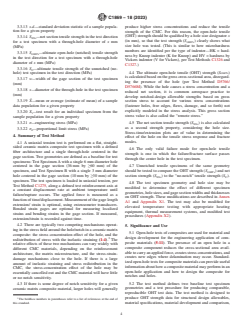
FIG. 3 Tensile Test Apparatus Schematic
7. Apparatus
7.1 The test apparatus (Fig. 3) shall be in accordance with
the following sections of Test Method C1275 and cited ASTM machine. The load train couplers, in conjunction with the type
of gripping device, play major roles in the alignment of the
mechanical testing references.
load train and thus reducing bending imposed in the specimen.
7.2 Testing Machine—The testing machine applies and mea-
Load train couplers are generally classified as fixed and
sures the force on the test specimen in a controlled manner. A
nonfixed. Load train couplers shall meet the requirements
testing machine commonly consists of a test frame, force
specified in 6.3 of Test Method C1275.
transducers, and the actuator/drive mechanism. The test ma-
7.2.3 Strain Measurement—Gage section strain is not a
chine and its components shall conform to the requirements of
required or typical measurement in the open-hole tensile test,
6.1 of Test Method C1275 and Practices E4.
because of the nonuniform strain in the region of the through-
7.2.1 Gripping Devices—Gripping devices are used to
hole. Optional strain measurement by extensometer, bonded
transmit the measured force to the test specimens and to keep
strain gages, and digital image correlation (DIC) are discussed
the specimen properly aligned in the load train. Face-gripping
in Appendix X3.
devices are commonly used for the flat, straight-sided test
specimens defined in this test method. Gripping devices are 7.3 Allowable Bending (Test Methods C1275 and D3039/
classed as those employing active or passive grip interfaces. D3039M and Practice E1012)—The recommended maximum
Gripping devices shall meet the requirements specified in 6.2 allowable percent bending for alignment specimens in the load
of Test Method C1275. train is five percent (5 %) at the onset of the cumulative
7.2.2 Load Train Couplers—Various types of load train fracture process (for example, matrix cracking stress).
couplers are used to attach the gripping devices to the testing However, it should be noted that unless each individual
C1869 − 18 (2023)
specimen is properly strain gaged and percent bending moni- be constructed to provide safe handling, control, and monitor-
tored until the onset of the cumulative fracture process, there ing of the test environment so that constant test environment
will be no record of percent bending at the onset of fracture for conditions and temperatures are maintained along the gage
each specimen. Therefore, the load train alignment should be section of the test specimen during the tensile test. The test
verified with an alignment specimen using the procedures chamber shall control the temperature to within 63 °C and the
detailed in 6.5 and Appendix X1 of Test Method C1275, 7.2.5 relative humidity at 65 % of the set humidity level, respec-
of Test Method D3039/D3039M, or Appendix X4 of this test tively. If the load train acts through bellows, fittings, or seals,
method such that percent bending with the alignment specimen verify that force losses or errors do not exceed 1 % of the
does not exceed five percent (5 %) at a mean strain equal to prospective failure forces.
either one-half the anticipated strain at the onset of the
7.8 Elevated Temperature Testing—This test method is used
cumulative fracture process (for example, matrix cracking
for ambient temperature testing. However, the test method may
stress), or a strain of 0.0005 (that is, 500 microstrain),
be used for elevated temperature (>300 °C) testing with the
whichever is greater. Note that percent bending in mounted test
addition/modification of the test apparatus, test specimens, test
specimens may be greater than 5 %, due to variations in the
procedures, and calculations as described in
Appendix X2 and
dimensions, flatness, and twist of individual test specimens. If
referenced in Test Method C1359.
test specimens are measured for percent bending, the recom-
8. Hazards
mended limit for percent bending in test specimens is <10 %
(Appendix X4).
8.1 During the conduct of this test method, the possibility of
flying fragments of broken test material is high. The brittle
7.4 Data Acquisition (6.6 of Test Method C1275)—At a
nature of advanced ceramics and the release of strain energy
minimum, an autographic record of applied force versus time
contribute to the potential release of uncontrolled fragments
shall be obtained. If strain is measured by extensometer or
upon fracture. Means for containment and retention of these
strain gage, strain data versus time shall also be recorded.
fragments for later fractographic reconstruction and analysis is
Either analog chart recorders or digital data acquisition systems
highly recommended. (Plastic shields can be used to encircle
may be used for this purpose, although a digital record is
the test fixture and specimen and to capture specimen frag-
recommended for ease of data analysis. A digital display or
ments.)
analog chart recorder/plotter should be used in conjunction
with the digital data acquisition system to provide an immedi-
8.2 Exposed fibers at the edges of CMC test specimens
ate record of the test as a supplement to the digital record.
present a hazard due to the sharpness and brittleness of the
Recording devices shall be accurate to within 60.1 % for the
ceramic fiber. All those required to handle these materials shall
entire testing system, including the readout unit as specified in
be well informed of such conditions and the proper handling
Practices E4 and shall have a minimum data acquisition rate of
techniques.
10 Hz and a minimum response of 50 Hz.
9. Test Specimens and Sampling
7.5 Dimension Measuring Devices (6.7 of Test Method
9.1 General—Two specific OHT test specimen geometries
C1275)—Micrometers, calipers, and other devices used for
are defined for general use within the CMC community. These
measuring linear dimensions shall be accurate and precise to at
two geometries determine the effect of two typical hole
least one-half the smallest unit to which the individual dimen-
diameters (6 mm and 3 mm) on the strength of a CMC
sion is required to be measured. For the purposes of this test
specimen. However, if testing objectives, material limitations,
method, cross-sectional dimensions w and h shall be measured
component size requirements, or test data comparability re-
to within 61 % or 60.02 mm, whichever is greater.
quire a different tensile specimen geometry, other tensile
Additionally, a micrometer, gage, or optical measurement
specimen geometries with modifications may be used for OHT
device capable of determining the hole diameter to within
testing. Annex A1 describes how different Test Method C1275
60.05 mm is required.
test specimen geometries may be modified for OHT testing for
7.6 Conditioning Chamber—If test materials and test speci-
different testing objectives.
mens are to be pre-test conditioned in a defined environment
9.2 Baseline Test Specimen Geometry—Two baseline test
(temperature, humidity, and atmosphere), a temperature/vapor/
specimen geometries are defined: Test Specimen A and Test
atmosphere-controlled conditioning chamber is required that
Specimen B. Both test specimens are flat, straight-sided test
shall be capable of maintaining the required temperature to
specimens with a through-hole in the center of the gage
within 63 °C [65 °F] and the required relative vapor level and
section. Nominal thickness shall be 3 mm, with a typical range
atmosphere to within 65 %. Chamber conditions shall be
of 2 mm to 10 mm, inclusive. Test Specimen A uses a 6 mm
monitored either on an automated continuous basis or on a
diameter through-hole in the center of a 36 mm wide gage
manual basis at regular intervals.
section. Test Specimen B uses a 3 mm diameter through-hole
7.7 Environmental Test Chamber—The test protocol may in the center of a 10 mm wide gage section. The two test
specify tensile testing in a controlled atmosphere (humidity, specimens are illustrated by the schematic in Fig. 4 and
inert, vacuum, or any other gaseous environment) or at described in Tables 1 and 2. The long axis of the test specimen
moderate test temperatures (<300 °C), or both. If testing is is oriented to the designated reinforcement axis (for example,
conducted in any environment other than ambient air and 0°, 90°, 645°). The grip sections of the test specimen are
temperature, an appropriate environmental test chamber shall clamped into the upper and lower grip devices.
C1869 − 18 (2023)
FIG. 4 Open-Hole Tensile Test Specimens A and B
9.2.1 A w/D ratio of 6 for Test Specimen A and a w/D ratio will affect the open-hole tensile strength. Any significant
of >3 for Test Specimen B are typically sufficient to minimize variation in the reinforcement architecture of the test material
stress-strain interactions between the center hole and the shall be clearly noted and described in the test report.
specimen edges. Test specimens with lower and higher w/D
9.2.6 Any variation in specimen hole diameter or position or
ratios can be tested to determine the interactions between the
gage section width or length, or combinations thereof, from
edge and hole stress-strain fields as a function of specimen
that specified for Test Specimens A and B, shall be clearly
width and hole diameter. (See Appendix X1.)
noted in the report.
9.2.2 The gage section shall be long enough to provide a
9.3 Specimen Fabrication and Marking—Test specimens
significant amount of material under stress and to produce a
shall be cut to align the long axis of the test specimen with the
uniform strain field in the specimen outside of the influence of
desired test reinforcement axis (for example, the 0°, 90°, or
the center hole. Typically, the gage section length (L ) is
gage
645° direction with reference to the principal structural axis).
greater than ten times the hole diameter (D)—([L / D] >
gage
9.3.1 Specimen Machining—Paragraph 8.2 of Test Method
10).
C1275 specifies four different ceramic composite machining
9.2.3 The specimen length shall be long enough to minimize
protocols: as-fabricated, application-matched machining, cus-
bending stresses caused by minor grip eccentricities. The grip
tomary practices, and standard procedures. Depending upon
sections shall be long enough for adequate grip surface that
the intended application of the tensile strength data, use one of
will prevent slippage in the grips or crushing in the grip
the defined Test Method C1275 machining procedures. The
sections. Typically, each grip length section is ~50 % of the
machining procedure must avoid notches, undercuts, rough or
gage length for a grip length of 30 mm and 15 mm for the two
uneven surfaces, edge damage, or delaminations and produce
test specimen geometries. Different ceramic composite mate-
machined surfaces that are flat and parallel within the specified
rials with different fiber architectures, porosities, and tensile
tolerances. Record and report the machining procedure in
and shear strengths may require longer gage, grip, and speci-
sufficient detail to allow replication. Regardless of the prepa-
men lengths to promote failure through the center hole and to
ration procedure used, sufficient details regarding the proce-
prevent invalid, out-of-gage failures.
dure must be reported to allow replication.
9.2.4 Reinforcement Architecture—The CMC test speci-
mens typically have multidirectional fiber orientations (fibers 9.3.2 The surface condition on the flat faces of the test
are oriented in a minimum of two directions producing a 2- or specimen can take two forms: an as-fabricated condition and
3-dimensional reinforcement structure) and a balanced, machined condition. For the as-fabricated condition, only the
symmetric, and laminated reinforcement architecture. length and the width are machined to the specified size for a
9.2.5 Test specimens with 1-D uniaxial reinforcement, 3-D regular machined edge. The two flat faces of the test specimen
woven or braided reinforcement, unbalanced, nonsymmetrical are not machined and may have surfaces with marked irregu-
architectures, or combinations thereof, may be tested with larities and variable surface finish. For the face-machined
appropriate consideration of how those different architectures condition, the faces of the test specimen are machined by a
C1869 − 18 (2023)
defined method to produce the desired surface finish. Toler- (delaminations, porosity concentrations, etc.) in the composite
ances on the thickness dimension apply only to machined test specimens. Describe the method and the observations/
surface faces. measurements/results of any nondestructive evaluations and
9.3.3 Hole Preparation—Special care shall be taken to include them in the final report.
ensure that creation of the specimen hole does not delaminate
9.8 If strain gages are used for strain measurement, position,
or otherwise damage the material surrounding the hole. Holes
align, and bond the selected strain gages to the test specimen(s)
should be drilled undersized and carefully reamed to final
prior to testing. Record and report the type, count,
dimensions. Record and report the specimen hole preparation
configuration, position, and bonding method of the strain
methods.
gages.
9.3.4 Hole walls may be backfilled, sealed, or coated to
9.9 Test Specimen Handling and Storage—Care shall be
match the specimen surface condition and permeability. Any
exercised in the handling, packaging, and storage of finished
post-machining hole treatments shall be noted in the report.
test specimens to avoid the introduction of surface flaws. In
9.3.5 Label/mark the individual test specimens so that they
addition, attention shall be given to pre-test storage of test
will be distinct from each other and traceable back to the
specimens in controlled environments or desiccators to avoid
starting material. The label/marking system shall have no effect
environmental (for example, humidity) degradation of test
or influence on the gage section, and the test procedure should
specimens prior to testing.
not affect the labels/marking.
9.10 Test Count and Sampling—A minimum of five (5) valid
9.4 Specimen Gripping and Use of End Tabs—In many
test specimens is required for the purpose of estimating a
tensile tests of unnotched fiber-reinforced composites, end tabs
mean/average with minimum precision. A greater number of
are used in the grip section of flat, straight-sided test specimens
valid test specimens may be necessary, if estimates regarding
to prevent invalid failure in the grip section. However, end tabs
the form of the strength distribution are required. The proce-
may not be needed in the OHT test, if the open center hole acts
dures outlined in Practice E122 may be used to estimate the
as a sufficient stress riser to force failure at the center hole. If
number of tests needed for determining a mean with a specified
OHT screening tests for a specific composite material and
precision. For Weibull statistical analysis, Practice C1239 shall
specimen geometry show invalid failure away from the center
be used to determine the number of tests required for Weibull
hole (at or close to the grip section), end tabs should be used to
strength distribution analysis. If material cost or test specimen
produce valid tests (fracture through the center hole). See 8.1.3
availability limits the number of possible tests, fewer tests can
of Test Method C1275 and 8.2.2.2 of Test Method D3039/
be conducted to determine an indication of material properties.
D3039M for guidance on the design, fabrication, attachment,
9.10.1 Test specimens shall be selected and prepared from
and use of polymer composite or metal end tabs for composite
representative ceramic composite samples that meet the stated
tensile testing. If used, prepare, attach, and bond the end tabs
testing objectives and requirements. Practice E105 and Guide
to the specimens per the test plan. This should be done before
E1402 provide guidance and direction on developing a sam-
testing, so that the bond adhesive has time to cure to full
pling plan. The method of sampling shall be reported.
strength.
9.11 Valid Test—A valid individual test is one which meets
9.5 Unnotched Test Specimens—For direct comparison
all the following requirements: all the testing requirements of
purposes, tensile tests may be done on unnotched (no-hole)
this test method are met; failure/rupture occurs at the test center
tensile test specimens of the same composite material
hole; and, if measured, the percent bending for a test specimen
(composition, reinforcement architecture, density, porosity,
is less than 10 % (see 7.3 and Appendix X4).
etc.) and equ
...