

ASTM C1674-23
(Test Method)Standard Test Method for Flexural Strength of Advanced Ceramics with Engineered Porosity (Honeycomb Cellular Channels) at Ambient Temperatures
General Information
- Abstract
SIGNIFICANCE AND USE
5.1 This test method is used to determine the mechanical properties in flexure of engineered ceramic components with multiple longitudinal hollow channels, commonly described as “honeycomb” channel architectures. The components generally have 30 % or more porosity and the cross-sectional dimensions of the honeycomb channels are on the order of 1 mm or greater.
5.2 The experimental data and calculated strength values from this test method are used for material and structural development, product characterization, design data, quality control, and engineering/production specifications.
Note 1: Flexure testing is the preferred method for determining the nominal “tensile fracture” strength of these components, as compared to a compression (crushing) test. A nominal tensile strength is required, because these materials commonly fail in tension under thermal gradient stresses. A true tensile test is difficult to perform on these honeycomb specimens because of gripping and alignment challenges.
5.3 The mechanical properties determined by this test method are both material and architecture dependent, because the mechanical response and strength of the porous test specimens are determined by a combination of inherent material properties and microstructure and the architecture of the channel porosity [porosity fraction/relative density, channel geometry (shape, dimensions, cell wall thickness, etc.), anisotropy and uniformity, etc.] in the specimen. Comparison of test data must consider both differences in material/composition properties as well as differences in channel porosity architecture between individual specimens and differences between and within specimen lots.
5.4 Test Method A is a user-defined specimen geometry with a choice of four-point or three-point flexure testing geometries. It is not possible to define a single fixed specimen geometry for flexure testing of honeycombs, because of the wide range of honeycomb architectures and cell sizes and consid...
SCOPE
1.1 This test method covers the determination of the flexural strength (modulus of rupture in bending) at ambient conditions of advanced ceramic structures with 2-dimensional honeycomb channel architectures.
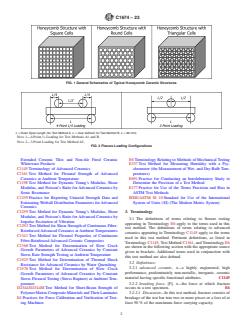
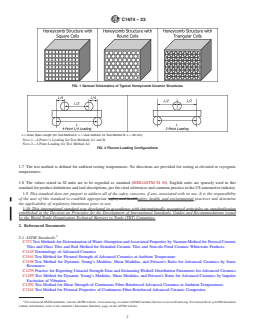
1.2 The test method is focused on engineered ceramic components with longitudinal hollow channels, commonly called “honeycomb” channels (see Fig. 1). The components generally have 30 % or more porosity and the cross-sectional dimensions of the honeycomb channels are on the order of 1 mm or greater. Ceramics with these honeycomb structures are used in a wide range of applications (catalytic conversion supports (1),2 high temperature filters (2, 3), combustion burner plates (4), energy absorption and damping (5), etc.). The honeycomb ceramics can be made in a range of ceramic compositions—alumina, cordierite, zirconia, spinel, mullite, silicon carbide, silicon nitride, graphite, and carbon. The components are produced in a variety of geometries (blocks, plates, cylinders, rods, rings).
FIG. 1 General Schematics of Typical Honeycomb Ceramic Structures
1.3 The test method describes two test specimen geometries for determining the flexural strength (modulus of rupture) for a porous honeycomb ceramic test specimen (see Fig. 2):
FIG. 2 Flexure Loading Configurations
L = Outer Span Length (for Test Method A, L = User defined; for Test Method B, L = 90 mm)
Note 1: 4-Point-1/4 Loading for Test Methods A1 and B.
Note 2: 3-Point Loading for Test Method A2.
1.3.1 Test Method A—A 4-point or 3-point bending test with user-defined specimen geometries, and
1.3.2 Test Method B—A 4-point-1/4 point bending test with a defined rectangular specimen geometry (13 mm × 25 mm × > 116 mm) and a 90 mm outer support span geometry suitable for cordierite and silicon carbide honeycombs with small cell sizes.
1.4 The test specimens are stressed to failure and the breaking force value, specimen and cell dimensions, and loa...
- Status
- Published
- Publication Date
- 31-May-2023
- Technical Committee
- C28 - Advanced Ceramics
- Drafting Committee
- C28.04 - Applications
Buy Documents
ASTM C1674-23 - Standard Test Method for Flexural Strength of Advanced Ceramics with Engineered Porosity (Honeycomb Cellular Channels) at Ambient Temperatures
REDLINE ASTM C1674-23 - Standard Test Method for Flexural Strength of Advanced Ceramics with Engineered Porosity (Honeycomb Cellular Channels) at Ambient Temperatures
Overview
ASTM C1674-23 is the international standard test method developed by ASTM International for determining the flexural strength of advanced ceramics with engineered porosity, specifically those with honeycomb cellular channels, at ambient temperatures. This standard applies to ceramic components featuring multiple longitudinal hollow channels, often referred to as honeycomb channel architectures, with 30% or more porosity and channel dimensions of approximately 1 mm or greater.
The standard helps laboratories, manufacturers, and product designers evaluate key mechanical properties in flexure (modulus of rupture in bending) of such engineered ceramics across various geometries and compositions. The data gathered through this method is vital for material and structural development, product characterization, design validation, and ongoing quality control.
Key Topics
- Honeycomb Ceramics Characterization: The method targets ceramics with engineered, controlled macroporosity (notably, “honeycomb” architectures). Applications demand understanding both material composition and channel architecture (shape, cell wall thickness, anisotropy, etc.) for accurate mechanical assessment.
- Test Methods:
- Test Method A: User-defined specimen geometry allowing flexibility for specimens with varying honeycomb architectures. Offers either four-point or three-point flexure testing configurations.
- Test Method B: Specifies a standardized rectangular specimen and a four-point-¼ point loading geometry, ideal for certain ceramics like cordierite and silicon carbide honeycombs with small cell sizes.
- Measurement Approaches: The procedure enables calculation of three types of flexural strength - nominal beam strength, wall fracture strength, and honeycomb structure strength - providing a comprehensive understanding based on specimen geometry, channel size, and porosity.
- Material and Architectural Dependence: The results account for the combined effects of intrinsic material properties and engineered pore geometry, making this standard particularly suitable for comparing different honeycomb ceramic materials and designs.
Applications
Advanced ceramics with engineered honeycomb porosity are essential in numerous industrial applications that demand a combination of lightweight structure, controlled permeability, and reliable strength. Typical uses include:
- Catalytic Converter Supports: Honeycomb ceramics act as substrates that maximize surface area while supporting catalysts in automotive and industrial emission control systems.
- High-Temperature Filters: Used in filtration systems for hot gases and particulates, these ceramics offer thermal stability and resistance to aggressive environments.
- Combustion Burner Plates: Their high thermal shock resistance and designed porosity suit combustion environments for energy generation and processing.
- Energy Absorption and Damping: Components engineered for controlled crash-energy management or vibration damping in automotive, aerospace, and industrial applications.
The flexural strength data referenced from ASTM C1674-23 supports product development, comparative material selection, and routine quality assurance, while also guiding design requirements for end users.
Related Standards
Several ASTM standards complement or are referenced in ASTM C1674-23 for comprehensive mechanical characterization of advanced ceramics:
- ASTM C1161: Standard Test Method for Flexural Strength of Advanced Ceramics at Ambient Temperature.
- ASTM C373: Methods for Determination of Water Absorption and Related Properties of Ceramic Tiles.
- ASTM C1198 / C1259: Test Methods for Dynamic Young's Modulus and Poisson’s Ratio (by sonic resonance and impulse excitation).
- ASTM C1239: Practice for Reporting Uniaxial Strength Data and Estimating Weibull Distribution Parameters for Advanced Ceramics.
- ASTM C1525: Test Method for Determination of Thermal Shock Resistance.
- ASTM D2344 / D2344M: Short-beam Strength of Polymer Matrix Composite Materials.
- ASTM E4, E6, E337, E691, E177: Various standards for mechanical test apparatus calibration, humidity measurements, and precision/bias reporting.
By adhering to ASTM C1674-23 and the associated guidance, organizations can efficiently test, compare, and verify the flexural performance of honeycomb-structured advanced ceramics for critical applications.
Keywords: ASTM C1674, flexural strength, honeycomb ceramics, advanced ceramics, engineered porosity, ceramic materials testing, product development, automotive ceramics, quality control, porous ceramics, channel architecture.
Relations
- Effective Date
- 01-Jan-2020
- Effective Date
- 01-Jul-2019
- Effective Date
- 01-Jul-2018
- Effective Date
- 01-Jul-2018
- Effective Date
- 01-Jan-2018
- Effective Date
- 01-Sep-2017
- Effective Date
- 01-Feb-2017
- Effective Date
- 01-Feb-2017
- Effective Date
- 01-Aug-2016
- Effective Date
- 01-Aug-2016
- Effective Date
- 01-Dec-2014
- Effective Date
- 01-Jun-2014
- Effective Date
- 01-May-2014
- Effective Date
- 01-Mar-2014
- Effective Date
- 01-Jan-2014
Buy Documents
ASTM C1674-23 - Standard Test Method for Flexural Strength of Advanced Ceramics with Engineered Porosity (Honeycomb Cellular Channels) at Ambient Temperatures
REDLINE ASTM C1674-23 - Standard Test Method for Flexural Strength of Advanced Ceramics with Engineered Porosity (Honeycomb Cellular Channels) at Ambient Temperatures
Frequently Asked Questions
ASTM C1674-23 is a standard published by ASTM International. Its full title is "Standard Test Method for Flexural Strength of Advanced Ceramics with Engineered Porosity (Honeycomb Cellular Channels) at Ambient Temperatures". This standard covers: SIGNIFICANCE AND USE 5.1 This test method is used to determine the mechanical properties in flexure of engineered ceramic components with multiple longitudinal hollow channels, commonly described as “honeycomb” channel architectures. The components generally have 30 % or more porosity and the cross-sectional dimensions of the honeycomb channels are on the order of 1 mm or greater. 5.2 The experimental data and calculated strength values from this test method are used for material and structural development, product characterization, design data, quality control, and engineering/production specifications. Note 1: Flexure testing is the preferred method for determining the nominal “tensile fracture” strength of these components, as compared to a compression (crushing) test. A nominal tensile strength is required, because these materials commonly fail in tension under thermal gradient stresses. A true tensile test is difficult to perform on these honeycomb specimens because of gripping and alignment challenges. 5.3 The mechanical properties determined by this test method are both material and architecture dependent, because the mechanical response and strength of the porous test specimens are determined by a combination of inherent material properties and microstructure and the architecture of the channel porosity [porosity fraction/relative density, channel geometry (shape, dimensions, cell wall thickness, etc.), anisotropy and uniformity, etc.] in the specimen. Comparison of test data must consider both differences in material/composition properties as well as differences in channel porosity architecture between individual specimens and differences between and within specimen lots. 5.4 Test Method A is a user-defined specimen geometry with a choice of four-point or three-point flexure testing geometries. It is not possible to define a single fixed specimen geometry for flexure testing of honeycombs, because of the wide range of honeycomb architectures and cell sizes and consid... SCOPE 1.1 This test method covers the determination of the flexural strength (modulus of rupture in bending) at ambient conditions of advanced ceramic structures with 2-dimensional honeycomb channel architectures. 1.2 The test method is focused on engineered ceramic components with longitudinal hollow channels, commonly called “honeycomb” channels (see Fig. 1). The components generally have 30 % or more porosity and the cross-sectional dimensions of the honeycomb channels are on the order of 1 mm or greater. Ceramics with these honeycomb structures are used in a wide range of applications (catalytic conversion supports (1),2 high temperature filters (2, 3), combustion burner plates (4), energy absorption and damping (5), etc.). The honeycomb ceramics can be made in a range of ceramic compositions—alumina, cordierite, zirconia, spinel, mullite, silicon carbide, silicon nitride, graphite, and carbon. The components are produced in a variety of geometries (blocks, plates, cylinders, rods, rings). FIG. 1 General Schematics of Typical Honeycomb Ceramic Structures 1.3 The test method describes two test specimen geometries for determining the flexural strength (modulus of rupture) for a porous honeycomb ceramic test specimen (see Fig. 2): FIG. 2 Flexure Loading Configurations L = Outer Span Length (for Test Method A, L = User defined; for Test Method B, L = 90 mm) Note 1: 4-Point-1/4 Loading for Test Methods A1 and B. Note 2: 3-Point Loading for Test Method A2. 1.3.1 Test Method A—A 4-point or 3-point bending test with user-defined specimen geometries, and 1.3.2 Test Method B—A 4-point-1/4 point bending test with a defined rectangular specimen geometry (13 mm × 25 mm × > 116 mm) and a 90 mm outer support span geometry suitable for cordierite and silicon carbide honeycombs with small cell sizes. 1.4 The test specimens are stressed to failure and the breaking force value, specimen and cell dimensions, and loa...
SIGNIFICANCE AND USE 5.1 This test method is used to determine the mechanical properties in flexure of engineered ceramic components with multiple longitudinal hollow channels, commonly described as “honeycomb” channel architectures. The components generally have 30 % or more porosity and the cross-sectional dimensions of the honeycomb channels are on the order of 1 mm or greater. 5.2 The experimental data and calculated strength values from this test method are used for material and structural development, product characterization, design data, quality control, and engineering/production specifications. Note 1: Flexure testing is the preferred method for determining the nominal “tensile fracture” strength of these components, as compared to a compression (crushing) test. A nominal tensile strength is required, because these materials commonly fail in tension under thermal gradient stresses. A true tensile test is difficult to perform on these honeycomb specimens because of gripping and alignment challenges. 5.3 The mechanical properties determined by this test method are both material and architecture dependent, because the mechanical response and strength of the porous test specimens are determined by a combination of inherent material properties and microstructure and the architecture of the channel porosity [porosity fraction/relative density, channel geometry (shape, dimensions, cell wall thickness, etc.), anisotropy and uniformity, etc.] in the specimen. Comparison of test data must consider both differences in material/composition properties as well as differences in channel porosity architecture between individual specimens and differences between and within specimen lots. 5.4 Test Method A is a user-defined specimen geometry with a choice of four-point or three-point flexure testing geometries. It is not possible to define a single fixed specimen geometry for flexure testing of honeycombs, because of the wide range of honeycomb architectures and cell sizes and consid... SCOPE 1.1 This test method covers the determination of the flexural strength (modulus of rupture in bending) at ambient conditions of advanced ceramic structures with 2-dimensional honeycomb channel architectures. 1.2 The test method is focused on engineered ceramic components with longitudinal hollow channels, commonly called “honeycomb” channels (see Fig. 1). The components generally have 30 % or more porosity and the cross-sectional dimensions of the honeycomb channels are on the order of 1 mm or greater. Ceramics with these honeycomb structures are used in a wide range of applications (catalytic conversion supports (1),2 high temperature filters (2, 3), combustion burner plates (4), energy absorption and damping (5), etc.). The honeycomb ceramics can be made in a range of ceramic compositions—alumina, cordierite, zirconia, spinel, mullite, silicon carbide, silicon nitride, graphite, and carbon. The components are produced in a variety of geometries (blocks, plates, cylinders, rods, rings). FIG. 1 General Schematics of Typical Honeycomb Ceramic Structures 1.3 The test method describes two test specimen geometries for determining the flexural strength (modulus of rupture) for a porous honeycomb ceramic test specimen (see Fig. 2): FIG. 2 Flexure Loading Configurations L = Outer Span Length (for Test Method A, L = User defined; for Test Method B, L = 90 mm) Note 1: 4-Point-1/4 Loading for Test Methods A1 and B. Note 2: 3-Point Loading for Test Method A2. 1.3.1 Test Method A—A 4-point or 3-point bending test with user-defined specimen geometries, and 1.3.2 Test Method B—A 4-point-1/4 point bending test with a defined rectangular specimen geometry (13 mm × 25 mm × > 116 mm) and a 90 mm outer support span geometry suitable for cordierite and silicon carbide honeycombs with small cell sizes. 1.4 The test specimens are stressed to failure and the breaking force value, specimen and cell dimensions, and loa...
ASTM C1674-23 is classified under the following ICS (International Classification for Standards) categories: 81.060.30 - Advanced ceramics. The ICS classification helps identify the subject area and facilitates finding related standards.
ASTM C1674-23 has the following relationships with other standards: It is inter standard links to ASTM C1198-20, ASTM C1145-19, ASTM C1525-18, ASTM C1239-13(2018), ASTM C1368-18, ASTM C373-17, ASTM C1576-05(2017), ASTM C1368-10(2017), ASTM C373-16, ASTM C373-16e1, ASTM C373-14a, ASTM E4-14, ASTM E177-14, ASTM C373-14, ASTM C1259-14. Understanding these relationships helps ensure you are using the most current and applicable version of the standard.
ASTM C1674-23 is available in PDF format for immediate download after purchase. The document can be added to your cart and obtained through the secure checkout process. Digital delivery ensures instant access to the complete standard document.
Standards Content (Sample)
This international standard was developed in accordance with internationally recognized principles on standardization established in the Decision on Principles for the
Development of International Standards, Guides and Recommendations issued by the World Trade Organization Technical Barriers to Trade (TBT) Committee.
Designation: C1674 − 23
Standard Test Method for
Flexural Strength of Advanced Ceramics with Engineered
Porosity (Honeycomb Cellular Channels) at Ambient
Temperatures
This standard is issued under the fixed designation C1674; the number immediately following the designation indicates the year of
original adoption or, in the case of revision, the year of last revision. A number in parentheses indicates the year of last reapproval. A
superscript epsilon (´) indicates an editorial change since the last revision or reapproval.
1. Scope loading geometry data are used to calculate a nominal beam
strength, a wall fracture strength, and a honeycomb structure
1.1 This test method covers the determination of the flexural
strength.
strength (modulus of rupture in bending) at ambient conditions
1.5 Test results are used for material and structural
of advanced ceramic structures with 2-dimensional honeycomb
channel architectures. development, product characterization, design data, quality
control, and engineering/production specifications.
1.2 The test method is focused on engineered ceramic
1.6 The test method is meant for ceramic materials that are
components with longitudinal hollow channels, commonly
linear-elastic to failure in tension. The test method is not
called “honeycomb” channels (see Fig. 1). The components
applicable to polymer or metallic porous structures that fail in
generally have 30 % or more porosity and the cross-sectional
an elastomeric or an elastic-ductile manner.
dimensions of the honeycomb channels are on the order of
1 mm or greater. Ceramics with these honeycomb structures
1.7 The test method is defined for ambient testing tempera-
are used in a wide range of applications (catalytic conversion
tures. No directions are provided for testing at elevated or
supports (1), high temperature filters (2, 3), combustion
cryogenic temperatures.
burner plates (4), energy absorption and damping (5), etc.). The
1.8 The values stated in SI units are to be regarded as
honeycomb ceramics can be made in a range of ceramic
standard (IEEE/ASTM SI 10). English units are sparsely used
compositions—alumina, cordierite, zirconia, spinel, mullite,
in this standard for product definitions and tool descriptions,
silicon carbide, silicon nitride, graphite, and carbon. The
per the cited references and common practice in the US
components are produced in a variety of geometries (blocks,
automotive industry.
plates, cylinders, rods, rings).
1.9 This standard does not purport to address all of the
1.3 The test method describes two test specimen geometries
safety concerns, if any, associated with its use. It is the
for determining the flexural strength (modulus of rupture) for a
responsibility of the user of this standard to establish appro-
porous honeycomb ceramic test specimen (see Fig. 2):
priate safety, health, and environmental practices and deter-
1.3.1 Test Method A—A 4-point or 3-point bending test with
mine the applicability of regulatory limitations prior to use.
user-defined specimen geometries, and
1.10 This international standard was developed in accor-
1.3.2 Test Method B—A 4-point- ⁄4 point bending test with a
dance with internationally recognized principles on standard-
defined rectangular specimen geometry (13 mm × 25 mm × >
ization established in the Decision on Principles for the
116 mm) and a 90 mm outer support span geometry suitable for
Development of International Standards, Guides and Recom-
cordierite and silicon carbide honeycombs with small cell
mendations issued by the World Trade Organization Technical
sizes.
Barriers to Trade (TBT) Committee.
1.4 The test specimens are stressed to failure and the
2. Referenced Documents
breaking force value, specimen and cell dimensions, and
2.1 ASTM Standards:
C373 Test Methods for Determination of Water Absorption
and Associated Properties by Vacuum Method for Pressed
This test method is under the jurisdiction of ASTM Committee C28 on
Ceramic Tiles and Glass Tiles and Boil Method for
Advanced Ceramics and is the direct responsibility of Subcommittee C28.04 on
Applications.
Current edition approved June 1, 2023. Published July 2023. Originally approved
in 2008. Last previous edition approved in 2016 as C1674 – 16. DOI: 10.1520/ For referenced ASTM standards, visit the ASTM website, www.astm.org, or
C1674-23. contact ASTM Customer Service at service@astm.org. For Annual Book of ASTM
The boldface numbers in parentheses refer to the list of references at the end of Standards volume information, refer to the standard’s Document Summary page on
this standard. the ASTM website.
Copyright © ASTM International, 100 Barr Harbor Drive, PO Box C700, West Conshohocken, PA 19428-2959. United States
C1674 − 23
FIG. 1 General Schematics of Typical Honeycomb Ceramic Structures
L = Outer Span Length (for Test Method A, L = User defined; for Test Method B, L = 90 mm)
NOTE 1—4-Point- ⁄4 Loading for Test Methods A1 and B.
NOTE 2—3-Point Loading for Test Method A2.
FIG. 2 Flexure Loading Configurations
Extruded Ceramic Tiles and Non-tile Fired Ceramic E6 Terminology Relating to Methods of Mechanical Testing
Whiteware Products E337 Test Method for Measuring Humidity with a Psy-
C1145 Terminology of Advanced Ceramics chrometer (the Measurement of Wet- and Dry-Bulb Tem-
C1161 Test Method for Flexural Strength of Advanced peratures)
Ceramics at Ambient Temperature E691 Practice for Conducting an Interlaboratory Study to
C1198 Test Method for Dynamic Young’s Modulus, Shear Determine the Precision of a Test Method
Modulus, and Poisson’s Ratio for Advanced Ceramics by E177 Practice for Use of the Terms Precision and Bias in
Sonic Resonance ASTM Test Methods
C1239 Practice for Reporting Uniaxial Strength Data and IEEE/ASTM SI 10 Standard for Use of the International
Estimating Weibull Distribution Parameters for Advanced System of Units (SI) (The Modern Metric System)
Ceramics
C1259 Test Method for Dynamic Young’s Modulus, Shear
3. Terminology
Modulus, and Poisson’s Ratio for Advanced Ceramics by
3.1 The definitions of terms relating to flexure testing
Impulse Excitation of Vibration
appearing in Terminology E6 apply to the terms used in this
C1292 Test Method for Shear Strength of Continuous Fiber-
test method. The definitions of terms relating to advanced
Reinforced Advanced Ceramics at Ambient Temperatures
ceramics appearing in Terminology C1145 apply to the terms
C1341 Test Method for Flexural Properties of Continuous
used in this test method. Pertinent definitions, as listed in
Fiber-Reinforced Advanced Ceramic Composites
Terminology C1145, Test Method C1161, and Terminology E6
C1368 Test Method for Determination of Slow Crack
are shown in the following section with the appropriate source
Growth Parameters of Advanced Ceramics by Constant
given in brackets. Additional terms used in conjunction with
Stress Rate Strength Testing at Ambient Temperature
this test method are also defined.
C1525 Test Method for Determination of Thermal Shock
3.2 Definitions:
Resistance for Advanced Ceramics by Water Quenching
3.2.1 advanced ceramic, n—a highly engineered, high
C1576 Test Method for Determination of Slow Crack
performance, predominately non-metallic, inorganic, ceramic
Growth Parameters of Advanced Ceramics by Constant
material having specific functional attributes. C1145
Stress Flexural Testing (Stress Rupture) at Ambient Tem-
perature 3.2.2 breaking force, [F], n—the force at which fracture
D2344/D2344M Test Method for Short-Beam Strength of occurs in a test specimen. E6
Polymer Matrix Composite Materials and Their Laminates 3.2.2.1 Discussion—In this test method, fracture consists of
E4 Practices for Force Calibration and Verification of Test- breakage of the test bar into two or more pieces or a loss of at
ing Machines least 50 % of the maximum force carrying capacity.
C1674 − 23
3.2.3 cell pitch, (p), [L], n—the unit dimension/s for the 3.2.8 four-point- ⁄4 point flexure, n—a configuration of flex-
cross-section of a cell in the honeycomb component. The cell ural strength testing where a specimen is symmetrically loaded
pitch p is calculated by measuring the specimen dimension of at two locations that are situated one quarter of the overall span
interest, the cell count in that dimension, and a cell wall inside the span of the outer two support bearings. (See Fig. 2.)
thickness, where p = (d – t)/n. (See Fig. 3.) C1161
3.2.3.1 Discussion—The cell pitch can be measured for both
3.2.9 fractional open frontal area, (OFA), [ND], n—a frac-
the height and width of the cell; those two measurements will
tional ratio of the open frontal area of the honeycomb
be equal for a square cell geometry and uniform cell wall
architecture, calculated by dividing the total frontal area of the
thickness and will be unequal for a rectangular cell geometry.
open channels by the full frontal area of the full size specimen,
3.2.4 cell wall thickness, (t), [L], n—the nominal thickness as a whole.
of the walls that form the cell channels of the honeycomb
3.2.9.1 Discussion—The fractional open frontal area of the
structure. (See Fig. 3.)
full size specimen can be calculated from the shape and
dimensions of the cells and the wall thickness between cells.
3.2.5 channel porosity, n—porosity in the porous ceramic
(See 11.4 on calculations.)
component that is defined by the large, open longitudinal
honeycomb channels. Channel porosity generally has cross-
3.2.10 fully-articulating fixture, n—a flexure fixture de-
sectional dimensions on the order of 1 mm or greater.
signed to be used both with flat and parallel specimens and
with uneven or nonparallel specimens. The fixture allows full
3.2.6 complete gage section, n—the portion of the specimen
independent articulation, or pivoting, of all load and support
between the two outer bearings in four-point flexure and
rollers about the specimen long axis to match the specimen
three-point flexure fixtures.
surface. In addition, the upper or lower roller pairs are free to
3.2.6.1 Discussion—In this standard, the complete 4-point
pivot to distribute force evenly to the bearing cylinders on
flexure gage section is twice the size of the inner gage section.
either side. (See Annex A1 for schematics and discussion.)
Weibull statistical analysis only includes portions of the
C1161
specimen volume or surface which experience tensile stresses.
3.2.11 honeycomb cell density, n—a characterization of the
3.2.7 engineered porosity, n—porosity in a component that
honeycomb cell structure that lists the number of cells per unit
is deliberately produced and controlled for a specific function
area and the nominal cell wall thickness (Terminology C1145).
and engineered performance. The porosity can be microporous
It is common practice in the automotive catalyst industry to use
(micron and submicron pores in the body of the ceramic) or
English units for this term, for example:
macroporous (millimeter and larger) cells and channels in the
ceramic. The porosity commonly has physical properties (vol-
100/17 density = 100 cells/in. with a cell wall thickness of 0.017 in.
200/12 density = 200 cells/in. with a cell wall thickness of 0.012 in.
ume fraction, size, shape, structure, architecture, dimensions,
etc.) that are produced by a controlled manufacturing process. 3.2.12 honeycomb cellular architecture, n—an engineered
The porosity in the component has a direct effect on the component architecture in which long cylindrical cells of
engineering properties and performance and often has to be defined geometric cross-section form a porous structure with
measured for quality control and performance verification. open channels in one dimension and a nominal closed-cell
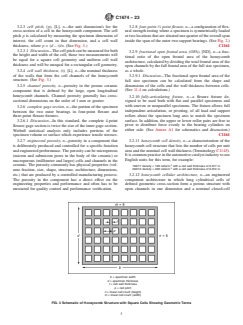
b = specimen width
d = specimen thickness
t = cell wall thickness
p = cell pitch
n = linear cell count (height)
m = linear cell count (width)
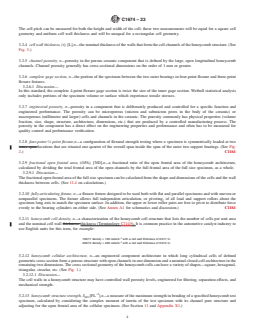
FIG. 3 Schematic of Honeycomb Structure with Square Cells Showing Geometric Terms
C1674 − 23
architecture in the remaining two dimensions. The cross the true/theoretical density of the material composition. The
sectional geometry of the honeycomb cells can have a variety relative density of the specimen is equal to 1 minus the
of shapes—square, hexagonal, triangular, circular, etc. (See fractional porosity, expressed as a percent. The relative density
Fig. 1.) accounts for both channel porosity and wall porosity.
3.2.12.1 Discussion—The cell walls in a honeycomb struc-
3.2.18 semi-articulating fixture, n—a flexure fixture de-
ture may have controlled wall porosity levels, engineered for
signed to be used with flat and parallel specimens. The fixture
filtering, separation effects, and mechanical strength.
allows some articulation, or pivoting, to ensure the top pair (or
–2
3.2.13 honeycomb structure strength, S , [FL ], n—a bottom pair) of bearing cylinders pivot together about an axis
HS
measure of the maximum strength in bending of a specified parallel to the specimen long axis, in order to match the
honeycomb test specimen, calculated by considering the com- specimen surfaces. In addition, the upper or lower pairs are free
plex moment of inertia of the test specimen with its channel to pivot to distribute force evenly to the bearing cylinders on
pore structure and adjusting for the open frontal area of the either side. (See Annex A1 for schematics.) C1161
cellular specimen. (See Section 11 and Appendix X1.)
3.2.19 three-point flexure, n—configuration of flexural
3.2.13.1 Discussion—The honeycomb structure strength
strength testing where a specimen is loaded at a location
gives a continuum strength that is more representative of the
midway between the two outer support bearings. (See Fig. 2.)
true continuum strength as compared to the nominal beam
C1161
strength S , particularly for specimens where the linear cell
NB
–2
3.2.20 wall fracture strength, S , [FL ], n—In honey-
WF
count in the smallest cross sectional dimension is less than 15.
comb test specimens, the calculated failure stress in the outer
3.2.13.2 Discussion—The honeycomb structure strength
fiber surface of the specimen, based on the true moment of
may be used to compare tests for specimens of different cell
inertia of the test specimen, accounting for cell geometry, cell
architectures and sizes and specimen dimensions. However, the
wall thickness, cell architecture, and linear cell count effects in
calculated honeycomb structure strength is not representative
the test specimen. (See Section 11 and Appendix X1.)
of the failure stress in the outer fiber surface (the wall fracture
strength) of the test specimen. 3.2.21 wall porosity, n—porosity found in the cell walls of
the ceramic component, distinct from the open channel poros-
3.2.14 linear cell count, [ND], n—the integer number of
ity. Wall porosity can exist in the ceramic walls in the form of
cells along a given cross-sectional dimension of a test speci-
closed and open pores, cracks, and interconnected
men. For the specimen width, the linear cell count is defined as
microchannels, and it can have a wide range of dimensions
m. For the specimen thickness dimension, the linear cell count
(from 10 nanometers to 100 micrometers), depending on the
is defined as n. (See Fig. 3.)
ceramic microstructure and fabrication method.
–2
3.2.15 modulus of elasticity, [FL ], n—the ratio of stress to
corresponding strain below the proportional limit. E6
4. Summary of Test Method
–2
3.2.16 nominal beam strength, S , [FL ], n—In honey-
NB
4.1 A test specimen with a honeycomb cellular structure and
comb test specimens, a measure of the maximum strength in
a rectangular cross section is tested as a beam in flexure at
bending, calculated with the simple elastic beam equations
ambient temperature in one of the following geometries:
using the overall specimen dimensions, disregarding the
4.1.1 Test Method A1 (4-Point Loading)—The test specimen
cellular/channel architecture, and making the simplifying as-
with a user-defined (see 9.2) rectangular geometry rests on two
sumption of a solid continuum in the bar. The nominal beam
supports and is loaded at two points (by means of two loading
strength is not necessarily representative of the true failure
rollers), each an equal distance from the adjacent support point.
stress in the outer fiber face, because it does not take the effect
The inner loading points are positioned one quarter of the
of channel porosity on the moment of inertia into account. (See
overall span away from the outer two support bearings. The
Section 11 and Appendix X1.)
distance between the loading rollers (the inner gage span) is
3.2.16.1 Discussion—The nominal beam strength is calcu-
one half of the complete gage (outer support) span. (See 5.4
lated without consideration of the dimensions, geometry/shape,
and Fig. 2.)
cell wall thickness, or linear cell count of the cellular channel
4.1.2 Test Method A2 (3-Point Loading)—The test specimen
architecture in the test specimen. The nominal beam strength
with a user-defined (see 9.2) rectangular geometry rests on two
can be used for material comparison and quality control for
supports and is loaded by means of a loading roller midway
flexure test specimens of equal size, comparable cell geometry,
between the two outer supports. (See 5.4 and Fig. 2.)
and equivalent loading configuration.
4.1.3 Test Method B (4-Point- ⁄4 Point Loading)—The test
3.2.16.2 Discussion—For specimens where the minimum
specimen with a defined rectangular geometry (13 mm ×
linear cell count is less than 15, the nominal beam strength
25 mm × >116 mm) rests on two supports (90 mm apart) and
should not be used for design purposes or material property
is loaded at two points (by means of two rollers), each an equal
characterization, because it is not necessarily an accurate
distance (22.5 mm) from the adjacent outer support point. (See
approximation of the true failure stress (material strength) in
5.5 and Fig. 2.)
the outer fiber face of the specimen.
3.2.17 relative density (percent), n—a relative measurement 4.2 Force is applied to the inner loading point/s and the
of the density of a porous material, defined as the ratio specimen is deflected until rupture occurs on the outer surface
(expressed as a percent) of the bulk density of the specimen to and the specimen fractures and fails.
C1674 − 23
4.3 Three different types of flexural strength (nominal beam uses simpler test fixtures, it is easier to adapt to high tempera-
strength, wall fracture strength, and honeycomb structure ture and fracture toughness testing, and it is sometimes helpful
strength) of the specimen are calculated from the breaking in Weibull statistical studies. However, four-point flexure is
force, the specimen dimensions, and the loading geometry, preferred and recommended for most characterization pur-
using the elastic beam equations. (See 5.7, Section 11, and poses.”)
Appendix X1 for a detailed description and discussion of the 5.4.2 The three-point flexure test configuration (Test
basis, use, and limitations of these three strength calculation
Method A2) may be used for specimens which are not suitable
formulas.) for 4-point testing, with the clear understanding that 3-point
loading exposes only a very small portion of the specimen to
5. Significance and Use the maximum stress, as compared to the much larger maximum
stress volume in a 4-point loading configuration. Therefore,
5.1 This test method is used to determine the mechanical
3-point flexural strengths are likely to be greater than 4-point
properties in flexure of engineered ceramic components with
flexural strengths, based on statistical flaw distribution factors.
multiple longitudinal hollow channels, commonly described as
“honeycomb” channel architectures. The components gener- 5.5 Test Method B (with a specified specimen size and a
ally have 30 % or more porosity and the cross-sectional 4-point- ⁄4 point flexure loading geometry) is widely used in
dimensions of the honeycomb channels are on the order of industry for cordierite and silicon carbide honeycomb struc-
1 mm or greater. tures with small cell size (cell pitch ~2 mm). Test Method B is
provided as a standard test geometry that provides a baseline
5.2 The experimental data and calculated strength values
specimen size for honeycomb structures with appropriate
from this test method are used for material and structural
properties and cell size with the benefit of experimental
development, product characterization, design data, quality
repeatability, reproducibility and comparability. (See 9.3 for
control, and engineering/production specifications.
details on Test Method B.)
NOTE 1—Flexure testing is the preferred method for determining the
nominal “tensile fracture” strength of these components, as compared to a
NOTE 2—Specific fixture and specimen configurations were chosen for
compression (crushing) test. A nominal tensile strength is required,
Test Method B to provide a balance between practical configurations and
because these materials commonly fail in tension under thermal gradient
linear cell count effect limits and to permit ready comparison of data
stresses. A true tensile test is difficult to perform on these honeycomb
without the need for Weibull-size scaling.
specimens because of gripping and alignment challenges.
5.6 The calculation of the flexure stress in these porous
5.3 The mechanical properties determined by this test
specimens is based on small deflection elastic beam theory
method are both material and architecture dependent, because
with assumptions that (1) the material properties are isotropic
the mechanical response and strength of the porous test
and homogeneous, (2) the moduli of elasticity in tension and
specimens are determined by a combination of inherent mate-
compression are identical, and (3) the material is linearly
rial properties and microstructure and the architecture of the
elastic. If the porous material in the walls of the honeycomb is
channel porosity [porosity fraction/relative density, channel
not specifically anisotropic in microstructure, it is also assumed
geometry (shape, dimensions, cell wall thickness, etc.), anisot-
that the microstructure of the wall material is uniform and
ropy and uniformity, etc.] in the specimen. Comparison of test
isotropic. To understand the effects of some of these
data must consider both differences in material/composition
assumptions, see Baratta et al. (6).
properties as well as differences in channel porosity architec-
NOTE 3—These assumptions may limit the application of the test to
ture between individual specimens and differences between
comparative type testing such as used for material development, quality
and within specimen lots.
control, and flexure specifications. Such comparative testing requires
consistent and standardized test conditions both for specimen geometry
5.4 Test Method A is a user-defined specimen geometry with
and porosity architecture, as well as experimental conditions—loading
a choice of four-point or three-point flexure testing geometries.
geometries, strain rates, and atmospheric/test conditions.
It is not possible to define a single fixed specimen geometry for
5.7 Three flexure strength values (defined in Section 3 and
flexure testing of honeycombs, because of the wide range of
calculated in Section 11) may be calculated in this test method.
honeycomb architectures and cell sizes and considerations of
They are the nominal beam strength, the wall fracture strength,
specimen size, cell shapes, pitch, porosity size, crush strength,
and the honeycomb structure strength.
and shear strength. As a general rule, the experimenter will
have to define a suitable test specimen geometry for the 5.7.1 Nominal Beam Strength—The first approach to calcu-
particular honeycomb structure of interest, considering lating a flexure strength is to make the simplifying assumption
composition, architecture, cell size, mechanical properties, and that the specimen acts as a uniform homogeneous material that
specimen limitations and using the following guidelines. De- reacts as a continuum. Based on these assumptions, a nominal
tails on specimen geometry definition are given in 9.2. beam strength S can be calculated using the standard flexure
NB
strength equations with the specimen dimensions and the
5.4.1 Four-point flexure (Test Method A1) is strongly pre-
breaking force. (See Section 11.)
ferred and recommended for testing and characterization pur-
poses. (From Test Method C1161 section 4.5: “The three-point 5.7.1.1 A linear cell count effect (specimen size-cell count
test configuration exposes only a very small portion of the effect) has been noted in research on the flexure strength of
specimen to the maximum stress. Therefore, three-point flex- ceramic honeycomb test specimens (7, 8). If the cell size is too
ural strengths are likely to be much greater than four-point large with respect to the specimen dimensions and if the linear
flexural strengths. Three-point flexure has some advantages. It cell count (the integer number of cells along the shortest
C1674 − 23
cross-sectional dimension) is too low (<15), channel porosity 5.7.4.2 For flexure test specimens where the linear cell
has a geometric effect on the moment of inertia that produces count is between 5 and 15, the nominal beam strength S
NB
an artificially high value for the nominal beam strength. (See calculation may produce a 10 % to 20 % overvalue. The S
NB
Appendix X1.) With the standard elastic beam equations the value should be used with caution.
strength value is overestimated, because the true moment of 5.7.4.3 For flexure test specimens where the linear cell
inertia of the open cell structure is not accounted for in the count is less than 5, the nominal beam strength S calculation
NB
calculation. may produce a 20 % to 100 % overvalue. It is recommended
that the honeycomb structure strength S be calculated and
5.7.1.2 This overestimate becomes increasingly larger for
HS
used as a more accurate flexure strength number.
specimens with lower linear cell counts. The linear cell count
5.7.4.4 If specimen availability and test configuration
has to be 15 or greater for the calculated nominal beam
permit, test specimens with a linear cell count of 15 or greater
strength, S , to be within a 10 % overestimate of the wall
NB
are preferred to reduce the specimen linear cell count effect on
fracture strength S .
WF
nominal beam strength S to less than 10 %.
NB
NOTE 4—The study by Webb, Widjaja, and Helfinstine (7) showed that
for cells with a square cross section a minimum linear cell count of 15 5.8 Flexure test data for porous ceramics will have a
should be maintained to minimize linear cell count effects on the
statistical distribution, which may be analyzed and described
calculated nominal beam strength. (This study is summarized in Appendix
by Weibull statistics, per Practice C1239.
X1.)
5.9 This flexure test can be used as a characterization tool to
5.7.1.3 For those smaller test specimens (where the linear
assess the effects of fabrication variables, geometry and mi-
cell count is between 2 and 15), equations for wall fracture
crostructure variations, and environmental exposure on the
strength and honeycomb structure strength are given in Section
mechanical properties of the honeycombs. The effect of these
11. These equations are used to calculate a more accurate value
variables is assessed by flexure testing a specimen set in a
for the flexure strength of the honeycomb, as compared to the
baseline condition and then testing a second set of specimens
calculated nominal beam strength.
with defined changes in geometry or fabrication methods or
5.7.2 Wall Fracture Strength, S , is calculated using the
WF
after controlled environmental exposure.
true moment of inertia of the honeycomb architecture, based on
5.9.1 Geometry and microstructure variations would in-
the geometry, dimensions, cell wall thickness, and linear count
clude variations in cell geometry (shape dimensions, cell wall
of the channels in the honeycomb structure. The wall fracture
thickness, and count) and wall porosity (percent, size, shape,
strength is a calculation of the true failure stress in the outer
morphology, etc.).
fiber surface of the specimen. (Appendix X1 describes the
5.9.2 Fabrication process variations would include forming
calculation as cited in the Webb, Widjaja, and Helfinstine (7)
parameters, drying and binder burn-out conditions, sintering
report). Section 11 on calculations gives the formula for
conditions, heat treatments, variations in coatings, etc.
calculating the moment of inertia for test specimens with
5.9.3 Environmental conditioning would include extended
square honeycomb channels and uniform cell wall thickness.
exposure at different temperatures and different corrosive
atmospheres (including steam).
NOTE 5—The moment of inertia formula given in Section 11 and
Appendix X1 is only applicable to square cell geometries. It is not suitable
5.10 This flexure test may be used to assess the thermal
for rectangular, circular, hexagonal, or triangular geometries. Formulas for
shock resistance of the honeycomb ceramics, as described in
those geometries have to be developed from geometric analysis and first
Test Method C1525.
principles.
5.11 The flexure test is not the preferred method for
5.7.3 Honeycomb Structure Strength, S , is calculated from
HS
determining the Young’s modulus of these porous structures.
the wall fracture strength S . This calculation gives a flexure
WF
(For this reason, the deflection of the flexure test bar is not
strength value which is independent of specimen-cell size
commonly measured in this test.) Young’s modulus measure-
geometry effects. The honeycomb structure strength value can
ments by sonic resonance (Test Method C1198) or by impulse
be used for comparison of different specimen geometries with
excitation (Test Method C1259) give more reliable and repeat-
different channel sizes. It also gives a flexure strength value
able data.
that can be used for stress models that assume continuum
strength. (See Appendix X1.) Section 11 on calculations gives
5.12 It is beyond the scope of this standard to require
the formula for calculating the honeycomb structure strength
fractographic analysis at the present time. Fractographic analy-
for test specimens with square honeycomb channels and
sis for critical flaws in porous honeycomb ceramics is ex-
uniform cell wall thickness.
tremely difficult and of very uncertain value.
5.7.4 The following recommendations are made for calcu-
6. Interferences and Critical Factors
lating a flexure strength for the ceramic honeycomb test
specimens.
6.1 Interferences and Critical Factors—The critical experi-
5.7.4.1 For flexure test specimens where the linear cell mental factors that need to be understood and controlled in this
count is 15 or greater, the nominal beam strength S flexure test can be grouped into three categories—material
NB
calculation and the honeycomb structure strength S are factors, specimen factors, and experimental test factors. The
HS
roughly equivalent in value (within 10 %). The nominal beam major factors that need to be understood and controlled are:
strength S calculation can be used considering this variabil- 6.1.1 Microstructure and critical flaw population which
NB
ity. affect the material strength,
C1674 − 23
6.1.2 Specimen size, cell geometry, and cell size 8.2.1 Test Method A1: 4-Point- ⁄4 Point Loading—The
considerations, specimen rests on two supports and is loaded at two points (by
6.1.3 Machining and surface preparation effects on the flaw means of two loading bearings), each an equal distance (one
population, quarter of the overall span) from the adjacent outer support
6.1.4 Crushing failure under the load points and shear point. The distance between the loading bearings (the inner
failure in the body of the specimen, and gage span) is one half of the complete gage (outer support)
6.1.5 Environmental effects on the flaw population (slow span (see Fig. 2). The Method B specimen thickness (d)
crack growth and stress corrosion). determines the outer span dimension (L) of the test fixture (see
9.2). Test fixtures shall be wide enough to support the entire
6.2 These factors are described in detail in Annex A2,
width of the selected specimen geometry.
covering the technical background and how the factors have to
8.2.2 Test Method A2: 3-Point Loading—The specimen
be controlled and managed.
rests on two supports and is loaded at one point (by means of
6.3 One aspect of ceramic failure-flaw dependence that is
one loading bearing), midway between the two outer support
commonly observed in tests of monolithic ceramics is a test
points (see Fig. 2). The Method B specimen thickness (d)
specimen size effect, where larger ceramic specimens have
determines the outer span dimension (L) of the test fixture (see
statistically lower strengths than smaller specimens. This is
9.2). Test fixtures shall be wide enough to support the entire
because the probability of finding a larger critical flaw (with a
width of the selected specimen geometry. (Under some cases,
lower fracture strength) increases in specimens with larger
for example, very short specimens, three point loading may be
stressed volumes, as compared to small test specimens. This
easier to do than the four point loading.)
size dependence can be analyzed and modeled using Weibull
8.2.3 Test Method B: 4-Point- ⁄4 Point Loading—The outer
statistical analysis (Practice C1239). The Weibull specimen
support span is 90 mm; the inner span is 45 mm. Each inner
size effect may occur in ceramic honeycomb specimens and
span point is an equal distance (22.5 mm) from the adjacent
should be considered as a possible experimental variable. The
outer support point. Test fixtures shall be wide enough to
Weibull specimen size effect is separate and distinct from the
support the entire width of the selected specimen geometry (see
linear cell count effect (see 5.5 – 5.10, and Appendix X1)
9.3 and Fig. 2).
where channel porosity has a major effect on the section
8.2.4 The test fixture shall be made of a material that is
modulus of specimens with low linear cell counts.
suitably rigid and resistant to permanent deformation at the
applied forces and that will give a low system compliance so
7. Safety
that most of the crosshead travel is imposed onto the test
7.1 During specimen cutting, grinding, and preparation,
specimen.
there may be a hazard of dust exposure and inhalation with
8.2.5 Test fixtures with an articulating geometry shall be
resulting skin irritation or respiratory distress, or both. Appro-
used to ensure that the fixtures produce even and uniform loads
priate dust elimination, reduction, and protection procedures
along the bearing-to-specimen surfaces. An articulated (full or
and equipment should be determined and used.
semi) test fixture reduces or eliminates uneven loading caused
7.2 During the conduct of this test method, the possibility of by geometric variations of the specimen or misalignment of the
flying fragments of broken test specimens may be high. The
test fixtures. A rigid test fixture is not permitted, because it
brittle nature of advanced ceramics and the release of strain cannot accommodate non-uniformity and variations in speci-
energy contribute to the potential release of uncontrolled
men dimensions. (See Annex A1 for a full description of
fragments upon fracture. The containment of these fragments
semi-articulating and articulating fixtures.)
with a suitable safety shield is highly recommended.
8.2.6 For articulating fixtures, the bearing cylinders shall be
free to rotate or rock in order to relieve frictional constraints
7.3 Waste Disposal—Hazardous material must be disposed
(with the exception of the center bearing cylinder in three-point
of in accordance with the applicable material safety data sheet
flexure, which need not rotate).
and local laws and regulations.
8.3 Support/Load Bearings—In both the three-point and
8. Apparatus
four-point flexure test fixtures, use contact bearings with
8.1 Testing Machine—The flexure specimens shall be tested
rounded edges for support of the test specimen and for force
in a properly calibrated mechanical testing machine that can be
application. The length of the contact bearings shall be at least
operated at constant rates of cross-head motion over the range
10 % greater than the specimen width. The bearing material
required with a suitable force sensor.
should be hard enough to minimize abrasion of the bearing
8.1.1 The error in the force measuring system shall not
surfaces.
exceed 61 % of the maximum force being measured. Verify
NOTE 6—It is recommended that the cylinders be made of a tool steel
the accuracy of the testing machine in accordance with Practice
(case hardened to about HRC 60) or a ceramic with an elastic modulus
E4. The force-indicating mechanism shall be essentially free
between 200 GPa and 400 GPa and a flexural strength no less than 275
from inertial lag at the cross-head rate used. Equip the system
MPa (40 ksi).
with a means for retaining the readout of the maximum force
8.3.1 The bearing fixture design shall provide for precise
as well as a record of force versus time.
and positive positioning of the bearings with no “slack” or
8.2 Test fixtures are defined for Test Methods A1, A2, and “slop.” Roller bearings positioned against mechanical stops
B. meet this requirement.
C1674 − 23
8.3.2 Ensure that the bearings have rounded bearing sur- 8.9 Dimension-Measuring Devices—Micrometers and other
faces that are smooth and parallel along their length to an devices used for measuring linear dimensions shall be accurate
accuracy of 60.05 mm. and precise to at least one half the smallest tolerance to which
8.3.3 The diameter of the bearing shall be large enough to the individual dimension is required to be measured. For the
avoid point load concentrations that produce localized crush- purposes of this test method, measure the cross-sectional
ing. Cylindrical bearings commonly have diameters that are dimensions to within 0.02 mm with a measuring device with an
50 % to 150 % of the specimen thickness. accuracy of 0.01 mm.
8.10 Calibration—Calibration of equipment shall be pro-
NOTE 7—If the specimen has low through-thickness compressive
strength such that the failure initiates at the bearing contact surface, the
vided by the supplier with traceability maintained to the
cylinder diameter should be increased to reduce the force concentration
National Institute of Standards and Technology (NIST). Re-
and prevent crushing at the contact/load points. Alternately the support
calibration shall be performed with a NIST-traceable standard
span can be increased to reduce the force required for fracture.
on all equipment on a six-month interval; with adjustment,
8.3.4 Position the outer support bearing cylinders carefully
replacement or repair of calibrated components; or whenever
such that the support span distance is accurate to a tolerance of
accuracy is in doubt.
6 ⁄2 %.
8.3.5 Position the inner support bearing carefully such that
9. Specimen Geometry and Preparation
the inner support span distance is accurate to a tolerance of
9.1 General Guidance—The test specimen should be large
6 ⁄2 %.
enough so that linear cell count effects on the moment of inertia
8.3.6 The inner support bearings for the four-point configu-
are minimized in the specimen (as described in Appendix X1).
rations shall be properly centered and aligned with respect to
It is recommended that the linear cell count be 15 or greater in
the outer support bearings to an accuracy of 6 ⁄2 % of the outer
the thickness and width dimensions for a honeycomb flexure
span length. The center bearing for the three-point configura-
specimen (see Fig. 3), so that the simpler nominal beam
tion shall be centered between the outer support bearings to an
strength equation (S , Section 11) can be used to calculate an
1 NB
accuracy of 6 ⁄2 % of the outer span length.
accurate flexure strength.
8.3.7 Bearings should be replaced when observable abrasive
NOTE 9—The linear cell count requirement of 15 is based on work and
wear occurs on the bearing surface.
analysis done with cordierite honeycombs with small square cell sizes ((7,
8.4 If failure cracks initiate at the point of contact between
8) and Appendix X1). Different materials and different cell geometries
the load bearings and wall stubs/asperities on the test
may require different minimum linear cell counts.
NOTE 10—The linear cell count can be measured directly by counting
specimen, a narrow strip of compliant, cushioning material
the cells in a given dimension. It can also be calculated by dividing the
may be placed between the specimen and the full length of the
smallest specimen dimension (width or thickness) for the flexure specimen
loading bearings/edges.
by the mean cell pitch in that dimension. (See Fig. 4.) (Examples: A
12-mm specimen thickness and a 2.4-mm cell pitch gives a linear cell
NOTE 8—Cushioning materials that have been used are PTFE polymer
count of 5. A 36-mm specimen thickness and a 2.4-mm cell pitch give a
gasket material, thick compliant construction paper, or thin polyurethane
linear cell count of 15.)
foam.
NOTE 11—Test specimens with linear cell counts of less than 15 can be
8.5 Deflection Measurement—Deflection of honeycomb
used, but those specimens will require the use of the more complex
specimens is not commonly measured in flexure tests. If honeycomb structure strength equation (S , Section 11) to calculate an
HS
accurate flexure strength.
deflection needs to be measured, refer to Test Method C1341,
section 7.4 for guidance and directions.
9.2 Test Method A—It is not possible to define a single fixed
specimen geometry for flexure testing of all ceramic
8.6 Direct Strain Measurement—Bonded strain gages are
honeycombs, because of the wide range of honeycomb archi-
not commonly used for testing porous ceramics because the
tectures and considerations of specimen size requirements, cell
bonding material can become a significant pore filler, that is,
shapes, cell pitch and size, porosity size, crush strength, and
stiffener, changing the local strain response.
shear strength. As a general rule, the experimenter will have to
8.7 The test system may include an environmental chamber
define a suitable test specimen geometry for the particular
for testing the specimens under controlled conditions of
honeycomb structure of interest (composition, architecture, cell
humidity, temperature, and atmosphere.
size, mechanical properties) using the following guidelines.
8.8 Data Acquisition—At the minimum, obtain an auto- 9.2.1 The user shall define a specimen geometry for Test
graphic record of the applied force as a function of time for the Method A that gives valid test data (failure in the gage section
specified cross-head rate. Either analog chart recorders or without major crushing failure or shear failure). Geometry A1
digital data acquisition systems may be used for this purpose, is used for 4-point- ⁄4 point bending; Geometry A2 is used for
although a digital record is recommended for ease of subse- 3-point bending. As a guideline, use the following consider-
quent data analysis. Ideally, an analog chart recorder or plotter ations to define a suitable initial test geometry. (See Figs. 3 and
or an electronic display should be used in conjunction with the 4.)
digital data acquisition system to provide an immediate display 9.2.1.1 The specimen thickness (d) should be at least 5× the
and record of the test as a supplement to the digital record. cell pitch, p, giving a linear cell count of 5 or greater. If
Ensure that the recording devices have an accuracy of 0.1 % of possible, a linear cell count of 15 is recommended. The
full scale and that the digital acquisition rate is such to capture specimen should be sized to give the maximum linear cell
changes in force of 0.2 % of full scale. count possible within experimental constraints.
C1674 − 23
FIG. 4 Test Specimen Geometry (Test Methods A1, A2 and B)
9.2.1.2 The width (b) of the specimen should be ≥1× the provides a baseline specimen size for experimental
defined specimen thickness (d).
repeatability, reproducibility and comparability for honeycomb
9.2.1.3 The outer-span for the
...
This document is not an ASTM standard and is intended only to provide the user of an ASTM standard an indication of what changes have been made to the previous version. Because
it may not be technically possible to adequately depict all changes accurately, ASTM recommends that users consult prior editions as appropriate. In all cases only the current version
of the standard as published by ASTM is to be considered the official document.
Designation: C1674 − 16 C1674 − 23
Standard Test Method for
Flexural Strength of Advanced Ceramics with Engineered
Porosity (Honeycomb Cellular Channels) at Ambient
Temperatures
This standard is issued under the fixed designation C1674; the number immediately following the designation indicates the year of
original adoption or, in the case of revision, the year of last revision. A number in parentheses indicates the year of last reapproval. A
superscript epsilon (´) indicates an editorial change since the last revision or reapproval.
1. Scope*Scope
1.1 This test method covers the determination of the flexural strength (modulus of rupture in bending) at ambient conditions of
advanced ceramic structures with 2-dimensional honeycomb channel architectures.
1.2 The test method is focused on engineered ceramic components with longitudinal hollow channels, commonly called
“honeycomb” channels. (Seechannels (see Fig. 1.)). The components generally have 30 % or more porosity and the cross-sectional
dimensions of the honeycomb channels are on the order of 1 mm or greater. Ceramics with these honeycomb structures are used
in a wide range of applications (catalytic conversion supports (1), high temperature filters (2, 3), combustion burner plates (4),
energy absorption and damping (5), etc.). The honeycomb ceramics can be made in a range of ceramic compositions—alumina,
cordierite, zirconia, spinel, mullite, silicon carbide, silicon nitride, graphite, and carbon. The components are produced in a variety
of geometries (blocks, plates, cylinders, rods, rings).
1.3 The test method describes two test specimen geometries for determining the flexural strength (modulus of rupture) for a porous
honeycomb ceramic test specimen (see Fig. 2):
1.3.1 Test Method A—A 4-point or 3-point bending test with user-defined specimen geometries, and
1.3.2 Test Method B—A 4-point- ⁄4 point bending test with a defined rectangular specimen geometry (13 mm × 25 mm × > 116
mm) and a 90 mm outer support span geometry suitable for cordierite and silicon carbide honeycombs with small cell sizes.
1.4 The test specimens are stressed to failure and the breaking force value, specimen and cell dimensions, and loading geometry
data are used to calculate a nominal beam strength, a wall fracture strength, and a honeycomb structure strength.
1.5 Test results are used for material and structural development, product characterization, design data, quality control, and
engineering/production specifications.
1.6 The test method is meant for ceramic materials that are linear-elastic to failure in tension. The test method is not applicable
to polymer or metallic porous structures that fail in an elastomeric or an elastic-ductile manner.
This test method is under the jurisdiction of ASTM Committee C28 on Advanced Ceramics and is the direct responsibility of Subcommittee C28.04 on Applications.
Current edition approved Dec. 15, 2016June 1, 2023. Published January 2017July 2023. Originally approved in 2008. Last previous edition approved in 20112016 as
C1674 – 11.C1674 – 16. DOI: 10.1520/C1674-16.10.1520/C1674-23.
The boldface numbers in parentheses refer to the list of references at the end of this standard.
*A Summary of Changes section appears at the end of this standard
Copyright © ASTM International, 100 Barr Harbor Drive, PO Box C700, West Conshohocken, PA 19428-2959. United States
C1674 − 23
FIG. 1 General Schematics of Typical Honeycomb Ceramic Structures
L = Outer Span Length (for Test Method A, L = User defined; for Test Method B, L = 90 mm)
NOTE 1—4-Point- ⁄4 Loading for Test Methods A1 and B.
NOTE 2—3-Point Loading for Test Method A2.
FIG. 2 Flexure Loading Configurations
1.7 The test method is defined for ambient testing temperatures. No directions are provided for testing at elevated or cryogenic
temperatures.
1.8 The values stated in SI units are to be regarded as standard (IEEE/ASTM SI 10). English units are sparsely used in this
standard for product definitions and tool descriptions, per the cited references and common practice in the US automotive industry.
1.9 This standard does not purport to address all of the safety concerns, if any, associated with its use. It is the responsibility
of the user of this standard to establish appropriate safety and healthsafety, health, and environmental practices and determine
the applicability of regulatory limitations prior to use.
1.10 This international standard was developed in accordance with internationally recognized principles on standardization
established in the Decision on Principles for the Development of International Standards, Guides and Recommendations issued
by the World Trade Organization Technical Barriers to Trade (TBT) Committee.
2. Referenced Documents
2.1 ASTM Standards:
C373 Test Methods for Determination of Water Absorption and Associated Properties by Vacuum Method for Pressed Ceramic
Tiles and Glass Tiles and Boil Method for Extruded Ceramic Tiles and Non-tile Fired Ceramic Whiteware Products
C1145 Terminology of Advanced Ceramics
C1161 Test Method for Flexural Strength of Advanced Ceramics at Ambient Temperature
C1198 Test Method for Dynamic Young’s Modulus, Shear Modulus, and Poisson’s Ratio for Advanced Ceramics by Sonic
Resonance
C1239 Practice for Reporting Uniaxial Strength Data and Estimating Weibull Distribution Parameters for Advanced Ceramics
C1259 Test Method for Dynamic Young’s Modulus, Shear Modulus, and Poisson’s Ratio for Advanced Ceramics by Impulse
Excitation of Vibration
C1292 Test Method for Shear Strength of Continuous Fiber-Reinforced Advanced Ceramics at Ambient Temperatures
C1341 Test Method for Flexural Properties of Continuous Fiber-Reinforced Advanced Ceramic Composites
For referenced ASTM standards, visit the ASTM website, www.astm.org, or contact ASTM Customer Service at service@astm.org. For Annual Book of ASTM Standards
volume information, refer to the standard’s Document Summary page on the ASTM website.
C1674 − 23
C1368 Test Method for Determination of Slow Crack Growth Parameters of Advanced Ceramics by Constant Stress Rate
Strength Testing at Ambient Temperature
C1525 Test Method for Determination of Thermal Shock Resistance for Advanced Ceramics by Water Quenching
C1576 Test Method for Determination of Slow Crack Growth Parameters of Advanced Ceramics by Constant Stress Flexural
Testing (Stress Rupture) at Ambient Temperature
D2344/D2344M Test Method for Short-Beam Strength of Polymer Matrix Composite Materials and Their Laminates
E4 Practices for Force Calibration and Verification of Testing Machines
E6 Terminology Relating to Methods of Mechanical Testing
E337 Test Method for Measuring Humidity with a Psychrometer (the Measurement of Wet- and Dry-Bulb Temperatures)
E691 Practice for Conducting an Interlaboratory Study to Determine the Precision of a Test Method
E177 Practice for Use of the Terms Precision and Bias in ASTM Test Methods
IEEE/ASTM SI 10 Standard for Use of the International System of Units (SI) (The Modern Metric System)
3. Terminology
3.1 The definitions of terms relating to flexure testing appearing in Terminology E6 apply to the terms used in this test method.
The definitions of terms relating to advanced ceramics appearing in Terminology C1145 apply to the terms used in this test method.
Pertinent definitions, as listed in Terminology C1145, Test Method C1161, and Terminology E6 are shown in the following section
with the appropriate source given in brackets. Additional terms used in conjunction with this test method are also defined.
3.2 Definitions:
3.2.1 advanced ceramic, n—a highly engineered, high-performance, predominately nonmetallic,high performance, predominately
non-metallic, inorganic, ceramic material having specific functional attributes. C1145
3.2.2 breaking force, [F],n—the force at which fracture occurs in a test specimen. E6
3.2.2.1 Discussion—
In this test method, fracture consists of breakage of the test bar into two or more pieces or a loss of at least 50 % of the maximum
force carrying capacity.
3.2.3 cell pitch, (p), [L],n—the unit dimension/s for the cross-section of a cell in the honeycomb component. The cell pitch p is
calculated by measuring the specimen dimension of interest, the cell count in that dimension, and a cell wall thickness, where p
= (d – t)/n. (See Fig. 3.)
3.2.3.1 Discussion—
b = specimen width
d = specimen thickness
t = cell wall thickness
p = cell pitch
n = linear cell count (height)
m = linear cell count (width)
FIG. 3 Schematic of Honeycomb Structure with Square Cells Showing Geometric Terms
C1674 − 23
The cell pitch can be measured for both the height and width of the cell; those two measurements will be equal for a square cell
geometry and uniform cell wall thickness and will be unequal for a rectangular cell geometry.
3.2.4 cell wall thickness, (t), [L],n—the nominal thickness of the walls that form the cell channels of the honeycomb structure. (See
Fig. 3.)
3.2.5 channel porosity, n—porosity in the porous ceramic component that is defined by the large, open longitudinal honeycomb
channels. Channel porosity generally has cross-sectional dimensions on the order of 1 mm or greater.
3.2.6 complete gage section, n—the portion of the specimen between the two outer bearings in four-point flexure and three-point
flexure fixtures.
3.2.6.1 Discussion—
In this standard, the complete 4-point flexure gage section is twice the size of the inner gage section. Weibull statistical analysis
only includes portions of the specimen volume or surface which experience tensile stresses.
3.2.7 engineered porosity, n—porosity in a component that is deliberately produced and controlled for a specific function and
engineered performance. The porosity can be microporous (micron and submicron pores in the body of the ceramic) or
macroporous (millimeter and larger) cells and channels in the ceramic. The porosity commonly has physical properties (volume
fraction, size, shape, structure, architecture, dimensions, etc.) that are produced by a controlled manufacturing process. The
porosity in the component has a direct effect on the engineering properties and performance and often has to be measured for
quality control and performance verification.
3.2.8 four-point- ⁄4 point flexure,n—a configuration of flexural strength testing where a specimen is symmetrically loaded at two
inner span locations that are situated one quarter of the overall span inside the span of the outer two support bearings. (See Fig.
2.) C1161
3.2.9 fractional open frontal area, (OFA), [ND],n—a fractional ratio of the open frontal area of the honeycomb architecture,
calculated by dividing the total frontal area of the open channels by the full frontal area of the full size specimen, as a whole.
3.2.9.1 Discussion—
The fractional open frontal area of the full size specimen can be calculated from the shape and dimensions of the cells and the wall
thickness between cells. (See 11.4 on calculations.)
3.2.10 fully-articulating fixture, n—a flexure fixture designed to be used both with flat and parallel specimens and with uneven or
nonparallel specimens. The fixture allows full independent articulation, or pivoting, of all load and support rollers about the
specimen long axis to match the specimen surface. In addition, the upper or lower roller pairs are free to pivot to distribute force
evenly to the bearing cylinders on either side. (See Annex A1 for schematics and discussion.) C1161
3.2.11 honeycomb cell density, n—a characterization of the honeycomb cell structure that lists the number of cells per unit area
and the nominal cell wall thickness. thickness (Terminology C1145). It is common practice in the automotive catalyst industry to
use English units for this term, for example:
100/17 density = 100 cells/in. with a cell wall thickness of 0.017 in.
200/12 density = 200 cells/in. with a cell wall thickness of 0.012 in.
3.2.12 honeycomb cellular architecture, n—an engineered component architecture in which long cylindrical cells of defined
geometric cross-section form a porous structure with open channels in one dimension and a nominal closed-cell architecture in the
remaining two dimensions. The cross sectional geometry of the honeycomb cells can have a variety of shapes—square, hexagonal,
triangular, circular, etc. (See Fig. 1.)
3.2.12.1 Discussion—
The cell walls in a honeycomb structure may have controlled wall porosity levels, engineered for filtering, separation effects, and
mechanical strength.
–2
3.2.13 honeycomb structure strength, S ,[FL ],n—a measure of the maximum strength in bending of a specified honeycomb test
HS
specimen, calculated by considering the complex moment of inertia of the test specimen with its channel pore structure and
adjusting for the open frontal area of the cellular specimen. (See Section 11 and Appendix X1.)
C1674 − 23
3.2.13.1 Discussion—
The honeycomb structure strength gives a continuum strength that is more representative of the true continuum strength as
compared to the nominal beam strength S , particularly for specimens where the linear cell count in the smallest cross sectional
NB
dimension is less than 15.
3.2.13.2 Discussion—
The honeycomb structure strength may be used to compare tests for specimens of different cell architectures and sizes and
specimen dimensions. However, the calculated honeycomb structure strength is not representative of the failure stress in the outer
fiber surface (the wall fracture strength) of the test specimen.
3.2.14 linear cell count, [ND],n—the integer number of cells along a given cross-sectional dimension of a test specimen. For the
specimen width, the linear cell count is defined as m. For the specimen thickness dimension, the linear cell count is defined as n.
(See Fig. 3.)
–2
3.2.15 modulus of elasticity, [FL ] ], , n—the ratio of stress to corresponding strain below the proportional limit. E6
–2
3.2.16 nominal beam strength, S ,[FL ],n—In honeycomb test specimens, a measure of the maximum strength in bending,
NB
calculated with the simple elastic beam equations using the overall specimen dimensions, disregarding the cellular/channel
architecture, and making the simplifying assumption of a solid continuum in the bar. The nominal beam strength is not necessarily
representative of the true failure stress in the outer fiber face, because it does not take the effect of channel porosity on the moment
of inertia into account. (See Section 11 and Appendix X1.)
3.2.16.1 Discussion—
The nominal beam strength is calculated without consideration of the dimensions, geometry/shape, cell wall thickness, or linear
cell count of the cellular channel architecture in the test specimen. The nominal beam strength can be used for material comparison
and quality control for flexure test specimens of equal size, comparable cell geometry, and equivalent loading configuration.
3.2.16.2 Discussion—
For specimens where the minimum linear cell count is less than 15, the nominal beam strength should not be used for design
purposes or material property characterization, because it is not necessarily an accurate approximation of the true failure stress
(material strength) in the outer fiber face of the specimen.
3.2.17 relative density (percent), n—a relative measurement of the density of a porous material, defined as the ratio (expressed as
a percent) of the bulk density of the specimen to the true/theoretical density of the material composition. The relative density of
the specimen is equal to 1 minus the fractional porosity, expressed as a percent. The relative density accounts for both channel
porosity and wall porosity.
3.2.18 semi-articulating fixture, n—a flexure fixture designed to be used with flat and parallel specimens. The fixture allows some
articulation, or pivoting, to ensure the top pair (or bottom pair) of bearing cylinders pivot together about an axis parallel to the
specimen long axis, in order to match the specimen surfaces. In addition, the upper or lower pairs are free to pivot to distribute
force evenly to the bearing cylinders on either side. (See Annex A1 for schematics.) C1161
3.2.19 three-point flexure, n—configuration of flexural strength testing where a specimen is loaded at a location midway between
the two outer support bearings. (See Fig. 2.) C1161
–2
3.2.20 wall fracture strength, S ,[FL ],n—In honeycomb test specimens, the calculated failure stress in the outer fiber surface
WF
of the specimen, based on the true moment of inertia of the test specimen, accounting for cell geometry, cell wall thickness, cell
architecture, and linear cell count effects in the test specimen. (See Section 11 and Appendix X1.)
3.2.21 wall porosity, n—porosity found in the cell walls of the ceramic component, distinct from the open channel porosity. Wall
porosity can exist in the ceramic walls in the form of closed and open pores, cracks, and interconnected microchannels, and it can
have a wide range of dimensions (from 10 nanometers to 100 micrometers), depending on the ceramic microstructure and
fabrication method.
4. Summary of Test Method
4.1 A test specimen with a honeycomb cellular structure and a rectangular cross section is tested as a beam in flexure at ambient
temperature in one of the following geometries:
C1674 − 23
4.1.1 Test Method A1 (4-Point Loading)—The test specimen with a user-defined (see 9.2) rectangular geometry rests on two
supports and is loaded at two points (by means of two loading rollers), each an equal distance from the adjacent support point.
The inner loading points are positioned one quarter of the overall span away from the outer two support bearings. The distance
between the loading rollers (the inner gage span) is one half of the complete gage (outer support) span. (See 5.4 and Fig. 2.)
4.1.2 Test Method A2 (3-Point Loading)—The test specimen with a user-defined (see 9.2) rectangular geometry rests on two
supports and is loaded by means of a loading roller midway between the two outer supports. (See 5.4 and Fig. 2.)
4.1.3 Test Method B (4-Point- ⁄4 Point Loading)—The test specimen with a defined rectangular geometry (13 mm × 25 mm × >116
mm) (13 mm × 25 mm × >116 mm) rests on two supports (90 mm apart) and is loaded at two points (by means of two rollers),
each an equal distance (22.5 mm) from the adjacent outer support point. (See 5.5 and Fig. 2.)
4.2 Force is applied to the inner loading point/s and the specimen is deflected until rupture occurs on the outer surface and the
specimen fractures and fails.
4.3 Three different types of flexural strength (nominal beam strength, wall fracture strength, and honeycomb structure strength)
of the specimen are calculated from the breaking force, the specimen dimensions, and the loading geometry, using the elastic beam
equations. (See sections 5.7, Section 11, and Appendix X1 for a detailed description and discussion of the basis, use, and
limitations of these three strength calculation formulas.)
5. Significance and Use
5.1 This test method is used to determine the mechanical properties in flexure of engineered ceramic components with multiple
longitudinal hollow channels, commonly described as “honeycomb” channel architectures. The components generally have 30 %
or more porosity and the cross-sectional dimensions of the honeycomb channels are on the order of 1 mm or greater.
5.2 The experimental data and calculated strength values from this test method are used for material and structural development,
product characterization, design data, quality control, and engineering/production specifications.
NOTE 1—Flexure testing is the preferred method for determining the nominal “tensile fracture” strength of these components, as compared to a
compression (crushing) test. A nominal tensile strength is required, because these materials commonly fail in tension under thermal gradient stresses. A
true tensile test is difficult to perform on these honeycomb specimens because of gripping and alignment challenges.
5.3 The mechanical properties determined by this test method are both material and architecture dependent, because the
mechanical response and strength of the porous test specimens are determined by a combination of inherent material properties
and microstructure and the architecture of the channel porosity [porosity fraction/relative density, channel geometry (shape,
dimensions, cell wall thickness, etc.), anisotropy and uniformity, etc.] in the specimen. Comparison of test data must consider both
differences in material/composition properties as well as differences in channel porosity architecture between individual specimens
and differences between and within specimen lots.
5.4 Test Method A is a user-defined specimen geometry with a choice of four-point or three-point flexure testing geometries. It
is not possible to define a single fixed specimen geometry for flexure testing of honeycombs, because of the wide range of
honeycomb architectures and cell sizes and considerations of specimen size, cell shapes, pitch, porosity size, crush strength, and
shear strength. As a general rule, the experimenter will have to define a suitable test specimen geometry for the particular
honeycomb structure of interest, considering composition, architecture, cell size, mechanical properties, and specimen limitations
and using the following guidelines. Details on specimen geometry definition are given in 9.2.
5.4.1 Four-point flexure (Test Method A1) is strongly preferred and recommended for testing and characterization purposes. (From
Test Method C1161 section 4.5: “The three-point test configuration exposes only a very small portion of the specimen to the
maximum stress. Therefore, three-point flexural strengths are likely to be much greater than four-point flexural strengths.
Three-point flexure has some advantages. It uses simpler test fixtures, it is easier to adapt to high temperature and fracture
toughness testing, and it is sometimes helpful in Weibull statistical studies. However, four-point flexure is preferred and
recommended for most characterization purposes.”)
5.4.2 The three-point flexure test configuration (Test Method A2) may be used for specimens which are not suitable for 4-point
testing, with the clear understanding that 3-point loading exposes only a very small portion of the specimen to the maximum stress,
C1674 − 23
as compared to the much larger maximum stress volume in a 4-point loading configuration. Therefore, 3-point flexural strengths
are likely to be greater than 4-point flexural strengths, based on statistical flaw distribution factors.
5.5 Test Method B (with a specified specimen size and a 4-point- ⁄4 point flexure loading geometry) is widely used in industry for
cordierite and silicon carbide honeycomb structures with small cell size (cell pitch ~2 mm). Test Method B is provided as a
standard test geometry that provides a baseline specimen size for honeycomb structures with appropriate properties and cell size
with the benefit of experimental repeatability, reproducibility and comparability. (See 9.3 for details on Test Method B.)
NOTE 2—Specific fixture and specimen configurations were chosen for Test Method B to provide a balance between practical configurations and linear
cell count effect limits and to permit ready comparison of data without the need for Weibull-size scaling.
5.6 The calculation of the flexure stress in these porous specimens is based on small deflection elastic beam theory with
assumptions that (1) the material properties are isotropic and homogeneous, (2) the moduli of elasticity in tension and compression
are identical, and (3) the material is linearly elastic. If the porous material in the walls of the honeycomb is not specifically
anisotropic in microstructure, it is also assumed that the microstructure of the wall material is uniform and isotropic. To understand
the effects of some of these assumptions, see Baratta et al. (6).
NOTE 3—These assumptions may limit the application of the test to comparative type testing such as used for material development, quality control, and
flexure specifications. Such comparative testing requires consistent and standardized test conditions both for specimen geometry and porosity architecture,
as well as experimental conditions—loading geometries, strain rates, and atmospheric/test conditions.
5.7 Three flexure strength values (defined in Section 3 and calculated in Section 11) may be calculated in this test method. They
are the nominal beam strength, the wall fracture strength, and the honeycomb structure strength.
5.7.1 Nominal Beam Strength—The first approach to calculating a flexure strength is to make the simplifying assumption that the
specimen acts as a uniform homogeneous material that reacts as a continuum. Based on these assumptions, a nominal beam
strength S can be calculated using the standard flexure strength equations with the specimen dimensions and the breaking force.
NB
(See Section 11.)
5.7.1.1 A linear cell count effect (specimen size-cell count effect) has been noted in research on the flexure strength of ceramic
honeycomb test specimens (7, 8). If the cell size is too large with respect to the specimen dimensions and if the linear cell count
(the integer number of cells along the shortest cross-sectional dimension) is too low (<15), channel porosity has a geometric effect
on the moment of inertia that produces an artificially high value for the nominal beam strength. (See Appendix X1.) With the
standard elastic beam equations the strength value is overestimated, because the true moment of inertia of the open cell structure
is not accounted for in the calculation.
5.7.1.2 This overestimate becomes increasingly larger for specimens with lower linear cell counts. The linear cell count has to be
15 or greater for the calculated nominal beam strength, S , to be within a 10 % overestimate of the wall fracture strength S .
NB WF
NOTE 4—The study by Webb, Widjaja, and Helfinstine (7) showed that for cells with a square cross section a minimum linear cell count of 15 should
be maintained to minimize linear cell count effects on the calculated nominal beam strength. (This study is summarized in Appendix X1.)
5.7.1.3 For those smaller test specimens (where the linear cell count is between 2 and 15), equations for wall fracture strength and
honeycomb structure strength are given in Section 11. These equations are used to calculate a more accurate value for the flexure
strength of the honeycomb, as compared to the calculated nominal beam strength.
5.7.2 Wall Fracture Strength, S ,is calculated using the true moment of inertia of the honeycomb architecture, based on the
WF
geometry, dimensions, cell wall thickness, and linear count of the channels in the honeycomb structure. The wall fracture strength
is a calculation of the true failure stress in the outer fiber surface of the specimen. (Appendix X1 describes the calculation as cited
in the Webb, Widjaja, and Helfinstine (7) report). Section 11 on calculations gives the formula for calculating the moment of inertia
for test specimens with square honeycomb channels and uniform cell wall thickness.
NOTE 5—The moment of inertia formula given in Section 11 and Appendix X1 is only applicable to square cell geometries. It is not suitable for
rectangular, circular, hexagonal, or triangular geometries. Formulas for those geometries have to be developed from geometric analysis and first principles.
5.7.3 Honeycomb Structure Strength, S ,is calculated from the wall fracture strength S . This calculation gives a flexure
HS WF
strength value which is independent of specimen-cell size geometry effects. The honeycomb structure strength value can be used
C1674 − 23
for comparison of different specimen geometries with different channel sizes. It also gives a flexure strength value that can be used
for stress models that assume continuum strength. (See Appendix X1.) Section 11 on calculations gives the formula for calculating
the honeycomb structure strength for test specimens with square honeycomb channels and uniform cell wall thickness.
5.7.4 The following recommendations are made for calculating a flexure strength for the ceramic honeycomb test specimens.
5.7.4.1 For flexure test specimens where the linear cell count is 15 or greater, the nominal beam strength S calculation and the
NB
honeycomb structure strength S are roughly equivalent in value (within 10 %). The nominal beam strength S calculation can
HS NB
be used considering this variability.
5.7.4.2 For flexure test specimens where the linear cell count is between 5 and 15, the nominal beam strength S calculation may
NB
produce a 1010 % to 20 % overvalue. The S value should be used with caution.
NB
5.7.4.3 For flexure test specimens where the linear cell count is less than 5, the nominal beam strength S calculation may
NB
produce a 2020 % to 100 % overvalue. It is recommended that the honeycomb structure strength S be calculated and used as
HS
a more accurate flexure strength number.
5.7.4.4 If specimen availability and test configuration permit, test specimens with a linear cell count of 15 or greater are preferred
to reduce the specimen linear cell count effect on nominal beam strength S to less than 10 %.
NB
5.8 Flexure test data for porous ceramics will have a statistical distribution, which may be analyzed and described by Weibull
statistics, per Practice C1239.
5.9 This flexure test can be used as a characterization tool to assess the effects of fabrication variables, geometry and
microstructure variations, and environmental exposure on the mechanical properties of the honeycombs. The effect of these
variables is assessed by flexure testing a specimen set in a baseline condition and then testing a second set of specimens with
defined changes in geometry or fabrication methods or after controlled environmental exposure.
5.9.1 Geometry and microstructure variations would include variations in cell geometry (shape dimensions, cell wall thickness,
and count) and wall porosity (percent, size, shape, morphology, etc.).
5.9.2 Fabrication process variations would include forming parameters, drying and binder burn-out conditions, sintering
conditions, heat treatments, variations in coatings, etc.
5.9.3 Environmental conditioning would include extended exposure at different temperatures and different corrosive atmospheres
(including steam).
5.10 This flexure test may be used to assess the thermal shock resistance of the honeycomb ceramics, as described in Test Method
C1525.
5.11 The flexure test is not the preferred method for determining the Young’s modulus of these porous structures. (For this reason,
the deflection of the flexure test bar is not commonly measured in this test.) Young’s modulus measurements by sonic resonance
(Test Method C1198) or by impulse excitation (Test Method C1259) give more reliable and repeatable data.
5.12 It is beyond the scope of this standard to require fractographic analysis at the present time. Fractographic analysis for critical
flaws in porous honeycomb ceramics is extremely difficult and of very uncertain value.
6. Interferences and Critical Factors
6.1 Interferences and Critical Factors—The critical experimental factors that need to be understood and controlled in this flexure
test can be grouped into three categories—material factors, specimen factors, and experimental test factors. The major factors that
need to be understood and controlled are:
6.1.1 Microstructure and critical flaw population which affect the material strength,
6.1.2 Specimen size, cell geometry, and cell size considerations,
C1674 − 23
6.1.3 Machining and surface preparation effects on the flaw population,
6.1.4 Crushing failure under the load points and shear failure in the body of the specimen, and
6.1.5 Environmental effects on the flaw population (slow crack growth and stress corrosion).
6.2 These factors are described in detail in Annex A2, covering the technical background and how the factors have to be controlled
and managed.
6.3 One aspect of ceramic failure-flaw dependence that is commonly observed in tests of monolithic ceramics is a test specimen
size effect, where larger ceramic specimens have statistically lower strengths than smaller specimens. This is because the
probability of finding a larger critical flaw (with a lower fracture strength) increases in specimens with larger stressed volumes,
as compared to small test specimens. This size dependence can be analyzed and modeled using Weibull statistical analysis (Practice
C1239). The Weibull specimen size effect may occur in ceramic honeycomb specimens and should be considered as a possible
experimental variable. The Weibull specimen size effect is separate and distinct from the linear cell count effect (see 5.5 – 5.10,
and Appendix X1) where channel porosity has a major effect on the section modulus of specimens with low linear cell counts.
7. Safety
7.1 During specimen cutting, grinding, and preparation, there may be a hazard of dust exposure and inhalation with resulting skin
irritation and/or respiratory distress. or respiratory distress, or both. Appropriate dust elimination, reduction, and protection
procedures and equipment should be determined and used.
7.2 During the conduct of this test method, the possibility of flying fragments of broken test specimens may be high. The brittle
nature of advanced ceramics and the release of strain energy contribute to the potential release of uncontrolled fragments upon
fracture. The containment of these fragments with a suitable safety shield is highly recommended.
7.3 Waste Disposal—Hazardous material must be disposed of in accordance with the applicable material safety data sheet and
local laws and regulations.
8. Apparatus
8.1 Testing Machine—The flexure specimens shall be tested in a properly calibrated mechanical testing machine that can be
operated at constant rates of cross-head motion over the range required with a suitable force sensor.
8.1.1 The error in the force measuring system shall not exceed 61 % of the maximum force being measured. Verify the accuracy
of the testing machine in accordance with Practice E4. The force-indicating mechanism shall be essentially free from inertial lag
at the cross-head rate used. Equip the system with a means for retaining the readout of the maximum force as well as a record of
force versus time.
8.2 Test fixtures are defined for Test Methods A1, A2, and B.
8.2.1 Test Method A1: 4-Point- ⁄4 Point Loading—The specimen rests on two supports and is loaded at two points (by means of
two loading bearings), each an equal distance (one quarter of the overall span) from the adjacent outer support point. The distance
between the loading bearings (the inner gage span) is one half of the complete gage (outer support) span. (Seespan (see Fig. 2.)).
The Method B specimen thickness (d) determines the outer span dimension (L) of the test fixture. (Seefixture (see 9.2.)). Test
fixtures shall be wide enough to support the entire width of the selected specimen geometry.
8.2.2 Test Method A2: 3-Point Loading—The specimen rests on two supports and is loaded at one point (by means of one loading
bearing), midway between the two outer support points. (Seepoints (see Fig. 2.)). The Method B specimen thickness (d) determines
the outer span dimension (L) of the test fixture. (Seefixture (see 9.2.)). Test fixtures shall be wide enough to support the entire width
of the selected specimen geometry. (Under some cases, for example, very short specimens, three point loading may be easier to
do than the four point loading.)
8.2.3 Test Method B: 4-Point- ⁄4 Point Loading—The outer support span is 90 mm; the inner span is 45 mm. Each inner span point
C1674 − 23
is an equal distance (22.5 mm) from the adjacent outer support point. Test fixtures shall be wide enough to support the entire width
of the selected specimen geometry. (Seegeometry (see 9.3 and Fig. 2.)).
8.2.4 The test fixture shall be made of a material that is suitably rigid and resistant to permanent deformation at the applied forces
and that will give a low system compliance so that most of the crosshead travel is imposed onto the test specimen.
8.2.5 Test fixtures with an articulating geometry shall be used to ensure that the fixtures produce even and uniform loads along
the bearing-to-specimen surfaces. An articulated (full or semi) test fixture reduces or eliminates uneven loading caused by
geometric variations of the specimen or misalignment of the test fixtures. A rigid test fixture is not permitted, because it cannot
accommodate non-uniformity and variations in specimen dimensions. (See Annex A1 for a full description of semi-articulating and
articulating fixtures.)
8.2.6 For articulating fixtures, the bearing cylinders shall be free to rotate or rock in order to relieve frictional constraints (with
the exception of the center bearing cylinder in three-point flexure, which need not rotate).
8.3 Support/Load Bearings—In both the three-point and four-point flexure test fixtures, use contact bearings with rounded edges
for support of the test specimen and for force application. The length of the contact bearings shall be at least 10 % greater than
the specimen width. The bearing material should be hard enough to minimize abrasion of the bearing surfaces.
NOTE 6—It is recommended that the cylinders be made of a tool steel (case hardened to about HRC 60) or a ceramic with an elastic modulus between
200 and 400 GPa 200 GPa and 400 GPa and a flexural strength no less than 275 MPa (40 ksi).
8.3.1 The bearing fixture design shall provide for precise and positive positioning of the bearings with no “slack” or “slop.” Roller
bearings positioned against mechanical stops meet this requirement.
8.3.2 Ensure that the bearings have rounded bearing surfaces that are smooth and parallel along their length to an accuracy of
60.05 mm.
8.3.3 The diameter of the bearing shall be large enough to avoid point load concentrations that produce localized crushing.
Cylindrical bearings commonly have diameters that are 5050 % to 150 % of the specimen thickness.
NOTE 7—If the specimen has low through-thickness compressive strength such that the failure initiates at the bearing contact surface, the cylinder diameter
should be increased to reduce the force concentration and prevent crushing at the contact/load points. Alternately the support span can be increased to
reduce the force required for fracture.
8.3.4 Position the outer support bearing cylinders carefully such that the support span distance is accurate to a tolerance of 6 ⁄2 %.
8.3.5 Position the inner support bearing carefully such that the inner support span distance is accurate to a tolerance of 6 ⁄2 %.
8.3.6 The inner support bearings for the four-point configurations shall be properly centered and aligned with respect to the outer
support bearings to an accuracy of 6 ⁄2 % of the outer span length. The center bearing for the three-point configuration shall be
centered between the outer support bearings to an accuracy of 6 ⁄2 % of the outer span length.
8.3.7 Bearings should be replaced when observable abrasive wear occurs on the bearing surface.
8.4 If failure cracks initiate at the point of contact between the load bearings and wall stubs/asperities on the test specimen, a
narrow strip of compliant, cushioning material may be placed between the specimen and the full length of the loading
bearings/edges.
NOTE 8—Cushioning materials that have been used are PTFE polymer (Teflon®) gasket material, thick compliant construction paper, or thin polyurethane
foam.
8.5 Deflection Measurement—Deflection of honeycomb specimens is not commonly measured in flexure tests. If deflection needs
to be measured, refer to Test Method C1341, section 7.4 for guidance and directions.
C1674 − 23
8.6 Direct Strain Measurement—Bonded strain gages are not commonly used for testing porous ceramics because the bonding
material can become a significant pore filler, that is, stiffener, changing the local strain response.
8.7 The test system may include an environmental chamber for testing the specimens under controlled conditions of humidity,
temperature, and atmosphere.
8.8 Data Acquisition—At the minimum, obtain an autographic record of the applied force as a function of time for the specified
cross-head rate. Either analog chart recorders or digital data acquisition systems may be used for this purpose, although a digital
record is recommended for ease of subsequent data analysis. Ideally, an analog chart recorder or plotter or an electronic display
should be used in conjunction with the digital data acquisition system to provide an immediate display and record of the test as
a supplement to the digital record. Ensure that the recording devices have an accuracy of 0.1 % of full scale and that the digital
acquisition rate is such to capture changes in force of 0.2 % of full scale.
8.9 Dimension-Measuring Devices—Micrometers and other devices used for measuring linear dimensions shall be accurate and
precise to at least one half the smallest tolerance to which the individual dimension is required to be measured. For the purposes
of this test method, measure the cross-sectional dimensions to within 0.02 mm with a measuring device with an accuracy of 0.01
mm.
8.10 Calibration—Calibration of equipment shall be provided by the supplier with traceability maintained to the National Institute
of Standards and Technology (NIST). Recalibration shall be performed with a NIST-traceable standard on all equipment on a
six-month interval; with adjustment, replacement or repair of calibrated components; or whenever accuracy is in doubt.
9. Specimen Geometry and Preparation
9.1 General Guidance—The test specimen should be large enough so that linear cell count effects on the moment of inertia are
minimized in the specimen (as described in Appendix X1). It is recommended that the linear cell count be 15 or greater in the
thickness and width dimensions for a honeycomb flexure specimen (see Fig. 3), so that the simpler nominal beam strength equation
(S , Section 11) can be used to calculate an accurate flexure strength.
NB
NOTE 9—The linear cell count requirement of 15 is based on work and analysis done with cordierite honeycombs with small square cell sizes ((7, 8) and
Appendix X1). Different materials and different cell geometries may require different minimum linear cell counts.
NOTE 10—The linear cell count can be measured directly by counting the cells in a given dimension. It can also be calculated by dividing the smallest
specimen dimension (width or thickness) for the flexure specimen by the mean cell pitch in that dimension. (See Fig. 4.) (Examples: A 12-mm specimen
thickness and a 2.4-mm cell pitch gives a linear cell count of 5. A 36-mm specimen thickness and a 2.4-mm cell pitch give a linear cell count of 15.)
NOTE 11—Test specimens with linear cell counts of less than 15 can be used, but those specimens will require the use of the more complex honeycomb
structure strength equation (S , Section 11) to calculate an accurate flexure strength.
HS
9.2 Test Method A—It is not possible to define a single fixed specimen geometry for flexure testing of all ceramic honeycombs,
because of the wide range of honeycomb architectures and considerations of specimen size requirements, cell shapes, cell pitch
FIG. 4 Test Specimen Geometry (Test Methods A1, A2 and B)
C1674 − 23
and size, porosity size, crush strength, and shear strength. As a general rule, the experimenter will have to define a suitable test
specimen geometry for the particular honeycomb structure of interest (composition, architecture, cell size, mechanical properties)
using the following guidelines.
9.2.1 The user shall define a specimen geometry for Test Method A that gives valid test data (failure in the gage section without
major crushing failure or shear failure). Geometry A1 is used for 4-point- ⁄4 point bending; Geometry A2 is used for 3-point
bending. A
...