

ASTM C1323-22
(Test Method)Standard Test Method for Ultimate Strength of Advanced Ceramics with Diametrally Compressed C-Ring Specimens at Ambient Temperature
General Information
- Abstract
SIGNIFICANCE AND USE
4.1 This test method may be used for material development, material comparison, quality assurance, and characterization. Extreme care should be exercised when generating design data.
4.2 For a C-ring under diametral compression, the maximum tensile stress occurs at the outer surface. Hence, the C-ring specimen loaded in compression will predominately evaluate the strength distribution and flaw population(s) on the external surface of a tubular component in the hoop direction. Accordingly, the condition of the inner surface may be of lesser consequence in specimen preparation and testing.
Note 1: A C-ring in tension or an O-ring in compression may be used to evaluate the internal surface.
4.2.1 The flexure stress is computed based on simple curved beam theory (1-5).3 It is assumed that the material is isotropic and homogeneous, the moduli of elasticity are identical in compression or tension, and the material is linearly elastic. These homogeneity and isotropy assumptions preclude the use of this standard for continuous fiber reinforced composites. Average grain size(s) should be no greater than one fiftieth (1/50 ) of the C-ring thickness. The curved beam stress solution from engineering mechanics is in good agreement (within 2 %) with an elasticity solution as discussed in (6) for the test specimen geometries recommended for this standard. The curved beam stress equations are simple and straightforward, and therefore it is relatively easy to integrate the equations for calculations for effective area or effective volume for Weibull analyses as discussed in Appendix X1.
4.2.2 The simple curved beam and theory of elasticity stress solutions both are two-dimensional plane stress solutions. They do not account for stresses in the axial (parallel to b) direction, or variations in the circumferential (hoop, σθ) stresses through the width (b) of the test piece. The variations in the circumferential stresses increase with increases in width (b) and ring thicknes...
SCOPE
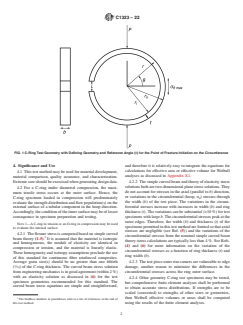
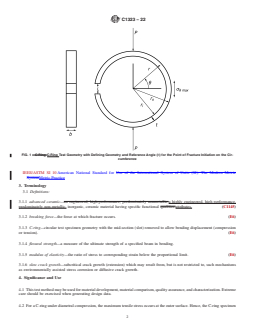
1.1 This test method covers the determination of ultimate strength under monotonic loading of advanced ceramics in tubular form at ambient temperatures. The ultimate strength as used in this test method refers to the strength obtained under monotonic compressive loading of C-ring specimens such as shown in Fig. 1, where monotonic refers to a continuous nonstop test rate with no reversals from test initiation to final fracture. This method permits a range of sizes and shapes since test specimens may be prepared from a variety of tubular structures. The method may be used with microminiature test specimens.
FIG. 1 C-Ring Test Geometry with Defining Geometry and Reference Angle (θ) for the Point of Fracture Initiation on the Circumference
1.2 The values stated in SI units are to be regarded as standard. No other units of measurement are included in this standard.
1.2.1 Values expressed in this test method are in accordance with the International System of Units (SI) and IEEE/ASTM SI 10.
1.3 This standard does not purport to address all of the safety concerns, if any, associated with its use. It is the responsibility of the user of this standard to establish appropriate safety, health, and environmental practices and determine the applicability of regulatory limitations prior to use.
1.4 This international standard was developed in accordance with internationally recognized principles on standardization established in the Decision on Principles for the Development of International Standards, Guides and Recommendations issued by the World Trade Organization Technical Barriers to Trade (TBT) Committee.
- Status
- Published
- Publication Date
- 14-Mar-2022
- Technical Committee
- C28 - Advanced Ceramics
- Drafting Committee
- C28.04 - Applications
Buy Documents
ASTM C1323-22 - Standard Test Method for Ultimate Strength of Advanced Ceramics with Diametrally Compressed C-Ring Specimens at Ambient Temperature
REDLINE ASTM C1323-22 - Standard Test Method for Ultimate Strength of Advanced Ceramics with Diametrally Compressed C-Ring Specimens at Ambient Temperature
Overview
ASTM C1323-22, titled "Standard Test Method for Ultimate Strength of Advanced Ceramics with Diametrally Compressed C-Ring Specimens at Ambient Temperature," is a critical testing standard developed by ASTM International for determining the ultimate strength of advanced ceramics in tubular form. This standard outlines a monotonic loading method using C-ring specimens, focusing on measuring the material’s performance under compressive stress at ambient temperatures. The method is suitable for a variety of sizes and shapes, including microminiature specimens, making it versatile for both research and industrial applications.
Key Topics
Purpose and Scope
- Evaluates the ultimate strength of advanced ceramics, specifically in tubular or ring forms, under monotonic diametral compression at room temperature.
- Focuses on the strength distribution and flaw populations at the external (outer) surface in the hoop (circumferential) direction.
Material and Specimen Requirements
- Applicable to monolithic, isotropic, and homogeneous ceramic materials; not recommended for fiber-reinforced composites.
- Specimens should closely represent the final component's size and surface condition to minimize scaling effects.
- Defined geometric requirements for ring thickness and width to ensure valid stress distribution.
Testing Procedure
- Use of appropriate loading machines with precise alignment and data recording capabilities.
- Careful mounting and loading of specimens to prevent undesired fracture origins due to edge or surface flaws.
- Monitoring test environment parameters such as humidity and temperature, as environmental factors can affect ceramic strength.
- Guidelines for specimen preparation, emphasizing surface finish and edge treatment to avoid artificially weakening the material.
Data Reporting and Analysis
- Calculation of maximum tensile (hoop) stress using curved beam theory.
- Use of Weibull statistics for strength distribution analysis, reflecting the brittle nature and flaw-driven failure in ceramics.
- Emphasis on statistical evaluation due to inherent variability in ceramic material strength.
Applications
Material Development and Characterization
- Essential for comparing material strength, optimizing new ceramic compositions, and validating manufacturing improvements.
Quality Assurance
- Provides consistent, reproducible methods for manufacturers to monitor batch-to-batch consistency in advanced ceramics.
Component Design and Reliability Assessment
- Supports the generation of data for statistical strength distributions, which are critical in reliability engineering and safe design of ceramic components used in demanding applications such as electronics, energy, automotive, and aerospace.
Evaluation of Surface Conditions
- Valuable for assessing how manufacturing processes, surface treatments, or environmental exposure affect the external surface integrity and ultimate strength of tubular ceramics.
Related Standards
For comprehensive ceramic testing and analysis, ASTM C1323-22 should be considered alongside several key ASTM standards:
- ASTM C1161: Test Method for Flexural Strength of Advanced Ceramics at Ambient Temperature
- ASTM C1145: Terminology of Advanced Ceramics
- ASTM C1239: Practice for Reporting Uniaxial Strength Data and Estimating Weibull Distribution Parameters for Advanced Ceramics
- ASTM C1322: Practice for Fractography and Characterization of Fracture Origins in Advanced Ceramics
- ASTM C1368: Test Method for Determination of Slow Crack Growth Parameters of Advanced Ceramics by Constant Stress Rate Strength Testing at Ambient Temperature
- ASTM C1683: Practice for Size Scaling of Tensile Strengths Using Weibull Statistics for Advanced Ceramics
- ASTM E4 & E6: Practices for Force Calibration and Terminology Relating to Mechanical Testing
- ASTM E337: Test Method for Measuring Humidity with a Psychrometer
By following ASTM C1323-22, professionals ensure reliable testing of advanced ceramics, promoting uniformity in material development, quality assurance, and component safety assessments within the global ceramics industry.
Relations
- Effective Date
- 01-Jul-2019
- Effective Date
- 01-Jul-2019
- Effective Date
- 01-Jul-2019
- Effective Date
- 01-Jul-2018
- Effective Date
- 01-Jan-2018
- Effective Date
- 01-Feb-2017
- Effective Date
- 01-Jul-2015
- Effective Date
- 01-Jan-2015
- Effective Date
- 01-Jun-2014
- Effective Date
- 01-Aug-2013
- Effective Date
- 01-Aug-2013
- Effective Date
- 01-Feb-2013
- Effective Date
- 01-Feb-2013
- Effective Date
- 01-Dec-2010
- Effective Date
- 01-Dec-2010
Buy Documents
ASTM C1323-22 - Standard Test Method for Ultimate Strength of Advanced Ceramics with Diametrally Compressed C-Ring Specimens at Ambient Temperature
REDLINE ASTM C1323-22 - Standard Test Method for Ultimate Strength of Advanced Ceramics with Diametrally Compressed C-Ring Specimens at Ambient Temperature
Frequently Asked Questions
ASTM C1323-22 is a standard published by ASTM International. Its full title is "Standard Test Method for Ultimate Strength of Advanced Ceramics with Diametrally Compressed C-Ring Specimens at Ambient Temperature". This standard covers: SIGNIFICANCE AND USE 4.1 This test method may be used for material development, material comparison, quality assurance, and characterization. Extreme care should be exercised when generating design data. 4.2 For a C-ring under diametral compression, the maximum tensile stress occurs at the outer surface. Hence, the C-ring specimen loaded in compression will predominately evaluate the strength distribution and flaw population(s) on the external surface of a tubular component in the hoop direction. Accordingly, the condition of the inner surface may be of lesser consequence in specimen preparation and testing. Note 1: A C-ring in tension or an O-ring in compression may be used to evaluate the internal surface. 4.2.1 The flexure stress is computed based on simple curved beam theory (1-5).3 It is assumed that the material is isotropic and homogeneous, the moduli of elasticity are identical in compression or tension, and the material is linearly elastic. These homogeneity and isotropy assumptions preclude the use of this standard for continuous fiber reinforced composites. Average grain size(s) should be no greater than one fiftieth (1/50 ) of the C-ring thickness. The curved beam stress solution from engineering mechanics is in good agreement (within 2 %) with an elasticity solution as discussed in (6) for the test specimen geometries recommended for this standard. The curved beam stress equations are simple and straightforward, and therefore it is relatively easy to integrate the equations for calculations for effective area or effective volume for Weibull analyses as discussed in Appendix X1. 4.2.2 The simple curved beam and theory of elasticity stress solutions both are two-dimensional plane stress solutions. They do not account for stresses in the axial (parallel to b) direction, or variations in the circumferential (hoop, σθ) stresses through the width (b) of the test piece. The variations in the circumferential stresses increase with increases in width (b) and ring thicknes... SCOPE 1.1 This test method covers the determination of ultimate strength under monotonic loading of advanced ceramics in tubular form at ambient temperatures. The ultimate strength as used in this test method refers to the strength obtained under monotonic compressive loading of C-ring specimens such as shown in Fig. 1, where monotonic refers to a continuous nonstop test rate with no reversals from test initiation to final fracture. This method permits a range of sizes and shapes since test specimens may be prepared from a variety of tubular structures. The method may be used with microminiature test specimens. FIG. 1 C-Ring Test Geometry with Defining Geometry and Reference Angle (θ) for the Point of Fracture Initiation on the Circumference 1.2 The values stated in SI units are to be regarded as standard. No other units of measurement are included in this standard. 1.2.1 Values expressed in this test method are in accordance with the International System of Units (SI) and IEEE/ASTM SI 10. 1.3 This standard does not purport to address all of the safety concerns, if any, associated with its use. It is the responsibility of the user of this standard to establish appropriate safety, health, and environmental practices and determine the applicability of regulatory limitations prior to use. 1.4 This international standard was developed in accordance with internationally recognized principles on standardization established in the Decision on Principles for the Development of International Standards, Guides and Recommendations issued by the World Trade Organization Technical Barriers to Trade (TBT) Committee.
SIGNIFICANCE AND USE 4.1 This test method may be used for material development, material comparison, quality assurance, and characterization. Extreme care should be exercised when generating design data. 4.2 For a C-ring under diametral compression, the maximum tensile stress occurs at the outer surface. Hence, the C-ring specimen loaded in compression will predominately evaluate the strength distribution and flaw population(s) on the external surface of a tubular component in the hoop direction. Accordingly, the condition of the inner surface may be of lesser consequence in specimen preparation and testing. Note 1: A C-ring in tension or an O-ring in compression may be used to evaluate the internal surface. 4.2.1 The flexure stress is computed based on simple curved beam theory (1-5).3 It is assumed that the material is isotropic and homogeneous, the moduli of elasticity are identical in compression or tension, and the material is linearly elastic. These homogeneity and isotropy assumptions preclude the use of this standard for continuous fiber reinforced composites. Average grain size(s) should be no greater than one fiftieth (1/50 ) of the C-ring thickness. The curved beam stress solution from engineering mechanics is in good agreement (within 2 %) with an elasticity solution as discussed in (6) for the test specimen geometries recommended for this standard. The curved beam stress equations are simple and straightforward, and therefore it is relatively easy to integrate the equations for calculations for effective area or effective volume for Weibull analyses as discussed in Appendix X1. 4.2.2 The simple curved beam and theory of elasticity stress solutions both are two-dimensional plane stress solutions. They do not account for stresses in the axial (parallel to b) direction, or variations in the circumferential (hoop, σθ) stresses through the width (b) of the test piece. The variations in the circumferential stresses increase with increases in width (b) and ring thicknes... SCOPE 1.1 This test method covers the determination of ultimate strength under monotonic loading of advanced ceramics in tubular form at ambient temperatures. The ultimate strength as used in this test method refers to the strength obtained under monotonic compressive loading of C-ring specimens such as shown in Fig. 1, where monotonic refers to a continuous nonstop test rate with no reversals from test initiation to final fracture. This method permits a range of sizes and shapes since test specimens may be prepared from a variety of tubular structures. The method may be used with microminiature test specimens. FIG. 1 C-Ring Test Geometry with Defining Geometry and Reference Angle (θ) for the Point of Fracture Initiation on the Circumference 1.2 The values stated in SI units are to be regarded as standard. No other units of measurement are included in this standard. 1.2.1 Values expressed in this test method are in accordance with the International System of Units (SI) and IEEE/ASTM SI 10. 1.3 This standard does not purport to address all of the safety concerns, if any, associated with its use. It is the responsibility of the user of this standard to establish appropriate safety, health, and environmental practices and determine the applicability of regulatory limitations prior to use. 1.4 This international standard was developed in accordance with internationally recognized principles on standardization established in the Decision on Principles for the Development of International Standards, Guides and Recommendations issued by the World Trade Organization Technical Barriers to Trade (TBT) Committee.
ASTM C1323-22 is classified under the following ICS (International Classification for Standards) categories: 81.060.30 - Advanced ceramics. The ICS classification helps identify the subject area and facilitates finding related standards.
ASTM C1323-22 has the following relationships with other standards: It is inter standard links to ASTM C1145-19, ASTM C1683-10(2019), ASTM C1322-15(2019), ASTM C1239-13(2018), ASTM C1368-18, ASTM C1368-10(2017), ASTM C1322-15, ASTM C1683-10(2015), ASTM E4-14, ASTM C1239-13, ASTM C1161-13, ASTM C1145-06(2013)e1, ASTM C1145-06(2013), ASTM C1683-10, ASTM C1368-10. Understanding these relationships helps ensure you are using the most current and applicable version of the standard.
ASTM C1323-22 is available in PDF format for immediate download after purchase. The document can be added to your cart and obtained through the secure checkout process. Digital delivery ensures instant access to the complete standard document.
Standards Content (Sample)
This international standard was developed in accordance with internationally recognized principles on standardization established in the Decision on Principles for the
Development of International Standards, Guides and Recommendations issued by the World Trade Organization Technical Barriers to Trade (TBT) Committee.
Designation: C1323 −22
Standard Test Method for
Ultimate Strength of Advanced Ceramics with Diametrally
Compressed C-Ring Specimens at Ambient Temperature
This standard is issued under the fixed designation C1323; the number immediately following the designation indicates the year of
original adoption or, in the case of revision, the year of last revision.Anumber in parentheses indicates the year of last reapproval.A
superscript epsilon (´) indicates an editorial change since the last revision or reapproval.
1. Scope C1161Test Method for Flexural Strength of Advanced
Ceramics at Ambient Temperature
1.1 This test method covers the determination of ultimate
C1239Practice for Reporting Uniaxial Strength Data and
strength under monotonic loading of advanced ceramics in
Estimating Weibull Distribution Parameters forAdvanced
tubular form at ambient temperatures.The ultimate strength as
Ceramics
used in this test method refers to the strength obtained under
C1322Practice for Fractography and Characterization of
monotonic compressive loading of C-ring specimens such as
Fracture Origins in Advanced Ceramics
shown in Fig. 1, where monotonic refers to a continuous
nonstop test rate with no reversals from test initiation to final C1368Test Method for Determination of Slow Crack
fracture.Thismethodpermitsarangeofsizesandshapessince Growth Parameters of Advanced Ceramics by Constant
test specimens may be prepared from a variety of tubular
Stress Rate Strength Testing at Ambient Temperature
structures. The method may be used with microminiature test
C1683Practice for Size Scaling of Tensile Strengths Using
specimens.
Weibull Statistics for Advanced Ceramics
E4Practices for Force Calibration and Verification of Test-
1.2 The values stated in SI units are to be regarded as
ing Machines
standard. No other units of measurement are included in this
E6Terminology Relating to Methods of MechanicalTesting
standard.
E337Test Method for Measuring Humidity with a Psy-
1.2.1 Valuesexpressedinthistestmethodareinaccordance
chrometer (the Measurement of Wet- and Dry-Bulb Tem-
withtheInternationalSystemofUnits(SI)andIEEE/ASTMSI
10. peratures)
IEEE/ASTM SI 10American National Standard for Metric
1.3 This standard does not purport to address all of the
Practice
safety concerns, if any, associated with its use. It is the
responsibility of the user of this standard to establish appro-
3. Terminology
priate safety, health, and environmental practices and deter-
mine the applicability of regulatory limitations prior to use.
3.1 Definitions:
1.4 This international standard was developed in accor-
3.1.1 advanced ceramic—a highly engineered, high
dance with internationally recognized principles on standard-
performance, predominately non-metallic, inorganic, ceramic
ization established in the Decision on Principles for the
material having specific functional attributes. (C1145)
Development of International Standards, Guides and Recom-
3.1.2 breaking force—the force at which fracture occurs.
mendations issued by the World Trade Organization Technical
(E6)
Barriers to Trade (TBT) Committee.
3.1.3 C-ring—circular test specimen geometry with the
2. Referenced Documents
mid-section (slot) removed to allow bending displacement
2.1 ASTM Standards:
(compression or tension). (E6)
C1145Terminology of Advanced Ceramics
3.1.4 flexural strength—a measure of the ultimate strength
This test method is under the jurisdiction of ASTM Committee C28 on of a specified beam in bending.
Advanced Ceramics and is the direct responsibility of Subcommittee C28.04 on
3.1.5 modulus of elasticity—the ratio of stress to corre-
Applications.
Current edition approved March 15, 2022. Published March 2022. Originally
sponding strain below the proportional limit. (E6)
approved in 1996. Last previous edition approved in 2016 as C1323–16. DOI:
10.1520/C1323-22.
3.1.6 slow crack growth—subcritical crack growth (exten-
For referenced ASTM standards, visit the ASTM website, www.astm.org, or
sion) which may result from, but is not restricted to, such
contact ASTM Customer Service at service@astm.org. For Annual Book of ASTM
mechanisms as environmentally assisted stress corrosion or
Standards volume information, refer to the standard’s Document Summary page on
the ASTM website. diffusive crack growth.
Copyright © ASTM International, 100 Barr Harbor Drive, PO Box C700, West Conshohocken, PA 19428-2959. United States
C1323 − 22
FIG. 1 C-Ring Test Geometry with Defining Geometry and Reference Angle (θ) for the Point of Fracture Initiation on the Circumference
4. Significance and Use and therefore it is relatively easy to integrate the equations for
calculations for effective area or effective volume for Weibull
4.1 Thistestmethodmaybeusedformaterialdevelopment,
analyses as discussed in Appendix X1.
material comparison, quality assurance, and characterization.
Extremecareshouldbeexercisedwhengeneratingdesigndata. 4.2.2 Thesimplecurvedbeamandtheoryofelasticitystress
solutionsbotharetwo-dimensionalplanestresssolutions.They
4.2 For a C-ring under diametral compression, the maxi-
do not account for stresses in the axial (parallel to b) direction,
mum tensile stress occurs at the outer surface. Hence, the
or variations in the circumferential (hoop, σ ) stresses through
θ
C-ring specimen loaded in compression will predominately
the width (b) of the test piece. The variations in the circum-
evaluatethestrengthdistributionandflawpopulation(s)onthe
ferential stresses increase with increases in width (b) and ring
external surface of a tubular component in the hoop direction.
thickness(t).Thevariationscanbesubstantial(>10%)fortest
Accordingly,theconditionoftheinnersurfacemaybeoflesser
specimenswithlargeb.Thecircumferentialstressespeakatthe
consequence in specimen preparation and testing.
outer edges. Therefore, the width (b) and thickness (t)ofthe
NOTE 1—AC-ring in tension or an O-ring in compression may be used
specimenspermittedinthistestmethodarelimitedsothataxial
to evaluate the internal surface.
stresses are negligible (see Ref. (5)) and the variations of the
4.2.1 Theflexurestressiscomputedbasedonsimplecurved
3 circumferential stresses from the nominal simple curved beam
beam theory (1-5). It is assumed that the material is isotropic
theorystresscalculationsaretypicallylessthan4%.SeeRefs.
and homogeneous, the moduli of elasticity are identical in
(4) and (6) for more information on the variation of the
compression or tension, and the material is linearly elastic.
circumferential stresses as a function of ring thickness (t) and
These homogeneity and isotropy assumptions preclude the use
ring width (b).
of this standard for continuous fiber reinforced composites.
4.2.3 Thetestpieceouterrimcornersarevulnerabletoedge
Average grain size(s) should be no greater than one fiftieth
( ⁄50) of the C-ring thickness. The curved beam stress solution damage, another reason to minimize the differences in the
fromengineeringmechanicsisingoodagreement(within2%) circumferential stresses across the ring outer surface.
with an elasticity solution as discussed in (6) for the test
4.2.4 Other geometry C-ring test specimens may be tested,
specimen geometries recommended for this standard. The
but comprehensive finite element analyses shall be performed
curved beam stress equations are simple and straightforward,
to obtain accurate stress distributions. If strengths are to be
scaled (converted) to strengths of other sizes or geometries,
3 then Weibull effective volumes or areas shall be computed
The boldface numbers in parentheses refer to a list of references at the end of
this test method. using the results of the finite element analyses.
C1323 − 22
4.3 Because advanced ceramics exhibiting brittle behavior potential), or an inherent part of the strength characteristics
generallyfracturecatastrophicallyfromasingledominantflaw beingmeasured.Universalorstandardizedmethodsofsurface/
for a particular tensile stress field in quasi-static loading, the sample preparation do not exist. Hence, final machining steps
surface area and volume of material subjected to tensile may or may not negate machining damage introduced during
stresses is a significant factor in determining the ultimate the initial machining. Thus, specimen fabrication history may
strength.Moreover,becauseofthestatisticaldistributionofthe play an important role in the measured strength distributions
flaw population(s) in advanced ceramics exhibiting brittle and shall be reported.
behavior, a sufficient number of specimens at each testing
5.3 Very small C-ring test specimens made by microfabri-
condition is required for statistical analysis and design. This
cationmethodsmayalsobetested.Thesetypicallyaretestedin
test method provides guidelines for the number of specimens
the as-fabricated state and do not require any machining
that should be tested for these purposes (see 8.4).
preparation. Chamfers or edge bevels may not be necessary.
4.4 Because of a multitude of factors related to materials
Dimensional nonuniformities (for example, through-thickness
processing and component fabrication, the results of C-ring
tapers or fabrication template artifacts) may alter the stress
testsfromaparticularmaterialorselectedportionsofapart,or
state and create experimental errors.
both, may not necessarily represent the strength and deforma-
tion properties of the full-size end product or its in-service
6. Apparatus
behavior.
6.1 Loading—Specimens shall be loaded in any suitable
4.5 The ultimate strength of a ceramic material may be
testing machine provided that uniform rates of direct loading
influenced by slow crack growth or stress corrosion, or both,
can be maintained. The system used to monitor the loading
and is therefore sensitive to the testing mode, testing rate, or
shall be free from any initial lags and will have the capacity to
environmental influences, or a combination thereof. Testing at
record the maximum force applied to the C-ring specimen
sufficiently rapid rates as outlined in this test method may
duringthetest.Testingmachineaccuracyshallbewithin1.0%
minimize the consequences of subcritical (slow) crack growth
in accordance with Practices E4.
or stress corrosion.
6.1.1 This test method permits the use of either fixed
4.6 The flexural behavior and strength of an advanced
loading rams or, when necessary (see 9.3), a self-adjusting
monolithic ceramic are dependent on the material’s inherent
fixture.Aself-adjustingfixturemayincludeauniversaljointor
resistance to fracture, the presence of flaws, or damage
spherically seated platen used in conjunction with the upper
accumulation processes, or a combination thereof.Analysis of
loading ram. Such an articulating fixture may be necessary to
fracturesurfacesandfractography,thoughbeyondthescopeof
ensure even line loading from front to back across the top of a
thistestmethod,ishighlyrecommended(furtherguidancemay
C-ring test specimen. Articulation from side to side is not
be obtained from Practice C1322 and Ref (7)).
requiredsinceaflatloadingplatencontactstheC-ringatitstop
on its centerline. When fixed loading rams are used, they shall
5. Interferences
be aligned so that the platen surfaces which come into contact
with the specimens are parallel to within 0.015 mm over the
5.1 Test environment (vacuum, inert gas, ambient air, etc.),
widthofthetestpiece.Alignmentofthetestingsystemmustbe
including moisture content (that is, relative humidity), may
verified at a minimum at the beginning and at the end of a test
have an influence on the measured ultimate strength. In
series.Anadditionalverificationofalignmentisrecommended,
particular, the behavior of materials susceptible to slow crack
although not required, at the middle of the test series.
growthfracturewillbestronglyinfluencedbytestenvironment
andtestingrate.Testingtoevaluatethemaximuminertstrength
NOTE2—Atestseriesisinterpretedtomeanadiscretegroupoftestson
(strength potential) of a material shall therefore be conducted
individual specimens conducted within a discrete period of time on a
in inert environments or at sufficiently rapid testing rates, or particular material configuration, test specimen geometry, test conditions,
or other uniquely definable qualifier. For example, a test series may be
both, so as to minimize slow crack growth effects. Conversely,
composed of one material comprising ten specimens of one geometry
testing can be conducted in environments and testing modes
tested at a fixed rate in strain control to final fracture in ambient air.
and rates representative of service conditions to evaluate
6.1.2 Materialssuchasfoilorthinrubbersheetshallbeused
material performance under use conditions. When testing in
between the loading rams and the specimen for ambient
uncontrolled ambient air for the purpose of evaluating maxi-
temperature tests to reduce the effects of friction and to
mum inert strength (strength potential), relative humidity and
redistribute the force.Aluminum oxide (alumina) felt or other
temperature must be monitored and reported. Testing at hu-
high-temperature “cloth” with a high-temperature capability
midity levels >65% RH is not recommended and any devia-
may also be used at ambient or elevated temperature. The use
tions from this recommendation must be reported.
of a material with a high-temperature capability is recom-
5.2 C-ring specimens are useful for the determination of
mended to ensure consistency with elevated temperature tests
ultimate strength of the outer diameter of tubular components
(if planned), provided the high-temperature “cloth” is chemi-
in the as-received/as-used condition without surface prepara-
cally compatible with the specimen at all testing temperatures.
tions that may distort the strength controlling flaw popula-
tion(s). Nonetheless, machining damage introduced during 6.2 The fixture used during the tests shall be stiffer than the
specimen preparation can be either a random interfering factor specimen to ensure that a majority of the crosshead travel (at
in the determination of the maximum inert strength (strength least 80%) is imposed on the C-ring specimen.
C1323 − 22
6.3 Data Acquisition—Either digital acquisition systems or route of an application where no machining is used. No
analog chart recorders may be used for this purpose, although additional machining specifications for these surfaces are
a digital record is recommended for ease of later data analysis. relevant. The two flat side faces shall be machined from the
Recording devices must be accurate to 61% of full scale and tubularstockandlapfinishedwith15µmmediatoremoveany
shall have a minimum data acquisition rate of 10 Hz, with a large machining defects. All edges shall then be either cham-
response of 50 Hz deemed more than sufficient. fered at 45° to a distance of 0.12 6 0.05 mm or rounded to a
radius of 0.15 6 0.05 mm to avoid edge dominated failures.
7. Hazards
NOTE 3—If the C-ring specimen has a nonuniform diameter, the edge
7.1 During the conduct of this test, the possibility of flying
chamfer or round tolerances stated in 8.2.1 may be relaxed; however, the
fragments of broken test material may be high. Means for edges shall still be chamfered or rounded. As-fabricated rings with
nonuniform diameters may be difficult to prepare with uniform chamfers
containment and retention of these fragments for safety, later
or edge bevels. Uneven or hand-prepared chamfers or rounded edges may
fractographic reconstruction, and analysis is highly recom-
lead to an inordinate number of fractures that initiate at the edges. A
mended. It is advisable to buffer the fragments so that they do
supplemental fine finishing step with a 600 grit wheel may be beneficial.
not suffer needless secondary impact fractures.Tape applied to
8.2.2 Application-Matched Machining—The C-ring speci-
the inside diameter may aid in specimen fragment retention.
menshallhavethesamesurfacepreparationasthatgiventothe
component. When possible, the specimen shall also retain the
8. Specimen
original radii of the component provided the surface area and
8.1 General—The C-ring geometry is designed to evaluate
volume are sufficient to sample the inherent flaws of the
the ultimate strength of advanced monolithic materials in
material under study. All other side finishing specifications
tubular form in as-received or as-machined form. When
shall be the same as the as-fabricated specimens. Unless the
possible, the specimen shall reflect the actual size of the
process is proprietary, the report shall include all details about
component to minimize size scaling effects and to increase the
thestagesofmaterialremoval,wheelgrits,wheelbonding,and
likelihoodthatthespecimenwillhavethesamemicrostructure
the material removal rates for each pass.
and flaw population(s) as the component. Hence, standard
8.2.3 Standard Procedure—In instances where 8.2.1 and
specimen dimensions or overall sizes cannot be recommended
8.2.2 are not appropriate, 8.2.3 shall apply. This procedure
without compromising the original purpose of the test method.
shall be viewed as a baseline; more stringent procedures may
Instead, specimens shall be prepared from the stock used for
be necessary depending on the application(s).
the actual component when possible.
NOTE4—ThisprocedureissimilartotheonesspecifiedinTestMethod
8.1.1 Specimen Size—The width of the test specimen, b,
C1161.
should be at least one, but no greater than two times the ring
8.2.3.1 All grinding or cutting shall be done with ample
thickness, t:
supply of appropriate filtered coolant to keep the workpiece
b b
1# 5 #2 (1) and grinding wheel constantly flooded and particles flushed.
S D S D
t r 2 r
o i
Grinding must be done in at least two stages, ranging from
where the dimensional terms t (the ring thickness), b (the
coarse to a finer rate of material removal. All cutting can be
ring width), r , the outer radius, and r, the inner radii are
o i
done in one stage appropriate for the depth of cut. Unless the
shown in Fig. 1. These limits are to ensure that essentially
plane stress conditions exist (6, 8, 9) in the specimen; varia- process is proprietary, all reports shall be specific about the
stagesofmaterialremoval,wheelgrits,wheelbonding,amount
tions in the circumferential stresses through the width of the
test specimen are minimized (4, 6); and axial stresses are of material removed per pass, and type of coolant used.
minimal (5). If it is necessary to use wider test specimens Centerless or transverse grinding modes may be used on the
(larger b) than this range, then consult 4.2.2 – 4.2.4 for fur- outside diameter prior to slotting. Surface grinding is recom-
ther guidance. The test specimen thickness, t, and thus the mended for the two flat side faces, but the grinding directions
radii, shall be within the following range: on the two sides shall be parallel to each other. Rotary or
Blanchard grinding modes are permitted for the side faces, but
r
i
0.5# #0.95 (2)
an additional final finishing step with a fine grinding wheel
...
This document is not an ASTM standard and is intended only to provide the user of an ASTM standard an indication of what changes have been made to the previous version. Because
it may not be technically possible to adequately depict all changes accurately, ASTM recommends that users consult prior editions as appropriate. In all cases only the current version
of the standard as published by ASTM is to be considered the official document.
Designation: C1323 − 16 C1323 − 22
Standard Test Method for
Ultimate Strength of Advanced Ceramics with Diametrally
Compressed C-Ring Specimens at Ambient Temperature
This standard is issued under the fixed designation C1323; the number immediately following the designation indicates the year of
original adoption or, in the case of revision, the year of last revision. A number in parentheses indicates the year of last reapproval. A
superscript epsilon (´) indicates an editorial change since the last revision or reapproval.
1. Scope
1.1 This test method covers the determination of ultimate strength under monotonic loading of advanced ceramics in tubular form
at ambient temperatures. The ultimate strength as used in this test method refers to the strength obtained under monotonic
compressive loading of C-ring specimens such as shown in Fig. 1, where monotonic refers to a continuous nonstop test rate with
no reversals from test initiation to final fracture. This method permits a range of sizes and shapes since test specimens may be
prepared from a variety of tubular structures. The method may be used with microminiature test specimens.
1.2 The values stated in SI units are to be regarded as standard. No other units of measurement are included in this standard.
1.2.1 Values expressed in this test method are in accordance with the International System of Units (SI) and IEEE/ASTM SI 10.
1.3 This standard does not purport to address all of the safety concerns, if any, associated with its use. It is the responsibility
of the user of this standard to establish appropriate safety safety, health, and healthenvironmental practices and determine the
applicability of regulatory limitations prior to use.
1.4 This international standard was developed in accordance with internationally recognized principles on standardization
established in the Decision on Principles for the Development of International Standards, Guides and Recommendations issued
by the World Trade Organization Technical Barriers to Trade (TBT) Committee.
2. Referenced Documents
2.1 ASTM Standards:
C1145 Terminology of Advanced Ceramics
C1161 Test Method for Flexural Strength of Advanced Ceramics at Ambient Temperature
C1239 Practice for Reporting Uniaxial Strength Data and Estimating Weibull Distribution Parameters for Advanced Ceramics
C1322 Practice for Fractography and Characterization of Fracture Origins in Advanced Ceramics
C1368 Test Method for Determination of Slow Crack Growth Parameters of Advanced Ceramics by Constant Stress Rate
Strength Testing at Ambient Temperature
C1683 Practice for Size Scaling of Tensile Strengths Using Weibull Statistics for Advanced Ceramics
E4 Practices for Force Calibration and Verification of Testing Machines
E6 Terminology Relating to Methods of Mechanical Testing
E337 Test Method for Measuring Humidity with a Psychrometer (the Measurement of Wet- and Dry-Bulb Temperatures)
This test method is under the jurisdiction of ASTM Committee C28 on Advanced Ceramics and is the direct responsibility of Subcommittee C28.04 on Applications.
Current edition approved Jan. 15, 2016March 15, 2022. Published February 2016March 2022. Originally approved in 1996. Last previous edition approved in 20102016
as C1323 – 10.C1323 – 16. DOI: 10.1520/C1323-16.10.1520/C1323-22.
For referenced ASTM standards, visit the ASTM website, www.astm.org, or contact ASTM Customer Service at service@astm.org. For Annual Book of ASTM Standards
volume information, refer to the standard’s Document Summary page on the ASTM website.
Copyright © ASTM International, 100 Barr Harbor Drive, PO Box C700, West Conshohocken, PA 19428-2959. United States
C1323 − 22
FIG. 1 C-Ring C-Ring Test Geometry with Defining Geometry and Reference Angle (θ) for the Point of Fracture Initiation on the Cir-
cumference
IEEE/ASTM SI 10 American National Standard for Use of the International System of Units (SI): The Modern Metric
SystemMetric Practice
3. Terminology
3.1 Definitions:
3.1.1 advanced ceramic—an engineered, high-performance, predominately nonmetallic,a highly engineered, high performance,
predominately non-metallic, inorganic, ceramic material having specific functional qualities.attributes. (C1145)
3.1.2 breaking force—the force at which fracture occurs. (E6)
3.1.3 C-ring—circular test specimen geometry with the mid-section (slot) removed to allow bending displacement (compression
or tension). (E6)
3.1.4 flexural strength—a measure of the ultimate strength of a specified beam in bending.
3.1.5 modulus of elasticity—the ratio of stress to corresponding strain below the proportional limit. (E6)
3.1.6 slow crack growth—subcritical crack growth (extension) which may result from, but is not restricted to, such mechanisms
as environmentally assisted stress corrosion or diffusive crack growth.
4. Significance and Use
4.1 This test method may be used for material development, material comparison, quality assurance, and characterization. Extreme
care should be exercised when generating design data.
4.2 For a C-ring under diametral compression, the maximum tensile stress occurs at the outer surface. Hence, the C-ring specimen
C1323 − 22
loaded in compression will predominately evaluate the strength distribution and flaw population(s) on the external surface of a
tubular component. component in the hoop direction. Accordingly, the condition of the inner surface may be of lesser consequence
in specimen preparation and testing.
NOTE 1—A C-ring in tension or an O-ring in compression may be used to evaluate the internal surface.
4.2.1 The flexure stress is computed based on simple curved-beam curved beam theory (11-5, 2, 3, 4, 5). It is assumed that the
material is isotropic and homogeneous, the moduli of elasticity are identical in compression or tension, and the material is linearly
elastic. These homogeneity and isotropy assumptions preclude the use of this standard for continuous fiber reinforced composites.
Average grain size(s) should be no greater than one fiftieth ( ⁄50) of the C-ring thickness. The curved-beam curved beam stress
solution from engineering mechanics is in good agreement (within 2 %) with an elasticity solution as discussed in (6) for the test
specimen geometries recommended for this standard. The curved beam stress equations are simple and straightforward, and
therefore it is relatively easy to integrate the equations for calculations for effective area or effective volume for Weibull analyses
as discussed in Appendix X1.
4.2.2 The simple curved beam and theory of elasticity stress solutions both are two-dimensional plane stress solutions. They do
not account for stresses in the axial (parallel to b)b) direction, or variations in the circumferential (hoop, σ ) stresses through the
θ
width (b) of the test piece. The variations in the circumferential stresses increase with increases in width (b) and ring thickness
(t). The variations can be substantial (>10 %) for test specimens with large b. The circumferential stresses peak at the outer edges.
Therefore, the width (b) and thickness (t) of the specimens permitted in this test method are limited so that axial stresses are
negligible (see Ref. (5))) and the variations of the circumferential stresses from the nominal simple curved beam theory stress
calculations are typically less than 4 %. See Ref.Refs. (4) and (6) for more information on the variation of the circumferential
stresses as a function of ring thickness (t) and ring width (b).
4.2.3 The test piece outer rim corners are vulnerable to edge damage, another reason to minimize the differences in the
circumferential stresses across the ring outer surface.
4.2.4 Other geometry C–ringC-ring test specimens may be tested, but comprehensive finite element analyses shall be performed
to obtain accurate stress distributions. If strengths are to be scaled (converted) to strengths of other sizes or geometries, then
Weibull effective volumes or areas shall be computed using the results of the finite element analyses.
4.3 Because advanced ceramics exhibiting brittle behavior generally fracture catastrophically from a single dominant flaw for a
particular tensile stress field in quasi-static loading, the surface area and volume of material subjected to tensile stresses is a
significant factor in determining the ultimate strength. Moreover, because of the statistical distribution of the flaw population(s)
in advanced ceramics exhibiting brittle behavior, a sufficient number of specimens at each testing condition is required for
statistical analysis and design. This test method provides guidelines for the number of specimens that should be tested for these
purposes (see 8.4).
4.4 Because of a multitude of factors related to materials processing and component fabrication, the results of C-ring tests from
a particular material or selected portions of a part, or both, may not necessarily represent the strength and deformation properties
of the full-size end product or its in-service behavior.
4.5 The ultimate strength of a ceramic material may be influenced by slow crack growth or stress corrosion, or both, and is
therefore,therefore sensitive to the testing mode, testing rate, or environmental influences, or a combination thereof. Testing at
sufficiently rapid rates as outlined in this test method may minimize the consequences of subcritical (slow) crack growth or stress
corrosion.
4.6 The flexural behavior and strength of an advanced monolithic ceramic are dependent on the material’s inherent resistance to
fracture, the presence of flaws, or damage accumulation processes, or a combination thereof. Analysis of fracture surfaces and
fractography, though beyond the scope of this test method, is highly recommended (further guidance may be obtained from
Practice C1322 and Ref (7)).
5. Interferences
5.1 Test environment (vacuum, inert gas, ambient air, etc.)etc.), including moisture content (that is, relative humidity)humidity),
The boldface numbers in parentheses refer to a list of references at the end of this test method.
C1323 − 22
may have an influence on the measured ultimate strength. In particular, the behavior of materials susceptible to slow crack-growth
crack growth fracture will be strongly influenced by test environment and testing rate. Testing to evaluate the maximum inert
strength (strength potential) of a material shall therefore be conducted in inert environments or at sufficiently rapid testing rates,
or both, so as to minimize slow crack-growth crack growth effects. Conversely, testing can be conducted in environments and
testing modes and rates representative of service conditions to evaluate material performance under use conditions. When testing
in uncontrolled ambient air for the purpose of evaluating maximum inert strength (strength potential), relative humidity and
temperature must be monitored and reported. Testing at humidity levels >65 % RH is not recommended and any deviations from
this recommendation must be reported.
5.2 C-ring specimens are useful for the determination of ultimate strength of the outer diameter of tubular components in the
as-received/as-used condition without surface preparations that may distort the strength controlling flaw population(s).
Nonetheless, machining damage introduced during specimen preparation can be either a random interfering factor in the
determination of the maximum inert strength (strength potential), or an inherent part of the strength characteristics being measured.
Universal or standardized methods of surface/sample preparation do not exist. Hence, final machining steps may or may not negate
machining damage introduced during the initial machining. Thus, specimen fabrication history may play an important role in the
measured strength distributions and shall be reported.
5.3 Very small C-ring test specimens made by micro fabrication microfabrication methods may also be tested. These typically are
tested in the as-fabricated state and do not require any machining preparation. Chamfers or edge bevels may not be necessary.
Dimensional nonuniformities (e.g., (for example, through-thickness tapers or fabrication template artifacts) may alter the stress
state and create experimental errors.
6. Apparatus
6.1 Loading—Specimens shall be loaded in any suitable testing machine provided that uniform rates of direct loading can be
maintained. The system used to monitor the loading shall be free from any initial lags and will have the capacity to record the
maximum force applied to the C-ring specimen during the test. Testing machine accuracy shall be within 1.0 % in accordance with
Practices E4.
6.1.1 This test method permits the use of either fixed loading rams or, when necessary (see 9.3), a self-adjusting fixture. A
self-adjusting fixture may include a universal joint or spherically seated platen used in conjunction with the upper loading ram.
Such an articulating fixture may be necessary to ensure even line loading from front to back across the top of a C-ring test
specimen. Articulation from side to side is not required since a flat loading platen contacts the C-ring at its top on its centerline.
When fixed loading rams are used, they shall be aligned so that the platen surfaces which come into contact with the specimens
are parallel to within 0.015 mm over the width of the test piece. Alignment of the testing system must be verified at a minimum
at the beginning and at the end of a test series. An additional verification of alignment is recommended, although not required, at
the middle of the test series.
NOTE 2—A test series is interpreted to mean a discrete group of tests on individual specimens conducted within a discrete period of time on a particular
material configuration, test specimen geometry, test conditions, or other uniquely definable qualifier. For example, a test series may be composed of one
material comprising ten specimens of one geometry tested at a fixed rate in strain control to final fracture in ambient air).air.
6.1.2 Materials such as foil or thin rubber sheet shall be used between the loading rams and the specimen for ambient temperature
tests to reduce the effects of friction and to redistribute the force. Aluminum oxide (alumina) felt or other high-temperature “cloth”
with a high-temperature capability may also be used at ambient or elevated temperature. The use of a material with a
high-temperature capability is recommended to ensure consistency with elevated temperature tests (if planned), provided the
high-temperature “cloth” is chemically compatible with the specimen at all testing temperatures.
6.2 The fixture used during the tests shall be stiffer than the specimen to ensure that a majority of the crosshead travel (at least
80 %) is imposed on the C-ring specimen.
6.3 Data Acquisition—At the minimum, an autographic record of applied force shall be obtained. Either Either digital acquisition
systems or analog chart recorders or digital data acquisition systems can may be used for this purpose. Ideally, an analog chart
recorder or plotter shall be used in conjunction with a digital data acquisition system to provide an immediate record of the test
as a supplement to the digital record. Recording devices shallpurpose, although a digital record is recommended for ease of later
data analysis. Recording devices must be accurate to 0.1 %61 % of full scale and shall have a minimum data acquisition rate of
10 Hz, with a response of 50 Hz deemed more than sufficient.
C1323 − 22
7. Hazards
7.1 During the conduct of this test, the possibility of flying fragments of broken test material may be high. Means for containment
and retention of these fragments for safety, later fractographic reconstruction, and analysis is highly recommended. It is advisable
to buffer the fragments so that they do not suffer needless secondary impact fractures. Tape applied to the inside diameter may aid
in specimen fragment retention.
8. Specimen
8.1 General—The C-ring geometry is designed to evaluate the ultimate strength of advanced monolithic materials in tubular form
in as-received or as-machined form. When possible, the specimen shall reflect the actual size of the component to minimize size
scaling effects and to increase the likelihood that the specimen will have the same microstructure and flaw population(s) as the
component. Hence, standard specimen dimensions or overall sizes cannot be recommended without compromising the original
purpose of the test method. Instead, specimens shall be prepared from the stock used for the actual component when possible.
8.1.1 Specimen Size—The width of the test specimen, b, should be at least one, but no greater than two times the ring thickness,
t:
b b
1# 5 # 2 (1)
S D S D
t r 2 r
o i
where the dimensional terms t (the ring thickness), b (the ring width), and r , the outer radius, and r , the inner radii are
o i
shown in Fig. 1. These limits are to ensure that essentially plane stress conditions exist (6, 8, 9) in the specimen; variations in
the circumferential stresses through the width of the test specimen are minimized (4, 6); and axial stresses are minimal (5). If
it is necessary to use wider test specimens (larger b) than this range, then consult paragraphs4.2.2 – 4.2.4 4.3.2 to 4.3.4 for
further guidance. The test specimen thickness, t, and thus the radii, shall be within the following range:
r
i
0.5 # # 0.95 (2)
r
o
or
0.05r # t # 0.5r (3)
o o
8.1.2 The parallelism tolerance for the two machined side faces of the C-ring specimen is 0.015 mm.
8.2 Specimen Preparation—Depending on the intended application of the ultimate strength data, use one of the following
specimen preparation procedures. C-ring test specimens are very sensitive to outer surface and edge damage, so they must be
prepared carefully (10, 11). The slot is usually prepared as the last step.
8.2.1 As-Fabricated—The external surface of the C-ring specimen shall simulate the surface conditions and processing route of
an application where no machining is used. No additional machining specifications for these surfaces are relevant. The two flat side
faces shall be machined from the tubular stock and lap finished with 15 μm media to remove any large machining defects. All edges
shall then be either chamfered at 45° to a distance of 0.12 6 0.05 mm or rounded to a radius of 0.15 6 0.05 mm to avoid edge
dominated failures.
NOTE 3—If the C-ring specimen has a nonuniform diameter, the edge chamfer or round tolerances stated in 8.2.1 may be relaxed; however, the edges
shall still be chamfered or rounded. As-fabricated rings with nonuniform diameters may be difficult to prepare with uniform chamfers or edge bevels.
Uneven or hand prepared hand-prepared chamfers or rounded edges may lead to an inordinate number of fractures that initiate at the edges. A
supplemental fine finishing step with a 600 grit wheel may be beneficial.
8.2.2 Application-Matched Machining—The C-ring specimen shall have the same surface preparation as that given to the
component. When possible, the specimen shall also retain the original radii of the component provided the surface area and volume
are sufficient to sample the inherent flaws of the material under study. All other side finishing specifications shall be the same as
the as-fabricated specimens. Unless the process is proprietary, the report shall include all details about the stages of material
removal, wheel grits, wheel bonding, and the material removal rates for each pass.
8.2.3 Standard Procedure—In instances where 8.2.1 throughand 8.2.2 are not appropriate, 8.2.3 shall apply. This procedure shall
be viewed as a baseline; more stringent procedures may be necessary depending on the application(s).
NOTE 4—This procedure is similar to the ones specified in Test Method C1161.
C1323 − 22
8.2.3.1 All grinding or cutting shall be done with ample supply of appropriate filtered coolant to keep the workpiece and grinding
wheel constantly flooded and particles flushed. Grinding must be done in at least two stages, ranging from coarse to a finer rate
of material removal. All cutting can be done in
...