


ASTM D6329-98(2015)
(Guide)Standard Guide for Developing Methodology for Evaluating the Ability of Indoor Materials to Support Microbial Growth Using Static Environmental Chambers
Standard Guide for Developing Methodology for Evaluating the Ability of Indoor Materials to Support Microbial Growth Using Static Environmental Chambers
SIGNIFICANCE AND USE
4.1 The static chambers have several different applications:
4.1.1 The static chambers can be used to compare the susceptibility of different materials to the colonization and amplification of various microorganisms under defined conditions.
4.1.2 Chambers operated at high relative humidities may be used to perform worst case scenario screening tests on materials by providing an atmosphere where environmental conditions may be favorable for microbial growth.
4.1.3 Use of multiple chambers with different environmental parameters, such as a range of relative humidities, permits the evaluation of multiple microenvironments and allows investigation of materials under differing environmental conditions.
4.1.4 Drying requirements for wetted materials may also be investigated. This information may be relevant for determining material resistance to microbial growth after becoming wet. These conditions may simulate those where materials are subjected to water incursion through leaks as well as during remediation of a building after a fire.
4.1.5 Growth rates of microorganisms on the material may also be investigated. Once it has been established that organisms are able to grow on a particular material under defined conditions, investigations into the rate of organism growth may be performed. These evaluations provide base line information and can be used to evaluate methods to limit or contain amplification of microorganisms.
4.2 These techniques should be performed by personnel with training in microbiology. The individual must be competent in the use of sterile technique, which is critical to exclude external contamination of materials.
SCOPE
1.1 Many different types of microorganisms (for example, bacteria, fungi, viruses, algae) can occupy indoor spaces. Materials that support microbial growth are potential indoor sources of biocontaminants (for example, spores and toxins) that can become airborne indoor biopollutants. This guide describes a simple, relatively cost effective approach to evaluating the ability of a variety of materials to support microbial growth using a small chamber method.
1.2 This guide is intended to assist groups in the development of specific test methods for a definite material or groups of materials.
1.3 Static chambers have certain limitations. Usually, only small samples of indoor materials can be evaluated. Care must be taken that these samples are representative of the materials being tested so that a true evaluation of the material is performed.
1.4 Static chambers provide controlled laboratory microenvironment conditions. These chambers are not intended to duplicate room conditions, and care must be taken when interpreting the results. Static chambers are not a substitute for dynamic chambers or field studies.
1.5 A variety of microorganisms, specifically bacteria and fungi, can be evaluated using these chambers. This guide is not intended to provide human health effect data. However, organisms of clinical interest, such as those described as potentially allergenic, may be studied using this approach.
1.6 The values stated in SI units are to be regarded as standard. No other units of measurement are included in this standard.
1.7 This standard does not purport to address all of the safety concerns, if any, associated with its use. It is the responsibility of the user of this standard to establish appropriate safety and health practices and determine the applicability of regulatory limitations prior to use.
General Information
Buy Standard
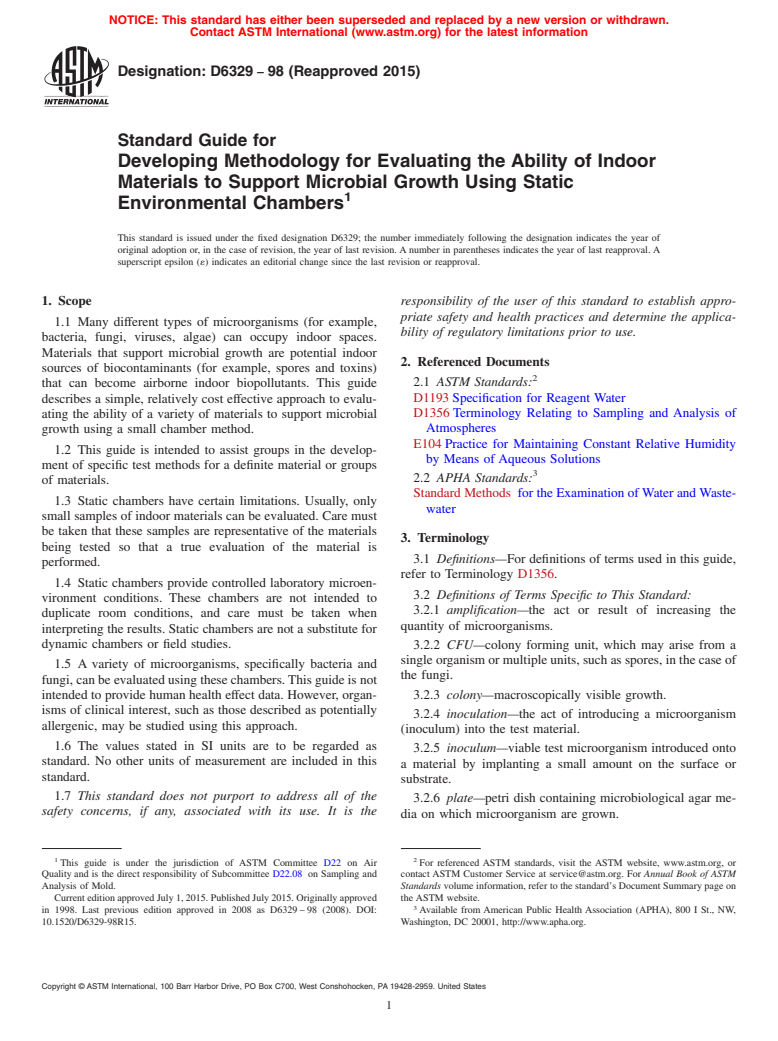
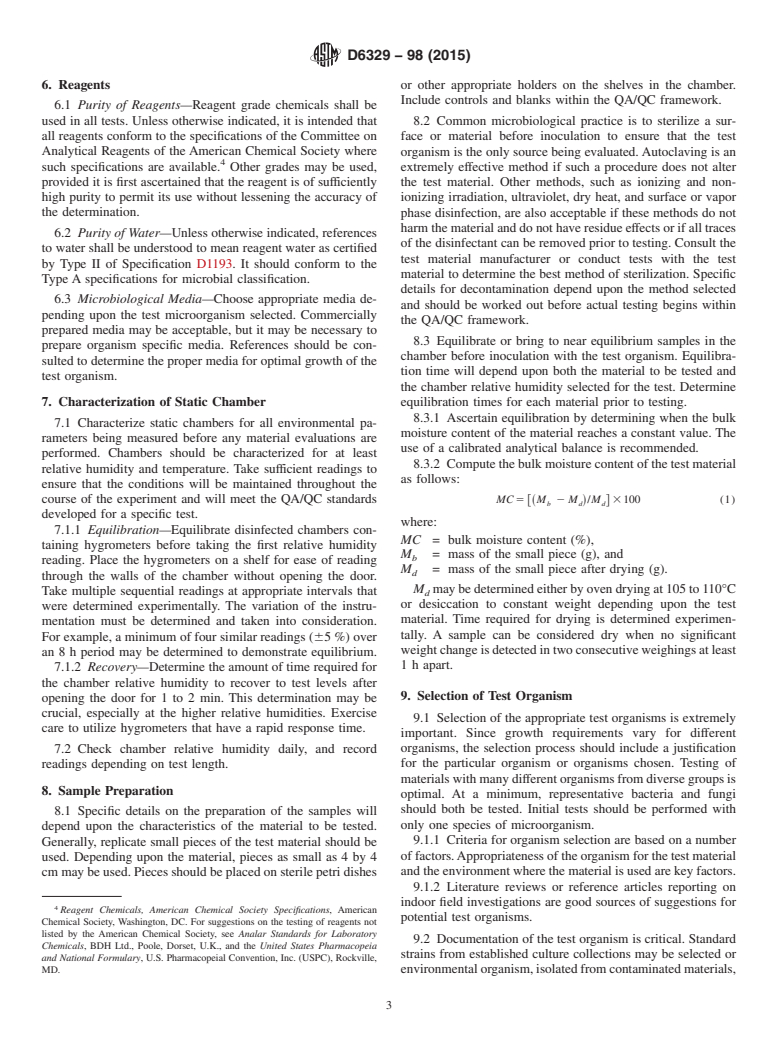
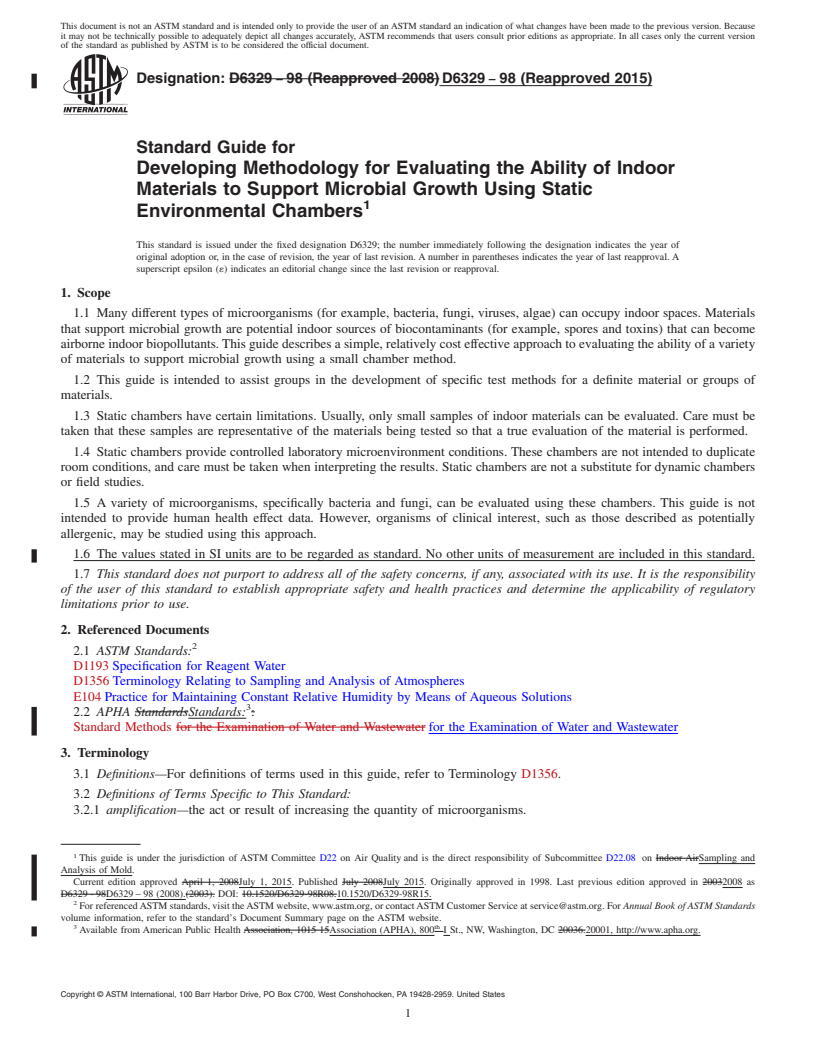
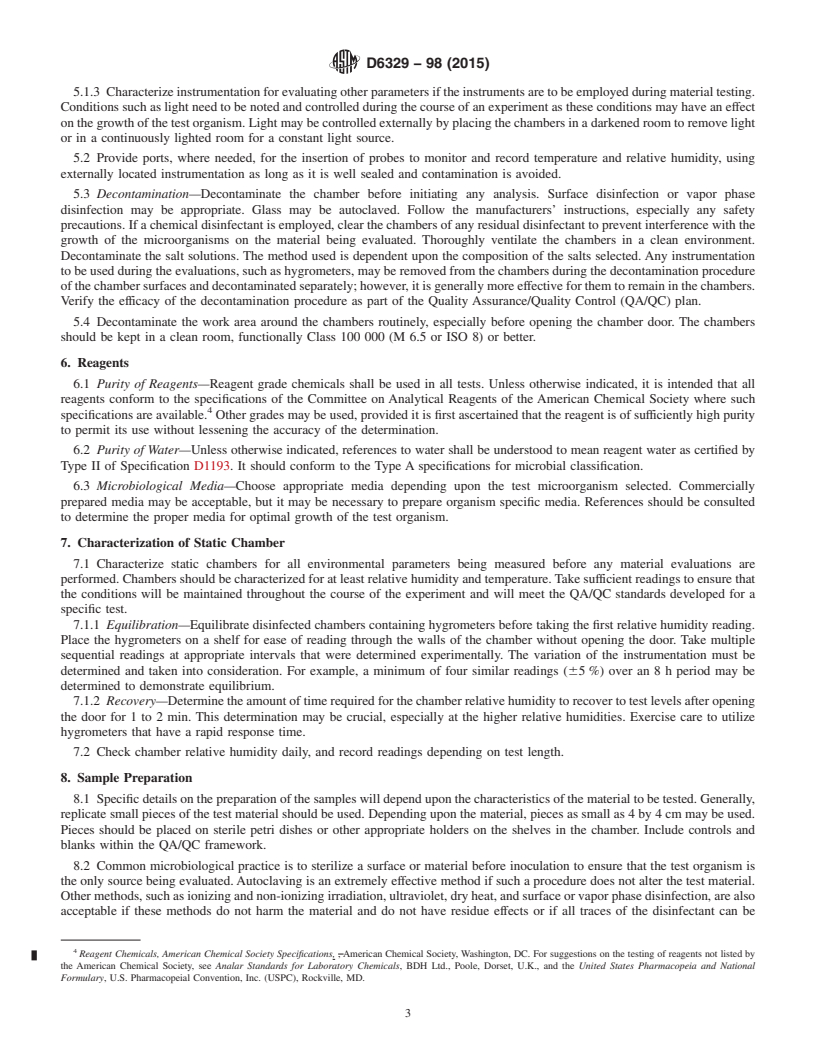
Standards Content (Sample)
NOTICE: This standard has either been superseded and replaced by a new version or withdrawn.
Contact ASTM International (www.astm.org) for the latest information
Designation: D6329 − 98 (Reapproved 2015)
Standard Guide for
Developing Methodology for Evaluating the Ability of Indoor
Materials to Support Microbial Growth Using Static
Environmental Chambers
This standard is issued under the fixed designation D6329; the number immediately following the designation indicates the year of
original adoption or, in the case of revision, the year of last revision. A number in parentheses indicates the year of last reapproval. A
superscript epsilon (´) indicates an editorial change since the last revision or reapproval.
1. Scope responsibility of the user of this standard to establish appro-
priate safety and health practices and determine the applica-
1.1 Many different types of microorganisms (for example,
bility of regulatory limitations prior to use.
bacteria, fungi, viruses, algae) can occupy indoor spaces.
Materials that support microbial growth are potential indoor
2. Referenced Documents
sources of biocontaminants (for example, spores and toxins)
2.1 ASTM Standards:
that can become airborne indoor biopollutants. This guide
describes a simple, relatively cost effective approach to evalu- D1193 Specification for Reagent Water
D1356 Terminology Relating to Sampling and Analysis of
ating the ability of a variety of materials to support microbial
growth using a small chamber method. Atmospheres
E104 Practice for Maintaining Constant Relative Humidity
1.2 This guide is intended to assist groups in the develop-
by Means of Aqueous Solutions
ment of specific test methods for a definite material or groups
2.2 APHA Standards:
of materials.
Standard Methods for the Examination of Water and Waste-
1.3 Static chambers have certain limitations. Usually, only
water
small samples of indoor materials can be evaluated. Care must
be taken that these samples are representative of the materials
3. Terminology
being tested so that a true evaluation of the material is
3.1 Definitions—For definitions of terms used in this guide,
performed.
refer to Terminology D1356.
1.4 Static chambers provide controlled laboratory microen-
3.2 Definitions of Terms Specific to This Standard:
vironment conditions. These chambers are not intended to
3.2.1 amplification—the act or result of increasing the
duplicate room conditions, and care must be taken when
quantity of microorganisms.
interpreting the results. Static chambers are not a substitute for
dynamic chambers or field studies.
3.2.2 CFU—colony forming unit, which may arise from a
single organism or multiple units, such as spores, in the case of
1.5 A variety of microorganisms, specifically bacteria and
the fungi.
fungi, can be evaluated using these chambers. This guide is not
intended to provide human health effect data. However, organ- 3.2.3 colony—macroscopically visible growth.
isms of clinical interest, such as those described as potentially
3.2.4 inoculation—the act of introducing a microorganism
allergenic, may be studied using this approach.
(inoculum) into the test material.
1.6 The values stated in SI units are to be regarded as
3.2.5 inoculum—viable test microorganism introduced onto
standard. No other units of measurement are included in this
a material by implanting a small amount on the surface or
standard.
substrate.
1.7 This standard does not purport to address all of the
3.2.6 plate—petri dish containing microbiological agar me-
safety concerns, if any, associated with its use. It is the
dia on which microorganism are grown.
1 2
This guide is under the jurisdiction of ASTM Committee D22 on Air For referenced ASTM standards, visit the ASTM website, www.astm.org, or
Quality and is the direct responsibility of Subcommittee D22.08 on Sampling and contact ASTM Customer Service at service@astm.org. For Annual Book of ASTM
Analysis of Mold. Standards volume information, refer to the standard’s Document Summary page on
Current edition approved July 1, 2015. Published July 2015. Originally approved the ASTM website.
in 1998. Last previous edition approved in 2008 as D6329 – 98 (2008). DOI: Available from American Public Health Association (APHA), 800 I St., NW,
10.1520/D6329-98R15. Washington, DC 20001, http://www.apha.org.
Copyright © ASTM International, 100 Barr Harbor Drive, PO Box C700, West Conshohocken, PA 19428-2959. United States
D6329 − 98 (2015)
3.2.7 static chamber—a small chamber (enclosed space) static chamber. Acrylic desiccators are readily available, easily
with no internal forced air motion. adaptable, and relatively inexpensive. Other options, such as
glass, are also acceptable. Glass has the advantage of being
3.2.8 susceptibility—the vulnerability of a material or sur-
autoclavable; however, it is frequently much less portable. The
face to colonization by microorganisms.
chamber door must provide ready access to the materials but
should be airtight when closed.
4. Significance and Use
5.1.1 Relative Humidity—Maintain humidities through the
4.1 The static chambers have several different applications:
use of saturated salt solutions contained in trays on the bottom
4.1.1 The static chambers can be used to compare the
of the chambers (see Practice E104). It is essential that the
susceptibility of different materials to the colonization and
chambers be tightly sealed so that the desired humidity will be
amplification of various microorganisms under defined condi-
maintained. Place hygrometers in the chambers for confirma-
tions.
tion that humidities are being maintained, although saturated
4.1.2 Chambers operated at high relative humidities may be
salt solutions are themselves standards. Exercise care that the
used to perform worst case scenario screening tests on mate-
salts selected for use in the chamber are not inhibitory to the
rials by providing an atmosphere where environmental condi-
test organisms.
tions may be favorable for microbial growth.
5.1.2 Temperature—Control the temperature of the cham-
4.1.3 Use of multiple chambers with different environmen-
bers. The chambers may be externally controlled through the
tal parameters, such as a range of relative humidities, permits
use of constant temperature environments, such as a room or
the evaluation of multiple microenvironments and allows
incubator. Chart recorders or other data logging devices are
investigation of materials under differing environmental con-
recommended to confirm maintenance of temperature. Con-
ditions.
trolled temperature is critical for two reasons. First, it can have
4.1.4 Drying requirements for wetted materials may also be
a profound effect on the growth of microorganisms. Second,
investigated. This information may be relevant for determining
relative humidity is dependent upon temperature. The control
material resistance to microbial growth after becoming wet.
limits may be defined by consulting a psychometric chart and
These conditions may simulate those where materials are
determining the impact of temperature on a specific test RH.
subjected to water incursion through leaks as well as during
5.1.3 Characterize instrumentation for evaluating other pa-
remediation of a building after a fire.
rameters if the instruments are to be employed during material
4.1.5 Growth rates of microorganisms on the material may
testing. Conditions such as light need to be noted and con-
also be investigated. Once it has been established that organ-
trolled during the course of an experiment as these conditions
isms are able to grow on a particular material under defined
may have an effect on the growth of the test organism. Light
conditions, investigations into the rate of organism growth may
may be controlled externally by placing the chambers in a
be performed. These evaluations provide base line information
darkened room to remove light or in a continuously lighted
and can be used to evaluate methods to limit or contain
room for a constant light source.
amplification of microorganisms.
5.2 Provide ports, where needed, for the insertion of probes
4.2 These techniques should be performed by personnel
to monitor and record temperature and relative humidity, using
with training in microbiology. The individual must be compe-
externally located instrumentation as long as it is well sealed
tent in the use of sterile technique, which is critical to exclude
and contamination is avoided.
external contamination of materials.
5.3 Decontamination—Decontaminate the chamber before
5. Apparatus initiating any analysis. Surface disinfection or vapor phase
disinfection may be appropriate. Glass may be autoclaved.
5.1 Static Chamber—Chambers should be relatively small
Follow the manufacturers’ instructions, especially any safety
and portable, contain three or four shelves, and be easily
precautions. If a chemical disinfectant is employed, clear the
decontaminated. In addition, transparent walls are desirable
chambers of any residual disinfectant to prevent interference
because visual inspection of the test material and monitoring of
with the growth of the microorganisms on the material being
instruments (that is, hygrometers) without opening the cham-
evaluated. Thoroughly ventilate the chambers in a clean
ber is preferred. Fig. 1 is a schematic diagram of a possible
environment. Decontaminate the salt solutions. The method
used is dependent upon the composition of the salts selected.
Any instrumentation to be used during the evaluations, such as
hygrometers, may be removed from the chambers during the
decontamination procedure of the chamber surfaces and de-
contaminated separately; however, it is generally more effec-
tive for them to remain in the chambers. Verify the efficacy of
the decontamination procedure as part of the Quality
Assurance/Quality Control (QA/QC) plan.
5.4 Decontaminate the work area around the chambers
routinely, especially before opening the chamber door. The
chambers should be kept in a clean room, functionally Class
FIG. 1 Schematic of Example Static Chamber 100 000 (M 6.5 or ISO 8) or better.
D6329 − 98 (2015)
6. Reagents or other appropriate holders on the shelves in the chamber.
Include controls and blanks within the QA/QC framework.
6.1 Purity of Reagents—Reagent grade chemicals shall be
used in all tests. Unless otherwise indicated, it is intended that 8.2 Common microbiological practice is to sterilize a sur-
all reagents conform to the specifications of the Committee on
face or material before inoculation to ensure that the test
Analytical Reagents of the American Chemical Society where organism is the only source being evaluated. Autoclaving is an
such specifications are available. Other grades may be used, extremely effective method if such a procedure does not alter
provided it is first ascertained that the reagent is of sufficiently the test material. Other methods, such as ionizing and non-
high purity to permit its use without lessening the accuracy of ionizing irradiation, ultraviolet, dry heat, and surface or vapor
the determination. phase disinfection, are also acceptable if these methods do not
harm the material and do not have residue effects or if all traces
6.2 Purity of Water—Unless otherwise indicated, references
of the disinfectant can be removed prior to testing. Consult the
to water shall be understood to mean reagent water as certified
test material manufacturer or conduct tests with the test
by Type II of Specification D1193. It should conform to the
material to determine the best method of sterilization. Specific
Type A specifications for microbial classification.
details for decontamination depend upon the method selected
6.3 Microbiological Media—Choose appropriate media de-
and should be worked out before actual testing begins within
pending upon the test microorganism selected. Commercially
the QA/QC framework.
prepared media may be acceptable, but it may be necessary to
8.3 Equilibrate or bring to near equilibrium samples in the
prepare organism specific media. References should be con-
chamber before inoculation with the test organism. Equilibra-
sulted to determine the proper media for optimal growth of the
tion time will depend upon both the material to be tested and
test organism.
the chamber relative humidity selected for the test. Determine
7. Characterization of Static Chamber equilibration times for each material prior to testing.
8.3.1 Ascertain equilibration by determining when the bulk
7.1 Characterize static chambers for all environmental pa-
moisture content of the material reaches a constant value. The
rameters being measured before any material evaluations are
use of a calibrated analytical balance is recommended.
performed. Chambers should be characterized for at least
8.3.2 Compute the bulk moisture content of the test material
relative humidity and temperature. Take sufficient readings to
as follows:
ensure that the conditions will be maintained throughout the
course of the experiment and will meet the QA/QC standards MC5 M 2 M /M 3 100 (1)
@~ ! #
b d d
developed for a specific test.
where:
7.1.1 Equilibration—Equilibrate disinfected chambers con-
MC = bulk moisture content (%),
taining hygrometers before taking the first relative humidity
M = mass of the small piece (g), and
b
reading. Place the hygrometers on a shelf for ease of reading
M = mass of the small piece after drying (g).
d
through the walls of the chamber without opening the door.
M may be determined either by oven drying at 105 to 110°C
Take multiple sequential readings at appropriate intervals that d
or desiccation to constant weight depending upon the test
were determined experimentally. The variation of the instru-
material. Time required for drying is determined experimen-
mentation must be determined and taken into consideration.
tally. A sample can be considered dry when no significant
For example, a minimum of four similar readings (65 %) over
weight change is detected in two consecutive weighings at least
an 8 h period may be determined to demonstrate equilibrium.
1 h apart.
7.1.2 Recovery—Determine the amount of time required for
the chamber relative humidity to recover to test levels after
9. Selection of Test Organism
opening the door for 1 to 2 min. This determination may be
crucial, especially at the higher relative humidities. Exercise
9.1 Selection of the appropriate test organisms is extremely
care to utilize hygrometers that have a rapid response time.
important. Since growth requirements vary for different
7.2 Check chamber relative humidity daily, and record organisms, the selection process should include a justification
for the particular organism or organisms chosen. Testing of
readings depending on test length.
materials with many different organisms from diverse groups is
8. Sample Preparation
optimal. At a minimum, representative
...
This document is not an ASTM standard and is intended only to provide the user of an ASTM standard an indication of what changes have been made to the previous version. Because
it may not be technically possible to adequately depict all changes accurately, ASTM recommends that users consult prior editions as appropriate. In all cases only the current version
of the standard as published by ASTM is to be considered the official document.
Designation: D6329 − 98 (Reapproved 2008) D6329 − 98 (Reapproved 2015)
Standard Guide for
Developing Methodology for Evaluating the Ability of Indoor
Materials to Support Microbial Growth Using Static
Environmental Chambers
This standard is issued under the fixed designation D6329; the number immediately following the designation indicates the year of
original adoption or, in the case of revision, the year of last revision. A number in parentheses indicates the year of last reapproval. A
superscript epsilon (´) indicates an editorial change since the last revision or reapproval.
1. Scope
1.1 Many different types of microorganisms (for example, bacteria, fungi, viruses, algae) can occupy indoor spaces. Materials
that support microbial growth are potential indoor sources of biocontaminants (for example, spores and toxins) that can become
airborne indoor biopollutants. This guide describes a simple, relatively cost effective approach to evaluating the ability of a variety
of materials to support microbial growth using a small chamber method.
1.2 This guide is intended to assist groups in the development of specific test methods for a definite material or groups of
materials.
1.3 Static chambers have certain limitations. Usually, only small samples of indoor materials can be evaluated. Care must be
taken that these samples are representative of the materials being tested so that a true evaluation of the material is performed.
1.4 Static chambers provide controlled laboratory microenvironment conditions. These chambers are not intended to duplicate
room conditions, and care must be taken when interpreting the results. Static chambers are not a substitute for dynamic chambers
or field studies.
1.5 A variety of microorganisms, specifically bacteria and fungi, can be evaluated using these chambers. This guide is not
intended to provide human health effect data. However, organisms of clinical interest, such as those described as potentially
allergenic, may be studied using this approach.
1.6 The values stated in SI units are to be regarded as standard. No other units of measurement are included in this standard.
1.7 This standard does not purport to address all of the safety concerns, if any, associated with its use. It is the responsibility
of the user of this standard to establish appropriate safety and health practices and determine the applicability of regulatory
limitations prior to use.
2. Referenced Documents
2.1 ASTM Standards:
D1193 Specification for Reagent Water
D1356 Terminology Relating to Sampling and Analysis of Atmospheres
E104 Practice for Maintaining Constant Relative Humidity by Means of Aqueous Solutions
2.2 APHA StandardsStandards: :
Standard Methods for the Examination of Water and Wastewater for the Examination of Water and Wastewater
3. Terminology
3.1 Definitions—For definitions of terms used in this guide, refer to Terminology D1356.
3.2 Definitions of Terms Specific to This Standard:
3.2.1 amplification—the act or result of increasing the quantity of microorganisms.
This guide is under the jurisdiction of ASTM Committee D22 on Air Quality and is the direct responsibility of Subcommittee D22.08 on Indoor AirSampling and
Analysis of Mold.
Current edition approved April 1, 2008July 1, 2015. Published July 2008July 2015. Originally approved in 1998. Last previous edition approved in 20032008 as
D6329 - 98D6329 – 98 (2008).(2003). DOI: 10.1520/D6329-98R08.10.1520/D6329-98R15.
For referenced ASTM standards, visit the ASTM website, www.astm.org, or contact ASTM Customer Service at service@astm.org. For Annual Book of ASTM Standards
volume information, refer to the standard’s Document Summary page on the ASTM website.
th
Available from American Public Health Association, 1015 15Association (APHA), 800 I St., NW, Washington, DC 20036.20001, http://www.apha.org.
Copyright © ASTM International, 100 Barr Harbor Drive, PO Box C700, West Conshohocken, PA 19428-2959. United States
D6329 − 98 (2015)
3.2.2 CFU—colony forming unit, which may arise from a single organism or multiple units, such as spores, in the case of the
fungi.
3.2.3 colony—macroscopically visible growth.
3.2.4 inoculation—the act of introducing a microorganism (inoculum) into the test material.
3.2.5 inoculum—viable test microorganism introduced onto a material by implanting a small amount on the surface or substrate.
3.2.6 plate—petri dish containing microbiological agar media on which microorganism are grown.
3.2.7 static chamber—a small chamber (enclosed space) with no internal forced air motion.
3.2.8 susceptibility—the vulnerability of a material or surface to colonization by microorganisms.
4. Significance and Use
4.1 The static chambers have several different applications:
4.1.1 The static chambers can be used to compare the susceptibility of different materials to the colonization and amplification
of various microorganisms under defined conditions.
4.1.2 Chambers operated at high relative humidities may be used to perform worst case scenario screening tests on materials
by providing an atmosphere where environmental conditions may be favorable for microbial growth.
4.1.3 Use of multiple chambers with different environmental parameters, such as a range of relative humidities, permits the
evaluation of multiple microenvironments and allows investigation of materials under differing environmental conditions.
4.1.4 Drying requirements for wetted materials may also be investigated. This information may be relevant for determining
material resistance to microbial growth after becoming wet. These conditions may simulate those where materials are subjected
to water incursion through leaks as well as during remediation of a building after a fire.
4.1.5 Growth rates of microorganisms on the material may also be investigated. Once it has been established that organisms are
able to grow on a particular material under defined conditions, investigations into the rate of organism growth may be performed.
These evaluations provide base line information and can be used to evaluate methods to limit or contain amplification of
microorganisms.
4.2 These techniques should be performed by personnel with training in microbiology. The individual must be competent in the
use of sterile technique, which is critical to exclude external contamination of materials.
5. Apparatus
5.1 Static Chamber—Chambers should be relatively small and portable, contain three or four shelves, and be easily
decontaminated. In addition, transparent walls are desirable because visual inspection of the test material and monitoring of
instruments (that is, hygrometers) without opening the chamber is preferred. Fig. 1 is a schematic diagram of a possible static
chamber. Acrylic desiccators are readily available, easily adaptable, and relatively inexpensive. Other options, such as glass, are
also acceptable. Glass has the advantage of being autoclavable; however, it is frequently much less portable. The chamber door
must provide ready access to the materials but should be airtight when closed.
5.1.1 Relative Humidity—Maintain humidities through the use of saturated salt solutions contained in trays on the bottom of the
chambers (see Practice E104). It is essential that the chambers be tightly sealed so that the desired humidity will be maintained.
Place hygrometers in the chambers for confirmation that humidities are being maintained, although saturated salt solutions are
themselves standards. Exercise care that the salts selected for use in the chamber are not inhibitory to the test organisms.
5.1.2 Temperature—Control the temperature of the chambers. The chambers may be externally controlled through the use of
constant temperature environments, such as a room or incubator. Chart recorders or other data logging devices are recommended
to confirm maintenance of temperature. Controlled temperature is critical for two reasons. First, it can have a profound effect on
the growth of microorganisms. Second, relative humidity is dependent upon temperature. The control limits may be defined by
consulting a psychometric chart and determining the impact of temperature on a specific test RH.
FIG. 1 Schematic of Example Static Chamber
D6329 − 98 (2015)
5.1.3 Characterize instrumentation for evaluating other parameters if the instruments are to be employed during material testing.
Conditions such as light need to be noted and controlled during the course of an experiment as these conditions may have an effect
on the growth of the test organism. Light may be controlled externally by placing the chambers in a darkened room to remove light
or in a continuously lighted room for a constant light source.
5.2 Provide ports, where needed, for the insertion of probes to monitor and record temperature and relative humidity, using
externally located instrumentation as long as it is well sealed and contamination is avoided.
5.3 Decontamination—Decontaminate the chamber before initiating any analysis. Surface disinfection or vapor phase
disinfection may be appropriate. Glass may be autoclaved. Follow the manufacturers’ instructions, especially any safety
precautions. If a chemical disinfectant is employed, clear the chambers of any residual disinfectant to prevent interference with the
growth of the microorganisms on the material being evaluated. Thoroughly ventilate the chambers in a clean environment.
Decontaminate the salt solutions. The method used is dependent upon the composition of the salts selected. Any instrumentation
to be used during the evaluations, such as hygrometers, may be removed from the chambers during the decontamination procedure
of the chamber surfaces and decontaminated separately; however, it is generally more effective for them to remain in the chambers.
Verify the efficacy of the decontamination procedure as part of the Quality Assurance/Quality Control (QA/QC) plan.
5.4 Decontaminate the work area around the chambers routinely, especially before opening the chamber door. The chambers
should be kept in a clean room, functionally Class 100 000 (M 6.5 or ISO 8) or better.
6. Reagents
6.1 Purity of Reagents—Reagent grade chemicals shall be used in all tests. Unless otherwise indicated, it is intended that all
reagents conform to the specifications of the Committee on Analytical Reagents of the American Chemical Society where such
specifications are available. Other grades may be used, provided it is first ascertained that the reagent is of sufficiently high purity
to permit its use without lessening the accuracy of the determination.
6.2 Purity of Water—Unless otherwise indicated, references to water shall be understood to mean reagent water as certified by
Type II of Specification D1193. It should conform to the Type A specifications for microbial classification.
6.3 Microbiological Media—Choose appropriate media depending upon the test microorganism selected. Commercially
prepared media may be acceptable, but it may be necessary to prepare organism specific media. References should be consulted
to determine the proper media for optimal growth of the test organism.
7. Characterization of Static Chamber
7.1 Characterize static chambers for all environmental parameters being measured before any material evaluations are
performed. Chambers should be characterized for at least relative humidity and temperature. Take sufficient readings to ensure that
the conditions will be maintained throughout the course of the experiment and will meet the QA/QC standards developed for a
specific test.
7.1.1 Equilibration—Equilibrate disinfected chambers containing hygrometers before taking the first relative humidity reading.
Place the hygrometers on a shelf for ease of reading through the walls of the chamber without opening the door. Take multiple
sequential readings at appropriate intervals that were determined experimentally. The variation of the instrumentation must be
determined and taken into consideration. For example, a minimum of four similar readings (65 %) over an 8 h period may be
determined to demonstrate equilibrium.
7.1.2 Recovery—Determine the amount of time required for the chamber relative humidity to recover to test levels after opening
the door for 1 to 2 min. This determination may be crucial, especially at the higher relative humidities. Exercise care to utilize
hygrometers that have a rapid response time.
7.2 Check chamber relative humidity daily, and record readings depending on test length.
8. Sample Preparation
8.1 Specific details on the preparation of the samples will depend upon the characteristics of the material to be tested. Generally,
replicate small pieces of the test material should be used. Depending upon the material, pieces as small as 4 by 4 cm may be used.
Pieces should be placed on sterile petri dishes or other appropriate holders on the shelves in the chamber. Include controls and
blanks within the QA/QC framework.
8.2 Common microbiological practice is to sterilize a surface or material before inoculation to ensure that the test organism is
the only source being evaluated. Autoclaving is an extremely effective method if such a procedure does not alter the test material.
Other methods, such as ionizing and non-ionizing irradiation, ultraviolet, dry heat, and surface or vapor phase disinfection, are also
acceptable if these methods do not harm the material and do not have residue effects or if all traces of the disinfectant can be
Reagent Chemicals, American Chemical Society Specifications, , American Chemical Society, Washington, DC. For suggestions on the testing of reagents not listed by
the American Chemical Society, see Analar Standards for Laboratory Chemicals, BDH Ltd., Poole, Dorset, U.K., and the United States Pharmacopeia and National
Formulary, U.S. Pharmacopeial Convention, Inc. (USPC), Rockville, MD.
D6329 − 98 (2015)
removed prior to testing. Consult the test material manufacturer or conduct tests with the test material to determine the best method
of sterilization. Specific details for decontamination depend upon the method selected and should be worked out before actual
testing begins within the QA/QC framework.
8.3 Equilibrate or bring to near equilibrium samples in the chamber before inoculation with the test organism. Equilibration time
will depend upon both the material to be tested and the chamber relative humidity selected for the test. Determine eq
...
Questions, Comments and Discussion
Ask us and Technical Secretary will try to provide an answer. You can facilitate discussion about the standard in here.