

ASTM D7299-20
(Practice)Standard Practice for Verifying Performance of a Vertical Inclinometer Probe
General Information
- Abstract
SIGNIFICANCE AND USE
4.1 Inclinometer monitoring programs often run several years or more. During this time, hundreds of surveys can be collected. Each new survey is processed by comparing it to a baseline survey.
4.2 Over a period of years, normal wear and tear can gradually degrade the probe’s ability to produce new surveys that are directly comparable to the baseline survey. This may go unnoticed for some time, because the quality of readings may degrade in very small increments.
4.3 When function tests are incorporated into an inclinometer monitoring program, the degradation of reading quality can be avoided. Probes that pass the tests can be used with confidence. Probes that fail the tests shall be returned to the probe manufacturer for servicing. It shall be noted that manufacturers calibrate inclinometer probes using high-precision, electronically-controlled equipment in temperature-controlled environments. Ordinary users do not have access to such equipment, so the pass/fail criteria suggested for these tests accommodate typical results produced by less precise equipment in a less controlled environment.
Note 1: The quality of the result produced by this standard is dependent on the competence of the personnel performing it and the suitability of the equipment and facilities used. Agencies that meet the criteria of Practice D3740 are generally considered capable of competent and objective testing/sampling/inspection/etc. Users of this standard are cautioned that compliance with Practice D3740 does not in itself assure reliable results. Reliable results depend on many factors; Practice D3740 provides a means of evaluating some of those factors.
SCOPE
1.1 This practice describes three function tests that together can be used to verify that a vertical traversing inclinometer probe is working properly.
1.2 This practice does not address calibration routines, electronic diagnostics, or repair of the probe, nor does it address inspection of the probe’s mechanical parts.
1.3 This practice is not intended to replace manufacturers’ recommendations for servicing and calibration of inclinometer equipment, nor is it intended to replace maintenance and calibration schedules established by users as part of their quality programs.
1.4 Units—The values stated in SI units are to be regarded as standard. No other units of measurement are included in this standard.
1.5 All observed and calculated values shall conform to the guidelines for significant digits and rounding established in Practice D6026.
1.6 This practice offers a set of instructions for performing one or more specific operations. This document cannot replace education or experience and should be used in conjunction with professional judgment. Not all aspects of this practice may be applicable in all circumstances. This ASTM standard is not intended to represent or replace the standard of care by which the adequacy of a given professional service must be judged, nor should this document be applied without consideration of a project’s many unique aspects. The word “standard” in the title of this document means only that the document has been approved through the ASTM consensus process.
1.7 This standard does not purport to address all of the safety concerns, if any, associated with its use. It is the responsibility of the user of this standard to establish appropriate safety, health, and environmental practices and determine the applicability of regulatory limitations prior to use.
1.8 This international standard was developed in accordance with internationally recognized principles on standardization established in the Decision on Principles for the Development of International Standards, Guides and Recommendations issued by the World Trade Organization Technical Barriers to Trade (TBT) Committee.
- Status
- Published
- Publication Date
- 31-Oct-2020
- Technical Committee
- D18 - Soil and Rock
- Drafting Committee
- D18.23 - Field Instrumentation
Overview
ASTM D7299-20: Standard Practice for Verifying Performance of a Vertical Inclinometer Probe establishes procedures to verify the functional performance of vertical traversing inclinometer probes used in geotechnical monitoring. Over multi-year monitoring programs, inclinometers gather large datasets for evaluating ground and structural movement. Reliable data is critical, and regular verification helps ensure that changes in probe performance due to normal wear, environmental factors, or handling are detected early. This ASTM standard outlines three function tests to assess and maintain the accuracy and repeatability of vertical inclinometer probes, giving users confidence in long-term data quality.
Key Topics
- Function Tests for Inclinometer Probes
The standard prescribes three tests for verifying probe performance:- Repeatability Test - Assesses if the probe produces consistent readings under repeat conditions.
- Conformity Test - Checks if probe readings fall within acceptable tolerances at specified tilt angles.
- Zero-Offset Test - Monitors sensor baseline values to identify significant shifts that could indicate malfunction.
- Apparatus and Setup
Implements the use of standard equipment such as a rotary table test stand or a test casing designed for inclinometer verification. - Quality Assurance
Emphasizes that results depend on both personnel competence and equipment suitability. Agencies should comply with ASTM D3740 for quality practices in testing and inspection. - Significance of Ongoing Verification
Recommends function testing as part of a regular inclinometer monitoring program to avoid unnoticed degradation in probe accuracy over years of service. - Scope and Limitations
This standard addresses functional assessments only, excluding full calibrations, detailed electronic diagnostics, or mechanical repair procedures.
Applications
ASTM D7299-20 is widely used in fields where long-term structural movement monitoring is required, such as:
- Geotechnical Engineering and Construction
Verifying inclinometer performance ensures reliable monitoring in retaining wall construction, embankment stability analysis, deep foundation monitoring, and slope stability assessments. - Infrastructure and Civil Projects
Used by engineers and technicians involved in tunnel construction, dam safety, landslide monitoring, and urban excavation projects. - Routine Maintenance and Quality Control
Testing protocols outlined are often incorporated into scheduled maintenance for inclinometer systems, supporting compliance with project quality plans. - Risk Management
Early identification of performance degradation allows timely recalibration or servicing, reducing the likelihood of faulty data collection and subsequent risks to safety and project integrity.
Related Standards
- ASTM D653 - Terminology Relating to Soil, Rock, and Contained Fluids
- ASTM D3740 - Practice for Minimum Requirements for Agencies Engaged in Testing and/or Inspection of Soil and Rock
- ASTM D6026 - Practice for Using Significant Digits in Geotechnical Data
Keywords: ASTM D7299-20, vertical inclinometer probe, inclinometer verification, geotechnical instrumentation, repeatability, conformity, zero-offset test, performance testing, function tests, soil movement monitoring.
Adopting ASTM D7299-20 ensures reliable performance of inclinometer instruments, supports project quality assurance, and underpins the credibility and safety of geotechnical monitoring programs.
Relations
- Effective Date
- 01-Nov-2023
- Effective Date
- 01-Oct-2019
- Effective Date
- 01-Aug-2014
- Effective Date
- 01-May-2012
- Effective Date
- 01-Mar-2012
- Effective Date
- 01-Sep-2011
- Effective Date
- 01-Sep-2011
- Effective Date
- 01-Mar-2010
- Effective Date
- 01-Jan-2009
- Effective Date
- 01-Dec-2008
- Effective Date
- 01-Nov-2008
- Effective Date
- 01-Mar-2008
- Effective Date
- 15-Dec-2007
- Effective Date
- 01-Nov-2007
- Effective Date
- 01-Aug-2007
Get Certified
Connect with accredited certification bodies for this standard

BSMI (Bureau of Standards, Metrology and Inspection)
Taiwan's standards and inspection authority.
Sponsored listings
Frequently Asked Questions
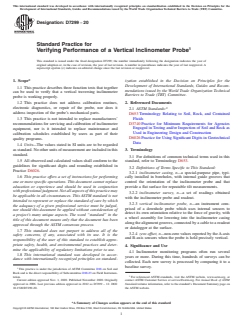
ASTM D7299-20 is a standard published by ASTM International. Its full title is "Standard Practice for Verifying Performance of a Vertical Inclinometer Probe". This standard covers: SIGNIFICANCE AND USE 4.1 Inclinometer monitoring programs often run several years or more. During this time, hundreds of surveys can be collected. Each new survey is processed by comparing it to a baseline survey. 4.2 Over a period of years, normal wear and tear can gradually degrade the probe’s ability to produce new surveys that are directly comparable to the baseline survey. This may go unnoticed for some time, because the quality of readings may degrade in very small increments. 4.3 When function tests are incorporated into an inclinometer monitoring program, the degradation of reading quality can be avoided. Probes that pass the tests can be used with confidence. Probes that fail the tests shall be returned to the probe manufacturer for servicing. It shall be noted that manufacturers calibrate inclinometer probes using high-precision, electronically-controlled equipment in temperature-controlled environments. Ordinary users do not have access to such equipment, so the pass/fail criteria suggested for these tests accommodate typical results produced by less precise equipment in a less controlled environment. Note 1: The quality of the result produced by this standard is dependent on the competence of the personnel performing it and the suitability of the equipment and facilities used. Agencies that meet the criteria of Practice D3740 are generally considered capable of competent and objective testing/sampling/inspection/etc. Users of this standard are cautioned that compliance with Practice D3740 does not in itself assure reliable results. Reliable results depend on many factors; Practice D3740 provides a means of evaluating some of those factors. SCOPE 1.1 This practice describes three function tests that together can be used to verify that a vertical traversing inclinometer probe is working properly. 1.2 This practice does not address calibration routines, electronic diagnostics, or repair of the probe, nor does it address inspection of the probe’s mechanical parts. 1.3 This practice is not intended to replace manufacturers’ recommendations for servicing and calibration of inclinometer equipment, nor is it intended to replace maintenance and calibration schedules established by users as part of their quality programs. 1.4 Units—The values stated in SI units are to be regarded as standard. No other units of measurement are included in this standard. 1.5 All observed and calculated values shall conform to the guidelines for significant digits and rounding established in Practice D6026. 1.6 This practice offers a set of instructions for performing one or more specific operations. This document cannot replace education or experience and should be used in conjunction with professional judgment. Not all aspects of this practice may be applicable in all circumstances. This ASTM standard is not intended to represent or replace the standard of care by which the adequacy of a given professional service must be judged, nor should this document be applied without consideration of a project’s many unique aspects. The word “standard” in the title of this document means only that the document has been approved through the ASTM consensus process. 1.7 This standard does not purport to address all of the safety concerns, if any, associated with its use. It is the responsibility of the user of this standard to establish appropriate safety, health, and environmental practices and determine the applicability of regulatory limitations prior to use. 1.8 This international standard was developed in accordance with internationally recognized principles on standardization established in the Decision on Principles for the Development of International Standards, Guides and Recommendations issued by the World Trade Organization Technical Barriers to Trade (TBT) Committee.
SIGNIFICANCE AND USE 4.1 Inclinometer monitoring programs often run several years or more. During this time, hundreds of surveys can be collected. Each new survey is processed by comparing it to a baseline survey. 4.2 Over a period of years, normal wear and tear can gradually degrade the probe’s ability to produce new surveys that are directly comparable to the baseline survey. This may go unnoticed for some time, because the quality of readings may degrade in very small increments. 4.3 When function tests are incorporated into an inclinometer monitoring program, the degradation of reading quality can be avoided. Probes that pass the tests can be used with confidence. Probes that fail the tests shall be returned to the probe manufacturer for servicing. It shall be noted that manufacturers calibrate inclinometer probes using high-precision, electronically-controlled equipment in temperature-controlled environments. Ordinary users do not have access to such equipment, so the pass/fail criteria suggested for these tests accommodate typical results produced by less precise equipment in a less controlled environment. Note 1: The quality of the result produced by this standard is dependent on the competence of the personnel performing it and the suitability of the equipment and facilities used. Agencies that meet the criteria of Practice D3740 are generally considered capable of competent and objective testing/sampling/inspection/etc. Users of this standard are cautioned that compliance with Practice D3740 does not in itself assure reliable results. Reliable results depend on many factors; Practice D3740 provides a means of evaluating some of those factors. SCOPE 1.1 This practice describes three function tests that together can be used to verify that a vertical traversing inclinometer probe is working properly. 1.2 This practice does not address calibration routines, electronic diagnostics, or repair of the probe, nor does it address inspection of the probe’s mechanical parts. 1.3 This practice is not intended to replace manufacturers’ recommendations for servicing and calibration of inclinometer equipment, nor is it intended to replace maintenance and calibration schedules established by users as part of their quality programs. 1.4 Units—The values stated in SI units are to be regarded as standard. No other units of measurement are included in this standard. 1.5 All observed and calculated values shall conform to the guidelines for significant digits and rounding established in Practice D6026. 1.6 This practice offers a set of instructions for performing one or more specific operations. This document cannot replace education or experience and should be used in conjunction with professional judgment. Not all aspects of this practice may be applicable in all circumstances. This ASTM standard is not intended to represent or replace the standard of care by which the adequacy of a given professional service must be judged, nor should this document be applied without consideration of a project’s many unique aspects. The word “standard” in the title of this document means only that the document has been approved through the ASTM consensus process. 1.7 This standard does not purport to address all of the safety concerns, if any, associated with its use. It is the responsibility of the user of this standard to establish appropriate safety, health, and environmental practices and determine the applicability of regulatory limitations prior to use. 1.8 This international standard was developed in accordance with internationally recognized principles on standardization established in the Decision on Principles for the Development of International Standards, Guides and Recommendations issued by the World Trade Organization Technical Barriers to Trade (TBT) Committee.
ASTM D7299-20 is classified under the following ICS (International Classification for Standards) categories: 17.040.30 - Measuring instruments. The ICS classification helps identify the subject area and facilitates finding related standards.
ASTM D7299-20 has the following relationships with other standards: It is inter standard links to ASTM D3740-23, ASTM D3740-19, ASTM D653-14, ASTM D3740-12a, ASTM D3740-12, ASTM D653-11, ASTM D3740-11, ASTM D3740-10, ASTM D653-09, ASTM D653-08a, ASTM D653-08, ASTM D3740-08, ASTM D653-07f, ASTM D653-07e, ASTM D653-07d. Understanding these relationships helps ensure you are using the most current and applicable version of the standard.
ASTM D7299-20 is available in PDF format for immediate download after purchase. The document can be added to your cart and obtained through the secure checkout process. Digital delivery ensures instant access to the complete standard document.
Standards Content (Sample)
This international standard was developed in accordance with internationally recognized principles on standardization established in the Decision on Principles for the
Development of International Standards, Guides and Recommendations issued by the World Trade Organization Technical Barriers to Trade (TBT) Committee.
Designation: D7299 − 20
Standard Practice for
Verifying Performance of a Vertical Inclinometer Probe
This standard is issued under the fixed designation D7299; the number immediately following the designation indicates the year of
original adoption or, in the case of revision, the year of last revision. A number in parentheses indicates the year of last reapproval. A
superscript epsilon (´) indicates an editorial change since the last revision or reapproval.
1. Scope* ization established in the Decision on Principles for the
Development of International Standards, Guides and Recom-
1.1 This practice describes three function tests that together
mendations issued by the World Trade Organization Technical
can be used to verify that a vertical traversing inclinometer
Barriers to Trade (TBT) Committee.
probe is working properly.
2. Referenced Documents
1.2 This practice does not address calibration routines,
electronic diagnostics, or repair of the probe, nor does it
2.1 ASTM Standards:
address inspection of the probe’s mechanical parts.
D653 Terminology Relating to Soil, Rock, and Contained
Fluids
1.3 This practice is not intended to replace manufacturers’
D3740 Practice for Minimum Requirements for Agencies
recommendations for servicing and calibration of inclinometer
Engaged in Testing and/or Inspection of Soil and Rock as
equipment, nor is it intended to replace maintenance and
Used in Engineering Design and Construction
calibration schedules established by users as part of their
D6026 Practice for Using Significant Digits in Geotechnical
quality programs.
Data
1.4 Units—The values stated in SI units are to be regarded
as standard. No other units of measurement are included in this
3. Terminology
standard.
3.1 For definitions of common technical terms used in this
1.5 All observed and calculated values shall conform to the
standard, refer to Terminology D653.
guidelines for significant digits and rounding established in
3.2 Definitions of Terms Specific to This Standard:
Practice D6026.
3.2.1 inclinometer casing, n—a special-purpose pipe, typi-
1.6 This practice offers a set of instructions for performing
cally installed in boreholes, with internal guide grooves that
one or more specific operations. This document cannot replace
control the orientation of the inclinometer probe and that
education or experience and should be used in conjunction
provide a flat surface for repeatable tilt measurements.
with professional judgment. Not all aspects of this practice may
3.2.2 inclinometer survey, n—a set of readings obtained
be applicable in all circumstances. This ASTM standard is not
with the inclinometer probe and readout.
intended to represent or replace the standard of care by which
3.2.3 vertical inclinometer probe, n—an instrument com-
the adequacy of a given professional service must be judged,
prised of a downhole probe which uses internal sensors to
nor should this document be applied without consideration of
detect its own orientation relative to the force of gravity, with
a project’s many unique aspects. The word “standard” in the
a wheel assembly for lowering into the inclinometer casing
title of this document means only that the document has been
along the alignment grooves, connected by a cable to a readout
approved through the ASTM consensus process.
or datalogger at the surface.
1.7 This standard does not purport to address all of the
3.2.4 zero offset, n—non-zero values reported by the A-axis
safety concerns, if any, associated with its use. It is the
and B-axis sensors when the probe is held precisely vertical.
responsibility of the user of this standard to establish appro-
priate safety, health, and environmental practices and deter-
4. Significance and Use
mine the applicability of regulatory limitations prior to use.
4.1 Inclinometer monitoring programs often run several
1.8 This international standard was developed in accor-
years or more. During this time, hundreds of surveys can be
dance with internationally recognized principles on standard-
collected. Each new survey is processed by comparing it to a
baseline survey.
This practice is under the jurisdiction of ASTM Committee D18 on Soil and
Rock and is the direct responsibility of Subcommittee D18.23 on Field Instrumen-
tation. For referenced ASTM standards, visit the ASTM website, www.astm.org, or
Current edition approved Nov. 1, 2020. Published November 2020. Originally contact ASTM Customer Service at service@astm.org. For Annual Book of ASTM
approved in 2006. Last previous edition approved in 2012 as D7299 – 12. DOI: Standardsvolume information, refer to the standard’s Document Summary page on
10.1520/D7299-20. the ASTM website.
*A Summary of Changes section appears at the end of this standard
Copyright © ASTM International, 100 Barr Harbor Drive, PO Box C700, West Conshohocken, PA 19428-2959. United States
D7299 − 20
4.2 Over a period of years, normal wear and tear can case, the table is mounted vertically, so that it can move the
gradually degrade the probe’s ability to produce new surveys probe through its specified tilt range. A suitable rotary table
that are directly comparable to the baseline survey. This may
will offer a placement accuracy of 30 seconds of arc or better
go unnoticed for some time, because the quality of readings
throughout its range. It shall provide an adjustable dial on the
may degrade in very small increments.
hand wheel that reads directly to each minute of arc, and a
Vernier plate that permits direct reading to within 5 s. The
4.3 When function tests are incorporated into an inclinom-
Vernier scale is used to make the various test measurements.
eter monitoring program, the degradation of reading quality
can be avoided. Probes that pass the tests can be used with 5.2.2 Make the pedestal from a steel I-beam or a steel pipe
confidence. Probes that fail the tests shall be returned to the approximately 150 mm diameter and cut to a convenient
probe manufacturer for servicing. It shall be noted that manu- height. Steel is a commonly available material but other metals
facturers calibrate inclinometer probes using high-precision,
may also be suitable. Make plates for the top and bottom of the
electronically-controlled equipment in temperature-controlled
pedestal using 0.5-in. (12.5 mm) thick steel. Mill the top plate
environments. Ordinary users do not have access to such
flat for proper mounting of the rotary table. Drill bolt holes in
equipment, so the pass/fail criteria suggested for these tests
the base plate, as shown in Fig. 1. Weld the steel plates to the
accommodate typical results produced by less precise equip-
two ends of the beam or pipe. Choose a location for the stand
ment in a less controlled environment.
and set bolts into stable flooring, such as a concrete floor slab.
NOTE 1—The quality of the result produced by this standard is
Ideally, the location will be free from vibration. Place the test
dependent on the competence of the personnel performing it and the
stand onto the bolts. Place steel shims under the bottom plate
suitability of the equipment and facilities used. Agencies that meet the
so that the top plate is completely horizontal, as indicated by a
criteria of Practice D3740 are generally considered capable of competent
and objective testing/sampling/inspection/etc. Users of this standard are
machinist’s bubble level. Tighten nuts on the floor bolts.
cautioned that compliance with Practice D3740 does not in itself assure
5.2.3 MounttherotarytabletothetopplateasshowninFig.
reliable results. Reliable results depend on many factors; Practice D3740
1. Place steel shims as necessary to make the plane of the table
provides a means of evaluating some of those factors.
vertical. Make a probe holder from aluminum tubing approxi-
5. Apparatus
mately 50 mm square-section. The square section tubing holds
the wheels tightly, in a fixed, repeatable position. Inclinometer
5.1 Two pieces of equipment are suggested: a rotary table
test stand and a test casing. All the tests could be performed casing is not a suitable substitute for the tubing, since casing
grooves are purposely made wider to facilitate passage of the
usingonlytherotarytableteststand,butoperationoftherotary
table requires a trained operator working slowly and deliber- probe through deformed casing. Mount the probe holder to the
ately. The test casing, on the other hand, provides a simple test rotary table using two V-blocks, fitting the holder so that it
thatcanbeusedfrequentlybyanyinclinometeruserafterafew
provides two possible positions for the probe, one parallel to
minutes of training. the rotary table, and the other perpendicular to the table.
5.2.4 Devise a means of applying a constant torque to the
5.2 Rotary Table Test Stand:
table to compensate for backlash in the gears and improve the
5.2.1 The rotary table test stand (Fig. 1) consists of a rotary
table mounted on a pedestal.The rotary table is a device that is precision with which the table can be rotated. Fig. 1 shows a
weight suspended from a wire rope that is attached to the table.
commonly used in precision machining operations. In machine
shops, rotary tables are usually mounted horizontally. In this Wrap the wire rope over the top of the table so that the weight
FIG. 1 Rotary Table Test Stand
D7299 − 20
assists rotation toward positive angles (typically clockwise) as 6.2 The test employs the rotary table test stand and requires
read from the scales on the rotary table. anunderstandingoftherotarytableandhowitsscalesareread.
To make positioning of the table as precise as possible, always
5.3 Test Casing:
ap
...
This document is not an ASTM standard and is intended only to provide the user of an ASTM standard an indication of what changes have been made to the previous version. Because
it may not be technically possible to adequately depict all changes accurately, ASTM recommends that users consult prior editions as appropriate. In all cases only the current version
of the standard as published by ASTM is to be considered the official document.
Designation: D7299 − 12 D7299 − 20
Standard Practice for
Verifying Performance of a Vertical Inclinometer Probe
This standard is issued under the fixed designation D7299; the number immediately following the designation indicates the year of
original adoption or, in the case of revision, the year of last revision. A number in parentheses indicates the year of last reapproval. A
superscript epsilon (´) indicates an editorial change since the last revision or reapproval.
1. Scope*
1.1 This practice describes three function tests that together can be used to verify that a vertical traversing inclinometer probe is
working properly.
1.2 This practice does not address calibration routines, electronic diagnostics, or repair of the probe, nor does it address inspection
of the probe’s mechanical parts.
1.3 This practice is not intended to replace manufacturers’ recommendations for servicing and calibration of inclinometer
equipment, nor is it intended to replace maintenance and calibration schedules established by users as part of their quality
programs.
1.4 Units—The values stated in SI units are to be regarded as standard. No other units of measurement are included in this
standard.
1.5 All observed and calculated values shall conform to the guidelines for significant digits and rounding established in Practice
D6026.
1.6 This practice offers a set of instructions for performing one or more specific operations. This document cannot replace
education or experience and should be used in conjunction with professional judgment. Not all aspects of this practice may be
applicable in all circumstances. This ASTM standard is not intended to represent or replace the standard of care by which the
adequacy of a given professional service must be judged, nor should this document be applied without consideration of a project’s
many unique aspects. The word “standard” in the title of this document means only that the document has been approved through
the ASTM consensus process.
1.7 This standard does not purport to address all of the safety concerns, if any, associated with its use. It is the responsibility
of the user of this standard to establish appropriate safety safety, health, and healthenvironmental practices and determine the
applicability of regulatory limitations prior to use.
1.8 This international standard was developed in accordance with internationally recognized principles on standardization
established in the Decision on Principles for the Development of International Standards, Guides and Recommendations issued
by the World Trade Organization Technical Barriers to Trade (TBT) Committee.
This practice is under the jurisdiction of ASTM Committee D18 on Soil and Rock and is the direct responsibility of Subcommittee D18.23 on Field Instrumentation.
Current edition approved July 1, 2012Nov. 1, 2020. Published September 2012November 2020. Originally approved in 2006. Last previous edition approved in 20062012
as D7299 – 06.12. DOI: 10.1520/D7299-12.10.1520/D7299-20.
*A Summary of Changes section appears at the end of this standard
Copyright © ASTM International, 100 Barr Harbor Drive, PO Box C700, West Conshohocken, PA 19428-2959. United States
D7299 − 20
2. Referenced Documents
2.1 ASTM Standards:
D653 Terminology Relating to Soil, Rock, and Contained Fluids
D3740 Practice for Minimum Requirements for Agencies Engaged in Testing and/or Inspection of Soil and Rock as Used in
Engineering Design and Construction
D6026 Practice for Using Significant Digits in Geotechnical Data
3. Terminology
3.1 For definitions of common technical terms used in this practice,standard, refer to Terminology D653.
3.2 Definitions of Terms Specific to This Standard:
3.2.1 inclinometer casing, n—Aa special-purpose pipe, typically installed in boreholes, with internal guide grooves that control
the orientation of the inclinometer probe and that provide a flat surface for repeatable tilt measurements.
3.2.2 inclinometer survey, n—Aa set of readings obtained with the inclinometer probe and readout.
3.2.3 vertical inclinometer probe, n—A wheeled device used to measure the tilt of inclinometer casing that is installed in a vertical
borehole. The wheels of the device track the grooves of the inclinometer casing and also keep the body of the probe centralized
within the casing. Typically there are two sensors inside the device, each capable of reporting positive and negative values. One
sensor measures tilt in the plane of the wheels and is commonly known as the A-axis sensor. The other sensor measures tilt in the
plane normal to the wheels and is commonly known as the B-axis sensor.an instrument comprised of a downhole probe which uses
internal sensors to detect its own orientation relative to the force of gravity, with a wheel assembly for lowering into the
inclinometer casing along the alignment grooves, connected by a cable to a readout or datalogger at the surface.
3.2.4 zero offset, n—Non-zeronon-zero values reported by the A-axis and B-axis sensors when the probe is held precisely vertical.
4. Significance and Use
4.1 Inclinometer monitoring programs often run several years or more. During this time, hundreds of surveys can be collected.
Each new survey is processed by comparing it to a baseline survey.
4.2 Over a period of years, normal wear and tear can gradually degrade the probe’s ability to produce new surveys that are directly
comparable to the baseline survey. This may go unnoticed for some time, because the quality of readings may degrade in very small
increments.
4.3 When function tests are incorporated into an inclinometer monitoring program, the degradation of reading quality can be
avoided. Probes that pass the tests can be used with confidence. Probes that fail the tests shouldshall be returned to the probe
manufacturer for servicing. It shouldshall be noted that manufacturers calibrate inclinometer probes using high-precision,
electronically-controlled equipment in temperature-controlled environments. Ordinary users do not have access to such equipment,
so the pass/fail criteria suggested for these tests accommodate typical results produced by less precise equipment in a less
controlled environment.
NOTE 1—The quality of the result produced by this standard is dependent on the competence of the personnel performing it and the suitability of the
equipment and facilities used. Agencies that meet the criteria of Practice D3740 are generally considered capable of competent and objective
testing/sampling/inspection/etc. Users of this standard are cautioned that compliance with Practice D3740 does not in itself assure reliable results. Reliable
results depend on many factors; Practice D3740 provides a means of evaluating some of those factors.
5. Apparatus
5.1 Two pieces of equipment are suggested: a rotary table test stand and a test casing. All the tests could be performed using only
the rotary table test stand, but operation of the rotary table requires a trained operator working slowly and deliberately. The test
casing, on the other hand, provides a simple test that can be used frequently by any inclinometer user after a few minutes of
training.
For referenced ASTM standards, visit the ASTM website, www.astm.org, or contact ASTM Customer Service at service@astm.org. For Annual Book of ASTM
Standardsvolume information, refer to the standard’s Document Summary page on the ASTM website.
D7299 − 20
5.2 Rotary Table Test Stand:
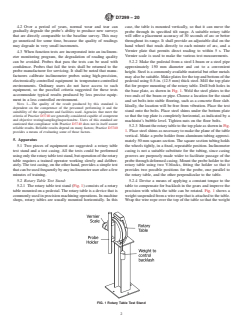
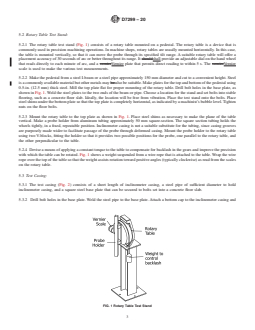
5.2.1 The rotary table test stand (Fig. 1) consists of a rotary table mounted on a pedestal. The rotary table is a device that is
commonly used in precision machining operations. In machine shops, rotary tables are usually mounted horizontally. In this case,
the table is mounted vertically, so that it can move the probe through its specified tilt range. A suitable rotary table will offer a
placement accuracy of 30 seconds of arc or better throughout its range. It shouldshall provide an adjustable dial on the hand wheel
that reads directly to each minute of arc, and a vernierVernier plate that permits direct reading to within 5 s. The vernierVernier
scale is used to make the various test measurements.
5.2.2 Make the pedestal from a steel I-beam or a steel pipe approximately 150 mm diameter and cut to a convenient height. Steel
is a commonly available material but other metals may be also be suitable. Make plates for the top and bottom of the pedestal using
0.5-in. (12.5 mm) thick steel. Mill the top plate flat for proper mounting of the rotary table. Drill bolt holes in the base plate, as
shown in Fig. 1. Weld the steel plates to the two ends of the beam or pipe. Choose a location for the stand and set bolts into stable
flooring, such as a concrete floor slab. Ideally, the location will be free from vibration. Place the test stand onto the bolts. Place
steel shims under the bottom plate so that the top plate is completely horizontal, as indicated by a machinist’s bubble level. Tighten
nuts on the floor bolts.
5.2.3 Mount the rotary table to the top plate as shown in Fig. 1. Place steel shims as necessary to make the plane of the table
vertical. Make a probe holder from aluminum tubing approximately 50 mm square-section. The square section tubing holds the
wheels tightly, in a fixed, repeatable position. Inclinometer casing is not a suitable substitute for the tubing, since casing grooves
are purposely made wider to facilitate passage of the probe through deformed casing. Mount the probe holder to the rotary table
using two V-blocks, fitting the holder so that it provides two possible positions for the probe, one parallel to the rotary table, and
the other perpendicular to the table.
5.2.4 Devise a means of applying a constant torque to the table to compensate for backlash in the gears and improve the precision
with which the table can be rotated. Fig. 1 shows a weight suspended from a wire rope that is attached to the table. Wrap the wire
rope over the top of the table so that the weight assists rotation toward positive angles (typically clockwise) as read from the scales
on the rotary table.
5.3 Test Casing:
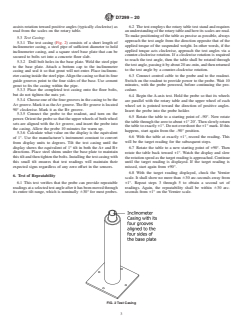
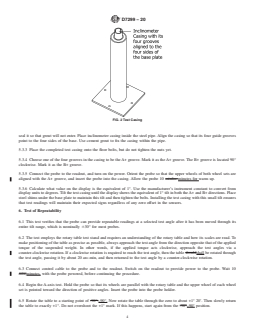
5.3.1 The test casing (Fig. 2) consists of a short length of inclinometer casing, a steel pipe of sufficient diameter
...