

ASTM C564-20a
(Specification)Standard Specification for Rubber Gaskets for Cast Iron Soil Pipe and Fittings
General Information
- Abstract
ABSTRACT
This specification covers preformed rubber gaskets used to seal joints in cast iron soil pipe and fittings. Gaskets shall be made of a properly vulcanized virgin rubber as the sole elastomer with no scrap or reclaim. Gaskets shall conform to the required physical properties such as hardness, elongation, tensile strength, tear strength and compression. The gasket material shall be tested for effects of heat aging. They shall be tested for weight increase due to water absorption and shall also be tested for volume decrease due to oil absorption. Gasket material shall be tested for ozone resistance.
SCOPE
1.1 This specification covers preformed rubber gaskets used to seal joints in cast iron soil pipe and fittings.
1.2 The committee with jurisdiction over this standard is not aware of another comparable standard for materials covered in this standard.
1.3 The values stated in inch-pound units are to be regarded as standard. The values given in parentheses are mathematical conversions to SI units that are provided for information only and are not considered standard.
1.4 The following safety hazards caveat pertains only to the test methods section of this specification: This standard does not purport to address all of the safety concerns, if any, associated with its use. It is the responsibility of the user of this standard to establish appropriate safety, health, and environmental practices and determine the applicability of regulatory limitations prior to use.
1.5 This international standard was developed in accordance with internationally recognized principles on standardization established in the Decision on Principles for the Development of International Standards, Guides and Recommendations issued by the World Trade Organization Technical Barriers to Trade (TBT) Committee.
- Status
- Published
- Publication Date
- 30-Apr-2020
- Technical Committee
- A04 - Iron Castings
- Drafting Committee
- A04.75 - Gaskets and Coupling for Plumbing and Sewer Piping
Buy Documents

ASTM C564-20a - Standard Specification for Rubber Gaskets for Cast Iron Soil Pipe and Fittings
REDLINE ASTM C564-20a - Standard Specification for Rubber Gaskets for Cast Iron Soil Pipe and Fittings
Overview
ASTM C564-20a, titled Standard Specification for Rubber Gaskets for Cast Iron Soil Pipe and Fittings, is a key international standard developed by ASTM that addresses the materials, manufacturing, physical properties, testing, and marking requirements for preformed rubber gaskets used in cast iron soil pipes and fittings. The standard ensures that gaskets used in sanitary, storm drain, waste, and vent piping systems meet stringent quality and performance criteria, supporting reliable, leak-proof pipe joints.
Key Topics
- Material Requirements: Gaskets must be made from properly vulcanized virgin rubber as the sole elastomer, with no added scrap or reclaim material. For certain coupling applications, polychloroprene (neoprene) is specified as the primary elastomer.
- Physical Properties: The rubber used must conform to strict requirements for hardness, elongation, tensile strength, tear strength, and compression set. These properties are assessed using standardized test methods.
- Testing Procedures:
- Heat Aging: Rubber gaskets are evaluated for changes in hardness, tensile strength, and elongation after exposure to high temperatures.
- Water Absorption: Gaskets are tested for weight gain to assess resistance to water penetration.
- Ozone Resistance: Materials are exposed to ozone to ensure resistance to cracking.
- Oil Immersion: Gaskets are tested for volume increase in oil to verify chemical resistance.
- Dimensional Tolerances: Gaskets must adhere to specified dimensional tolerances (RMA Class 3) to ensure compatibility and proper sealing in pipe assemblies.
- Marking and Traceability: All gaskets must be clearly marked with the manufacturer’s name or symbol, pipe size and class, country of origin, ASTM specification number, and year of manufacture to support product traceability.
- Certification and Inspection: Supports quality control through manufacturer and third-party certification of compliance and regular inspection of products.
Applications
The ASTM C564-20a standard is widely used by manufacturers, plumbing engineers, contractors, and inspectors involved in the design, installation, and maintenance of cast iron soil pipe systems. The specification applies to:
- Sanitary Drainage Systems: Ensuring durable and reliable sealing in wastewater removal infrastructure.
- Storm Drain and Vent Piping: Maintaining pipe integrity in systems subject to environmental and structural stresses.
- Fittings and Couplings: Compatibility with hubless and hub-and-spigot cast iron pipes, fittings, and couplings that require secure joint sealing.
- Regulatory Compliance: Facilitating building code adherence and product acceptance for municipal plumbing and public works projects.
- Quality Assurance: Providing benchmarks for manufacturers and third-party certifiers to verify product quality and consistency through rigorous testing and marking protocols.
Related Standards
ASTM C564-20a references and aligns with several other ASTM and industry standards, including:
- ASTM A644 - Terminology Relating to Iron Castings
- ASTM C1277 - Specification for Shielded Couplings Joining Hubless Cast Iron Soil Pipe and Fittings
- ASTM D395, D412, D471, D573, D624, D1149, D1415, D2240, D3677 - Various methods assessing rubber’s mechanical and chemical properties
- CISPI 310 - Specification for Couplings for Use in Connection with Hubless Cast Iron Soil Pipe and Fittings
- RMA Class 3 Dimensional Tolerances - Rubber Manufacturers Association tolerancing standard
ASTM C564-20a is a foundational document for anyone involved in the selection, supply, or regulation of rubber gaskets in cast iron soil pipe applications, supporting safe, consistent, and reliable plumbing system performance. For full technical details, always consult the official ASTM publication.
Relations
- Replaces
ASTM C564-20 - Standard Specification for Rubber Gaskets for Cast Iron Soil Pipe and Fittings - Effective Date
- 01-May-2020
- Effective Date
- 01-Feb-2018
- Effective Date
- 01-Nov-2017
- Effective Date
- 01-May-2015
- Effective Date
- 01-Oct-2014
- Effective Date
- 01-May-2014
- Effective Date
- 01-May-2013
- Effective Date
- 01-Dec-2012
- Effective Date
- 01-Jul-2011
- Effective Date
- 01-Dec-2009
- Effective Date
- 01-Sep-2009
- Effective Date
- 01-Jul-2009
- Effective Date
- 01-Jun-2009
- Effective Date
- 01-Oct-2008
- Effective Date
- 01-Jun-2006
Buy Documents
ASTM C564-20a - Standard Specification for Rubber Gaskets for Cast Iron Soil Pipe and Fittings
REDLINE ASTM C564-20a - Standard Specification for Rubber Gaskets for Cast Iron Soil Pipe and Fittings
Get Certified
Connect with accredited certification bodies for this standard

Institut za varilstvo d.o.o. (Welding Institute)
Slovenia's leading welding institute since 1952. ISO 3834, EN 1090, pressure equipment certification, NDT personnel, welder qualification. Only IIW Au
Sponsored listings
Frequently Asked Questions
ASTM C564-20a is a technical specification published by ASTM International. Its full title is "Standard Specification for Rubber Gaskets for Cast Iron Soil Pipe and Fittings". This standard covers: ABSTRACT This specification covers preformed rubber gaskets used to seal joints in cast iron soil pipe and fittings. Gaskets shall be made of a properly vulcanized virgin rubber as the sole elastomer with no scrap or reclaim. Gaskets shall conform to the required physical properties such as hardness, elongation, tensile strength, tear strength and compression. The gasket material shall be tested for effects of heat aging. They shall be tested for weight increase due to water absorption and shall also be tested for volume decrease due to oil absorption. Gasket material shall be tested for ozone resistance. SCOPE 1.1 This specification covers preformed rubber gaskets used to seal joints in cast iron soil pipe and fittings. 1.2 The committee with jurisdiction over this standard is not aware of another comparable standard for materials covered in this standard. 1.3 The values stated in inch-pound units are to be regarded as standard. The values given in parentheses are mathematical conversions to SI units that are provided for information only and are not considered standard. 1.4 The following safety hazards caveat pertains only to the test methods section of this specification: This standard does not purport to address all of the safety concerns, if any, associated with its use. It is the responsibility of the user of this standard to establish appropriate safety, health, and environmental practices and determine the applicability of regulatory limitations prior to use. 1.5 This international standard was developed in accordance with internationally recognized principles on standardization established in the Decision on Principles for the Development of International Standards, Guides and Recommendations issued by the World Trade Organization Technical Barriers to Trade (TBT) Committee.
ABSTRACT This specification covers preformed rubber gaskets used to seal joints in cast iron soil pipe and fittings. Gaskets shall be made of a properly vulcanized virgin rubber as the sole elastomer with no scrap or reclaim. Gaskets shall conform to the required physical properties such as hardness, elongation, tensile strength, tear strength and compression. The gasket material shall be tested for effects of heat aging. They shall be tested for weight increase due to water absorption and shall also be tested for volume decrease due to oil absorption. Gasket material shall be tested for ozone resistance. SCOPE 1.1 This specification covers preformed rubber gaskets used to seal joints in cast iron soil pipe and fittings. 1.2 The committee with jurisdiction over this standard is not aware of another comparable standard for materials covered in this standard. 1.3 The values stated in inch-pound units are to be regarded as standard. The values given in parentheses are mathematical conversions to SI units that are provided for information only and are not considered standard. 1.4 The following safety hazards caveat pertains only to the test methods section of this specification: This standard does not purport to address all of the safety concerns, if any, associated with its use. It is the responsibility of the user of this standard to establish appropriate safety, health, and environmental practices and determine the applicability of regulatory limitations prior to use. 1.5 This international standard was developed in accordance with internationally recognized principles on standardization established in the Decision on Principles for the Development of International Standards, Guides and Recommendations issued by the World Trade Organization Technical Barriers to Trade (TBT) Committee.
ASTM C564-20a is classified under the following ICS (International Classification for Standards) categories: 23.040.80 - Seals for pipe and hose assemblies. The ICS classification helps identify the subject area and facilitates finding related standards.
ASTM C564-20a has the following relationships with other standards: It is inter standard links to ASTM C564-20, ASTM C1277-18, ASTM A644-17, ASTM C1277-15, ASTM A644-14, ASTM C1277-14, ASTM A644-13, ASTM C1277-12, ASTM C1277-11, ASTM C1277-09a, ASTM C1277-09, ASTM A644-09a, ASTM A644-09, ASTM C1277-08, ASTM C1277-06. Understanding these relationships helps ensure you are using the most current and applicable version of the standard.
ASTM C564-20a is available in PDF format for immediate download after purchase. The document can be added to your cart and obtained through the secure checkout process. Digital delivery ensures instant access to the complete standard document.
Standards Content (Sample)
This international standard was developed in accordance with internationally recognized principles on standardization established in the Decision on Principles for the
Development of International Standards, Guides and Recommendations issued by the World Trade Organization Technical Barriers to Trade (TBT) Committee.
Designation:C564 −20a Endorsed by the
Cast Iron Soil Pipe Institute
Standard Specification for
Rubber Gaskets for Cast Iron Soil Pipe and Fittings
This standard is issued under the fixed designation C564; the number immediately following the designation indicates the year of
original adoption or, in the case of revision, the year of last revision. A number in parentheses indicates the year of last reapproval. A
superscript epsilon (´) indicates an editorial change since the last revision or reapproval.
This standard has been approved for use by agencies of the U.S. Department of Defense.
1. Scope tic Elastomers—Tension
D471 Test Method for Rubber Property—Effect of Liquids
1.1 This specification covers preformed rubber gaskets used
D573 Test Method for Rubber—Deterioration in an Air
to seal joints in cast iron soil pipe and fittings.
Oven
1.2 Thecommitteewithjurisdictionoverthisstandardisnot
D624 Test Method for Tear Strength of Conventional Vul-
aware of another comparable standard for materials covered in
canized Rubber and Thermoplastic Elastomers
this standard.
D1149 Test Methods for Rubber Deterioration—Cracking in
an Ozone Controlled Environment
1.3 The values stated in inch-pound units are to be regarded
as standard. The values given in parentheses are mathematical D1415 Test Method for Rubber Property—International
Hardness
conversions to SI units that are provided for information only
and are not considered standard. D2240 Test Method for Rubber Property—Durometer Hard-
ness
1.4 The following safety hazards caveat pertains only to the
D3677 Test Methods for Rubber—Identification by Infrared
test methods section of this specification: This standard does
Spectrophotometry
not purport to address all of the safety concerns, if any,
associated with its use. It is the responsibility of the user of this 2.2 Other Documents:
standard to establish appropriate safety, health, and environ- RMA Class 3 Dimensional Tolerances, RMA Manual
mental practices and determine the applicability of regulatory CISPI 310 Specification for Couplings for Use in Connec-
limitations prior to use. tion with Hubless Cast Iron Soil Pipe and Fittings for
1.5 This international standard was developed in accor- Sanitary and Storm Drain, Waste, and Vent Piping Appli-
dance with internationally recognized principles on standard- cations
ization established in the Decision on Principles for the
Development of International Standards, Guides and Recom-
3. Terminology
mendations issued by the World Trade Organization Technical
3.1 Definitions—For definitions of terms in this standard,
Barriers to Trade (TBT) Committee.
see Terminology A644.
3.2 Definitions of Terms Specific to This Standard:
2. Referenced Documents
3.2.1 flash, n—the excess material protruding from the
2.1 ASTM Standards:
surface of a molded article at the mold junction.
A644 Terminology Relating to Iron Castings
3.2.2 manufacturer, n—the entity that molds the gaskets
C1277 SpecificationforShieldedCouplingsJoiningHubless
covered by this standard.
Cast Iron Soil Pipe and Fittings
D395 Test Methods for Rubber Property—Compression Set 3.2.3 virgin rubber, n—atermthatmaybeusedinterchange-
D412 Test Methods forVulcanized Rubber andThermoplas- ably with raw rubber (raw thermoset elastomer). A rubber or
thermoset elastomer that has not had any additional work,
diluents incorporated, processes performed on it, or any
This specification is under the jurisdiction of ASTM Committee A04 on Iron
combination thereof.Arubber that is in an unmodified state or
Castings and is the direct responsibility of Subcommittee A04.75 on Gaskets and
oneinwhichnoattempthasbeenmadetoalteritinanyfashion
Coupling for Plumbing and Sewer Piping.
as received from the manufacturer or supplier.
Current edition approved May 1, 2020. Published May 2020. Originally
approved in 1965. Last previous edition approved in 2020 as C564 – 20. DOI:
10.1520/C0564-20A.
For referenced ASTM standards, visit the ASTM website, www.astm.org, or
contact ASTM Customer Service at service@astm.org. For Annual Book of ASTM Available fromAssociation for Rubber Products Manufacturers (ARPM), 7321
Standards volume information, refer to the standard’s Document Summary page on Shadeland StationWay, Suite 285, Indianapolis, IN 46256, http://www.arpminc.org.
the ASTM website. Available from Cast Iron Soil Pipe Institute (CISPI), http://www.cispi.org.
Copyright © ASTM International, 100 Barr Harbor Drive, PO Box C700, West Conshohocken, PA 19428-2959. United States
C564−20a
4. Materials and Manufacture 9. Test Methods
4.1 Gaskets shall be made of a properly vulcanized virgin 9.1 Hardness—The gasket material shall be tested for hard-
compound containing virgin rubber as the sole elastomer with ness in accordance with Test Method D2240. Test Method
no scrap or reclaim. D1415 shall be used as the referee method. Hardness measure-
mentsshallbemadeonspecimenspreparedinaccordancewith
4.2 Gaskets manufactured for use in couplings complying
9.2.However,hardnessreadingsforguidancepurposesshallbe
with Specification C1277 or CISPI 310 shall be manufactured
permitted to be taken directly on the gasket, recognizing that
from a properly vulcanized virgin compound in which the
these readings shall be permitted to vary slightly from those
primary elastomer is polychloroprene (neoprene). The gaskets
taken on the dumbbell specimens. Tests shall be performed
shall be tested in accordance with Test Methods D3677.
during the day of production not to exceed a 24-h period for
each size and type gasket produced during that period.
5. Physical Requirements
9.2 Elongation and Tensile Strength—The gasket material
5.1 Sample gaskets selected as specified in Section 8 shall
shallbetestedforelongationandtensilestrengthinaccordance
conform to the requirements for physical properties listed in
with Test Methods D412. Standard ASTM Type C dumbbell
Table 1 when tested in accordance with the methods specified
specimens conforming to Fig. 1 (Apparatus for Tensile Set
in Section 9.
Test) of Test Methods D412 shall be cut from a section of the
6. Dimensions and Permissible Variations
gasket for this test. To obtain a uniform thickness, these gasket
sections shall be permitted to be buffed prior to cutting into
6.1 Gaskets shall conform to the dimensions specified by
dumbbell specimens, so as to produce a finely ground surface
the manufacturer.
without cuts or burns. Tests shall be performed during the day
6.2 Allcross-sectionaldimensionsshallhaveanRMAClass
ofproductionnottoexceeda24-hperiodforeachsizeandtype
3 tolerance as shown in Annex A1, and all diametral dimen-
gasket produced during that period.
sions shall have a tolerance of 61%.
9.3 Tear Strength—The gasket material shall be tested for
tear strength in accordance with Test Method D624 using Die
7. Workmanship
C.Tests shall be performed during the day of production not to
7.1 The surface of the gasket shall be smooth and free of
exceed a 24-h period for each size and type gasket produced
pitting, cracks, blisters, air marks, and any other imperfections
during that period.
that will affect its behavior in service. The body of the gasket
9.4 Compression Set—The gasket material shall be tested
shall be free of porosity and air pockets.
for compression set in accordance with Test Methods D395
7.2 Neither the flash thickness nor the flash extension shall
using Method B. Specimens shall be aged in an oven for 22 h
exceed ⁄32 in. (0.8 mm) at any point on the sealing ring.
at 158 6 2 °F (70 6 1 °C). Where plied specimens are
7.3 The offset, or failure of the mold to register accurately,
necessary, the results shall comply with the requirements of
shall not exceed ⁄64 in. (0.4 mm).
Table 1.Tests shall be performed after 24 h but not longer than
72 h after day of production for each size and type gasket
8. Sampling
produced during that day.
8.1 For each of the tests, gaskets shall be selected at random 9.4.1 When testing pipe gaskets, the prepared specimens
and tests be performed by the method and frequency of the shall be 1-in. disks cut from prepared samples 0.075 in.
tests as specified in Section 9. (1.905 mm) to 0.090 in. (2.286 mm) thick and not to exceed
TABLE 1 Physical Requirements of Gaskets
Property Requirements ASTM Test Method
AB C
Hardness (nominal durometer ±5) as specified by the 50 60 70 D2240
pipe manufacturer
Elongation, min, % 350 300 250 D412
Tensile strength, min, psi 1500 1500 1500 D412
(MPa) (10) (10) (10)
Tear strength, min, lbf/in. 150 150 150
(N/cm) (268) (268) (268) D624
Compression set, max, % 25 25 25 D395
Heat aging, 96 h at 158 ± 2 °F (70 ± 1
...
This document is not an ASTM standard and is intended only to provide the user of an ASTM standard an indication of what changes have been made to the previous version. Because
it may not be technically possible to adequately depict all changes accurately, ASTM recommends that users consult prior editions as appropriate. In all cases only the current version
of the standard as published by ASTM is to be considered the official document.
Designation: C564 − 20 C564 − 20a Endorsed by the
Cast Iron Soil Pipe Institute
Standard Specification for
Rubber Gaskets for Cast Iron Soil Pipe and Fittings
This standard is issued under the fixed designation C564; the number immediately following the designation indicates the year of
original adoption or, in the case of revision, the year of last revision. A number in parentheses indicates the year of last reapproval. A
superscript epsilon (´) indicates an editorial change since the last revision or reapproval.
This standard has been approved for use by agencies of the U.S. Department of Defense.
1. Scope
1.1 This specification covers preformed rubber gaskets used to seal joints in cast iron soil pipe and fittings.
1.2 The committee with jurisdiction over this standard is not aware of another comparable standard for materials covered in this
standard.
1.3 The values stated in inch-pound units are to be regarded as standard. The values given in parentheses are mathematical
conversions to SI units that are provided for information only and are not considered standard.
1.4 The following safety hazards caveat pertains only to the test methods section of this specification: This standard does not
purport to address all of the safety concerns, if any, associated with its use. It is the responsibility of the user of this standard to
establish appropriate safety, health, and environmental practices and determine the applicability of regulatory limitations prior
to use.
1.5 This international standard was developed in accordance with internationally recognized principles on standardization
established in the Decision on Principles for the Development of International Standards, Guides and Recommendations issued
by the World Trade Organization Technical Barriers to Trade (TBT) Committee.
2. Referenced Documents
2.1 ASTM Standards:
A644 Terminology Relating to Iron Castings
C1277 Specification for Shielded Couplings Joining Hubless Cast Iron Soil Pipe and Fittings
D395 Test Methods for Rubber Property—Compression Set
D412 Test Methods for Vulcanized Rubber and Thermoplastic Elastomers—Tension
D471 Test Method for Rubber Property—Effect of Liquids
D573 Test Method for Rubber—Deterioration in an Air Oven
D624 Test Method for Tear Strength of Conventional Vulcanized Rubber and Thermoplastic Elastomers
D1149 Test Methods for Rubber Deterioration—Cracking in an Ozone Controlled Environment
D1415 Test Method for Rubber Property—International Hardness
D2240 Test Method for Rubber Property—Durometer Hardness
D3677 Test Methods for Rubber—Identification by Infrared Spectrophotometry
2.2 Other Documents:
RMA Class 3 Dimensional Tolerances, RMA Manual
CISPI 310 Specification for Couplings for Use in Connection with Hubless Cast Iron Soil Pipe and Fittings for Sanitary and
Storm Drain, Waste, and Vent Piping Applications
3. Terminology
3.1 Definitions—For definitions of terms in this standard, see Terminology A644.
3.2 Definitions of Terms Specific to This Standard:
This specification is under the jurisdiction of ASTM Committee A04 on Iron Castings and is the direct responsibility of Subcommittee A04.75 on Gaskets and Coupling
for Plumbing and Sewer Piping.
Current edition approved March 15, 2020May 1, 2020. Published March 2020May 2020. Originally approved in 1965. Last previous edition approved in 20142020 as
C564 – 14.C564 – 20. DOI: 10.1520/C0564-20.10.1520/C0564-20A.
For referenced ASTM standards, visit the ASTM website, www.astm.org, or contact ASTM Customer Service at service@astm.org. For Annual Book of ASTM Standards
volume information, refer to the standard’s Document Summary page on the ASTM website.
Available from Association for Rubber Products Manufacturers (ARPM), 7321 Shadeland Station Way, Suite 285, Indianapolis, IN 46256, http://www.arpminc.org.
Available from Cast Iron Soil Pipe Institute (CISPI), http://www.cispi.org.
Copyright © ASTM International, 100 Barr Harbor Drive, PO Box C700, West Conshohocken, PA 19428-2959. United States
C564 − 20a
3.2.1 flash, n—the excess material protruding from the surface of a molded article at the mold junction.
3.2.2 manufacturer, n—the entity that molds the gaskets covered by this standard.
3.2.3 virgin rubber, n—a term that may be used interchangeably with raw rubber (raw thermoset elastomer). A rubber or
thermoset elastomer that has not had any additional work, diluents incorporated, processes performed on it, or any combination
thereof. A rubber that is in an unmodified state or one in which no attempt has been made to alter it in any fashion as received
from the manufacturer or supplier.
4. Materials and Manufacture
4.1 Gaskets shall be made of a properly vulcanized virgin compound containing virgin rubber as the sole elastomer with no
scrap or reclaim.
4.2 Gaskets manufactured for use in couplings complying with Specification C1277 or CISPI 310 shall be manufactured from
a properly vulcanized virgin compound in which the primary elastomer is polychloroprene (neoprene). The gaskets shall be tested
in accordance with Test Methods D3677.
5. Physical Requirements
5.1 Sample gaskets selected as specified in Section 8 shall conform to the requirements for physical properties listed in Table
1 when tested in accordance with the methods specified in Section 9.
6. Dimensions and Permissible Variations
6.1 Gaskets shall conform to the dimensions specified by the manufacturer.
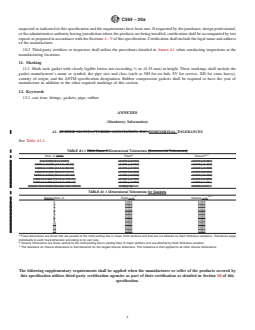
6.2 All cross-sectional dimensions shall have an RMA Class 3 tolerance as shown in Annex A1, and all diametral dimensions
shall have a tolerance of 61 %.
7. Workmanship
7.1 The surface of the gasket shall be smooth and free of pitting, cracks, blisters, air marks, and any other imperfections that
will affect its behavior in service. The body of the gasket shall be free of porosity and air pockets.
7.2 Neither the flash thickness nor the flash extension shall exceed ⁄32 in. (0.8 mm) at any point on the sealing ring.
7.3 The offset, or failure of the mold to register accurately, shall not exceed ⁄64 in. (0.4 mm).
8. Sampling
8.1 For each of the tests, gaskets shall be selected at random and tests be performed by the method and frequency of the tests
as specified in Section 9.
9. Test Methods
9.1 Hardness—The gasket material shall be tested for hardness in accordance with Test Method D2240. Test Method D1415
shall be used as the referee method. Hardness measurements shall be made on specimens prepared in accordance with 9.2.
However, hardness readings for guidance purposes shall be permitted to be taken directly on the gasket, recognizing that these
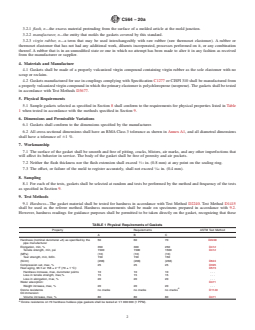
TABLE 1 Physical Requirements of Gaskets
Property Requirements ASTM Test Method
A B C
Hardness (nominal durometer ±5) as specified by the 50 60 70 D2240
pipe manufacturer
Elongation, min, % 350 300 250 D412
Tensile strength, min, psi 1500 1500 1500 D412
(MPa) (10) (10) (10)
Tear strength, min, lbf/in. 150 150 150
(N/cm) (268) (268) (268) D624
Compression set, max, % 25 25 25 D395
Heat aging, 96 h at 158 ± 2 °F (70 ± 1 °C): D573
Hardness increase, max, durometer points 10 10 10 . . .
Loss in tensile strength, max,% 15 15 15 . . .
Loss in elongation, max, % 20 20 20 . . .
Water absorption: D471
Weight increase, max, % 20 20 20 . . .
A
Ozone resistance no cracks no cracks no cracks D1149
Oil immersion:
Volume increase, max, % 80 80 80 D471
A
Ozone resistance on 70 hardness hubless pipe gaskets shall be tested at 1/1 000 000 (1 PPM).
C564 − 20a
readings shall be permitted to vary slightly from those taken on the dumbbell specimens. Tests shall be performed during the day
of production not to exceed a 24-h period for each size and type gasket produced during that period.
9.2 Elongation and Tensile Strength—The gasket material shall be tested for elongation and tensile strength in accordance with
Test Methods D412. Standard ASTM Type C dumbbell specimens conforming to Fig. 1 (Apparatus for Tensile Set Test) of Test
Methods D412 shall be cut from a section of the gasket for this test. To obtain a uniform thickness, these gasket sections shall be
permitted to be buffed prior to cutting into dumbbell specimens, so as to produce a finely ground surface without cuts or burns.
Tests shall be performed during the day of production not to exceed a 24-h period for each size and type gasket produced during
that period.
9.3 Tear Strength—The gasket material shall be tested for tear strength in accordance with Test Method D624 using Die C. Tests
shall be performed during the day of production not to exceed a 24-h period for each size and type gasket produced during that
period.
9.4 Compression Set—The gasket material shall be tested for compression set in accordance with Test Methods D395 using
Method B. Specimens shall be aged in an oven for 22 h at 158 6 2 °F (70 6 1 °C). Where plied specimens are necessary, the results
shall comply with the requirements of Table 1. Tests shall be performed after 24 h but not longer than 72 h after day of production
for e
...