

ASTM D3874-20
(Test Method)Standard Test Method for Ignition of Materials by Hot Wire Sources
General Information
- Abstract
SIGNIFICANCE AND USE
5.1 During operation of electrical equipment, including wires, resistors, and other conductors, it is possible for overheating to occur, under certain conditions of operation or when malfunctions occur. When this happens, a possible result is ignition of the insulation material.
5.2 This test method assesses the relative resistance of electrical insulating materials to ignition by the effect of hot wire sources.
5.3 This test method determines the average time, in seconds, required for material specimens to ignite under the specified conditions of test.
5.4 This method is suitable to characterize materials, subject to the appropriate limitations of an expected precision of ±15 %, to categorize materials.
5.5 In this procedure the specimens are subjected to one or more specific sets of laboratory conditions. If different test conditions are substituted or the end-use conditions are changed, it is not always possible by or from this test to predict changes in the fire-test-response characteristics measured. Therefore, the results are valid only for the fire test exposure conditions described in this procedure.
SCOPE
1.1 This test method is intended to differentiate, in a preliminary fashion, among materials with respect to their resistance to ignition because of their proximity to electrically-heated wires and other heat sources.2
1.2 This test method applies to molded or sheet materials available in thicknesses up to and including 13.0 mm (0.51 in.).
1.3 This test method applies to materials that are rigid or flexible at normal room temperatures. It is important to minimize deformation during preparation, especially during the wire-wrapping step described in 10.1, by following the method outlined under Clause 10, Sample Preparation. Examples of deformation include bowing, in either a transverse or a longitudinal direction, twisting of the specimen, and indentation of the wire into the specimen during the wire-wrapping step, to a degree visible to the eye.
1.4 The values stated in SI units are to be regarded as standard. The values given in parentheses after SI units are provided for information only and are not considered standard. (See SI10 for further details.)
1.5 This test method measures and describes the response of materials, products, or assemblies to heat and flame under controlled conditions, but does not by itself incorporate all factors required for fire hazard or fire risk assessment of the materials, products, or assemblies under actual fire conditions.
1.6 This standard does not purport to address all of the safety concerns, if any, associated with its use. It is the responsibility of the user of this standard to establish appropriate safety, health, and environmental practices and determine the applicability of regulatory limitations prior to use.
1.7 Fire testing is inherently hazardous. Adequate safeguards for personnel and property shall be employed in conducting these tests.
Note 1: Although this test method and IEC TS 60695-2-20 (withdrawn) differ in approach and in detail, data obtained using either are technically equivalent.
1.8 This international standard was developed in accordance with internationally recognized principles on standardization established in the Decision on Principles for the Development of International Standards, Guides and Recommendations issued by the World Trade Organization Technical Barriers to Trade (TBT) Committee.
- Status
- Published
- Publication Date
- 29-Feb-2020
- Technical Committee
- D09 - Electrical and Electronic Insulating Materials
- Drafting Committee
- D09.17 - Fire and Thermal Properties
Overview
ASTM D3874-20 is the internationally recognized Standard Test Method for Ignition of Materials by Hot Wire Sources, developed by ASTM International. This test method provides a systematic approach for assessing the resistance of electrical insulating materials to ignition when exposed to heated wires or similar heat sources. As electrical equipment operates, overheating can sometimes cause electrical conductors, such as wires and resistors, to become potential ignition sources, especially in the event of equipment malfunction. This standard helps differentiate materials based on their ignition resistance under controlled laboratory conditions, enabling safer material selection for electrical insulation.
Key Topics
- Hot Wire Ignition Testing: The method involves wrapping a sample with a calibrated, electrically heated wire and measuring the time to ignition or melt-through under controlled conditions.
- Applicability: Covers both rigid and flexible molded or sheet materials up to 13.0 mm (0.51 in.) thick, ensuring a broad scope for insulation materials.
- Material Characterization: Provides a means to categorize and compare materials by their average ignition time, supporting product development and safety evaluations.
- Testing Parameters:
- Specimens are exposed to a specified power density on the hot wire.
- The time-to-ignition or time-to-melt-through is precisely recorded.
- Results are valid only for the laboratory exposure conditions defined in this procedure.
- Limitations: While useful for preliminary material differentiation, results are not directly transferable to all real-world fire-risk scenarios.
- Precision: The test has an expected precision of ±15% for the characterization of materials.
Applications
- Electrical Insulating Materials: Critical for selecting or certifying insulating materials used in wiring, electronic devices, transformers, and other electrical equipment.
- Fire Hazard Assessment: While not a comprehensive fire risk assessment tool, this standardized method helps in reducing the fire risks posed by insulating materials in proximity to hot electrical components.
- Safety Compliance: Alignment with fire safety requirements for consumer electronics, industrial equipment, and building materials, aiding manufacturers and regulatory agencies.
- Research and Development: Valuable in R&D for new materials, enabling precise comparison of new formulations or insulation products.
- Quality Assurance: Used by manufacturers for batch testing insulating materials to verify conformance to ignition resistance specifications.
Related Standards
- ASTM D1711: Terminology Relating to Electrical Insulation, which provides critical definitions for key terms used in D3874-20.
- ASTM D6194: Test Method for Glow-Wire Ignition of Materials, addressing material response to another common ignition hazard.
- ASTM E176: Terminology of Fire Standards, serving as the authority for fire-related terminology.
- ASTM E3020: Practice for Ignition Sources, outlining various ignition source characteristics and additional test methods.
- IEC 60695-4: International vocabulary for fire tests related to electrotechnical products.
- ISO 13943: Fire Safety Vocabulary.
- IEEE/ASTM SI-10: American National Standard for Metric Practice, relevant for unit standardization throughout testing.
- IEC TS 60695-2-20 (Withdrawn): Provided comparable hot-wire ignition methods, with results considered technically equivalent for reference purposes.
Practical Value
By applying ASTM D3874-20, manufacturers, testing laboratories, and regulatory bodies can make informed, safety-conscious decisions in the selection and approval of electrical insulating materials. This hot wire ignition test method is especially vital for mitigating potential fire hazards in electrical and electronic applications, promoting compliance with global safety standards, and ensuring the overall integrity and reliability of electrical systems.
Relations
- Effective Date
- 01-Mar-2020
- Effective Date
- 01-Mar-2024
- Effective Date
- 01-Jan-2024
- Effective Date
- 15-Dec-2018
- Effective Date
- 01-Mar-2018
- Effective Date
- 01-Jun-2016
- Effective Date
- 01-Nov-2015
- Effective Date
- 01-Aug-2015
- Effective Date
- 01-Aug-2015
- Effective Date
- 01-Aug-2015
- Effective Date
- 01-Feb-2015
- Effective Date
- 01-Nov-2014
- Effective Date
- 01-Nov-2014
- Effective Date
- 01-Oct-2014
- Effective Date
- 15-Aug-2014
Get Certified
Connect with accredited certification bodies for this standard

IMQ S.p.A. (Certification)
Italian electrical product certification.

SLG Prüf- und Zertifizierungs GmbH
German testing and certification body.

UL Solutions
Global safety science company with testing, inspection and certification.
Sponsored listings
Frequently Asked Questions
ASTM D3874-20 is a standard published by ASTM International. Its full title is "Standard Test Method for Ignition of Materials by Hot Wire Sources". This standard covers: SIGNIFICANCE AND USE 5.1 During operation of electrical equipment, including wires, resistors, and other conductors, it is possible for overheating to occur, under certain conditions of operation or when malfunctions occur. When this happens, a possible result is ignition of the insulation material. 5.2 This test method assesses the relative resistance of electrical insulating materials to ignition by the effect of hot wire sources. 5.3 This test method determines the average time, in seconds, required for material specimens to ignite under the specified conditions of test. 5.4 This method is suitable to characterize materials, subject to the appropriate limitations of an expected precision of ±15 %, to categorize materials. 5.5 In this procedure the specimens are subjected to one or more specific sets of laboratory conditions. If different test conditions are substituted or the end-use conditions are changed, it is not always possible by or from this test to predict changes in the fire-test-response characteristics measured. Therefore, the results are valid only for the fire test exposure conditions described in this procedure. SCOPE 1.1 This test method is intended to differentiate, in a preliminary fashion, among materials with respect to their resistance to ignition because of their proximity to electrically-heated wires and other heat sources.2 1.2 This test method applies to molded or sheet materials available in thicknesses up to and including 13.0 mm (0.51 in.). 1.3 This test method applies to materials that are rigid or flexible at normal room temperatures. It is important to minimize deformation during preparation, especially during the wire-wrapping step described in 10.1, by following the method outlined under Clause 10, Sample Preparation. Examples of deformation include bowing, in either a transverse or a longitudinal direction, twisting of the specimen, and indentation of the wire into the specimen during the wire-wrapping step, to a degree visible to the eye. 1.4 The values stated in SI units are to be regarded as standard. The values given in parentheses after SI units are provided for information only and are not considered standard. (See SI10 for further details.) 1.5 This test method measures and describes the response of materials, products, or assemblies to heat and flame under controlled conditions, but does not by itself incorporate all factors required for fire hazard or fire risk assessment of the materials, products, or assemblies under actual fire conditions. 1.6 This standard does not purport to address all of the safety concerns, if any, associated with its use. It is the responsibility of the user of this standard to establish appropriate safety, health, and environmental practices and determine the applicability of regulatory limitations prior to use. 1.7 Fire testing is inherently hazardous. Adequate safeguards for personnel and property shall be employed in conducting these tests. Note 1: Although this test method and IEC TS 60695-2-20 (withdrawn) differ in approach and in detail, data obtained using either are technically equivalent. 1.8 This international standard was developed in accordance with internationally recognized principles on standardization established in the Decision on Principles for the Development of International Standards, Guides and Recommendations issued by the World Trade Organization Technical Barriers to Trade (TBT) Committee.
SIGNIFICANCE AND USE 5.1 During operation of electrical equipment, including wires, resistors, and other conductors, it is possible for overheating to occur, under certain conditions of operation or when malfunctions occur. When this happens, a possible result is ignition of the insulation material. 5.2 This test method assesses the relative resistance of electrical insulating materials to ignition by the effect of hot wire sources. 5.3 This test method determines the average time, in seconds, required for material specimens to ignite under the specified conditions of test. 5.4 This method is suitable to characterize materials, subject to the appropriate limitations of an expected precision of ±15 %, to categorize materials. 5.5 In this procedure the specimens are subjected to one or more specific sets of laboratory conditions. If different test conditions are substituted or the end-use conditions are changed, it is not always possible by or from this test to predict changes in the fire-test-response characteristics measured. Therefore, the results are valid only for the fire test exposure conditions described in this procedure. SCOPE 1.1 This test method is intended to differentiate, in a preliminary fashion, among materials with respect to their resistance to ignition because of their proximity to electrically-heated wires and other heat sources.2 1.2 This test method applies to molded or sheet materials available in thicknesses up to and including 13.0 mm (0.51 in.). 1.3 This test method applies to materials that are rigid or flexible at normal room temperatures. It is important to minimize deformation during preparation, especially during the wire-wrapping step described in 10.1, by following the method outlined under Clause 10, Sample Preparation. Examples of deformation include bowing, in either a transverse or a longitudinal direction, twisting of the specimen, and indentation of the wire into the specimen during the wire-wrapping step, to a degree visible to the eye. 1.4 The values stated in SI units are to be regarded as standard. The values given in parentheses after SI units are provided for information only and are not considered standard. (See SI10 for further details.) 1.5 This test method measures and describes the response of materials, products, or assemblies to heat and flame under controlled conditions, but does not by itself incorporate all factors required for fire hazard or fire risk assessment of the materials, products, or assemblies under actual fire conditions. 1.6 This standard does not purport to address all of the safety concerns, if any, associated with its use. It is the responsibility of the user of this standard to establish appropriate safety, health, and environmental practices and determine the applicability of regulatory limitations prior to use. 1.7 Fire testing is inherently hazardous. Adequate safeguards for personnel and property shall be employed in conducting these tests. Note 1: Although this test method and IEC TS 60695-2-20 (withdrawn) differ in approach and in detail, data obtained using either are technically equivalent. 1.8 This international standard was developed in accordance with internationally recognized principles on standardization established in the Decision on Principles for the Development of International Standards, Guides and Recommendations issued by the World Trade Organization Technical Barriers to Trade (TBT) Committee.
ASTM D3874-20 is classified under the following ICS (International Classification for Standards) categories: 13.220.40 - Ignitability and burning behaviour of materials and products; 29.035.01 - Insulating materials in general. The ICS classification helps identify the subject area and facilitates finding related standards.
ASTM D3874-20 has the following relationships with other standards: It is inter standard links to ASTM D3874-18, ASTM D1711-24, ASTM E176-24, ASTM E176-18a, ASTM E176-18, ASTM E3020-16, ASTM D1711-15, ASTM E176-15a, ASTM E3020-15, ASTM E176-15ae1, ASTM E176-15, ASTM D1711-14a, ASTM D6194-14, ASTM E176-14c, ASTM E176-14b. Understanding these relationships helps ensure you are using the most current and applicable version of the standard.
ASTM D3874-20 is available in PDF format for immediate download after purchase. The document can be added to your cart and obtained through the secure checkout process. Digital delivery ensures instant access to the complete standard document.
Standards Content (Sample)
This international standard was developed in accordance with internationally recognized principles on standardization established in the Decision on Principles for the
Development of International Standards, Guides and Recommendations issued by the World Trade Organization Technical Barriers to Trade (TBT) Committee.
Designation: D3874 − 20
Standard Test Method for
Ignition of Materials by Hot Wire Sources
This standard is issued under the fixed designation D3874; the number immediately following the designation indicates the year of
original adoption or, in the case of revision, the year of last revision. A number in parentheses indicates the year of last reapproval. A
superscript epsilon (´) indicates an editorial change since the last revision or reapproval.
NOTE 1—Although this test method and IEC TS 60695-2-20 (with-
1. Scope*
drawn) differ in approach and in detail, data obtained using either are
1.1 This test method is intended to differentiate, in a
technically equivalent.
preliminary fashion, among materials with respect to their
1.8 This international standard was developed in accor-
resistance to ignition because of their proximity to electrically-
dance with internationally recognized principles on standard-
heated wires and other heat sources.
ization established in the Decision on Principles for the
1.2 This test method applies to molded or sheet materials
Development of International Standards, Guides and Recom-
availableinthicknessesuptoandincluding13.0mm(0.51 in.). mendations issued by the World Trade Organization Technical
Barriers to Trade (TBT) Committee.
1.3 This test method applies to materials that are rigid or
flexible at normal room temperatures. It is important to
2. Referenced Documents
minimize deformation during preparation, especially during
2.1 ASTM Standards:
the wire-wrapping step described in 10.1, by following the
D1711 Terminology Relating to Electrical Insulation
method outlined under Clause 10, Sample Preparation. Ex-
D6194 Test Method for Glow-Wire Ignition of Materials
amplesofdeformationincludebowing,ineitheratransverseor
E176 Terminology of Fire Standards
a longitudinal direction, twisting of the specimen, and inden-
E3020 Practice for Ignition Sources
tation of the wire into the specimen during the wire-wrapping
IEEE/ASTM SI-10 American National Standard for Metric
step, to a degree visible to the eye.
Practice
1.4 The values stated in SI units are to be regarded as 4
2.2 IEC Standards:
standard. The values given in parentheses after SI units are
IEC TS 60695-2-20:2004 Fire Hazard Testing—Section 20:
provided for information only and are not considered standard.
Glowing/Hot-wire Based Test Methods, Hot-wire Coil
(See SI10 for further details.)
Ignitability Test on Materials (withdrawn)
1.5 Thistestmethodmeasuresanddescribestheresponseof
IEC 60695-4 Fire Hazard Testing—Part 4: Terminology
materials, products, or assemblies to heat and flame under
Concerning Fire Tests for Electrotechnical Products
controlled conditions, but does not by itself incorporate all
2.3 ISO Standard:
factors required for fire hazard or fire risk assessment of the
ISO 13943 Fire Safety—Vocabulary
materials, products, or assemblies under actual fire conditions.
3. Terminology
1.6 This standard does not purport to address all of the
3.1 Definitions:
safety concerns, if any, associated with its use. It is the
3.1.1 Use Terminology E176, ISO 13943, and IEC 60695-4
responsibility of the user of this standard to establish appro-
for definitions of terms used in this test method and associated
priate safety, health, and environmental practices and deter-
with fire issues. Where differences exist in definitions, those
mine the applicability of regulatory limitations prior to use.
contained in Terminology E176 shall be used. Use Terminol-
1.7 Fire testing is inherently hazardous. Adequate safe-
ogy D1711 for definitions of terms used in this test method and
guards for personnel and property shall be employed in
associated with electrical insulation materials.
conducting these tests.
For referenced ASTM standards, visit the ASTM website, www.astm.org, or
This test method is under the jurisdiction of ASTM Committee D09 on contact ASTM Customer Service at service@astm.org. For Annual Book of ASTM
Electrical and Electronic Insulating Materials and is the direct responsibility of Standards volume information, refer to the standard’s Document Summary page on
Subcommittee D09.17 on Fire and Thermal Properties. the ASTM website.
Current edition approved March 1, 2020. Published March 2020. Originally Available from International Electrotechnical Commission (IEC), 3, rue de
approved in 1988. Last previous edition approved in 2018 as D3874 – 18. DOI: Varembé, 1st floor, P.O. Box 131, CH-1211, Geneva 20, Switzerland, https://
10.1520/D3874-20. www.iec.ch.
2 5
Mathes, K. N., “Surface Failure Measurements,” Engineering Dielectrics, Available from International Organization for Standardization (ISO), ISO
Vol IIB, Electrical Properties of Solid Insulating Materials: Measurement Central Secretariat, BIBC II, Chemin de Blandonnet 8, CP 401, 1214 Vernier,
Techniques, ASTM STP 926, Chapter 4, ASTM International, 1987. Geneva, Switzerland, http://www.iso.org.
*A Summary of Changes section appears at the end of this standard
Copyright © ASTM International, 100 Barr Harbor Drive, PO Box C700, West Conshohocken, PA 19428-2959. United States
D3874 − 20
3.2 Definitions of Terms Specific to This Standard: least 0.31 W/mm (8.0 W/in.) over the length of the heater wire
3.2.1 ignition, n—the initiation of combustion. E176 at or near unity power factor. The power density of the supply
3.2.1.1 Discussion—The combustion may be evidenced by circuit at 60 A and 1.5 V shall approximate 0.3 W/mm.
glow, flame, detonation, or explosion. The combustion may be 6.3.2 The supply circuit shall have a means of voltage
sustained or transient. (See Terminology E176.) adjustment to achieve the desired current as determined from
Annex A1. Such means of voltage adjustment shall provide a
4. Summary of Test Method
smooth and continuous adjustment of the power level.
4.1 In this test method, a rectangular bar-shaped test
6.3.3 The supply circuit shall have a means of voltage
specimen, with the center portion wrapped with a coil of heater
adjustment of measuring the power to within 62%.
wire, is supported horizontally at both ends. The circuit is then
6.3.4 The test circuit shall be provided with an easily
energized by applying a fixed power density to the heater wire,
actuated on-off switch for the test power, and with timers to
which rapidly heats up. The behavior of the test specimen is
record the duration of the application of test power.
observed until one of the following happens: (a) the material
6.4 Test Chamber—Useasatestchamberadraft-freeclosed
under test ignites, (b) the material under test melts, or (c) 120 s 3 3
chamberhavingavolumeofatleast0.3m (10.5ft ).Theratio
ofexposurehavegonebywithoutignitionormelting.Thetime
between any two transverse dimensions of the chamber shall
to ignition and the time to melt through, as applicable, are
not exceed 2.5. The test chamber shall be positively vented to
recorded.
the outside of the test facility before and after the test, but it
shall remain closed and unvented during the test. The chamber
5. Significance and Use
shall be equipped with an observation window.
5.1 During operation of electrical equipment, including
6.5 Test Fixture—Two supporting posts shall be positioned
wires, resistors, and other conductors, it is possible for over-
70 mm (2 ⁄4 in.) apart to support the specimen in a horizontal
heating to occur, under certain conditions of operation or when
position, at a height of 60 mm (2 ⁄8 in.) above the bottom of the
malfunctions occur. When this happens, a possible result is
test chamber, in the approximate center of the test chamber.
ignition of the insulation material.
6.6 Specimen-Winding Fixture—A fixture shall be provided
5.2 This test method assesses the relative resistance of
to uniformly position the wire, with a spacing of 6.35 6
electrical insulating materials to ignition by the effect of hot
0.05 mm(0.250 60.002in.)betweenturnsandwithawinding
wire sources.
tension of 5.4 6 0.02 N (1.21 6 0.0045 lbf).
5.3 This test method determines the average time, in
6.7 Support Bar—Steel bar(s), 13 + 0.5/-0 mm (0.512 +
seconds, required for material specimens to ignite under the
0.02/-0.00 in.) wide, 125 6 5 mm (4.9 6 0.2 in.) long, by 0.5
specified conditions of test.
6 0.1 mm (0.02 6 0.04 in.) thick.
5.4 Thismethodissuitabletocharacterizematerials,subject
6.8 Weight—Aweight of sufficient mass to flatten the heater
to the appropriate limitations of an expected precision of
wire against the specimen without indenting the specimen.
615 %, to categorize materials.
NOTE 2—50 N (11 lbf) has been found to be a sufficient for most
5.5 In this procedure the specimens are subjected to one or
specimens.
more specific sets of laboratory conditions. If different test
6.9 Plate—Flat metal plate, minimum 1.5 mm (0.06 in.)
conditions are substituted or the end-use conditions are
thick, large enough to accommodate weight.
changed, it is not always possible by or from this test to predict
changes in the fire-test-response characteristics measured.
7. Safety Precautions
Therefore, the results are valid only for the fire test exposure
7.1 It is possible that fumes and products of incomplete
conditions described in this procedure.
combustion are liberated from the specimen when conducting
this test. Avoid the inhalation of such fumes and products of
6. Apparatus
combustion and exhaust them from the test chamber after each
6.1 Heater Wire—The heater wire shall be a No. 24 AWG,
run.
Nichrome (Nickel-Chrome) wire, that is iron free, with the
7.2 Take precautions to safeguard the health of personnel
following nominal properties: a wire composition of 20 %
against the risk of explosion or fire, the inhalation of smoke, or
chromium-80 % nickel, a diameter of 0.5 mm (0.020 in.), a
other products of combustion, or the exposure to the residues
nominal cold resistance of 5.28Ω/m (1.61Ω/ft), and a length-
potentially remaining on the specimen after testing.
to-mass ratio of 580 m/kg (864 ft/lb).
6.2 Calibrate each spool of test wire for energized
8. Test Specimens
resistance, in accordance with the method outlined in Annex
8.1 The test specimen shall consist of a bar measuring 13.0
A1. Such calibration is necessary due to the typical variability
6 0.5 by 125 65mm( ⁄2 by 5 in.) and of the thickness to be
of wire lots in composition, processing, sizing, and metallurgy.
tested.
6.3 SupplyCircuit—Thesupplycircuit,whichisameansfor
9. Conditioning
electrically energizing the heater wire, shall comply with 6.3.1
– 6.3.4. 9.1 Condition the specimens and heater wire as follows:
6.3.1 The supply circuit capacity shall be sufficient to 9.1.1 Sample Conditioning—Prior to testing, maintain the
maintain a continuous linear 50 to 60 Hz power density of at samples in a dry condition. If this is not practical, dry the
D3874 − 20
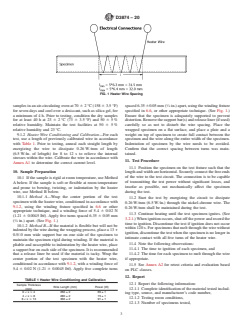
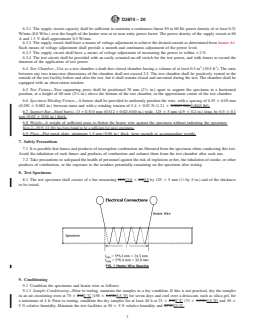
FIG. 1 Heater Wire Spacing
samples in an air-circulating oven at 70 6 2 °C (158 6 3.5 °F) spaced 6.35 60.05 mm ( ⁄4 in.) apart, using the winding fixture
for seven days and cool over a desiccant, such as silica gel, for specified in 6.6, or other appropriate technique. (See Fig. 1.)
a minimum of 4 h. Prior to testing, condition the dry samples Ensure that the specimen is adequately supported to prevent
for at least 40 h at 23 6 2 °C (73 6 3.5 °F) an
...
This document is not an ASTM standard and is intended only to provide the user of an ASTM standard an indication of what changes have been made to the previous version. Because
it may not be technically possible to adequately depict all changes accurately, ASTM recommends that users consult prior editions as appropriate. In all cases only the current version
of the standard as published by ASTM is to be considered the official document.
Designation: D3874 − 18 D3874 − 20
Standard Test Method for
Ignition of Materials by Hot Wire Sources
This standard is issued under the fixed designation D3874; the number immediately following the designation indicates the year of
original adoption or, in the case of revision, the year of last revision. A number in parentheses indicates the year of last reapproval. A
superscript epsilon (´) indicates an editorial change since the last revision or reapproval.
1. Scope*
1.1 This test method is intended to differentiate, in a preliminary fashion, among materials with respect to their resistance to
ignition because of their proximity to electrically-heated wires and other heat sources.
1.2 This test method applies to molded or sheet materials available in thicknesses ranging from 0.25 to 6.4 mm (0.010 to 0.25
in.).up to and including 13.0 mm (0.51 in.).
1.3 This test method applies to materials that are rigid or flexible at normal room temperatures. That is, it applies to materials
for which the specimen does not deform It is important to minimize deformation during preparation, especially during the
wire-wrapping step described in 10.1. , by following the method outlined under Clause 10, Sample Preparation. Examples of
deformation that render this test method inapplicable include:include bowing, in either a transverse or a longitudinal direction,
twisting of the specimen, and indentation of the wire into the specimen during the wire-wrapping step, to a degree visible to the
eye.
1.3.1 Bowing, in either a transverse or a longitudinal direction, or twisting of the specimen, during the wire-wrapping step, to
a degree visible to the eye.
1.3.2 Visible indentation of the wrapped wire into the specimen.
1.4 The values stated in SI units are to be regarded as the standard. The inch-pound units values given in parentheses are for
information only. after SI units are provided for information only and are not considered standard. (See SI10 for further details.)
1.5 This test method measures and describes the response orof materials, products, or assemblies to heat and flame under
controlled conditions, but does not by itself incorporate all factors required for fire hazard or fire risk assessment of the materials,
products, or assemblies under actual fire conditions.
1.6 This standard does not purport to address all of the safety concerns, if any, associated with its use. It is the responsibility
of the user of this standard to establish appropriate safety, health, and environmental practices and determine the applicability of
regulatory limitations prior to use.
1.7 Fire testing is inherently hazardous. Adequate safeguards for personnel and property shall be employed in conducting these
tests.
NOTE 1—Although this test method and IEC TS 60695-2-20 (withdrawn),(withdrawn) differ in approach and in detail, data obtained using either are
technically equivalent.
1.8 This international standard was developed in accordance with internationally recognized principles on standardization
established in the Decision on Principles for the Development of International Standards, Guides and Recommendations issued
by the World Trade Organization Technical Barriers to Trade (TBT) Committee.
2. Referenced Documents
2.1 ASTM Standards:
D1711 Terminology Relating to Electrical Insulation
D6194 Test Method for Glow-Wire Ignition of Materials
E176 Terminology of Fire Standards
This test method is under the jurisdiction of ASTM Committee D09 on Electrical and Electronic Insulating Materials and is the direct responsibility of Subcommittee
D09.17 on Fire and Thermal Properties.
Current edition approved Nov. 1, 2018March 1, 2020. Published November 2018March 2020. Originally approved in 1988. Last previous edition approved in 20132018
as D3874 – 13.D3874 – 18. DOI: 10.1520/D3874-18. 10.1520/D3874-20.
K. N. Mathes, Chapter 4,Mathes, K. N., “Surface Failure Measurements”,Measurements,” Engineering Dielectrics, Vol. IIB, Vol IIB, Electrical Properties of Solid
Insulating Materials,Materials: Measurement Techniques, R. Bartnikas, Editor, ASTM STP 926, ASTM, Philadelphia, Chapter 4, ASTM International, 1987.
For referenced ASTM standards, visit the ASTM website, www.astm.org, or contact ASTM Customer Service at service@astm.org. For Annual Book of ASTM Standards
volume information, refer to the standard’s Document Summary page on the ASTM website.
*A Summary of Changes section appears at the end of this standard
Copyright © ASTM International, 100 Barr Harbor Drive, PO Box C700, West Conshohocken, PA 19428-2959. United States
D3874 − 20
E3020 Practice for Ignition Sources
IEEE/ASTM SI-10 American National Standard for Metric Practice
2.2 IEC Standards:
IEC TS 60695-2-2060695-2-20:2004 Fire Hazard Testing—Section 20: Glowing/Hot-wire Based Test Methods, Hot-wire Coil
Ignitability Test on Materials (withdrawn)
IEC 60695-4 Fire Hazard Testing—Part 4: Terminology Concerning Fire Tests for Electrotechnical Products
2.3 ISO StandardsStandard:
ISO 13943 Fire Safety—Vocabulary
3. Terminology
3.1 Definitions:
3.1.1 Use Terminology E176 and , ISO 13943, and IEC 60695-4 for definitions of terms used in this test method and associated
with fire issues. Where differences exist in definitions, those contained in Terminology E176 shall be used. Use Terminology D1711
for definitions of terms used in this test method and associated with electrical insulation materials.
3.2 Definitions of Terms Specific to This Standard:
3.2.1 ignition, n—the initiation of combustion. E176
3.2.1.1 Discussion—
The combustion may be evidenced by glow, flame, detonation, or explosion. The combustion may be sustained or transient
(seetransient. (See Terminology E176).)
4. Summary of Test Method
4.1 In this test method, a rectangular bar-shaped test specimen, with the center portion wrapped with a coil of heater wire, is
supported horizontally at both ends. The circuit is then energized by applying a fixed power density to the heater wire, which
rapidly heats up. The behavior of the test specimen is observed.observed until one of the following happens: (a)(a) the material
under test ignites, (b)(b) the material under test melts, (c) 120or (c s) 120 s of exposure have gone by without ignition or melting.
The time to ignition and the time to melt through, as applicable, are recorded.
5. Significance and Use
5.1 During operation of electrical equipment, including wires, resistors, and other conductors, it is possible for overheating to
occur, under certain conditions of operation,operation or when malfunctions occur. When this happens, a possible result is ignition
of the insulation material.
5.2 This test method assesses the relative resistance of electrical insulating materials to ignition by the effect of hot wire sources.
5.3 This test method determines the average time, in seconds, required for material specimens to ignite under the specified
conditions of test.
5.4 This method is suitable to characterize materials, subject to the appropriate limitations of an expected precision of 615 %,
to categorize materials.
5.5 In this procedure the specimens are subjected to one or more specific sets of laboratory conditions. If different test conditions
are substituted or the end-use conditions are changed, it is not always possible by or from this test to predict changes in the
fire-test-response characteristics measured. Therefore, the results are valid only for the fire test exposure conditions described in
this procedure.
6. Apparatus
6.1 Heater Wire—The heater wire shall be a No. 24 AWG, Nichrome (Nickel-Chrome) wire, that is iron free, with the following
nominal properties: a wire composition of 20 % chromium-80 % nickel, a diameter of 0.5 mm (0.020 in.), a nominal cold resistance
of 5.28 Ω/m (1.61Ω/ft), and a length-to-mass ratio of 580 m/kg (864 ft/lb).
6.2 Calibrate each spool of test wire for energized resistance, in accordance with the method outlined in Annex A1. Such
calibration is necessary due to the typical variability of wire lots in composition, processing, sizing, and metallurgy.
6.3 Supply Circuit—The supply circuit, which is a means for electrically energizing the heater wire, shall comply with 6.3.1 –
6.3.4.
Available from International Electrotechnical Commission (IEC), 3, rue de Varembé, Case postale 1st floor, P.O. Box 131, CH-1211, Geneva 20, Switzerland,
http://www.iec.ch.https://www.iec.ch.
Available from International Organization for Standardization (ISO), 1, ch. de la Voie-Creuse, Case postale 56, CH-1211, Geneva 20, Switzerland, http://www.iso.ch.ISO
Central Secretariat, BIBC II, Chemin de Blandonnet 8, CP 401, 1214 Vernier, Geneva, Switzerland, http://www.iso.org.
D3874 − 20
6.3.1 The supply circuit capacity shall be sufficient to maintain a continuous linear 50 to 60 Hz power density of at least 0.31
W/mm (8.0 W/in.) over the length of the heater wire at or near unity power factor. The power density of the supply circuit at 60
A and 1.5 V shall approximate 0.3 W/mm.
6.3.2 The supply circuit shall have a means of voltage adjustment to achieve the desired current as determined from Annex A1.
Such means of voltage adjustment shall provide a smooth and continuous adjustment of the power level.
6.3.3 The supply circuit shall have a means of voltage adjustment of measuring the power to within 62 %.
6.3.4 The test circuit shall be provided with an easily actuated on-off switch for the test power, and with timers to record the
duration of the application of test power.
3 3
6.4 Test Chamber—Use as a test chamber a draft-free closed chamber having a volume of at least 0.3 m (10.5 ft ). The ratio
between any two transverse dimensions of the chamber shall not exceed 2.5. The test chamber shall be positively vented to the
outside of the test facility before and after the test, but it shall remain closed and unvented during the test. The chamber shall be
equipped with an observation window.
6.5 Test Fixture—Two supporting posts shall be positioned 70 mm (2 ⁄4 in.) apart to support the specimen in a horizontal
position, at a height of 60 mm (2 ⁄8 in.) above the bottom of the test chamber, in the approximate center of the test chamber.
6.6 Specimen-Winding Fixture—A fixture shall be provided to uniformly position the wire, with a spacing of 6.35 6 0.05 mm
(0.250 6 0.002 in.) between turns and with a winding tension of 5.4 6 0.02 N (1.21 6 0.0045 lbf).0.0045 lbf).
6.7 Support Bar—Steel bar(s), 13 + 0.5/-0 mm (0.512 + 0.02/-0.00 in.) wide, 125 6 5 mm (4.9 6 0.2 in.) long, by 0.5 6 0.1
mm (0.02 6 0.04 in.) thick.
6.8 Weight—A weight of sufficient mass to flatten the heater wire against the specimen without indenting the specimen.
NOTE 2—50 N (11 lbf) has been found to be a sufficient for most specimens.
6.9 Plate—Flat metal plate, minimum 1.5 mm (0.06 in.) thick, large enough to accommodate weight.
7. Safety Precautions
7.1 It is possible that fumes and products of incomplete combustion are liberated from the specimen when conducting this test.
Avoid the inhalation of such fumes and products of combustion and exhaust them from the test chamber after each run.
7.2 Take precautions to safeguard the health of personnel against the risk of explosion or fire, the inhalation of smoke, or other
products of combustion, or the exposure to the residues potentially remaining on the specimen after testing.
8. Test Specimens
8.1 The test specimen shall consist of a bar measuring 12.513.0 6 0.20.5 by 125 6 5 mm ( ⁄2 by 5 in.) and of the thickness
to be tested.
FIG. 1 Heater Wire Spacing
9. Conditioning
9.1 Condition the specimens and heater wire as follows:
9.1.1 Sample Conditioning—Prior to testing, maintain the samples in a dry condition. If this is not practical, dry the samples
in an air-circulating oven at 70 6 2°C2 °C (158 6 3.5°F)3.5 °F) for seven days and cool over a desiccant, such as silica gel, for
a minimum of 4 h. Prior to testing, condition the dry samples for at least 40 h at 23 6 2°C2 °C (73 6 3.5°F)3.5 °F) and 50 6
5 % relative humidity. Maintain the test facilities at 50 6 5 % relative humidity and 23°C.23 °C.
D3874 − 20
9.1.2 Heater Wire Con
...