

ASTM B1009-20
(Specification)Standard Specification for Titanium Alloy Bars for Near Surface Mounts in Civil Structures
General Information
- Abstract
SCOPE
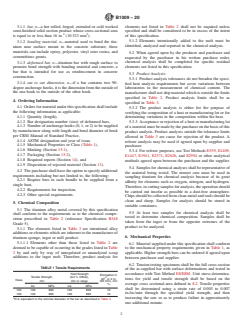
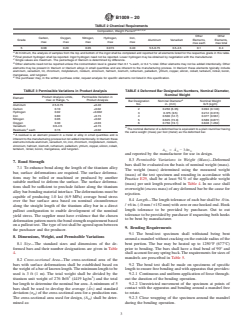
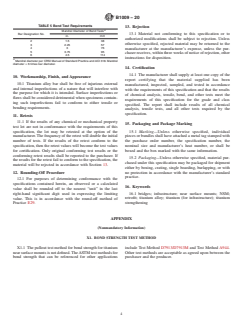
1.1 This specification covers titanium alloy bars with surface deformations and 90-degree anchorage hooks for use as near surface mounts for flexural and shear strengthening of concrete beams. The product can be furnished with or without anchorage hooks as specified by the purchaser. If supplied without hooks, the hooks shall be bent on-site prior to installation, as this method requires two 90-degree anchorage hooks.
1.2 The values stated in inch-pound units are to be regarded as standard. The values given in parentheses are mathematical conversions to SI units that are provided for information only and are not considered standard.
1.3 This standard does not purport to address all of the safety concerns, if any, associated with its use. It is the responsibility of the user of this standard to establish appropriate safety, health, and environmental practices and determine the applicability of regulatory limitations prior to use.
1.4 This international standard was developed in accordance with internationally recognized principles on standardization established in the Decision on Principles for the Development of International Standards, Guides and Recommendations issued by the World Trade Organization Technical Barriers to Trade (TBT) Committee.
- Status
- Published
- Publication Date
- 31-Jan-2020
- Technical Committee
- B10 - Reactive and Refractory Metals and Alloys
- Drafting Committee
- B10.01 - Titanium
Buy Documents
ASTM B1009-20 - Standard Specification for Titanium Alloy Bars for Near Surface Mounts in Civil Structures
REDLINE ASTM B1009-20 - Standard Specification for Titanium Alloy Bars for Near Surface Mounts in Civil Structures
Overview
ASTM B1009-20: Standard Specification for Titanium Alloy Bars for Near Surface Mounts in Civil Structures sets the requirements for titanium alloy bars with surface deformations and 90-degree anchorage hooks. These bars are used as near surface mounts (NSM) for flexural and shear strengthening of concrete beams in civil structure applications, offering an innovative approach to infrastructure reinforcement. The standard supports the use of deformed titanium alloy bars with and without anchorage hooks, with hooks capable of being formed by the manufacturer or bent on-site before installation.
ASTM B1009-20 is developed under the jurisdiction of ASTM Committee B10 on Reactive and Refractory Metals and Alloys, aligning with internationally recognized standardization principles.
Key Topics
- Product Scope: Covers titanium alloy bars for use as near surface mounts in concrete beams, specifically for flexural and shear reinforcement applications.
- Bar Configuration: Bars may be supplied with or without factory-formed 90-degree anchorage hooks. If not supplied, hooks must be bent on-site as required.
- Surface Deformation: Deformations are necessary to increase bond strength between the titanium alloy bar and the bonding material (such as epoxy or grout) to concrete substrates.
- Mechanical Requirements: Bars must meet defined tensile properties and undergo tension and bend tests to ensure performance.
- Chemical Composition: Specifies strict requirements for alloy composition, referencing ASTM B348 for Grade 5 titanium alloys.
- Dimensional Tolerances: Details on bar size, weight, permissible variations, and length tolerances provide clarity for consistent fabrication and installation.
- Testing and Quality Assurance: Includes directions for sampling, retesting procedures, and certification practices to verify compliance.
- Ordering and Marking: Comprehensive requirements for how materials should be ordered, labeled, and reported are included.
Applications
The practical value of ASTM B1009-20 lies in its support of advanced infrastructure strengthening methods. Titanium alloy bars manufactured to this standard offer several key benefits:
- Bridge and Infrastructure Retrofit: Ideal for strengthening existing concrete structures in bridges and critical infrastructure by providing high strength-to-weight ratios and excellent corrosion resistance.
- Seismic Upgrading: Useful for seismic retrofitting where improved ductility and anchorage can enhance structural resilience.
- New Construction: Employed in new civil engineering projects requiring durable, high-performance reinforcement.
- Corrosive Environments: Titanium alloys resist degradation in harsh chemical or marine environments, making them suitable for coastal infrastructure.
- NSM Methodologies: Near surface mounts allow for minimally invasive strengthening, preserving architectural integrity while upgrading load-bearing capacity.
Related Standards
Several standards are referenced within ASTM B1009-20 to ensure the quality and performance of titanium alloy bars in civil structural applications:
- ASTM B348: Specification for Titanium and Titanium Alloy Bars and Billets.
- ASTM A944: Test Method for Comparing Bond Strength of Steel Reinforcing Bars to Concrete Using Beam-End Specimens.
- ASTM E8/E8M: Test Methods for Tension Testing of Metallic Materials.
- ASTM D7913/D7913M: Test Method for Bond Strength of Fiber-Reinforced Polymer Matrix Composite Bars to Concrete by Pullout Testing.
- CRSI Manual of Standard Practice: Referenced for hooked bar dimensions and bending practices.
- ACI 318: Building Code Requirements for Structural Concrete, for design and construction guidance.
- Other ASTM Analytical Standards: Including E29, E539, E1409, E1447, E1941, E2371, and E2994 for verifying chemical composition.
Summary
ASTM B1009-20 establishes a consistent, high-quality benchmark for the use of titanium alloy bars as near surface mounts in civil structures. By leveraging titanium's material advantages and precise fabrication standards, engineers and stakeholders can enhance the durability, safety, and longevity of concrete infrastructure in both retrofit and new construction projects. This standard is essential for professionals involved in bridge strengthening, seismic upgrading, infrastructure repair, and other critical applications where advanced, corrosion-resistant reinforcement is required.
Relations
- Effective Date
- 01-Feb-2020
- Effective Date
- 01-Jan-2024
- Effective Date
- 01-Feb-2020
- Effective Date
- 01-Mar-2019
- Effective Date
- 15-Jul-2016
- Effective Date
- 01-Feb-2015
- Effective Date
- 15-Aug-2014
- Effective Date
- 01-Jul-2013
- Effective Date
- 01-Jun-2013
- Effective Date
- 01-Dec-2011
- Effective Date
- 01-Jul-2011
- Effective Date
- 01-May-2011
- Effective Date
- 01-Dec-2010
- Effective Date
- 01-Nov-2010
- Effective Date
- 01-Jun-2009
Buy Documents
ASTM B1009-20 - Standard Specification for Titanium Alloy Bars for Near Surface Mounts in Civil Structures
REDLINE ASTM B1009-20 - Standard Specification for Titanium Alloy Bars for Near Surface Mounts in Civil Structures
Get Certified
Connect with accredited certification bodies for this standard

Element Materials Technology
Materials testing and product certification.

Inštitut za kovinske materiale in tehnologije
Institute of Metals and Technology. Materials testing, metallurgical analysis, NDT.
Sponsored listings
Frequently Asked Questions
ASTM B1009-20 is a technical specification published by ASTM International. Its full title is "Standard Specification for Titanium Alloy Bars for Near Surface Mounts in Civil Structures". This standard covers: SCOPE 1.1 This specification covers titanium alloy bars with surface deformations and 90-degree anchorage hooks for use as near surface mounts for flexural and shear strengthening of concrete beams. The product can be furnished with or without anchorage hooks as specified by the purchaser. If supplied without hooks, the hooks shall be bent on-site prior to installation, as this method requires two 90-degree anchorage hooks. 1.2 The values stated in inch-pound units are to be regarded as standard. The values given in parentheses are mathematical conversions to SI units that are provided for information only and are not considered standard. 1.3 This standard does not purport to address all of the safety concerns, if any, associated with its use. It is the responsibility of the user of this standard to establish appropriate safety, health, and environmental practices and determine the applicability of regulatory limitations prior to use. 1.4 This international standard was developed in accordance with internationally recognized principles on standardization established in the Decision on Principles for the Development of International Standards, Guides and Recommendations issued by the World Trade Organization Technical Barriers to Trade (TBT) Committee.
SCOPE 1.1 This specification covers titanium alloy bars with surface deformations and 90-degree anchorage hooks for use as near surface mounts for flexural and shear strengthening of concrete beams. The product can be furnished with or without anchorage hooks as specified by the purchaser. If supplied without hooks, the hooks shall be bent on-site prior to installation, as this method requires two 90-degree anchorage hooks. 1.2 The values stated in inch-pound units are to be regarded as standard. The values given in parentheses are mathematical conversions to SI units that are provided for information only and are not considered standard. 1.3 This standard does not purport to address all of the safety concerns, if any, associated with its use. It is the responsibility of the user of this standard to establish appropriate safety, health, and environmental practices and determine the applicability of regulatory limitations prior to use. 1.4 This international standard was developed in accordance with internationally recognized principles on standardization established in the Decision on Principles for the Development of International Standards, Guides and Recommendations issued by the World Trade Organization Technical Barriers to Trade (TBT) Committee.
ASTM B1009-20 is classified under the following ICS (International Classification for Standards) categories: 77.150.50 - Titanium products. The ICS classification helps identify the subject area and facilitates finding related standards.
ASTM B1009-20 has the following relationships with other standards: It is inter standard links to ASTM B1009-18, ASTM E8/E8M-24, ASTM D7913/D7913M-14(2020), ASTM E539-19, ASTM E8/E8M-16, ASTM E8/E8M-15, ASTM D7913/D7913M-14, ASTM B348-13, ASTM E8/E8M-13, ASTM E8/E8M-11, ASTM B348-11, ASTM E539-11, ASTM E1941-10, ASTM A944-10, ASTM B348-09. Understanding these relationships helps ensure you are using the most current and applicable version of the standard.
ASTM B1009-20 is available in PDF format for immediate download after purchase. The document can be added to your cart and obtained through the secure checkout process. Digital delivery ensures instant access to the complete standard document.
Standards Content (Sample)
This international standard was developed in accordance with internationally recognized principles on standardization established in the Decision on Principles for the
Development of International Standards, Guides and Recommendations issued by the World Trade Organization Technical Barriers to Trade (TBT) Committee.
Designation:B1009 −20
Standard Specification for
Titanium Alloy Bars for Near Surface Mounts in Civil
Structures
This standard is issued under the fixed designation B1009; the number immediately following the designation indicates the year of
original adoption or, in the case of revision, the year of last revision. A number in parentheses indicates the year of last reapproval. A
superscript epsilon (´) indicates an editorial change since the last revision or reapproval.
1. Scope D7913/D7913M Test Method for Bond Strength of Fiber-
Reinforced Polymer Matrix Composite Bars to Concrete
1.1 This specification covers titanium alloy bars with sur-
by Pullout Testing
face deformations and 90-degree anchorage hooks for use as
E8/E8M Test Methods for Tension Testing of Metallic Ma-
near surface mounts for flexural and shear strengthening of
terials
concrete beams. The product can be furnished with or without
E29 Practice for Using Significant Digits in Test Data to
anchorage hooks as specified by the purchaser. If supplied
Determine Conformance with Specifications
without hooks, the hooks shall be bent on-site prior to
E539 Test Method for Analysis of Titanium Alloys by
installation, as this method requires two 90-degree anchorage
WavelengthDispersiveX-RayFluorescenceSpectrometry
hooks.
E1409 Test Method for Determination of Oxygen and Nitro-
1.2 The values stated in inch-pound units are to be regarded
gen in Titanium and Titanium Alloys by Inert Gas Fusion
as standard. The values given in parentheses are mathematical
E1447 Test Method for Determination of Hydrogen in Tita-
conversions to SI units that are provided for information only
nium and Titanium Alloys by Inert Gas Fusion Thermal
and are not considered standard.
Conductivity/Infrared Detection Method
1.3 This standard does not purport to address all of the
E1941 Test Method for Determination of Carbon in Refrac-
safety concerns, if any, associated with its use. It is the tory and Reactive Metals andTheirAlloys by Combustion
responsibility of the user of this standard to establish appro-
Analysis
priate safety, health, and environmental practices and deter- E2371 Test Method for Analysis of Titanium and Titanium
mine the applicability of regulatory limitations prior to use.
Alloys by Direct Current Plasma and Inductively Coupled
1.4 This international standard was developed in accor- Plasma Atomic Emission Spectrometry (Performance-
dance with internationally recognized principles on standard-
Based Test Methodology)
ization established in the Decision on Principles for the
E2626 Guide for Spectrometric Analysis of Reactive and
Development of International Standards, Guides and Recom- Refractory Metals (Withdrawn 2017)
mendations issued by the World Trade Organization Technical
E2994 Test Method for Analysis of Titanium and Titanium
Barriers to Trade (TBT) Committee. AlloysbySparkAtomicEmissionSpectrometryandGlow
Discharge Atomic Emission Spectrometry (Performance-
2. Referenced Documents
Based Method)
2.1 ASTM Standards:
2.2 CRSI Standard:
A944 Test Method for Comparing Bond Strength of Steel
CRSI Manual of Standard Practice
Reinforcing Bars to Concrete Using Beam-End Speci-
2.3 ACI Standard:
mens
ACI 318 Building Code Requirements for Structural Con-
B348 Specification for Titanium and Titanium Alloy Bars
crete
and Billets
3. Terminology
This specification is under the jurisdiction of ASTM Committee B10 on 3.1 Definitions of Terms Specific to This Standard:
Reactive and Refractory Metals and Alloys and is the direct responsibility of
Subcommittee B10.01 on Titanium.
Current edition approved Feb. 1, 2020. Published February 2020. Originally
approved in 2018. Last previous edition approved in 2018 as B1009 – 18. DOI: The last approved version of this historical standard is referenced on
10.1520/B1009-20. www.astm.org.
2 4
For referenced ASTM standards, visit the ASTM website, www.astm.org, or Available from Concrete Reinforcing Steel Institute (CRSI), 933 N. Plum
contact ASTM Customer Service at service@astm.org. For Annual Book of ASTM Grove Rd., Schaumburg, IL 60173, www.crsi.org.
Standards volume information, refer to the standard’s Document Summary page on Available from American Concrete Institute (ACI), 38800 Country Club Dr.,
the ASTM website. Farmington Hills, MI 48331-3439, www.concrete.org.
Copyright © ASTM International, 100 Barr Harbor Drive, PO Box C700, West Conshohocken, PA 19428-2959. United States
B1009−20
3.1.1 bar, n—a hot rolled, forged, extruded or cold worked elements not listed in Table 2 shall not be required unless
semi-finished solid section product whose cross-sectional area specified and shall be considered to be in excess of the intent
2 2
is equal to or less than 16 in. (10 323 mm ). of this specification.
5.1.2 Elements intentionally added to the melt must be
3.1.2 bonding material, n—material used to bond the tita-
identified, analyzed and reported in the chemical analysis.
nium near surface mount to the concrete substrate; these
materials can include epoxy, polyester, vinyl ester resins, and
5.2 When agreed upon by the producer and purchaser and
cementitious grouts.
requested by the purchaser in his written purchase order,
chemical analysis shall be completed for specific residual
3.1.3 deformed bar, n—titanium bar with rough surface to
promote bond strength with bonding material and concrete; a elements not listed in this specification.
bar that is intended for use as reinforcement in concrete
5.3 Product Analysis:
construction.
5.3.1 Product analysis tolerances do not broaden the speci-
3.1.4 out to out dimension, n—if a bar contains two 90-
fied heat analysis requirements but cover variations between
degreeanchoragehooks,itisthedimensionfromtheoutsideof
laboratories in the measurement of chemical content. The
the one hook to the outside of the other hook.
manufacturer shall not ship material which is outside the limits
specified in Table 2. Product analysis limits shall be as
4. Ordering Information
specified in Table 3.
4.1 Orders for material under this specification shall include
5.3.2 The product analysis is either for the purpose of
the following information as applicable:
verifying the composition of a heat or manufacturing lot or for
4.1.1 Quantity (length),
determining variations in the composition within the heat.
4.1.2 Bar designation number (size) of deformed bars,
5.3.3 Acceptance or rejection of a heat or manufacturing lot
4.1.3 Number of anchorage hooks (0, 1, or 2) to be supplied
ofamaterialmustbemadebythepurchaseronthebasisofthis
by manufacturer along with length and bend diameter of hook
product analysis. Product analyses outside the tolerance limits
per CRSI Manual of Standard Practice,
allowed in Table 3 are cause for rejection of the product. A
4.1.4 ASTM designation and year of issue,
referee analysis may be used if agreed upon by supplier and
4.1.5 Mechanical Properties or Class (Table 1),
purchaser.
4.1.6 Marking (Section 15.1),
5.3.4 For referee purposes, use Test Methods E539, E1409,
4.1.7 Packaging (Section 15.2),
E1447, E1941, E2371, E2626, and E2994 or other analytical
4.1.8 Required reports (Section 14), and
methods agreed upon between the purchaser and the supplier.
4.1.9 Disposition of rejected material (Section 13).
5.4 Samples for chemical analyses shall be representative of
4.2 Thepurchasershallhavetheoptiontospecifyadditional
the material being tested. The utmost care must be used in
requirements including but not limited to, the following:
sampling titanium for chemical analysis because of its great
4.2.1 Require bars in each bundle to be supplied from a
affinity for elements such as oxygen, nitrogen, and hydrogen.
single heat,
Therefore, in cutting samples for analysis, the operation should
4.2.2 Requirements for inspection,
be carried out insofar as possible in a dust-free atmosphere.
4.2.3 Other special requirements.
Chips should be collected from clean metal and tools should be
clean and sharp. Samples for analysis should be stored in
5. Chemical Composition
suitable containers.
5.1 The titanium alloy metal covered by this specification
5.5 At least two samples for chemical analysis shall be
shall conform to the requirements as to the chemical compo-
tested to determine chemical composition. Samples shall be
sition prescribed in Table 2 (reference Specification B348
taken from the ingot or from the opposite extremes of the
Grade 5).
product to be analyzed.
5.1.1 The elements listed in Table 3 are intentional alloy
additions or elements which are inherent to the manufacture of
6. Mechanical Properties
titanium sponge, ingot or mill product.
5.1.1.1 Elements other than those listed in Table 2 are
6.1 Material supplied under this specification shall conform
deemed to be capable of occurring in the grades listed in Table
to the mechanical property requirements given in Table 1,as
2 by and only by way of unregulated or unanalyzed scrap
applicable. Higher strength bars can be ordered if agreed upon
additions to the ingot melt. Therefore, product analysis for
between purchaser and supplier.
6.2 Tension testing specimens shall be the full cross-section
TABLE 1 Tensile Requirements
of the as-supplied bar with surface deformations and tested in
Yield Strength
accordance with Test Method E8/E8M. Unit stress determina-
Elongation in
Tensile Strength, (0.2 % Offset), A
4D or 2 in.
tions for yield and tensile strength shall be based on the
Class
min min or range
(50 mm), min
average cross sectional-area defined in 8.2. Tensile properties
%
ksi MPa ksi MPa
shall be determined using a strain rate of 0.003 to 0.007
120 130 895 120 828 10
in./in./min through the specified yield strength, and then
130 140 965 130 895 10
A increasing the rate so as to produce failure in approximately
D is equivalent to the nominal diameter of the bar as described in Table 4.
one additional minute.
B1009−20
TABLE 2 Chemical Requirements
A,B,C,D,E
Composition, Weight Percent
Other Other
Carbon, Oxygen, Nitrogen, Hydrogen, Iron,
Grade Aluminum Vanadium Elements, Elements,
max max max max max
max each max tota
...
This document is not an ASTM standard and is intended only to provide the user of an ASTM standard an indication of what changes have been made to the previous version. Because
it may not be technically possible to adequately depict all changes accurately, ASTM recommends that users consult prior editions as appropriate. In all cases only the current version
of the standard as published by ASTM is to be considered the official document.
Designation: B1009 − 18 B1009 − 20
Standard Specification for
Titanium Alloy Bars for Near Surface Mounts in Civil
Structures
This standard is issued under the fixed designation B1009; the number immediately following the designation indicates the year of
original adoption or, in the case of revision, the year of last revision. A number in parentheses indicates the year of last reapproval. A
superscript epsilon (´) indicates an editorial change since the last revision or reapproval.
1. Scope
1.1 This specification covers titanium alloy bars with surface deformations and 90-degree anchorage hooks for use as near
surface mounts for flexural and shear strengthening of concrete beams. The product can be furnished with or without anchorage
hooks as specified by the purchaser. If supplied without hooks, the hooks shall be bent on-site prior to installation, as this method
requires two 90-degree anchorage hooks.
1.2 The values stated in inch-pound units are to be regarded as standard. The values given in parentheses are mathematical
conversions to SI units that are provided for information only and are not considered standard.
1.3 This standard does not purport to address all of the safety concerns, if any, associated with its use. It is the responsibility
of the user of this standard to establish appropriate safety, health, and environmental practices and determine the applicability of
regulatory limitations prior to use.
1.4 This international standard was developed in accordance with internationally recognized principles on standardization
established in the Decision on Principles for the Development of International Standards, Guides and Recommendations issued
by the World Trade Organization Technical Barriers to Trade (TBT) Committee.
2. Referenced Documents
2.1 ASTM Standards:
A944 Test Method for Comparing Bond Strength of Steel Reinforcing Bars to Concrete Using Beam-End Specimens
B348 Specification for Titanium and Titanium Alloy Bars and Billets
D7913/D7913M Test Method for Bond Strength of Fiber-Reinforced Polymer Matrix Composite Bars to Concrete by Pullout
Testing
E8/E8M Test Methods for Tension Testing of Metallic Materials
E29 Practice for Using Significant Digits in Test Data to Determine Conformance with Specifications
E539 Test Method for Analysis of Titanium Alloys by Wavelength Dispersive X-Ray Fluorescence Spectrometry
E1409 Test Method for Determination of Oxygen and Nitrogen in Titanium and Titanium Alloys by Inert Gas Fusion
E1447 Test Method for Determination of Hydrogen in Titanium and Titanium Alloys by Inert Gas Fusion Thermal
Conductivity/Infrared Detection Method
E1941 Test Method for Determination of Carbon in Refractory and Reactive Metals and Their Alloys by Combustion Analysis
E2371 Test Method for Analysis of Titanium and Titanium Alloys by Direct Current Plasma and Inductively Coupled Plasma
Atomic Emission Spectrometry (Performance-Based Test Methodology)
E2626 Guide for Spectrometric Analysis of Reactive and Refractory Metals (Withdrawn 2017)
E2994 Test Method for Analysis of Titanium and Titanium Alloys by Spark Atomic Emission Spectrometry and Glow Discharge
Atomic Emission Spectrometry (Performance-Based Method)
2.2 CRSI Standard:
CRSI Manual of Standard Practice
This specification is under the jurisdiction of ASTM Committee B10 on Reactive and Refractory Metals and Alloys and is the direct responsibility of Subcommittee
B10.01 on Titanium.
Current edition approved Nov. 1, 2018Feb. 1, 2020. Published December 2018February 2020. Originally approved in 2018. Last previous edition approved in 2018 as
B1009 – 18. DOI: 10.1520/B1009-XX.10.1520/B1009-20.
For referenced ASTM standards, visit the ASTM website, www.astm.org, or contact ASTM Customer Service at service@astm.org. For Annual Book of ASTM Standards
volume information, refer to the standard’s Document Summary page on the ASTM website.
The last approved version of this historical standard is referenced on www.astm.org.
Available from Concrete Reinforcing Steel Institute (CRSI), 933 N. Plum Grove Rd., Schaumburg, IL 60173, www.crsi.org.
Copyright © ASTM International, 100 Barr Harbor Drive, PO Box C700, West Conshohocken, PA 19428-2959. United States
B1009 − 20
2.3 ACI Standard:
ACI 318 Building Code Requirements for Structural Concrete
3. Terminology
3.1 Definitions of Terms Specific to This Standard:
3.1.1 bar, n—a hot rolled, forged, extruded or cold worked semi-finished solid section product whose cross-sectional area is
2 2
equal to or less than 16 in. (10 323 mm ).
3.1.2 bonding material, n—material used to bond the titanium near surface mount to the concrete substrate; these materials can
include epoxy, polyester, vinyl ester resins, and cementitious grouts.
3.1.3 deformed bar, n—titanium bar with rough surface to promote bond strength with bonding material and concrete; a bar that
is intended for use as reinforcement in concrete construction.
3.1.4 out to out dimension, n—if a bar contains two 90-degree anchorage hooks, it is the dimension from the outside of the one
hook to the outside of the other hook.
4. Ordering Information
4.1 Orders for material under this specification shall include the following information as applicable:
4.1.1 Quantity (length),
4.1.2 Bar designation number (size) of deformed bars,
4.1.3 Number of anchorage hooks (0, 1, or 2) to be supplied by manufacturer along with length and bend diameter of hook per
CRSI Manual of Standard Practice,
4.1.4 ASTM designation and year of issue,
4.1.5 Mechanical Properties or Class (Table 1),
4.1.6 Marking (Section 15.1),
4.1.7 Packaging (Section 15.2),
4.1.8 Required reports (Section 14), and
4.1.9 Disposition of rejected material (Section 13).
4.2 The purchaser shall have the option to specify additional requirements including but not limited to, the following:
4.2.1 Require bars in each bundle to be supplied from a single heat,
4.2.2 Requirements for inspection,
4.2.3 Other special requirements.
5. Chemical Composition
5.1 The titanium alloy metal covered by this specification shall conform to the requirements as to the chemical composition
prescribed in Table 2 (reference Specification B348 Grade 5).
5.1.1 The elements listed in Table 3 are intentional alloy additions or elements which are inherent to the manufacture of titanium
sponge, ingot or mill product.
5.1.1.1 Elements other than those listed in Table 2 are deemed to be capable of occurring in the grades listed in Table 2 by and
only by way of unregulated or unanalyzed scrap additions to the ingot melt. Therefore, product analysis for elements not listed in
Table 2 shall not be required unless specified and shall be considered to be in excess of the intent of this specification.
5.1.2 Elements intentionally added to the melt must be identified, analyzed and reported in the chemical analysis.
5.2 When agreed upon by the producer and purchaser and requested by the purchaser in his written purchase order, chemical
analysis shall be completed for specific residual elements not listed in this specification.
5.3 Product Analysis:
TABLE 1 Tensile Requirements
Yield Strength
Elongation in
Tensile Strength, (0.2 % Offset), A
4D,D or 2
Class
min min or range
in. (50 mm),
min %
ksi MPa ksi MPa
120 130 895 120 828 10
130 140 965 130 895 10
A
D is equivalent to the nominal diameter of the bar as described in Table 4.
Available from American Concrete Institute (ACI), 38800 Country Club Dr., Farmington Hills, MI 48331-3439, www.concrete.org.
B1009 − 20
TABLE 2 Chemical Requirements
A,B,C,D,E
Composition, Weight Percent
Other Other
Carbon, Oxygen, Nitrogen, Hydrogen, Iron,
Grade Aluminum Vanadium Elements, Elements,
max max max max max
max each max total
5 0.08 0.20 0.05 0.015 0.40 5.5-6.75 3.5-4.5 0.1 0.4
A
At minimum, the analysis of samples from the top and bottom of the ingot shall be completed and reported for all elements listed for the respective grade in this table.
B
Final product hydrogen shall be reported. Ingot hydrogen need not be reported. Lower hydrogen may be obtained by negotiation with the manufacturer.
C
Single values are maximum. The percentage of titanium is determined by difference.
D
Other elements need not be reported unless the concentration level is greater than 0.1 % each, or 0.4 % total. Other elements may not be added intentionally. Other
elements may be present in titanium or titanium alloys in small quantities and are inherent to the manufacturing process. In titanium these elements typically include
aluminum, vanadium, tin, chromium, molybdenum, niobium, zirconium, hafnium, bismuth, ruthenium, palladium, yttrium, copper, silicon, cobalt, tantalum, nickel, boron,
manganese, and tungsten
E
The purchaser may, in the written purchase order, request analysis for specific elements not listed in this specification.
TABLE 3 Permissible Variations in Product Analysis
Product Analysis Limits, Permissible Variation in
Element
max or Range, % Product Analysis
Aluminum 2.5-6.75 ±0.40
Carbon 0.10 +0.02
Hydrogen 0.02 +0.002
Iron 0.80 +0.15
Nitrogen 0.05 +0.02
Oxygen 0.30 +0.03
Vanadium 0.6-4.5 ±0.15
A
Residuals, each 0.15 +0.02
A
A residual is an element present in a metal or alloy in small quantities and is
inherent to the manufacturing process but not added intentionally. In titanium these
elements include aluminum, vanadium, tin, iron, chromium, molybdenum, niobium,
zirconium, hafnium, bismuth, ruthenium, palladium, yttrium, copper, silicon, cobalt,
tantalum, nickel, boron, manganese, and tungsten.
5.3.1 Product analysis tolerances do not broaden the specified heat analysis requirements but cover variations between
laboratories in the measurement of chemical content. The manufacturer shall not ship material which is outside the limits specified
in Table 2. Product analysis limits shall be as specified in Table 3.
5.3.2 The product analysis is either for the purpose of verifying the composition of a heat or manufacturing lot or for
determining variations in the composition within the heat.
5.3.3 Acceptance or rejection of a heat or manufacturing lot of a material must be made by the purchaser on the basis of this
product analysis. Product analyse
...