

ASTM D6480-19
(Test Method)Standard Test Method for Wipe Sampling of Surfaces, Indirect Preparation, and Analysis for Asbestos Structure Number Surface Loading by Transmission Electron Microscopy
General Information
- Abstract
SIGNIFICANCE AND USE
5.1 This wipe sampling and indirect analysis test method is used for the general testing of surfaces for asbestos. It is used to assist in the evaluation of surfaces in buildings, such as ceiling tiles, shelving, electrical components, duct work, and so forth. This test method provides an index of the concentration of asbestos structures per unit area sampled as derived from a quantitative measure of the number of asbestos structures detected during analysis.
5.1.1 This test method does not describe procedures or techniques required for the evaluation of the safety or habitability of buildings with asbestos-containing materials, or compliance with federal, state, or local regulations or statutes. It is the user's responsibility to make these determinations.
5.1.2 At present, a single direct relationship between asbestos sampled from a surface and potential human exposure does not exist. Accordingly, the user should consider these data in relationship to other available information (for example, air sampling data) in their evaluation.
5.2 One or more large asbestos-containing particles dispersed during sample preparation may result in large asbestos surface loading results in the TEM analyses of that sample. It is, therefore, recommended that multiple replicate independent samples be secured in the same area, and that a minimum of three such samples be analyzed by the entire procedure.
SCOPE
1.1 This test method covers a procedure to identify asbestos in samples wiped from surfaces and to provide an estimate of the concentration of asbestos reported as the number of asbestos structures per unit area of sampled surface. The procedure outlined in this test method employs an indirect sample preparation technique. It is intended to disperse aggregated asbestos into fundamental fibrils, fiber bundles, clusters, or matrices. However, as with all indirect sample preparation techniques, the asbestos observed for quantification may not represent the physical form of the asbestos as sampled. More specifically, the procedure described neither creates nor destroys asbestos, but it may alter the physical form of the mineral fiber aggregates.
1.2 This test method describes the equipment and procedures necessary for wipe sampling of surfaces for levels of asbestos structures. The sample is collected onto a particle-free wipe material (wipe) from the surface of a sampling area that may contain asbestos.
1.2.1 The collection efficiency of this wipe sampling technique is unknown and will vary among substrates. Properties influencing collection efficiency include surface texture, adhesiveness, and other factors.
1.2.2 This test method is generally applicable for an estimate of the surface loading of asbestos structures starting from approximately 1000 asbestos structures per square centimetre.
1.3 Asbestos identification by transmission electron microscopy (TEM) is based on morphology, electron diffraction (ED), and energy dispersive X-ray analysis (EDXA).
1.4 This test method allows determination of the type(s) of asbestos fibers present.
1.4.1 This test method cannot always discriminate between individual fibers of the asbestos and nonasbestos analogues of the same amphibole mineral.
1.4.2 There is no lower limit to the dimensions of asbestos fibers that can be detected. However, in practice, the lower limit to the dimensions of asbestos fibers, that can be detected, is variable and dependent on individual microscopists. Therefore, a minimum length of 0.5 μm has been defined as the shortest fiber to be incorporated in the reported results.
1.5 The values stated in SI units are to be regarded as standard.
1.6 This standard does not purport to address all of the safety concerns, if any, associated with its use. It is the responsibility of the user of this standard to establish appropriate safety, health, and environmental practices and determine the applicability of regulator...
- Status
- Published
- Publication Date
- 31-May-2019
- Technical Committee
- D22 - Air Quality
Buy Documents
ASTM D6480-19 - Standard Test Method for Wipe Sampling of Surfaces, Indirect Preparation, and Analysis for Asbestos Structure Number Surface Loading by Transmission Electron Microscopy
REDLINE ASTM D6480-19 - Standard Test Method for Wipe Sampling of Surfaces, Indirect Preparation, and Analysis for Asbestos Structure Number Surface Loading by Transmission Electron Microscopy
Overview
ASTM D6480-19 is the Standard Test Method developed by ASTM International for the wipe sampling of surfaces, indirect preparation, and analysis for asbestos structure number surface loading by transmission electron microscopy (TEM). This method provides a standardized approach to collect and analyze wipe samples from various surfaces in buildings-such as ceiling tiles, shelving, ductwork, and electrical components-to estimate the concentration of asbestos structures present per unit area. Although this test method yields valuable quantitative data on asbestos contamination, it does not address the direct evaluation of human exposure risk or regulatory compliance.
Key Topics
- Wipe Sampling Technique: This method outlines specific procedures for collecting particulate samples from surfaces accused of asbestos contamination. Samples are collected using a particle-free wipe material carefully applied over a designated area, ensuring accurate spatial documentation and collection procedures.
- Indirect Sample Preparation: The process employs an indirect preparation technique, which disperses aggregated asbestos into fibrils, bundles, clusters, or matrices. This approach ensures that asbestos structures suitable for microscopic analysis are isolated and distributed for reliable counting.
- Transmission Electron Microscopy (TEM) Analysis: TEM is used to identify, size, and count asbestos fibers. Identification is based on morphology, electron diffraction (ED), and energy dispersive X-ray analysis (EDXA).
- Replicate Sampling and Quality Control: The standard emphasizes the importance of collecting independent replicate samples-typically a minimum of three-to mitigate anomalies in sample results due to dispersed large particles.
- Detection Limitations and Reporting: The test method is generally applicable for estimating surface loading at concentrations starting from approximately 1000 asbestos structures per square centimetre. It sets a minimum reportable fiber length of 0.5 μm and outlines potential interferences from similar minerals.
Applications
ASTM D6480-19 is essential in several practical contexts:
- Building Assessments: Used during inspections and post-remediation verification in environments potentially contaminated with asbestos-containing materials. Surfaces sampled may include floors, ceilings, HVAC ductwork, and equipment.
- Maintenance and Construction Planning: Assists facility managers and contractors in understanding surface asbestos loading before, during, and after renovation or demolition activities.
- Environmental and Occupational Health: Supports environmental consultants and industrial hygienists in mapping asbestos contamination to help guide control strategies. This method provides a reliable index of surface loading to supplement air sampling data.
- Legal and Documentation Requirements: Produces defensible, quantifiable results that can be integrated into compliance documentation, property transactions, or litigation support.
Important Note: The standard does not provide a direct link to human exposure risk nor set regulatory safety thresholds; users must interpret results alongside other data sources, such as air monitoring.
Related Standards
Professionals using ASTM D6480-19 may also reference these key documents to ensure comprehensive asbestos assessment and analysis:
- ASTM D1193 - Specification for Reagent Water
- ASTM D1356 - Terminology Relating to Sampling and Analysis of Atmospheres
- ASTM E691 - Practice for Conducting an Interlaboratory Study to Determine the Precision of a Test Method
- 40 CFR 763 (EPA) - Asbestos-Containing Materials in Schools: Final Rule and Notice
- EPA 600/4-83-043 - Analytical Method for the Determination of Asbestos in Water
Practical Value
By following ASTM D6480-19, environmental professionals, asbestos consultants, and laboratories benefit from:
- Consistent Data Collection: Ensures wipe samples from diverse building substrates are gathered and processed using best practices.
- Reliable Quantification: Yields objective, quantitative estimates of asbestos surface loading.
- Enhanced Building Safety Decisions: Informs remediation planning, clearance testing, and ongoing monitoring strategies for asbestos management in buildings.
ASTM D6480-19 is a vital standard for anyone involved in the management, assessment, or remediation of asbestos in building environments, ensuring standardized and reliable determination of asbestos structure contamination on surfaces.
Relations
- Effective Date
- 01-Jun-2019
- Effective Date
- 01-Sep-2020
- Effective Date
- 15-Mar-2020
- Effective Date
- 15-Oct-2015
- Effective Date
- 01-Jul-2015
- Effective Date
- 01-Dec-2014
- Effective Date
- 01-May-2014
- Effective Date
- 01-May-2014
- Effective Date
- 15-Jan-2014
- Effective Date
- 01-May-2013
- Effective Date
- 01-May-2013
- Effective Date
- 01-Nov-2011
- Effective Date
- 01-Oct-2010
- Effective Date
- 01-Apr-2010
- Effective Date
- 01-Oct-2008
Buy Documents
ASTM D6480-19 - Standard Test Method for Wipe Sampling of Surfaces, Indirect Preparation, and Analysis for Asbestos Structure Number Surface Loading by Transmission Electron Microscopy
REDLINE ASTM D6480-19 - Standard Test Method for Wipe Sampling of Surfaces, Indirect Preparation, and Analysis for Asbestos Structure Number Surface Loading by Transmission Electron Microscopy
Get Certified
Connect with accredited certification bodies for this standard

CIS Institut d.o.o.
Personal Protective Equipment (PPE) certification body. Notified Body NB-2890 for EU Regulation 2016/425 PPE.

Kiwa BDA Testing
Building and construction product certification.
Kmetijski inštitut Slovenije
Agricultural Institute of Slovenia. Soil testing, plant health, agricultural product analysis.
Sponsored listings
Frequently Asked Questions
ASTM D6480-19 is a standard published by ASTM International. Its full title is "Standard Test Method for Wipe Sampling of Surfaces, Indirect Preparation, and Analysis for Asbestos Structure Number Surface Loading by Transmission Electron Microscopy". This standard covers: SIGNIFICANCE AND USE 5.1 This wipe sampling and indirect analysis test method is used for the general testing of surfaces for asbestos. It is used to assist in the evaluation of surfaces in buildings, such as ceiling tiles, shelving, electrical components, duct work, and so forth. This test method provides an index of the concentration of asbestos structures per unit area sampled as derived from a quantitative measure of the number of asbestos structures detected during analysis. 5.1.1 This test method does not describe procedures or techniques required for the evaluation of the safety or habitability of buildings with asbestos-containing materials, or compliance with federal, state, or local regulations or statutes. It is the user's responsibility to make these determinations. 5.1.2 At present, a single direct relationship between asbestos sampled from a surface and potential human exposure does not exist. Accordingly, the user should consider these data in relationship to other available information (for example, air sampling data) in their evaluation. 5.2 One or more large asbestos-containing particles dispersed during sample preparation may result in large asbestos surface loading results in the TEM analyses of that sample. It is, therefore, recommended that multiple replicate independent samples be secured in the same area, and that a minimum of three such samples be analyzed by the entire procedure. SCOPE 1.1 This test method covers a procedure to identify asbestos in samples wiped from surfaces and to provide an estimate of the concentration of asbestos reported as the number of asbestos structures per unit area of sampled surface. The procedure outlined in this test method employs an indirect sample preparation technique. It is intended to disperse aggregated asbestos into fundamental fibrils, fiber bundles, clusters, or matrices. However, as with all indirect sample preparation techniques, the asbestos observed for quantification may not represent the physical form of the asbestos as sampled. More specifically, the procedure described neither creates nor destroys asbestos, but it may alter the physical form of the mineral fiber aggregates. 1.2 This test method describes the equipment and procedures necessary for wipe sampling of surfaces for levels of asbestos structures. The sample is collected onto a particle-free wipe material (wipe) from the surface of a sampling area that may contain asbestos. 1.2.1 The collection efficiency of this wipe sampling technique is unknown and will vary among substrates. Properties influencing collection efficiency include surface texture, adhesiveness, and other factors. 1.2.2 This test method is generally applicable for an estimate of the surface loading of asbestos structures starting from approximately 1000 asbestos structures per square centimetre. 1.3 Asbestos identification by transmission electron microscopy (TEM) is based on morphology, electron diffraction (ED), and energy dispersive X-ray analysis (EDXA). 1.4 This test method allows determination of the type(s) of asbestos fibers present. 1.4.1 This test method cannot always discriminate between individual fibers of the asbestos and nonasbestos analogues of the same amphibole mineral. 1.4.2 There is no lower limit to the dimensions of asbestos fibers that can be detected. However, in practice, the lower limit to the dimensions of asbestos fibers, that can be detected, is variable and dependent on individual microscopists. Therefore, a minimum length of 0.5 μm has been defined as the shortest fiber to be incorporated in the reported results. 1.5 The values stated in SI units are to be regarded as standard. 1.6 This standard does not purport to address all of the safety concerns, if any, associated with its use. It is the responsibility of the user of this standard to establish appropriate safety, health, and environmental practices and determine the applicability of regulator...
SIGNIFICANCE AND USE 5.1 This wipe sampling and indirect analysis test method is used for the general testing of surfaces for asbestos. It is used to assist in the evaluation of surfaces in buildings, such as ceiling tiles, shelving, electrical components, duct work, and so forth. This test method provides an index of the concentration of asbestos structures per unit area sampled as derived from a quantitative measure of the number of asbestos structures detected during analysis. 5.1.1 This test method does not describe procedures or techniques required for the evaluation of the safety or habitability of buildings with asbestos-containing materials, or compliance with federal, state, or local regulations or statutes. It is the user's responsibility to make these determinations. 5.1.2 At present, a single direct relationship between asbestos sampled from a surface and potential human exposure does not exist. Accordingly, the user should consider these data in relationship to other available information (for example, air sampling data) in their evaluation. 5.2 One or more large asbestos-containing particles dispersed during sample preparation may result in large asbestos surface loading results in the TEM analyses of that sample. It is, therefore, recommended that multiple replicate independent samples be secured in the same area, and that a minimum of three such samples be analyzed by the entire procedure. SCOPE 1.1 This test method covers a procedure to identify asbestos in samples wiped from surfaces and to provide an estimate of the concentration of asbestos reported as the number of asbestos structures per unit area of sampled surface. The procedure outlined in this test method employs an indirect sample preparation technique. It is intended to disperse aggregated asbestos into fundamental fibrils, fiber bundles, clusters, or matrices. However, as with all indirect sample preparation techniques, the asbestos observed for quantification may not represent the physical form of the asbestos as sampled. More specifically, the procedure described neither creates nor destroys asbestos, but it may alter the physical form of the mineral fiber aggregates. 1.2 This test method describes the equipment and procedures necessary for wipe sampling of surfaces for levels of asbestos structures. The sample is collected onto a particle-free wipe material (wipe) from the surface of a sampling area that may contain asbestos. 1.2.1 The collection efficiency of this wipe sampling technique is unknown and will vary among substrates. Properties influencing collection efficiency include surface texture, adhesiveness, and other factors. 1.2.2 This test method is generally applicable for an estimate of the surface loading of asbestos structures starting from approximately 1000 asbestos structures per square centimetre. 1.3 Asbestos identification by transmission electron microscopy (TEM) is based on morphology, electron diffraction (ED), and energy dispersive X-ray analysis (EDXA). 1.4 This test method allows determination of the type(s) of asbestos fibers present. 1.4.1 This test method cannot always discriminate between individual fibers of the asbestos and nonasbestos analogues of the same amphibole mineral. 1.4.2 There is no lower limit to the dimensions of asbestos fibers that can be detected. However, in practice, the lower limit to the dimensions of asbestos fibers, that can be detected, is variable and dependent on individual microscopists. Therefore, a minimum length of 0.5 μm has been defined as the shortest fiber to be incorporated in the reported results. 1.5 The values stated in SI units are to be regarded as standard. 1.6 This standard does not purport to address all of the safety concerns, if any, associated with its use. It is the responsibility of the user of this standard to establish appropriate safety, health, and environmental practices and determine the applicability of regulator...
ASTM D6480-19 is classified under the following ICS (International Classification for Standards) categories: 13.300 - Protection against dangerous goods. The ICS classification helps identify the subject area and facilitates finding related standards.
ASTM D6480-19 has the following relationships with other standards: It is inter standard links to ASTM D6480-05(2010), ASTM D1356-20a, ASTM D1356-20, ASTM D1356-15a, ASTM D1356-15, ASTM D1356-14b, ASTM E177-14, ASTM D1356-14a, ASTM D1356-14, ASTM E177-13, ASTM E691-13, ASTM E691-11, ASTM E177-10, ASTM D1356-05(2010), ASTM E177-08. Understanding these relationships helps ensure you are using the most current and applicable version of the standard.
ASTM D6480-19 is available in PDF format for immediate download after purchase. The document can be added to your cart and obtained through the secure checkout process. Digital delivery ensures instant access to the complete standard document.
Standards Content (Sample)
This international standard was developed in accordance with internationally recognized principles on standardization established in the Decision on Principles for the
Development of International Standards, Guides and Recommendations issued by the World Trade Organization Technical Barriers to Trade (TBT) Committee.
Designation: D6480 − 19
Standard Test Method for
Wipe Sampling of Surfaces, Indirect Preparation, and
Analysis for Asbestos Structure Number Surface Loading
by Transmission Electron Microscopy
This standard is issued under the fixed designation D6480; the number immediately following the designation indicates the year of
original adoption or, in the case of revision, the year of last revision.Anumber in parentheses indicates the year of last reapproval.A
superscript epsilon (´) indicates an editorial change since the last revision or reapproval.
1. Scope 1.4.2 There is no lower limit to the dimensions of asbestos
fibers that can be detected. However, in practice, the lower
1.1 Thistestmethodcoversaproceduretoidentifyasbestos
limit to the dimensions of asbestos fibers, that can be detected,
in samples wiped from surfaces and to provide an estimate of
is variable and dependent on individual microscopists.
the concentration of asbestos reported as the number of
Therefore,aminimumlengthof0.5µmhasbeendefinedasthe
asbestos structures per unit area of sampled surface. The
shortest fiber to be incorporated in the reported results.
procedure outlined in this test method employs an indirect
sample preparation technique. It is intended to disperse aggre- 1.5 The values stated in SI units are to be regarded as
gated asbestos into fundamental fibrils, fiber bundles, clusters,
standard.
or matrices. However, as with all indirect sample preparation
1.6 This standard does not purport to address all of the
techniques, the asbestos observed for quantification may not
safety concerns, if any, associated with its use. It is the
represent the physical form of the asbestos as sampled. More
responsibility of the user of this standard to establish appro-
specifically, the procedure described neither creates nor de-
priate safety, health, and environmental practices and deter-
stroys asbestos, but it may alter the physical form of the
mine the applicability of regulatory limitations prior to use.
mineral fiber aggregates.
1.7 This international standard was developed in accor-
1.2 This test method describes the equipment and proce- dance with internationally recognized principles on standard-
dures necessary for wipe sampling of surfaces for levels of ization established in the Decision on Principles for the
Development of International Standards, Guides and Recom-
asbestosstructures.Thesampleiscollectedontoaparticle-free
wipe material (wipe) from the surface of a sampling area that mendations issued by the World Trade Organization Technical
Barriers to Trade (TBT) Committee.
may contain asbestos.
1.2.1 The collection efficiency of this wipe sampling tech-
nique is unknown and will vary among substrates. Properties
2. Referenced Documents
influencing collection efficiency include surface texture, 2
2.1 ASTM Standards:
adhesiveness, and other factors.
D1193Specification for Reagent Water
1.2.2 This test method is generally applicable for an esti-
D1356Terminology Relating to Sampling and Analysis of
mateofthesurfaceloadingofasbestosstructuresstartingfrom
Atmospheres
approximately 1000 asbestos structures per square centimetre.
E691Practice for Conducting an Interlaboratory Study to
1.3 Asbestosidentificationbytransmissionelectronmicros-
Determine the Precision of a Test Method
copy(TEM)isbasedonmorphology,electrondiffraction(ED),
E177Practice for Use of the Terms Precision and Bias in
and energy dispersive X-ray analysis (EDXA).
ASTM Test Methods
1.4 This test method allows determination of the type(s) of 2.2 Government Standard:
asbestos fibers present.
40 CFR 763, USEPA,Asbestos-Containing Materials in
1.4.1 This test method cannot always discriminate between Schools:FinalRuleandNotice,AppendixAtoSub-partE
individual fibers of the asbestos and nonasbestos analogues of
the same amphibole mineral.
For referenced ASTM standards, visit the ASTM website, www.astm.org, or
This test method is under the jurisdiction of ASTM Committee D22 on Air contact ASTM Customer Service at service@astm.org. For Annual Book of ASTM
Quality and is the direct responsibility of Subcommittee D22.07 on Sampling, Standards volume information, refer to the standard’s Document Summary page on
Analysis, Management of Asbestos, and Other Microscopic Particles. the ASTM website.
CurrenteditionapprovedJune1,2019.PublishedJuly2019.Originallyapproved Available from U.S. Government Printing Office, Superintendent of
in 1999. Last previous edition approved in 2010 as D6480–05 (2010). DOI: Documents, 732 N. Capitol St., NW, Washington, DC 20401-0001, http://
10.1520/D6480-19. www.access.gpo.gov.
Copyright © ASTM International, 100 Barr Harbor Drive, PO Box C700, West Conshohocken, PA 19428-2959. United States
D6480 − 19
3 3+
2.3 U.S. Environmental Protection Agency Standards: chrysotile, minor substitution of silicon by Al may occur.
EPA600/4-83-043Analytical Method for the Determination Chrysotile is the most prevalent type of asbestos.
of Asbestos in Water
3.2.9 cluster, n—astructurewithfibersinarandomarrange-
EPA747-R-95-001USEPA, Residential Sampling for Lead:
ment such that all fibers are intermixed and no single fiber is
Protocols for Dust and Soil Sampling: Final Report
isolated from the group; groupings of fibers must have more
than two points touching.
3. Terminology
3.2.10 d-spacing or inter-planar spacing, n—the perpen-
3.1 Definitions—Fordefinitionsofgeneraltermsusedinthis
dicular distance between identical adjacent and parallel planes
test method, refer to Terminology D1356.
of atoms in a crystal.
3.2 Definitions of Terms Specific to This Standard:
3.2.11 electron diffraction, n—techniques in electron mi-
3.2.1 amphibole asbestos, n—amphibole in an asbestiform
croscopythatincludeselectedareaelectrondiffraction(SAED)
habit (1).
and microdiffraction by which the crystal structure of a
3.2.2 analytical sensitivity, n—thecalculatedasbestosstruc- specimen is examined.
ture concentration in asbestos structures/square centimetre,
3.2.12 energy dispersive X-ray analysis, n—measurementof
equivalent to counting of one asbestos structure in the analysis
the energies and intensities of X-rays by use of a solid state
calculated using Eq 2.
detector and multichannel analyzer system.
3.2.3 asbestos, n—a collective term that describes a group
3.2.13 eucentric, n—the condition when the area of interest
of naturally occurring, inorganic, highly fibrous, silicate
of an object is placed on a tilting axis at the intersection of the
minerals, that are easily separated into long, thin, flexible,
electron beam at that axis and is in the plane of focus.
strong fibers when crushed or processed (1-3).
3.2.14 fiber, n—an elongate particle with parallel or stepped
3.2.3.1 Discussion—Included in the definition are the as-
sides. For the purposes of this test method, a fiber is defined to
bestiform varieties of serpentine (chrysotile), riebeckite
haveanaspectratioequaltoorgreaterthan5:1andaminimum
(crocidolite), grunerite (grunerite asbestos [Amosite]), an-
length of 0.5 µm (see 40 CFR 763).
thophyllite (anthophyllite asbestos), tremolite (tremolite
3.2.15 fibril, n—a single fiber, that cannot be further sepa-
asbestos), and actinolite (actinolite asbestos). The amphibole
ratedlongitudinallyintosmallercomponentswithoutlosingits
mineral compositions are defined in accordance with nomen-
fibrous properties or appearances.
clature of the International Mineralogical Association (3, 4).
A
3.2.16 fibrous mineral, n—a mineral composed of parallel,
Asbestos Chemical Abstracts Service Registry No.
radiating, or interlaced aggregates of fibers from which the
Chrysotile 12001-29-5
fibers are sometimes separable. That is, the crystalline aggre-
Crocidolite 12001-28-4
gate may be referred to as fibrous even if it is not composed of
Grunerite Asbestos [Amosite] 12172-73-5
Anthophyllite Asbestos 77536-67-5
separable fibers but has that distinct appearance. The term
Tremolite Asbestos 77536-68-6
fibrous is used in a general mineralogical way to describe
Actinolite Asbestos 77536-66-4
aggregates of grains that crystallize in a needle-like habit and
A
appear to be composed of fibers. Fibrous has a much more
The nonasbestiform variations of the minerals indicated in 3.2.3.1 have different
Chemical Abstract Service (CAS) numbers.
general meaning than asbestos. While it is correct that all
3.2.4 asbestos structure, n—atermappliedtoisolatedfibers asbestos minerals are fibrous, not all minerals having fibrous
or to any connected or overlapping grouping of asbestos fibers habits are asbestos.
or bundles, with or without other nonasbestos particles.
3.2.17 fibrous structure, n—a fiber, or connected grouping
3.2.5 aspect ratio, n—the length to width ratio of a particle.
of fibers, with or without other particles.
3.2.6 bundle, n—a structure composed of three or more
3.2.18 field wipe blank, n—a clean, unused, moistened wipe
fibers in a parallel arrangement with the fibers closer than one
from the same supply that is used for sampling. Field wipes
fiber diameter to each other.
shall be processed in the same manner used to collect field
sampleswiththeexceptionthatnosurfaceiswiped.Eachwipe
3.2.7 camera length, n—the equivalent projection length
designated as a field wipe should be removed from the bulk
between the specimen and its selection diffraction pattern, in
pack, moistened, and folded in the same manner as the field
the absence of lens action.
samplesandplacedinasamplecontainerlabeledasfieldwipe.
3.2.8 chrysotile, n—a group of fibrous minerals of the
3.2.19 filter blank, n—an unused, unprocessed filter of the
serpentine group that have the nominal composition
type used for liquid filtration.
Mg Si O (OH) and have the crystal structure of either
3 2 5 4
clinochrysotile,orthochrysotile,orparachrysotile.Mostnatural
3.2.20 filtration blank, n—a filter prepared from 250 mL of
chrysotile deviates little from this nominal composition.
water.
Chrysotile may be partially dehydrated or magnesium-leached
3.2.21 habit, n—the characteristic crystal growth form or
both in nature and in building materials. In some varieties of
combination of these forms of a mineral, including character-
istic irregularities.
3.2.22 indirect preparation, n—a method in which a sample
Theboldfacenumbersinparenthesesrefertothelistofreferencesattheendof
this standard. passes through one or more intermediate steps prior to final
D6480 − 19
filtration. The particles are removed from the original medium
TEM = transmission electron microscope
and deposited on a second filter prior to analysis.
4. Summary of Test Method
3.2.23 limit of detection, n—the limit of detection for a
measurement by this test method is 2.99 multiplied by the 4.1 Wiping a surface of known area with a wipe material
collects a sample. The sample is transferred from the wipe
analytical sensitivity for the measurement.
material to an aqueous suspension of known volume.Aliquots
3.2.23.1 Discussion—This limit of detection is based on the
ofthesuspensionarethenfilteredthroughamembranefilter.A
assumption that the count resulting from potential filter
contamination, sample preparation contamination, and other section of the membrane filter is prepared and transferred to a
TEM grid, using the direct transfer method. The asbestiform
uncontrollable background sources is no greater than 0.05
structurespersample.Atthistime,however,thissubcommittee structuresareidentified,sized,andcountedbyTEM,usingED
and EDXA at a magnification from 15000 to 20000×.
has no empirical data to confirm this rate.
3.2.24 matrix, n—astructureinwhichoneormorefibers,or
5. Significance and Use
fiber bundles that are touching, are attached to, or partially
5.1 This wipe sampling and indirect analysis test method is
concealed by, a single particle or connected group of nonfi-
used for the general testing of surfaces for asbestos. It is used
brous particles. The exposed fiber must meet the fiber defini-
to assist in the evaluation of surfaces in buildings, such as
tion.
ceilingtiles,shelving,electricalcomponents,ductwork,andso
3.2.25 process blank, n—an unused wipe (that has not been
forth. This test method provides an index of the concentration
taken into the field) processed in accordance with the entire
of asbestos structures per unit area sampled as derived from a
preparation and analytical procedure.
quantitative measure of the number of asbestos structures
3.2.26 replicate sampling, n—one of several identical pro-
detected during analysis.
cedures or samples.
5.1.1 This test method does not describe procedures or
techniques required for the evaluation of the safety or habit-
3.2.27 serpentine, n—a group of common rock-forming
ability of buildings with asbestos-containing materials, or
minerals having the nominal formula: Mg Si O (OH) . For
3 2 5 4
compliance with federal, state, or local regulations or statutes.
further information see Ref (4).
It is the user’s responsibility to make these determinations.
3.2.28 structure, n—a single fiber, fiber bundle, cluster, or
5.1.2 At present, a single direct relationship between asbes-
matrix.
tossampledfromasurfaceandpotentialhumanexposuredoes
3.2.29 structure number concentration, n—concentration
not exist. Accordingly, the user should consider these data in
expressed in terms of asbestos structure number per unit of
relationship to other available information (for example, air
surface area.
sampling data) in their evaluation.
3.2.30 zone-axis,n—thecrystallographicdirectionofacrys-
5.2 One or more large asbestos-containing particles dis-
tal that is parallel to the intersecting edges of the crystal faces
persed during sample preparation may result in large asbestos
defining the crystal zone.
surface loading results in the TEM analyses of that sample. It
is, therefore, recommended that multiple replicate independent
3.3 Symbols:
samples be secured in the same area, and that a minimum of
eV = electron volt
three such samples be analyzed by the entire procedure.
h = hour
J = joule
6. Interferences
kV = kilovolt
6.1 The following materials have properties (that is, chemi-
min = minute(s)
–3 calcompositionorcrystallinestructure)thatareverysimilarto
mL = millilitre (10 litre)
–6
asbestos minerals and may interfere with the analysis by
µL = microlitre (10 litre)
–3
causing a false positive to be recorded during the test.
mm = millimetre (10 metre)
–6
Therefore, literature references for these materials shall be
µm = micrometre (10 metre)
–9
maintained in the laboratory for comparison with asbestos
nm = nanometre (10 metre)
s = second(s) mineralssothattheyarenotmisidentifiedasasbestosminerals.
W = watt 6.1.1 Antigorite,
Pa = pascals 6.1.2 Fibrous talc,
6.1.3 Halloysite,
3.4 Acronyms:
6.1.4 Hornblende and other amphiboles,
DMF = dimethyl formamide 6.1.5 Palygorskite (attapulgite),
ED = electron diffraction 6.1.6 Pyroxenes,
EDXA = energy dispersive X-ray analysis
6.1.7 Sepiolite, and
FWHM = full width, half maximum
6.1.8 Vermiculite scrolls.
HEPA = High Efficiency Particulate Air
MCE = mixed cellulose ester and also refers to pure 7. Apparatus
cellulose nitrate filters
7.1 Equipment and Materials for Sampling:
PC = polycarbonate
7.1.1 Disposable Wet Towels.
D6480 − 19
7.1.2 Masking Tape. 7.2.12 Plasma Asher, for preparation of TEM specimens
7.1.3 Measuring Tape. from MCE filters. The plasma asher shall have a radio
7.1.4 Powderless, Rubber Gloves. frequencypowerratingof50Worhigherandbeprovidedwith
7.1.5 Sample Container, clean, sealable, used for transport- a controlled, filtered oxygen flow. Admission of filtered air
ing the sample to the laboratory. shall be through a valve to control the speed of air admission
7.1.6 Template to Delineate Sampling Area, a reusable or so that rapid air admission does not disturb particulate matter
disposable template of nonparticle-shedding material, such as from the surface of the filter after the etching step.
aluminum, plastic, or nonshedding cardboard. A variety of 7.2.13 Plastic Petri Dishes, or similar container to retain
shapes (for example, square, rectangular) are acceptable. All
filters(50mmindiameterorlarger).Thesepetridishesmaybe
templates shall have accurately known inside dimensions. used as storage containers for archiving filters.
Templates should be thin (less than ⁄8 in. (3 mm)) and capable
7.2.14 Polycarbonate (PC) Membrane Filters,25or47-mm
of lying flat on a flat surface. Clean reusable template before
diameter, ≤0.2-µm pore size.
and after each use with a suitable cleaning method, such as
7.2.15 Routine Electron Microscopy Tools and Supplies,
surfactant solution or particle-free disposable wipe.
such as fine-point tweezers or forceps, scalpel holders and
7.1.7 Wipe, particle free, sealed edge, continuous filament
blades, microscope slides, double-coated adhesive tape,
cloth sampling medium. Satisfactory brands are available
gummed paper reinforcement rings, lens tissue, gold wire,
through commercial scientific suppliers. This material is com-
tungsten filaments, and other routine supplies.
monly listed under clean room wiper. Wipe brands or sources
7.2.16 Side Arm Filter Flask, 1000 mL.
shouldnotcontainunacceptableparticleorfiberlevels.Priorto
7.2.17 Slide Warmer or Low Temperature Drying Oven, for
use, TEM analysis on blank wipe preparations should be
drying filters or heating slides during the preparation of TEM
performed to determine that background particle and fiber
specimens from MCE or cellulose nitrate filters, capable of
levels will not interfere with preparation and analysis.
maintaining a temperature from 65 to 70°C.
7.2.18 Specimen Bottle, wide mouth, sealable, capable of
7.2 Equipment and Materials for Preparation:
accommodatingthewipeandaminimumofapproximately500
7.2.1 Carbon Rod Electrodes, spectrochemically pure for
mL of distilled water.
use in the vacuum evaporator during carbon coating of filters.
7.2.2 Carbon Rod Sharpener—An instrument used to 7.2.19 Sputter Coater, for deposition of gold onto TEM
specimens to be used as an internal calibration of ED patterns.
sharpen carbon rod electrodes.
7.2.3 Cork Borer, 7-mm diameter. Other calibration materials are also acceptable. Experience has
shown that a sputter coater allows control of the deposition
7.2.4 Disposable Tip Micropipettes, 30 µL.
7.2.5 Electron Microscope Grids (for example, Cu Au, Ni), thickness of the calibration material.
200 mesh TEM grids with grid openings of uniform size. Use 7.2.20 Solvent Washer (Jaffe washer) (see EPA 600/4-83-
grids with numerical or alphabetical indexing, or both, of 043), allows for dissolution of the filter polymer while leaving
anintactevaporatedcarbonfilmsupportingthefibersandother
individual grid openings to facilitate the relocation of indi-
vidual grid openings for quality assurance purposes. particles from the filter surface. One design of a washer, that
7.2.6 Filtration Unit,25or47-mmfilterfunnel(eitherglass has been found satisfactory for various solvents and filter
or disposable). Filter funnel assemblies, either glass or dispos- media, is shown in Fig. 1. Use dimethyl formamide or acetone
able plastic, using a 25 or 47-mm diameter filter. for dissolving MCE or cellulose nitrate filters. Use either
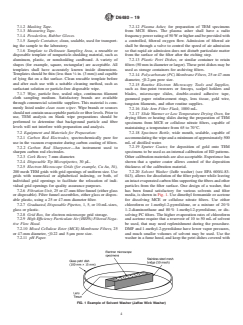
7.2.7 Graduated, Disposable Pipettes, 1, 5, or 10-mLsizes, chloroform or 1-methyl-2-pyrrolidone, or a mixture of 20%
glass or plastic. 1-2-diaminoethane and 80% 1-methyl-2-pyrrolidone, or dis-
7.2.8 Grid Box, for electron microscope grid storage. solving PC filters. The higher evaporation rates of chloroform
7.2.9 High Effıciency ParticulateAir (HEPA) Filtered Nega- and acetone require that a reservoir of 10 to 50 mL of solvent
tive Flow Hood. be used, that may need replenishment during the procedure.
7.2.10 Mixed Cellulose Ester (MCE) Membrane Filters, 25 DMF and 1-methyl-2-pyrrolidone have lower vapor pressures,
or 47-mm diameter, ≤0.22 and 5-µm pore size. and much smaller volumes of solvent may be used. Use the
7.2.11 pH Paper. washer in a fume hood, and keep the petri dishes covered with
FIG. 1 Example of Solvent Washer (Jaffee Wick Washer)
D6480 − 19
their lids when specimens are not being inserted or removed requirement is often fulfilled through use of a fluorescent
during the solvent dissolution. Clean the washer before it is screen with calibrated gradation in the form of circles.
used for each batch of specimens.
7.3.5.1 For Bragg angles less than 0.01 radians, the TEM
7.2.21 Ultrasonic Bath, table top model (100 W).
shall be capable of performing ED from an area of 0.6 µm or
7.2.22 Vacuum Coating Unit, capable of producing a less. This performance requirement defines the minimum
vacuum better than 0.013 Pa, used for vacuum deposition of separationbetweenparticlesatwhichindependentEDpatterns
carbononthemembranefilters.Asampleholderthatwillallow can be obtained from each particle. If ED is used, the
a glass microscope slide to be tilted and continuously rotated performance of a particular instrument may normally be
during the coating procedure is recommended. A liquid nitro- calculated using the following relationship:
gen trap may be used to minimize the possibility of contami- 2
D
A 50.7854 12000C θ (1)
nation of the filter surfaces by oil from the pumping system. F G
s
M
Thevacuumcoatingunitmayalsobeusedfordepositionofthe
where:
thin film of gold, or other calibration material, when it is
required on TEM specimens as an internal calibration of ED A = the effective ED area, µm ,
D = the diameter of the ED aperture, µm,
patterns.
M = the magnification of the objective lens,
7.2.23 Vacuum Pump, able to maintain a vacuum of at least
C = thesphericalaberrationcoefficientoftheobjectivelens,
20 kPa. s
mm, and
7.3 Equipment and Materials for Analysis:
θ = maximum required Bragg angle, radians.
7.3.1 Calibration Specimen Grids for EDXA Calibration—
7.3.5.2 It is not possible to reduce the effective ED area
TEM specimen grids prepared from dispersion of calibration
indefinitely by the use of progressively smaller ED apertures
minerals required for calibration of the EDXA system: croci-
because there is a fundamental limitation imposed by the
dolite (NIST SRM 1866) and chrysotile.
spherical aberration coefficient of the objective lens.
7.3.2 Energy Dispersive X-rayAnalyzer—TheTEMshallbe
7.3.5.3 If zone axis ED analyses of amphiboles are to be
equipped with an energy dispersive X-ray analyzer capable of
performed, the TEM shall incorporate a goniometer stage that
achieving a resolution better than 180 eV (FWHM) on the
permits the TEM specimen to be either:
MnKα peak. The performance of an individual TEM-EDXA
(1)Rotated through 360°, combined with tilting through at
system is dependent on a number of geometrical factors.
least +30 to -30° about an axis in the plane of the specimen; or
Therefore, the required performance of the TEM-EDXA sys-
(2)Tilted through at least +30 to -30° about two perpen-
tem is specified in terms of the measured X-ray obtained from
dicular axes in the plane of the specimen.
a fiber of small diameter, using a known electron beam
7.3.5.4 The analysis is greatly facilitated if the goniometer
diameter. Solid state X-ray detectors are least sensitive in the
permits eucentric tilting, although this is not essential. If
low energy region; therefore, measurement of sodium in
EDXA and zone-axis ED are required on the same fiber, the
crocidolite shall be the performance criterion. Irradiation of a
goniometer shall be of a type that permits tilting of the
UICC crocidolite fiber (50 nm or smaller diameter) by an
specimen and acquisition of EDXAspectra without change of
electron probe (250 nm or smaller diameter), the TEM-EDXA
specimen holder. If the goniometer does not permit eucentric
system shall yield, under routine analytical conditions, a
tilting, gold or other metal film must be evaporated on the
background-subtracted NaKα integrated peak count rate of
sample in order that ED patterns may be accurately calibrated.
morethan1countpersecond(cps).Thepeak/backgroundratio
7.3.5.5 The TEM shall have an illumination and condenser
for this performance test shall exceed 1:0.
lens system capable of forming an electron probe smaller than
7.3.2.1 TheEDXAunitshallprovidethemeansforsubtrac-
250 nm in diameter. It is recommended that an anticontamina-
tion of the background, identification of elemental peaks, and
tion trap be used around the specimen.
calculation of background-subtracted peak areas.
7.3.3 GratingReplica,approximately2000parallellinesper
8. Reagents
mm, used to calibrate the magnification of the TEM.
7.3.4 Reference Asbestos Samples, for preparation of refer-
8.1 Reagents for Sample Preparation:
ence TEM specimens of the primary asbestos minerals. The
8.1.1 1-Methyl-2-pyrrolidone, analytical grade.
UICC or NIST mineral set is suitable for this purpose.
8.1.2 1-2-diaminoethane, analytical grade.
7.3.5 TransmissionElectronMicroscope—ATEMoperating
8.1.3 Acetone, analytical grade.
atanacceleratingpotentialfrom80to120kV,witharesolution
8.1.4 Alcohol, ethanol, 2-propanol, or methanol.
betterthan1.0nm,andamagnificationrangeofapproximately
8.1.5 Chloroform, analytical grade, distilled in glass (pre-
300 to 100000× shall be used, with the ability to obtain a
served with 1% (v/v) ethanol).
screen magnification of about 100000×, for inspection of fiber
8.1.6 Dimethyl Formamide, analytical grade.
morphology. This magnification may be obtained by supple-
8.1.7 Glacial Acetic Acid, analytical grade.
mentary optical enlargement of the screen image by use of a
binocular. It is also required that the viewing screen of the 8.1.8 Purity of Water—References to water shall be under-
microscope be calibrated such that the lengths and widths of stood to mean reagent water as defined by Type I of Specifi-
fiber images down to 1-mm width can be estimated in cation D1193, or by distilled or deionized water filtered
increments of 1 mm regardless of fiber orientation. This through a membrane filter of 0.22-µm maximum pore size.
D6480 − 19
(Warning—Use the reagents in accordance with the appropri- 9.2.1.5 Adequately moisten the wipe with a 50/50 mixture
ate health and safety regulations. Review their Material Safety ofalcoholandwater.Forexample,10to20mLwilladequately
Data Sheets before use.) moisten a 21 by 21-cm wipe. It is recommended that a portion
ofthewipebetestedwiththemixtureifthereisanydoubtthat
the solvent may damage the wipe material.
9. Procedure
9.2.1.6 First Wiping, Side to Side—Hold one edge of the
9.1 Identify and document all areas to be sampled. Docu-
wipe between the thumb and forefinger, draping the wipe over
mentation should include:
the fingers of a gloved hand. Hold fingers together, hand flat,
9.1.1 General sampling site description.
and wipe the selected surface area, starting at either corner
9.1.2 Projectorclientname,address,andcity/statelocation.
furthest away from the operator (referred to as a far corner),
9.1.3 Samplelocation,whichshouldincludeallinformation
and use a slow side to side (left to right or right to left)
neededtolocatetheroomandwherethesamplewascollected.
sweeping motion. During wiping, apply even pressure to the
These include building, floor, room number, and room name.
fingertips.
NOTE 1—Some investigators include dimensions from some sort of 9.2.1.7 At the end of the first side to side pass, turn the
reference (for example, 3 ft 0 in. (0.9 m) from outside wall and 2 ft 0 in.
wipe’s leading edge (portion of the wipe touching the surface)
(0.6 m) from north wall), whereas others provide a section allowing such
180°.Pullthewipepathslightlyclosetotheoperatorandmake
information to be recorded on a sample collection sheet.
a second side to side pass in the reverse direction, slightly
9.1.4 Surface type, which should include descriptors of the
overlapping the first pass. The 180° turn is used to ensure that
surfaces in the room upon which the samples were collected.
the wiping motion is always performed in the same direction
These include floor, wall, ceiling, top of light fixture, top of
on the wipe to maximize sample pickup. Continue to cover the
ceilingtile,exteriororduct,andsoforth.Itissometimesuseful
sampling area within the template, using the slightly overlap-
to provide a section allowing for identification of surface
ping side to side passes with the 180° turns at each edge until
sampled(forexample,foralouver,whetherthesampleisfrom
the close corner of the template is reached. Carefully lift the
the top or bottom surface; for a grill, whether the sample is
sampledmaterialintothewipe,usingaslightrollingmotionof
from the upstream or downstream side).
the hand to capture the sample inside the wipe. Fold the wipe
9.1.5 Surface material, which should describe the material
in half with the sample folded inside the fold.
from which the surface is constructed (for example, painted
9.2.1.8 Second Wiping, Top to Bottom—Using a clean side
plaster or drywall, wood, concrete, metal, fabric, brick, resil-
of the wipe, perform a second wiping over the sampling area
ient flooring, and so forth).
within the template, starting from a far corner in the same
9.1.6 Surface description, which should describe the nature
manner used for the first wiping, except use a top to bottom
of the surface (for example color, texture, clean, dry, greasy,
sweepingofthesurface.Whentheclosecornerofthetemplate
wet).
is reached, carefully lift the sampled material into the wipe,
9.1.7 The area of surface wiped. It may not always be
using a slight rolling motion of the hand to capture the sample
possible to collect from 100 cm of surface. For example, one
inside the wipe. Fold the wipe in half again, with the sample
should indicate whether the effective surface area of a grill is
from this second wiping folded inside the fold.
discounted for the open spaces in the grill.
9.2.1.9 Third Wiping, Clean Corners—Usingacleansideof
9.1.8 Post sampling cleanliness of surface. A visual evalu-
the wipe, perform a third wiping around the perimeter of the
ation of the cleanliness of the surface post-sampling should be
sampling area within the template. Start from one edge of the
made and recorded. This evaluation should not be made until
template and use the same wiping technique as described in
the surface has dried.
9.2.1.8. When the interior perimeter has been wiped and the
starting location reached, carefully lift the sampled material
9.2 Two sampling procedures are presented (see EPA 747-
into the wipe, using a slight rolling motion of the hand to
R-95-001). One procedures for sampling in unrestricted areas
capture the sample inside the wipe. Fold the wipe in half one
such as floors (Template Assisted Sampling Procedure). The
moretime,withthesamplefromthisthirdwipingfoldedinside
ConfinedArea Sampling Procedure should only be used when
the fold.
theTemplateAssistedSamplingProcedurecannotbeuseddue
9.2.1.10 Insert the folded wipe into a sample container and
to sampling location constraints. The ConfinedArea Sampling
seal. Label the container with sample number and sufficient
Procedure assumes the width of the sampling location is no
information to uniquely identify the sample.
largerthanthedimensionsofawipe.Ifthisisnottrue,thenthe
Template Assisted Sampling Procedure is used. 9.2.1.11 Ifthetemplateisareusabletype,cleanthetemplate
(see 7.1.6).
9.2.1 Template Assisted Sampling Procedure:
9.2.1.12 Discard gloves.
9.2.1.1 If a reuseable template is used, clean template (see
7.1.6). 9.2.1.13 Check that all sampling information sheets are
9.2.1.2 Determine, measure, mark, or mask area, or place completed and that all pertinent information has been enclosed
before transferring the samples to the laboratory
templateontosurface.Documentthelocationandarea(cm )of
surface to be sampled.
9.2.1.14 Collect a field wipe (see 3.2.18).
9.2.1.3 Atypicalsamplingareais100cm .Smallerorlarger
9.2.1.15 Wipe off the exterior surface of the sample con-
areas may be sampled depending on surface cleanliness.
tainers with disposable wet towels prior to packaging for
9.2.1.4 Put on a pair of clean, powderless, rubber gloves. shipment.
D6480 − 19
Regulations for air shipment or Department of Transportation (DOT) for
9.2.2 Confined Area Sampling Procedure:
ground shipment.
9.2.2.1 Put on a pair of clean, powderless, rubber gloves.
9.2.2.2 Adequately moisten the wipe with a 50/50 mixture
11. Sample Suspension Preparation
of alcohol and water. (For example, 10 to 20 mL will
11.1 Before taking sample containers into a clean prepara-
adequately moisten a 21 by 21-cm wipe.) It is recommended
tion area, carefully wet-wipe the exterior of the containers to
that a portion of the wipe be tested with the mixture if there is
remove any possible contamination.
any doubt that the solvent may damage the wipe material.
9.2.2.3 First Wiping, One Direction, Side-to-Side—Hold
11.2 Perform sample preparation in a clean facility that has
one edge of the wipe between the thumb and forefinger,
a separate work area from both the bulk and airborne asbestos
draping the wipe over the fingers of a gloved hand. Hold
sample preparation areas.
fingers together, hand flat, and wipe the selected surface area.
11.3 Initial specimen preparation (see 11.3.1 – 11.3.6) shall
Start at either corner furthest away from the operator (referred
take place in a clean HEPA filtered negative pressure hood to
to as a far corner), and use a slow side to side (left to right or
avoid any possible contamination of the laboratory or
right to left) sweeping motion. During wiping, apply even
personnel, or both, by the potentially large number of asbestos
pressure to the fingertips.At the end of the first pass from one
structures in an asbestos-containing surface wipe sample.
side to the other, carefully lift the sample material into the
11.3.1 Transfer the wipe into a clean, wide-mouthed speci-
wipe, using a slight rolling motion of the hand to capture the
men bottle.
sample inside the wipe. Fold the wipe in half with the sample
11.3.2 Rinse out the interior of the sample transport con-
folded inside the fold.
tainer with a known volume of water.
9.2.2.4 Second Wiping, One Direction, Side-to-Side—Using
11.3.3 Pour this rinse water into the specimen bottle con-
a clean side of the wipe, repeat step 9.2.2.3, using a wiping
taining the wipe.
motion in the reverse direction. When the close corner of the
11.3.4 Add an additional measured volume into the labeled
sampling area is reached, carefully lift the sampled material
specimen bottle to submerge the wipe in 500 mL of water.
into the wipe, using a slight rolling motion of the hand to
11.3.5 Usingforceps,carefullyunfoldthewipetoexposeall
capturethesampleinsidethewipe.Foldthewipeinhalfagain,
of the surfaces.
withthesamplefromthissecondwipingfoldedinsidethefold.
11.3.6 Adjust the pH of the suspension to 3 to 4, using a
9.2.2.5 Third Wiping, Clean Corners—Usingacleansideof
10.0% solution of acetic acid. Use pH paper for testing.
the wipe, perform a third wiping around the interior perimeter
11.3.7 Replace the top to the specimen bottle, and lightly
of the sampling area. Start from the middle of one edge of an
shake the suspension by hand for 3 s.
areaandusethesamewipingtechniqueasdescribedin9.2.2.3.
11.4 Place the specimen bottle in a tabletop ultrasonic bath.
When the perimeter has been wiped and the starting location
Maintain the water level in the sonicator at the same height as
reached, carefully lift the sample material into the wipe, using
the suspension in the specimen bottle. Sonicate for 5.0 min to
a slight rolling motion of the hand to capture sample inside the
release particles from wipe.
wipe. Fold the wipe in half one more time with the sample
11.4.1 Calibrate the ultrasonic bath as described in 21.4.2.
from this third wiping folded inside the fold.
Operate the ultrasonic bath at equilibrium temperature. After
9.2.2.6 Insert the folded wipe into a sample container and
sonication, return the specimen bottle to the work surface of
seal. Label the sample container with sample number and
the HEPA hood.
sufficient information to uniquely identify the sample.
9.2.2.7 Discard gloves.
12. Blank Filtration
9.2.2.8 Using a tape measure, measure the dimension of the
12.1 Process at least one field wipe (see 3.2.18) along with
sampled surface with units such as inches or centimetres.
eachbatchofsamplestotestforpotentialcontaminationduring
9.2.2.9 Check that all sampling information sheets are
the sampling, shipping, handling, and preparation steps of the
completed and that all pertinent information has been enclosed
test method. Reject the sample set or take appropriate actions
before transfer of the sample to the laboratory
if relatively high fiber counts are determined.
9.2.2.10 Collect a field wipe.
9.2.2.11 Wipe off the exterior surface of the sample trans- 12.2 In addition, process sample blanks that include a
port containers with disposable wet towels prior to packaging
process blank (see 3.2.25) and filtration blank (see 3.2.19). If
for shipment. glass filtration units are used, prepare a filtration blank prior to
each new use of the filtration unit.
10. Sample Shipment
12.3 The process and filtration blanks will be considered
10.1 Ship samples to an analytical laboratory, separately contaminatedif,afteranalysis,theyareshowntocontainmore
than 53 asbestos structures per square millimetre of the
packed from any bulk or air samples. The samples shall be
packed in a material fiber-free material to minimize the analyzed filter. This generally corresponds to 3 or 4 asbestos
structuresfoundin10gridsquares.Thesourceofthecontami-
potential for contamination.
nation must be found before any further analysis can be
NOTE 2—One package containing a large number of wipes moistened
performed. Reject samples that were processed along with the
with a 50/50 mixture of alcohol and water may fall under regulations
contaminatedblanks,andpreparenewsamplesafterthesource
regarding transportation of dangerous goods. Prior to shipment, contact
either International Air Transport Association (IATA) Dangerous Good of the contamination is found.
D6480 − 19
13. Sample Filtration 13.11.1 Estimate the amount of suspension to be withdrawn
toproduceanadequatefilterpreparation.Alightstainingofthe
13.1 Use a filtration unit for filtration of suspension ali-
filter surface will yield a suitable preparation for analysis.
quots.
Filter at least 1.0 mL, but no more than half the total volume.
13.2 If a disposable plastic filtration unit is used, then
13.11.2 Toensurethatanoptimallyloadedfilterisobtained,
unwrap a new disposable plastic filter funnel unit and remove
it is recommended that filters be prepared from varying
the tape around the base of the funnel. Remove the funnel and
aliquots of the suspension.A3 to 10% particulate coverage of
discard the top filter supplied with the apparatus. Retain the
the grid opening is ideal.
coarse polypropylene support pad in place. Assemble the unit
13.11.2.1 If the filters are prepared in order of increasing
with the adapter and a properly sized neoprene stopper, and
aliquotvolume,allofthefiltersforonesamplecanbeprepared
attach the funnel to the 1000-mLside arm vacuum flask. Place
using one plastic disposable filtration unit, or without cleaning
a 5.0-µm pore size MCE (backing filter) on the support pad.
of glass filtration equipment between individual filtration.
Before withdrawal of each aliquot from the sample, shake the
13.3 Wet the backing filter with a few millilitres of water,
suspensionwithoutadditionalsonificationandallowtorestfor
andplacea≤0.22-µmMCEora≤0.2-µmPCfilterontopofthe
2 min.
backing filter. Apply a vacuum, ensuring that the filters are
13.11.3 If after examination in the TEM, the smallest
centered and pulled flat without air bubbles.Any irregularities
volume measured (1.0 mL) yields an overloaded sample,
on the filter surface require the discard of the ≤0.22-µm MCE
perform a sample dilution.
or the ≤0.2-µm PC filter.
13.11.3.1 If a sample dilution is required, repeat 13.10
13.4 Once the filter has been seated properly, replace the
before the dilution aliquot is taken. Do not resonicate the
funnel and reseal it with the tape. Return the flask to atmo-
original suspension or any sample dilutions. Mix 10 mLof the
spheric pressure.
sample suspension with 90 mL of water in a clean specimen
bottle to obtain a 1:10 dilution. Follow good laboratory
NOTE 3—When using a PC filter, the filter must not be allowed to dry
practices when performing dilutions.
beforefiltration.PCfiltersarehydrophobic.Awater-solublewettingagent
is applied to the surface in order to make the surface hydrophilic. Once
13.12 Apply vacuum to the flask, and draw the suspension
thisagentisremovedandthefilterallowedtodry,filtrationthroughthePC
through the filter.
filter is almost impossible.
13.13 Discard the pipette.
13.5 If a glass filtration unit is used, place a 5-µm pore size
MCE (backing filter) on the glass frit surface. 13.14 Disassemble the filtering unit, and carefully remove
the sample filter with fine forceps. Place the completed sample
13.6 Wet the backing filter with a few mL of water, and
filter, sample surface side up into a precleaned, labeled
place an MCE or PC filter (≤0.22-µm pore size) on top of the
disposable plastic petri dish or other similar container.
backing filter. Apply a vacuum, ensuring that the filters are
13.15 There are many practical methods for drying both
centered and pulled flat without air bubbles. Replace the filters
MCEandPCfilters,forexample,dryingfiltersinaplasticpetri
if any irregularities are seen on the filter surface.
dish on a slide warmer or in a low temperature oven at 65 to
13.7 If aliquots of the same sample are filtered in order of
70°C for 10 to 15 min.
increasing concentration or volume, the glass filtration unit
13.16 Prepare TEM specimens from small sections of each
need not be washed between filtration.
dried filter, using the appropriate direct transfer preparation
13.8 After completion of the filtration, do not allow the
method (see Sections 14 and 15).
filtration funnel assembly to dry because contamination is then
more difficult to remove. Wash any residual suspension from
14. TEM Specimen Preparation of Mixed Cellulose Ester
the filtration assembly by holding it under a flow of water, and
(MCE) Filters
then rub the surface with a clean paper towel soaked in a
NOTE 4—Use of either the acetone or the dimethyl formamide (DMF)-
detergent solution. Repeat the cleaning operation, and then
acetic acid method is acceptable.
rinse two times in water.
14.1 Acetone Fusing Method:
14.1.1 Process at least one filter blank with every batch of
13.9 With the flask at atmospheric pressure, add 20 mL of
samples.
water into the funnel. Cover the filter funnel with its plastic
14.1.2 Remove a section from any quadrant of the sample
cover if the disposable filtering unit is used.
and blank filters. Sections can be removed from the filters
13.10 Shake the sample suspension lightly by hand for 3 s,
using either a scalpel or 7-mm cork borer. The scalpel or cork
thenletitrestfor2.0mintoallowlargeparticlestosettletothe
borermustbewet-wipedaftereachtimeasectionisremoved.
bottom of the bottle or float to the surface.
14.1.3 Place the filter section (sample side up) on a clean
13.11 Insert a new pipette into the sample suspension to microscope slide. Affix the filter section to the slide with a
withdraw an aliquot from the central region of the suspension. gummed page reinforcement, or other suitable means. Label
Avoid pipetting any of the large floating or settled particles. the slide with a glass scribing tool or permanent marker.
Uncover the filter funnel and dispense the aliquot from the 14.1.4 Prepare a fusing dish from a glass petri dish and a
pipette into the water in the funnel. Stir with pipette to mix metal screen bridge with a pad of five to six paper filters, and
thoroughly. place in the bottom of the petri dish (see 40 CFR 763). Place
D6480 − 19
the screen bridge on top of the pad and saturate the filter pads the TEM specimen, and there will be few complete and
with acetone. Place the slide on top of the bridge in the petri undamagedgridopeningsonthespecimen.Ifthecoatingistoo
dish, and cover the dish. Wait approximately 5 min for the thick, it will lead to a TEM image that is lacking in contrast,
sample filter to fuse and clear. and the ability to obtain electron diffraction patterns will be
compromised. The carbon film shall be as thin as possible and
14.2 DMF-Acetic Acid M
...
This document is not an ASTM standard and is intended only to provide the user of an ASTM standard an indication of what changes have been made to the previous version. Because
it may not be technically possible to adequately depict all changes accurately, ASTM recommends that users consult prior editions as appropriate. In all cases only the current version
of the standard as published by ASTM is to be considered the official document.
Designation: D6480 − 05 (Reapproved 2010) D6480 − 19
Standard Test Method for
Wipe Sampling of Surfaces, Indirect Preparation, and
Analysis for Asbestos Structure Number Surface Loading
by Transmission Electron Microscopy
This standard is issued under the fixed designation D6480; the number immediately following the designation indicates the year of
original adoption or, in the case of revision, the year of last revision. A number in parentheses indicates the year of last reapproval. A
superscript epsilon (´) indicates an editorial change since the last revision or reapproval.
1. Scope
1.1 This test method covers a procedure to identify asbestos in samples wiped from surfaces and to provide an estimate of the
concentration of asbestos reported as the number of asbestos structures per unit area of sampled surface. The procedure outlined
in this test method employs an indirect sample preparation technique. It is intended to disperse aggregated asbestos into
fundamental fibrils, fiber bundles, clusters, or matrices. However, as with all indirect sample preparation techniques, the asbestos
observed for quantification may not represent the physical form of the asbestos as sampled. More specifically, the procedure
described neither creates nor destroys asbestos, but it may alter the physical form of the mineral fiber aggregates.
1.2 This test method describes the equipment and procedures necessary for wipe sampling of surfaces for levels of asbestos
structures. The sample is collected onto a particle-free wipe material (wipe) from the surface of a sampling area that may contain
asbestos.
1.2.1 The collection efficiency of this wipe sampling technique is unknown and will vary among substrates. Properties
influencing collection efficiency include surface texture, adhesiveness, and other factors.
1.2.2 This test method is generally applicable for an estimate of the surface loading of asbestos structures starting from
approximately 1000 asbestos structures per square centimetre.
1.3 Asbestos identification by transmission electron microscopy (TEM) is based on morphology, electron diffraction (ED), and
energy dispersive X-ray analysis (EDXA).
1.4 This test method allows determination of the type(s) of asbestos fibers present.
1.4.1 This test method cannot always discriminate between individual fibers of the asbestos and nonasbestos analogues of the
same amphibole mineral.
1.4.2 There is no lower limit to the dimensions of asbestos fibers that can be detected. However, in practice, the lower limit to
the dimensions of asbestos fibers, that can be detected, is variable and dependent on individual microscopists. Therefore, a
minimum length of 0.5 μm has been defined as the shortest fiber to be incorporated in the reported results.
1.5 The values stated in SI units are to be regarded as standard.
1.6 This test method standard does not purport to address all of the safety concerns, if any, associated with its use. It is the
responsibility of the user of this test method standard to establish appropriate safety safety, health, and healthenvironmental
practices and determine the applicability of regulatory limitations prior to use.
1.7 This international standard was developed in accordance with internationally recognized principles on standardization
established in the Decision on Principles for the Development of International Standards, Guides and Recommendations issued
by the World Trade Organization Technical Barriers to Trade (TBT) Committee.
2. Referenced Documents
2.1 ASTM Standards:
D1193 Specification for Reagent Water
D1356 Terminology Relating to Sampling and Analysis of Atmospheres
This test method is under the jurisdiction of ASTM Committee D22 on Air Quality and is the direct responsibility of Subcommittee D22.07 on Sampling and Analysis
of AsbestosSampling, Analysis, Management of Asbestos, and Other Microscopic Particles.
Current edition approved Oct. 1, 2010June 1, 2019. Published November 2010July 2019. Originally approved in 1999. Last previous edition approved in 20052010 as
D6480 – 05.D6480 – 05 (2010). DOI: 10.1520/D6480-05R10.10.1520/D6480-19.
For referenced ASTM standards, visit the ASTM website, www.astm.org, or contact ASTM Customer Service at service@astm.org. For Annual Book of ASTM Standards
volume information, refer to the standard’s Document Summary page on the ASTM website.
Copyright © ASTM International, 100 Barr Harbor Drive, PO Box C700, West Conshohocken, PA 19428-2959. United States
D6480 − 19
E691 Practice for Conducting an Interlaboratory Study to Determine the Precision of a Test Method
D3670E177 GuidePractice for DeterminationUse of the Terms Precision and Bias of Methods of Committee D22in ASTM Test
Methods
2.2 Government Standard:
40 CFR 763, USEPA, Asbestos-Containing Materials in Schools: Final Rule and Notice, Appendix A to Sub-part E
2.3 U.S. Environmental Protection Agency Standards:
EPA 600/4-83-043 Analytical Method for the Determination of Asbestos in Water
EPA 747-R-95-001 USEPA, Residential Sampling for Lead: Protocols for Dust and Soil Sampling: Final Report
3. Terminology
3.1 Definitions—For definitions of general terms used in this test method, refer to Terminology D1356.
3.2 Definitions of Terms Specific to This Standard:
3.2.1 amphibole asbestos—asbestos, n—amphibole in an asbestiform habit (1).
3.2.2 analytical sensitivity—sensitivity, n—the calculated asbestos structure concentration in asbestos structures/square
centimetre, equivalent to counting of one asbestos structure in the analysis calculated using Eq 2.
3.2.3 asbestos—asbestos, n—a collective term that describes a group of naturally occurring, inorganic, highly fibrous, silicate
minerals, that are easily separated into long, thin, flexible, strong fibers when crushed or processed (1-3).
3.2.3.1 Discussion—
Included in the definition are the asbestiform varieties of serpentine (chrysotile), riebeckite (crocidolite), grunerite (grunerite
asbestos [Amosite]), anthophyllite (anthophyllite asbestos), tremolite (tremolite asbestos), and actinolite (actinolite asbestos). The
amphibole mineral compositions are defined in accordance with nomenclature of the International Mineralogical Association (3,
4).
A
Asbestos Chemical Abstracts Service Registry No.
Chrysotile 12001-29-5
Crocidolite 12001-28-4
Grunerite Asbestos [Amosite] 12172-73-5
Anthophyllite Asbestos 77536-67-5
Tremolite Asbestos 77536-68-6
Actinolite Asbestos 77536-66-4
A
The nonasbestiform variations of the minerals indicated in 3.2.3.1 have different Chemical Abstract Service (CAS) numbers.
3.2.4 asbestos structure—structure, n—a term applied to isolated fibers or to any connected or overlapping grouping of asbestos
fibers or bundles, with or without other nonasbestos particles.
3.2.5 aspect ratio—ratio, n—the length to width ratio of a particle.
3.2.6 bundle—bundle, n—a structure composed of three or more fibers in a parallel arrangement with the fibers closer than one
fiber diameter to each other.
3.2.7 camera length—length, n—the equivalent projection length between the specimen and its selection diffraction pattern, in
the absence of lens action.
3.2.8 chrysotile—chrysotile, n—a group of fibrous minerals of the serpentine group that have the nominal composition
Mg Si O (OH) and have the crystal structure of either clinochrysotile, orthochrysotile, or parachrysotile. Most natural chrysotile
3 2 5 4
deviates little from this nominal composition. Chrysotile may be partially dehydrated or magnesium-leached both in nature and
3+
in building materials. In some varieties of chrysotile, minor substitution of silicon by Al may occur. Chrysotile is the most
prevalent type of asbestos.
3.2.9 cluster—cluster, n—a structure with fibers in a random arrangement such that all fibers are intermixed and no single fiber
is isolated from the group; groupings of fibers must have more than two points touching.
3.2.10 d-spacing or inter-planar spacing—spacing, n—the perpendicular distance between identical adjacent and parallel planes
of atoms in a crystal.
3.2.11 electron diffraction—diffraction, n—techniques in electron microscopy that include selected area electron diffraction
(SAED) and microdiffraction by which the crystal structure of a specimen is examined.
Available from U.S. Government Printing Office, Superintendent of Documents, 732 N. Capitol St., NW, Mail Stop: SDE, Washington, DC 20401,20401-0001,
http://www.access.gpo.gov.
The boldface numbers in parentheses refer to the list of references at the end of this standard.
D6480 − 19
3.2.12 energy dispersive X-ray analysis—analysis, n—measurement of the energies and intensities of X-rays by use of a solid
state detector and multichannel analyzer system.
3.2.13 eucentric—eucentric, n—the condition when the area of interest of an object is placed on a tilting axis at the intersection
of the electron beam at that axis and is in the plane of focus.
3.2.14 fiber—fiber, n—an elongate particle with parallel or stepped sides. For the purposes of this test method, a fiber is defined
to have an aspect ratio equal to or greater than 5:1 and a minimum length of 0.5 μm (see 40 CFR 763).
3.2.15 fibril—fibril, n—a single fiber, that cannot be further separated longitudinally into smaller components without losing its
fibrous properties or appearances.
3.2.16 fibrous mineral—mineral, n—a mineral composed of parallel, radiating, or interlaced aggregates of fibers from which the
fibers are sometimes separable. That is, the crystalline aggregate may be referred to as fibrous even if it is not composed of
separable fibers but has that distinct appearance. The term fibrous is used in a general mineralogical way to describe aggregates
of grains that crystallize in a needle-like habit and appear to be composed of fibers. Fibrous has a much more general meaning
than asbestos. While it is correct that all asbestos minerals are fibrous, not all minerals having fibrous habits are asbestos.
3.2.17 fibrous structure—structure, n—a fiber, or connected grouping of fibers, with or without other particles.
3.2.18 field wipe blank—blank, n—a clean, unused, moistened wipe from the same supply that is used for sampling. Field wipes
shall be processed in the same manner used to collect field samples with the exception that no surface is wiped. Each wipe
designated as a field wipe should be removed from the bulk pack, moistened, and folded in the same manner as the field samples
and placed in a sample container labeled as field wipe.
3.2.19 filter blank—blank, n—an unused, unprocessed filter of the type used for liquid filtration.
3.2.20 filtration blank—blank, n—a filter prepared from 250 mL of water.
3.2.21 habit—habit, n—the characteristic crystal growth form or combination of these forms of a mineral, including
characteristic irregularities.
3.2.22 indirect preparation—preparation, n—a method in which a sample passes through one or more intermediate steps prior
to final filtration. The particles are removed from the original medium and deposited on a second filter prior to analysis.
3.2.23 limit of detection—detection, n—the limit of detection for a measurement by this test method is 2.99 multiplied by the
analytical sensitivity for the measurement.
3.2.23.1 Discussion—
This limit of detection is based on the assumption that the count resulting from potential filter contamination, sample preparation
contamination, and other uncontrollable background sources is no greater than 0.05 structures per sample. At this time, however,
this subcommittee has no empirical data to confirm this rate.
3.2.24 matrix—matrix, n—a structure in which one or more fibers, or fiber bundles that are touching, are attached to, or partially
concealed by, a single particle or connected group of nonfibrous particles. The exposed fiber must meet the fiber definition.
3.2.25 process blank—blank, n—an unused wipe (that has not been taken into the field) processed in accordance with the entire
preparation and analytical procedure.
3.2.26 replicate sampling—sampling, n—one of several identical procedures or samples.
3.2.27 serpentine—serpentine, n—a group of common rock-forming minerals having the nominal formula: Mg Si O (OH) . For
3 2 5 4
further information see Ref.Ref (4).
3.2.28 structure—structure, n—a single fiber, fiber bundle, cluster, or matrix.
3.2.29 structure number concentration—concentration, n—concentration expressed in terms of asbestos structure number per
unit of surface area.
3.2.30 zone-axis—zone-axis, n—the crystallographic direction of a crystal that is parallel to the intersecting edges of the crystal
faces defining the crystal zone.
3.3 Symbols:
eV = electron volt
h = hour
J = joule
kV = kilovolt
min = minute(s)
–3
mL = millilitre (10 litre)
–6
μL = microlitre (10 litre)
D6480 − 19
–3
mm = millimetre (10 metre)
–6
μm = micrometre (10 metre)
–9
nm = nanometre (10 metre)
s = second(s)
W = watt
Pa = pascals
3.4 Acronyms:
DMF = dimethyl formamide
ED = electron diffraction
EDXA = energy dispersive X-ray analysis
FWHM = full width, half maximum
HEPA = High Efficiency Particulate Air
MCE = mixed cellulose ester and also refers to pure cellulose nitrate filters
PC = polycarbonate
TEM = transmission electron microscope
4. Summary of Test Method
4.1 Wiping a surface of known area with a wipe material collects a sample. The sample is transferred from the wipe material
to an aqueous suspension of known volume. Aliquots of the suspension are then filtered through a membrane filter. A section of
the membrane filter is prepared and transferred to a TEM grid, using the direct transfer method. The asbestiform structures are
identified, sized, and counted by TEM, using ED and EDXA at a magnification from 15 000 to 20 000 ×.20 000×.
5. Significance and Use
5.1 This wipe sampling and indirect analysis test method is used for the general testing of surfaces for asbestos. It is used to
assist in the evaluation of surfaces in buildings, such as ceiling tiles, shelving, electrical components, duct work, and so forth. This
test method provides an index of the concentration of asbestos structures per unit area sampled as derived from a quantitative
measure of the number of asbestos structures detected during analysis.
5.1.1 This test method does not describe procedures or techniques required for the evaluation of the safety or habitability of
buildings with asbestos-containing materials, or compliance with federal, state, or local regulations or statutes. It is the user’s
responsibility to make these determinations.
5.1.2 At present, a single direct relationship between asbestos sampled from a surface and potential human exposure does not
exist. Accordingly, the user should consider these data in relationship to other available information (for example, air sampling
data) in their evaluation.
5.2 One or more large asbestos-containing particles dispersed during sample preparation may result in large asbestos surface
loading results in the TEM analyses of that sample. It is, therefore, recommended that multiple replicate independent samples be
secured in the same area, and that a minimum of three such samples be analyzed by the entire procedure.
6. Interferences
6.1 The following materials have properties (that is, chemical composition or crystalline structure) that are very similar to
asbestos minerals and may interfere with the analysis by causing a false positive to be recorded during the test. Therefore, literature
references for these materials shall be maintained in the laboratory for comparison with asbestos minerals so that they are not
misidentified as asbestos minerals.
6.1.1 Antigorite,
6.1.2 Fibrous talc,
6.1.3 Halloysite,
6.1.4 Hornblende and other amphiboles,
6.1.5 Palygorskite (attapulgite),
6.1.6 Pyroxenes,
6.1.7 Sepiolite, and
6.1.8 Vermiculite scrolls.
7. Apparatus
7.1 Equipment and Materials for Sampling:
7.1.1 Disposable Wet Towels.
7.1.2 Masking Tape.
7.1.3 Measuring Tape.
7.1.4 Powderless, Rubber Gloves.
D6480 − 19
7.1.5 Sample Container, clean, sealable, used for transporting the sample to the laboratory.
7.1.6 Template to Delineate Sampling Area, a reusable or disposable template of nonparticle-shedding material, such as
aluminum, plastic, or nonshedding cardboard. A variety of shapes (for example, square, rectangular) are acceptable. All templates
shall have accurately known inside dimensions. Templates should be thin (less than ⁄8 in. (3 mm)) and capable of lying flat on
a flat surface. Clean reusable template before and after each use with a suitable cleaning method, such as surfactant solution or
particle-free disposable wipe.
7.1.7 Wipe, particle free, sealed edge, continuous filament cloth sampling medium. Satisfactory brands are available through
commercial scientific suppliers. This material is commonly listed under clean room wiper. Wipe brands or sources should not
contain unacceptable particle or fiber levels. Prior to use, TEM analysis on blank wipe preparations should be performed to
determine that background particle and fiber levels will not interfere with preparation and analysis.
7.2 Equipment and Materials for Preparation:
7.2.1 Carbon Rod Electrodes, spectrochemically pure for use in the vacuum evaporator during carbon coating of filters.
7.2.2 Carbon Rod Sharpener—An instrument used to sharpen carbon rod electrodes.
7.2.3 Cork Borer, 7-mm diameter.
7.2.4 Disposable Tip Micropipettes, 30 μL.
7.2.5 Electron Microscope Grids (for example, Cu Au, Ni), 200 mesh TEM grids with grid openings of uniform size. Use grids
with numerical or alphabetical indexing, or both, of individual grid openings to facilitate the relocation of individual grid openings
for quality assurance purposes.
7.2.6 Filtration Unit, 25 or 47-mm filter funnel (either glass or disposable). Filter funnel assemblies, either glass or disposable
plastic, using a 25 or 47-mm diameter filter.
7.2.7 Graduated, Disposable Pipettes, 1, 5, or 10–mL10-mL sizes, glass or plastic.
7.2.8 Grid Box, for electron microscope grid storage.
7.2.9 High Effıciency Particulate Air (HEPA) Filtered Negative Flow Hood.
7.2.10 Mixed Cellulose Ester (MCE) Membrane Filters, 25 or 47-mm diameter, ≤ 0.22 ≤0.22 and 5-μm pore size.
7.2.11 pH Paper.
7.2.12 Plasma Asher, for preparation of TEM specimens from MCE filters. The plasma asher shall have a radio frequency power
rating of 50 W or higher and be provided with a controlled, filtered oxygen flow. Admission of filtered air shall be through a valve
to control the speed of air admission so that rapid air admission does not disturb particulate matter from the surface of the filter
after the etching step.
7.2.13 Plastic Petri Dishes, or similar container to retain filters (50 mm in diameter or larger). These petri dishes may be used
as storage containers for archiving filters.
7.2.14 Polycarbonate (PC) Membrane Filters, 25 or 47-mm diameter ≤ 0.2-μm diameter, ≤0.2-μm pore size.
7.2.15 Routine Electron Microscopy Tools and Supplies, such as fine-point tweezers or forceps, scalpel holders and blades,
microscope slides, double-coated adhesive tape, gummed paper reinforcement rings, lens tissue, gold wire, tungsten filaments, and
other routine supplies.
7.2.16 Side Arm Filter Flask, 1000 mL.
7.2.17 Slide Warmer or Low Temperature Drying Oven, for drying filters or heating slides during the preparation of TEM
specimens from MCE or cellulose nitrate filters, capable of maintaining a temperature from 65 to 70°C.
7.2.18 Specimen Bottle, wide mouth, sealable, capable of accommodating the wipe and a minimum of approximately 500 mL
of distilled water.
7.2.19 Sputter Coater, for deposition of gold onto TEM specimens to be used as an internal calibration of ED patterns. Other
calibration materials are also acceptable. Experience has shown that a sputter coater allows control of the deposition thickness of
the calibration material.
7.2.20 Solvent Washer (Jaffe washer) (see EPA 600/4-83-043),allows for dissolution of the filter polymer while leaving an intact
evaporated carbon film supporting the fibers and other particles from the filter surface. One design of a washer, that has been found
satisfactory for various solvents and filter media, is shown in Fig. 1. Use dimethyl formamide or acetone for dissolving MCE or
cellulose nitrate filters. Use either chloroform or 1-methyl-2-pyrrolidone, or a mixture of 20 % 1-2-diaminoethane and 80 %
1-methyl-2-pyrrolidone, or dissolving PC filters. The higher evaporation rates of chloroform and acetone require that a reservoir
of 10 to 50 mL of solvent be used, that may need replenishment during the procedure. DMF and 1-methyl-2-pyrrolidone have lower
vapor pressures, and much smaller volumes of solvent may be used. Use the washer in a fume hood, and keep the petri dishes
covered with their lids when specimens are not being inserted or removed during the solvent dissolution. Clean the washer before
it is used for each batch of specimens.
7.2.21 Ultrasonic Bath, table top model (100 W).
7.2.22 Vacuum Coating Unit, capable of producing a vacuum better than 0.013 Pa, used for vacuum deposition of carbon on
the membrane filters. A sample holder that will allow a glass microscope slide to be tilted and continuously rotated during the
coating procedure is recommended. A liquid nitrogen trap may be used to minimize the possibility of contamination of the filter
surfaces by oil from the pumping system. The vacuum coating unit may also be used for deposition of the thin film of gold, or
other calibration material, when it is required on TEM specimens as an internal calibration of ED patterns.
D6480 − 19
FIG. 1 Example of Solvent Washer (Jaffee Wick Washer)
7.2.23 Vacuum Pump, able to maintain a vacuum of at least 20 kPa.
7.3 Equipment and Materials for Analysis:
7.3.1 Calibration Specimen Grids for EDXA Calibration—TEM specimen grids prepared from dispersion of calibration
minerals required for calibration of the EDXA system: crocidolite (NIST SRM 1866) and chrysotile.
7.3.2 Energy Dispersive X-ray Analyzer—The TEM shall be equipped with an energy dispersive X-ray analyzer capable of
achieving a resolution better than 180 eV (FWHM) on the MnKα peak. The performance of an individual TEM-EDXA system is
dependent on a number of geometrical factors. Therefore, the required performance of the TEM-EDXA system is specified in terms
of the measured X-ray obtained from a fiber of small diameter, using a known electron beam diameter. Solid state X-ray detectors
are least sensitive in the low energy region; therefore, measurement of sodium in crocidolite shall be the performance criterion.
Irradiation of a UICC crocidolite fiber (50 nm or smaller diameter) by an electron probe (250 nm or smaller diameter), the
TEM-EDXA system shall yield, under routine analytical conditions, a background-subtracted NaKα integrated peak count rate of
more than 1 count per second (cps). The peak/background ratio for this performance test shall exceed 1:0.
7.3.2.1 The EDXA unit shall provide the means for subtraction of the background, identification of elemental peaks, and
calculation of background-subtracted peak areas.
7.3.3 Grating Replica, approximately 2000 parallel lines per mm, used to calibrate the magnification of the TEM.
7.3.4 Reference Asbestos Samples, for preparation of reference TEM specimens of the primary asbestos minerals. The UICC or
NIST mineral set is suitable for this purpose.
7.3.5 Transmission Electron Microscope—A TEM operating at an accelerating potential from 80 to 120 kV, with a resolution
better than 1.0 nm, and a magnification range of approximately 300 to 100 000× shall be used, with the ability to obtain a screen
magnification of about 100 000×, for inspection of fiber morphology. This magnification may be obtained by supplementary optical
enlargement of the screen image by use of a binocular. It is also required that the viewing screen of the microscope be calibrated
such that the lengths and widths of fiber images down to 1–mm1-mm width can be estimated in increments of 1 mm regardless
of fiber orientation. This requirement is often fulfilled through use of a fluorescent screen with calibrated gradation in the form of
circles.
7.3.5.1 For Bragg angles less than 0.01 radians, the TEM shall be capable of performing ED from an area of 0.6 μm or less.
This performance requirement defines the minimum separation between particles at which independent ED patterns can be
obtained from each particle. If ED is used, the performance of a particular instrument may normally be calculated using the
following relationship:
D
A 5 0.7854 12000C θ (1)
F G
s
M
where:
A = the effective ED area, μm ,
D = the diameter of the ED aperture, μm,
M = the magnification of the objective lens,
C = the spherical aberration coefficient of the objective lens, mm, and
s
θ = maximum required Bragg angle, radians.
7.3.5.2 It is not possible to reduce the effective ED area indefinitely by the use of progressively smaller ED apertures because
there is a fundamental limitation imposed by the spherical aberration coefficient of the objective lens.
7.3.5.3 If zone axis ED analyses of amphiboles are to be performed, the TEM shall incorporate a goniometer stage that permits
the TEM specimen to be either:
(1) Rotated through 360°, combined with tilting through at least +30 to -30° about an axis in the plane of the specimen; or
(2) Tilted through at least +30 to -30° about two perpendicular axes in the plane of the specimen.
7.3.5.4 The analysis is greatly facilitated if the goniometer permits eucentric tilting, although this is not essential. If EDXA and
zone-axis ED are required on the same fiber, the goniometer shall be of a type that permits tilting of the specimen and acquisition
D6480 − 19
of EDXA spectra without change of specimen holder. If the goniometer does not permit eucentric tilting, gold or other metal film
must be evaporated on the sample in order that ED patterns may be accurately calibrated.
7.3.5.5 The TEM shall have an illumination and condenser lens system capable of forming an electron probe smaller than 250
nm in diameter. It is recommended that an anticontamination trap be used around the specimen.
8. Reagents
8.1 Reagents for Sample Preparation:
8.1.1 1-Methyl-2-pyrrolidone, analytical grade.
8.1.2 1-2-diaminoethane, analytical grade.
8.1.3 Acetone, analytical grade.
8.1.4 Alcohol, ethanol, 2-propanol, or methanol.
8.1.5 Chloroform, analytical grade, distilled in glass (preserved with 1 % (v/v) ethanol).
8.1.6 Dimethyl Formamide, analytical grade.
8.1.7 Glacial Acetic Acid, analytical grade.
8.1.8 Purity of Water—References to water shall be understood to mean reagent water as defined by Type I of Specification
D1193, or by distilled or deionized water filtered through a membrane filter of 0.22 μm 0.22-μm maximum pore size.
(Warning—Use the reagents in accordance with the appropriate health and safety regulations. Review their Material Safety Data
Sheets before use.)
9. Procedure
9.1 Identify and document all areas to be sampled. Documentation should include:
9.1.1 General sampling site description.
9.1.2 Project or client name, address, and city/state location.
9.1.3 Sample location, which should include all information needed to locate the room and where the sample was collected.
These include building, floor, room number, and room name.
NOTE 1—Some investigators include dimensions from some sort of reference (for example, 3 ft.ft 0 in. (0.9 m) from outside wall and 2 ft.ft 0 in. (0.6
m) from north wall), whereas others provide a section allowing such information to be recorded on a sample collection sheet.
9.1.4 Surface type, which should include descriptors of the surfaces in the room upon which the samples were collected. These
include floor, wall, ceiling, top of light fixture, top of ceiling tile, exterior or duct, and so forth. It is sometimes useful to provide
a section allowing for identification of surface sampled (for example, for a louver, whether the sample is from the top or bottom
surface; for a grill, whether the sample is from the upstream or downstream side).
9.1.5 Surface material, which should describe the material from which the surface is constructed (for example, painted plaster
or drywall, wood, concrete, metal, fabric, brick, resilient flooring, and so forth).
9.1.6 Surface description, which should describe the nature of the surface (for example color, texture, clean, dry, greasy, wet).
9.1.7 The area of surface wiped. It may not always be possible to collect from 100 cm of surface. For example, one should
indicate whether the effective surface area of a grill is discounted for the open spaces in the grill.
9.1.8 Post sampling cleanliness of surface. A visual evaluation of the cleanliness of the surface post-sampling should be made
and recorded. This evaluation should not be made until the surface has dried.
9.2 Two sampling procedures are presented (see EPA 747-R-95-001). One procedures for sampling in unrestricted areas such
as floors (Template Assisted Sampling Procedure). The Confined Area Sampling Procedure should only be used when the Template
Assisted Sampling Procedure can not be used due to sampling location constraints. The Confined Area Sampling Procedure
assumes the width of the sampling location is no larger than the dimensions of a wipe. If this is not true, then the Template Assisted
Sampling Procedure is used.
9.2.1 Template Assisted Sampling Procedure:
9.2.1.1 If a reuseable template is used, clean template (see 7.1.6).
9.2.1.2 Determine, measure, mark, or mask area, or place template onto surface. Document the location and area (cm ) of
surface to be sampled.
9.2.1.3 A typical sampling area is 100 cm . Smaller or larger areas may be sampled depending on surface cleanliness.
9.2.1.4 Put on a pair of clean, powderless, rubber gloves.
9.2.1.5 Adequately moisten the wipe with a 50/50 mixture of alcohol and water. For example, 10 to 20 mL will adequately
moisten a 21 by 21 cm 21-cm wipe. It is recommended that a portion of the wipe be tested with the mixture if there is any doubt
that the solvent may damage the wipe material.
9.2.1.6 First Wiping, Side to Side—Hold one edge of the wipe between the thumb and forefinger, draping the wipe over the
fingers of a gloved hand. Hold fingers together, hand flat, and wipe the selected surface area, starting at either corner furthest away
from the operator (referred to as a far corner), and use a slow side to side (left to right or right to left) sweeping motion. During
wiping, apply even pressure to the fingertips.
9.2.1.7 At the end of the first side to side pass, turn the wipe’s leading edge (portion of the wipe touching the surface) 180°.
Pull the wipe path slightly close to the operator and make a second side to side pass in the reverse direction, slightly overlapping
D6480 − 19
the first pass. The 180° turn is used to ensure that the wiping motion is always performed in the same direction on the wipe to
maximize sample pickup. Continue to cover the sampling area within the template, using the slightly overlapping side to side
passes with the 180° turns at each edge until the close corner of the template is reached. Carefully lift the sampled material into
the wipe, using a slight rolling motion of the hand to capture the sample inside the wipe. Fold the wipe in half with the sample
folded inside the fold.
9.2.1.8 Second Wiping, Top to Bottom—Using a clean side of the wipe, perform a second wiping over the sampling area within
the template, starting from a far corner in the same manner used for the first wiping, except use a top to bottom sweeping of the
surface. When the close corner of the template is reached, carefully lift the sampled material into the wipe, using a slight rolling
motion of the hand to capture the sample inside the wipe. Fold the wipe in half again, with the sample from this second wiping
folded inside the fold.
9.2.1.9 Third Wiping, Clean Corners—Using a clean side of the wipe, perform a third wiping around the perimeter of the
sampling area within the template. Start from one edge of the template and use the same wiping technique as described in 9.2.1.8.
When the interior perimeter has been wiped and the starting location reached, carefully lift the sampled material into the wipe,
using a slight rolling motion of the hand to capture the sample inside the wipe. Fold the wipe in half one more time, with the sample
from this third wiping folded inside the fold.
9.2.1.10 Insert the folded wipe into a sample container and seal. Label the container with sample number and sufficient
information to uniquely identify the sample.
9.2.1.11 If the template is a reusable type, clean the template (see 7.1.6).
9.2.1.12 Discard gloves.
9.2.1.13 Check that all sampling information sheets are completed and that all pertinent information has been enclosed before
transferring the samples to the laboratory
9.2.1.14 Collect a field wipe (see 3.2.18).
9.2.1.15 Wipe off the exterior surface of the sample containers with disposable wet towels prior to packaging for shipment.
9.2.2 Confined Area Sampling Procedure:
9.2.2.1 Put on a pair of clean, powderless, rubber gloves.
9.2.2.2 Adequately moisten the wipe with a 50/50 mixture of alcohol and water. (For example, 10 to 20 mL will adequately
moisten a 21 by 21 cm 21-cm wipe.) It is recommended that a portion of the wipe be tested with the mixture if there is any doubt
that the solvent may damage the wipe material.
9.2.2.3 First Wiping, One Direction, Side-to-Side—Hold one edge of the wipe between the thumb and forefinger, draping the
wipe over the fingers of a gloved hand. Hold fingers together, hand flat, and wipe the selected surface area. Start at either corner
furthest away from the operator (referred to as a far corner), and use a slow side to side (left to right or right to left) sweeping
motion. During wiping, apply even pressure to the fingertips. At the end of the first pass from one side to the other, carefully lift
the sample material into the wipe, using a slight rolling motion of the hand to capture the sample inside the wipe. Fold the wipe
in half with the sample folded inside the fold.
9.2.2.4 Second Wiping, One Direction, Side-to-Side—Using a clean side of the wipe, repeat step 9.2.2.3, using a wiping motion
in the reverse direction. When the close corner of the sampling area is reached, carefully lift the sampled material into the wipe,
using a slight rolling motion of the hand to capture the sample inside the wipe. Fold the wipe in half again, with the sample from
this second wiping folded inside the fold.
9.2.2.5 Third Wiping, Clean Corners—Using a clean side of the wipe, perform a third wiping around the interior perimeter of
the sampling area. Start from the middle of one edge of an area and use the same wiping technique as described in 9.2.2.3. When
the perimeter has been wiped and the starting location reached, carefully lift the sample material into the wipe, using a slight rolling
motion of the hand to capture sample inside the wipe. Fold the wipe in half one more time with the sample from this third wiping
folded inside the fold.
9.2.2.6 Insert the folded wipe into a sample container and seal. Label the sample container with sample number and sufficient
information to uniquely identify the sample.
9.2.2.7 Discard gloves.
9.2.2.8 Using a tape measure, measure the dimension of the sampled surface with units such as inches or centimetres.
9.2.2.9 Check that all sampling information sheets are completed and that all pertinent information has been enclosed before
transfer of the sample to the laboratory
9.2.2.10 Collect a field wipe.
9.2.2.11 Wipe off the exterior surface of the sample transport containers with disposable wet towels prior to packaging for
shipment.
10. Sample Shipment
10.1 Ship samples to an analytical laboratory, separately packed from any bulk or air samples. The samples shall be packed in
a material fiber-free material to minimize the potential for contamination.
NOTE 2—One package containing a large number of wipes moistened with a 50/50 mixture of alcohol and water may fall under regulations regarding
transportation of dangerous goods. Prior to shipment, contact either International Air Transport Association (IATA) Dangerous Good Regulations for air
D6480 − 19
shipment or Department of Transportation (DOT) for ground shipment.
11. Sample Suspension Preparation
11.1 Before taking sample containers into a clean preparation area, carefully wet-wipe the exterior of the containers to remove
any possible contamination.
11.2 Perform sample preparation in a clean facility that has a separate work area from both the bulk and airborne asbestos
sample preparation areas.
11.3 Initial specimen preparation (see 11.3.1 – 11.3.6) shall take place in a clean HEPA filtered negative pressure hood to avoid
any possible contamination of the laboratory or personnel, or both, by the potentially large number of asbestos structures in an
asbestos-containing surface wipe sample.
11.3.1 Transfer the wipe into a clean, wide-mouthed specimen bottle.
11.3.2 Rinse out the interior of the sample transport container with a known volume of water.
11.3.3 Pour this rinse water into the specimen bottle containing the wipe.
11.3.4 Add an additional measured volume into the labeled specimen bottle to submerge the wipe in 500 mL of water.
11.3.5 Using forceps, carefully unfold the wipe to expose all of the surfaces.
11.3.6 Adjust the pH of the suspension to 3 to 4, using a 10.0 % solution of acetic acid. Use pH paper for testing.
11.3.7 Replace the top to the specimen bottle, and lightly shake the suspension by hand for 3 s.
11.4 Place the specimen bottle in a tabletop ultrasonic bath. Maintain the water level in the sonicator at the same height as the
suspension in the specimen bottle. Sonicate for 5.0 min to release particles from wipe.
11.4.1 Calibrate the ultrasonic bath as described in 21.4.2. Operate the ultrasonic bath at equilibrium temperature. After
sonication, return the specimen bottle to the work surface of the HEPA hood.
12. Blank Filtration
12.1 Process at least one field wipe (see 3.2.18) along with each batch of samples to test for potential contamination during the
sampling, shipping, handling, and preparation steps of the test method. Reject the sample set or take appropriate actions if
relatively high fiber counts are determined.
12.2 In addition, process sample blanks that include a process blank (see 3.2.25) and filtration blank (see 3.2.19). If glass
filtration units are used, prepare a filtration blank prior to each new use of the filtration unit.
12.3 The process and filtration blanks will be considered contaminated if, after analysis, they are shown to contain more than
53 asbestos structures per square millimetre of the analyzed filter. This generally corresponds to 3 or 4 asbestos structures found
in 10 grid squares. The source of the contamination must be found before any further analysis can be performed. Reject samples
that were processed along with the contaminated blanks, and prepare new samples after the source of the contamination is found.
13. Sample Filtration
13.1 Use a filtration unit for filtration of suspension aliquots.
13.2 If a disposable plastic filtration unit is used, then unwrap a new disposable plastic filter funnel unit and remove the tape
around the base of the funnel. Remove the funnel and discard the top filter supplied with the apparatus. Retain the coarse
polypropylene support pad in place. Assemble the unit with the adapter and a properly sized neoprene stopper, and attach the funnel
to the 1000-mL side arm vacuum flask. Place a 5.0-μm pore size MCE (backing filter) on the support pad.
13.3 Wet the backing filter with a few millilitres of water, and place a ≤0.22-μm MCE or a ≤0.2-μm PC filter on top of the
backing filter. Apply a vacuum, ensuring that the filters are centered and pulled flat without air bubbles. Any irregularities on the
filter surface require the discard of the ≤0.22-μm MCE or the ≤0.2-μm PC filter.
13.4 Once the filter has been seated properly, replace the funnel and reseal it with the tape. Return the flask to atmospheric
pressure.
NOTE 3—When using a PC filter, the filter must not be allowed to dry before filtration. PC filters are hydrophobic. A water-soluble wetting agent is
applied to the surface in order to make the surface hydrophilic. Once this agent is removed and the filter allowed to dry, filtration through the PC filter
is almost impossible.
13.5 If a glass filtration unit is used, place a 5-μm pore size MCE (backing filter) on the glass frit surface.
13.6 Wet the backing filter with a few mL of water, and place an MCE or PC filter (≤ 0.22-μm (≤0.22-μm pore size) on top of
the backing filter. Apply a vacuum, ensuring that the filters are centered and pulled flat without air bubbles. Replace the filters if
any irregularities are seen on the filter surface.
13.7 If aliquots of the same sample are filtered in order of increasing concentration or volume, the glass filtration unit need not
be washed between filtration.
D6480 − 19
13.8 After completion of the filtration, do not allow the filtration funnel assembly to dry because contamination is then more
difficult to remove. Wash any residual suspension from the filtration assembly by holding it under a flow of water, and then rub
the surface with a clean paper towel soaked in a detergent solution. Repeat the cleaning operation, and then rinse two times in
water.
13.9 With the flask at atmospheric pressure, add 20 mL of water into the funnel. Cover the filter funnel with its plastic cover
if the disposable filtering unit is used.
13.10 Shake the sample suspension lightly by hand for 3 s, then let it rest for 2.0 min to allow large particles to settle to the
bottom of the bottle or float to the surface.
13.11 Insert a new pipette into the sample suspension to withdraw an aliquot from the central region of the suspension. Avoid
pipetting any of the large floating or settled particles. Uncover the filter funnel and dispense the aliquot from the pipette into the
water in the funnel. Stir with pipette to mix thoroughly.
13.11.1 Estimate the amount of suspension to be withdrawn to produce an adequate filter preparation. A light staining of the
filter surface will yield a suitable preparation for analysis. Filter at least 1.0 mL, but no more than half the total volume.
13.11.2 To ensure that an optimally loaded filter is obtained, it is recommended that filters be prepared from varying aliquots
of the suspension. A3A 3 to 10 % particulate coverage of the grid opening is ideal.
13.11.2.1 If the filters are prepared in order of increasing aliquot volume, all of the filters for one sample can be prepared using
one plastic disposable filtration unit, or without cleaning of glass filtration equipment between individual filtration. Before
withdrawal of each aliquot from the sample, shake the suspension without additional sonification and allow to rest for 2 min.
13.11.3 If after examination in the TEM, the smallest volume measured (1.0 mL) yields an overloaded sample, perform a sample
dilution.
13.11.3.1 If a sample dilution is required, repeat 13.10 before the dilution aliquot is taken. Do not resonicate the original
suspension or any sample dilutions. Mix 10 mL of the sample suspension with 90 mL of water in a clean specimen bottle to obtain
a 1:10 dilution. Follow good laboratory practices when performing dilutions.
13.12 Apply vacuum to the flask, and draw the suspension through the filter.
13.13 Discard the pipette.
13.14 Disassemble the filtering unit, and carefully remove the sample filter with fine forceps. Place the completed sample filter,
sample surface side up into a precleaned, labeled disposable plastic petri dish or other similar container.
13.15 There are many practical methods for drying both MCE and PC filters, for example, drying filters in a plastic petri dish
on a slide warmer or in a low temperature oven at 65 to 70°C for 10 to 15 min.
13.16 Prepare TEM specimens from small sections of each dried filter, using the appropriate direct transfer preparation method
(see Sections 14 and 15).
14. TEM Specimen Preparation of Mixed Cellulose Ester
...