

ASTM D3636-19
(Practice)Standard Practice for Sampling and Judging Quality of Solid Electrical Insulating Materials
General Information
- Abstract
ABSTRACT
This practice covers procedures for obtaining data on the quality of solid electrical insulating materials and for judging whether the materials meet the requirements specified. This practice, however, is not intended to define internal quality control procedures of the producer; rather, it is designed to determine the acceptability of all, or some portion, of a quantity of electrical insulating materials available for inspection by the user of the material. In addition, this practice is intended for use in conjunction with existing material specifications including property characteristic limits, acceptable quality level, standard test methods, and sampling instructions. Data shall be obtained by taking lot samples randomly. Sampling plans are available in single, double, and multiple types. Acceptable quality levels for each critical, major, and minor property as well as inspection levels shall conform to the requirements specified. Acceptance of lot quality shall be determined based on the comparison of test results and other information obtained using the sampling plans with the requirements set forth in the material specification (nonconformity) and on whether the lot meets the requirements specified.
SCOPE
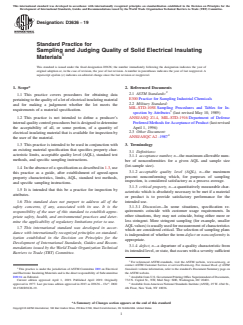
1.1 This practice covers procedures for obtaining data pertaining to the quality of a lot of electrical insulating material and for making a judgement whether the lot meets the requirements of a material specification.
1.2 This practice is not intended to define a producer's internal quality control procedures but is designed to determine the acceptability of all, or some portion, of a quantity of electrical insulating material that is available for inspection by the user of the material.
1.3 This practice is intended to be used in conjunction with an existing material specification that specifies property characteristic limits, acceptable quality level (AQL), standard test methods, and specific sampling instructions.
1.4 In the absence of a specification as described in 1.3, use this practice as a guide, after establishment of agreed-upon property characteristics, limits, AQL, standard test methods, and specific sampling instructions.
1.5 It is intended that this be a practice for inspection by attributes.
1.6 This standard does not purport to address all of the safety concerns, if any, associated with its use. It is the responsibility of the user of this standard to establish appropriate safety, health, and environmental practices and determine the applicability of regulatory limitations prior to use.
1.7 This international standard was developed in accordance with internationally recognized principles on standardization established in the Decision on Principles for the Development of International Standards, Guides and Recommendations issued by the World Trade Organization Technical Barriers to Trade (TBT) Committee.
- Status
- Published
- Publication Date
- 31-Mar-2019
- Technical Committee
- D09 - Electrical and Electronic Insulating Materials
- Drafting Committee
- D09.94 - Editorial
Buy Documents
ASTM D3636-19 - Standard Practice for Sampling and Judging Quality of Solid Electrical Insulating Materials
REDLINE ASTM D3636-19 - Standard Practice for Sampling and Judging Quality of Solid Electrical Insulating Materials
Overview
ASTM D3636-19, titled Standard Practice for Sampling and Judging Quality of Solid Electrical Insulating Materials, is a recognized standard by ASTM International. This practice provides systematic procedures for collecting data on the quality of solid electrical insulating materials and determining if they meet specified requirements. It is aimed at users inspecting lots of insulating material, rather than internal quality control by producers. The standard is designed to work in conjunction with established material specifications, testing methods, and predefined acceptable quality levels (AQLs). It establishes objective, statistical guidelines for acceptance sampling, enabling evidence-based judgment of product quality.
Key Topics
- Sampling Procedures: The standard describes methods for randomly selecting samples from lots of solid electrical insulating materials, helping to ensure unbiased assessment.
- Judging Acceptability: Based on test data and comparison with relevant specifications, users decide if a lot or part thereof meets defined requirements.
- Inspection by Attributes: ASTM D3636-19 is intended as an attribute inspection practice, addressing nonconformities as departures from set specifications.
- Acceptable Quality Levels (AQLs): The document requires setting AQLs for critical, major, and minor material properties, agreed upon by both producer and user.
- Sampling Plan Types: Single, double, and multiple sampling plans are covered, allowing users flexibility based on their administrative and quality assurance needs.
- Inspection Levels: Several inspection levels (I, II, III, S-1 to S-4) allow adjustment of sample size and scrutiny based on lot size and quality requirement.
Applications
ASTM D3636-19 is widely used in industries reliant on solid electrical insulating materials, such as:
- Electrical Manufacturing: Inspection of bulk insulating materials (e.g., resins, films, ceramics) before use in electrical equipment, ensuring only compliant lots are used in critical assemblies.
- Quality Assurance: Third-party or customer quality verification during material procurement, supporting decisions on accepting or rejecting material shipments.
- Vendor Qualification: Comparative evaluation during supplier selection, ensuring consistent supply of acceptable materials.
- Contract Compliance: Provides tangible criteria and procedures for evaluating conformity to procurement contracts, minimizing disputes by basing quality judgments on standardized sampling protocols.
This standard enhances traceability and objectivity in material acceptance, reducing the risk of substandard insulation materials in sensitive electrical systems and improving overall reliability.
Related Standards
- ASTM E300: Practice for Sampling Industrial Chemicals - referenced for guidance on sampling bulky materials like resins.
- MIL-STD-105E: Sampling Procedures and Tables for Inspection by Attributes - provides foundational statistical tables from which ASTM D3636-19's sampling protocols are derived.
- ANSI/ASQ Z1.4: Sampling Procedures and Tables for Inspection by Attributes - accepted as an alternative for C=0 sampling plans or where MIL-STD-105E is unsuitable.
- MIL-STD-1916: Department of Defense Preferred Methods for Acceptance of Product - alternative acceptance sampling methods.
- ANSI/ASQC A2-1987: Discusses terminology and concepts such as nonconformities and defects in quality evaluation.
Practical Value
By following ASTM D3636-19, users can:
- Ensure statistically valid quality assessment of solid electrical insulating materials.
- Minimize risks associated with electrical insulation failures.
- Facilitate transparent supplier quality agreements.
- Efficiently manage material acceptance, lot disposition, and corrective actions.
- Ensure compliance with global trade and quality practices, as established under WTO principles for international standards.
Keywords: ASTM D3636, electrical insulating material testing, acceptance sampling, quality judgment, AQL, inspection by attributes, lot acceptance, electrical insulation quality standards.
Relations
- Effective Date
- 01-Apr-2019
- Effective Date
- 01-Apr-2019
- Effective Date
- 01-Apr-2019
- Effective Date
- 01-Apr-2019
- Effective Date
- 01-Apr-2019
- Effective Date
- 01-Apr-2019
- Effective Date
- 01-Apr-2019
- Effective Date
- 01-Apr-2019
- Effective Date
- 01-Apr-2019
- Referred By
ASTM D350-21 - Standard Test Methods for Flexible Treated Sleeving Used for Electrical Insulation - Effective Date
- 01-Apr-2019
- Referred By
ASTM D3394-16(2022) - Standard Test Methods for Sampling and Testing Electrical Insulating Board - Effective Date
- 01-Apr-2019
- Effective Date
- 01-Apr-2019
- Effective Date
- 01-Apr-2019
- Effective Date
- 01-Apr-2019
- Effective Date
- 01-Apr-2019
Buy Documents
ASTM D3636-19 - Standard Practice for Sampling and Judging Quality of Solid Electrical Insulating Materials
REDLINE ASTM D3636-19 - Standard Practice for Sampling and Judging Quality of Solid Electrical Insulating Materials
Get Certified
Connect with accredited certification bodies for this standard

IMQ S.p.A. (Certification)
Italian electrical product certification.

SLG Prüf- und Zertifizierungs GmbH
German testing and certification body.

UL Solutions
Global safety science company with testing, inspection and certification.
Sponsored listings
Frequently Asked Questions
ASTM D3636-19 is a standard published by ASTM International. Its full title is "Standard Practice for Sampling and Judging Quality of Solid Electrical Insulating Materials". This standard covers: ABSTRACT This practice covers procedures for obtaining data on the quality of solid electrical insulating materials and for judging whether the materials meet the requirements specified. This practice, however, is not intended to define internal quality control procedures of the producer; rather, it is designed to determine the acceptability of all, or some portion, of a quantity of electrical insulating materials available for inspection by the user of the material. In addition, this practice is intended for use in conjunction with existing material specifications including property characteristic limits, acceptable quality level, standard test methods, and sampling instructions. Data shall be obtained by taking lot samples randomly. Sampling plans are available in single, double, and multiple types. Acceptable quality levels for each critical, major, and minor property as well as inspection levels shall conform to the requirements specified. Acceptance of lot quality shall be determined based on the comparison of test results and other information obtained using the sampling plans with the requirements set forth in the material specification (nonconformity) and on whether the lot meets the requirements specified. SCOPE 1.1 This practice covers procedures for obtaining data pertaining to the quality of a lot of electrical insulating material and for making a judgement whether the lot meets the requirements of a material specification. 1.2 This practice is not intended to define a producer's internal quality control procedures but is designed to determine the acceptability of all, or some portion, of a quantity of electrical insulating material that is available for inspection by the user of the material. 1.3 This practice is intended to be used in conjunction with an existing material specification that specifies property characteristic limits, acceptable quality level (AQL), standard test methods, and specific sampling instructions. 1.4 In the absence of a specification as described in 1.3, use this practice as a guide, after establishment of agreed-upon property characteristics, limits, AQL, standard test methods, and specific sampling instructions. 1.5 It is intended that this be a practice for inspection by attributes. 1.6 This standard does not purport to address all of the safety concerns, if any, associated with its use. It is the responsibility of the user of this standard to establish appropriate safety, health, and environmental practices and determine the applicability of regulatory limitations prior to use. 1.7 This international standard was developed in accordance with internationally recognized principles on standardization established in the Decision on Principles for the Development of International Standards, Guides and Recommendations issued by the World Trade Organization Technical Barriers to Trade (TBT) Committee.
ABSTRACT This practice covers procedures for obtaining data on the quality of solid electrical insulating materials and for judging whether the materials meet the requirements specified. This practice, however, is not intended to define internal quality control procedures of the producer; rather, it is designed to determine the acceptability of all, or some portion, of a quantity of electrical insulating materials available for inspection by the user of the material. In addition, this practice is intended for use in conjunction with existing material specifications including property characteristic limits, acceptable quality level, standard test methods, and sampling instructions. Data shall be obtained by taking lot samples randomly. Sampling plans are available in single, double, and multiple types. Acceptable quality levels for each critical, major, and minor property as well as inspection levels shall conform to the requirements specified. Acceptance of lot quality shall be determined based on the comparison of test results and other information obtained using the sampling plans with the requirements set forth in the material specification (nonconformity) and on whether the lot meets the requirements specified. SCOPE 1.1 This practice covers procedures for obtaining data pertaining to the quality of a lot of electrical insulating material and for making a judgement whether the lot meets the requirements of a material specification. 1.2 This practice is not intended to define a producer's internal quality control procedures but is designed to determine the acceptability of all, or some portion, of a quantity of electrical insulating material that is available for inspection by the user of the material. 1.3 This practice is intended to be used in conjunction with an existing material specification that specifies property characteristic limits, acceptable quality level (AQL), standard test methods, and specific sampling instructions. 1.4 In the absence of a specification as described in 1.3, use this practice as a guide, after establishment of agreed-upon property characteristics, limits, AQL, standard test methods, and specific sampling instructions. 1.5 It is intended that this be a practice for inspection by attributes. 1.6 This standard does not purport to address all of the safety concerns, if any, associated with its use. It is the responsibility of the user of this standard to establish appropriate safety, health, and environmental practices and determine the applicability of regulatory limitations prior to use. 1.7 This international standard was developed in accordance with internationally recognized principles on standardization established in the Decision on Principles for the Development of International Standards, Guides and Recommendations issued by the World Trade Organization Technical Barriers to Trade (TBT) Committee.
ASTM D3636-19 is classified under the following ICS (International Classification for Standards) categories: 29.035.01 - Insulating materials in general. The ICS classification helps identify the subject area and facilitates finding related standards.
ASTM D3636-19 has the following relationships with other standards: It is inter standard links to ASTM D3636-13ae1, ASTM D2903-21, ASTM D4733-17, ASTM D202-23, ASTM D1711-22, ASTM D922-23, ASTM D5288-21, ASTM D1248-16, ASTM D2902-21, ASTM D350-21, ASTM D3394-16(2022), ASTM D710-19, ASTM D3032-21a, ASTM D5948-05(2020), ASTM D5213-19. Understanding these relationships helps ensure you are using the most current and applicable version of the standard.
ASTM D3636-19 is available in PDF format for immediate download after purchase. The document can be added to your cart and obtained through the secure checkout process. Digital delivery ensures instant access to the complete standard document.
Standards Content (Sample)
This international standard was developed in accordance with internationally recognized principles on standardization established in the Decision on Principles for the
Development of International Standards, Guides and Recommendations issued by the World Trade Organization Technical Barriers to Trade (TBT) Committee.
Designation: D3636 − 19
Standard Practice for
Sampling and Judging Quality of Solid Electrical Insulating
Materials
This standard is issued under the fixed designation D3636; the number immediately following the designation indicates the year of
original adoption or, in the case of revision, the year of last revision. A number in parentheses indicates the year of last reapproval. A
superscript epsilon (´) indicates an editorial change since the last revision or reapproval.
1. Scope* 2. Referenced Documents
2.1 ASTM Standards:
1.1 This practice covers procedures for obtaining data
E300 Practice for Sampling Industrial Chemicals
pertainingtothequalityofalotofelectricalinsulatingmaterial
2.2 Military Standard:
and for making a judgement whether the lot meets the
MIL-STD-105E Sampling Procedures and Tables for In-
requirements of a material specification.
spection by Attributes (last revised May 10, 1989)
1.2 This practice is not intended to define a producer’s
ANSI/ASQ Z1.4, MIL-STD-1916 Department of Defense
internalqualitycontrolproceduresbutisdesignedtodetermine Preferred Methods forAcceptance of Product (last revised
the acceptability of all, or some portion, of a quantity of April 1, 1996)
2.3 Other Document:
electrical insulating material that is available for inspection by
ANSI/ASQC A2 -1987
the user of the material.
3. Terminology
1.3 This practice is intended to be used in conjunction with
an existing material specification that specifies property char-
3.1 Definitions:
acteristic limits, acceptable quality level (AQL), standard test
3.1.1 acceptance number, n—the maximum allowable num-
methods, and specific sampling instructions.
ber of nonconformities for a given AQL and sample size
(lot-sample size).
1.4 In the absence of a specification as described in 1.3, use
3.1.2 acceptable quality level (AQL), n—the maximum
this practice as a guide, after establishment of agreed-upon
percent nonconforming which, for purposes of sampling
property characteristics, limits, AQL, standard test methods,
inspection, is considered satisfactory as a process average.
and specific sampling instructions.
3.1.3 critical property, n—a quantitatively measurable char-
1.5 It is intended that this be a practice for inspection by
acteristic which is absolutely necessary to be met if a material
attributes.
or product is to provide satisfactory performance for the
intended use.
1.6 This standard does not purport to address all of the
3.1.3.1 Discussion—In some situations, specification re-
safety concerns, if any, associated with its use. It is the
quirements coincide with customer usage requirements. In
responsibility of the user of this standard to establish appro-
other situations, they may not coincide, being either more or
priate safety, health, and environmental practices and deter-
less stringent. More stringent sampling (for example, smaller
mine the applicability of regulatory limitations prior to use.
AQLvalues)isusuallyusedformeasurementofcharacteristics
1.7 This international standard was developed in accor-
which are considered critical. The selection of sampling plans
dance with internationally recognized principles on standard-
is independent of whether the term defect or nonconformity is
ization established in the Decision on Principles for the
appropriate.
Development of International Standards, Guides and Recom-
3.1.4 defect, n—a departure of a quality characteristic from
mendations issued by the World Trade Organization Technical
its intended level, or state, that occurs with a severity sufficient
Barriers to Trade (TBT) Committee.
For referenced ASTM standards, visit the ASTM website, www.astm.org, or
contact ASTM Customer Service at service@astm.org. For Annual Book of ASTM
This practice is under the jurisdiction of ASTM Committee D09 on Electrical Standards volume information, refer to the standard’s Document Summary page on
and Electronic Insulating Materials and is the direct responsibility of Subcommittee the ASTM website.
D09.94 on Editorial. AvailablefromU.S.GovernmentPrintingOfficeSuperintendentofDocuments,
Current edition approved April 1, 2019. Published April 2019. Originally 732 N. Capitol St., NW, Mail Stop: SDE, Washington, DC 20401.
ε1
approved in 1977. Last previous edition approved in 2013 as D3636 – 13a . DOI: Available fromAmerican National Standards Institute (ANSI), 25 W. 43rd St.,
10.1520/D3636-19. 4th Floor, New York, NY 10036.
*A Summary of Changes section appears at the end of this standard
Copyright © ASTM International, 100 Barr Harbor Drive, PO Box C700, West Conshohocken, PA 19428-2959. United States
D3636 − 19
tocauseanassociatedproductorservicenottosatisfyintended 3.1.11 nonconformities per hundred units, n—a calculated
normal, or reasonably foreseeable, usage requirements. ratio of nonconforming units to the number of units inspected,
the quotient being multiplied by 100 (see 3.1.13).
3.1.4.1 Discussion—The terms defect and nonconformity
and their derivatives are used somewhat interchangeably in the
3.1.12 nonconformity, n—a departure of a quality character-
historical and current literature. Nonconformity objectively
istic from its intended level or state that occurs with a severity
describes the comparison of test results to specification
sufficient to cause a test result not to meet a specification
requirements, while the term defect has a connotation of
requirement.
predicting the failure of a product or service to perform its
3.1.13 percent nonconforming, n—a calculated ratio of non-
intended function in use. Since this latter connotation is often
conforming units to the number of units inspected, the quotient
unintended, the term nonconformity is preferred in full consen-
being multiplied by 100.
sus standards. The selection of any sample plan is independent
3.1.14 rejection number, n—the minimum number of non-
of whether the term defect or nonconformity is appropriate.
conformitiesforagivenAQLandsamplesize(lot-samplesize)
The term defect may be appropriate for specifications
which will subject a lot to rejection.
mutually agreed upon by a producer and a user where specific
use conditions are clearly understood. Even in these cases
3.1.15 sample, n—one or more units of product taken from
however, use the term defect with caution and consider
a lot without regard to the quality of the unit (also often termed
substituting the term nonconformity.
lot sample).
For additional comments, see ANSI/ASQC A2-1987 that
3.1.16 sample size, n—the number of units of product taken
also states: “When a quality characteristic of a product or
to make up the sample.
service is “evaluated” in terms of conformance to specification
3.1.16.1 Discussion—This standard uses only lot sample
requirements, the use of the term nonconformity is appropri-
sizes and not lot sizes since the discriminatory power of any
ate.”
sampling plan is independent essentially of the size of the lot.
3.1.5 group AQL—theAQL assigned to a group of material
The sample size selected by the user for a given acceptable
properties.
quality level (AQL) is optional depending upon the degree of
3.1.5.1 Discussion—See 5.2 for additional information
protection desired by the user against the acceptance of
about the meaning of AQL.
nonconforming lots.
3.1.6 lot, n—an entity of electrical insulating material or
3.1.17 test measurement, n—a quantitative expression of
product which, insofar as is practicable, consists of a single
one value determined for a property of interest by a single
type, grade, class, size, or composition that was manufactured
application of a specified test procedure.
under essentially the same conditions and is available to the
3.1.18 test result, n—the value that expresses the level of a
user for sampling at one time.
property of the test unit.
3.1.7 lot number, n—the number used by a producer to
3.1.18.1 Discussion—Atest result is sometimes a single test
identify an entity of electrical insulating material or product.
measurement but usually a test result is computed from several
3.1.8 major property, n—a quantitatively measurable char- test measurements.
acteristic which, if not met, is likely to seriously impair the
3.1.19 test specimen, n—a portion of a test unit upon which
performance of a material or product for the intended use.
one or more test measurements are made.
3.1.8.1 Discussion—In some situations, specification re-
3.1.20 test unit, n—a fraction of a unit of product from
quirements coincide with customer usage requirements. In
which one or more test specimens are taken for each property.
other situations, they may not coincide, being either more or
3.1.20.1 Discussion—If the unit of product is of insufficient
less stringent. More stringent sampling (for example, smaller
size to meet the requirements of a testing method: (1) sample
AQLvalues)isusuallyusedformeasurementofcharacteristics
adjacent units of product and aggregate units of product for the
that are considered important. The selection of sampling plans
test unit or, (2) obtain a test unit of sufficient size, and
is independent of whether the term defect or nonconformity is
representative of the unit of product, from the producer.
appropriate.
3.1.21 unit of product, n—an entity of electrical insulating
3.1.9 minor property, n—a characteristic which, if not met,
materialorproductforinspectiontodetermineitsclassification
is not likely to materially reduce the performance of a material
as conforming or non-conforming.
or product for the intended use.
3.1.21.1 Discussion—Aunit of product is established by the
3.1.9.1 Discussion—In some situations, specification re-
user and may or may not be the same as a unit of purchase,
quirements coincide with customer usage requirements. In
supply, production, or shipment. Some examples of a unit of
other situations, they may not coincide, being either more or
product are:
less stringent. More stringent sampling (for example, smaller
Bag Case Reel
AQLvalues)isusuallyusedformeasurementofcharacteristics
Barrel Container Roll
that are considered important. The selection of sampling plans
Bin Cop Sheet
is independent of whether the term defect or nonconformity is
Bobbin Drum Skid
Box Length Spool
appropriate.
Bundle Pad Tank
3.1.10 nonconforming unit, n—a unit of product containing Car Pail Tank compartment
Carton Pallet Truckload
at least one nonconformity.
D3636 − 19
4. Summary of Practice other document. This standard is not intended to impose limits
upon the risks acceptable to either the user or the producer.
4.1 Instructions are given for obtaining a sample from
5.2.2 When a user designates some specific value of AQL
which specimens are then taken for testing. The test data are
for a single nonconformity, it indicates that the user’s accep-
compared to the material specification and a judgement is then
tance sampling plan will accept the great majority of the lots
made as to whether the material meets the requirements of said
submitted by the producer if the process average level of
material specification.
percent nonconforming in the lots is no greater than the
4.2 This practice has been modeled after MIL-STD-105E.
designated value ofAQL. The preceding statement is also true
4.3 In those cases where MIL-STD-105E is determined to for a group AQL value designated for a group of nonconfor-
be unacceptable for a specific application or purpose and a mities.
form of C=0 sampling is required instead, alternatively apply 5.2.2.1 The sampling plans of this standard are so arranged
ANSI/ASQ Z1.4, MIL-STD-1916, or a similar sampling plan.
thattheprobabilityofacceptance,atthedesignatedAQLvalue,
depends upon the sample size. For a givenAQL, the probabil-
5. Procedure
ityofacceptancewillbegenerallyhigherforlargesamplesizes
than for small sample sizes. The AQL alone does not describe
5.1 General Considerations:
the user protection for individual lots, but more directly relates
5.1.1 Assemble the lot of electrical insulating material so
to what a user might expect from a series of lots. Refer to the
that a lot sample is obtained in a manner that will minimize
operating characteristic curve to determine what protection the
bias in the selection of the units of product that will be
user will have for a specific AQL.
inspected. A scheme that offers a good chance of minimizing
5.2.3 The designation of an AQL shall not imply that a
bias is the assignment of numbers to each unit of product and
producerhastherighttoknowinglysupplyanynonconforming
then using a table of random numbers to select those units of
unit of product.
product from which test units are taken.
5.2.4 The values of AQL listed in the accompanying tables
5.1.2 Foralotofelectricalinsulatingmaterialthatisinbulk
(see Appendix X1) are known as preferredAQL’s. If anyAQL
form (for example, a tank car of powdered resin) take the lot
is designated other than a preferred AQL, these tables are not
sample from the unit of product in accordance with Practice
applicable.
E300.
5.1.3 Take the material to be removed from any unit of
5.3 Sampling Plan Selection:
product in a random manner. When it is impracticable to meet
5.3.1 Use the designated AQL and the sample size code
this requirement (for example, in the case of long lengths of
letter from Table 1 to select a sampling plan from Tables 2-22.
material wound onto rolls or large, thick, heavy sheets packed
When no sampling plan is available for a given combination of
on pallets or skids), economy will dictate the removal of
AQL and code letter, the table directs the user to a different
materialfromtheendofaroll,orthetopofapile,etc.inwhich
code letter. Use the sample size given by the new code letter,
cases the selection cannot be described as “random.”
not the original code letter.
5.1.4 Take the necessary amount of material from the test
5.3.1.1 It is possible this procedure will lead to different
unitsoastomeetthespecimenrequirementsofthevarioustest
sample sizes for different classes of nonconformities. In such
methods that will be used to evaluate the material.
cases the user of the electrical insulating material shall desig-
5.1.5 Refer to the material specification for the allowable
nate and authorize, for all classes of nonconformities, the
maximum elapsed time between the assembly of the lot for
selection and use of the code letter corresponding to the largest
inspection and the disposition of the lot. If the material
sample size derived.
specification (or other pertinent document) does not cover this
5.3.1.2 As an alternative to a single sampling plan with an
matter, the maximum allowable time is 30 calendar days.
acceptance number of 0, use the plan with an acceptance
5.1.6 Exercise care to protect the electrical insulating mate-
number of 1 with its correspondingly larger sample size for a
rial contained in the test unit from which specimens are to be
designated AQL (where available) when designated and ap-
prepared. An example of this protection is packaging in metal
proved by the user.
foil or glass containers so as to prevent or minimize contami-
5.3.2 Types of Sampling Plans—Three types of sampling
nation of the material from the effects of the environment to
plans: single, double, and multiple are given in Table 2, Table
whichsuchmaterialissubjectedbetweensamplingandtesting.
3, and Table 4, respectively. When several types of plans are
5.1.7 Test units assembled as described above shall be
available for a given AQL and code letter, use any one. A
deemed to be representative of the lot of material being
decision as to type of plan, either single, double, or multiple,
inspected. Disposition of the lot, or portions thereof will be
whenavailableforagivenAQLandcodeletter,willusuallybe
based upon the data generated from these test units unless
based upon the comparison between the administrative diffi-
otherwise agreed upon between the user and the producer.
culty and the average sample sizes of the available plans. The
5.2 Establishing Acceptable Quality Levels: average sample size of multiple plans is less than for double
5.2.1 Acceptable quality levels (AQL’s) for each critical, (except in the case corresponding to single acceptance number
major, and minor property shall be as mutually agreed upon by 1) and both of these are always less than a single sample size.
the producer and the user. It is also acceptable to establish Usually the administrative difficulty for single sampling and
group AQL’s for given groups of properties. Disclose these the cost per unit of the sample are less than for double or
AQL’s in a purchase order, material specification, or in some multiple.
D3636 − 19
TABLE 1 Sample Size Code Letters (See 5.4)
Special Inspection Levels General Inspection Levels
Lot or Batch Size
S-1 S-2 S-3 S-4 I II III
2to 8 A A A A A A B
9to 15 A A A A A B C
16 to 25 A A B B B C D
26 to 50 A B B C C D E
51 to 90 B B C C C E F
91 to 150 B B C D D F G
151 to 280 B C D E E G H
281 to 500 B C D E F H J
501 to 1200 C C E F G J K
1201 to 3200 C D E G H K L
3201 to 10 000 C D F G J L M
10 001 to 35 000 C D F H K M N
35 001 to 150 000 D E G J L N P
150 001 to 500 000 D E G J M P Q
500 001 and over D E H K N Q R
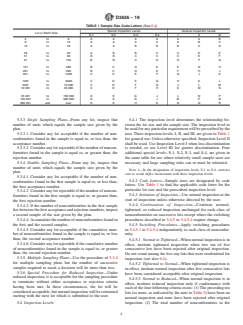
5.3.3 Single Sampling Plans—From any lot, inspect that 5.4.1 The inspection level determines the relationship be-
number of units which equals the sample size given by the tween the lot size and the sample size. The inspection level to
plan. beusedforanyparticularrequirementwillbeprescribedbythe
5.3.3.1 Consider any lot acceptable if the number of non- user. Three inspection levels: I, II, and III, are given in Table 1
conformities found in the sample is equal to, or less than, the for general use. Unless otherwise specified, Inspection Level II
acceptance number. shall be used. Use Inspection Level I when less discrimination
5.3.3.2 Consider any lot rejectable if the number of noncon- is needed, or use Level III for greater discrimination. Four
formities found in the sample is equal to, or greater than, the additional special levels: S-1, S-2, S-3, and S-4, are given in
rejection number. the same table for use where relatively small sample sizes are
5.3.4 Double Sampling Plans—From any lot, inspect that necessary and large sampling risks can or must be tolerated.
number of units which equals the sample size given by the
NOTE 1—In the designation of inspection levels S-1 to S-4, exercise
plan.
care to avoid AQLs inconsistent with these inspection levels.
5.3.4.1 Consider any lot acceptable if the number of non-
5.4.2 Code Letters—Sample sizes are designated by code
conformities found in the first sample is equal to, or less than,
letters. Use Table 1 to find the applicable code letter for the
the first acceptance number.
particular lot size and the prescribed inspection level.
5.3.4.2 Consider any lot rejectable if the number of noncon-
5.4.3 Initiation of Inspection—Use normal inspection at the
formities found in the first sample is equal to, or greater than,
start of inspection unless otherwise directed by the user.
the first rejection number.
5.4.4 Continuation of Inspection—Continue normal,
5.3.4.3 If the number of nonconformities in the first sample
tightened, or reduced inspection unchanged for each class of
liesbetweenthefirstacceptanceandrejectionnumbers,inspect
nonconformities on successive lots except where the switching
a second sample of the size given by the plan.
procedures described in 5.4.5 to 5.4.5.4 require change.
5.3.4.4 Accumulatethenumberofnonconformitiesfoundin
the first and the second samples. 5.4.5 Switching Procedures—Apply switching procedures
5.3.4.5 Consider any lot acceptable if the cumulative num- in 5.4.5.1 to 5.4.5.4 independently to each class of nonconfor-
ber of nonconformities found in the sample is equal to, or less
mity.
than, the second acceptance number.
5.4.5.1 Normal to Tightened—When normal inspection is in
5.3.4.6 Consideranylotrejectableifthecumulativenumber
effect, institute tightened inspection when two out of five
of nonconformities found in the sample is equal to, or greater
consecutive lots have been rejected after original inspection.
than, the second rejection number.
Do not count among the five any lots that were resubmitted for
5.3.5 Multiple Sampling Plans—Use the procedure of 5.3.4
inspection (see also 6.4).
for multiple sampling plans but the number of successive
5.4.5.2 Tightened to Normal—When tightened inspection is
samples required to reach a decision will be more than two.
in effect, institute normal inspection after five consecutive lots
5.3.6 Special Procedure for Reduced Inspection—Under
have been considered acceptable after original inspection.
reduced inspection, it is acceptable for the sampling procedure
5.4.5.3 Normal to Reduced—When normal inspection is in
to terminate without either acceptance or rejection criteria
effect, institute reduced inspection only if conformance with
having been met. In these circumstances, the lot will be
each of the four following criteria exists: (1)The preceding ten
considered acceptable, but normal inspection will be reinstated
lots (or more, as indicated by the note to Table 5) have been on
starting with the next lot which is submitted to the user.
normal inspection and none have been rejected after original
5.4 Inspection Levels: inspection. (2) The total number of nonconformities in the
D3636 − 19
TABLE 2 A Single Sampling Plans For Normal Inspection (Master Table) (See 5.3.1 and 5.3.2)
D3636 − 19
TABLE2BSingle Sampling Plans for Tightened Inspection (Master Table) (See 8.4 and 8.5) (continued)
D3636 − 19
TABLE2CSingle Sampling Plans for Reduced Inspection (Master Table) (See 5.3.1 and 5.3.2) (continued)
D3636 − 19
TABLE 3 A Double Sampling Plans for Normal Inspection (Master Table) (See 8.4 and 8.5)
D3636 − 19
TABLE 3 B Double Sampling Plans for Tightened Inspection (Master Table) (See 8.4 and 8.5) (continued)
samples from the preceding ten lots (or such other number as Production is at a steady rate. (4) Reduced inspection is
indicated by 1 > above) is equal to, or less than, the applicable considered desirable by the user.
number given in Table 5. If double or multiple sampling is in 5.4.5.4 Reduced to Normal—When reduced inspection is in
use, include all samples inspected, not “first” samples only. (3) effect institute normal if any one of the following occur after
D3636 − 19
TABLE 3 C Double Sampling Plans for Reduced Inspection (Master Table) (continued)
D3636 − 19
TABLE 4 A Multiple Sampling Plans for Normal Inspection (Master Table) (See 8.4 and 8.5)
original inspection: (1) Any lot is rejected. (2) Any lot is 5.4.6 Discontinuation of Inspection—In the event that ten
considered acceptable under the procedures of 5.3.6.(3)
consecutive lots (or other number as designated by the user)
Production becomes irregular or delayed. (4) Other conditions
remain on tightened inspection, discontinue the inspection and
warrant institution of normal inspection.
D3636 − 19
TABLE 4 A Multiple Sampling Plans for Normal Inspection (Master Table) (Continued) (See 8.4 and 8.5) (continued)
acceptance of material under the provisions of this standard tioncomparedtothetestresultsandotherinformationobtained
pending action by the producer to improve the quality of by the use of a sampling plan (or plans) associated with the
submitted material.
designated AQL (or AQL’s).
6.2 The user reserves the right to reject any unit of product
6. Judging Lot Quality
found to be nonconforming during inspection. That rejected
6.1 Determine the acceptance (or rejection) of a lot by
unit of product need not be one of the units of product
comparing the requirements set forth in the material specifica-
D3636 − 19
TABLE 4 B Multiple Sampling Plans for Tightened Inspection (Master Table) (See 8.4 and 8.5) (continued)
comprising the lot sample. The user reserves the right to reject tion to inspect every unit of product for critical properties or
that unit regardless of the disposition of the lot as a whole. It characteristics.When a nonconformity is found for any critical
is also acceptable for such rejected units of product to be property or characteristic, the user shall be permitted to reject
repaired or corrected and resubmitted for inspection with the the entire lot.
approval of, and in the manner specified by, the user.
6.4 If a lot has been found unacceptable, it shall not be
6.3 For cases of evaluating material or product for critical permitted to be submitted for re-inspection unless all units of
properties or characteristics, the user is allowed at his discre- product in the lot have been examined and tested and all
D3636 − 19
TABLE 4 B Multiple Sampling Plans for Tightened Inspection (Master Table) (Continued) (See 8.4 and 8.5) (continued)
D3636 − 19
TABLE 4 C Multiple Sampling Plans for Reduced Inspection (Master Table) (See 8.4 and 8.5) (continued)
nonconforming units of product have been either removed 7. Disposition of the Lot
therefrom or the nonconformities have been corrected. Only
7.1 If the lot-sample fails to meet the requirements for
theuserdetermineswhether:(1)normalortightenedinspection
acceptabilityassetforthinthematerialspecification,theentire
is applied during this reinspection, and whether (2) all, or
lot shall be subject to rejection and the user shall notify the
particular, types and classes of nonconformities are included in
producer immediately.
the reinspection.
D3636 − 19
TABLE 4 C Multiple Sampling Plans for Reduced Inspection (Master Table) (Continued) (See 8.4 and 8.5) (continued)
D3636 − 19
TABLE 5 Limit Numbers for Reduced Inspection
NOTE 1—Denotes that the number of sample units from the last ten lots or batches is not sufficient for reduced inspection for thisAQL. In this instance,
more than ten lots or batches may be used for the calculation, provided that the lots or batches used are the most recent ones in sequence, that they have
all been on normal inspection, and that none has been rejected while on original inspection.
Number
of
Sample
Units Acceptable Quality Level
From
Last 10
0.0100.0150.0250.0400.065 0.10 0.15 0.25 0.40 0.65 1.0 1.5 2.5 4.0 6.5 10 15 25 40 65 100 150 250 400 650 1000
Lots or
Batches
20–29 · · · · · · · · · · · · · · · 0 0 2 4 8 14 22 40 68 115 181
30–49 · · · · · · · · · · · · · · 0 0 1 3 7 13 22 36 63 105 178 277
50–79 · · · · · · · · · · · · · 0 0 2 3 7 14 25 40 63 110 181 301
80–129 · · · · · · · · · · · · 0 0 2 4 7 14 24 42 68 105 181 297
130–199 · · · · · · · · · · · 0 0 2 4 7 13 25 42 72 115 177 301 490
200–319 · · · · · · · · · · 0 0 2 4 8 14 22 40 68 115 181 277 471
320–499 · · · · · · · · · 0 0 1 4 8 14 24 39 68 113 189
500–799 · · · · · · · · 0 0 2 3 7 14 25 40 63 110 181
800–1249 · · · · · · · 0 0 2 4 7 14 24 42 68 105 181
1250–1999 · · · · · · 0 0 2 1 7 13 26 40 69 110 169
2000–3149 · · · · · 0 0 2 4 8 14 22 40 68 115 181
3150–4999 · · · · 0 0 1 4 8 14 24 38 67 111 186
5000–7999 · · · 0 0 2 3 7 14 25 40 63 110 181
8000–12 · · 0 0 2 4 7 14 24 42 68 105 181
12 · 0 0 2 4 7 13 24 40 69 110 169
500–19
20 0 0 2 4 8 14 22 40 68 115 181
000–31
31 0 1 4 8 14 243867 111 186
500–49
500 000 2 3 7 14 25 40 63 110 181 301
& Over
7.2 The user shall have the prerogative to waive require- 8.2.4 Types of sampling are discussed in 5.3.2.
ments with respect to the sampling plans, conducting of tests,
8.3 Given the lot size and inspection level (generally Level
applicable property specified limits, resampling and lot rejec-
II unless noted otherwise) a sample size code letter can be
tion.
found in Table 1.
8. Sampling Tables
8.4 TheAQLand the sample size code letter is then used to
8.1 These sampling tables have been adapted from MIL-
obtain the sampling plan from Table 2, Table 3, and Table 4,
STD-105E. The following discussion and references are pro-
which are for single, double or multiple plans, respectively.
vided to supplement the user’s knowledge of this standard.
Generally, a single sampling plan would be used. The sub-
Tables 2, 3, and 4 denote the severity of inspection depending
8.2 To choose a sampling plan one must know the lot size,
upon the quality of previously submitted lots. The levels of
the inspection level, the AQL, and the type of sampling to be
severity are noted as normal, tightened and reduced and are
used which is either single, double, or multiple sampling.
listed in Tables sub B, C and D, respectively. The initial
8.2.1 Lotsizeisthetotalnumberofunitsofproductinalot.
8.2.2 To define the inspection level, see 5.4.1. sampling plan is generally obtained from the A (normal
inspection)Tables.Paragraph5.4.5containsrulesforswitching
8.2.3 The AQL is found in the material specification,
purchase order, or other pertinent document. See also 5.2.2. inspection procedures. It is acceptable to reduce the inspection
D3636 − 19
TABLE 6 Sample Size Code Letter A
level when the quality of submitted lots is consistently good, AQL. These curves show the percent of lots likely to be
and to tighten it when lots are of poor quality. accepted by each sampling plan depending upon the quality of
submitted lots. This is also known as the probability of
8.5 Tables 6-22 portray the sampling plans for each sample
acceptance.
size code letter. In addition, each Table includes the respective
Operating Characteristic Curves and tabulated values for each
D3636 − 19
TABLE 6 Sample Size Code Letter A (continued)
Acceptable Quality Levels (normal inspection)
Cumu- Cumu-
Type of Less
lative lative
Sampling than 6.5 × 10 15 25 40 65 100 150 × 250 × 400 × 650 × 1000
Sample Sample
Plan 6.5
Size Size
Ac Re Ac Re Ac Re Ac Re Ac Re Ac Re Ac Re Ac Re Ac Re Ac Re Ac Re Ac Re Ac Re Ac Re Ac Re Ac Re Ac Re Ac Re
Single 2 π 0 1 1 2 2 3 3 4 5 6 7 8 8 9 10 11 12 13 14 15 18 19 21 22 27 28 30 31 2
Use Use Use
Letter Letter Letter
DC B
Double π · (·) (·) (·) (·) (·) (·) (·) (·) (·) (·) (·) (·) (·)
Multiple π · · · · · · ··· · · ·· ·
Less × 10 15 25 40 65 100
...
This document is not an ASTM standard and is intended only to provide the user of an ASTM standard an indication of what changes have been made to the previous version. Because
it may not be technically possible to adequately depict all changes accurately, ASTM recommends that users consult prior editions as appropriate. In all cases only the current version
of the standard as published by ASTM is to be considered the official document.
´1
Designation: D3636 − 13a D3636 − 19
Standard Practice for
Sampling and Judging Quality of Solid Electrical Insulating
Materials
This standard is issued under the fixed designation D3636; the number immediately following the designation indicates the year of
original adoption or, in the case of revision, the year of last revision. A number in parentheses indicates the year of last reapproval. A
superscript epsilon (´) indicates an editorial change since the last revision or reapproval.
ε NOTE—Changes were made editorially in April 2014.
1. Scope*
1.1 This practice covers procedures for obtaining data pertaining to the quality of a lot of electrical insulating material and for
making a judgement whether the lot meets the requirements of a material specification.
1.2 This practice is not intended to define a producer’s internal quality control procedures but is designed to determine the
acceptability of all, or some portion, of a quantity of electrical insulating material that is available for inspection by the user of
the material.
1.3 This practice is intended to be used in conjunction with an existing material specification that specifies property
characteristic limits, acceptable quality level (AQL), standard test methods, and specific sampling instructions.
1.4 In the absence of a specification as described in 1.3, use this practice as a guide, after establishment of agreed-upon property
characteristics, limits, AQL, standard test methods, and specific sampling instructions.
1.5 It is intended that this be a practice for inspection by attributes.
1.6 This standard does not purport to address all of the safety concerns, if any, associated with its use. It is the responsibility
of the user of this standard to establish appropriate safety safety, health, and healthenvironmental practices and determine the
applicability of regulatory limitations prior to use.
1.7 This international standard was developed in accordance with internationally recognized principles on standardization
established in the Decision on Principles for the Development of International Standards, Guides and Recommendations issued
by the World Trade Organization Technical Barriers to Trade (TBT) Committee.
2. Referenced Documents
2.1 ASTM Standards:
E300 Practice for Sampling Industrial Chemicals
2.2 Military Standard:
MIL-STD-105E Sampling Procedures and Tables for Inspection by Attributes (last revised May 10, 1989)
ANSI/ASQ Z1.4, MIL-STD-1916 Department of Defense Preferred Methods for Acceptance of Product (last revised April 1,
1996)
2.3 Other Document:
ANSI/ASQC A2 -1987
3. Terminology
3.1 Definitions:
3.1.1 acceptance number, n—the maximum allowable number of nonconformities for a given AQL and sample size (lot-sample
size).
This practice is under the jurisdiction of ASTM Committee D09 on Electrical and Electronic Insulating Materials and is the direct responsibility of Subcommittee D09.94
on Editorial.
Current edition approved March 1, 2013April 1, 2019. Published June 2013April 2019. Originally approved in 1977. Last previous edition approved in 2013 as
ε1
D3636 – 13.D3636 – 13a . DOI: 10.1520/D3636-13a.10.1520/D3636-19.
For referenced ASTM standards, visit the ASTM website, www.astm.org, or contact ASTM Customer Service at service@astm.org. For Annual Book of ASTM Standards
volume information, refer to the standard’s Document Summary page on the ASTM website.
Available from U.S. Government Printing Office Superintendent of Documents, 732 N. Capitol St., NW, Mail Stop: SDE, Washington, DC 20401.
Available from American National Standards Institute (ANSI), 25 W. 43rd St., 4th Floor, New York, NY 10036.
*A Summary of Changes section appears at the end of this standard
Copyright © ASTM International, 100 Barr Harbor Drive, PO Box C700, West Conshohocken, PA 19428-2959. United States
D3636 − 19
3.1.2 acceptable quality level (AQL), n—the maximum percent nonconforming which, for purposes of sampling inspection, is
considered satisfactory as a process average.
3.1.3 critical property, n—a quantitatively measurable characteristic which is absolutely necessary to be met if a material or
product is to provide satisfactory performance for the intended use.
3.1.3.1 Discussion—
In some situations, specification requirements coincide with customer usage requirements. In other situations, they may not
coincide, being either more or less stringent. More stringent sampling (for example, smaller AQL values) is usually used for
measurement of characteristics which are considered critical. The selection of sampling plans is independent of whether the term
defect or nonconformity is appropriate.
3.1.4 defect, n—a departure of a quality characteristic from its intended level, or state, that occurs with a severity sufficient to
cause an associated product or service not to satisfy intended normal, or reasonably foreseeable, usage requirements.
3.1.4.1 Discussion—
The terms defect and nonconformity and their derivatives are used somewhat interchangeably in the historical and current literature.
Nonconformity objectively describes the comparison of test results to specification requirements, while the term defect has a
connotation of predicting the failure of a product or service to perform its intended function in use. Since this latter connotation
is often unintended, the term nonconformity is preferred in full consensus standards. The selection of any sample plan is
independent of whether the term defect or nonconformity is appropriate.
The term defect may be appropriate for specifications mutually agreed upon by a producer and a user where specific use
conditions are clearly understood. Even in these cases however, use the term defect with caution and consider substituting the term
nonconformity.
For additional comments, see ANSI/ASQC A2-1987 that also states: “When a quality characteristic of a product or service is
“evaluated” in terms of conformance to specification requirements, the use of the term nonconformity is appropriate.”
The term defect may be appropriate for specifications mutually agreed upon by a producer and a user where specific use
conditions are clearly understood. Even in these cases however, use the term defect with caution and consider substituting the
term nonconformity.
For additional comments, see ANSI/ASQC A2-1987 that also states: “When a quality characteristic of a product or service
is “evaluated” in terms of conformance to specification requirements, the use of the term nonconformity is appropriate.”
3.1.5 group AQL—the AQL assigned to a group of material properties.
3.1.5.1 Discussion—
See 5.2 for additional information about the meaning of AQL.
3.1.6 lot, n—an entity of electrical insulating material or product which, insofar as is practicable, consists of a single type, grade,
class, size, or composition that was manufactured under essentially the same conditions and is available to the user for sampling
at one time.
3.1.7 lot number, n—the number used by a producer to identify an entity of electrical insulating material or product.
3.1.8 major property, n—a quantitatively measurable characteristic which, if not met, is likely to seriously impair the
performance of a material or product for the intended use.
3.1.8.1 Discussion—
In some situations, specification requirements coincide with customer usage requirements. In other situations, they may not
coincide, being either more or less stringent. More stringent sampling (for example, smaller AQL values) is usually used for
measurement of characteristics that are considered important. The selection of sampling plans is independent of whether the term
defect or nonconformity is appropriate.
3.1.9 minor property, n—a characteristic which, if not met, is not likely to materially reduce the performance of a material or
product for the intended use.
3.1.9.1 Discussion—
In some situations, specification requirements coincide with customer usage requirements. In other situations, they may not
D3636 − 19
coincide, being either more or less stringent. More stringent sampling (for example, smaller AQL values) is usually used for
measurement of characteristics that are considered important. The selection of sampling plans is independent of whether the term
defect or nonconformity is appropriate.
3.1.10 nonconforming unit, n—a unit of product containing at least one nonconformity.
3.1.11 nonconformities per hundred units, n—a calculated ratio of nonconforming units to the number of units inspected, the
quotient being multiplied by 100 (See(see 3.1.13.)).
3.1.12 nonconformity, n—a departure of a quality characteristic from its intended level or state that occurs with a severity
sufficient to cause a test result not to meet a specification requirement.
3.1.13 percent nonconforming, n—a calculated ratio of nonconforming units to the number of units inspected, the quotient being
multiplied by 100.
3.1.14 rejection number, n—the minimum number of nonconformities for a given AQL and sample size (lot-sample size) which
will subject a lot to rejection.
3.1.15 sample, n—one or more units of product taken from a lot without regard to the quality of the unit. (Alsounit (also often
termed lot sample).
3.1.16 sample size, n—the number of units of product taken to make up the sample.
3.1.16.1 Discussion—
This standard uses only lot sample sizes and not lot sizes since the discriminatory power of any sampling plan is independent
essentially of the size of the lot. The sample size selected by the user for a given acceptable quality level (AQL) is optional
depending upon the degree of protection desired by the user against the acceptance of nonconforming lots.
3.1.17 test measurement, n—a quantitative expression of one value determined for a property of interest by a single application
of a specified test procedure.
3.1.18 test result, n—the value that expresses the level of a property of the test unit.
3.1.18.1 Discussion—
A test result is sometimes a single test measurement but usually a test result is computed from several test measurements.
3.1.19 test specimen, n—a portion of a test unit upon which one or more test measurements are made.
3.1.20 test unit, n—a fraction of a unit of product from which one or more test specimens are taken for each property.
3.1.20.1 Discussion—
If the unit of product is of insufficient size to meet the requirements of a testing method: (1) sample adjacent units of product and
aggregate units of product for the test unit or, (2) obtain a test unit of sufficient size, and representative of the unit of product, from
the producer.
3.1.21 unit of product, n—an entity of electrical insulating material or product for inspection to determine its classification as
conforming or non-conforming.
3.1.21.1 Discussion—
A unit of product is established by the user and may or may not be the same as a unit of purchase, supply, production, or shipment.
Some examples of a unit of product are:
Bag Case Reel
Barrel Container Roll
Bin Cop Sheet
Bobbin Drum Skid
Box Length Spool
Bundle Pad Tank
Car Pail Tank compartment
Carton Pallet Truckload
D3636 − 19
Bag Case Reel
Barrel Container Roll
Bin Cop Sheet
Bobbin Drum Skid
Box Length Spool
Bundle Pad Tank
Car Pail Tank compartment
Carton Pallet Truckload
4. Summary of Practice
4.1 Instructions are given for obtaining a sample from which specimens are then taken for testing. The test data are compared
to the material specification and a judgement is then made as to whether the material meets the requirements of said material
specification.
4.2 This practice has been modeled after MIL-STD-105E.
4.3 In those cases where MIL-STD-105E is determined to be unacceptable for a specific application or purpose and a form of
C=0 sampling is required instead, it is permissible to alternatively apply ANSI/ASQ Z1.4, MIL-STD-1916, or a similar sampling
plan.
5. Procedure
5.1 General Considerations:
5.1.1 Assemble the lot of electrical insulating material so that a lot sample is obtained in a manner that will minimize bias in
the selection of the units of product that will be inspected. A scheme that offers a good chance of minimizing bias is the assignment
of numbers to each unit of product and then using a table of random numbers to select those units of product from which test units
are taken.
5.1.2 For a lot of electrical insulating material that is in bulk form (for example, a tank car of powdered resin) take the lot sample
from the unit of product in accordance with Practice E300.
5.1.3 Take the material to be removed from any unit of product in a random manner. When it is impracticable to meet this
requirement (for example, in the case of long lengths of material wound onto rolls or large, thick, heavy sheets packed on pallets
or skids), economy will dictate the removal of material from the end of a roll, or the top of a pile, etc. in which cases the selection
cannot be described as “random.”
5.1.4 Take the necessary amount of material from the test unit so as to meet the specimen requirements of the various test
methods that will be used to evaluate the material.
5.1.5 Refer to the material specification for the allowable maximum elapsed time between the assembly of the lot for inspection
and the disposition of the lot. If the material specification (or other pertinent document) does not cover this matter, the maximum
allowable time is 30 calendar days.
5.1.6 Exercise care to protect the electrical insulating material contained in the test unit from which specimens are to be
prepared. An example of this protection is packaging in metal foil or glass containers so as to prevent or minimize contamination
of the material from the effects of the environment to which such material is subjected between sampling and testing.
5.1.7 Test units assembled as described above shall be deemed to be representative of the lot of material being inspected.
Disposition of the lot, or portions thereof will be based upon the data generated from these test units unless otherwise agreed upon
between the user and the producer.
5.2 Establishing Acceptable Quality Levels:
5.2.1 Acceptable quality levels (AQL’s) for each critical, major, and minor property shall be as mutually agreed upon by the
producer and the user. It is also acceptable to establish group AQL’s for given groups of properties. Disclose these AQL’s in a
purchase order, material specification, or in some other document. This standard is not intended to impose limits upon the risks
acceptable to either the user or the producer.
5.2.2 When a user designates some specific value of AQL for a single nonconformity, it indicates that the user’s acceptance
sampling plan will accept the great majority of the lots submitted by the producer if the process average level of percent
nonconforming in the lots is no greater than the designated value of AQL. The preceding statement is also true for a group AQL
value designated for a group of nonconformities.
5.2.2.1 The sampling plans of this standard are so arranged that the probability of acceptance, at the designated AQL value,
depends upon the sample size. For a given AQL, the probability of acceptance will be generally higher for large sample sizes than
for small sample sizes. The AQL alone does not describe the user protection for individual lots, but more directly relates to what
a user might expect from a series of lots. Refer to the operating characteristic curve to determine what protection the user will have
for a specific AQL.
5.2.3 The designation of an AQL shall not imply that a producer has the right to knowingly supply any nonconforming unit of
product.
5.2.4 The values of AQL listed in the accompanying tables (see Section Appendix X1) are known as preferred AQL’s. If any
AQL is designated other than a preferred AQL, these tables are not applicable.
D3636 − 19
5.3 Sampling Plan Selection:
5.3.1 Use the designated AQL and the sample size code letter from Table 1 to select a sampling plan from Tables 2-22. When
no sampling plan is available for a given combination of AQL and code letter, the table directs the user to a different code letter.
Use the sample size given by the new code letter, not the original code letter.
5.3.1.1 It is possible this procedure will lead to different sample sizes for different classes of nonconformities. In such cases the
user of the electrical insulating material shall designate and authorize, for all classes of nonconformities, the selection and use of
the code letter corresponding to the largest sample size derived.
5.3.1.2 As an alternative to a single sampling plan with an acceptance number of 0, use the plan with an acceptance number
of 1 with its correspondingly larger sample size for a designated AQL (where available) when designated and approved by the user.
5.3.2 Types of Sampling Plans—Three types of sampling plans: single, double, and multiple are given in Table 2, Table 3, and
Table 4, respectively. When several types of plans are available for a given AQL and code letter, use any one. A decision as to type
of plan, either single, double, or multiple, when available for a given AQL and code letter, will usually be based upon the
comparison between the administrative difficulty and the average sample sizes of the available plans. The average sample size of
multiple plans is less than for double (except in the case corresponding to single acceptance number 1) and both of these are always
less than a single sample size. Usually the administrative difficulty for single sampling and the cost per unit of the sample are less
than for double or multiple.
5.3.3 Single Sampling Plans—From any lot, inspect that number of units which equals the sample size given by the plan.
5.3.3.1 Consider any lot acceptable if the number of nonconformities found in the sample is equal to, or less than, the acceptance
number.
5.3.3.2 Consider any lot rejectable if the number of nonconformities found in the sample is equal to, or greater than, the rejection
number.
5.3.4 Double Sampling Plans—From any lot, inspect that number of units which equals the sample size given by the plan.
5.3.4.1 Consider any lot acceptable if the number of nonconformities found in the first sample is equal to, or less than, the first
acceptance number.
5.3.4.2 Consider any lot rejectable if the number of nonconformities found in the first sample is equal to, or greater than, the
first rejection number.
5.3.4.3 If the number of nonconformities in the first sample lies between the first acceptance and rejection numbers, inspect a
second sample of the size given by the plan.
5.3.4.4 Accumulate the number of nonconformities found in the first and the second samples.
5.3.4.5 Consider any lot acceptable if the cumulative number of nonconformities found in the sample is equal to, or less than,
the second acceptance number.
5.3.4.6 Consider any lot rejectable if the cumulative number of nonconformities found in the sample is equal to, or greater than,
the second rejection number.
5.3.5 Multiple Sampling Plans—Use the procedure of 5.3.4 for multiple sampling plans but the number of successive samples
required to reach a decision will be more than two.
5.3.6 Special Procedure for Reduced Inspection—Under reduced inspection, it is acceptable for the sampling procedure to
terminate without either acceptance or rejection criteria having been met. In these circumstances, the lot will be considered
acceptable, but normal inspection will be reinstated starting with the next lot which is submitted to the user.
5.4 Inspection Levels:
TABLE 1 Sample Size Code Letters (See 5.4)
Special Inspection Levels General Inspection Levels
Lot or Batch Size
S-1 S-2 S-3 S-4 I II III
2 to 8 A A A A A A B
9 to 15 A A A A A B C
16 to 25 A A B B B C D
26 to 50 A B B C C D E
51 to 90 B B C C C E F
91 to 150 B B C D D F G
151 to 280 B C D E E G H
281 to 500 B C D E F H J
501 to 1200 C C E F G J K
1201 to 3200 C D E G H K L
3201 to 10 000 C D F G J L M
10 001 to 35 000 C D F H K M N
35 001 to 150 000 D E G J L N P
150 001 to 500 000 D E G J M P Q
500 001 and over D E H K N Q R
D3636 − 19
TABLE 2 A Single Sampling Plans For Normal Inspection (Master Table) (See 5.3.1 and 5.3.2)
D3636 − 19
TABLE 2 B Single Sampling Plans for Tightened Inspection (Master Table) (See 8.4 and 8.5) (continued)
D3636 − 19
TABLE 2 C Single Sampling Plans for Reduced Inspection (Master Table) (See 5.3.1 and 5.3.2) (continued)
D3636 − 19
TABLE 3 A Double Sampling Plans for Normal Inspection (Master Table) (See 8.4 and 8.5)
D3636 − 19
TABLE 3 B Double Sampling Plans for Tightened Inspection (Master Table) (See 8.4 and 8.5) (continued)
5.4.1 The inspection level determines the relationship between the lot size and the sample size. The inspection level to be used
for any particular requirement will be prescribed by the user. Three inspection levels: I, II, and III, are given in Table 1 for general
D3636 − 19
TABLE 3 C Double Sampling Plans for Reduced Inspection (Master Table) (continued)
D3636 − 19
TABLE 4 A Multiple Sampling Plans for Normal Inspection (Master Table) (See 8.4 and 8.5)
use. Unless otherwise specified, Inspection Level II shall be used. Use Inspection Level I when less discrimination is needed, or
use Level III for greater discrimination. Four additional special levels: S-1, S-2, S-3S-3, and S-4, are given in the same table for
use where relatively small sample sizes are necessary and large sampling risks can or must be tolerated.
NOTE 1—In the designation of inspection levels S-1 to S-4, exercise care to avoid AQLs inconsistent with these inspection levels.
5.4.2 Code Letters—Sample sizes are designated by code letters. Use Table 1 to find the applicable code letter for the particular
lot size and the prescribed inspection level.
5.4.3 Initiation of Inspection—Use normal inspection at the start of inspection unless otherwise directed by the user.
D3636 − 19
TABLE 4 A Multiple Sampling Plans for Normal Inspection (Master Table) (Continued)(See 8.4 and 8.5) (continued)
5.4.4 Continuation of Inspection—Continue normal, tightened, or reduced inspection unchanged for each class of nonconfor-
mities on successive lots except where the switching procedures described in 5.4.5 to 5.4.5.4 require change.
5.4.5 Switching Procedures—Apply switching procedures in 5.4.5.1 to 5.4.5.4 independently to each class of nonconformity.
5.4.5.1 Normal to Tightened—When normal inspection is in effect, institute tightened inspection when two out of five
consecutive lots have been rejected after original inspection. Do not count among the five any lots that were resubmitted for
inspection (see also 6.4).
5.4.5.2 Tightened to Normal—When tightened inspection is in effect, institute normal inspection after five consecutive lots have
been considered acceptable after original inspection.
D3636 − 19
TABLE 4 B Multiple Sampling Plans for Tightened Inspection (Master Table) (See 8.4 and 8.5) (continued)
5.4.5.3 Normal to Reduced—When normal inspection is in effect, institute reduced inspection only if conformance with each
of the four following criteria exists: (1) The preceding 10ten lots (or more, as indicated by the note to Table 5) have been on normal
inspection and none have been rejected after original inspection. (2) The total number of nonconformities in the samples from the
preceding ten lots (or such other number as indicated by 1 > above) is equal to, or less than, the applicable number given in Table
5. If double or multiple sampling is in use, include all samples inspected, not “first” samples only. (3) Production is at a steady
rate. (4) Reduced inspection is considered desirable by the user.
D3636 − 19
TABLE 4 B Multiple Sampling Plans for Tightened Inspection (Master Table) (Continued)(See 8.4 and 8.5) (continued)
D3636 − 19
TABLE 4 C Multiple Sampling Plans for Reduced Inspection (Master Table) (See 8.4 and 8.5) (continued)
5.4.5.4 Reduced to Normal—When reduced inspection is in effect institute normal if any one of the following occur after
original inspection: (1) Any lot is rejected. (2) Any lot is considered acceptable under the procedures of 5.3.6. (3) Production
becomes irregular or delayed. (4) Other conditions warrant institution of normal inspection.
5.4.6 Discontinuation of Inspection—In the event that ten consecutive lots (or other number as designated by the user) remain
on tightened inspection, discontinue the inspection and acceptance of material under the provisions of this standard pending action
by the producer to improve the quality of submitted material.
D3636 − 19
TABLE 4 C Multiple Sampling Plans for Reduced Inspection (Master Table) (Continued)(See 8.4 and 8.5) (continued)
6. Judging Lot Quality
6.1 Determine the acceptance (or rejection) of a lot by comparing the requirements set forth in the material specification
compared to the test results and other information obtained by the use of a sampling plan (or plans) associated with the designated
AQL (or AQL’s).
D3636 − 19
TABLE 5 Limit Numbers for Reduced Inspection
NOTE 1—Denotes that the number of sample units from the last ten lots or batches is not sufficient for reduced inspection for this AQL. In this instance,
more than ten lots or batches may be used for the calculation, provided that the lots or batches used are the most recent ones in sequence, that they have
all been on normal inspection, and that none has been rejected while on original inspection.
Number
of
Sample
Units Acceptable Quality Level
From
Last 10
0.010 0.015 0.025 0.040 0.065 0.10 0.15 0.25 0.40 0.65 1.0 1.5 2.5 4.0 6.5 10 15 25 40 65 100 150 250 400 650 1000
Lots or
Batches
20–29 · · · · · · · · · · · · · · · 0 0 2 4 8 14 22 40 68 115 181
30–49 · · · · · · · · · · · · · · 0 0 1 3 7 13 22 36 63 105 178 277
50–79 · · · · · · · · · · · · · 0 0 2 3 7 14 25 40 63 110 181 301
80–129 · · · · · · · · · · · · 0 0 2 4 7 14 24 42 68 105 181 297
130–199 · · · · · · · · · · · 0 0 2 4 7 13 25 42 72 115 177 301 490
200–319 · · · · · · · · · · 0 0 2 4 8 14 22 40 68 115 181 277 471
320–499 · · · · · · · · · 0 0 1 4 8 14 24 39 68 113 189
500–799 · · · · · · · · 0 0 2 3 7 14 25 40 63 110 181
800–1249 · · · · · · · 0 0 2 4 7 14 24 42 68 105 181
1250–1999 · · · · · · 0 0 2 1 7 13 26 40 69 110 169
2000–3149 · · · · · 0 0 2 4 8 14 22 40 68 115 181
3150–4999 · · · · 0 0 1 4 8 14 24 38 67 111 186
5000–7999 · · · 0 0 2 3 7 14 25 40 63 110 181
8000–12 · · 0 0 2 4 7 14 24 42 68 105 181
12 · 0 0 2 4 7 13 24 40 69 110 169
500–19
20 0 0 2 4 8 14 22 40 68 115 181
000–31
31 0 1 4 8 14 24 38 67 111 186
500–49
500 000 2 3 7 14 25 40 63 110 181 301
& Over
6.2 The user reserves the right to reject any unit of product found to be nonconforming during inspection. That rejected unit
of product need not be one of the units of product comprising the lot sample. The user reserves the right to reject that unit regardless
of the disposition of the lot as a whole. It is also acceptable for such rejected units of product to be repaired or corrected and
resubmitted for inspection with the approval of, and in the manner specified by, the user.
6.3 For cases of evaluating material or product for critical properties or characteristics, the user is allowed at his discretion to
inspect every unit of product for critical properties or characteristics. When a nonconformity is found for any critical property or
characteristic, the user shall be permitted to reject the entire lot.
6.4 If a lot has been found unacceptable, it shall not be permitted to be submitted for re-inspection unless all units of product
in the lot have been examined and tested and all nonconforming units of product have been either removed therefrom or the
nonconformities have been corrected. Only the user determines whether: (1) normal or tightened inspection is applied during this
reinspection, and whether (2) all, or particular, types and classes of nonconformities are included in the reinspection.
7. Disposition of the Lot
7.1 If the lot-sample fails to meet the requirements for acceptability as set forth in the material specification, the entire lot shall
be subject to rejection and the user shall notify the producer immediately.
7.2 The user shall have the prerogative to waive requirements with respect to the sampling plans, conducting of tests, applicable
property specified limits, resampling and lot rejection.
D3636 − 19
TABLE 6 Sample Size Code Letter A
8. Sampling Tables
8.1 These sampling tables have been adapted from MIL-STD-105E. The following discussion and references are provided to
supplement the user’s knowledge of this standard.
8.2 To choose a sampling plan one must know the lot size, the inspection level, the AQL, and the type of sampling to be used
which is either single, double, or multiple sampling.
8.2.1 Lot size is the total number of units of product in a lot.
8.2.2 To define the inspection level, see 5.4.1.
D3636 − 19
TABLE 6 Sample Size Code Letter A (continued)
Acceptable Quality Levels (normal inspection)
Cumu- Cumu-
Type of Less
lative lative
Sampling than 6.5 × 10 15 25 40 65 100 150 × 250 × 400 × 650 × 1000
Sample Sample
Plan 6.5
Size Size
Ac Re Ac Re Ac Re Ac Re Ac Re Ac Re Ac Re Ac Re Ac Re Ac Re Ac Re Ac Re Ac Re Ac Re Ac Re Ac Re Ac Re Ac Re
Single 2 π 0 1 1 2 2 3 3 4 5 6 7 8 8 9 10 11 12 13 14 15 18 19 21 22 27 28 30 31 2
Use Use Use
Letter Letter Letter
D C B
Double π · (·) (·) (·) (·) (·) (·) (·) (·) (·) (·) (·) (·) (·)
Multiple π · · · · · · · · · · · · · ·
Less × 10 15 25 40 65 100 150 × 250 × 400 × 650 × 1000 ×
than 10
Acceptable Quality Levels (tightened inspection)
π = Use next subsequent sample size code letter for which acceptance and rejection numbers are available.
Ac = Acceptance number
Re = Rejection number
· = Use single sampling plan above (or alternatively use letter D).
(·) = Use double sampling plan above (or alternatively use letter B).
D3636 − 19
TABLE 7 Sample Size Code Letter B
8.2.3 The AQL is found in the material specification, purchase order, or other pertinent document. See also 5.2.2.
8.2.4 Types of sampling are discussed in 5.3.2.
8.3 Given the lot size and inspection level (generally Level II unless noted otherwise) a sample size code letter can be found
in Table 1.
8.4 The AQL and the sample size code letter is then used to obtain the sampling plan from Table 2, Table 3, and Table 4, which
are for single, double or multiple plans, respectively. Generally, a single sampling plan would be used. The sub-Tables 2, 3, and
4 denote the severity of inspection depending upon the quality of previously submitted lots. The levels of severity are noted as
D3636 − 19
TABLE 7 Sample Size Code Letter B (continued) (cont
...