


ASTM F2070-00(2017)
(Specification)Standard Specification for Transducers, Pressure and Differential, Pressure, Electrical and Fiber-Optic
Standard Specification for Transducers, Pressure and Differential, Pressure, Electrical and Fiber-Optic
ABSTRACT
This specification covers the requirements for pressure and differential pressure transducers for general applications. Pressure transducers typically consist of a sensing element that is in contact with the process medium and a transduction element that modifies the signal from the sensing element to produce an electrical or optical output. Some parts of the transducer may be hermetically sealed if those parts are sensitive to and may be exposed to moisture. Pressure connections must be threaded with appropriate fittings to connect the transducer to standard pipe fittings or to other appropriate leak-proof fittings. The output cable must be securely fastened to the body of the transducer. Most common sensing elements are diaphragms, bellows, capsules, Bourdon tubes, and piezoelectric crystals. The function of the sensing element is to produce a measurable response to applied pressure or vacuum. The response may be sensed directly on the element or a separate sensor may be used to detect element response. The following are the different types of electrical pressure transducers: differential transformed transducer, potentiometric transducer, strain gage transducer, variable reluctance transducer, and piezoelectric transducer. Different kinds of fiber-optic pressure transducers shall be discussed: Fabry-Perot interferometer, Bragg grating interferometer, quartz resonator, and micromachined membrane/diaphragm deflection. The following physical properties of transducers shall be determined: enclosure, transducer mounting, external configuration, standard electrical connection, pressure connections, damping, size, and weight. Different tests shall be conducted in order to determine the service life and overall performance of the transducers.
SCOPE
1.1 This specification covers the requirements for pressure and differential pressure transducers for general applications.
1.2 Special requirements for naval shipboard applications are included in Supplementary Requirements S1, S2, and S3.
1.3 The values stated in SI units are to be regarded as standard. The values given in parentheses are mathematical conversions to inch-pound units that are provided for information only and are not considered standard. Where information is to be specified, it shall be stated in SI units.
1.4 This standard does not purport to address all of the safety concerns, if any, associated with its use. It is the responsibility of the user of this standard to establish appropriate safety, health and environmental practices and determine the applicability of regulatory limitations prior to use.
1.5 This international standard was developed in accordance with internationally recognized principles on standardization established in the Decision on Principles for the Development of International Standards, Guides and Recommendations issued by the World Trade Organization Technical Barriers to Trade (TBT) Committee.
General Information
Buy Standard
Standards Content (Sample)
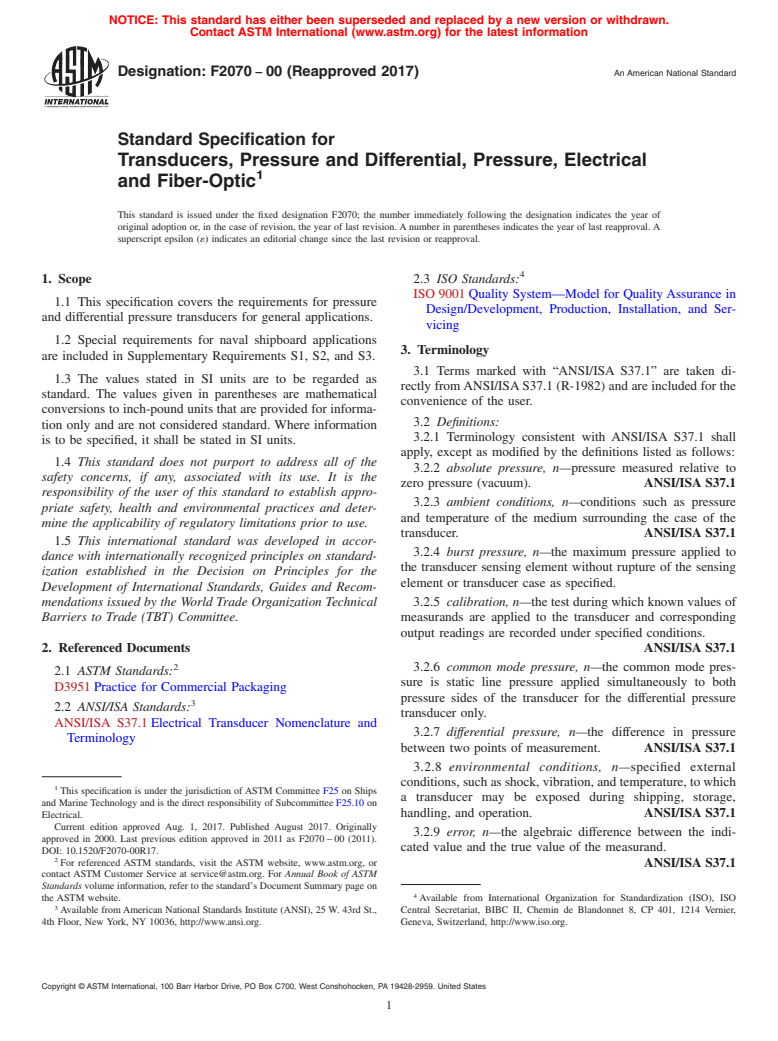
NOTICE: This standard has either been superseded and replaced by a new version or withdrawn.
Contact ASTM International (www.astm.org) for the latest information
Designation:F2070 −00 (Reapproved 2017) AnAmerican National Standard
Standard Specification for
Transducers, Pressure and Differential, Pressure, Electrical
and Fiber-Optic
This standard is issued under the fixed designation F2070; the number immediately following the designation indicates the year of
original adoption or, in the case of revision, the year of last revision.Anumber in parentheses indicates the year of last reapproval.A
superscript epsilon (´) indicates an editorial change since the last revision or reapproval.
1. Scope 2.3 ISO Standards:
ISO 9001Quality System—Model for QualityAssurance in
1.1 This specification covers the requirements for pressure
Design/Development, Production, Installation, and Ser-
and differential pressure transducers for general applications.
vicing
1.2 Special requirements for naval shipboard applications
3. Terminology
are included in Supplementary Requirements S1, S2, and S3.
3.1 Terms marked with “ANSI/ISA S37.1” are taken di-
1.3 The values stated in SI units are to be regarded as
rectly fromANSI/ISAS37.1 (R-1982) and are included for the
standard. The values given in parentheses are mathematical
convenience of the user.
conversions to inch-pound units that are provided for informa-
3.2 Definitions:
tion only and are not considered standard. Where information
3.2.1 Terminology consistent with ANSI/ISA S37.1 shall
is to be specified, it shall be stated in SI units.
apply, except as modified by the definitions listed as follows:
1.4 This standard does not purport to address all of the
3.2.2 absolute pressure, n—pressure measured relative to
safety concerns, if any, associated with its use. It is the
zero pressure (vacuum). ANSI/ISA S37.1
responsibility of the user of this standard to establish appro-
3.2.3 ambient conditions, n—conditions such as pressure
priate safety, health and environmental practices and deter-
and temperature of the medium surrounding the case of the
mine the applicability of regulatory limitations prior to use.
transducer. ANSI/ISA S37.1
1.5 This international standard was developed in accor-
3.2.4 burst pressure, n—the maximum pressure applied to
dance with internationally recognized principles on standard-
the transducer sensing element without rupture of the sensing
ization established in the Decision on Principles for the
element or transducer case as specified.
Development of International Standards, Guides and Recom-
mendations issued by the World Trade Organization Technical
3.2.5 calibration, n—the test during which known values of
Barriers to Trade (TBT) Committee. measurands are applied to the transducer and corresponding
output readings are recorded under specified conditions.
2. Referenced Documents ANSI/ISA S37.1
3.2.6 common mode pressure, n—the common mode pres-
2.1 ASTM Standards:
sure is static line pressure applied simultaneously to both
D3951Practice for Commercial Packaging
pressure sides of the transducer for the differential pressure
2.2 ANSI/ISA Standards:
transducer only.
ANSI/ISA S37.1Electrical Transducer Nomenclature and
3.2.7 differential pressure, n—the difference in pressure
Terminology
between two points of measurement. ANSI/ISA S37.1
3.2.8 environmental conditions, n—specified external
conditions,suchasshock,vibration,andtemperature,towhich
This specification is under the jurisdiction ofASTM Committee F25 on Ships
a transducer may be exposed during shipping, storage,
and Marine Technology and is the direct responsibility of Subcommittee F25.10 on
Electrical. handling, and operation. ANSI/ISA S37.1
Current edition approved Aug. 1, 2017. Published August 2017. Originally
3.2.9 error, n—the algebraic difference between the indi-
approved in 2000. Last previous edition approved in 2011 as F2070–00 (2011).
cated value and the true value of the measurand.
DOI: 10.1520/F2070-00R17.
For referenced ASTM standards, visit the ASTM website, www.astm.org, or
ANSI/ISA S37.1
contact ASTM Customer Service at service@astm.org. For Annual Book of ASTM
Standards volume information, refer to the standard’s Document Summary page on
the ASTM website. Available from International Organization for Standardization (ISO), ISO
Available fromAmerican National Standards Institute (ANSI), 25 W. 43rd St., Central Secretariat, BIBC II, Chemin de Blandonnet 8, CP 401, 1214 Vernier,
4th Floor, New York, NY 10036, http://www.ansi.org. Geneva, Switzerland, http://www.iso.org.
Copyright ©ASTM International, 100 Barr Harbor Drive, PO Box C700, West Conshohocken, PA19428-2959. United States
F2070−00 (2017)
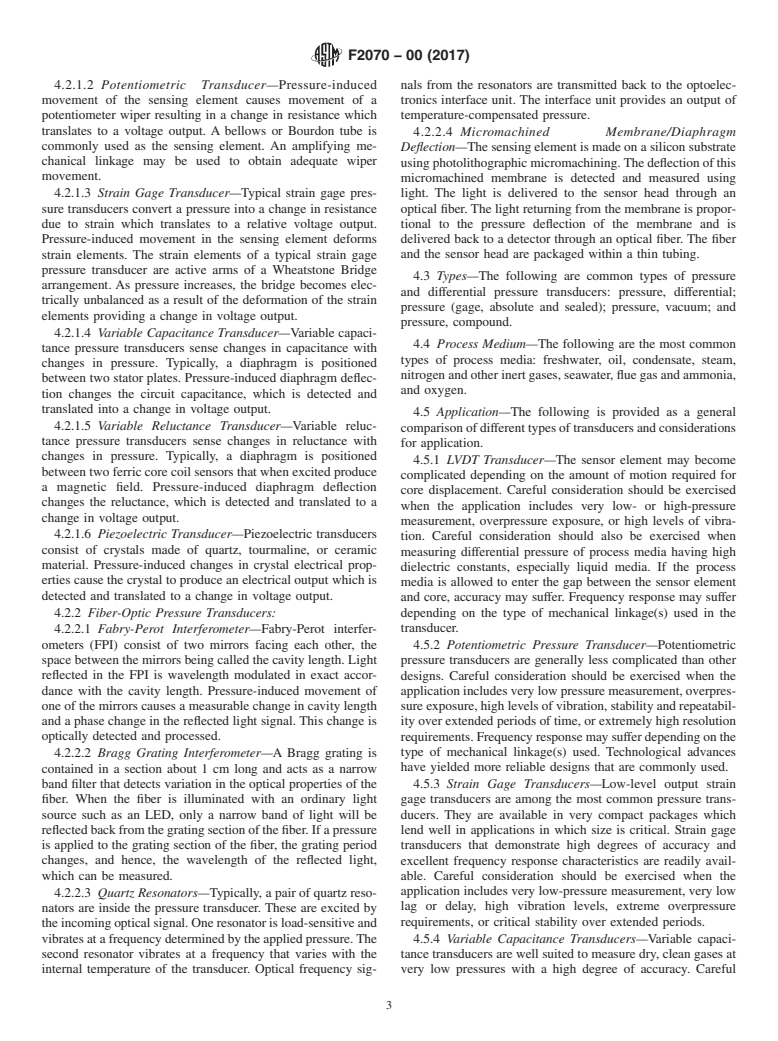
3.2.10 fiber-optic pressure transducer, n—a device that 3.2.26 ripple, n—the peak-to-peak ac component of the dc
converts fluid pressure, by means of changes in fiber-optic output.
properties, to an output that is a function of the applied
3.2.27 sensing element, n—that part of the transducer that
measurand. The fiber-optic pressure transducer normally con-
responds directly to the measurand. ANSI/ISA S37.1
sists of a sensor head, optoelectronics module, and connector-
3.2.28 sensitivity factor, n—the ratio of the change in
ized fiber-optic cable.
transducer output to a change in the value of the measurand.
3.2.11 hysteresis, n—the maximum difference in output, at
3.2.29 sensor head, n—the transduction element of the
any measurand value within the specified range, when the
fiber-optic pressure transducer that detects fluid pressure by
valueisapproachedfirstwithincreasingandthenwithdecreas-
means of changes in optical properties.
ing measurand. ANSI/ISA S37.1
3.2.30 signal conditioner, n—an electronic device that
3.2.12 insulation resistance, n—the resistance measured
makes the output signal from a transduction element compat-
between insulated portions of a transducer and between the
ible with a readout system.
insulated portions of a transducer and ground when a specified
3.2.31 static error band, n—static error band is the maxi-
dc voltage is applied under specified conditions.
mum deviation from a straight line drawn through the coordi-
3.2.13 line pressure, n—the pressure relative to which a
nates of the lower range limit at specified transducer output,
differential pressure transducer measures pressure.
and the upper range limit at specified transducer output
ANSI/ISA S37.1
expressed in percent of transducer span.
3.2.14 operating environmental conditions, n— environ-
3.2.32 transducer, n—device that provides a usable output
mental conditions during exposure to which a transducer must
in response to a specified measurand. ANSI/ISA S37.1
perform in some specified manner.
3.2.33 wetted parts, n—transducer components with at least
ANSI/ISA S37.1
one surface in direct contact with the process medium.
3.2.15 optical, adj—involving the use of light-sensitive
devices to acquire information.
4. Classification
3.2.16 optical fiber, n—averythinfilamentorfiber,madeof
4.1 Designation—Mosttransducermanufacturersusedesig-
dielectricmaterials,thatisenclosedbymaterialoflowerindex
nations or systematic numbering or identifying codes. Once
of refraction and transmits light throughout its length by
understood, these designations could aid the purchaser in
internal reflections.
quickly identifying the transducer type, range, application, and
other parameters.
3.2.17 optoelectronics module, n—acomponentofthefiber-
optic pressure transducer that contains the optical source and
4.2 Design—Pressure transducers typically consist of a
detector, and signal conditioner devices necessary to convert
sensingelementthatisincontactwiththeprocessmediumand
the sensed pressure to the specified output signal.
a transduction element that modifies the signal from the
sensing element to produce an electrical or optical output.
3.2.18 output, n—electrical or numerical quantity, produced
Some parts of the transducer may be hermetically sealed if
by a transducer or measurement system, that is a function of
those parts are sensitive to and may be exposed to moisture.
the applied measurand.
Pressureconnectionsmustbethreadedwithappropriatefittings
3.2.19 overpressure, n—the maximum magnitude of mea-
to connect the transducer to standard pipe fittings or to other
surand that can be applied to a transducer without causing a
appropriate leak-proof fittings. The output cable must be
change in performance beyond the specified tolerance.
securely fastened to the body of the transducer. A variety of
sensing elements are used in pressure transducers. The most
3.2.20 pressure cycling, n—the specified minimum number
commonelementsarediaphragms,bellows,capsules,Bourdon
of specified periodic pressure changes over which a transducer
tubes, and piezoelectric crystals. The function of the sensing
will operate and meet the specified performance.
element is to produce a measurable response to applied
3.2.21 pressure rating, n—the maximum allowable applied
pressure or vacuum. The response may be sensed directly on
pressure of a differential pressure transducer.
theelementoraseparatesensormaybeusedtodetectelement
3.2.22 process medium, n—the measured fluid (measurand)
response. The following is a brief introduction to the major
that comes in contact with the sensing element.
pressure sensing technology design categories.
4.2.1 Electrical Pressure Transducers:
3.2.23 range, n—measurand values, over which a trans-
4.2.1.1 Differential Transformer Transducer—Linear vari-
ducer is intended to measure, specified by their upper and
able differential transformers (LVDT) are variable reluctance
lower limits. ANSI/ISA S37.1
devices. Pressure-induced sensor movement, usually transmit-
3.2.24 repeatability, n—ability of a transducer to reproduce
ted through a mechanical linkage, moves a core within a
output readings when the same measurand value is applied to
differential transformer. Sensors are most commonly bellows,
it consecutively, under the same conditions, and in the same
capsules, or Bourdon tubes. The movement of the core within
direction. ANSI/ISA S37.1
the differential transformer results in a change in reluctance
3.2.25 response, n—the measured output of a transducer to that translates to a voltage output. An amplifying mechanical
a specified change in measurand. linkage may be used to obtain adequate core movement.
F2070−00 (2017)
4.2.1.2 Potentiometric Transducer—Pressure-induced nals from the resonators are transmitted back to the optoelec-
movement of the sensing element causes movement of a tronics interface unit. The interface unit provides an output of
potentiometer wiper resulting in a change in resistance which temperature-compensated pressure.
translates to a voltage output. A bellows or Bourdon tube is
4.2.2.4 Micromachined Membrane/Diaphragm
commonly used as the sensing element. An amplifying me-
Deflection—Thesensingelementismadeonasiliconsubstrate
chanical linkage may be used to obtain adequate wiper
usingphotolithographicmicromachining.Thedeflectionofthis
movement.
micromachined membrane is detected and measured using
4.2.1.3 Strain Gage Transducer—Typical strain gage pres- light. The light is delivered to the sensor head through an
sure transducers convert a pressure into a change in resistance optical fiber.The light returning from the membrane is propor-
due to strain which translates to a relative voltage output. tional to the pressure deflection of the membrane and is
Pressure-induced movement in the sensing element deforms delivered back to a detector through an optical fiber. The fiber
strain elements. The strain elements of a typical strain gage and the sensor head are packaged within a thin tubing.
pressure transducer are active arms of a Wheatstone Bridge
4.3 Types—The following are common types of pressure
arrangement. As pressure increases, the bridge becomes elec-
and differential pressure transducers: pressure, differential;
trically unbalanced as a result of the deformation of the strain
pressure (gage, absolute and sealed); pressure, vacuum; and
elements providing a change in voltage output.
pressure, compound.
4.2.1.4 Variable Capacitance Transducer—Variable capaci-
4.4 Process Medium—The following are the most common
tance pressure transducers sense changes in capacitance with
types of process media: freshwater, oil, condensate, steam,
changes in pressure. Typically, a diaphragm is positioned
nitrogenandotherinertgases,seawater,fluegasandammonia,
between two stator plates. Pressure-induced diaphragm deflec-
and oxygen.
tion changes the circuit capacitance, which is detected and
translated into a change in voltage output.
4.5 Application—The following is provided as a general
4.2.1.5 Variable Reluctance Transducer—Variable reluc-
comparisonofdifferenttypesoftransducersandconsiderations
tance pressure transducers sense changes in reluctance with
for application.
changes in pressure. Typically, a diaphragm is positioned
4.5.1 LVDT Transducer—The sensor element may become
betweentwoferriccorecoilsensorsthatwhenexcitedproduce
complicated depending on the amount of motion required for
a magnetic field. Pressure-induced diaphragm deflection
core displacement. Careful consideration should be exercised
changes the reluctance, which is detected and translated to a
when the application includes very low- or high-pressure
change in voltage output.
measurement, overpressure exposure, or high levels of vibra-
4.2.1.6 Piezoelectric Transducer—Piezoelectric transducers
tion. Careful consideration should also be exercised when
consist of crystals made of quartz, tourmaline, or ceramic
measuring differential pressure of process media having high
material. Pressure-induced changes in crystal electrical prop-
dielectric constants, especially liquid media. If the process
erties cause the crystal to produce an electrical output which is
media is allowed to enter the gap between the sensor element
detected and translated to a change in voltage output.
and core, accuracy may suffer. Frequency response may suffer
4.2.2 Fiber-Optic Pressure Transducers:
depending on the type of mechanical linkage(s) used in the
transducer.
4.2.2.1 Fabry-Perot Interferometer—Fabry-Perot interfer-
ometers (FPI) consist of two mirrors facing each other, the 4.5.2 Potentiometric Pressure Transducer—Potentiometric
spacebetweenthemirrorsbeingcalledthecavitylength.Light pressure transducers are generally less complicated than other
reflected in the FPI is wavelength modulated in exact accor- designs. Careful consideration should be exercised when the
dance with the cavity length. Pressure-induced movement of applicationincludesverylowpressuremeasurement,overpres-
oneofthemirrorscausesameasurablechangeincavitylength
sureexposure,highlevelsofvibration,stabilityandrepeatabil-
and a phase change in the reflected light signal.This change is ityoverextendedperiodsoftime,orextremelyhighresolutio
...
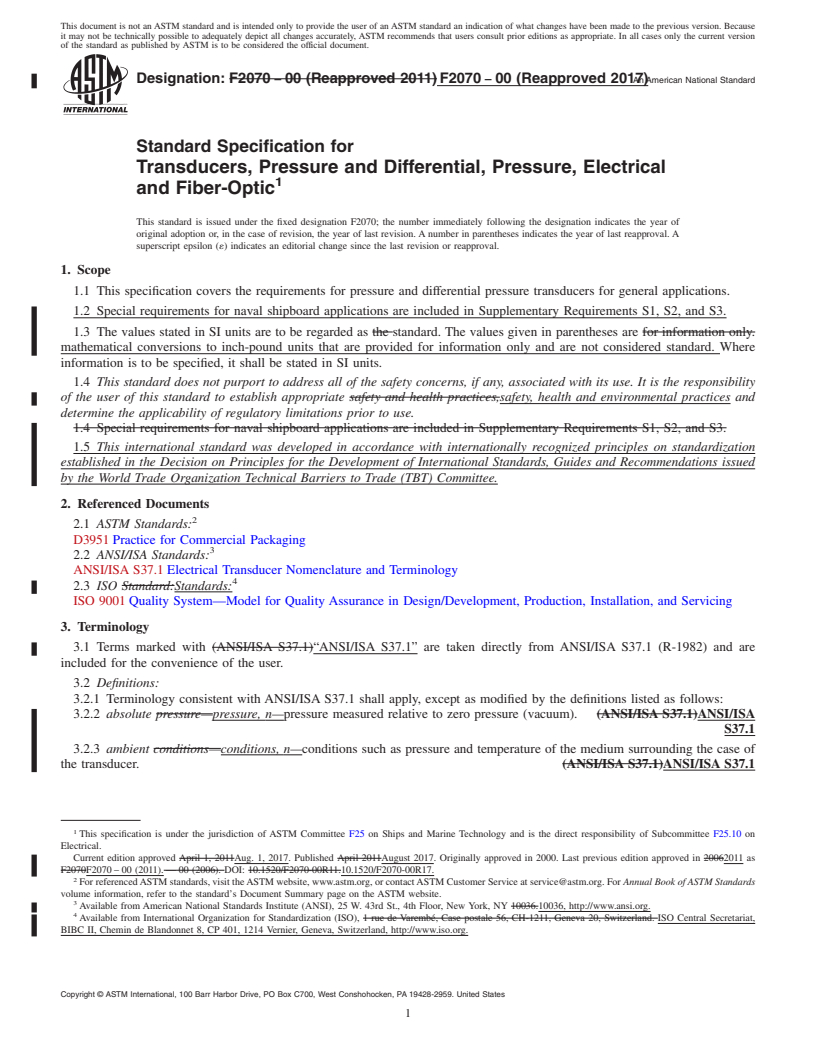
This document is not an ASTM standard and is intended only to provide the user of an ASTM standard an indication of what changes have been made to the previous version. Because
it may not be technically possible to adequately depict all changes accurately, ASTM recommends that users consult prior editions as appropriate. In all cases only the current version
of the standard as published by ASTM is to be considered the official document.
Designation: F2070 − 00 (Reapproved 2011) F2070 − 00 (Reapproved 2017)An American National Standard
Standard Specification for
Transducers, Pressure and Differential, Pressure, Electrical
and Fiber-Optic
This standard is issued under the fixed designation F2070; the number immediately following the designation indicates the year of
original adoption or, in the case of revision, the year of last revision. A number in parentheses indicates the year of last reapproval. A
superscript epsilon (´) indicates an editorial change since the last revision or reapproval.
1. Scope
1.1 This specification covers the requirements for pressure and differential pressure transducers for general applications.
1.2 Special requirements for naval shipboard applications are included in Supplementary Requirements S1, S2, and S3.
1.3 The values stated in SI units are to be regarded as the standard. The values given in parentheses are for information only.
mathematical conversions to inch-pound units that are provided for information only and are not considered standard. Where
information is to be specified, it shall be stated in SI units.
1.4 This standard does not purport to address all of the safety concerns, if any, associated with its use. It is the responsibility
of the user of this standard to establish appropriate safety and health practices,safety, health and environmental practices and
determine the applicability of regulatory limitations prior to use.
1.4 Special requirements for naval shipboard applications are included in Supplementary Requirements S1, S2, and S3.
1.5 This international standard was developed in accordance with internationally recognized principles on standardization
established in the Decision on Principles for the Development of International Standards, Guides and Recommendations issued
by the World Trade Organization Technical Barriers to Trade (TBT) Committee.
2. Referenced Documents
2.1 ASTM Standards:
D3951 Practice for Commercial Packaging
2.2 ANSI/ISA Standards:
ANSI/ISA S37.1 Electrical Transducer Nomenclature and Terminology
2.3 ISO Standard:Standards:
ISO 9001 Quality System—Model for Quality Assurance in Design/Development, Production, Installation, and Servicing
3. Terminology
3.1 Terms marked with (ANSI/ISA S37.1)“ANSI/ISA S37.1” are taken directly from ANSI/ISA S37.1 (R-1982) and are
included for the convenience of the user.
3.2 Definitions:
3.2.1 Terminology consistent with ANSI/ISA S37.1 shall apply, except as modified by the definitions listed as follows:
3.2.2 absolute pressure—pressure, n—pressure measured relative to zero pressure (vacuum). (ANSI/ISA S37.1)ANSI/ISA
S37.1
3.2.3 ambient conditions—conditions, n—conditions such as pressure and temperature of the medium surrounding the case of
the transducer. (ANSI/ISA S37.1)ANSI/ISA S37.1
This specification is under the jurisdiction of ASTM Committee F25 on Ships and Marine Technology and is the direct responsibility of Subcommittee F25.10 on
Electrical.
Current edition approved April 1, 2011Aug. 1, 2017. Published April 2011August 2017. Originally approved in 2000. Last previous edition approved in 20062011 as
F2070F2070 – 00 (2011). — 00 (2006). DOI: 10.1520/F2070-00R11.10.1520/F2070-00R17.
For referenced ASTM standards, visit the ASTM website, www.astm.org, or contact ASTM Customer Service at service@astm.org. For Annual Book of ASTM Standards
volume information, refer to the standard’s Document Summary page on the ASTM website.
Available from American National Standards Institute (ANSI), 25 W. 43rd St., 4th Floor, New York, NY 10036.10036, http://www.ansi.org.
Available from International Organization for Standardization (ISO), 1 rue de Varembé, Case postale 56, CH-1211, Geneva 20, Switzerland. ISO Central Secretariat,
BIBC II, Chemin de Blandonnet 8, CP 401, 1214 Vernier, Geneva, Switzerland, http://www.iso.org.
Copyright © ASTM International, 100 Barr Harbor Drive, PO Box C700, West Conshohocken, PA 19428-2959. United States
F2070 − 00 (2017)
3.2.4 burst pressure—pressure, n—the maximum pressure applied to the transducer sensing element without rupture of the
sensing element or transducer case as specified.
3.2.5 calibration—calibration, n—the test during which known values of measurands are applied to the transducer and
corresponding output readings are recorded under specified conditions. (ANSI/ISA S37.1)ANSI/ISA S37.1
3.2.6 common mode pressure—pressure, n—the common mode pressure is static line pressure applied simultaneously to both
pressure sides of the transducer for the differential pressure transducer only.
3.2.7 differential pressure—pressure, n—the difference in pressure between two points of measurement. (ANSI/ISA
S37.1)ANSI/ISA S37.1
3.2.8 environmental conditions—conditions, n—specified external conditions, such as shock, vibration, and temperature, to
which a transducer may be exposed during shipping, storage, handling, and operation. (ANSI/ISA S37.1)ANSI/ISA S37.1
3.2.9 error—error, n—the algebraic difference between the indicated value and the true value of the measurand.
(ANSI/ISA S37.1)ANSI/ISA S37.1
3.2.10 fiber-optic pressure transducer—transducer, n—a device that converts fluid pressure, by means of changes in fiber-optic
properties, to an output that is a function of the applied measurand. The fiber-optic pressure transducer normally consists of a
sensor head, optoelectronics module, and connectorized fiber-optic cable.
3.2.11 hysteresis—hysteresis, n—the maximum difference in output, at any measurand value within the specified range, when
the value is approached first with increasing and then with decreasing measurand. (ANSI/ISA S37.1)ANSI/ISA S37.1
3.2.12 insulation resistance—resistance, n—the resistance measured between insulated portions of a transducer and between the
insulated portions of a transducer and ground when a specified dc voltage is applied under specified conditions.
3.2.13 line pressure—pressure, n—the pressure relative to which a differential pressure transducer measures pressure.
(ANSI/ISA S37.1)ANSI/ISA S37.1
3.2.14 operating environmental conditions—conditions, n— environmental conditions during exposure to which a transducer
must perform in some specified manner.
(ANSI/ISA S37.1)ANSI/ISA S37.1
3.2.15 optical—optical, adj—involving the use of light-sensitive devices to acquire information.
3.2.16 optical fiber—fiber, n—a very thin filament or fiber, made of dielectric materials, that is enclosed by material of lower
index of refraction and transmits light throughout its length by internal reflections.
3.2.17 optoelectronics module—module, n—a component of the fiber-optic pressure transducer that contains the optical source
and detector, and signal conditioner devices necessary to convert the sensed pressure to the specified output signal.
3.2.18 output—output, n—electrical or numerical quantity, produced by a transducer or measurement system, that is a function
of the applied measurand.
3.2.19 overpressure—overpressure, n—the maximum magnitude of measurand that can be applied to a transducer without
causing a change in performance beyond the specified tolerance.
3.2.20 pressure cycling—cycling, n—the specified minimum number of specified periodic pressure changes over which a
transducer will operate and meet the specified performance.
3.2.21 pressure rating—rating, n—the maximum allowable applied pressure of a differential pressure transducer.
3.2.22 process medium—medium, n—the measured fluid (measurand) that comes in contact with the sensing element.
3.2.23 range—range, n—measurand values, over which a transducer is intended to measure, specified by their upper and lower
limits. (ANSI/ISA S37.1)ANSI/ISA S37.1
3.2.24 repeatability—repeatability, n—ability of a transducer to reproduce output readings when the same measurand value is
applied to it consecutively, under the same conditions, and in the same direction. (ANSI/ISA S37.1)ANSI/ISA S37.1
3.2.25 response—response, n—the measured output of a transducer to a specified change in measurand.
3.2.26 ripple—ripple, n—the peak-to-peak ac component of the dc output.
3.2.27 sensing element—element, n—that part of the transducer that responds directly to the measurand. (ANSI/ISA
S37.1)ANSI/ISA S37.1
3.2.28 sensitivity factor—factor, n—the ratio of the change in transducer output to a change in the value of the measurand.
3.2.29 sensor head—head, n—the transduction element of the fiber-optic pressure transducer that detects fluid pressure by
means of changes in optical properties.
3.2.30 signal conditioner—conditioner, n—an electronic device that makes the output signal from a transduction element
compatible with a readout system.
F2070 − 00 (2017)
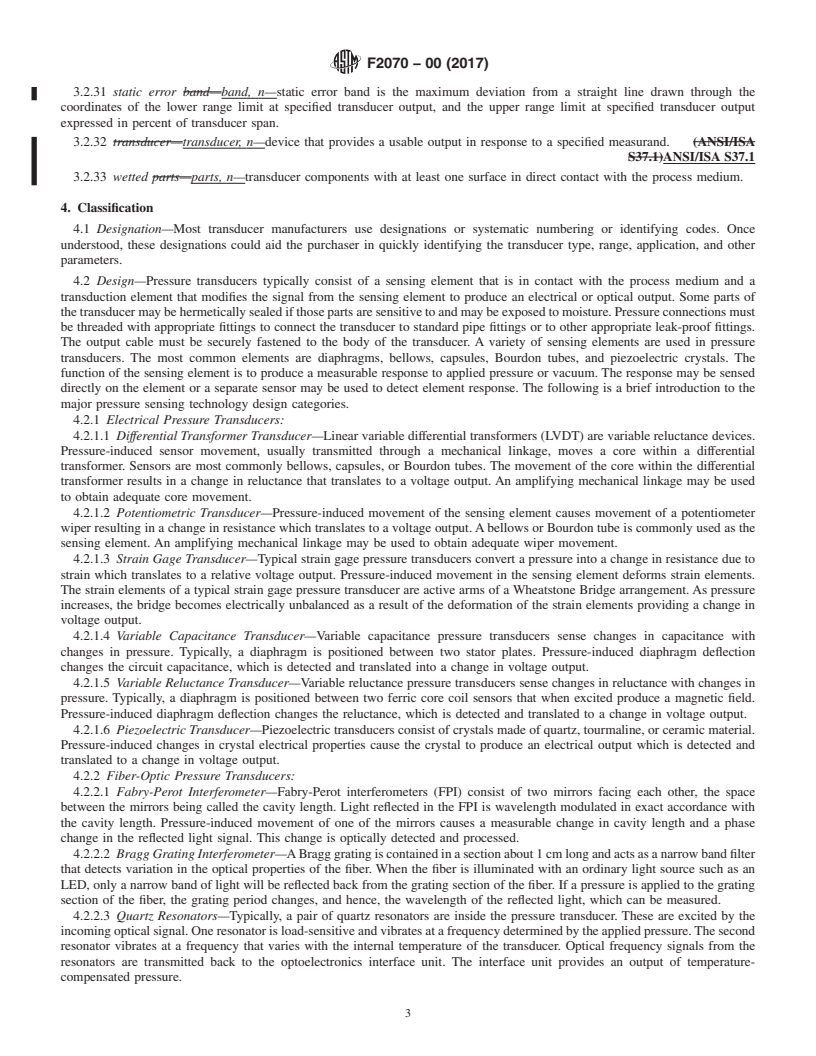
3.2.31 static error band—band, n—static error band is the maximum deviation from a straight line drawn through the
coordinates of the lower range limit at specified transducer output, and the upper range limit at specified transducer output
expressed in percent of transducer span.
3.2.32 transducer—transducer, n—device that provides a usable output in response to a specified measurand. (ANSI/ISA
S37.1)ANSI/ISA S37.1
3.2.33 wetted parts—parts, n—transducer components with at least one surface in direct contact with the process medium.
4. Classification
4.1 Designation—Most transducer manufacturers use designations or systematic numbering or identifying codes. Once
understood, these designations could aid the purchaser in quickly identifying the transducer type, range, application, and other
parameters.
4.2 Design—Pressure transducers typically consist of a sensing element that is in contact with the process medium and a
transduction element that modifies the signal from the sensing element to produce an electrical or optical output. Some parts of
the transducer may be hermetically sealed if those parts are sensitive to and may be exposed to moisture. Pressure connections must
be threaded with appropriate fittings to connect the transducer to standard pipe fittings or to other appropriate leak-proof fittings.
The output cable must be securely fastened to the body of the transducer. A variety of sensing elements are used in pressure
transducers. The most common elements are diaphragms, bellows, capsules, Bourdon tubes, and piezoelectric crystals. The
function of the sensing element is to produce a measurable response to applied pressure or vacuum. The response may be sensed
directly on the element or a separate sensor may be used to detect element response. The following is a brief introduction to the
major pressure sensing technology design categories.
4.2.1 Electrical Pressure Transducers:
4.2.1.1 Differential Transformer Transducer—Linear variable differential transformers (LVDT) are variable reluctance devices.
Pressure-induced sensor movement, usually transmitted through a mechanical linkage, moves a core within a differential
transformer. Sensors are most commonly bellows, capsules, or Bourdon tubes. The movement of the core within the differential
transformer results in a change in reluctance that translates to a voltage output. An amplifying mechanical linkage may be used
to obtain adequate core movement.
4.2.1.2 Potentiometric Transducer—Pressure-induced movement of the sensing element causes movement of a potentiometer
wiper resulting in a change in resistance which translates to a voltage output. A bellows or Bourdon tube is commonly used as the
sensing element. An amplifying mechanical linkage may be used to obtain adequate wiper movement.
4.2.1.3 Strain Gage Transducer—Typical strain gage pressure transducers convert a pressure into a change in resistance due to
strain which translates to a relative voltage output. Pressure-induced movement in the sensing element deforms strain elements.
The strain elements of a typical strain gage pressure transducer are active arms of a Wheatstone Bridge arrangement. As pressure
increases, the bridge becomes electrically unbalanced as a result of the deformation of the strain elements providing a change in
voltage output.
4.2.1.4 Variable Capacitance Transducer—Variable capacitance pressure transducers sense changes in capacitance with
changes in pressure. Typically, a diaphragm is positioned between two stator plates. Pressure-induced diaphragm deflection
changes the circuit capacitance, which is detected and translated into a change in voltage output.
4.2.1.5 Variable Reluctance Transducer—Variable reluctance pressure transducers sense changes in reluctance with changes in
pressure. Typically, a diaphragm is positioned between two ferric core coil sensors that when excited produce a magnetic field.
Pressure-induced diaphragm deflection changes the reluctance, which is detected and translated to a change in voltage output.
4.2.1.6 Piezoelectric Transducer—Piezoelectric transducers consist of crystals made of quartz, tourmaline, or ceramic material.
Pressure-induced changes in crystal electrical properties cause the crystal to produce an electrical output which is detected and
translated to a change in voltage output.
4.2.2 Fiber-Optic Pressure Transducers:
4.2.2.1 Fabry-Perot Interferometer—Fabry-Perot interferometers (FPI) consist of two mirrors facing each other, the space
between the mirrors being called the cavity length. Light reflected in the FPI is wavelength modulated in exact accordance with
the cavity length. Pressure-induced movement of one of the mirrors causes a measurable change in cavity length and a phase
change in the reflected light signal. This change is optically detected and processed.
4.2.2.2 Bragg Grating Interferometer—A Bragg grating is contained in a section about 1 cm long and acts as a narrow band filter
that detects variation in the optical properties of the fiber. When the fiber is illuminated with an ordinary light source such as an
LED, only a narrow band of light will be reflected back from the grating section of the fiber. If a pressure is applied to the grating
section of the fiber, the grating period changes, and hence, the wavelength of the reflected light, which can be measured.
4.2.2.3 Quartz Resonators—Typically, a pair of quartz resonators are inside the pressure transducer. These are excited by the
incoming optical signal. One resonator is load-sensitive and vibrates at a frequency determined by the applied pressure. The second
resonator vibrates at a frequency that varies with the internal temperature of the transducer. Optical frequency signals from the
resonators are transmitted back to the optoelect
...
Questions, Comments and Discussion
Ask us and Technical Secretary will try to provide an answer. You can facilitate discussion about the standard in here.