


ASTM D94-07(2017)
(Test Method)Standard Test Methods for Saponification Number of Petroleum Products
Standard Test Methods for Saponification Number of Petroleum Products
SIGNIFICANCE AND USE
5.1 Petroleum products can contain additives that react with alkali to form metal soaps. Fats are examples of such additives. Also, certain used engine oils, especially from turbine or internal combustion engines, can contain chemicals that will similarly react with alkali. The saponification number expresses the amount of base that will react with 1 g of sample when heated in a specific manner. This then gives an estimation of the amount of acid present in the sample, that is, any free acid originally present plus any combined (for example, in esters) that have been converted to metal soaps during the heating procedure.
5.2 Saponification numbers are also used in setting product specifications for lubricants and additives.
SCOPE
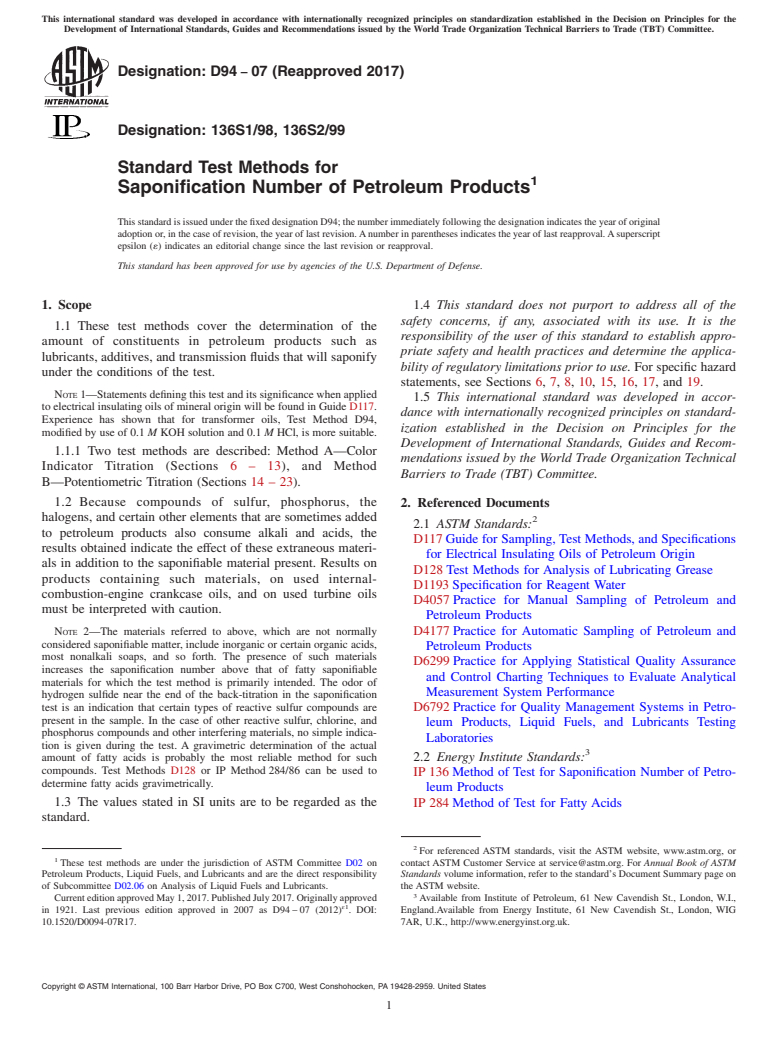
1.1 These test methods cover the determination of the amount of constituents in petroleum products such as lubricants, additives, and transmission fluids that will saponify under the conditions of the test.
Note 1: Statements defining this test and its significance when applied to electrical insulating oils of mineral origin will be found in Guide D117. Experience has shown that for transformer oils, Test Method D94, modified by use of 0.1 M KOH solution and 0.1 M HCl, is more suitable.
1.1.1 Two test methods are described: Method A—Color Indicator Titration (Sections 6 – 13), and Method B—Potentiometric Titration (Sections 14 – 23).
1.2 Because compounds of sulfur, phosphorus, the halogens, and certain other elements that are sometimes added to petroleum products also consume alkali and acids, the results obtained indicate the effect of these extraneous materials in addition to the saponifiable material present. Results on products containing such materials, on used internal-combustion-engine crankcase oils, and on used turbine oils must be interpreted with caution.
Note 2: The materials referred to above, which are not normally considered saponifiable matter, include inorganic or certain organic acids, most nonalkali soaps, and so forth. The presence of such materials increases the saponification number above that of fatty saponifiable materials for which the test method is primarily intended. The odor of hydrogen sulfide near the end of the back-titration in the saponification test is an indication that certain types of reactive sulfur compounds are present in the sample. In the case of other reactive sulfur, chlorine, and phosphorus compounds and other interfering materials, no simple indication is given during the test. A gravimetric determination of the actual amount of fatty acids is probably the most reliable method for such compounds. Test Methods D128 or IP Method 284/86 can be used to determine fatty acids gravimetrically.
1.3 The values stated in SI units are to be regarded as the standard.
1.4 This standard does not purport to address all of the safety concerns, if any, associated with its use. It is the responsibility of the user of this standard to establish appropriate safety and health practices and determine the applicability of regulatory limitations prior to use. For specific hazard statements, see Sections 6, 7, 8, 10, 15, 16, 17, and 19.
1.5 This international standard was developed in accordance with internationally recognized principles on standardization established in the Decision on Principles for the Development of International Standards, Guides and Recommendations issued by the World Trade Organization Technical Barriers to Trade (TBT) Committee.
General Information
Relations
Standards Content (Sample)
This international standard was developed in accordance with internationally recognized principles on standardization established in the Decision on Principles for the
Development of International Standards, Guides and Recommendations issued by the World Trade Organization Technical Barriers to Trade (TBT) Committee.
Designation: D94 −07 (Reapproved 2017)
Designation: 136S1/98, 136S2/99
Standard Test Methods for
1
Saponification Number of Petroleum Products
ThisstandardisissuedunderthefixeddesignationD94;thenumberimmediatelyfollowingthedesignationindicatestheyearoforiginal
adoptionor,inthecaseofrevision,theyearoflastrevision.Anumberinparenthesesindicatestheyearoflastreapproval.Asuperscript
epsilon (´) indicates an editorial change since the last revision or reapproval.
This standard has been approved for use by agencies of the U.S. Department of Defense.
1. Scope 1.4 This standard does not purport to address all of the
safety concerns, if any, associated with its use. It is the
1.1 These test methods cover the determination of the
responsibility of the user of this standard to establish appro-
amount of constituents in petroleum products such as
priate safety and health practices and determine the applica-
lubricants, additives, and transmission fluids that will saponify
bility of regulatory limitations prior to use. For specific hazard
under the conditions of the test.
statements, see Sections 6, 7, 8, 10, 15, 16, 17, and 19.
NOTE1—Statementsdefiningthistestanditssignificancewhenapplied
1.5 This international standard was developed in accor-
toelectricalinsulatingoilsofmineraloriginwillbefoundinGuideD117.
dance with internationally recognized principles on standard-
Experience has shown that for transformer oils, Test Method D94,
ization established in the Decision on Principles for the
modified by use of 0.1 M KOH solution and 0.1 M HCl, is more suitable.
Development of International Standards, Guides and Recom-
1.1.1 Two test methods are described: Method A—Color
mendations issued by the World Trade Organization Technical
Indicator Titration (Sections 6–13), and Method
Barriers to Trade (TBT) Committee.
B—Potentiometric Titration (Sections14–23).
1.2 Because compounds of sulfur, phosphorus, the 2. Referenced Documents
halogens, and certain other elements that are sometimes added
2
2.1 ASTM Standards:
to petroleum products also consume alkali and acids, the
D117Guide for Sampling, Test Methods, and Specifications
results obtained indicate the effect of these extraneous materi-
for Electrical Insulating Oils of Petroleum Origin
als in addition to the saponifiable material present. Results on
D128Test Methods for Analysis of Lubricating Grease
products containing such materials, on used internal-
D1193Specification for Reagent Water
combustion-engine crankcase oils, and on used turbine oils
D4057Practice for Manual Sampling of Petroleum and
must be interpreted with caution.
Petroleum Products
NOTE 2—The materials referred to above, which are not normally D4177Practice for Automatic Sampling of Petroleum and
considered saponifiable matter, include inorganic or certain organic acids,
Petroleum Products
most nonalkali soaps, and so forth. The presence of such materials
D6299Practice for Applying Statistical Quality Assurance
increases the saponification number above that of fatty saponifiable
and Control Charting Techniques to Evaluate Analytical
materials for which the test method is primarily intended. The odor of
Measurement System Performance
hydrogen sulfide near the end of the back-titration in the saponification
test is an indication that certain types of reactive sulfur compounds are D6792Practice for Quality Management Systems in Petro-
present in the sample. In the case of other reactive sulfur, chlorine, and
leum Products, Liquid Fuels, and Lubricants Testing
phosphorus compounds and other interfering materials, no simple indica-
Laboratories
tion is given during the test. A gravimetric determination of the actual
3
amount of fatty acids is probably the most reliable method for such 2.2 Energy Institute Standards:
compounds. Test Methods D128 or IP Method284/86 can be used to
IP 136Method of Test for Saponification Number of Petro-
determine fatty acids gravimetrically.
leum Products
1.3 The values stated in SI units are to be regarded as the IP 284Method of Test for Fatty Acids
standard.
2
For referenced ASTM standards, visit the ASTM website, www.astm.org, or
1
These test methods are under the jurisdiction of ASTM Committee D02 on contact ASTM Customer Service at service@astm.org. For Annual Book of ASTM
Petroleum Products, Liquid Fuels, and Lubricants and are the direct responsibility Standards volume information, refer to the standard’s Document Summary page on
of Subcommittee D02.06 on Analysis of Liquid Fuels and Lubricants. the ASTM website.
3
CurrenteditionapprovedMay1,2017.PublishedJuly2017.Originallyapproved Available from Institute of Petroleum, 61 New Cavendish St., London, W.I.,
ɛ1
in 1921. Last previ
...
Questions, Comments and Discussion
Ask us and Technical Secretary will try to provide an answer. You can facilitate discussion about the standard in here.